



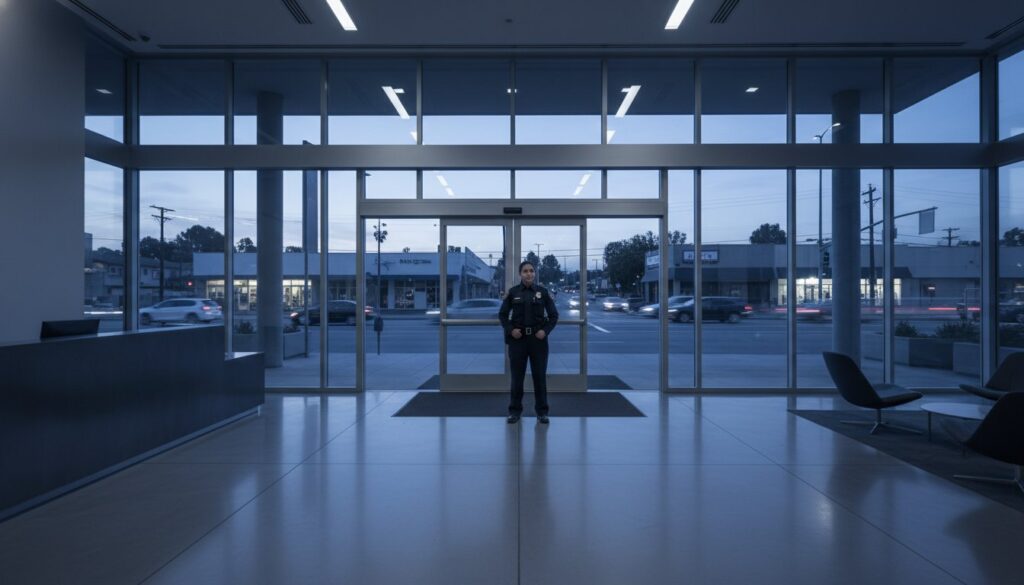
Effective security service management isn’t a passive expense. It’s a proactive, disciplined framework that transforms presence into prevention. You likely recognize that a lack of guard accountability and rising insurance premiums aren’t just administrative burdens. They’re critical gaps in your defensive perimeter. In California, the stakes are even higher as Senate Bill 652 mandates rigorous training standards that must be met to maintain legal and operational integrity. A failure in oversight is a failure in protection.
This guide provides the professional insights you need to master risk assessment and personnel oversight with military-like precision. You’ll learn how to address complex California compliance requirements while ensuring your assets remain under the care of a vigilant and unyielding force. We’ll preview the essential components of modern security contracts, the latest BSIS mandates, and the transparent reporting protocols that reduce liability and guarantee a disciplined, reliable presence on your site.
Key Takeaways
- Understand how strategic security service management integrates personnel and technology to transform a passive presence into a proactive defensive shield.
- Identify critical contract components necessary for transparent reporting, focusing on real-time digital logs that eliminate accountability gaps.
- Evaluate the specific risk profiles of San Fernando Valley properties to determine the appropriate management model for armed versus unarmed personnel.
- Navigate 2026 California BSIS compliance requirements and learn how professional oversight of Fire Watch services mitigates regulatory risk.
- Master the principles of disciplined oversight to ensure your security force operates with the precision and reliability required for commercial protection.
What is Security Service Management and Why Is It Critical in 2026?
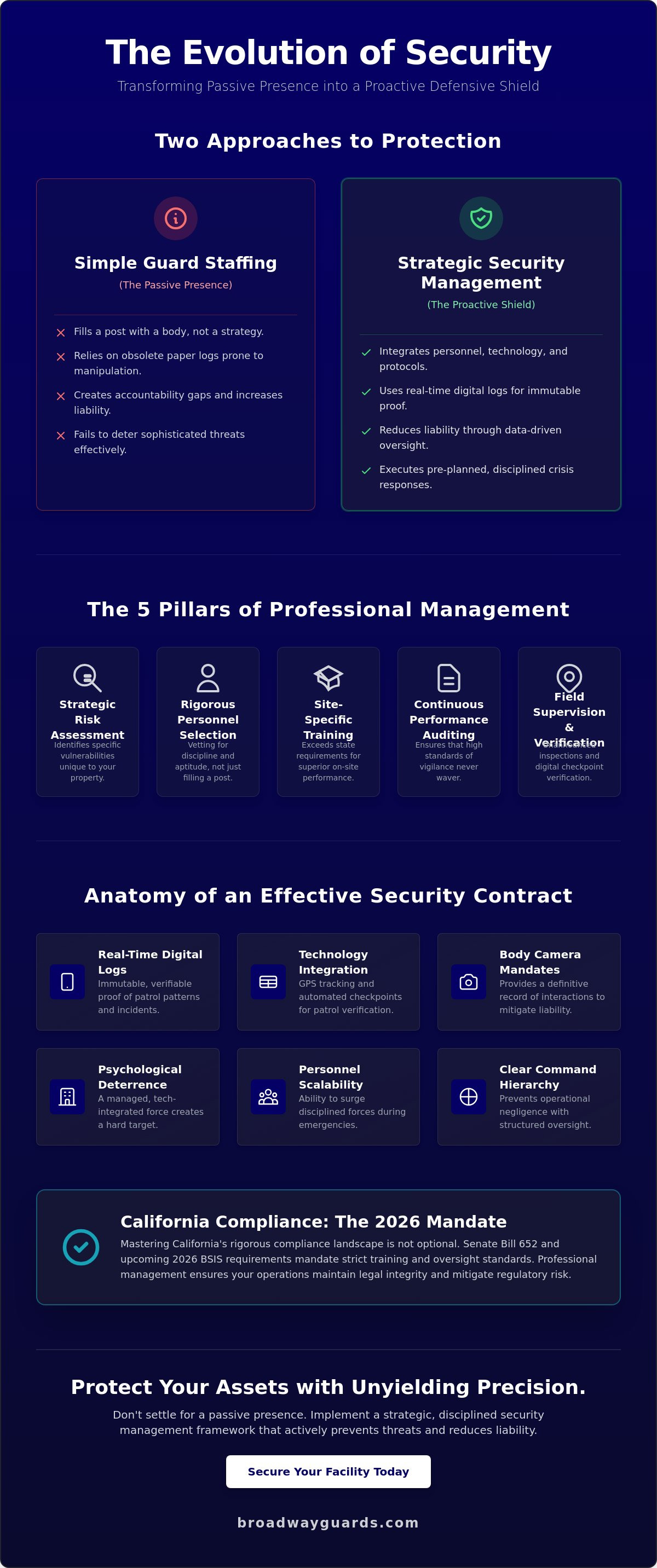
In the high-stakes commercial environment of Southern California, security service management is no longer a luxury. It’s a mandatory operational requirement. This discipline represents the strategic integration of elite personnel, advanced surveillance technology, and rigorous protocols. While some view security as a simple line item, true management transforms it into a proactive, disciplined shield. This Security Management Overview illustrates how the identification of assets and the implementation of strict protection policies form the bedrock of organizational safety. In 2026, the industry has shifted toward data-driven oversight. Real-time digital reporting and AI-enhanced monitoring have replaced outdated, passive methods. For property owners in the San Fernando Valley, this shift means greater accountability and a measurable reduction in long-term liability.
The Core Pillars of Professional Management
A disciplined approach to security begins long before a guard arrives on site. It starts with a strategic risk assessment. This foundation allows for the identification of specific vulnerabilities unique to a retail center in Woodland Hills or a construction site in Canoga Park. Professional management demands rigorous personnel selection. We don’t just hire; we vet for discipline and aptitude. Once selected, personnel undergo site-specific training that exceeds standard state requirements. Continuous performance auditing ensures that these standards never waver. Field supervision protocols involve unannounced inspections and digital checkpoint verification. This methodical oversight guarantees that every post remains alert and every protocol is followed to the letter.
Differentiating Staffing vs. Strategic Oversight
There’s a critical distinction between simple guard staffing and comprehensive security service management. Staffing merely fills a post with a body. This approach often fails in high-risk Los Angeles environments where threats are dynamic and sophisticated. Strategic oversight ensures that every post achieves a specific security objective. Management involves the active command and control of the security force. It includes crisis response planning and immediate incident mitigation. When a breach occurs, a managed service doesn’t just record the event; it executes a pre-planned, disciplined response. This level of professional rigor separates a reliable protector from a mere observer. By prioritizing oversight, commercial property owners ensure their assets are under the care of an unyielding force that values results over simple presence.
What Are the Essential Components of an Effective Security Contract?
A security contract serves as the tactical blueprint for site safety. It establishes the rigid parameters of security service management. Without specific, measurable metrics, a contract is merely a suggestion of safety rather than a guarantee of performance. In 2026, standardized reporting has transitioned entirely to digital platforms. Paper logs are obsolete and unacceptable for high-stakes environments. They’re prone to manipulation and lack the immutable timestamps required for legal defense. Digital logs provide real-time visibility into patrol patterns, ensuring that no sector of your property remains unobserved.
Effective management requires a strict command hierarchy. A high ratio of guards to a single supervisor inevitably leads to operational negligence. A disciplined shield requires frequent, unannounced field inspections to maintain professional standards. Technology integration is the modern standard for verification. GPS tracking and automated checkpoints verify that patrols are executed exactly as ordered. This methodology reflects the rigorous standards found in CISA System Security Management guidelines, which prioritize consistent log reviews and the maintenance of a secure posture. Body cameras add another layer of accountability, providing a definitive record of all interactions to mitigate liability claims.
Management provides psychological deterrence. It’s about creating a hard target environment. When bad actors observe a managed, tech-integrated force, they recognize an unyielding presence. This perception of order often stops a crime before the first step is taken. Your contract must also account for scalability. The ability to surge disciplined personnel during emergencies or large-scale events is a core requirement for commercial stability.
Accountability Through Technology
GPS geofencing creates a digital boundary that triggers immediate alerts if a guard deviates from their assigned route. This ensures constant coverage of high-value assets. Immediate incident notification systems allow management to coordinate a response within seconds of an alert. Over time, the data collected from these systems allows for predictive analysis. If patterns of unauthorized access emerge, security service management protocols are adjusted to reinforce vulnerable sectors. This data-driven precision is a cornerstone of elite protection services.
The Human Element: Training and Supervision
Technology is a tool for the human protector. Site-specific post orders are mandatory to replace generic, ineffective manuals. These orders must be updated regularly to reflect evolving threats. Guards must possess advanced training in de-escalation and crisis management to handle volatile situations without escalating risk. Field inspections verify that this training is applied with military-like precision. We prioritize rules, protocols, and visible results above all else. This methodical oversight ensures that the human element remains a reliable, unyielding force in the face of any challenge.
Armed vs. Unarmed: Which Management Model Fits Your Facility?
Risk dictates response. Effective security service management requires a cold, objective analysis of your facility’s vulnerabilities. In the San Fernando Valley, commercial properties present a wide spectrum of threats. A construction site in Canoga Park facing recurring copper theft requires a different tactical posture than a quiet corporate lobby in Woodland Hills. Armed personnel offer the highest level of visible deterrence, yet they demand significantly more management oversight. This includes rigorous use-of-force training and frequent evaluations to ensure they remain a disciplined shield. Every armed post requires a higher degree of accountability to mitigate the increased legal liability associated with lethal force.
The choice also hinges on the “deterrence factor” versus the “hospitality factor.” Retail environments often require a precise balance. You need an unyielding presence to discourage loss, but personnel must maintain a level of professionalism that doesn’t alienate legitimate customers. Broadway Security Services achieves this balance through methodical training and a strict focus on hierarchy. We prioritize rules and protocols to ensure our presence is reassuring to clients but formidable to threats. This creates an atmosphere of high-stakes reliability where the asset owner can focus on operations while we handle the burden of protection.
Managing High-Risk Asset Protection
Some environments leave no room for compromise. Armed security guards are a non-negotiable requirement for high-value retail, executive protection, and sites with critical infrastructure. These roles demand guards who meet the core competencies reflected in DoD Security Professional Standards, ensuring they possess the specialized skills required for high-stakes defense. Management protocols for these posts include daily equipment inspections and intensive scenario-based drills. This level of professional rigor is essential for liability protection and preventing sophisticated vandalism or theft at high-risk commercial sites. Static barriers alone cannot provide this level of defense; perimeter patrol security that actively identifies and neutralizes threats is what separates a truly protected site from a stationary target.
The Strategic Use of Unarmed Presence
Unarmed security guards serve as the essential eyes and ears for residential complexes and corporate offices. They provide a strategic management model without sacrificing the core values of presence and prevention. While the physical threat level might be lower, the requirement for disciplined reporting remains absolute. Unarmed personnel focus on access control, detailed incident logging, and mobile patrol duties. A cost-benefit analysis often reveals that for long-term contracts in low-risk environments, a well-managed unarmed force provides a comprehensive safety net while maintaining a professional, welcoming atmosphere for tenants and employees.
How Does California Compliance Impact Security Management?
Operational success in California is inseparable from regulatory rigor. In 2026, the legal landscape for security service management has become significantly more complex. Managing a commercial property in the San Fernando Valley requires more than just a visible presence; it requires a deep understanding of the Bureau of Security and Investigative Services (BSIS) mandates. Failure to verify the credentials of your security force doesn’t just create a safety gap. It exposes your business to massive legal liability and state-level sanctions. A disciplined protector must operate within the strict confines of the law to ensure your assets remain truly secure.
Effective January 1, 2026, Senate Bill 652 has fundamentally shifted training requirements. Security guard applicants must now complete their initial 8-hour “Power to Arrest and Appropriate Use of Force” training within the six months immediately preceding their license application. This training must be certified by a single, BSIS-licensed provider to ensure consistency and quality. Once a guard receives their card, the management burden continues. New registrants are required to complete an additional 32 hours of specialized security officer skills training within their first six months of employment. Professional management ensures every guard on your site has met these rigorous standards before they ever step into a post.
Navigating BSIS and State Regulations
The responsibility for credential verification rests solely on the management team. You must ensure that your provider holds a valid Private Patrol Operator (PPO) license. This license is the functional signature of a legitimate security firm. Under California law, the mandatory reporting of use-of-force incidents is a critical component of security service management. Any incident involving the discharge of a weapon or a physical confrontation must be documented with military-like precision. We maintain an unyielding commitment to these reporting standards, protecting our clients from the fallout of undocumented field actions. Staying ahead of these evolving labor and safety laws is the only way to maintain a reliable, disciplined shield. If you need a provider that prioritizes these standards, you can secure your facility with a PPO-licensed partner today.
Fire Watch Compliance in Southern California
Fire Watch Services are a mandatory requirement when a building’s fire alarm or sprinkler system is non-functional. In cities like Canoga Park, the Los Angeles Fire Department (LAFD) mandates a continuous, vigilant watch to prevent catastrophic loss. Management of these services is high-stakes. Fire watch logs must be maintained with absolute accuracy to pass municipal inspections. These logs aren’t just paperwork; they’re legal proof of life-safety monitoring. Our approach integrates fire safety into our broader physical security framework. We ensure that personnel assigned to fire watch are trained to identify hazards and execute evacuation protocols with the same precision applied to asset protection. This methodical oversight prevents costly municipal fines and, more importantly, ensures the safety of every individual on your property.
Why Broadway Security Services is the Standard for Management in Canoga Park
The standard for security service management is defined by results, not promises. In Canoga Park and the surrounding San Fernando Valley, Broadway Security Services operates as a disciplined shield for commercial interests. Our approach is built on military-like precision, ensuring your assets remain under the care of a vigilant and unyielding force. We recognize that Woodland Hills and Canoga Park present unique operational challenges that national providers often overlook. Localized expertise allows us to respond with a level of speed and tactical awareness that ensures constant protection. We don’t just occupy a space; we command it through a rigorous hierarchy and a commitment to visible order.
Transparency is the cornerstone of our management philosophy. Clients receive direct access to leadership and real-time digital reporting, which eliminates the accountability gaps that often plague traditional security firms. Every patrol, every incident, and every observation is logged with immutable timestamps for your review. Broadway Security Services offers fully customizable contracts that scale from specific hourly staffing for retail security to full-scale risk management for complex construction sites. This flexibility ensures you only pay for the protection you need while maintaining the highest standards of professional rigor.
Our Proactive Risk Assessment Process
Superior protection begins with the identification of vulnerabilities before they manifest as incidents. Our security service management framework includes a comprehensive initial assessment of your property’s perimeter, access points, and internal protocols. We customize post orders to fit the specific rhythm of your business, ensuring that security measures facilitate rather than hinder your operations. Continuous improvement is a mandatory requirement of our service. We conduct quarterly security audits to refine our tactics and adapt to evolving threats in the San Fernando Valley. This methodical oversight ensures your defensive posture remains impenetrable over the long term.
The Broadway Commitment to Professionalism
Our guards are recognized as the most disciplined in Southern California. This reputation is earned through a focus on rules, protocols, and a stoic professional image. We prioritize the “disciplined shield” identity, ensuring our presence serves as a powerful deterrent to criminal activity. The Broadway Security Services headquarters at 21031 Ventura Blvd serves as the central hub for local oversight. This location allows our management team to maintain a constant, watchful presence over all field operations in the valley. We take our responsibilities with the utmost gravity, providing the peace of mind that comes from knowing your assets are protected by an unyielding force. Secure your facility with a professional risk assessment today and experience the difference of a managed security solution.
Secure Your Commercial Future Through Disciplined Oversight
Commercial stability in the current regulatory environment depends on more than just presence. It requires a strategic framework that integrates technology with human vigilance. You’ve explored how security service management transforms a reactive guard post into a proactive defensive perimeter. By prioritizing the rigorous standards of Senate Bill 652 and embracing real-time digital accountability, you effectively eliminate the gaps that lead to liability and loss.
Broadway Security Services provides the professional discipline required to safeguard your commercial interests. We combine our deep San Fernando Valley expertise with a commitment to military-style oversight that ensures your site remains a hard target. As a BSIS licensed and insured provider, we take the burden of compliance and protection off your shoulders. It’s time to elevate your safety standards with a partner that values results above all else. Request a Comprehensive Risk Assessment from Broadway Security Services to secure your facility. We’re ready to stand as your disciplined shield.
Frequently Asked Questions
What is the primary role of a security service management company?
A security service management company acts as the central command for your property’s defense. It’s responsible for the strategic integration of elite personnel, surveillance technology, and rigorous site protocols. Rather than just providing staffing, a management firm executes a comprehensive safety plan that prioritizes the outcome of protection. This systematic approach ensures that every guard on your site operates as part of a disciplined shield.
How does Broadway Security Services ensure guard accountability on-site?
We maintain accountability through a rigorous hierarchy and real-time digital verification. Every patrol is tracked via GPS geofencing to ensure no sector is neglected. Our field supervisors conduct unannounced inspections to verify that guards adhere to site-specific post orders with military-like precision. This methodical oversight eliminates the gaps often found in unmanaged staffing models, ensuring a reliable and unyielding presence.
What are the legal requirements for security management in California?
In California, any firm providing security must hold a valid Private Patrol Operator (PPO) license from the BSIS. Beyond licensing, effective security service management requires strict adherence to SB 652 training mandates for all personnel. This includes verified use-of-force training and documented skills development. Management is also legally responsible for the mandatory reporting of incidents to state authorities to maintain operational transparency.
Can security management help reduce my business insurance premiums?
A managed security framework often leads to reduced insurance costs by mitigating the risk of negligent security lawsuits. By maintaining immutable digital logs and a consistent audit trail, you provide insurers with evidence of proactive risk reduction. This documented deterrence demonstrates a higher standard of care. This professional rigor can help lower your overall liability profile and potentially decrease annual premiums.
What is the difference between a security consultant and a security manager?
A consultant provides high-level analysis and policy recommendations, whereas a manager handles the daily execution and active command of the force. Management involves the direct supervision of personnel, the enforcement of rules, and the immediate response to incidents. While a consultant identifies what should be done, a manager ensures it’s done with professional discipline and visible results.
How often should a security risk assessment be performed?
We recommend a comprehensive assessment at least every quarter to stay ahead of evolving threats. However, security service management protocols should be re-evaluated immediately if there are changes to your facility’s layout or local crime trends. Regular audits ensure your defensive posture remains effective. This constant refinement is essential for maintaining a high-stakes level of reliability on your property.
What happens if a guard fails to show up for a scheduled shift?
Our command structure includes a redundant staffing model to ensure no post is ever left vacant. If a primary guard is unable to report, our supervisors immediately deploy a qualified, disciplined replacement from our local pool. We prioritize continuity of protection above all else. This system prevents the dangerous security gaps that occur when a provider lacks a structured management hierarchy.
How does mobile patrol management differ from on-site guard management?
Mobile patrol management focuses on the strategic randomization of checks across several locations to prevent criminals from timing their activities. It relies on rapid response and high-visibility vehicle presence. On-site management involves a constant, unyielding perimeter at a single facility. Both models require strict reporting and GPS verification, but mobile patrols demand more complex logistical coordination to ensure every sector is inspected. Understanding why passive barriers fall short is essential; learn how active perimeter patrol security neutralizes threats before they escalate into costly incidents.