



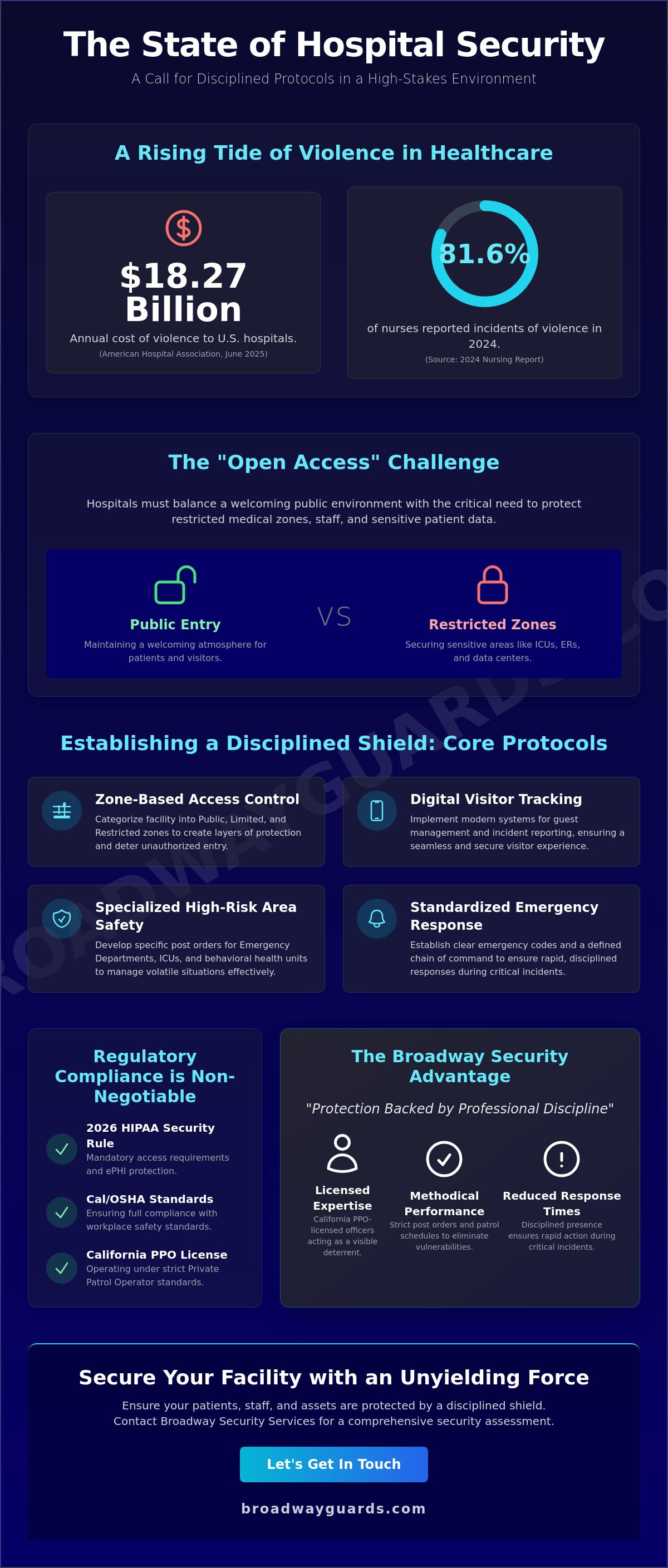
Did you know that workplace violence now costs U.S. hospitals $18.27 billion annually according to the June 2025 American Hospital Association report? With 81.6% of nurses reporting incidents of violence in 2024, the implementation of rigorous hospital security protocols is no longer optional. You understand the strain of balancing patient privacy with the rising rates of ER violence. It’s a complex challenge that requires a disciplined approach to ensure every professional remains safe behind a vigilant shield.
Broadway Security Services provides protection backed by professional discipline. You’ll learn to master the essential security protocols required to protect patients, staff, and assets in this high-stakes landscape. We’ll detail the November 2026 HIPAA Security Rule updates, mandatory multi-factor authentication requirements, and the Cal/OSHA standards necessary for full compliance. Our focus is on reducing incident response times through licensed expertise and methodical field performance. Let’s Touch With Us to secure your facility under our California Private Patrol Operator standards and ensure your assets are under the care of an unyielding force.
Key Takeaways
- Identify the core challenges of the “Open Access” model and how to maintain order within restricted medical zones.
- Learn how to implement robust hospital security protocols through zone-based access control and digital visitor tracking to protect sensitive data.
- Develop specialized safety standards for high-traffic Emergency Departments and behavioral health units to effectively mitigate workplace violence.
- Standardize hospital emergency codes and establish a clear chain of command to ensure a rapid, disciplined response during critical incidents.
- Discover how California PPO-licensed security guards provide a disciplined shield that ensures full regulatory compliance and operational rigor.
The Foundation of Healthcare Security: Why Protocols Matter
The current environment in Southern California healthcare facilities demands an unyielding commitment to safety. According to the June 2025 American Hospital Association report, the annual cost of violence to U.S. hospitals reached $18.27 billion. This staggering financial burden reflects a deeper crisis of order. Hospitals face the “Open Access Challenge,” where the requirement for public entry must be balanced against the need for restricted medical zones. Effective hospital security protocols serve as the framework for this balance. They establish clear boundaries that prevent unauthorized access while maintaining the facility’s clinical mission. Without these structures, a hospital becomes vulnerable to liability and chaos.
A professionally trained hospital security officer acts as a visible deterrent to potential agitators. This presence isn’t merely about response; it’s about prevention through discipline. When security personnel maintain a vigilant stance, they create an atmosphere of high-stakes reliability. This environment is essential for staff retention. A 2025 report from the Crisis Prevention Institute found that 37% of healthcare workers considered leaving the field due to the strain of workplace violence. Implementing rigorous hospital security protocols is a direct investment in your workforce’s stability and peace of mind.
Understanding the Landscape of Workplace Violence
Healthcare workers face workplace violence at a rate five times higher than other industries. High-risk zones such as Emergency Departments, Intensive Care Units, and psychiatric wards require specific post orders to manage volatile situations. Threats often split between patient-on-staff interactions and external intruder risks. A “Disciplined Guardian” on-site provides a psychological anchor for clinical staff. This presence ensures that doctors and nurses can focus on patient care, knowing a disciplined shield protects their perimeter. Our personnel operate with the accountability required to handle these high-pressure environments.
The Balance: Safety vs. Patient Experience
Maintaining a welcoming atmosphere while enforcing strict access requires professional finesse. Broadway Security Services prioritizes a serious emotional style that emphasizes safety without disrupting the healing process. Our guards utilize professional attire and a stoic demeanor to signal authority and readiness. We integrate security into the clinical workflow, ensuring that guest management and incident reporting happen seamlessly. This approach transforms security from a separate entity into a supportive part of the hospital’s operational rigor. Protection Backed by Professional Discipline ensures that your facility remains a place of recovery, not a site of conflict. Let’s Touch With Us to review your current standards under our California Private Patrol Operator license.
Core Hospital Security Protocols: Access and Perimeter Control
Establishing a disciplined shield starts at the hospital’s edge. While digital surveillance provides data, it cannot replace the physical presence of a disciplined guardian at every checkpoint. Effective hospital security protocols require a tiered, zone-based access system. This ensures that only authorized personnel enter sensitive areas containing electronic protected health information (ePHI). These measures align with the mandatory access requirements of the 2026 HIPAA Security Rule. By categorizing the facility into public, limited, and restricted zones, you create layers of protection that deter unauthorized entry before it reaches a critical point.
Every entry and exit point must be governed by strict post orders that leave no room for ambiguity. These orders define the exact duties of a licensed guard, ensuring that accountability is maintained at all times. Protection Backed by Professional Discipline means that security personnel don’t just observe; they actively manage the environment to prevent breaches. This level of operational rigor is why many facilities choose to implement professional hospital security to maintain a secure perimeter.
Perimeter Control and Entry Point Management
Parking structures and loading docks often harbor blind spots that invite risk. We eliminate these vulnerabilities through methodical perimeter patrol schedules and mobile patrol services, which are particularly vital for large medical campuses in the San Fernando Valley. Regular vulnerability assessments of these external areas ensure that the physical perimeter remains unyielding. Following OSHA violence prevention guidelines, these patrols serve as a visible deterrence. They signal to any potential agitator that the facility is under vigilant, professional care.
Visitor Identification and Tracking Systems
Managing the flow of people in a 24-hour healing environment requires precision. Standardizing visitor management involves digital tracking and physical badges for every individual on-site. This protocol extends to late-night visitor screenings and escort services. It ensures that clinical staff don’t have to manage security risks while providing care. Vendor access must be strictly logged without disrupting hospital logistics. By using advanced incident reporting software, our team tracks unauthorized access attempts in real-time. This creates a data-driven foundation for safety. Every interaction at a checkpoint is an opportunity for a licensed guard to verify credentials and maintain the order necessary for a safe workplace. Our hospital security protocols prioritize this intersection of legal compliance and operational rigor. Effective security service management ensures that these tracking systems and personnel oversight protocols are maintained with the transparency and accountability your facility requires.
Specialized Protocols for High-Risk Healthcare Areas
High-risk environments within a medical facility demand more than general oversight. They require specialized hospital security protocols that account for the volatile nature of acute care and psychiatric treatment. In a February 2026 Medscape survey, nearly 70% of hospital physicians reported that physical security at work is a more pressing issue than it was just three years ago. This heightened concern is most visible in the Emergency Department (ED) and infant care units, where the stakes of a security breach are absolute. Our approach treats these zones as critical assets requiring a disciplined shield and specific post orders.
Emergency Department (ED) De-escalation Strategies
The ED often serves as the primary point of entry for agitated, intoxicated, or combative individuals. During peak hours, guards must employ tactical communication, often referred to as “Verbal Judo,” to de-escalate patients before physical intervention becomes necessary. This isn’t a soft approach; it’s a professional discipline designed to maintain order without escalating existing tension. Guards are positioned to provide an immediate response while remaining observant of triggers in the waiting area. Effective protocols for the ED include:
- Constant monitoring of high-traffic waiting zones to identify early signs of aggression.
- Maintaining a stoic, professional presence that signals authority to potential agitators.
- Executing rapid intervention protocols for combative individuals that prioritize the safety of clinical staff.
Safeguarding Pharmacies and Infant Units
Securing the pharmacy and nurseries requires redundant alarm systems and strict dual-authentication access. Pharmaceutical storage is a high-value target that demands visible deterrence and methodical logging of every entry. In infant units, managing “Code Pink” (infant abduction) protocols requires military-like precision. There’s no room for error when a child’s safety is at stake. Every panic button and integrated alarm must undergo regular testing to ensure 100% dependability. Protection Backed by Professional Discipline means that our personnel are trained to lock down perimeters instantly upon a code activation, following the specific hierarchy established in your facility’s safety plan.
Our guards also receive training in HIPAA-compliant communication during crisis intervention. With the May 2026 HIPAA Security Rule updates making many controls mandatory, security personnel must handle information with extreme care. They ensure that incident reporting remains professional and discrete, protecting patient privacy even during high-stakes physical interventions. This intersection of legal compliance and operational rigor is the hallmark of our California PPO-licensed protection. Let’s Touch With Us to implement these specialized standards in your most vulnerable wards.
Emergency Preparedness: Standardizing Response Codes
Order is the only effective response to a crisis. In a high-pressure healthcare environment, ambiguity leads to delays that cost lives. Standardized hospital security protocols provide the necessary structure to manage emergencies with military-like precision. These protocols define specific responses to codes such as Code Blue for medical emergencies or Code Pink for infant abductions. Every second counts. A clear chain of command ensures that decisions are made with authority and executed without hesitation.
Reliability depends on consistency. We mandate quarterly multi-departmental drills to ensure that every professional on-site is familiar with their post orders. These exercises, conducted every 90 days, identify weaknesses in the disciplined shield before a real-world incident occurs. Additionally, integrating professional fire watch services into the facility safety plan ensures that fire hazards are monitored with the same vigilance as physical threats. This comprehensive approach creates an atmosphere of high-stakes reliability.
The Active Shooter Protocol (Code Silver)
A Code Silver event requires an unyielding and immediate response. Our framework follows a three-step tactical execution:
- Step 1: Security personnel initiate an immediate lockdown of high-risk sectors to contain the threat.
- Step 2: Our command center coordinates directly with local Canoga Park and LAPD responders to provide real-time intelligence.
- Step 3: Guards facilitate the execution of “Run, Hide, Fight” guidance for all non-security staff to minimize casualties.
Incident Reporting and Post-Event Debriefing
The work doesn’t end when the code is cleared. Detailed, objective incident reporting is mandatory for legal compliance and liability protection. These reports serve as a functional signature of our accountability. We conduct After-Action Reviews to identify any gaps in the security shield and refine our field performance. Protecting those who protect others is equally vital. We provide mental health support for security personnel after high-stress events to ensure their continued dependability. Protection Backed by Professional Discipline means maintaining the human element of security with the same gravity as the physical perimeter. Secure your facility’s future by implementing licensed hospital security that adheres to California Private Patrol Operator standards.
The Broadway Security Advantage: Protection Backed by Professional Discipline
Choosing a security partner is a decision of the highest gravity. Broadway Security Services operates as a disciplined shield, providing hospital security protocols that exceed standard industry expectations. Our foundation rests on our California Private Patrol Operator (PPO) license. This certification isn’t just a legal requirement; it’s a functional signature of our operational rigor. We serve Southern California hospitals with a commitment to visible deterrence and unyielding order. Every guard we deploy acts as a Disciplined Guardian, trained to maintain the hierarchy and structure necessary for a safe clinical environment.
Order is not accidental. It’s the result of professional discipline. A superior security presence requires absolute accountability through rigorous field performance monitoring. We utilize advanced digital systems to track patrol routes and incident reporting in real-time. This ensures that every post order is followed with military-like precision. Protection Backed by Professional Discipline means our clients never have to guess if their assets are protected. They see the results through our methodical approach to safety and our unwavering commitment to duty.
Training Standards for California Healthcare Security
Our training modules are designed for the high-stakes reality of 2026 healthcare. Guards receive specialized instruction in HIPAA-compliant communication and advanced de-escalation techniques. This ensures they handle crisis intervention without compromising patient privacy or facility safety. We prioritize instruction that aligns with the latest state-level regulations, ensuring our personnel are prepared for the specific challenges of the Southern California medical landscape. By focusing on these specialized areas, we provide a level of site protection that generic security firms cannot match. Our guards are not just observers; they’re trained professionals ready to respond with composure.
Let’s Touch With Us: Securing Your Facility
Securing your facility begins with a comprehensive risk assessment. We analyze your current vulnerabilities and develop site-specific post orders that address every blind spot in your perimeter. This organized approach ensures your hospital security protocols are both legally compliant and operationally sound. We don’t believe in one-size-fits-all solutions. Instead, we craft custom security contracts tailored to the unique needs of your medical campus. Our process is transparent, methodical, and focused on providing you with peace of mind. Secure your facility with Broadway Security today and place your assets under the care of a vigilant and unyielding force.
Secure Your Clinical Environment with Operational Rigor
The healthcare landscape of 2026 allows no room for security gaps. You’ve seen how the November 2026 HIPAA compliance deadline and rising workplace violence rates demand a shift from reactive measures to a disciplined shield. Implementing robust hospital security protocols is the only way to ensure your staff remains focused on patient care rather than personal safety. By standardizing emergency codes and securing high-risk perimeters, you protect the $18.27 billion in assets currently at risk across the industry according to the American Hospital Association.
Broadway Security Services provides the expertise in Southern California healthcare security necessary to maintain this order. Our status as a California Private Patrol Operator (PPO) licensed provider ensures that your facility meets every regulatory standard with precision. We deliver Protection Backed by Professional Discipline to every medical campus we serve. Let’s Touch With Us to begin your transition toward a more dependable security framework. Consult with our Disciplined Guardians for a Hospital Risk Assessment today. You can build a safer, more resilient environment where healing and security exist in perfect alignment.
Frequently Asked Questions
What are the most common security codes used in California hospitals?
Standardized codes include Code Blue for medical emergencies, Code Red for fire, Code Pink for infant abduction, and Code Silver for a person with a weapon. These signals ensure every professional understands the immediate threat without causing public panic. Utilizing these codes allows for a disciplined response across the entire facility.
How does HIPAA compliance affect hospital security protocols?
HIPAA compliance mandates that hospital security protocols include physical safeguards for all areas containing electronic protected health information (ePHI). The May 2026 update specifically requires mandatory encryption for data at rest and multi-factor authentication for remote access. Security personnel must ensure that only authorized individuals enter server rooms or records departments to maintain these legal standards.
Is it better to have armed or unarmed security guards in a hospital setting?
The choice between armed and unarmed guards depends on the specific risk profile of each hospital zone. High-traffic areas like the Emergency Department often require armed guards to provide a visible deterrent against rising workplace violence. General information desks may only need unarmed guards. A balanced approach ensures that the most vulnerable sectors are protected by an unyielding force.
What is the role of a security guard during a hospital lockdown?
During a lockdown, a guard’s primary role is to execute immediate perimeter control and isolate high-risk sectors. They follow established post orders to seal all entry points and prevent unauthorized movement. This methodical approach ensures that threats are contained while guards provide real-time intelligence to law enforcement responders.
How often should hospital security risk assessments be performed?
Risk assessments must be performed annually or immediately following any significant security breach. The 2026 HIPAA Security Rule update also emphasizes annual penetration testing and regular vulnerability scanning. Consistent evaluations allow a facility to identify gaps in its disciplined shield and update its defensive posture before an incident occurs.
Can security guards assist in restraining combative patients?
Licensed guards can assist in restraining combative patients when requested by clinical personnel and guided by hospital policy. This intervention must prioritize the safety of both the patient and the staff. Guards use specialized de-escalation and restraint techniques to restore order without escalating the situation unnecessarily.
What qualifications should I look for in a hospital security provider in Canoga Park?
You must verify that the provider holds a valid California Private Patrol Operator (PPO) license and employs IAHSS-certified personnel. Look for a firm with specific expertise in Southern California healthcare environments. A reputable provider in Canoga Park will offer protection backed by professional discipline and a clear record of regulatory accountability.
How does visible security presence impact patient satisfaction scores?
A visible security presence significantly improves patient and staff perceptions of safety. When patients feel secure, it positively influences their overall experience and satisfaction scores. A February 2026 Medscape survey highlighted that 70% of physicians now view physical security as a top priority, reflecting the demand for a vigilant guardian presence in healing spaces.