



A security plan that relies on presence without a rigid framework isn’t a strategy; it’s a liability. Many Southern California business owners realize that inconsistent guard performance and the constant threat of theft persist even with personnel on site. It’s a common struggle to balance effective protection with the mounting pressure of California regulatory standards. This is where professional business security protocol development becomes the essential line of defense. By establishing a disciplined framework, you move beyond reactive measures and toward a state of constant, methodical oversight that secures your assets against evolving threats.
You’re about to master the process of developing professional security protocols that integrate highly trained personnel with rigorous operational standards. We’ll provide a clear roadmap to improve site safety, reduce liability, and ensure your operations align with the latest 2026 California requirements, including the newest CCPA mandates. This article previews the strategic phases of protocol development and demonstrates how to transform your security from a passive expense into a disciplined shield. We’ll examine how to align your physical assets under the care of a vigilant and unyielding force that prioritizes both legal compliance and field performance.
Key Takeaways
- Distinguish between passive security policies and the standardized operational rules required to govern physical safety effectively.
- Master the structured 5-phase lifecycle for business security protocol development to identify vulnerabilities and establish site-specific objectives.
- Integrate professional armed or unarmed personnel as a disciplined shield within your framework to ensure unyielding asset protection.
- Navigate California’s rigorous BSIS requirements and mandatory training standards to maintain full legal and regulatory compliance.
- Implement military-like precision in guard deployment and reporting to reduce liability through methodical oversight and accountability.
Defining Modern Business Security Protocols
A business security protocol is much more than a general guideline; it’s a standardized set of rules that governs every aspect of physical protection. While a security policy might state a broad intent to protect assets, a protocol dictates the exact movements and actions required to achieve that goal. In 2026, the complexity of threats has reached a tipping point. Passive surveillance and perimeter fencing are no longer enough to deter modern criminal tactics or sophisticated vandalism. Effective business security protocol development bridges the gap between intention and execution by establishing a disciplined framework. This framework ensures that security measures aren’t just present but are actively managed through methodical oversight.
Modern protocols draw inspiration from established information security standards while applying those rigorous principles to the physical world. This transition from broad policy to specific protocol allows for a higher degree of accountability. Every guard knows their post, every vendor’s entry is logged, and every anomaly is reported with military-like precision. It’s about creating a disciplined shield that remains vigilant regardless of the hour. Without these specific rules, security remains reactive and vulnerable to human error.
The Core Components of Site Protection
Site protection relies on three primary pillars. First, access control measures must be absolute. This includes verifying the credentials of every employee, vendor, and visitor before they cross the threshold. It isn’t enough to check a badge; the protocol must dictate the verification process. Second, the protocol must define a clear incident response hierarchy. When a breach occurs, the communication chain shouldn’t be a mystery. It’s a pre-defined path of action that minimizes delays. Finally, crisis management strategies for emergencies like fire or civil unrest must be practiced until they’re second nature. These protocols ensure that your personnel act as a cohesive unit during high-stakes events.
The ROI of Proactive Protocol Development
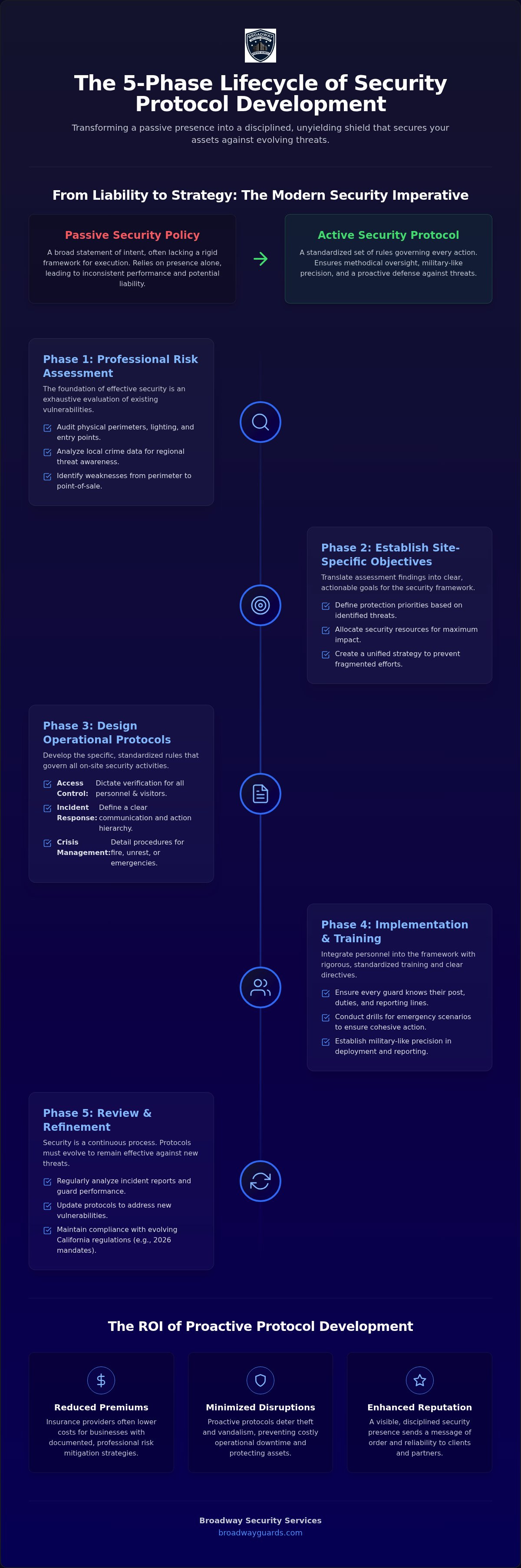
Investing in professional business security protocol development pays dividends beyond simple safety. Insurance providers often reduce premiums for businesses that demonstrate documented risk mitigation through professional oversight. Beyond cost savings, these protocols minimize operational disruptions. Theft and vandalism don’t just cost money; they stop work. In 2026, where IoT endpoints have risen by 14%, the attack surface for physical and digital assets is wider than ever. A visible, professional security presence also protects your brand reputation. Clients and partners feel more secure when they see a disciplined shield protecting the environment. This presence sends a clear message of order and reliability to the Southern California market.
The 5-Phase Lifecycle of Security Protocol Development
A disciplined approach to protection requires a structured lifecycle that eliminates guesswork. Successful business security protocol development follows a methodical five-phase process. This framework replaces reactive habits with strategic oversight, ensuring that every layer of defense operates with total synchronization. By moving through these phases, a business transforms its security from a passive presence into an unyielding force capable of deterring sophisticated threats.
Phase 1: Professional Risk Assessment
Effective security begins with an exhaustive evaluation of existing vulnerabilities. This involves auditing physical perimeters, lighting, and entry points to identify potential weaknesses. In regions like the San Fernando Valley, analyzing local crime data is critical to understanding the specific regional threats that might impact your facility. Evaluating vulnerabilities from the perimeter to the point-of-sale ensures no gap is left unaddressed. For a deeper look at this process, you can learn how to conduct a professional security risk assessment in California to ground your strategy in local reality.
Phase 2 builds upon these findings by establishing clear objectives based on site-specific threats. These goals provide the foundation for the entire protocol, ensuring that resources are allocated where they are needed most. Without these objectives, security measures often become fragmented and inefficient.
Phase 3: Designing Operational Procedures
Phase 3 involves the actual design of operational procedures for both personnel and technology. This is where you develop detailed post orders that define specific guard duties with military-like precision. These procedures often incorporate essential security protocols to ensure a comprehensive defense. For large facility perimeters, integrating mobile patrol services provides a high-visibility deterrent that static posts cannot achieve alone. These patrols follow unpredictable schedules to prevent patterns that criminals could exploit.
Phase 4 requires rigorous training and drills for all stakeholders. Every individual must understand their role within the response hierarchy to ensure a seamless reaction during a crisis. Finally, Phase 5 focuses on continuous oversight and refinement. Reliability is maintained through constant evaluation of field reporting and performance data. This methodical loop ensures your security remains an unyielding force against evolving threats. If your current strategy lacks this level of structure, engaging a partner for professional security consultation can help establish the necessary order.
Integrating Professional Personnel into Operational Protocols
Professional personnel serve as the active enforcement mechanism within any successful security framework. While technology provides data, human intervention provides the decisive response required to secure a facility. Within the context of business security protocol development, guards act as a disciplined shield. They aren’t merely observers; they’re trained professionals who execute the rigid operational standards defined in your post orders. This human element ensures that your security remains proactive rather than just a passive collection of data points.
Visible deterrence remains a cornerstone of safety in commercial and retail environments. The presence of a uniformed professional immediately signals a sense of order and vigilance to potential bad actors. To maintain this environment, reporting methods must be standardized. Accountability is achieved through meticulous field reporting that documents every patrol, incident, and observation. This methodical oversight ensures that the protocol is being followed with the required precision. It’s a system built on the principle that presence alone is insufficient without a structured reporting hierarchy.
Protocols for Armed Security Guards
High-value assets and executive safety require a specialized level of protection. Protocols for armed security guard services Los Angeles focus on high-stakes scenarios where the threat level is elevated. These procedures include strict use-of-force guidelines and an unwavering adherence to California legal standards. Every armed professional must demonstrate tactical proficiency and the psychological readiness to manage conflict with restraint and authority. This ensures that the use of a firearm is a measure of last resort, strictly governed by regulatory requirements and the specific safety needs of the site.
Protocols for Unarmed Personnel and Fire Watch
Most daily security needs are met through the deployment of unarmed security guards. These professionals follow standardized observation and reporting (O&R) procedures to maintain site integrity. Their role is to provide a vigilant presence that deters theft and unauthorized access. In specific scenarios, such as when fire alarm systems are offline or under maintenance, fire watch services California become a mandatory requirement. These protocols are designed to avoid costly fines and shutdowns by providing continuous, documented monitoring of fire hazards. Integrating these specialized roles into your business security protocol development ensures that every vulnerability is covered by a professional capable of decisive action.
Compliance and Regulatory Standards in California
Operating in California requires navigating a complex web of legal mandates. For any organization engaged in business security protocol development, compliance isn’t optional; it’s the foundation of liability protection. The Bureau of Security and Investigative Services (BSIS) sets the standard for how physical protection must be executed. Failure to adhere to these rules exposes a business to significant legal risks and potential shutdowns. A disciplined approach to security ensures that every guard on your site is fully vetted and licensed under state law. This commitment to regulatory reality acts as a functional signature of your professional standards.
California Security Guard Training Standards
California law mandates a rigorous training schedule for all security personnel. Every guard must complete a minimum of 40 hours of training to meet state requirements. This includes an initial 8-hour course before starting work, followed by 16 hours within the first 30 days and another 16 hours within the first six months. Beyond this baseline, specialized certifications are required for armed personnel or those carrying batons and pepper spray. Maintaining these credentials requires ongoing education and periodic background checks to ensure the highest standards of field performance. This level of professional discipline transforms a standard guard into a vigilant protector capable of managing high-stakes environments with precision.
Documentation and Audit Readiness
Liability protection is cemented through meticulous record-keeping. Daily activity reports (DARs) serve as a legal safeguard, providing a chronological account of every patrol and observation. In the event of a breach, these reports demonstrate that the site was under disciplined oversight. Incident report protocols must be designed to stand up to regulatory scrutiny, capturing precise details without ambiguity. This “disciplined reporting” is a core component of modern risk management. It ensures that your organization is always audit-ready and legally protected. When your protocols are backed by rigorous documentation, you create an unyielding paper trail that defends your operational decisions.
Navigating these requirements alone is a high-stakes gamble. Professional consultation ensures that your security contracts and operational standards are strictly compliant with California law. By partnering with an expert, you ground your professional claims in legal reality. This strategic partnership moves your security from a point of interest to a certified line of defense. If you need to ensure your site meets these rigorous standards, you can secure professional compliance consultation to protect your assets and your reputation.
Optimizing Protocol Execution with Broadway Security Services
The final and most critical stage of business security protocol development is the transition from strategic planning to field execution. A protocol is only as effective as the personnel tasked with its implementation. Broadway Security Services specializes in this transition, providing custom security management tailored to the unique demands of Southern California. We replace the uncertainty of general security with a vigilant and unyielding force. By deploying highly trained guards who operate with military-like precision, we ensure your assets remain under constant, professional protection. Our commitment is to maintain an atmosphere of high-stakes reliability through methodical oversight.
The Broadway Security Advantage
Our expertise is deeply rooted in the San Fernando Valley and the greater Los Angeles area. From our headquarters in Canoga Park, we manage site protection with a level of disciplined oversight that exceeds industry norms. We provide reliable security solutions across several key sectors:
- Construction Site Security: Protecting high-value equipment and materials from theft and vandalism.
- Retail Security and Loss Prevention: Maintaining a visible deterrence that prevents shrinkage and ensures customer safety.
- Hospital and Healthcare Security: Managing complex access control and sensitive environments with professional restraint.
Each sector faces specific risks that require more than just a presence. Our personnel are trained to address these vulnerabilities within your established protocol. This disciplined approach to personnel management ensures that your assets are under the care of a vigilant protector at all times. We don’t just provide a service; we act as a disciplined shield for your operations.
Next Steps for Your Business
Refining your security requires a commitment to order and structure. If your current measures feel inconsistent, professional consultation is the first step toward reclaiming control. We analyze your current business security protocol development to identify gaps in reporting or field performance. Our goal is to transform your security operations into an unyielding line of defense that protects your reputation and your bottom line. This process involves refining post orders and patrol schedules to ensure zero downtime in your defense.
Take decisive action to secure your facility by following these steps:
- Schedule a professional risk assessment to identify your current physical and operational vulnerabilities.
- Develop a customized contract that prioritizes your unique site needs and regulatory requirements.
- Contact Broadway Security Services to deploy a disciplined shield for your assets.
Our commitment to duty ensures your business operates with total peace of mind. As a licensed provider (PPO #122027), we ground every professional claim in regulatory reality and operational rigor. Don’t leave your assets to chance. Establish a foundation of trust through rigorous operational standards today. We remain serious, observant, and prepared to defend what you’ve built.
Establishing Your Unyielding Defense Framework
A professional security strategy is defined by its structure and its ability to adapt to high-stakes environments. You’ve learned that effective business security protocol development requires a shift from passive observation to a state of constant, methodical oversight. By integrating the five-phase development lifecycle with the deployment of highly trained personnel, you create a disciplined shield that protects both your physical assets and your legal standing. Success in 2026 relies on this intersection of regulatory compliance and operational rigor.
Broadway Security Services stands ready as your strategic partner in Southern California. Our California-licensed security professionals bring military-style oversight to every post, from retail centers to construction sites in the San Fernando Valley. We don’t just provide guards; we provide the peace of mind that comes from knowing your facility is under the care of a vigilant and unyielding force. It’s time to replace inconsistent performance with a foundation of trust and order. Secure Your Assets with Broadway Security Services and ensure your business remains resilient against any threat. Your commitment to safety starts with a professional framework built to endure.
Frequently Asked Questions
What is the first step in business security protocol development?
The initial phase of business security protocol development is a comprehensive risk assessment. This process identifies physical vulnerabilities, such as compromised perimeters or blind spots in surveillance. By evaluating site-specific threats and local crime data, you establish a baseline for your defense strategy. This assessment ensures that subsequent protocols are grounded in reality rather than assumptions. It’s the essential first step in building a disciplined shield for your California facility.
How often should a business update its security protocols?
Protocols should undergo a formal review at least once per year or immediately following a significant site change. In 2026, the introduction of new CCPA regulations and evolving IoT threats necessitates more frequent audits. If a security breach occurs, an immediate refinement of existing operational standards is required to prevent a recurrence. Regular updates ensure your security remains a vigilant and unyielding force against the latest criminal tactics and regulatory changes.
Are armed security guards necessary for all business types in Los Angeles?
Armed security guards aren’t a universal requirement but are recommended for high-stakes environments. Businesses managing high-value assets, jewelry, or executive safety often require the heightened deterrence of armed personnel. Conversely, retail or residential sites may find that unarmed guards provide sufficient visible protection. The decision rests on a professional risk assessment that weighs the potential for conflict against the specific safety objectives of your Los Angeles location.
What are the California requirements for security guard training?
California law requires all guards to complete a mandatory 40-hour training program overseen by the BSIS. This includes eight hours of pre-assignment training, followed by 16 hours within the first 30 days of employment. The final 16 hours must be completed within the first six months. Armed guards must also secure a specific firearm permit and pass rigorous psychological and tactical evaluations. These strict standards ensure that every protector on your site possesses the necessary professional discipline.
How does a fire watch protocol differ from standard security?
Fire watch protocols are specialized procedures activated when a building’s fire alarm or sprinkler system is non-functional. Unlike standard security, which focuses on crime prevention, fire watch personnel are strictly dedicated to identifying fire hazards and ensuring rapid evacuation. These guards must maintain a continuous log of their patrols to meet California Fire Code requirements. This methodical oversight prevents catastrophic property loss and protects the business from severe regulatory fines or mandatory shutdowns.
Can professional security protocols reduce my insurance costs?
Documented security protocols often lead to reduced insurance premiums by demonstrating a commitment to risk mitigation. Insurers view a disciplined framework as evidence that a business is actively minimizing its liability exposure. When you provide a clear roadmap of your security operations, you prove that your assets are under professional care. This proactive approach reduces the likelihood of successful claims related to theft or vandalism, making your business a lower risk for providers.
What role does technology play in physical security protocols?
Technology serves as a critical force multiplier within physical security protocols. Modern frameworks utilize digital access control, IoT-enabled sensors, and real-time reporting software to enhance guard effectiveness. These tools provide the data necessary for methodical oversight and accountability. However, technology isn’t a replacement for the human element. Instead, it provides the disciplined shield with the information required to execute business security protocol development with military-like precision and total situational awareness.
How do I ensure my security guards are following protocol?
Accountability is maintained through rigorous reporting and professional management oversight. You should require daily activity reports (DARs) that document every patrol and observation in detail. Random site audits and electronic guard tour systems also verify that personnel are executing post orders as intended. By partnering with a firm that prioritizes hierarchy and structure, you ensure that every guard understands their duty. This systematic approach guarantees that your operational standards are followed without deviation.