


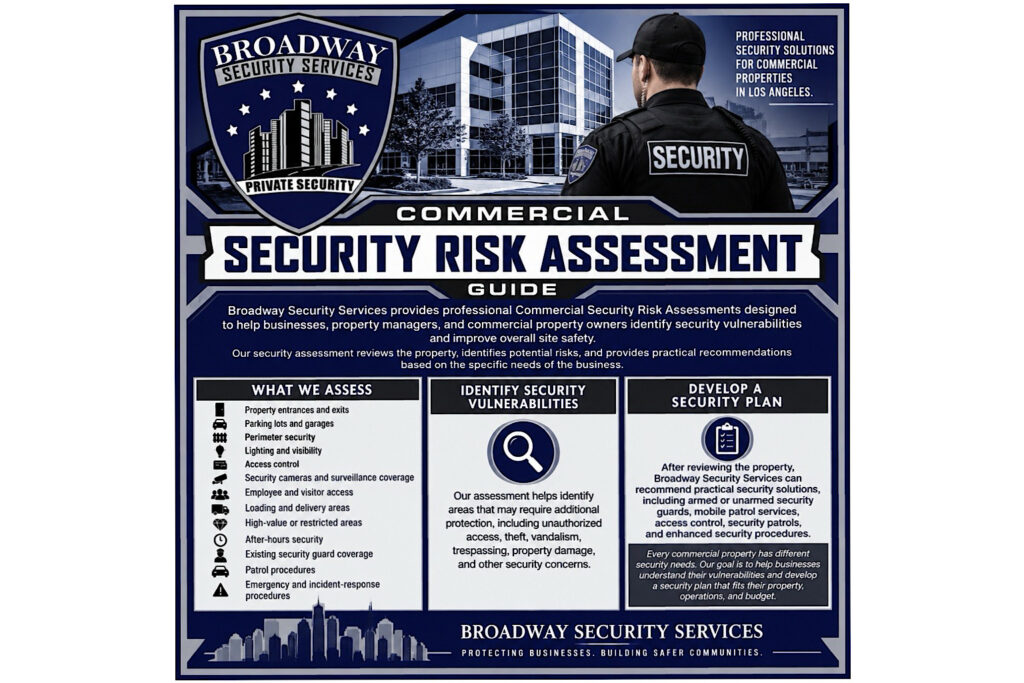
A loading dock that is quiet at 2:00 a.m., a lobby with several public entrances, and a construction site with changing crews do not carry the same exposure. A commercial security risk assessment guide helps decision-makers identify where a site can be disrupted, who or what is exposed, and which controls will produce measurable protection rather than the appearance of coverage.
The goal is not to place a guard at every door. It is to build a disciplined security plan around real operating conditions: traffic flow, access points, valuable assets, public contact, after-hours activity, and the consequences of an incident. When the assessment is done correctly, staffing levels, patrol routes, post orders, reporting requirements, and escalation procedures all have a clear purpose.
Commercial Security Risk Assessment Guide: Start With Operations
Security risk begins with how the property actually functions. Before reviewing cameras, gates, or guard schedules, document what happens at the site across a full day and week. A property that appears low-risk during office hours may become highly vulnerable during overnight deliveries, shift changes, tenant move-outs, or weekend closures.
Walk the property with the people responsible for operations. Facility managers, maintenance teams, receiving staff, construction supervisors, and tenant representatives often know where rules are routinely bypassed. Ask where unauthorized people have entered before, when employees feel least safe, which doors are propped open, and what activity is difficult to observe.
A useful assessment separates normal activity from exceptions. For example, a warehouse may have controlled access during scheduled receiving hours but leave drivers waiting outside the gate after a delayed delivery. An apartment property may have a secure garage on paper but experience tailgating when residents return during peak evening traffic. These are not minor details. They define where a visible officer, vehicle patrol, access procedure, or revised post order can reduce exposure.
Identify Assets, People, and Consequences
Every site has assets worth protecting, but loss is not limited to stolen equipment. The assessment should account for people, operations, property, information, reputation, and compliance obligations. A security failure may delay a shipment, shut down a tenant area, create a workplace violence concern, expose a vacant building to trespass, or leave a fire watch requirement undocumented.
Rank assets by both value and operational impact. A low-dollar key card may create greater risk than a piece of office furniture if it provides access to restricted areas. A damaged gate can affect an entire logistics operation. At an event, an uncontrolled entrance may jeopardize guest safety and the organizer’s ability to manage attendance.
Consider four basic questions for each asset or activity:
- Who can access it, and who should not?
- When is it least protected or least visible?
- What would an incident interrupt, damage, or expose?
- How quickly would management need to know and respond?
This approach prevents a common mistake: assigning security according to the most visible asset instead of the most consequential vulnerability.
Examine Access, Visibility, and Human Behavior
Most commercial security gaps are created by a combination of weak access control and predictable human behavior. Doors are held open for convenience. Contractors arrive without clear authorization. Employees assume someone else checked identification. Visitors follow authorized personnel through a gate. These patterns create opportunities for theft, trespass, vandalism, and unsafe confrontations.
During the site walk, inspect every practical entry and exit point, including pedestrian doors, vehicle gates, loading areas, stairwells, roof access, emergency exits, utility rooms, and adjacent properties. Note whether each location is locked, monitored, illuminated, recorded, and regularly checked.
Visibility matters, but it is not only about lighting or cameras. Determine whether someone can see suspicious activity and act on it. A camera pointed at a rear door is less useful when nobody reviews alerts in real time and there is no officer assigned to investigate. An access log is limited if credentials are shared or visitor badges are not recovered.
This is where professional guard coverage adds operational value. Licensed and trained guards can verify access, enforce visitor procedures, conduct documented patrols, observe changing conditions, and provide a visible deterrent at the times and places where technology alone cannot intervene.
Score Risk by Likelihood and Impact
Not every vulnerability requires the same investment. A practical risk score helps management decide what to address first. Rate each issue based on the likelihood that it will occur and the impact if it does. Use a simple scale, such as low, medium, or high, but define those terms for the property.
Likelihood should reflect local conditions, incident history, ease of access, surrounding activity, and the consistency of existing controls. Impact should reflect potential injury, business interruption, property loss, liability, regulatory exposure, and reputational damage.
A poorly lit side gate may be a high-likelihood trespass point with moderate impact. A main lobby with inconsistent visitor screening may have lower likelihood but high impact because it exposes employees, guests, and sensitive areas. Both deserve attention, but the response may differ. The first may need lighting, a locked gate, and scheduled patrol checks. The second may require a controlled lobby post during business hours, visitor sign-in procedures, and defined escalation instructions.
Avoid treating the score as a substitute for judgment. A single credible threat, recurring assault concern, or fire watch obligation may demand immediate action even if a basic scoring sheet does not capture its urgency.
Match Controls to the Risk
Effective security plans use layers. Physical improvements, policy changes, electronic systems, and on-site personnel should support one another. The right mix depends on the site, budget, operating schedule, and the level of response required.
For a vacant commercial property, marked vehicle patrols may provide a cost-effective visible presence when paired with perimeter checks, incident reporting, and rapid escalation for forced entry or fire hazards. A busy medical office or corporate lobby may need a fixed unarmed officer who can manage visitors, maintain order, and address concerns before they become disruptions. A high-value cargo movement may justify dedicated escort coverage and controlled handoffs.
Armed coverage is not automatically the strongest answer. It may be appropriate where the threat profile, asset value, and operating environment support it, but it also requires carefully defined duties, qualified personnel, management oversight, and clear communication with the client. In many customer-facing settings, a professional unarmed officer provides the more suitable balance of deterrence, service, and de-escalation.
Turn Findings Into Post Orders and Accountability
An assessment has limited value unless it becomes daily instruction. Each identified priority should be reflected in site-specific post orders that tell officers what to observe, where to patrol, who may enter, what records to maintain, and when to notify management or emergency services.
Post orders should be direct enough to guide an officer during a busy shift. “Monitor the property” is too vague. “Check the north loading door every hour, verify delivery credentials before access, document vehicle plate numbers for after-hours arrivals, and immediately report forced-entry indicators” creates accountability.
Reliable incident reporting is equally important. Reports should record time, location, persons involved, actions taken, notifications made, and any follow-up needed. This documentation helps clients identify repeat problems, demonstrate compliance, manage claims, and adjust deployment when conditions change.
Supervision should verify that coverage is being performed as designed. A guard program without field oversight can drift from the assessment that justified it. Regular site reviews, patrol verification, report review, and client communication keep the security plan aligned with current conditions.
Review the Assessment When Conditions Change
Commercial risk is not fixed. New tenants, construction phases, staffing reductions, public events, inventory increases, neighborhood activity, and changes in business hours can alter the threat picture quickly. Review the assessment after any significant incident and at planned intervals, especially for properties with high traffic or changing operations.
For Los Angeles-area sites, this is particularly relevant where mixed-use activity, dense vehicle traffic, large events, and active construction can change access patterns from one shift to the next. A plan that worked during normal operations may need additional access control, patrol coverage, or parking enforcement during a major delivery, tenant transition, or event.
The strongest security assessment is one that gives management clear decisions: what must be protected, where exposure exists, which controls are justified, and how performance will be verified. Start with the conditions your people face every day, then require a security plan that is visible, documented, supervised, and built to protect business continuity.