


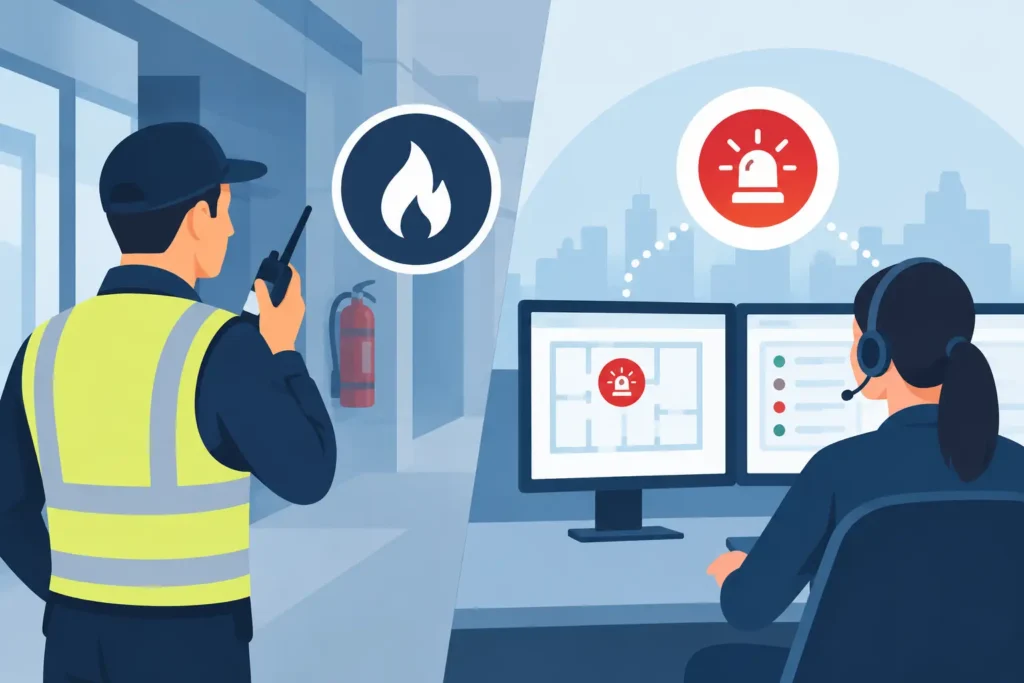
A fire alarm panel can report a signal from an impaired building system. It cannot walk a dark stairwell, check a temporary heating unit, keep an exit route clear, or identify smoke before a detector activates. That is the operational difference in fire watch versus alarm monitoring. Property managers and facility leaders need to understand where each service begins, where it stops, and when a trained on-site presence is required.
For a commercial property, construction site, apartment community, warehouse, or institutional facility, the right decision protects people, supports business continuity, and creates a defensible record of the actions taken during an impairment. The wrong assumption can leave a site exposed during the hours when a fire protection system is unavailable or conditions change quickly.
Fire Watch Versus Alarm Monitoring: Different Functions
Alarm monitoring is a communications function. When a connected fire alarm system detects an alarm, trouble, or supervisory condition, it transmits a signal to a monitoring center. Depending on the account instructions and signal type, the monitoring center may contact designated representatives, notify emergency responders, or both.
This service has real value. It provides off-site awareness when a property is closed, staff are not near the fire alarm control panel, or a signal requires immediate escalation. It is part of an organized fire protection program, particularly for occupied buildings that rely on automatic detection and notification systems.
But alarm monitoring does not provide continuous human observation of the property. The operator receiving the signal is not inspecting fire extinguishers, checking whether doors are blocked, watching for hot work hazards, or confirming that occupants have safely cleared an affected area. Monitoring responds to information transmitted by the system. It does not replace physical patrol activity.
Fire watch is an on-site risk-control measure. Trained security officers make recurring patrols of designated areas, look for signs of fire or unsafe conditions, maintain awareness of access and occupancy activity, and follow site-specific instructions for reporting and emergency response. Their visible presence is designed to identify and escalate hazards while the property has reduced fire protection capability or elevated fire exposure.
When Alarm Monitoring Is the Right Fit
Alarm monitoring is generally appropriate when the fire alarm system is fully operational and the property needs reliable off-site signal handling. A monitored system may be the right baseline for a business that closes overnight, a multifamily property with limited on-site staff, or a facility where immediate notification procedures need to be clearly defined.
Its effectiveness depends on more than the equipment itself. The account must have current emergency contacts, accurate site information, and documented call procedures. Facility managers should know who receives alarm, trouble, and supervisory notifications, who has authority to make decisions after hours, and how responders gain access to the property.
Monitoring can also support a temporary issue that does not disable required detection or notification functions. For example, a low-priority condition may generate a trouble signal while the essential system remains functional. The fire alarm contractor, property representative, and authority having jurisdiction should determine whether the condition requires a fire watch or another compensating measure.
A monitoring center should never be treated as proof that the building is adequately protected during a full or partial system impairment. It can notify people that a problem exists. It cannot manage the conditions on the ground.
When an On-Site Fire Watch Is Needed
Fire watch is commonly used when a fire alarm, sprinkler, standpipe, or other fire protection component is impaired, when repair work is underway, or when temporary site conditions create a higher risk of ignition or delayed detection. Construction and renovation projects often need closer observation because walls, access routes, occupancy patterns, and utilities can change from one shift to the next.
The decision is not always automatic. Requirements can vary based on the system affected, the duration of the impairment, building use, occupancy, fire load, and direction from the local fire authority. In Los Angeles and surrounding jurisdictions, facility leaders should coordinate with their fire alarm contractor, fire protection provider, insurer when applicable, and the authority having jurisdiction. Do not wait until after normal business hours to determine who is responsible for coverage.
A professional fire watch assignment starts with clear post orders. Officers need to know which systems are impaired, which floors or zones require patrols, the required patrol frequency, the location of extinguishers and standpipes, emergency exits, assembly areas, utility shutoffs when applicable, and the escalation chain. A generic guard standing at a lobby desk is not a fire watch plan.
During patrols, officers should remain alert for smoke, unusual odors, overheating equipment, open flames, unsafe storage, blocked exits, disabled extinguishers, unauthorized work, and signs that a temporary condition has become more serious. If a hazard is identified, the officer follows established emergency procedures, notifies the appropriate contacts, and helps support orderly response within the scope of assigned duties.
What Documentation Should Include
Documentation is one of the clearest distinctions between informal coverage and accountable fire watch service. A property may need to demonstrate when the impairment began, what temporary protections were placed in service, and what actions were taken until repairs were completed. Detailed reporting also gives management a reliable record if conditions change between shifts.
A proper fire watch log should identify the property, date, patrol times, officer name, areas inspected, conditions observed, and any corrective or escalation actions. It should also record when a system was restored and when the fire watch was released by the appropriate party. If an officer observes a blocked egress path or an unsafe work practice, the report should state the location, condition, notification made, and outcome.
Reporting does not eliminate risk by itself. Its value comes from disciplined patrols, prompt escalation, and supervisory review. Broadway Security Services builds fire watch coverage around site-specific post orders and reliable incident reporting so clients have a visible record of the protection in place.
Cost Is Not the Only Comparison
When comparing fire watch and alarm monitoring, cost matters, but it should not be the only factor. Monitoring is typically a standing service with lower routine cost because it relies on remote signal handling. Fire watch requires licensed personnel on site, often around the clock, and its cost reflects staffing, supervision, patrol requirements, reporting, and the duration of the assignment.
The practical question is whether remote notification can manage the risk at the site. If the system is working properly and the need is signal response, monitoring may be sufficient. If detection, notification, or suppression capabilities are impaired, or the property faces elevated hazards that require eyes on the ground, on-site fire watch may be the more appropriate measure.
There are also hybrid situations. A facility may maintain alarm monitoring while deploying fire watch personnel during a temporary impairment. This approach preserves the available signal path while adding physical patrols and immediate hazard observation. It is often a sensible option when only part of a system is affected, but the exact arrangement should follow the direction of qualified fire protection professionals and the local authority.
How to Set Up Effective Fire Watch Coverage
Start by defining the impairment and the area it affects. A single disabled device, a sprinkler outage in one zone, and a full fire alarm panel failure create different exposure levels. Confirm the start time, anticipated repair window, current occupancy, active operations, and any high-risk work taking place during the impairment.
Next, establish post orders that are specific enough for officers to execute consistently. The plan should identify patrol routes, inspection intervals, restricted areas, emergency contacts, access procedures, reporting requirements, and the instructions for a fire or smoke condition. Shift changes need formal handoff procedures so no gap develops between officers.
Finally, maintain management oversight. Supervisors should be able to verify officer arrival, review logs, address changing conditions, and confirm that coverage continues until the system is restored or the responsible authority releases the requirement. Fire watch is temporary, but the standard of accountability should remain high throughout the assignment.
The best protection decision is the one that matches the actual condition of the property. If the system can send a signal, monitoring gives your team timely notification. If the site needs active observation, disciplined patrols, and documented on-site response, place trained fire watch officers where the risk is – at the property itself.