


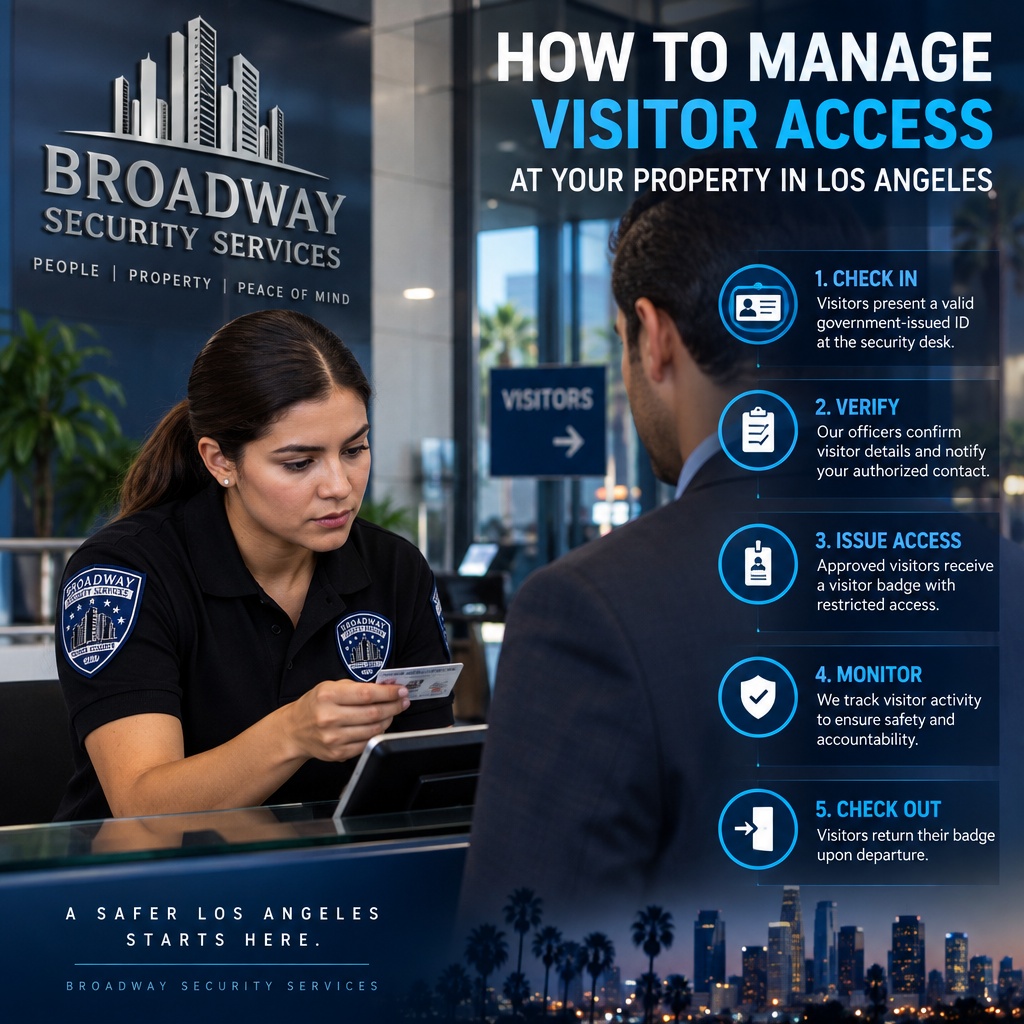
A visitor arriving at an unsecured entrance can become a disruption, a safety concern, or an unrecorded liability in minutes. Knowing how to manage visitor access means establishing control before someone reaches a tenant floor, loading dock, jobsite, restricted office, or event area. The objective is not to make every guest feel suspected. It is to verify who is entering, why they are there, where they may go, and when they leave.
For property managers and operational leaders, access control must work during routine traffic and under pressure. A good system supports business activity while giving staff and security officers the authority, tools, and procedures to stop unauthorized entry.
Start With a Site-Specific Visitor Access Plan
Visitor access should not be managed with a generic sign-in sheet and verbal instructions alone. Each property has different exposure points: a lobby may handle vendors and appointments, an industrial site may receive drivers and contractors, and a residential community may need to separate invited guests from delivery traffic.
Begin by identifying every location where a visitor can enter or bypass the intended entry process. This includes vehicle gates, side doors, loading docks, employee entrances, elevators, construction perimeters, and parking areas. Then determine which entry point will serve as the primary check-in location and which points should remain locked, alarmed, monitored, or staffed.
Your written visitor plan should answer practical questions. Who may authorize a guest? What identification or proof of appointment is required? Which areas are open to visitors? When is an escort required? What happens when the host cannot be reached? Clear answers prevent a front-desk employee or guard from having to make inconsistent decisions in real time.
A licensed security officer can enforce these procedures with visible professionalism, but post orders must define the standard. Officers should know the approved access points, restricted areas, key contacts, escalation procedures, and documentation requirements for the site.
How to Manage Visitor Access From Arrival to Departure
The strongest access process follows the visitor’s full movement through the property, not only the first interaction at the door. A controlled process has four connected stages: verification, authorization, monitoring, and checkout.
Verify identity and purpose before entry
At check-in, the officer or authorized staff member should confirm the visitor’s name, destination, host, reason for visit, and expected duration. Depending on the property, verification may include a government-issued photo ID, contractor credentials, a delivery reference number, a work order, or a preapproved guest list.
The level of screening should match the risk. A tenant meeting a client in a commercial lobby may need a simple host confirmation. A visitor seeking access to a data room, school, medical facility, construction zone, warehouse, or executive area may require stronger identification, an escort, and additional screening under site policy.
Do not rely on appearance, confidence, or familiarity. People may claim they are expected, say a supervisor approved them, or attempt to follow an employee through a controlled door. The process must remain consistent: no confirmation, no access. A professional officer can state the rule clearly and respectfully while protecting the property from pressure-based exceptions.
Obtain authorization from the right person
Authorization should come from a designated host, manager, tenant representative, or preapproved visitor system. It should not be based on a casual message passed through an unrelated employee. For higher-risk locations, establish an approved list of personnel who can authorize access to sensitive areas.
If a host does not respond, the visitor should wait in a designated public area or be asked to return. Allowing unsupervised entry because a person appears frustrated creates an avoidable gap in the access plan. This is especially relevant during busy delivery windows, shift changes, and large events, when staff may feel pressure to move people through quickly.
Issue visible credentials and set boundaries
A visitor badge, hangtag, wristband, or temporary credential immediately distinguishes authorized guests from people who do not belong in controlled areas. The credential should be visible, difficult to transfer, and appropriate to the property. A color-coded badge can identify a visitor who must remain escorted, while a contractor pass can show the approved work zone and expiration date.
The credential is only useful when employees, security personnel, and supervisors are expected to challenge or report anyone without one. That expectation should be communicated to tenants and staff before the program begins. Otherwise, an access badge becomes a formality rather than a control.
At entry, visitors should receive concise instructions: where they may go, prohibited areas, parking rules, safety requirements, photography restrictions when applicable, and checkout expectations. Contractors may also need instructions regarding personal protective equipment, tools, hot-work authorization, or delivery staging.
Record arrival, movement, and departure
A complete visitor log provides accountability after an incident, dispute, alarm, or emergency evacuation. Record the visitor’s name, company when applicable, host, arrival time, credential number, destination, and departure time. For contractors and vendors, note the vehicle information, work order, crew size, and areas authorized for work when relevant.
Digital visitor systems can improve searchability and reporting, particularly at multi-tenant or high-volume sites. Paper logs may be appropriate for smaller properties or temporary posts, but they must be legible, secured, and reviewed. The best choice depends on traffic volume, privacy requirements, budget, and the need for audit-ready records.
Avoid collecting more personal information than the site genuinely needs. Visitor records should be protected, retained according to company policy, and accessible only to authorized personnel. A disciplined process respects privacy while preserving the documentation needed for security and operational accountability.
Separate Visitor Types Instead of Using One Rule for Everyone
Not every visitor presents the same risk or requires the same process. Treating a delivery driver, a prospective tenant, a job applicant, and a subcontractor exactly alike can slow operations without improving protection.
For most properties, visitor categories should include guests, vendors, delivery personnel, contractors, and event attendees. Guests may be checked in and directed to a host. Vendors should have an appointment or service request. Delivery personnel may be limited to a dock, receiving area, or designated handoff point. Contractors require verified scope of work, approved access areas, and safety coordination. Event attendees may need ticket verification, bag policy enforcement, queue control, and clearly marked entry and exit routes.
This tiered approach prevents over-screening at low-risk interactions while placing stronger controls around locations, assets, and activities that demand them. The visitor’s access level should always be based on the purpose of the visit, not convenience.
Train Staff and Security Officers to Enforce the Process
Technology supports visitor management, but people enforce it. Reception staff, building engineers, managers, and guards need to understand where their responsibility begins and ends. Employees should know not to prop secured doors open, loan access cards to guests, or wave unfamiliar people through a restricted entrance.
Security officers require site-specific post orders and regular supervisory review. They should be trained to verify credentials, communicate professionally, recognize suspicious behavior, handle denied-entry situations, call emergency contacts, and document incidents accurately. The ability to stay calm and consistent matters as much as the ability to control a doorway.
At a busy Los Angeles property, the officer may also be managing rideshare arrivals, delivery congestion, parking enforcement, and pedestrian traffic. That is why visitor access procedures must be practical enough to follow during peak activity. If the plan causes long lines or forces officers to abandon other critical duties, it needs adjustment.
Prepare for Exceptions and Security Incidents
Every access plan needs a response path for visitors who cannot be verified, become confrontational, attempt to enter restricted areas, or refuse to comply with site rules. Officers should know when to deny entry, when to request management support, when to contact law enforcement, and how to preserve accurate incident details.
Emergency conditions require separate procedures. During a fire alarm, evacuation, medical incident, or other urgent event, visitor logs help account for nonemployees on site. Guards should be prepared to direct visitors to assembly areas and provide responding personnel with relevant access information.
Review visitor activity after incidents and at regular operational intervals. Repeated unauthorized-entry attempts, missing badges, tailgating patterns, delivery bottlenecks, or after-hours visitors may indicate that staffing levels, access points, signage, or post orders need to change. Good visitor management is maintained through observation and correction, not installed once and forgotten.
A controlled entrance sends a clear message: the property is professionally managed, expectations are enforced, and access is granted with purpose. When guards, staff, and management follow the same standard, visitors can be welcomed without leaving the site exposed.