

A guard who misses a shift, fails to document an incident, or does not understand a restricted access point creates an operational problem fast. For property managers and business leaders, the question of in house versus contract security is not simply about hourly rates. It is about who owns recruiting, training, supervision, relief coverage, reporting, and the response when conditions change.
The right model depends on the site. A single corporate campus with a mature internal safety department has different needs than a multifamily property, construction site, distribution yard, or special event with changing traffic and access patterns. The goal is not to choose the cheapest arrangement. It is to establish dependable protection that supports daily operations.
What In-House Security Requires
An in-house security team consists of guards employed directly by the organization they protect. The client controls hiring standards, schedules, uniforms, workplace policies, and the day-to-day chain of command. For organizations with stable, long-term security needs, that control can be valuable.
Internal officers may develop a deep understanding of company culture, employee routines, building systems, and recurring issues. At a large facility with established leadership and predictable operations, they can become an integrated part of the workplace. A dedicated internal team may also make sense when security personnel need highly specialized knowledge of proprietary processes or sensitive internal systems.
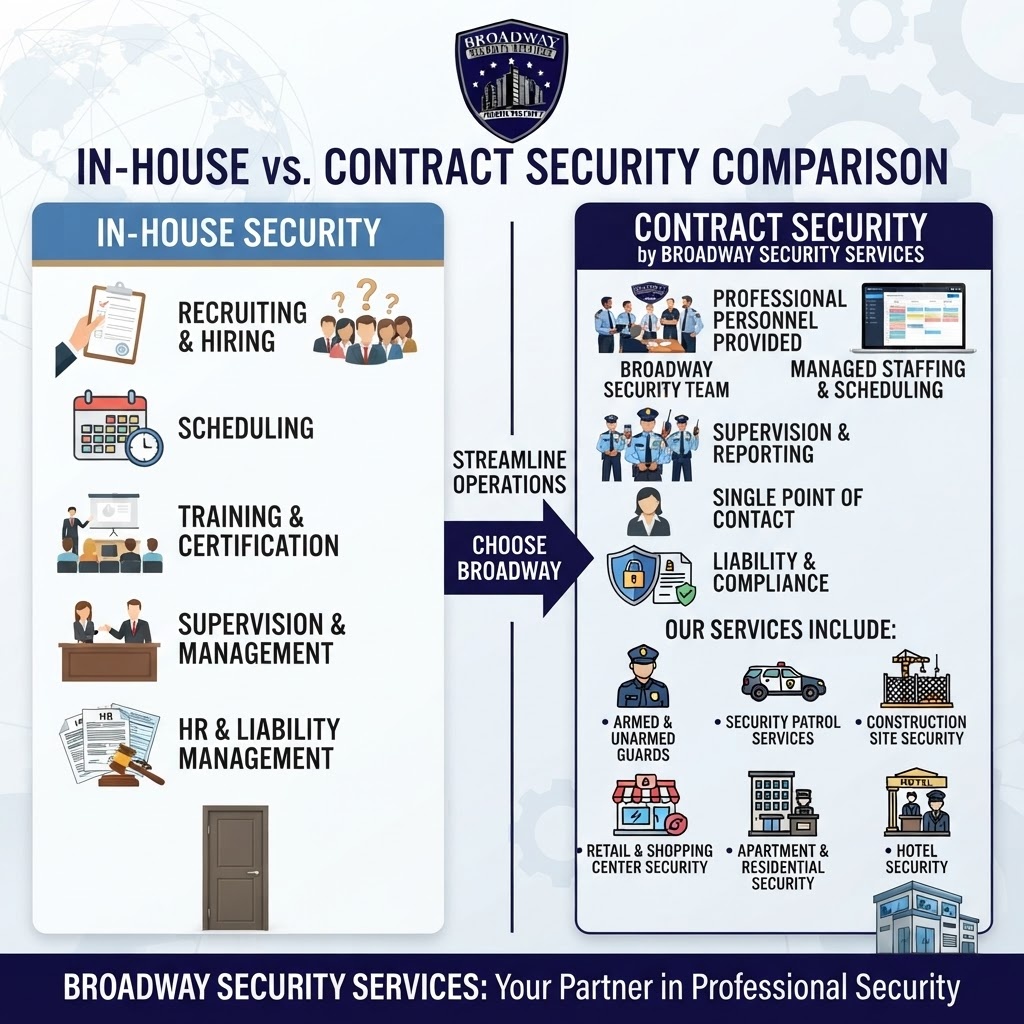
That level of control comes with full operational responsibility. The organization must recruit qualified candidates, conduct background screening, manage payroll, provide benefits, maintain personnel files, schedule coverage, address call-offs, and handle performance issues. In California, employers must also stay current with applicable labor obligations, licensing requirements, training expectations, and insurance considerations.
The hidden workload is often relief coverage. A security post does not disappear when an employee calls out, takes leave, resigns, or needs additional training. If a facility requires around-the-clock coverage, management needs enough trained personnel to cover every shift, days off, sick time, vacations, and turnover. A lean internal roster can look efficient on paper while leaving the property exposed in practice.
How Contract Security Operates
Contract security places those staffing and support responsibilities with a licensed security provider. The client defines the site requirements, while the provider supplies trained guards, post orders, supervision, scheduling support, and a process for reporting and escalation.
A properly managed contract program is not a generic guard placed at a door. It starts with a site assessment: access points, public traffic, high-value assets, after-hours exposure, parking conditions, emergency procedures, and the level of authority expected at each post. Those details should be translated into written post orders that tell officers what to monitor, whom to contact, how to document activity, and when to escalate an incident.
The provider should also have a plan for routine field supervision and emergency replacement coverage. This is where contract security either proves its value or falls short. A provider that simply fills shifts transfers little risk. A provider with responsive supervision, documented patrol procedures, management oversight, and reliable incident reporting gives the client a controlled operating system rather than a staffing transaction.
For Los Angeles-area properties, contract coverage can be especially useful when demands change quickly. A construction project may need overnight fire watch for a limited period. A commercial property may require marked vehicle patrols after repeated trespassing. An event organizer may need trained access control and crowd-management personnel for one weekend. Building and administering an internal team for each assignment is rarely practical.
In-House Versus Contract Security: The Real Cost Comparison
Comparing a contract guard rate to an employee’s base hourly wage will produce the wrong answer. The employee’s true cost includes payroll taxes, workers’ compensation, benefits, uniforms, equipment, recruiting time, training, management time, overtime, and the cost of vacancies. It also includes the operational consequences when coverage fails.
Contract security generally presents a more visible service cost because many of those obligations are bundled into the provider’s rate. That does not automatically make contracting less expensive. A large organization with its own recruiting capacity, security leadership, training infrastructure, and consistent staffing needs may achieve efficiencies internally. But it must honestly account for administrative overhead and relief staffing.
The more useful question is: who is best prepared to keep a qualified officer at the post every required hour? If your team has to pull a maintenance supervisor, office manager, or operations director into shift coverage, the internal model may be consuming more resources than its wage calculation shows.
Cost should also be measured against exposure. An unlocked gate, undocumented injury, unmanaged confrontation, or missed fire-watch round can affect tenant confidence, operations, insurance claims, and liability. Security is a risk-control function. The lowest apparent price is not the same as the lowest total risk.
Control, Accountability, and Site Knowledge
Some decision-makers assume in-house staffing always means more control. It can, but only if internal leaders have time and security expertise to manage it. Control requires clear policies, audits, performance reviews, documentation standards, and someone with authority to correct poor performance.
A contract model can provide strong control when the client sets clear expectations and the provider follows them. The best arrangements establish a defined chain of command: site leadership directs property priorities, the security provider manages officers and field operations, and both parties receive timely information about incidents, trends, and corrective action.
Accountability should be visible. Ask how patrols are verified, how incident reports are reviewed, who conducts site inspections, and what happens when an officer is late or a post order is not followed. A professional provider should be able to explain its supervision process without vague assurances.
Site knowledge also improves when post orders are specific and regularly updated. Contract officers do not need to be company employees to understand a property. They need a disciplined onboarding process, accurate instructions, accessible supervisors, and feedback from the client when operations change.
When an In-House Team May Fit Best
An internal team may be the stronger choice when security operations are permanent, highly specialized, and central to the organization’s mission. This may apply to major corporate campuses, institutions with established internal public safety departments, or facilities where guards require extensive access to confidential systems and internal processes.
It can also fit organizations that already have experienced security leadership, formal training programs, sufficient staffing depth, and the administrative capacity to manage personnel around the clock. Without those resources, direct employment can create gaps that are difficult to see until an incident or staffing shortage exposes them.
When Contract Security Is the Better Operating Model
Contract security is often the practical choice for properties that need flexibility, rapid deployment, scalable staffing, or specialized assignments. Apartment communities, retail centers, warehouses, construction projects, medical offices, schools, transportation operations, and event venues frequently benefit from a provider that can adjust coverage without requiring the client to build an entire security department.
It is also a strong fit when the client needs visible deterrence backed by management oversight. Armed or unarmed guard coverage, vehicle patrols, access monitoring, fire watch, cargo escort, and parking enforcement each require different post instructions and officer capabilities. A qualified provider can structure those assignments around the property rather than force every risk into one staffing model.
Broadway Security Services approaches contract coverage as a site-specific operation, not a one-size-fits-all guard placement. The standard should be licensed and trained guards, responsive supervision, clear post orders, and documentation that helps management understand what is happening on the property.
Questions to Ask Before You Decide
Before selecting either model, define the assignment in operational terms. Identify which hours require coverage, where the vulnerabilities are, what officers must observe or enforce, and how they will communicate with property leadership. Then determine whether the role requires a static post, patrol activity, controlled access, emergency response coordination, or a combination of duties.
Ask who will recruit and train replacements, who covers absences, who supervises after hours, and who reviews reports for recurring problems. Clarify what authority guards have when confronting unauthorized persons, enforcing parking rules, addressing employee disputes, or responding to a medical or fire-related concern. These decisions should be documented before the first shift begins.
Finally, evaluate providers or internal processes on performance standards, not promises. Require clear reporting, defined escalation contacts, documented site procedures, and regular review of incidents and patrol activity. The security program should give leadership usable information, not just reassurance that someone was scheduled.
The strongest choice is the one that keeps trained, accountable personnel in the right places and gives your team confidence that issues will be noticed, documented, and addressed before they disrupt the property.