


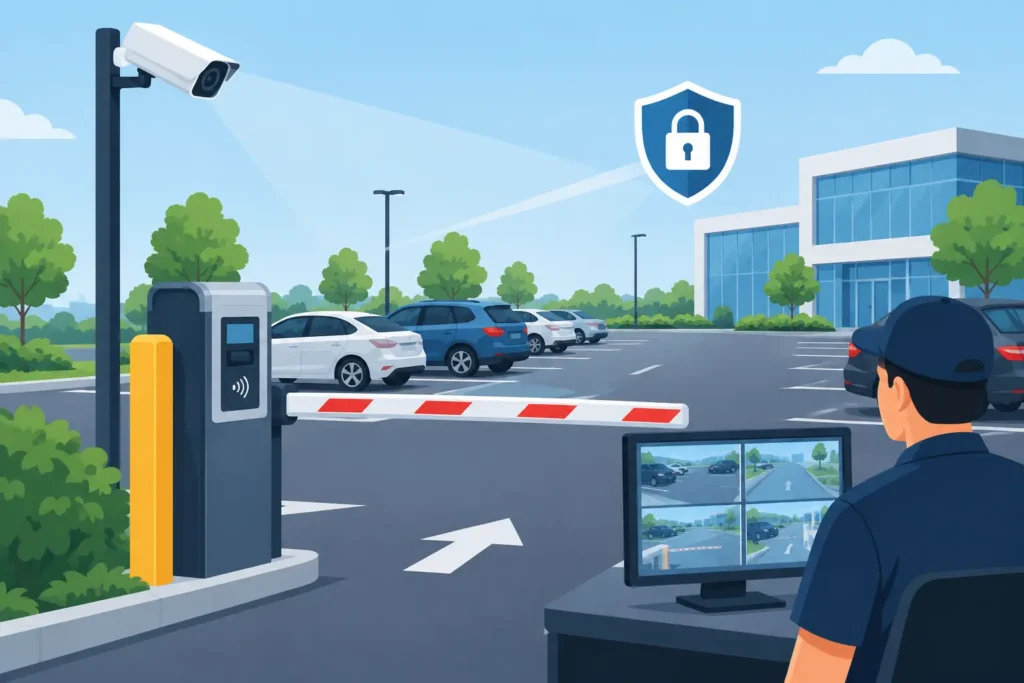
A parking lot can become a property’s most exposed area after business hours, during shift changes, or whenever access is loosely controlled. Knowing how to secure parking lots means treating the area as an active part of the facility, not an unmonitored space between the street and the building. The right plan protects people, vehicles, equipment, and operations while keeping legitimate traffic moving.
Start With a Site-Specific Parking Lot Risk Assessment
Effective parking lot security begins with an on-site assessment. A downtown office garage, a retail center, a construction site, and a logistics yard may all have parking areas, but they do not face the same threats. Property managers should identify when the lot is busiest, who is authorized to use it, where unauthorized entry occurs, and which areas lack visibility.
Walk the property during daytime and after dark. Review vehicle entrances, pedestrian gates, stairwells, elevators, loading zones, rear access doors, perimeter fencing, and places where someone could hide or enter unnoticed. Pay attention to traffic patterns at opening, closing, shift changes, and special events. These periods often create congestion and reduce staff attention to suspicious activity.
Incident history should shape the plan. Vehicle break-ins, vandalism, catalytic converter theft, loitering, illegal dumping, trespassing, employee harassment, and unauthorized parking each require a different response. A security provider should convert these findings into clear post orders, patrol routes, escalation procedures, and reporting requirements.
Control Access Before Problems Reach the Property
Open access creates uncertainty. A lot intended for tenants, employees, customers, or approved vendors should clearly communicate who may enter and what rules apply. Signs alone are not enough, but visible rules support enforcement and reduce disputes when staff or guards address violations.
Depending on the property, access control may include gates, key cards, access codes, visitor registration, permit decals, reserved-area markings, and monitored pedestrian entrances. The objective is not to make every property difficult to enter. It is to separate authorized use from unrestricted public access.
For higher-exposure locations, trained security officers can verify credentials, direct visitors, monitor delivery activity, and challenge unauthorized persons professionally. This is particularly useful at industrial sites, residential communities, medical facilities, private campuses, and properties with recurring after-hours activity.
Access procedures must fit operations. A gate that slows employee arrival can create frustration and backups onto public streets. A visitor policy that is too loose can leave the site exposed. The strongest approach applies tighter controls during vulnerable hours while maintaining practical entry procedures for authorized users.
Improve Visibility With Lighting, Layout, and Maintenance
Poor visibility gives offenders time and concealment. Lighting should cover driving lanes, pedestrian walkways, payment stations, entrances, exits, stairwells, elevators, dumpster enclosures, and the perimeter. Replace failed fixtures promptly and inspect lighting after dark, when gaps are easiest to identify.
Good lighting does not mean placing bright fixtures everywhere without a plan. Glare can interfere with drivers, cameras, and nearby tenants. Lighting should be positioned to provide consistent coverage, reduce deep shadows, and support clear identification of people and vehicles.
Landscaping and maintenance also affect security. Overgrown shrubs can block camera views or create concealment near walkways. Faded striping causes traffic confusion. Broken gates, damaged fencing, abandoned vehicles, and overflowing trash areas signal that the property is not actively managed. Prompt correction supports deterrence and helps guards enforce expectations from a position of authority.
Use Visible Patrols to Create Real Deterrence
Cameras and gates are valuable tools, but they do not replace a visible, trained security presence. A marked vehicle patrol or uniformed officer can observe conditions, intervene early, provide direction, and respond to problems while they are developing. That visible presence is often what causes trespassers, thieves, and disruptive individuals to move on.
Patrols should not follow a predictable pattern every night. Fixed patrol times allow repeat offenders to identify gaps. Instead, officers should vary routes and timing while still covering priority areas such as isolated rows, perimeter lines, employee entrances, loading areas, and vehicles storing equipment or inventory.
A disciplined patrol program includes more than driving through the lot. Officers should inspect gates and doors, check for suspicious vehicles, identify safety hazards, watch for damaged property, confirm lighting conditions, and document enforcement activity. Where appropriate, officers can provide employee escorts, assist with traffic flow, and maintain a visible presence near closing times.
Choose Armed or Unarmed Coverage Based on Risk
The appropriate level of guard coverage depends on the site, operating hours, incident history, valuables on site, and potential threat level. Many parking facilities benefit from professional unarmed officers who can manage access, enforce rules, observe activity, and contact law enforcement when necessary.
Armed coverage may be appropriate for higher-risk environments, valuable cargo operations, sensitive facilities, or locations with a documented threat profile. This decision should follow a professional assessment and a clear understanding of the guard’s responsibilities. More force is not automatically better security. The goal is appropriate protection delivered by licensed, trained personnel under active supervision.
Make Cameras Part of an Active Security Plan
Video surveillance is most effective when cameras are placed for a specific purpose. Cover vehicle entrances and exits, pedestrian access points, payment areas, loading zones, high-theft areas, and locations where people may be isolated. Images should be usable, not merely recorded. Camera placement, angle, lighting, and retention procedures all affect whether footage can support an investigation.
Cameras should complement patrols rather than create false confidence. A camera may document a vehicle break-in, but a nearby officer may deter it, report it immediately, preserve the scene, and assist the victim. For properties with monitoring capabilities, establish who watches alerts, how they verify activity, and when they dispatch a guard or call law enforcement.
Regular testing matters. Check that cameras record properly, timestamps are accurate, views are not blocked, and management can retrieve footage when an incident occurs. Equipment that has not been maintained may fail at the exact moment it is needed.
Establish Clear Rules for Parking Enforcement
Unauthorized parking can become a security issue when it blocks fire lanes, loading areas, accessible spaces, emergency access, tenant spaces, or traffic lanes. It also signals that rules can be ignored. Clear enforcement protects the property’s operations and reduces conflict between legitimate users.
Post parking terms visibly and apply them consistently. Security officers should know when to issue a warning, request a vehicle be moved, document a violation, contact management, or coordinate with an authorized towing provider. Officers should avoid confrontational enforcement. Professional communication, accurate documentation, and adherence to property policy protect both the client and the public.
For mixed-use properties, define separate procedures for customers, employees, residents, vendors, and contractors. A vendor truck parked briefly in a loading area may be expected. An unapproved vehicle remaining there overnight is a different situation. Specific rules allow officers to act with confidence instead of making inconsistent judgment calls.
Prepare Officers and Staff for Incidents
The best parking lot security plan answers practical questions before an incident occurs. Who responds to a suspicious person? What happens if a vehicle gate is damaged? Who contacts law enforcement? How are employees notified if a threat develops? Where should an officer position themselves during a medical emergency or evacuation?
Written post orders give officers a defined scope of responsibility. They should include patrol duties, access procedures, emergency contacts, reporting standards, site maps, restricted areas, parking enforcement procedures, and instructions for handling incidents. Supervisory review helps ensure those instructions are followed consistently.
Staff also need a simple reporting process. Employees and tenants should know how to report suspicious behavior, damaged vehicles, lighting failures, and safety concerns without assuming someone else will handle it. Prompt reports give security teams an opportunity to correct vulnerabilities before they become losses.
Require Detailed Reporting and Management Oversight
Security coverage should produce accountability, not just a person standing at an entrance. Daily activity reports, incident reports, patrol records, photographs when appropriate, and documented maintenance concerns provide management with a clear record of what occurred on the property.
Reporting also reveals trends. Repeated loitering near one entrance, recurring gate failures, frequent unauthorized parking, or a pattern of vehicle damage may indicate a larger issue requiring operational changes. Responsive supervision turns those observations into action through adjusted patrol schedules, improved lighting, revised access controls, or additional coverage during high-risk periods.
For Los Angeles-area properties, where parking congestion, public access, and after-hours activity can vary significantly by neighborhood, a site-specific deployment plan is especially valuable. Broadway Security Services approaches parking lot coverage with licensed guards, defined post orders, visible patrol procedures, and reliable incident reporting designed around the conditions of the property.
A secure parking lot is not created by one camera, one gate, or one occasional patrol. It is maintained through visible control, consistent enforcement, trained personnel, and a willingness to correct small vulnerabilities before they create a serious incident.