


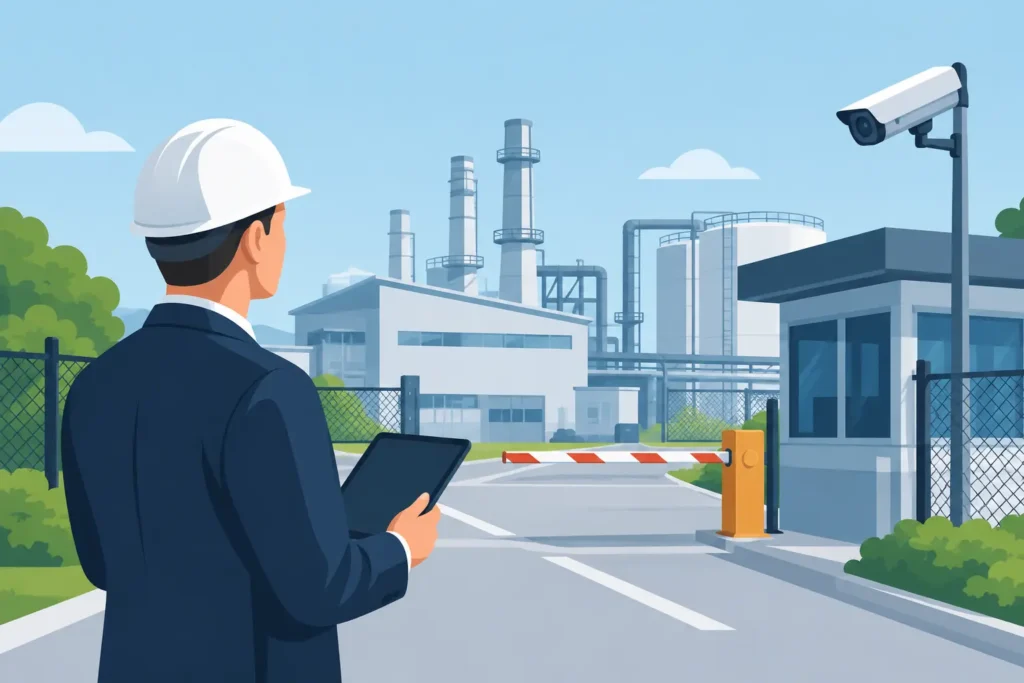
A loading gate left open during a shift change, an unverified driver at the dock, or a contractor moving through an unmarked access point can create an expensive security failure in minutes. This industrial facility security guide is built for facility managers who need more than occasional patrols. They need controlled access, visible deterrence, disciplined officers, and documentation that supports operations when an incident occurs.
Industrial properties face a different exposure profile than standard commercial buildings. They may operate overnight, receive frequent deliveries, store high-value materials, run heavy equipment, and depend on contractors who are unfamiliar with the site. Effective security must protect people, inventory, equipment, and business continuity without slowing legitimate work.
Start the Industrial Facility Security Guide With Risk Mapping
A security plan should begin with the actual way the facility operates, not a generic guard schedule. Walk the property during active hours and after hours. Identify where people, vehicles, materials, and information enter, move, wait, and leave.
For many industrial sites, the highest-risk areas are not the front office. They are employee entrances, truck gates, loading docks, equipment yards, fuel storage areas, perimeter fencing, roof access points, and blind corners behind buildings. A camera may cover part of these locations, but cameras do not challenge an unauthorized person, confirm a delivery appointment, or direct emergency responders to the right gate.
Risk mapping should account for normal operations and exceptions. A warehouse that is secure at 2:00 p.m. may be exposed at 5:30 a.m. when shift crews arrive before supervisors are present. A construction-related industrial site may need stronger perimeter checks on weekends, while a distribution center may require tighter truck verification during peak delivery windows.
Document the findings in site-specific post orders. Officers need clear direction on which doors must remain secured, where patrols must be conducted, who can authorize access, and when to escalate a problem. Vague instructions such as “watch the property” produce inconsistent coverage. Defined responsibilities create accountability.
Control Access Without Blocking Operations
Controlled access monitoring is one of the most effective ways to reduce theft, trespassing, and unauthorized entry. It also supports safety by keeping unapproved visitors away from vehicle lanes, machinery, and restricted work zones.
The goal is not to create unnecessary delays. It is to establish a consistent process for employees, visitors, vendors, contractors, and drivers. A trained security officer can verify identification, confirm appointments, issue visitor credentials, record vehicle information, and direct approved personnel to the correct area.
A practical access-control procedure should define four decisions: who may enter, what they may access, when they may enter, and who approves an exception. Exceptions are where control often breaks down. A driver who claims to have an urgent pickup, a former employee requesting entry, or a contractor arriving without a work order should not be admitted based on pressure or familiarity alone.
At facilities with frequent truck traffic, gate officers should be given a current contact list and clear delivery verification steps. They should know whether to inspect seals, record trailer numbers, check bills of lading, or hold a vehicle in a designated staging area. The exact procedure depends on the client’s operations, but the procedure must be consistent across all shifts.
Build Visible Patrols Around Real Vulnerabilities
A stationary guard post can provide strong gate control, but industrial properties often need active patrol coverage as well. Visible foot or vehicle patrols deter trespassing, identify unsecured doors, detect fence damage, and discourage unauthorized loading or removal of property.
Patrol routes should not become predictable. An officer who checks the same areas at the same time every night can be easily avoided. Supervisors should establish required patrol points while allowing reasonable variation in timing and route order.
A productive patrol checks more than locks. Officers should observe conditions that could affect safety or operations, including leaking fluids, damaged fencing, blocked fire lanes, unsecured trailers, suspicious parked vehicles, unauthorized occupants, and signs of forced entry. When an issue is found, the officer should document it, notify the proper contact, and preserve the scene when necessary.
Marked vehicle patrols can be particularly valuable for large yards, multi-building properties, and sites with after-hours exposure. They create a visible security presence over a wider area and support faster response to alarms, perimeter concerns, or employee escorts. For interior-sensitive areas and close inspection of doors or equipment, foot patrols remain necessary.
Match Staffing to the Threat Level
Not every facility requires the same type of guard coverage. An unarmed officer may be the right fit for access control, visitor management, parking enforcement, and routine patrols at a lower-risk property. An armed assignment may be appropriate where the facility handles high-value cargo, faces a documented threat, operates in an isolated area, or requires a higher level of deterrence.
The decision should be based on risk, legal requirements, client policy, and the officer’s role. Armed coverage is not a substitute for poor access procedures or inadequate supervision. It carries additional responsibility and must be managed by a qualified provider with trained, properly licensed personnel.
Coverage hours matter as much as staffing type. A site may be well protected during business hours but exposed during shift changes, overnight production, holidays, or weekends. Review incident history, delivery schedules, alarm activity, and employee arrival patterns before setting the schedule. Security resources should follow exposure, not convenience.
Make Reporting Part of the Security Operation
If an incident is not accurately documented, management cannot properly investigate it, identify trends, or demonstrate that corrective action was taken. Reliable incident reporting turns security activity into usable operational information.
Officers should record patrols, visitor entries, vehicle activity, access denials, property damage, safety hazards, alarms, disturbances, and interactions with law enforcement or emergency services. Reports should state what happened, when and where it occurred, who was involved, what actions were taken, and who was notified.
Good reporting is factual and specific. It avoids assumptions, emotional language, and unsupported conclusions. “Officer observed the north pedestrian gate unsecured at 10:42 p.m. and notified the facility contact” is useful. “Gate was probably left open by staff” is speculation unless confirmed.
Management should review reports regularly, not only after a major incident. Repeated open-door findings, the same unauthorized vehicle, recurring fence damage, or frequent after-hours access requests may reveal a process failure that needs correction. A professional security provider should support this review with responsive supervision and consistent communication.
Prepare Officers for Incidents and Emergencies
Industrial security personnel must know what to do before a critical event occurs. Post orders should cover fire alarms, medical emergencies, hazardous conditions, workplace violence concerns, evacuation procedures, suspicious packages, utility failures, and law enforcement response.
The officer’s role is often to secure access, protect the scene, notify key contacts, direct responders, and maintain order. Officers should not exceed their training or interfere with emergency operations. Their value comes from calm control, accurate communication, and disciplined adherence to site procedures.
Fire watch coverage deserves particular attention when a fire alarm or sprinkler system is impaired. A fire watch officer must conduct required checks, watch for signs of fire or smoke, maintain clear records, and report hazards immediately. This is not a casual patrol assignment. It is a life-safety responsibility that requires defined procedures and dependable reporting.
Evaluate the Guard Provider, Not Just the Hourly Rate
The lowest quoted rate can become the highest operational cost if guards arrive late, post orders are ignored, reports are incomplete, or no supervisor answers when conditions change. Industrial clients should evaluate the provider’s field management structure as carefully as the assigned officer.
Ask how officers are selected for industrial assignments, how they are briefed on site-specific procedures, how often supervisors inspect the post, and how the company handles call-offs or urgent coverage changes. Confirm that reporting expectations are clear and that the provider can scale coverage for a theft incident, labor disruption, shutdown, or special delivery.
Broadway Security Services approaches industrial coverage around the property’s access points, operating activity, traffic patterns, and documented risks. That approach supports a guard plan that protects the facility without losing sight of production schedules and daily business demands.
Review the Plan as the Facility Changes
Security plans should change when operations change. New tenants, expanded yards, different inventory, revised delivery routes, construction activity, staffing reductions, and recurring incidents can all create gaps in an otherwise sound plan.
Schedule regular reviews with facility leadership and security supervision. Compare incident reports against current post orders, inspect the perimeter, test communication procedures, and confirm that approved access lists are current. Small corrections made early are far less disruptive than responding after a theft, injury, or major access failure.
A disciplined security program gives industrial managers control where it matters most: at the gate, on the perimeter, around critical assets, and during the unpredictable moments when normal operations are interrupted. The right coverage does not simply place an officer on site. It establishes a visible, accountable presence that helps the facility keep moving safely.