


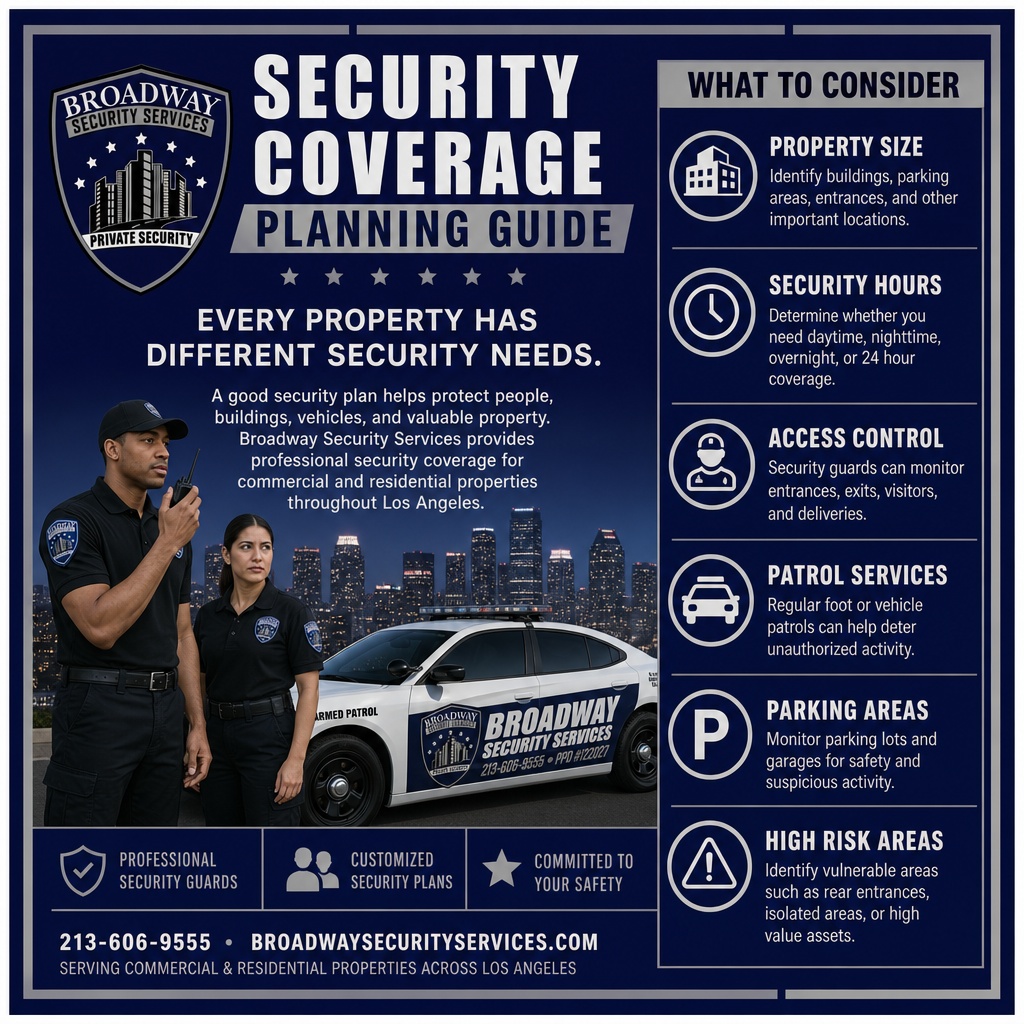
A security plan fails when it is built around a headcount instead of the conditions on the ground. One guard at a front desk may be sufficient for a quiet professional office, but inadequate for a mixed-use property with open parking, delivery traffic, after-hours contractors, and recurring trespass issues. This security coverage planning guide helps property and operations leaders define where protection is needed, when it is needed, and what officers must be prepared to do.
The objective is not simply to place guards where they can be seen. Effective coverage creates controlled access, visible deterrence, documented activity, and a clear response structure when an incident occurs. It also supports normal operations without creating unnecessary friction for tenants, employees, visitors, vendors, or customers.
Start With the Property’s Actual Exposure
Security coverage should begin with an assessment of the site, not with a standard schedule copied from another property. Review how people, vehicles, deliveries, and assets move through the location during operating hours and after closing. Then identify where normal activity creates opportunities for unauthorized access, theft, conflict, safety hazards, or property damage.
For a commercial building, the highest-risk area may be a side entrance that employees use after hours. At a construction site, it may be an unsecured material yard after crews leave. For a logistics operation, the primary concern may be cargo transfer points, driver check-in, and trailer access. Event venues face a different mix of risks, including crowd flow, credential verification, restricted-area control, and rapid response to disturbances.
A useful assessment separates ongoing conditions from isolated incidents. A single vehicle break-in does not always require around-the-clock vehicle patrols. Repeated break-ins in a poorly lit lot, especially during predictable hours, may justify a more visible and structured patrol assignment. The right response depends on frequency, severity, exposure, and the consequence of a failure.
Map Access Points and Blind Areas
Every entrance is not equally important. List public entrances, employee doors, loading areas, gates, parking access, roof access, stairwells, elevators, and emergency exits. Determine which points should remain open, which require credential checks, and which must be secured except for authorized use.
Physical conditions matter. Camera coverage, lighting, fencing, alarm systems, locks, landscaping, and line of sight all affect the number of officers required and how they should be deployed. Security personnel can compensate for some gaps, but staffing should not be treated as a permanent substitute for basic physical security improvements.
A site walk should also identify blind areas where people can enter, conceal activity, or remain unnoticed. These locations often require scheduled patrol checks, not a stationary officer who never leaves the lobby or gatehouse.
Define Coverage by Time, Task, and Response Need
The next step in security coverage planning is matching personnel to the hours and duties that create the greatest value. Coverage may be required continuously, only overnight, during tenant move-ins, during construction shutdowns, at shift changes, or during high-traffic events. A plan that provides the same staffing level every hour may be appropriate for a high-exposure facility, but it can also waste resources at a site with clear peaks and low-risk periods.
A fixed-post officer is best when a specific point requires consistent observation or control. Examples include visitor screening, gate access, lobby security, loading dock verification, and employee badge checks. Mobile patrol officers are better suited to larger properties, multiple buildings, parking facilities, perimeter checks, and locations where an unpredictable presence strengthens deterrence.
Many properties need both. A fixed officer controls the primary access point while a patrol officer checks remote doors, parking areas, fire exits, vacant suites, and exterior conditions. The arrangement should reflect the time required to perform each task properly. If one officer is expected to monitor a busy entrance, receive deliveries, conduct patrols, handle calls, and write reports, critical areas will be left unattended.
Armed coverage requires separate consideration. It may be appropriate where a documented threat profile, valuable assets, isolated operating conditions, or elevated public risk supports it. It also brings a higher level of responsibility, training expectations, and coordination with the client’s policies. Unarmed licensed guards are often the right fit for access control, patrol, customer-facing assignments, and deterrence where professional presence and observation are the primary requirements.
Build Clear Post Orders Before Coverage Begins
A guard cannot enforce a standard that has not been defined. Site-specific post orders turn a staffing assignment into an operational security program. They should explain the officer’s authority, responsibilities, patrol routes, reporting requirements, escalation process, and communication procedures.
Post orders should address who may enter the property, how visitors and vendors are verified, what officers should do when someone refuses to comply, and when law enforcement or emergency services must be contacted. They should also identify restricted areas, key control procedures, package or delivery protocols, parking rules, and procedures for lost property, suspicious activity, medical incidents, fires, and facility hazards.
The instructions must be realistic. A post order that tells an officer to challenge every person entering a public retail center is not workable. A better instruction identifies the areas and behaviors that require intervention, such as access to closed corridors, employee-only spaces, loading zones, or private parking areas.
Set the Reporting Standard
Reliable reporting is one of the strongest indicators of accountable security coverage. Daily activity reports show that patrols and assigned duties occurred. Incident reports establish a factual record when a rule violation, injury, property damage, disturbance, or security concern takes place.
Reports should be timely, specific, and objective. They should record the time, location, persons involved when known, observed facts, actions taken, notifications made, and disposition of the incident. Officers should avoid assumptions and opinions that cannot be supported by direct observation.
For property managers and facility directors, reporting also reveals patterns. Repeated door alarms, recurring loitering, unauthorized vendor access, and frequent parking violations can all point to a coverage adjustment or a physical security issue that needs correction.
Plan for Supervision, Relief, and Escalation
A schedule is only the starting point. Security coverage must account for officer relief, call-offs, meal periods, shift handoffs, and supervisory checks. An uncovered post during a lunch break can create the same vulnerability as a missed shift, especially at a gate, lobby, or active construction entrance.
Supervision should confirm that officers understand their post orders, maintain professional appearance, complete patrols, and document activity correctly. It should also provide a responsive point of contact when site conditions change. A property experiencing a new trespass pattern or tenant complaint should not have to wait weeks for the coverage plan to be reviewed.
Escalation procedures should be decided before an incident. Officers need to know which issues they handle directly, which require client notification, and which call for emergency services or law enforcement. That clarity protects personnel, limits confusion, and supports a measured response under pressure.
Review Coverage Against Real Results
Security plans should be reviewed after operational changes, significant incidents, new tenant activity, construction phases, seasonal events, or changes in public access. The review should consider more than incident totals. Fewer reported incidents can mean effective deterrence, but it can also mean officers are not documenting activity consistently.
Examine patrol records, access logs, incident reports, client feedback, camera observations, response times, and recurring complaints. If violations continue in the same area, ask whether the post order is clear, patrol timing is predictable, staffing is too thin, or a physical condition is contributing to the problem.
Broadway Security Services approaches coverage as a site-specific assignment supported by licensed and trained guards, responsive supervision, controlled access monitoring, and reliable incident reporting. The goal is disciplined protection that fits the property’s real operating conditions.
The strongest coverage plan gives officers clear authority, gives management useful information, and gives everyone on site a visible reason to follow the rules. That is how security becomes a dependable part of daily operations rather than a last-minute response after a loss.