


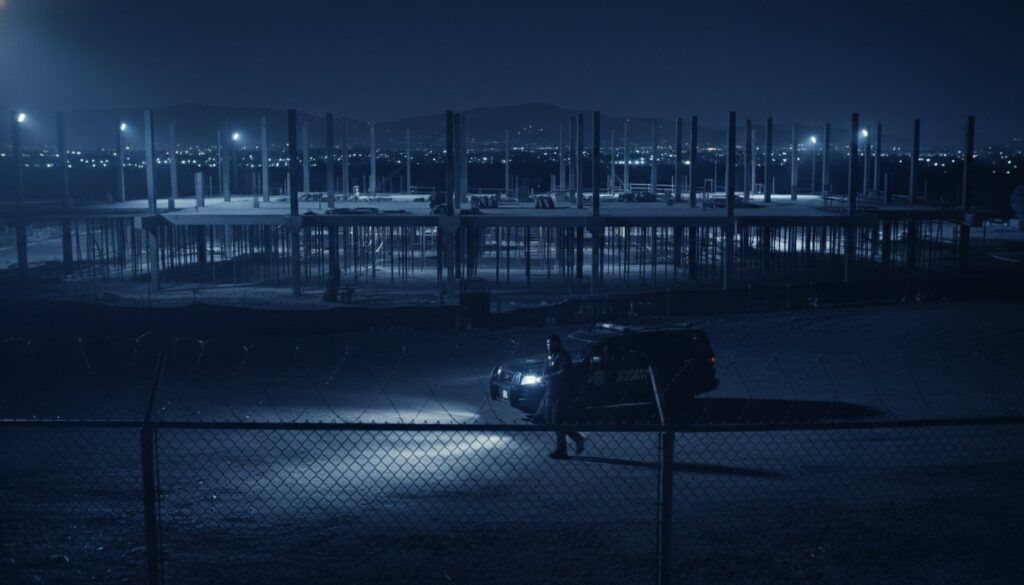
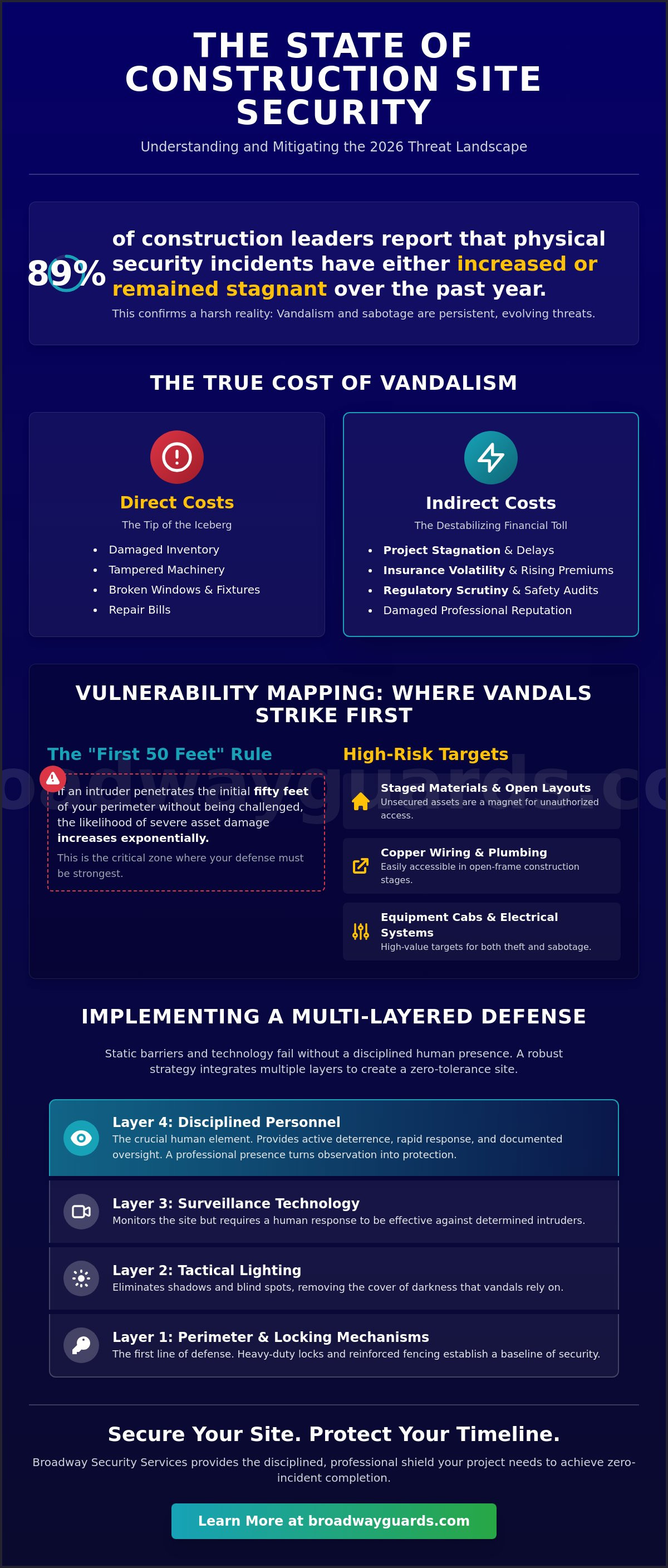
A staggering 89% of construction leaders reported in a September 2025 survey that physical security incidents have either increased or remained stagnant over the previous year. For project managers, this data confirms a harsh reality; vandalism is a crime of perceived anonymity that thrives in the shadows of unsecured sites. When unauthorized access leads to damaged inventory or tampered machinery, the result isn’t just a repair bill. It’s a compromised project timeline and a direct hit to your insurance standing. Maintaining effective construction vandalism security requires more than a perimeter fence. It demands a disciplined, visible presence that functions as an unyielding shield against site destruction.
You recognize that protecting high-value assets is a matter of operational rigor and professional oversight. This article details the latest trends in site protection and explains how to implement a multi-layered security framework designed for the demands of 2026. We’ll examine how documented security protocols and mobile patrol services lead to zero-incident project completion, providing the peace of mind you require during after-hours and weekends. By establishing a culture of vigilance, you can ensure your assets remain under the care of a professional and unyielding force.
Key Takeaways
- Assess the evolving landscape of site sabotage to understand why indirect project delays often carry a higher financial toll than direct asset loss.
- Master the “First 50 Feet” rule to identify site blind spots and prevent perimeter breaches from escalating into structural damage.
- Understand why surveillance technology requires a disciplined human presence and how specialized construction vandalism security ensures a rapid response to unauthorized access.
- Implement a multi-layered defense framework that integrates heavy-duty locking mechanisms with tactical lighting to establish a zero-tolerance site.
- Discover how military-like operational standards and rigorous training protocols provide the documented oversight necessary to lower insurance premiums.
The 2026 Landscape of Construction Vandalism and Asset Risk
The 2026 landscape for Southern California development projects has shifted toward higher stakes and more aggressive site interference. While theft remains a concern, the primary threat has evolved into malicious sabotage and structural damage. By defining vandalism as a deliberate act of destruction, developers can better prepare for the psychological shift from opportunistic looting to targeted disruption. In 2026, urban density in areas like the San Fernando Valley creates an environment where unauthorized access occurs with alarming frequency. Modern construction vandalism security must address these threats with a disciplined framework that prioritizes asset protection over simple observation. It’s no longer enough to react after a breach occurs; you need a strategy that eliminates the opportunity for destruction entirely.
Direct vs. Indirect Costs of Vandalism
Direct losses, such as the cost of a broken window or damaged skid steer, are only the surface of the problem. The true financial toll lies in the indirect consequences that destabilize a project’s budget. Repairing specialized equipment or remediating structural sabotage takes time that your schedule doesn’t have. This delay pushes back completion dates, leading to liquidated damages and increased labor costs. Frequent insurance claims also erode your bonding capacity, making it harder to secure future high-value contracts. For developers in the San Fernando Valley, a single night of unchecked vandalism can damage a professional reputation that took years to build. Consider the following indirect impacts:
- Project Stagnation: Every day spent on repairs is a day lost on progress.
- Insurance Volatility: Rising premiums following multiple site incidents can compromise your profit margins.
- Regulatory Scrutiny: Repeated breaches may trigger safety audits or municipal oversight.
Why Traditional Fencing is No Longer Sufficient
Standard chain-link barriers are a baseline requirement, but they don’t deter a determined intruder. In the current climate, vandalism has become a thrill crime for some and a professional sabotage operation for others. Fencing is easily bypassed or cut, providing only a false sense of security. Site vulnerability in 2026 is defined as the gap between physical barriers and the active oversight required to monitor high-density urban environments effectively. Relying on static obstacles without a disciplined shield leaves your assets exposed to those who view a construction site as an anonymous playground for destruction. You need a presence that commands respect and ensures accountability across every square foot of the development.
Vulnerability Mapping: Where Vandals Strike First
Professional risk assessment is the foundation of a disciplined security posture. You can’t protect what you haven’t identified as a target. Mapping site blind spots requires a methodical approach that looks beyond the obvious. The “First 50 Feet” rule states that if an intruder penetrates the initial fifty feet of your perimeter without challenge, the likelihood of severe asset damage increases exponentially. This critical zone is where the psychological barrier must be strongest. A breach that goes undetected for even sixty seconds allows an intruder to reach high-value targets like equipment cabs or exposed electrical wiring. Effective construction vandalism security depends on identifying these vulnerabilities before the first intruder arrives.
High-value targets aren’t just limited to expensive machinery. Vandals often focus on plumbing fixtures and copper wiring because they’re easily accessible in open-frame stages of construction. Staged materials left in open-layout developments act as a magnet for unauthorized access. Leaving these assets unsecured overnight signals a lack of oversight. Implementing effective approaches to vandalism prevention involves hardening these specific targets through strategic staging and a visible guard presence. A disciplined shield doesn’t just react; it removes the intruder’s confidence entirely.
Identifying High-Risk Zones on Your Jobsite
Multi-story developments present unique challenges, specifically in dark corners and unmonitored stairwells. These areas offer vandals the cover of anonymity. Environmental design plays a vital role in reducing criminal opportunity by eliminating shadows and creating clear lines of sight. When developing a security plan, it’s beneficial to coordinate with local Canoga Park authorities to understand regional crime hotspots. This localized intelligence allows for a more focused deployment of construction site security assets, ensuring that personnel are stationed where they’re needed most.
Psychology of Deterrence
The “Broken Windows” theory suggests that visible signs of disorder invite further criminal activity. A site that appears neglected is a site that invites intrusion. Conversely, a workspace maintained with military-like precision signals that every square foot is under professional oversight. Visible signage and a disciplined order act as a psychological deterrent. When an intruder sees a professional guard presence, the risk of detection becomes too high to ignore. This shift in the intruder’s decision-making process is the direct result of a documented security protocol that prioritizes presence and prevention. Your assets deserve the care of a vigilant and unyielding force.
The Deterrence Gap: Why Technology Alone Fails Without Disciplined Personnel
Many developers fall into the trap of believing that high-definition cameras alone constitute a complete security strategy. This is a dangerous myth. Masked vandals in 2026 are fully aware that cameras are passive observers. They often proceed with structural sabotage regardless of being filmed, knowing that remote monitoring cannot physically intervene. The reality of response times is often the difference between a minor trespass and a total site shutdown. While AI can flag an intruder instantly, the critical minutes between detection and police arrival are when the most damage occurs. Effective construction vandalism security relies on closing this response lag with a physical, disciplined presence that commands the site.
Professional guards provide immediate crisis management that technology cannot replicate. When a breach occurs, a guard doesn’t just watch; they execute a predetermined tactical response to secure the area and protect assets. This active intervention prevents the escalation of damage and ensures that unauthorized individuals are removed before they can target critical infrastructure. A camera records your loss, but a disciplined protector prevents it. By positioning a vigilant force on-site, you replace the uncertainty of remote monitoring with the reliability of professional oversight.
The Limitations of Remote Monitoring
Remote monitoring systems are prone to connectivity failures and inevitable blind spots in the ever-changing geography of a jobsite. As scaffolding rises and materials are moved, static camera angles become obsolete. A lens might see an intruder, but it cannot stop a sledgehammer or a spray can. There’s a profound psychological difference between being watched by a lens and being confronted by a uniformed professional. A disciplined human shield is the ultimate deterrent because it replaces the passive recording of a crime with the active prevention of one.
Integrating Guards with Smart Surveillance
AI surveillance should be viewed as a force multiplier that enhances the capabilities of professional personnel. By utilizing construction patrol services to verify AI-triggered alerts in real-time, developers ensure that every notification receives an immediate physical response. This is the Broadway standard: technical oversight fused with military-like precision. In a recent San Fernando Valley project, a developer faced repeated incursions despite having a full camera suite. After integrating a hybrid model of smart sensors and mobile patrols, the site achieved a zero-incident record for the remainder of the build. This structured approach provides the documented oversight required to reduce insurance liability and protect your bottom line. Our commitment to rigorous operational standards ensures your project moves forward without the threat of costly delays.
Implementing a Layered Defense Strategy for Zero-Tolerance Sites
Establishing a zero-tolerance site requires a methodical transition from passive observation to active deterrence. A disciplined shield doesn’t just watch the gate; it controls every point of entry with military-like precision. Implementing a comprehensive construction vandalism security framework involves five critical steps designed to eliminate opportunity and enforce order. This protocol ensures that your project remains a hard target, deterring both opportunistic vandals and professional saboteurs who seek to disrupt your timeline.
- Step 1: Establish a rigid perimeter using heavy-duty locking mechanisms that resist brute-force entry and tampering.
- Step 2: Deploy tactical lighting and motion-sensor technology to strip away the cover of darkness.
- Step 3: Implement strict access control for all personnel, contractors, and deliveries.
- Step 4: Schedule unpredictable mobile patrols to disrupt any surveillance conducted by potential intruders.
- Step 5: Enforce a culture of accountability where every worker understands and follows site security protocols without exception.
By following this structured approach, you create multiple hurdles that an intruder must overcome. Each layer adds a new level of risk for the vandal, making the site an unattractive target. Reliability isn’t a byproduct of luck; it’s the result of rigorous operational standards and a commitment to methodical oversight. Secure your project with professional construction site security that prioritizes asset protection through disciplined oversight.
Rigorous Access Control Protocols
Managing the flow of contractors and vendors requires more than a simple sign-in sheet. In 2026, biometric identifiers and RFID portals provide the necessary verification to prevent unauthorized after-hours entry. These systems ensure that only vetted personnel can cross the threshold of your development. Standardizing reporting procedures for every individual on-site ensures a documented trail of activity, which is essential for maintaining a zero-incident environment. When access is tightly controlled, the risk of internal sabotage or “inside job” vandalism is significantly mitigated.
Mobile Patrol and Perimeter Vigilance
Fixed security positions are often predictable, allowing intruders to wait for a lapse in attention. Randomized patrol schedules provide a tactical advantage by preventing vandals from timing their breaches. Mobile units offer a visible, unyielding presence across expansive perimeters, ensuring that every corner of the site is inspected. This oversight is especially critical during high-risk holiday and weekend windows when sites are traditionally most vulnerable. Understanding the strategic differences between mobile and static models is essential; a detailed comparison of construction patrol services and security models for LA job sites can help you determine the right deployment for your project. This proactive stance is the hallmark of a professional security operation that values presence and prevention above all else.
Securing the Perimeter: The Broadway Security Professional Standard
Broadway Security Services operates as the disciplined shield for Southern California developers. We recognize that high-stakes projects require more than just presence; they require an unyielding force committed to professional oversight. Our approach to construction vandalism security is rooted in the intersection of legal compliance and operational rigor. We utilize industry-specific terminology and high-value standards to ensure every asset remains under vigilant care. This commitment to duty transforms your jobsite from a vulnerable target into a secure, methodical environment. Our team doesn’t just watch; we protect with a focus on hierarchy and structure that ensures accountability at every level.
Our customized risk assessments are the first step in developing a site-specific crisis management strategy. We don’t rely on generic security templates. Instead, we analyze the specific geography of your development to identify blind spots and high-risk zones. This professional consultation is essential for reducing long-term liability and ensuring project continuity. By grounding our professional claims in legal and regulatory reality, we provide a foundation of trust that sets a standard of quality across the industry. Reliability is our signature, and we maintain it through methodical oversight.
The Broadway Difference: Discipline and Accountability
Field performance is monitored through a structured hierarchy that prioritizes results. We utilize a framework that links professional discipline directly to the outcome of protection. Our guards are trained for high-stakes reliability in Canoga Park, where regional crime trends demand a higher standard of vigilance. We provide real-time reporting that offers documented proof of perimeter integrity and operational standards. This rhythmic reinforcement of identity ensures that every member of our team adheres to the Broadway standard of excellence in construction vandalism security. We prioritize safety and peace of mind by maintaining a stoic, professional image that commands respect from intruders and contractors alike.
Next Steps for Your Site Protection
Preparing your development for a zero-incident construction phase requires proactive planning and a commitment to rules. You can request a project-based risk assessment today to identify vulnerabilities before they are exploited by unauthorized individuals. Our team remains serious, observant, and prepared to secure your perimeter against all forms of interference. We move with a predictable cadence that mirrors the nature of methodical oversight, ensuring your assets are never left exposed. Contact Broadway Security Services for a professional consultation to establish a disciplined shield around your high-value assets. Take the necessary steps to ensure your project moves forward under the care of a vigilant and unyielding force.
Hardening Your Site for Zero-Incident Completion
Maintaining a secure jobsite in 2026 requires a transition from passive observation to active deterrence. You’ve seen that while AI and surveillance provide valuable data, they lack the physical presence needed to stop structural sabotage in real-time. Effective construction vandalism security is built on a foundation of professional risk assessments and a multi-layered defense strategy. By integrating highly trained guards with randomized mobile patrols, you eliminate the anonymity that vandals rely on. This disciplined approach ensures your project moves forward without the burden of costly delays or rising insurance liabilities.
Broadway Security Services provides the unyielding force necessary to protect your high-value assets in Canoga Park and the San Fernando Valley. Our commitment to military-like precision and rigorous operational standards creates a site culture of total accountability. We specialize in developing site-specific crisis management strategies that prioritize peace of mind and operational rigor. Don’t leave your project’s success to chance or unmonitored lenses. Secure Your Assets with Broadway Security Services and ensure your development remains under the care of a vigilant protector. You can achieve a zero-incident project phase through methodical oversight and professional vigilance.
Frequently Asked Questions
What is the most effective way to prevent construction site vandalism?
The most effective prevention method is a multi-layered security shield that integrates physical barriers with a disciplined human presence. Relying on a single measure leaves gaps in your perimeter. By combining heavy-duty locking mechanisms, tactical lighting, and professional construction vandalism security, you create an environment where the risk of detection exceeds the potential gain for any intruder. This structured approach ensures that every square foot of your project is under constant, methodical oversight.
How much does construction site security usually cost in Southern California?
Security costs in Southern California are determined by the specific requirements of the jobsite, including the scale of the development and the level of risk. Rates for mobile patrol services differ significantly from dedicated on-site guard coverage. While industry costs for unarmed guards or specialized patrols vary, project managers should prioritize the value of asset protection over the initial expense. You should request a customized risk assessment to receive an accurate quote tailored to your operational standards.
Can security cameras alone stop vandals from entering my site?
Cameras are passive observers and don’t physically stop a determined intruder from entering your site. While high-definition surveillance provides documentation, it doesn’t offer the immediate crisis management required to prevent structural damage or equipment sabotage. A camera records the loss, but it’s the disciplined presence of a professional guard that acts as a physical barrier. Effective construction vandalism security requires an unyielding force capable of active intervention during a breach.
What should I do if my construction site has already been vandalized?
If your site has been compromised, you must immediately secure the perimeter and document all damage for law enforcement and insurance purposes. Following the initial report, it’s critical to perform a professional risk assessment to identify the specific blind spots that allowed the breach. Implementing more rigorous operational standards will prevent future incidents. Securing your assets with a disciplined shield ensures that your project remains a hard target for any subsequent attempts at sabotage.
Are armed or unarmed guards better for construction site security?
The choice between armed and unarmed guards is determined by the specific threat level and the value of the assets being protected. Armed security guards are often deployed for high-stakes environments where the risk of violent intrusion or high-value theft is elevated. Unarmed guards provide excellent perimeter vigilance and access control for most standard development projects. A professional security consultation will determine which level of force is appropriate for maintaining a zero-incident construction phase.
How does professional security reduce my construction insurance premiums?
Insurance carriers often offer lower premiums when developers provide documented proof of rigorous security protocols and GPS-verified patrols. By maintaining a disciplined shield, you reduce the likelihood of costly builder’s risk claims. Professional security demonstrates a commitment to risk mitigation that lowers your overall liability. This proactive oversight is a signal to insurance providers that your assets are under the care of a vigilant force, leading to more favorable bonding terms.
What specific areas of a construction site are most vulnerable to vandalism?
Vandals typically target unlit corners, equipment cabs, and areas where high-value materials are staged overnight. Multi-story developments with open access points are also highly vulnerable during after-hours and weekends. These locations offer the cover of anonymity that intruders seek. A methodical security plan focuses on hardening these specific zones through tactical lighting and randomized patrol schedules. By eliminating these zones, you disrupt the intruder’s surveillance and protect your site’s integrity.
How quickly can Broadway Security deploy guards to a new construction project?
Deployment timelines for new projects are established following a comprehensive risk assessment of the site’s current security posture. The process involves identifying the specific needs of the development and assigning personnel who meet our rigorous training standards. While we prioritize a prompt response, we ensure that every deployment is handled with the necessary operational rigor to guarantee long-term reliability. You should contact a professional consultant to begin the mapping of your site-specific defense strategy.