


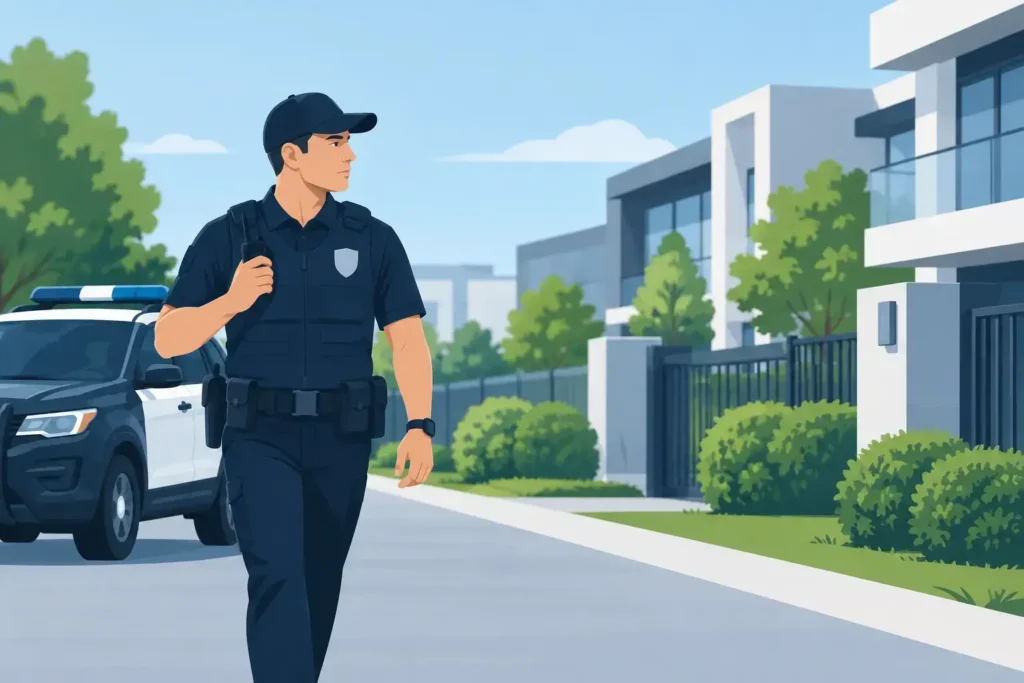
A break-in attempt, unauthorized parking problem, or after-hours trespasser does not wait for a scheduled office visit. Properties with changing activity need security that is visible, mobile, and prepared to act. The top benefits of marked patrols come from that visible operational presence: licensed officers can inspect vulnerable areas, reinforce site rules, identify concerns early, and document what occurred.
For property managers, business owners, construction supervisors, and logistics operators, marked patrols are not simply a vehicle circling a site. When planned around access points, traffic patterns, operating hours, and known risks, they create a controlled security presence without requiring a stationary officer at every location around the clock.
Top Benefits of Marked Patrols for Active Properties
Visible deterrence before an incident develops
A clearly marked security vehicle sends an immediate message that the property is actively monitored. That visibility can discourage opportunistic theft, trespassing, vandalism, illegal dumping, vehicle break-ins, and other unwanted activity. Individuals looking for an easy target are more likely to move on when they see an identifiable patrol unit making regular, unpredictable rounds.
The deterrent value is strongest when patrol activity is consistent. A vehicle that appears only after a complaint has limited preventive value. Regular patrols, documented site checks, and varied patrol timing make it harder for unauthorized individuals to predict when an officer will be present.
This is particularly valuable for large commercial sites, multifamily communities, construction projects, retail centers, industrial yards, and parking facilities. These properties often have several entrances, perimeter areas, loading zones, stairwells, and low-visibility locations that cannot be watched effectively from one fixed post.
Broader coverage at a controlled cost
A dedicated on-site officer provides continuous observation at a specific post. In some environments, that level of coverage is necessary. However, many properties need scheduled checks, rapid response capability, and visible deterrence rather than a full-time officer stationed in one location.
Marked patrols allow clients to direct resources toward the periods and areas with the greatest exposure. A patrol plan may emphasize after-hours perimeter checks, opening and closing times, delivery windows, overnight vehicle inspections, or weekend coverage. Officers can inspect gates, doors, parking areas, common spaces, and exterior conditions during each visit.
This structure can provide practical coverage for a single property or for multiple nearby locations. The right approach depends on the site. A high-traffic location with frequent access-control issues may require a stationary officer in addition to patrol coverage, while a lower-activity property may be well served by regular vehicle patrols and alarm response procedures.
Faster assessment when something changes
Security issues do not always begin as clear emergencies. A gate left open, a broken light, a vehicle parked in a restricted area, or unfamiliar activity near a loading dock can become a larger problem if no one notices it. Patrol officers are positioned to identify these conditions during routine rounds and take action according to established post orders.
When an alarm activation, tenant concern, or property incident occurs, a marked patrol officer can respond, assess the immediate conditions, and report findings to the appropriate contacts. Depending on the situation, that may include securing an access point, contacting emergency services, preserving the area for law enforcement, or notifying property management.
Rapid response does not mean an officer can replace police, fire, or medical personnel. It means the property has a trained security professional available to observe, communicate, and take appropriate initial steps while the responsible parties are notified. That early assessment can reduce uncertainty during a stressful event.
Stronger control of access and site activity
Many security problems are access problems. Contractors arrive outside authorized hours. Delivery vehicles use the wrong entrance. Visitors park in restricted spaces. Unapproved individuals follow authorized tenants through a gate or door. Marked patrol officers help reinforce the operating rules that keep a property orderly.
During patrol rounds, officers can check whether gates are secured, doors are properly closed, restricted areas are clear, and vehicles comply with posted requirements. At properties with heavy traffic, they can also monitor delivery areas, loading activity, visitor movement, and parking conditions.
The officer’s marked presence matters here. It provides an immediate point of contact for people who need direction and makes enforcement more credible when rules must be communicated. Professional patrol coverage should be firm without disrupting legitimate tenants, employees, customers, or vendors.
Accountability Through Patrol Reporting
A patrol program should produce more than a visible vehicle. It should create a record of security activity and site conditions. Accurate reporting gives clients a clear view of what officers observed, what actions were taken, and where recurring concerns may be developing.
Documentation that supports management decisions
Detailed patrol reports can document arrival times, areas inspected, unusual activity, maintenance or safety hazards, access issues, incidents, and notifications made during a shift. This information helps management verify that coverage occurred as assigned and evaluate whether the current plan is addressing actual risks.
Reporting also helps identify patterns that may not be apparent from a single incident. Repeated unauthorized parking, recurring loitering near a particular entrance, damaged fencing, or frequent alarms at the same door may call for changes to lighting, access procedures, patrol frequency, or site design.
For facilities with insurance, regulatory, tenant, or internal compliance obligations, clear records can be especially useful. Documentation does not eliminate liability, but it demonstrates that the property took organized steps to monitor known conditions and respond to reported concerns.
Supervision keeps patrol standards consistent
A marked vehicle alone is not a security plan. Effective coverage depends on trained, licensed guards, clear post orders, management oversight, and defined response procedures. Officers need to know which areas require attention, who to contact after hours, how to handle incidents, and when to escalate a concern.
Responsive supervision is what separates accountable patrol service from irregular drive-through visits. Supervisors can review reports, verify performance, adjust instructions, and address changes in site conditions. This is critical when a property is experiencing elevated theft, tenant complaints, construction activity, staffing changes, or seasonal increases in traffic.
At Broadway Security Services, marked patrol assignments are built around the conditions of the property rather than a generic route. That includes defined patrol procedures, controlled access monitoring, incident reporting, and oversight designed to maintain consistent field performance.
Where Marked Patrols Deliver the Most Value
Marked patrols are a practical fit for sites with large exterior areas, multiple entry points, fluctuating operating hours, or periods of limited occupancy. In Los Angeles and surrounding service areas, they are frequently used at commercial buildings, apartment communities, retail properties, warehouses, construction sites, transportation locations, and special events.
Their value increases when a property has identifiable gaps between peak operating hours and after-hours vulnerability. A retail center may need extra patrols during closing and overnight periods. A construction site may need perimeter checks after workers leave. A warehouse may need observation around late deliveries and trailer access. An apartment community may need attention to parking areas, mail locations, gates, and common areas.
The service is less effective when expectations are unclear. If management expects a patrol officer to provide continuous observation at a busy entrance, manage a large crowd, and respond instantly across a wide area, the plan may need dedicated on-site staffing or additional officers. Security coverage should match the actual exposure, not an assumed one.
Building a Patrol Plan That Works
Before assigning a marked patrol, evaluate the property as it operates in real conditions. Identify the times when the site is most exposed, the access points that require inspection, the areas with poor visibility, and the incidents that have occurred previously. A useful plan also establishes who can authorize access, who receives reports, and how officers should respond to common problems.
Patrol timing should be deliberate but not overly predictable. Officers need clear inspection responsibilities during each visit, including perimeter checks, access control observations, parking enforcement needs, fire or safety hazards, and any location-specific concerns. The plan should be reviewed when the property changes, such as during construction phases, tenant turnover, special events, or changes in operating hours.
The most effective marked patrol program gives a property something more useful than occasional visibility: a disciplined security presence that notices conditions, reinforces rules, and provides reliable information when decisions need to be made.