



True corporate security planning is a discipline of presence, not just a suite of products. In regions like the San Fernando Valley, where property crime continues to challenge commercial stability, a passive approach to safety is a dangerous liability. You likely recognize that standard protocols often fail when faced with the complexity of California Senate Bill 652 and the latest NIST CSF 2.0 governance standards. Effective security requires a transition from reactive measures to a posture of constant, methodical oversight.
We understand the pressure of maintaining safety while adhering to the rigorous legal mandates that went into effect on January 1, 2026. This article provides a comprehensive, risk-first checklist to fortify your assets and ensure your organization maintains a disciplined security posture. You’ll gain a clear roadmap for risk mitigation that prioritizes legal compliance and operational rigor. We will examine how to integrate professional guard services with mobile patrol oversight to create a vigilant and unyielding shield for your enterprise.
Key Takeaways
- Conduct a site-specific vulnerability evaluation to identify and neutralize risks unique to your commercial location.
- Implement a tiered perimeter defense strategy that utilizes visible deterrence to prevent security breaches before they occur.
- Determine the precise operational requirements for deploying armed or unarmed guards within your corporate security planning framework.
- Ensure regulatory compliance and personnel safety during a breach by establishing a clear chain of command and utilizing Fire Watch services.
- Learn the methodology for transitioning from a theoretical security plan to a disciplined and vigilant operational posture.
Foundational Risk Assessment: Identifying Corporate Vulnerabilities
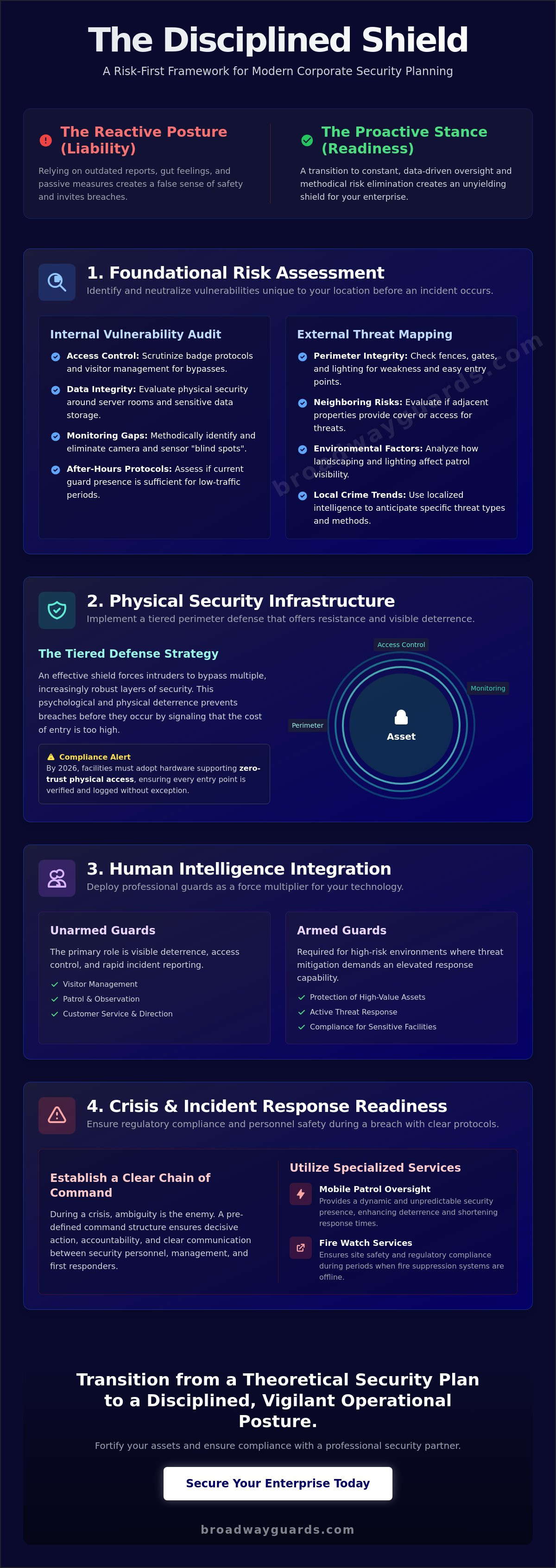
Corporate security planning is not a reaction to loss. It is a proactive methodology designed to eliminate vulnerability before an incident occurs. Successful protection begins with a rigorous assessment of every asset, entry point, and operational protocol. By establishing a “Disciplined Shield” mindset from day one, an organization moves beyond hope and into a state of readiness. This transition requires a departure from perceived threats in favor of data-driven risk profiles. Relying on gut feeling or outdated reports creates a false sense of safety. Instead, security leaders must align their strategies with established Security Management Principles to ensure every decision is grounded in professional standards.
A site-specific vulnerability evaluation is the cornerstone of this process. It’s particularly critical for businesses operating in the San Fernando Valley. Localized intelligence allows you to anticipate threats rather than just reacting to them. This isn’t just about installing hardware. It’s about understanding the rhythm of your facility. You need to know who’s coming, who’s going, and where the oversight is weakest. Effective corporate security planning demands that every potential failure point is documented and addressed with precision. There is no room for ambiguity when assets are at stake.
The Internal Vulnerability Audit
An internal audit focuses on the structural and procedural weaknesses within your perimeter. It’s about identifying where the system fails under pressure. You must scrutinize every layer of your operation to ensure total accountability.
- Access Control: Review employee badge protocols and visitor management systems for potential bypasses.
- Data Integrity: Evaluate physical barriers surrounding sensitive data areas and server rooms.
- Monitoring Gaps: Identify “blind spots” where existing cameras or sensors fail to provide clear visual coverage.
- After-Hours Protocols: Assess if current security guard presence is sufficient to deter intrusion during low-traffic periods.
Many firms overlook the transition between shifts or the accessibility of storage rooms. These aren’t minor details. They’re the cracks through which liability enters. A disciplined protector closes these gaps through methodical observation.
External Threat Mapping in Southern California
San Fernando Valley businesses face specific environmental challenges. Mapping these threats requires a localized lens. In hubs like Canoga Park, rising property crime necessitates a more aggressive stance on perimeter integrity. You must analyze local crime trends to understand the methods used by offenders in your specific area.
- Perimeter Integrity: Check fences, gates, and lighting for signs of wear or easy entry.
- Neighboring Risks: Evaluate if adjacent properties provide cover for unauthorized individuals.
- Environmental Factors: Consider how landscaping or lighting affects the visibility of your mobile patrol services.
A site-specific evaluation ensures your resources are deployed where they matter most. It isn’t enough to have a general plan. You need a map that accounts for every alleyway and adjacent lot. This level of detail builds the foundation of a truly unyielding force.
The Physical Security Infrastructure Checklist
A robust physical infrastructure serves as the primary line of engagement in any corporate security planning initiative. Digital systems offer data, but physical barriers offer resistance. Effective protection requires a tiered perimeter defense strategy that forces an intruder to bypass multiple layers of deterrence. Each layer must be visible, imposing, and meticulously maintained. A disciplined shield relies on the psychological impact of order. When a facility demonstrates high standards of perimeter integrity, it signals to opportunistic threats that the cost of entry is too high. This visible deterrence is the first victory in prevention.
Technology must serve as a force multiplier for physical presence. While AI-powered cameras and sensors provide valuable intelligence, they cannot intervene during a breach. Relying solely on software is a tactical error. True operational excellence integrates these tools with a physical response capability. Following the CISA Physical Security Guidelines ensures your hardware standards meet federal benchmarks for resilience. By 2026, corporate facilities must adopt hardware that supports zero-trust physical access, ensuring that every point of entry is verified and logged without exception.
Access Control and Perimeter Integrity
Perimeter integrity starts with the physical boundaries of your property. Gaps in fencing or poorly secured gates are invitations for liability. You should implement a rigorous visitor management system that requires multi-factor credentialing before access is granted. This protocol eliminates the risk of unauthorized personnel entering sensitive zones. Consider the following checklist for your perimeter:
- High-Visibility Signage: Deploy clear, authoritative warnings that indicate 24/7 monitoring and professional oversight.
- Hardened Fencing: Use anti-climb materials and ensure all footings are reinforced against forced entry.
- Barrier Testing: Conduct monthly audits to test the response time and locking strength of all electronic gates and turnstiles.
If your current infrastructure feels inadequate, upgrading to professional Mobile Patrol Services can provide the necessary oversight to bridge the gap between physical barriers and active response.
Lighting and Surveillance Optimization
Shadows are a security failure. Lighting standards for 2026 demand high-intensity exterior systems that eliminate dark zones across your entire property. Proper illumination supports your surveillance network by ensuring cameras capture high-resolution, actionable footage. Strategic camera placement should focus on choke points and high-value assets rather than broad, unfocused views. Maintenance is non-negotiable. Establish a weekly schedule to verify that every lens is clean and every bulb is operational. Reliability is the hallmark of a professional security posture. Equipment that fails when it’s needed is a liability you cannot afford.
Human Intelligence: Integrating Professional Security Guard Protocols
Technology provides the data, but human intelligence provides the response. In a high-stakes environment, the physical presence of a trained professional remains the ultimate deterrent against criminal intent. While cameras record events, a disciplined guard interrupts them. Effective corporate security planning must prioritize the deployment of personnel who function as a vigilant and unyielding force. This human element bridges the gap between detecting a threat and neutralizing it. In the San Fernando Valley, where property crime requires a visible countermeasure, the presence of a uniformed officer signals that your assets are under methodical oversight.
Accountability starts with rigorous compliance. As of January 1, 2026, California Senate Bill 652 mandates updated training requirements for all security personnel. The “Power to Arrest and Appropriate Use of Force” training must be completed through a single, certified provider to ensure legal and operational consistency. Adhering to these standards isn’t just a regulatory hurdle; it’s a critical component of risk mitigation. Utilizing the CISA Security Planning Workbook can help your organization align these human resources with broader federal safety benchmarks. Professionalism in the field is a direct reflection of the discipline established during the planning phase.
Armed vs. Unarmed Guard Strategic Deployment
The decision to deploy Armed Security Guards or Unarmed Security Guards depends on the specific risk profile of your facility. High-value asset environments or locations with elevated threat levels require the decisive presence of armed personnel. Conversely, unarmed guards are often the superior choice for professional reception, retail environments, and visible deterrence where public interaction is frequent. Every deployment must be governed by site-specific Post Orders. These documents act as the operational constitution for the guard, dictating precise behavior and response protocols for every conceivable scenario.
Patrol Schedules and Reporting Rigor
Predictability is a tactical weakness. A disciplined protector avoids patterns that an intruder could exploit. Designing unpredictable patrol routes ensures that surveillance remains constant but never repetitive. This methodical oversight is supported by real-time digital reporting, which provides transparent accountability for every minute of a shift. A clear hierarchy of command ensures that information flows rapidly from the field to management. This structure allows for immediate adjustments to the security posture as new threats emerge. If your current strategy lacks this level of precision, integrating Mobile Patrol Services can provide the necessary movement and oversight to secure large-scale corporate perimeters.
Crisis Management and Incident Response Readiness
When a crisis strikes, the time for theoretical planning ends and the era of operational execution begins. A disciplined protector recognizes that digital automation often fails during physical emergencies. True corporate security planning must establish a clear, hierarchical chain of command that remains functional when power or networks fail. Every member of the organization needs to know exactly who makes the final call during a security or safety breach. This structure prevents the chaos that leads to injury and liability. Order is the only effective response to a high-stakes incident.
Establishing a “Ready-State” culture requires more than just a written document. It demands regular drills and rigorous audits to ensure every protocol is ingrained in the staff’s muscle memory. From a legal and insurance perspective, a documented response plan is a non-negotiable requirement for risk mitigation. If an incident occurs and you cannot prove a disciplined approach to prevention and response, the resulting liability can be catastrophic. Security is a commitment to duty that must be verified through constant practice. For organizations that host large gatherings or public-facing events, applying proven crowd management techniques is an equally essential component of a comprehensive crisis readiness framework.
Fire Watch and Life Safety Compliance
In California, life safety compliance is a critical operational priority. You must be prepared to deploy professional Fire Watch Services the moment a fire alarm or sprinkler system becomes inoperable. The Los Angeles Fire Department (LAFD) maintains strict regulations regarding these scenarios. A Fire Watch guard serves as a vigilant human sensor, responsible for the following duties:
- Continuous Monitoring: Conducting methodical patrols of all affected areas to detect smoke or flame.
- Detailed Logging: Maintaining a precise, chronological fire log that is available for LAFD inspection at any time.
- Immediate Notification: Serving as the primary link to emergency services to ensure rapid response.
If your facility faces a system failure, you can secure your premises and maintain legal compliance by engaging our Fire Watch Services immediately.
Emergency Communication and Evacuation
Clear communication is the backbone of any successful incident response. You should establish redundant communication channels that don’t rely solely on standard cellular or internet networks. This ensures that instructions reach every staff member during an evacuation. Your corporate security planning checklist must include the following elements for life safety:
- Verified Evacuation Routes: Clearly marked paths that are kept free of obstructions at all times.
- Designated Assembly Points: Secure locations away from the perimeter where personnel can be accounted for.
- Post-Incident Documentation: A standardized process for recording every action taken during the crisis to provide liability protection.
A methodical approach to evacuation saves lives and protects the organization’s reputation. Documenting these actions provides the evidence needed to prove that your response was professional, prepared, and compliant with all regulatory standards.
Executing the Plan: The Broadway Security Standard
The transition from a theoretical framework to an operational reality is where most safety strategies fail. A document on a shelf offers no protection against a breach. True corporate security planning requires a partner capable of executing complex protocols with military-like precision. Broadway Security Services acts as a disciplined shield for California firms, ensuring that every vulnerability identified in the risk assessment phase is neutralized through active oversight. We don’t just provide personnel; we provide a structured environment where rules and protocols are absolute. This level of execution ensures that your organization moves from a state of vulnerability to a posture of unyielding strength. Relying on a professional standard means your safety is never left to chance.
Long-term reliability is the result of consistent training and uncompromising standards. Professional consultation allows for the refinement of security contracts to match the evolving threat landscape of 2026. This methodical approach ensures that your assets remain under the care of a vigilant force that values duty above all else. When you partner with a professional firm, you’re not just hiring guards. You’re establishing a hierarchy of protection that integrates legal compliance with field performance. We focus on the intersection of legal mandates and operational rigor to ensure your business remains both safe and compliant. Every action we take is grounded in the necessity of protecting your property and personnel.
Customized Security Management for Corporate Assets
Facilities in Canoga Park require more than generic coverage. Tailoring guard services to the specific geographic and structural needs of a site is essential for effective asset protection. Contractual security management offers a level of continuity that ad-hoc staffing cannot match. By establishing a permanent security presence, we ensure that personnel become experts in your facility’s specific Post Orders. Broadway manages complex scheduling and personnel logistics to maintain a constant state of readiness. Whether you require Retail Security, Hospital Security, or Construction Site Security, our management team ensures that every shift is filled by a qualified, disciplined professional. This consistency builds a foundation of trust that is vital for long-term operational excellence.
The Broadway Commitment to Professionalism
Our selection process for Armed Security Guards and Unarmed Security Guards is defined by its rigor. We prioritize candidates who demonstrate a high degree of self-assurance and a commitment to hierarchy. This focus on discipline sets the standard for Southern California security operations. Every officer is a representative of our unwavering commitment to duty, trained to act as an observant and prepared protector. We rely on professional reporting and field performance data to demonstrate our expertise and maintain your peace of mind. Our presence is a promise of order in an unpredictable environment. We take our responsibilities with the utmost gravity to ensure your assets are under the care of a vigilant and unyielding force.
Request a Professional Risk Assessment from Broadway Security
Establishing Your Disciplined Posture for 2026
Effective protection is never an accident. It’s the result of a methodical transition from theoretical risk assessment to active, human-led deterrence. We’ve established that a tiered perimeter and rigorous incident response protocols form the backbone of a resilient organization. True corporate security planning demands that every asset is shielded by personnel who value rules and protocols above all else. Broadway Security Services provides this level of high-stakes reliability through military-grade operational oversight and highly trained, BSIS-certified guards. We serve Canoga Park and the broader Southern California region with unyielding discipline. Your assets deserve the care of a vigilant force that prioritizes safety and professional accountability. Moving forward, your security posture should reflect a commitment to order and methodical oversight. Take the final step in fortifying your perimeter and ensuring your organization remains a hardened target. Peace of mind is the direct outcome of total preparation and professional execution.
Secure Your Corporate Future with Broadway Security Services
Establish your shield today and lead your organization with the confidence that only a disciplined protector can provide.
Frequently Asked Questions
What are the three main pillars of a corporate security plan?
The three pillars consist of physical infrastructure, human intelligence, and procedural readiness. Physical infrastructure establishes the initial perimeter defense. Human intelligence, delivered through professional guard services, provides the active deterrence necessary to stop a breach. Procedural readiness ensures that your staff and security teams know exactly how to respond to an incident without hesitation. These layers work together to create a disciplined shield for your organization.
Does my California business legally require armed or unarmed guards?
The choice between armed and unarmed personnel depends on your specific risk profile and the nature of the assets you protect. High-value environments or locations in areas with elevated crime rates often require the decisive presence of armed guards. Unarmed guards are typically utilized for professional reception, retail deterrence, and low-risk environments. You should evaluate your site-specific vulnerabilities to determine which level of force is appropriate for your posture.
How often should a corporate security risk assessment be updated?
You should update your corporate security planning assessment at least once per year to account for evolving threats. It’s also mandatory to conduct a new evaluation following any significant site renovations, changes in local crime trends, or after a security breach. Regular updates ensure that your protocols remain effective and compliant with the latest California regulations. This methodical approach prevents your defensive strategy from becoming obsolete or predictable.
What is the role of a security guard in a crisis management plan?
A security guard acts as the primary responder and the central link in your communication chain during a crisis. Their duties include identifying the threat, notifying the proper authorities, and leading the evacuation according to established post orders. They maintain the hierarchy of command to prevent chaos and ensure that all personnel reach safety. Their presence provides the order and discipline required to manage high-stakes emergencies effectively.
Are Fire Watch services mandatory for construction or renovation projects in LA?
Fire Watch services are legally mandated in Los Angeles whenever a building’s fire sprinkler or alarm system is non-functional. They’re also required during “hot work” phases of construction that involve welding or open flames. LAFD regulations demand a dedicated professional to monitor the site, maintain a precise fire log, and notify emergency services if a fire occurs. This service is essential for maintaining life safety compliance and avoiding costly project shutdowns.
How does professional security staffing reduce corporate liability?
Professional staffing reduces liability by ensuring that all guards meet California BSIS training and licensing standards. By following strict operational protocols and maintaining detailed records, a professional team provides evidence of due diligence. This disciplined approach proves that your organization has taken every necessary step to protect personnel and property. If an incident occurs, having a documented history of methodical oversight is your strongest legal defense.
What should be included in a security guard’s daily activity report (DAR)?
A Daily Activity Report must contain a chronological log of all patrols, shift changes, and any observed irregularities. It should document maintenance issues such as broken lighting or compromised fencing that could affect your corporate security planning. Detailed reporting ensures total accountability for every minute a guard is on duty. These reports provide the data necessary to refine your security posture and demonstrate a consistent standard of professional oversight.