


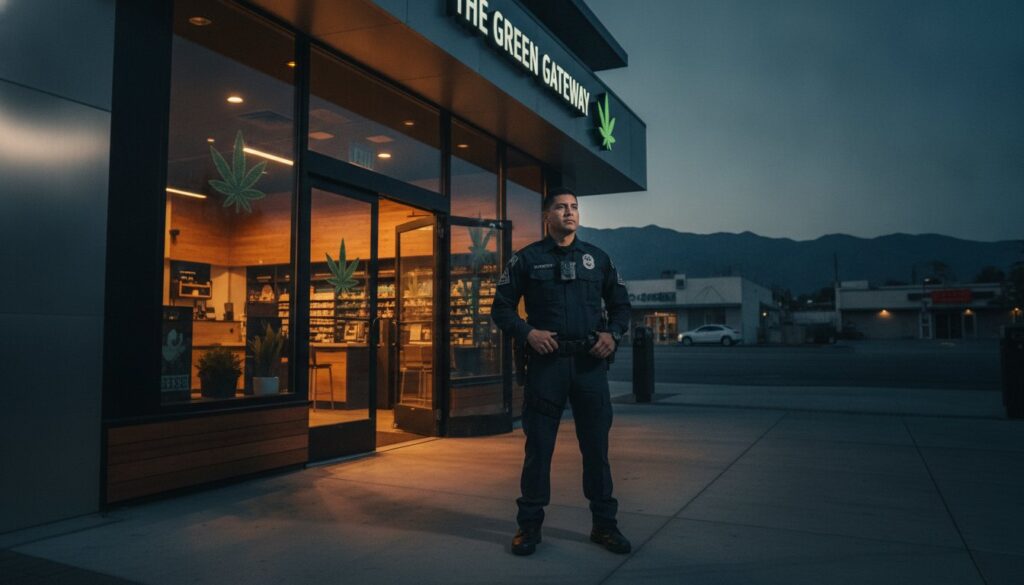
The most dangerous assumption a Los Angeles dispensary owner can make is that visible security alone is enough to deter a determined threat. It isn’t. Armed robbery targeting cannabis retail operations remains a persistent and serious risk across the LA market, and the consequences of an underprepared response extend far beyond the immediate incident: compromised staff safety, regulatory scrutiny, and a brand reputation that takes years to rebuild.
You already know the stakes. Running a dispensary in Los Angeles means operating at the intersection of high-value inventory, strict Department of Cannabis Control oversight, and a threat environment that demands more than a uniform at the door. The question most operators are really asking isn’t whether they need armed security for dispensaries in Los Angeles. It’s how to deploy it with the precision and professionalism that protects assets without alienating the clientele who walk through the door every day.
This guide answers that question directly. Drawing on the tactical standards and risk assessment frameworks used by Southern California’s most disciplined security operations, it covers DCC compliance requirements, guard deployment strategy, and how to build a protection posture that reassures staff, satisfies regulators, and keeps your operation running without incident.
Key Takeaways
- The 2026 threat landscape for Los Angeles cannabis retailers is defined by organized, targeted criminal activity—understanding current crime trends is the first step toward building a protection posture that holds.
- Deploying armed security for dispensaries in Los Angeles requires strict alignment with DCC regulations and BSIS licensing standards; non-compliance exposes your operation to penalties that can be as damaging as the threats you’re guarding against.
- The decision between armed and unarmed guards is not a matter of budget—it is a calculated risk assessment based on your location, inventory value, and the criminal’s risk-reward calculation when facing a visible, credentialed armed presence.
- A disciplined crisis strategy begins before any incident occurs: site-specific vulnerability mapping and internal diversion protocols are the structural foundation that separates prepared operations from reactive ones.
- Localized expertise and rigorous personnel standards are not interchangeable with general security services—learn what separates a disciplined, cannabis-specialized security partner from a commodity guard provider.
The Security Landscape for Los Angeles Dispensaries in 2026
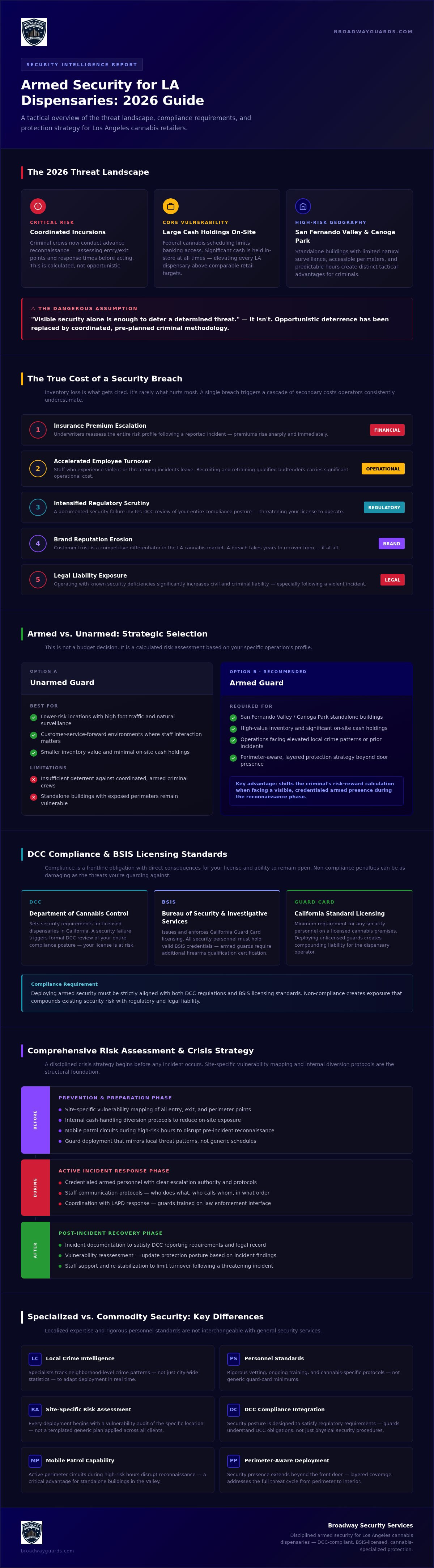
Cannabis retail in Los Angeles doesn’t operate in a vacuum. It operates inside a threat environment that has evolved considerably since the state’s legal framework took shape, and operators who treat security as a static checklist are consistently the ones caught unprepared. The California cannabis regulatory framework created a licensed, taxed industry, but it also concentrated high-value inventory and large volumes of cash inside retail storefronts, making dispensaries structurally attractive targets for organized criminal activity.
What’s changed in recent years isn’t the motivation. It’s the methodology. Opportunistic theft, the kind deterred by a visible camera or a single guard at the door, has given way to coordinated incursions. Crews conduct advance reconnaissance. Entry and exit points are assessed before a single move is made. Response times are factored in. This is not random criminal behavior. It’s calculated, and it demands a calculated response.
Cash is the core vulnerability. Because cannabis remains federally classified, most dispensaries operate with limited banking access, meaning significant cash holdings on-site at any given time. That single structural reality elevates the risk profile of every dispensary in the Los Angeles market above virtually any comparable retail operation. Criminals understand this. Your security posture needs to account for it directly.
High-Risk Zones: San Fernando Valley and Canoga Park
The San Fernando Valley presents specific challenges for cannabis retailers. Standalone dispensary buildings, common throughout the Valley corridor, offer criminals distinct tactical advantages: limited natural surveillance from neighboring businesses, accessible perimeters, and predictable operating hours. Perimeter security isn’t a secondary consideration in this geography; it’s foundational. Mobile patrol services that actively circuit a building’s exterior during high-risk hours disrupt the reconnaissance phase that precedes most planned incursions. For operators in the Canoga Park area specifically, local threat patterns reinforce the case for deploying armed security for dispensaries in Los Angeles as a layered, perimeter-aware strategy rather than a static, door-only presence.
The Cost of Inadequate Protection
Inventory loss is the number that gets cited. It’s rarely the number that hurts most. A security breach triggers a cascade of secondary costs that operators consistently underestimate:
- Insurance premiums escalate sharply following a reported incident, with underwriters reassessing the entire risk profile of the operation
- Employee turnover accelerates after staff experience a violent or threatening incident; recruiting and retraining qualified budtenders and floor staff carries real operational cost
- Regulatory scrutiny intensifies; a documented security failure invites DCC review of your entire compliance posture
- Brand reputation erodes in a market where customer trust is a competitive differentiator
- Legal liability exposure increases significantly if an owner is found to have operated with known security deficiencies
Tactical security, in this context, means something precise: a protection posture built on site-specific risk assessment, credentialed personnel, and structured protocols that address the full threat cycle before, during, and after a potential incident. It’s the standard that separates disciplined armed security for dispensaries in Los Angeles from a commodity guard service that checks a compliance box and nothing more.
DCC Compliance and California Guard Card Standards
Compliance isn’t a background concern for Los Angeles dispensary operators. It’s a frontline obligation with direct consequences for your license, your operation, and your ability to remain open. The Department of Cannabis Control sets the regulatory floor for security, and the Bureau of Security and Investigative Services sets the personnel standards that determine who is legally authorized to stand on your floor. Understanding both frameworks isn’t optional; it’s the structural prerequisite for any defensible security posture.
DCC Operating Hours and Presence Requirements
California Code of Regulations Title 4, Sections 15044 through 15048, establishes the security baseline for licensed cannabis retail storefronts. These provisions require that licensed premises maintain continuous video surveillance with sufficient resolution to identify individuals at all entry and exit points, integrated alarm systems, and controlled access to restricted areas. Critically, the DCC mandates that a licensed security guard be present during all operating hours. That requirement isn’t satisfied by a camera system alone or by a manager standing near the door. It requires a credentialed, BSIS-licensed guard whose presence is documented and verifiable.
BSIS licensing is the legal threshold. Any individual providing security services in California, armed or unarmed, must hold a valid Guard Card issued by the Bureau of Security and Investigative Services. For armed security for dispensaries in Los Angeles, the requirements go further: personnel must obtain a separate Firearms Permit through BSIS, which requires a minimum of fourteen hours of firearms training, a live-fire qualification, and a background investigation. That permit must be renewed annually, with ongoing qualification standards that confirm the guard remains proficient and legally authorized to carry. Operators who engage security personnel without verifying these credentials expose themselves to regulatory penalties that have nothing to do with any criminal incident.
The distinction between armed and unarmed certification matters operationally, not just administratively. An unarmed guard cannot legally carry a firearm on your premises, regardless of the threat environment. Confirming the specific credentials of every guard assigned to your location is not a courtesy; it’s a compliance requirement.
Written Security Plans and METRC Awareness
The DCC requires licensees to maintain a written security plan that documents protocols for access control, response procedures, and surveillance system maintenance. During a state inspection, this document is reviewed as evidence that your operation has thought through its protection posture systematically, not reactively. A plan that exists only on paper and hasn’t been operationalized will not satisfy a disciplined inspector.
Where many operators create an unnecessary gap is at the intersection of physical security and seed-to-sale tracking. METRC, California’s cannabis track-and-trace system, creates a digital record of every product movement within your facility. Physical security guards who understand the importance of logging all entries and exits to restricted areas provide a human layer that supports the integrity of that digital record. Discrepancies between METRC data and physical access logs are a red flag during compliance audits. Guards trained to maintain accurate entry and exit documentation close that gap before it becomes a liability.
Operators who want to build a security program that holds up under both criminal pressure and regulatory scrutiny should start with a site-specific risk assessment. Consulting a cannabis-specialized security firm before finalizing your written security plan ensures the document reflects real operational conditions, not a generic template that satisfies no one.
Armed vs. Unarmed Guards: Strategic Selection for High-Value Assets
The choice between armed and unarmed security isn’t a budget line item. It’s a tactical decision rooted in a single question: what does a determined criminal see when they assess your location? The answer to that question determines whether your security posture functions as a genuine deterrent or as a threshold that gets crossed anyway.
Armed presence changes the criminal’s risk-reward calculation in a way that unarmed presence simply cannot replicate. A coordinated crew conducting advance reconnaissance on a dispensary doesn’t just count cameras. They assess the consequences of moving forward. A credentialed, armed guard signals that those consequences are severe and immediate. That signal alone disrupts the planning phase that precedes most organized incursions. It doesn’t guarantee immunity, but it fundamentally alters the math that drives criminal decision-making.
The concern most operators raise at this point is legitimate: how do you deploy that level of protection without creating an atmosphere that feels adversarial to the customers who drive your revenue? The answer is professional presence. Armed guards who are trained in customer interaction, de-escalation, and retail-environment protocols project authority without projecting aggression. The uniform communicates seriousness. The conduct communicates professionalism. That combination is achievable, and it’s the standard that separates disciplined armed security for dispensaries in Los Angeles from a blunt-force approach that costs you customers.
When Armed Security is Non-Negotiable
Three operational realities remove ambiguity from this decision. First, high-volume cash handling and vault access. Any location where significant cash accumulates on a predictable schedule requires armed oversight at those moments specifically. Second, inventory transport and delivery windows. The movement of product between your facility and a vehicle is a structurally vulnerable interval; it requires a credentialed armed presence, not a passive one. Third, documented history. If a location has experienced a robbery or credible threat, the risk profile is no longer theoretical. It’s established. Responding to that history with unarmed personnel isn’t a cost-saving measure; it’s an unacceptable exposure.
The Role of Unarmed Guards in Low-Risk Scenarios
Unarmed personnel serve a defined and valuable function in the right context. Concierge-level access control, ID verification, and customer flow management don’t require a firearms permit. They require professionalism and situational awareness. In lower-risk environments, or in areas of your facility that are structurally separated from cash and inventory, unarmed guards provide a cost-efficient layer that keeps your overall security architecture calibrated to actual threat levels rather than uniformly over-resourced.
The most operationally sound approach for high-volume dispensaries is a layered model: armed personnel at vault access points, cash-handling areas, and exterior perimeter positions, with unarmed staff managing the customer-facing floor. This structure controls cost without compromising protection where it counts. For a detailed breakdown of how unarmed personnel fit into a comprehensive protection strategy, The Strategic Guide to Unarmed Security Guards covers the operational framework directly.
The starting point for any deployment decision is a site-specific risk assessment. Location, operating hours, cash volume, prior incident history, and proximity to high-risk corridors all factor into a defensible recommendation. Generic staffing models don’t account for these variables. A disciplined security partner builds the deployment around your actual threat environment, not a standard template.
Developing a Comprehensive Risk Assessment and Crisis Strategy
A written security plan that satisfies a DCC inspector is not the same thing as a security plan that actually protects your operation. The gap between those two documents is where most dispensaries are exposed. Closing that gap requires a structured methodology: one that moves systematically from physical vulnerabilities to operational weaknesses, and from prevention protocols to active crisis response.
The Methodology of Professional Risk Assessment
Physical security and operational security are not the same discipline, and treating them as interchangeable is a structural error. Physical assessment maps the built environment: entry and exit points, blind spots in camera coverage, perimeter exposure, vault proximity to customer-facing areas, and the sightlines available to a guard stationed at any given position. Operational assessment goes deeper. It examines staff scheduling patterns, cash-handling procedures, access control logs, and the human behaviors that create predictable windows of vulnerability.
A disciplined assessment addresses both layers simultaneously. Identifying that a rear delivery entrance sits in a camera blind spot is a physical finding. Identifying that the same entrance is staffed by a single unarmed employee during a predictable shift overlap is an operational finding. Neither is complete without the other. How to Conduct a Professional Security Risk Assessment in California outlines the full framework for integrating these two dimensions into a single, actionable protection posture.
Periodic reassessment isn’t optional in the cannabis market. Criminal methodology evolves, staffing changes, and inventory volumes shift seasonally. A risk assessment conducted at license approval reflects conditions that may no longer exist. Scheduling structured reassessments at defined intervals ensures your protection posture remains calibrated to your current threat environment, not a historical one.
Internal diversion is a specific risk category that operators consistently underweight. Employee theft in cannabis retail is a documented pattern, and it often exploits gaps between physical access controls and METRC tracking data. Diversion protocols should include access tiering that limits vault and back-office entry to credentialed personnel, dual-verification requirements for high-value inventory movements, and clear documentation standards that create an auditable record. These aren’t punitive measures; they’re structural controls that protect honest employees as much as they deter dishonest ones.
Crisis Management and Emergency Response
A crisis protocol that exists only as a document fails at the moment it’s needed most. Effective crisis management for armed security for dispensaries in Los Angeles requires pre-established communication channels with local LAPD divisions, not a general emergency number pulled from memory under duress. Guards and staff should have direct contact protocols that specify who initiates law enforcement contact, what information is communicated first, and who manages internal communication during an active incident.
Lockdown and evacuation procedures must be site-specific. A lockdown that works in a standalone Valley building doesn’t translate directly to a shared commercial space with common corridors. Staff training on these protocols should be conducted in the actual physical environment, not in a conference room. The difference between a rehearsed response and an improvised one is measurable in outcomes.
Armed guards function as the first line of active defense during a crisis, but their role is defined by protocol, not instinct. Trained armed personnel assess, contain, and communicate. They do not act unilaterally. The value of a credentialed armed presence in an active threat scenario is the structured authority it projects and the response time it buys for law enforcement to arrive. That value is only realized when the guard’s crisis role is clearly defined before an incident occurs.
Operators who want a protection posture built on methodology rather than assumption should start with a site-specific consultation. Contact Broadway Security Services to schedule a risk assessment that integrates physical, operational, and crisis response planning into a single, defensible framework.
Why Broadway Security is the Disciplined Shield for LA Cannabis Firms
Broadway Security Services operates on a single principle: precision is the only acceptable standard for high-stakes protection. In a market where generalist firms treat security as a commodity, we position ourselves as a disciplined shield for the cannabis industry. Our approach to armed security for dispensaries in Los Angeles is built on military-like rigor and a deep understanding of the unique threat landscape facing Southern California operators. We don’t just fill posts; we deploy trained personnel who understand that their presence is the primary deterrent against coordinated criminal activity.
Our localized expertise is a core operational advantage. Based in Canoga Park, we possess an intimate understanding of the San Fernando Valley’s specific security challenges. This regional focus allows us to provide more than just a visible presence. We provide a strategic partnership rooted in risk assessment and crisis management. Every security contract we execute is customized to the specific vulnerabilities of the site, from standalone retail storefronts to high-volume cash-handling facilities. We build the protection around your actual risks, ensuring no resource is wasted and no gap is left unaddressed.
Professionalism and Accountability in the Field
We reject the aggressive, uncoordinated posture often seen in retail security. Broadway personnel maintain a stoic, authoritative presence that reassures high-value clientele while signaling unyielding vigilance to potential threats. This professional image is backed by structured oversight. Every deployment includes field performance reporting that ensures protocols are followed with methodical consistency. Our guards are held to a standard of accountability that mirrors the high stakes of the assets they protect. For a deeper look at our operational framework, see our guide on Armed Security Guard Services Los Angeles: Strategic Safety.
Securing the Future of the Cannabis Industry
We don’t just provide personnel; we provide the operational stability required for your business to flourish. Our commitment to regulatory excellence means your dispensary remains in total alignment with DCC requirements, protecting your license as effectively as we protect your inventory. We believe that a secure environment is the foundation of a successful retail operation. When your staff feels safe and your clientele feels reassured, your business has the space to grow without the constant shadow of potential incursions.
Choosing armed security for dispensaries in Los Angeles is a decision that defines your operational resilience. Don’t leave your assets to chance or commodity guard services. Your business deserves the care of a vigilant and unyielding force that takes its duty with the utmost gravity. Contact Broadway Security Services today to schedule a professional consultation and a comprehensive risk assessment for your facility.
Build Your Protection Posture Before the Threat Does
The threat environment facing Los Angeles dispensaries in 2026 is organized, calculated, and unforgiving of preparation gaps. Three realities define every defensible security posture: strict DCC and BSIS compliance is non-negotiable, the decision between armed and unarmed personnel must be driven by actual risk assessment rather than budget assumptions, and crisis protocols only work when they’re built before an incident occurs.
Operators who treat armed security for dispensaries Los Angeles as a compliance checkbox will remain exposed. Those who build a layered, site-specific protection strategy will operate with the stability their staff, clientele, and license depend on.
Broadway Security Services brings BSIS-licensed and DCC-compliant personnel, specialized Southern California cannabis expertise, and a structured approach to risk assessment and crisis management to every engagement. Your operation deserves a partner who takes that responsibility with the same gravity you do.
Secure your dispensary with Broadway’s disciplined armed protection and put a credentialed, methodical security framework between your assets and every threat that targets them.
Frequently Asked Questions About Armed Security for Dispensaries in Los Angeles
Does California law require armed security for dispensaries?
California law doesn’t mandate armed guards specifically, but the Department of Cannabis Control requires a licensed security guard to be present during all operating hours. Whether that guard is armed is a risk-based decision left to the operator. That said, the DCC’s written security plan requirement means your deployment choice must be documented and defensible, not arbitrary.
Operators in high-risk corridors or those handling significant cash volumes regularly find that unarmed personnel don’t satisfy their actual threat exposure, even when they technically satisfy the regulatory minimum. Compliance and protection are not always the same standard.
What are the BSIS requirements for armed security guards in Los Angeles?
Every security guard operating in California must hold a valid Guard Card issued by the Bureau of Security and Investigative Services. Armed personnel carry an additional requirement: a BSIS Firearms Permit, which mandates a minimum of fourteen hours of firearms training, a live-fire qualification, and a background investigation. That permit requires annual renewal with continued qualification standards.
Operators should verify both credentials for every guard assigned to their location. An individual holding a Guard Card but not a current Firearms Permit cannot legally carry on your premises, regardless of what a staffing firm may represent.
How much does armed security for a dispensary cost in 2026?
We don’t publish pricing here because security costs vary considerably based on deployment structure, hours of coverage, number of personnel, and site-specific risk factors. Quoting a range without knowing your operation’s actual requirements would be misleading. What’s consistent across the industry is that the cost of inadequate security, measured in inventory loss, insurance increases, regulatory penalties, and staff turnover, routinely exceeds the cost of a properly structured security contract.
The right starting point is a site-specific risk assessment that defines your actual coverage requirements. Contact Broadway Security Services directly to discuss a deployment structure calibrated to your facility and budget.
Can armed security guards assist with DCC compliance and inspections?
Armed guards contribute directly to compliance when they’re trained to do so. Guards who understand METRC’s role in seed-to-sale tracking and who maintain accurate entry and exit documentation for restricted areas provide a human layer that supports the integrity of your digital records. Discrepancies between access logs and METRC data are a documented audit trigger, and disciplined guards close that gap.
During a DCC inspection, a credentialed guard whose presence is documented and whose credentials are current is itself a compliance asset. It demonstrates that your written security plan has been operationalized, not just filed.
What is the difference between armed and unarmed guards for cannabis retail?
The practical difference is deterrence weight. Armed security for dispensaries in Los Angeles changes the criminal’s risk-reward calculation in a way unarmed presence can’t replicate. A coordinated crew assessing a location factors in the consequences of proceeding. An armed, credentialed guard signals those consequences are immediate and severe. Unarmed personnel serve a defined function in customer-facing, lower-risk areas, but they don’t carry that same deterrent signal.
The most operationally sound model for high-volume dispensaries layers both: armed personnel at vault access points and cash-handling areas, with unarmed staff managing customer flow and ID verification. This structure matches protection intensity to actual risk level at each position.
How do I ensure armed guards don’t intimidate my customers?
Professional presence is the answer, and it’s a trainable standard. Guards who are selected and trained for retail cannabis environments understand that their conduct communicates as much as their uniform. A stoic, authoritative posture that signals vigilance to a potential threat reads as reassurance to a legitimate customer. The two aren’t in conflict when personnel standards are high enough.
Operators should ask any security firm directly about retail-specific training protocols and customer interaction standards before signing a contract. Guards who’ve only worked warehouse or construction environments don’t automatically translate to a dispensary floor without that specialized preparation.
Are armed guards trained in de-escalation for retail environments?
They should be, and confirming this is a non-negotiable part of vetting any security partner. De-escalation training for retail environments covers verbal communication techniques, threat recognition before a situation becomes physical, and protocols for managing agitated individuals without force. In a cannabis dispensary, where customer interactions are frequent and varied, these skills are as operationally important as firearms proficiency.
A disciplined security firm doesn’t treat de-escalation as a supplemental skill. It’s a core competency that protects staff, customers, and the operator’s liability exposure simultaneously. Ask for specifics on training curriculum, not just a general confirmation that it exists.
What should be included in a dispensary’s written security plan?
The DCC requires a written security plan that covers access control protocols, surveillance system maintenance procedures, and response procedures for security incidents. A plan that satisfies regulatory review and actually protects your operation goes further: it documents guard deployment positions, cash-handling protocols, lockdown and evacuation procedures specific to your physical layout, and internal diversion controls tied to your METRC access structure.
Generic templates don’t account for site-specific vulnerabilities. A plan built from an actual physical and operational assessment of your facility is the only version that holds up under both a disciplined DCC inspector and a real incident. Broadway Security Services structures its risk assessments to produce documentation that meets both standards.