


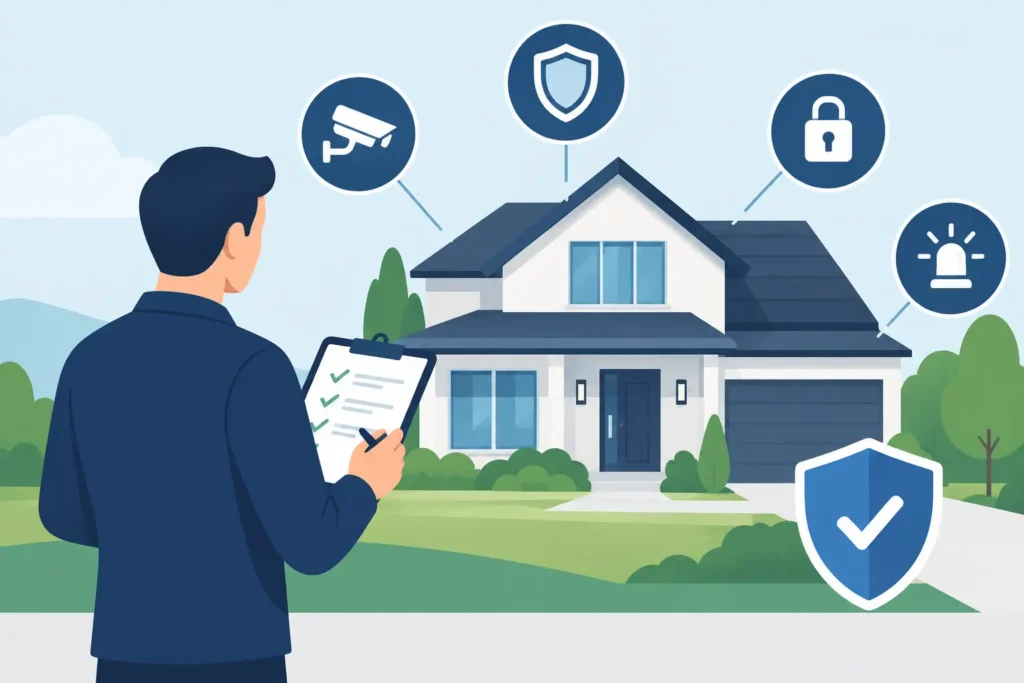
A property can appear secure during a daytime walkthrough and still be exposed after closing, during shift changes, or when a gate is left open for a delivery. Knowing how to assess property security means examining what actually happens on site, not simply counting cameras, locks, or guards. The objective is to identify where people, vehicles, assets, and operations can be put at risk – then establish controlled, accountable coverage.
For property managers and operational leaders, the assessment should lead to clear decisions. Which areas require monitored access? When is a visible officer needed? What incidents must be documented and escalated? A useful review connects physical conditions with the way the property operates each day.
Start With the Property’s Real Risk Profile
Security requirements should follow exposure, not assumptions. A medical office with frequent public traffic has different vulnerabilities than a construction site holding equipment overnight. A distribution facility may be most exposed at loading docks and during trailer movements, while a multifamily property may need stronger visitor control, parking enforcement, and response to resident concerns.
Begin by documenting the property’s purpose, operating hours, occupancy levels, valuable assets, and history of incidents. Review theft, vandalism, trespassing, workplace disputes, unauthorized parking, fire watch needs, and access-control failures. Near misses matter as much as confirmed losses. A rear door that is routinely propped open, for example, is a security failure even if no theft has yet occurred.
Also identify changes that alter the risk level. Construction phases, tenant turnover, special events, holiday closures, layoffs, high-value deliveries, and extended after-hours work can create temporary vulnerabilities that standard coverage does not address. Security planning should be able to adjust when operations change.
How to Assess Property Security at Every Entry Point
Walk the entire perimeter at the times the property is most vulnerable, including after dark when possible. Start at the public edge of the site and follow the same routes a visitor, employee, contractor, delivery driver, or trespasser would use. Pay close attention to pedestrian gates, vehicle entrances, rear doors, roof access, loading docks, stairwells, and connections to adjacent properties.
Ask a direct question at each point: can an unauthorized person enter, remain, or leave without being noticed? A locked door is not enough if the lock is damaged, the door does not latch, or no one notices when someone follows an authorized person inside. Controlled access requires physical barriers, clear procedures, and consistent enforcement.
Vehicle access deserves the same scrutiny. Review gate hours, visitor instructions, delivery staging, parking layouts, and the ability to identify vehicles entering restricted areas. At properties with frequent traffic, an officer or vehicle patrol may be more effective than relying on signs alone. The right approach depends on traffic volume and the consequences of an unauthorized vehicle reaching the site.
Check Visibility, Lighting, and Line of Sight
Poor visibility creates opportunity. During the walkthrough, look for blind corners, overgrown landscaping, unlit walkways, obscured camera views, storage areas behind buildings, and spaces where a person can wait without being seen. Lighting should support safe movement and observation, especially around entrances, parking areas, trash enclosures, and perimeter fencing.
Cameras can support investigations and real-time awareness, but they do not replace an active security presence. Confirm that cameras have useful angles, clear images, reliable recording, and a defined process for reviewing footage after an incident. If no one is responsible for acting on an alert, the system is only recording a problem.
Review How People Move Through the Site
Many security gaps are operational rather than physical. Employees may use convenience entrances, contractors may not sign in, and vendors may be allowed beyond the area necessary for their work. Assess how credentials are issued, how visitors are screened, and whether personnel know who has authority to approve access.
Observe the busiest periods as well as quiet ones. A lobby may be controlled during business hours but unstaffed before opening and after closing. A loading dock may have a written check-in process that breaks down when several deliveries arrive at once. Security procedures must work under normal pressure, not only when conditions are calm.
Define restricted areas clearly and establish a challenge process for unfamiliar persons. This does not require confrontational behavior. It requires trained personnel who can communicate professionally, verify authorization, direct visitors, and escalate concerns when a person refuses to comply. Clear post orders give officers the authority and consistency needed to enforce these expectations.
Test Detection, Response, and Accountability
A property security assessment is incomplete if it focuses only on prevention. Incidents will occur. The decisive issue is whether the site can detect them promptly, respond in an organized manner, protect people, preserve information, and return operations to normal.
Review alarm procedures, emergency contacts, radio or phone communications, key control, and access to current site instructions. Determine who calls law enforcement, who notifies management, and who is authorized to close a gate, stop work, or restrict entry after an incident. If those responsibilities are unclear, response delays are likely.
Reporting is a core control, not administrative paperwork. Quality daily activity reports and incident reports create a record of patrols, observed hazards, visitor issues, maintenance concerns, and enforcement actions. They also show whether recurring problems are being corrected. A report that merely states “all clear” provides little accountability and no useful intelligence for property management.
Test response readiness with practical scenarios. Consider a person attempting to enter after hours, a vehicle blocking emergency access, a damaged perimeter fence, a suspicious package, a fire alarm impairment, or a dispute in the parking lot. The goal is not to create unnecessary disruption. It is to verify that personnel know their role, communications are current, and escalation procedures are understood.
Match Staffing to the Risk, Not the Budget Line Alone
Security staffing is a deployment decision. The least expensive schedule may leave the property uncovered during its most exposed hours, while continuous coverage may be unnecessary at a low-traffic location with strong access control. Assess when visible deterrence has the most value and where an officer can actively control risk rather than remain isolated at a desk.
An unarmed officer may be appropriate for access monitoring, visitor management, patrols, parking enforcement, and routine policy enforcement. Higher-risk assignments may require armed coverage, executive protection, specialized vehicle patrols, or coordinated response planning. The level of service should reflect the property’s threat profile, contractual requirements, and operational realities.
When evaluating a contract security provider, look beyond headcount. Confirm licensing, training, supervision, officer appearance, post-order development, patrol verification, reporting standards, and management availability. A guard who is not properly briefed, supervised, or supported cannot deliver consistent protection. Professional security depends on discipline before an incident occurs, not promises made afterward.
Turn Findings Into a Working Security Plan
Document findings by priority. Separate immediate issues, such as broken locks or unsecured access points, from improvements that require planning, such as camera repositioning, fencing repairs, revised delivery procedures, or changes to staffing hours. Assign an owner and due date to each corrective action. Unassigned findings tend to become recurring risks.
The final plan should state who is responsible for access control, patrol routes, visitor processing, key management, emergency communication, incident reporting, and follow-up. It should also identify when the plan will be reviewed. Properties change, and a security plan that is not revisited will eventually stop matching the site it is meant to protect.
A disciplined assessment gives management more than a checklist of weaknesses. It provides a clear operating standard: who belongs on the property, what officers are expected to observe, and how the site will respond when conditions fall outside normal operations. That clarity is where visible protection becomes accountable protection.