


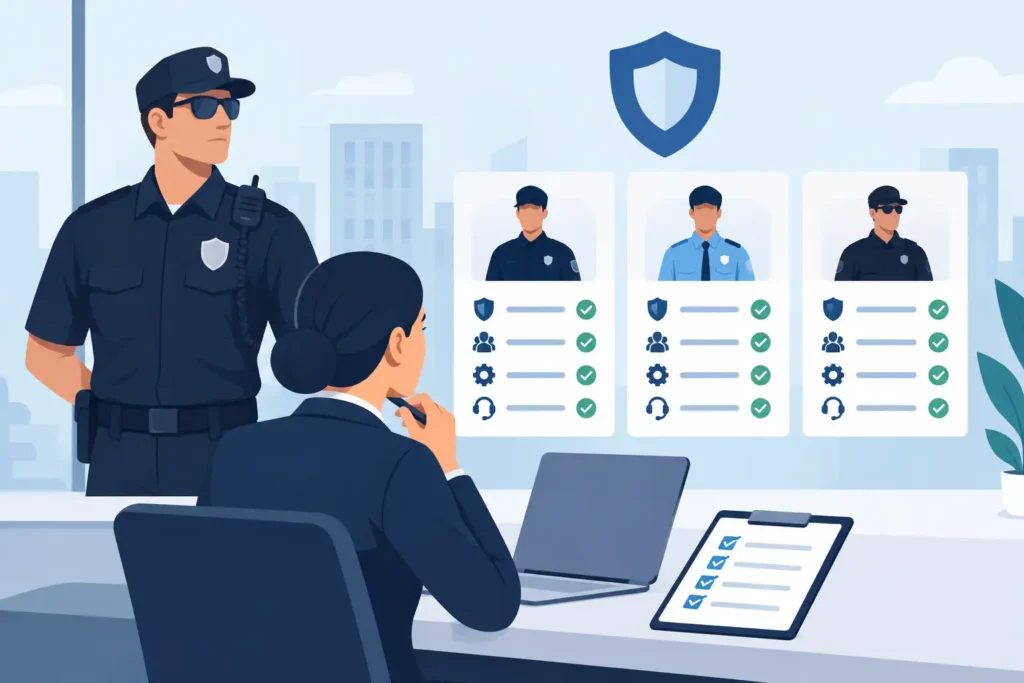
A security vendor evaluation should begin at the property, not with a rate sheet. A low hourly quote means little if officers do not understand the site, supervisors are difficult to reach, or incidents are documented poorly. The right contract security provider protects people, assets, operations, and the continuity of daily business.
For a property manager, facility director, construction supervisor, or event organizer, the decision is practical: Can this company place trained officers at the right posts, enforce site rules professionally, and respond when conditions change? That standard requires more than confirming that a vendor can fill shifts.
Start With Your Actual Exposure
Before comparing providers, define what needs protection and when the risk is greatest. A retail center with frequent public traffic has different requirements than a gated community, an active construction site, a warehouse yard, or a special event venue. One site may need controlled access monitoring and visible foot patrols. Another may need after-hours patrol checks, fire watch documentation, vehicle patrol coverage, or cargo escort support.
Review recent incidents, access points, traffic patterns, tenant concerns, operating hours, blind spots, and areas where employees or visitors may feel unsafe. Be specific about the outcome you expect. “Need a guard” is not a workable scope. “Need a uniformed officer to control contractor entry, patrol perimeter gates every hour, document deliveries, and escalate trespassing incidents” gives a qualified provider something operational to evaluate.
This process also prevents overbuying. Armed coverage may be appropriate for a high-exposure assignment, valuable cargo movement, or a location with a documented threat profile. It is not automatically the right answer for every property. In many environments, professional unarmed officers, consistent patrol procedures, controlled access, and responsive supervision provide the right level of deterrence without creating unnecessary disruption.
Verify Licensing, Insurance, and Employment Practices
A security company should be able to provide clear, current documentation without hesitation. In California, confirm that the company is properly licensed to provide private patrol services and that assigned officers meet applicable registration and training requirements. Ask what procedures the company uses to verify eligibility before an officer is placed at your location.
Insurance deserves the same attention. Confirm general liability coverage, workers’ compensation coverage, and any additional policies that may be relevant to the assignment. A provider should explain its coverage plainly and provide certificates through the appropriate process when requested. Do not treat a vague assurance that the company is “fully insured” as a substitute for verification.
Employment practices also affect performance on site. Ask how officers are screened, whether the company uses employees rather than loosely managed subcontracted labor, and how it handles call-offs, vacancies, and replacement coverage. A vendor that cannot maintain staffing discipline will eventually shift that burden to your management team.
Evaluate the Deployment Plan, Not Just the Proposal
A credible proposal explains how the provider intends to operate at your property. It should identify recommended posts, schedules, patrol responsibilities, access procedures, communication expectations, and escalation paths. If every prospect presents the same generic package, none of them has performed a meaningful assessment.
During the security vendor evaluation, ask the provider to walk through a realistic scenario. For example, what happens if an unauthorized person refuses to leave? Who is contacted after an alarm activation? What does the officer do when a delivery driver arrives after receiving hours? How is a medical emergency handled while preserving access for first responders?
The best answers are direct and site-specific. They should reference post orders, documented reporting, supervisory notification, and defined client contacts. A provider does not need to promise that every incident can be prevented. It should demonstrate that its officers can recognize conditions, follow procedure, protect life safety, and report facts accurately.
Post Orders Show Whether a Plan Can Be Executed
Post orders are the written instructions that turn a security agreement into field operations. They should cover responsibilities by post, patrol routes or checkpoints, opening and closing procedures, visitor rules, key and access-control handling, emergency contacts, prohibited activities, and reporting expectations.
Ask who writes the post orders, how the client approves them, and how changes are communicated to every assigned officer. Static instructions become unreliable when a property adds a tenant, changes access hours, begins construction, or experiences a new threat pattern. The vendor should have a controlled process for keeping instructions current.
Test Supervision and Communication
The officer at the gate or lobby is the visible face of the security program, but performance depends on what happens behind that post. Responsive supervision separates organized contract security from staffing that is merely present.
Ask who supervises officers, how often supervisors visit the site, and what happens when an officer misses a shift, violates a post order, or needs immediate direction. Clarify whether supervisory visits are documented and whether management is available after normal business hours. For locations operating nights, weekends, or holidays, this question is especially important.
Communication standards should be equally clear. Determine who your team calls for routine adjustments, urgent operational issues, and serious incidents. A provider should establish a chain of command rather than leaving clients to track down an individual officer. At Broadway Security Services, this operational discipline is central to reliable on-site coverage: officers need clear direction, and clients need accountable points of contact.
Compare Training Against the Assignment
Training should match the environment officers will enter. General guard training is a baseline, not a complete deployment plan. A residential community may require strong customer-service judgment, parking enforcement procedures, visitor management, and de-escalation skills. An industrial property may require perimeter control, truck-entry procedures, hazard awareness, and detailed patrol documentation.
For event security, ask how the vendor prepares officers for crowd movement, entry screening, restricted areas, emergency exits, and coordination with event staff. For fire watch, verify that officers understand patrol intervals, hazard observation, log requirements, and escalation procedures. For executive protection or cargo escort assignments, examine relevant experience, communication protocols, and the provider’s approach to advance planning.
Do not judge training only by the number of classroom hours listed in a brochure. Ask how officers are briefed on your site before their first shift, how performance is reviewed, and how corrective coaching is handled. A trained officer who arrives without site orientation is still operating with incomplete information.
Make Reporting a Contract Requirement
Incident reporting is not administrative overhead. It is how management sees what happens when no manager is present. Reports can reveal recurring access failures, trespassing patterns, safety hazards, employee concerns, and times when additional controls may be needed.
Request examples of routine activity reports and incident reports with sensitive information removed. Look for reports that state who, what, when, where, and what action was taken. Good documentation is factual, timely, readable, and consistent. It avoids speculation while preserving details that may matter later for management decisions, insurance matters, or law enforcement follow-up.
Also ask how reports are delivered and how quickly serious incidents are escalated. A monthly recap may be useful for trend review, but it is not sufficient when a client needs immediate notice of an injury, break-in, threat, or significant property damage.
Review Price in the Context of Control
Pricing matters, but an unusually low rate often signals a gap somewhere else: limited supervision, weak relief coverage, inadequate training, rushed onboarding, or high officer turnover. Those problems may not appear on the first invoice. They appear when a post is uncovered, a guard is unfamiliar with the property, or an incident receives no timely follow-up.
Compare proposals by scope and controls, not only by the hourly figure. Confirm whether the price includes supervisory visits, reporting tools, uniforms, patrol vehicles when applicable, onboarding, post-order development, and relief coverage. A clear proposal should identify what is included, what is optional, and what would trigger an additional charge.
A short trial period can be useful when practical, particularly for a new site or a complex deployment. Set measurable expectations before coverage begins: attendance, patrol completion, report quality, supervisor responsiveness, client communication, and compliance with post orders. Review those standards early, before small failures become normal operating conditions.
Select a Partner That Can Be Held Accountable
The strongest security provider is not the company that makes the broadest promises. It is the one that can explain its staffing plan, demonstrate its controls, document its work, and accept responsibility for performance. That is what gives property leadership confidence when employees go home, public traffic increases, or an unexpected incident tests the site.
Use the evaluation process to ask direct questions, inspect the operational details, and establish standards that can be measured after the contract begins. Security coverage becomes more dependable when the provider knows exactly what it is responsible for protecting and the client knows exactly how that responsibility will be managed.