


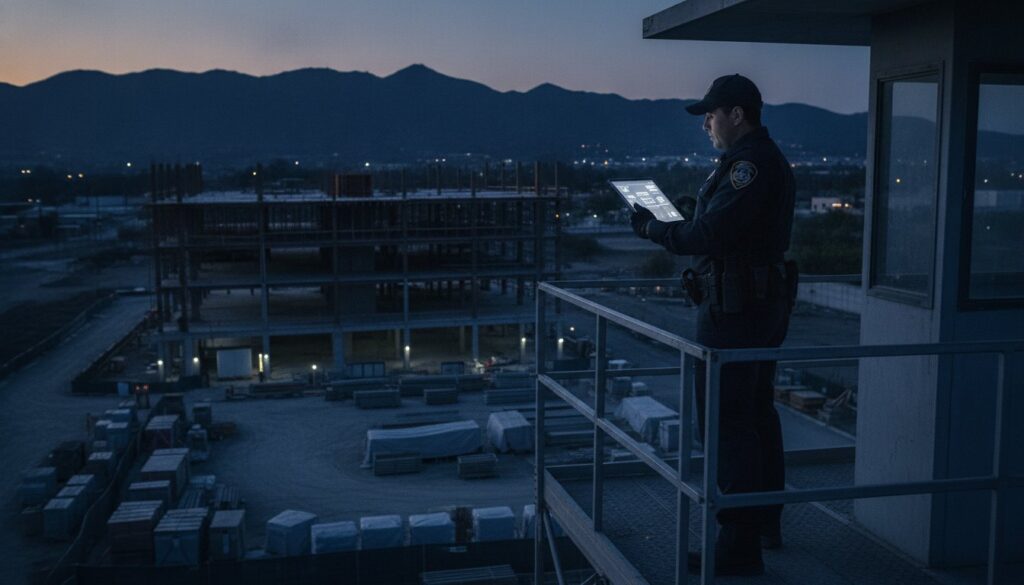
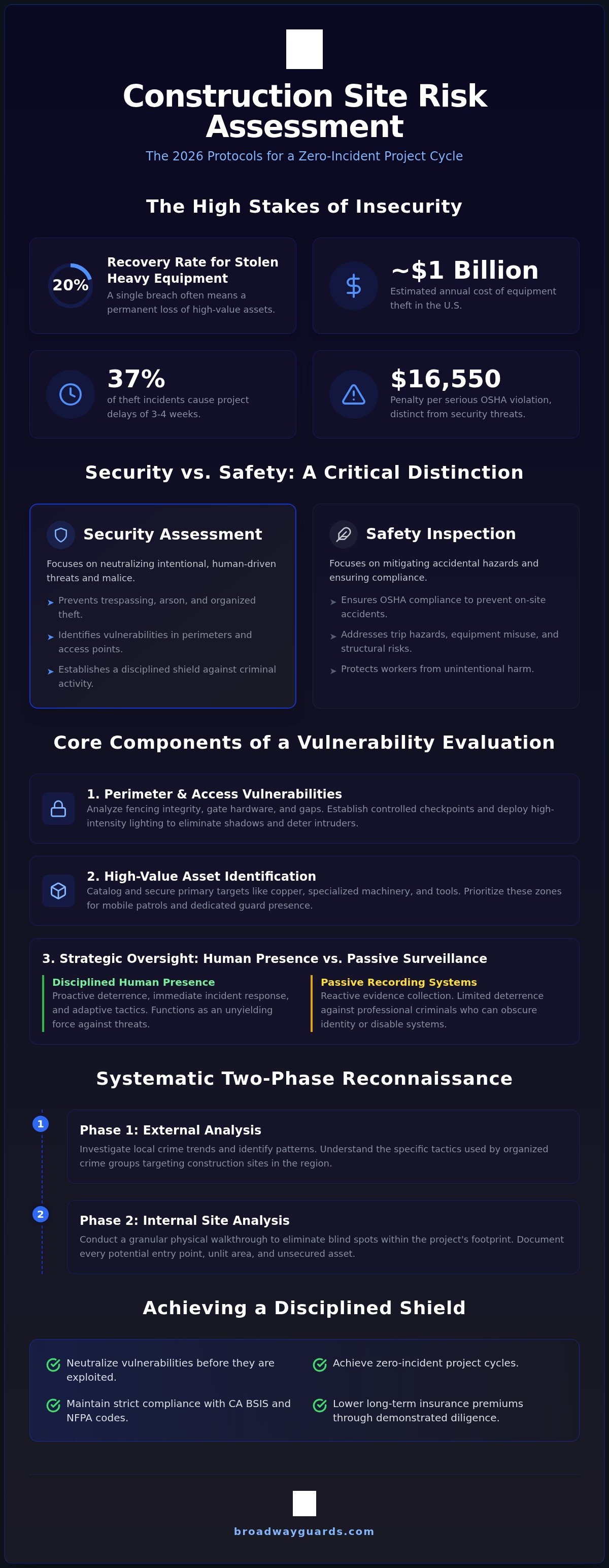
With only 20% of stolen heavy equipment ever recovered, a single security breach is often the difference between a profitable venture and a stalled project. You recognize that rising copper prices and equipment theft aren’t just inconveniences; they are direct threats to your project’s continuity and insurance standing. Conducting a rigorous construction site risk assessment is the only way to establish a disciplined perimeter that withstands modern criminal tactics. We understand that your site requires more than passive observation; it demands a professional framework that prioritizes order and accountability.
This 2026 guide provides the exact protocols needed to secure your high-value assets and maintain a zero-incident project cycle. We’ll show you how to identify site vulnerabilities, adhere to California BSIS standards, and navigate updated NFPA fire codes to avoid the $16,550 penalties associated with serious OSHA violations. By the end of this article, you’ll have a clear, actionable security plan that functions as a disciplined shield for your investments. We’ll move from broad oversight strategies to the specific mobile patrol and guard protocols that ensure your assets remain under the care of an unyielding force.
Key Takeaways
- Learn why a rigorous construction site risk assessment serves as the essential first step in neutralizing vulnerabilities and preventing project-stalling theft.
- Identify the critical components of site integrity by categorizing high-value materials and reinforcing perimeter access points against unauthorized entry.
- Evaluate the psychological and operational impact of disciplined security professionals compared to the inherent limitations of passive recording systems.
- Implement a systematic two-phase reconnaissance process to analyze local crime trends and eliminate blind spots within your project’s footprint.
- Achieve zero-incident project cycles and maintain strict compliance with California BSIS and insurance standards through professional oversight.
Why Construction Site Risk Assessments are Non-Negotiable in 2026
A professional construction site risk assessment is a systematic, methodical evaluation designed to identify security vulnerabilities before they are exploited. It’s not a mere checklist or a passive observation; it’s a strategic operation that prioritizes the protection of high-value assets and project continuity. In the high-stakes Southern California market, where organized crime groups target machinery and materials with military-like precision, an assessment serves as your first line of defense. It establishes a disciplined perimeter that protects your bottom line from the rising costs of copper theft and site vandalism.
When a site is breached, the fallout triggers a destructive domino effect. A single theft incident often results in immediate insurance premium hikes and significant project delays. Data from 2025 indicates that 37% of theft incidents caused project delays of three to four weeks. These aren’t just minor inconveniences; they are structural threats to your project’s success. By conducting a rigorous construction site risk assessment, you move from a reactive posture to one of unyielding prevention. This proactive approach ensures that your site remains a hard target, discouraging opportunistic criminals and organized syndicates alike.
The Financial Reality of Site Vulnerability
The financial impact of a security failure is staggering. The estimated annual cost of construction equipment theft in the United States reaches up to $1 billion. In Southern California, high-value materials like copper and specialized machinery are primary targets for organized theft rings. Beyond the replacement cost, you must account for “hidden” delays. These include labor downtime while waiting for replacement parts and the administrative burden of filing police reports and insurance claims. A professional assessment identifies these high-risk zones, allowing for the deployment of mobile patrols or guards that lower long-term insurance premiums by demonstrating a commitment to rigorous oversight.
Security vs. Safety: Understanding the Distinction
It’s vital to distinguish between a safety inspection and a security evaluation. While a Construction Site Safety Overview focuses on mitigating accidental hazards and ensuring OSHA compliance, a security assessment focuses on intentional human-driven threats. Safety is about preventing accidents; security is about neutralizing malice. An OSHA safety walk-through won’t stop a professional thief from breaching your perimeter at 2:00 AM. A security-first mindset requires a disciplined shield that accounts for trespassing, arson, and organized theft. At Broadway Security Services, we treat every assessment as a mission to identify blind spots that technology alone cannot cover. This professional rigor ensures your site isn’t just safe for workers, but secure against those who wish to disrupt your progress.
The Core Components of a Professional Security Vulnerability Evaluation
A professional construction site risk assessment demands a granular focus on the physical and operational landscape. It moves beyond general safety to address the specific mechanics of criminal entry. This evaluation identifies exactly where a site’s defenses are likely to fail under pressure. By dissecting the site into manageable sectors, security professionals can deploy resources with military-like precision. This methodical approach ensures that every vulnerability is documented and neutralized before it can be exploited by external threats.
Perimeter and Access Vulnerabilities
The perimeter is the first line of engagement in any security doctrine. We analyze site fencing for structural integrity, specifically looking for the weakest link in gate hardware or gaps in the chain-link fabric. Effective site access management ensures that every entry point is a controlled checkpoint rather than an invitation for unauthorized entry. High-intensity lighting plays a critical role in this sector. It eliminates the shadows that intruders rely on for cover; it transforms the site into a visible, high-risk environment for potential vandals. A disciplined shield is only as strong as its most vulnerable access point.
High-Value Asset Mapping
Asset categorization involves mapping the location of high-value materials to minimize exposure. We identify an Inner Sanctum for sensitive items like copper wiring, power tools, and specialized components. These assets must be stored in reinforced containers away from the perimeter. If a passerby can easily see your heavy machinery or material stacks from the road, your site is already at risk. Following established HSE Risk Assessment Steps allows project managers to prioritize protection based on the financial impact of a specific loss. Inventory management acts as a powerful deterrent when combined with visible, professional oversight.
Environmental factors such as site topography and blind spots created by storage containers must be neutralized through strategic placement of personnel. We also review sign-in protocols and subcontractor movement to prevent unauthorized access during high-traffic hours. A disciplined security professional provides the oversight needed to manage these complex human variables. This approach ensures your project remains a hard target. If you require a professional evaluation of these components, our construction site security guards can provide the necessary boots-on-the-ground expertise to safeguard your investment.
Strategic Oversight: Evaluating Human Presence vs. Passive Surveillance
A comprehensive construction site risk assessment must determine the necessary balance between technological monitoring and physical intervention. While digital surveillance provides a record of events, it lacks the immediate capability to neutralize a threat in real-time. Sophisticated criminals in Southern California often target sites that rely solely on passive technology. They understand that a camera is a witness, not an obstacle. Integrating human intelligence into your security doctrine ensures that vulnerabilities identified during the assessment phase are addressed with decisive action rather than delayed observation.
The Limitations of Passive Technology
Cameras often fail in “dark site” scenarios where lighting is insufficient or when intruders wear masks to evade facial recognition. The primary weakness of passive surveillance is the response gap. There is often a significant delay between a camera alert and the arrival of law enforcement, providing thieves ample time to extract high-value copper or equipment. Following authoritative guidance on risk assessment, project managers must account for the specific vulnerabilities of building construction where time is the most critical factor. Proactive deterrence is the immediate, physical neutralization of a threat before it results in loss or property damage. Relying on recording devices alone is a reactive strategy that frequently leads to unrecovered assets and project-stalling insurance claims.
The Power of Professional Presence
The psychological impact of a uniformed, disciplined security professional on-site cannot be overstated. A visible presence signals to potential intruders that the site is under methodical oversight and that any breach will meet an immediate response. For many developments, unarmed security guards provide a sufficient deterrent by maintaining strict access control and conducting regular perimeter sweeps. However, high-risk developments in areas with elevated crime trends may require armed personnel to ensure a higher standard of protection. We maintain accountability through the following protocols:
- Rigorous Patrol Logs: Detailed reporting of every perimeter check and gate activity.
- Strategic Force Deployment: Choosing between stationary guards and mobile patrols based on site topography and size.
- Real-Time Reporting: Immediate notification of site anomalies to project stakeholders.
This integration of human intelligence and modern reporting is what we define as the “Disciplined Shield” approach. It ensures that every guard is not just a presence, but an active component of your risk mitigation strategy. By prioritizing professional oversight over passive recording, you establish a standard of quality that protects your assets and ensures project continuity.
Step-by-Step: Conducting Your Construction Site Risk Assessment in California
A methodical construction site risk assessment follows a strict operational sequence. It moves from initial observation to decisive mitigation. This process ensures that no vulnerability remains unaddressed. By following a structured framework, project managers can establish a baseline of security that scales as the project advances. This disciplined approach is essential for identifying the specific threats that technology alone might miss.
Phase 1 begins with site reconnaissance. This involves a physical walk of the perimeter to identify blind spots created by topography or temporary structures. Phase 2 moves into threat modeling. We analyze local crime data for regions like Canoga Park and the wider San Fernando Valley to anticipate specific criminal tactics. In Phase 3, we conduct asset valuation. This quantifies the financial risk by mapping the current value of on-site machinery and materials. Phase 4 focuses on mitigation planning, where we deploy guards, lighting, and access protocols. Finally, Phase 5 requires continuous review. A construction site is a dynamic environment; the security requirements for a grading phase differ significantly from those during the finishing stages.
California Regulatory Compliance and BSIS Standards
Adhering to state regulations is a functional necessity for insurance and legal standing. All security measures must meet the rigorous security risk assessment CA standards established by the Bureau of Security and Investigative Services (BSIS). This includes maintaining proper documentation for use-of-force protocols and ensuring that all private property signage meets legal requirements. Failure to maintain these standards can lead to significant liability, matching the $16,550 penalties associated with serious OSHA violations. Rigorous record-keeping is often the primary factor in successful insurance claims following a neutralized incident. Our personnel are trained to maintain these high standards of professional rigor at all times.
Local Context: San Fernando Valley Security Dynamics
The San Fernando Valley presents unique security challenges, particularly for high-density urban infill projects. We address specific theft trends prevalent in the Canoga Park and Woodland Hills areas by coordinating with local law enforcement. This local expertise allows us to adapt our security posture to regional crime shifts. For large perimeter sites, we often recommend mobile patrols to ensure consistent oversight across expansive areas. This localized approach ensures that your project remains a hard target within the specific context of the Southern California market.
Establishing a disciplined perimeter begins with professional oversight. If you are ready to secure your assets with a professional framework, schedule your construction site risk assessment with our expert team today.
The Broadway Advantage: Implementing Your Security Doctrine
Broadway Security Services translates technical data into an unyielding force of protection. We don’t just identify threats; we neutralize them through a disciplined security doctrine. Every construction site risk assessment we conduct serves as the blueprint for our “Disciplined Shield” strategy. This framework ensures that your high-value assets remain under the care of a vigilant, unyielding force that prioritizes order and accountability above all else. Our approach is defined by military-like precision, moving from broad oversight to specific, categorical protection.
We believe that reliability is the foundation of trust. By repeating key thematic motifs regarding operational standards across every shift, we create a rhythmic reinforcement of safety on your site. Our personnel don’t just occupy a space; they command it. This methodical oversight is what distinguishes a Broadway contract from standard security providers. We provide the structure and hierarchy necessary to manage complex construction environments in the San Fernando Valley.
Professionalism, Presence, and Prevention
Our reputation is built on the caliber of our personnel and our rigorous training standards. We maintain the highest expectations for our armed security guard services Los Angeles, ensuring every officer is BSIS-licensed and trained in specialized construction protocols. This level of training provides the peace of mind that comes from knowing your site is managed by experts who understand the nuances of Southern California crime trends. In areas like Canoga Park, our presence has repeatedly prevented large-scale asset loss by interrupting organized theft attempts before they could result in project-stalling breaches. We provide a visible, professional deterrent that passive systems simply cannot match.
Securing Your Project’s Future
A partnership with Broadway is a strategic investment in your project’s continuity and long-term success. We provide comprehensive reporting that ensures total accountability for every patrol shift. You’ll receive documented evidence of our methodical oversight, which is critical for maintaining insurance compliance and defending against liability claims. Our local expertise allows us to anticipate regional shifts in criminal activity, ensuring your security posture remains effective throughout the project’s lifecycle. We move with a predictable cadence that mirrors the nature of professional oversight: consistent and methodical.
The next step in securing your investment is a professional consultation. We’ll evaluate your site’s topography, analyze local threat vectors, and implement a customized security plan designed for zero-incident project cycles. Don’t leave your assets vulnerable to the rising costs of theft and vandalism. Secure your construction site with a Broadway Risk Assessment today and experience the reliability of a disciplined protector.
Establishing a Disciplined Perimeter for Project Continuity
A rigorous construction site risk assessment is more than a regulatory requirement; it’s a strategic necessity for project continuity. You’ve seen how identifying perimeter vulnerabilities and mapping high-value assets prevents the project-stalling delays caused by theft and vandalism. By prioritizing professional human presence over passive surveillance, you ensure that every threat is met with an immediate, disciplined response. It’s the difference between recording a crime and preventing one from occurring.
Maintaining site security requires a partner that values order and accountability. Broadway Security Services provides the structure needed to protect your investments through 24/7 disciplined oversight and specialized protocols. Our California BSIS licensed personnel act as a disciplined shield, ensuring your site remains a hard target in the Southern California market. We translate military-precision security protocols into tangible results for your development.
Request a Professional Construction Site Risk Assessment and secure your project’s future today. Your assets deserve the care of a vigilant and unyielding force.
Frequently Asked Questions
What is a construction site risk assessment?
A construction site risk assessment is a systematic evaluation of physical vulnerabilities and potential security threats. It identifies blind spots in perimeters and high-risk zones where valuable materials are stored. This professional framework allows project managers to implement a disciplined shield that neutralizes threats before they result in loss or project delays.
How often should a security risk assessment be updated during a project?
You should update your security protocols at every major project milestone. The transition from grading to vertical construction introduces new blind spots and higher asset density. A dynamic site requires a dynamic security posture. Regular updates ensure your oversight remains consistent with the current physical landscape and evolving regional crime trends.
Do I need armed or unarmed guards for my construction site?
The decision depends on the specific threat profile established during your initial construction site risk assessment. Unarmed guards provide a professional presence and effective access control for most standard developments. However, high-risk developments in Southern California often require armed guards to provide an unyielding force against organized criminal elements targeting high-value machinery.
What are the most commonly stolen items from California job sites?
Copper wiring, specialized power tools, and heavy equipment are the primary targets for organized theft rings in California. Materials with high resale value and low traceability are prioritized by criminals. Mapping these assets and securing them in a reinforced storage area is a critical step in neutralizing these specific threats and ensuring project continuity.
Does a professional risk assessment reduce insurance premiums?
Implementing a professional construction site risk assessment often results in reduced insurance premiums. Insurance providers recognize documented security protocols and BSIS-licensed oversight as significant risk reducers. By proving your site is a hard target, you demonstrate the professional rigor that underwriters require to offer more favorable rates and lower deductibles.
Can security cameras replace the need for a risk assessment?
Cameras are recording devices; they aren’t a security strategy. They provide a record of events but cannot replace the methodical identification of vulnerabilities found in a professional assessment. A camera without a human response plan creates a delay that criminals exploit. True security requires human intelligence to interpret threats and take immediate, decisive action.
What are the BSIS requirements for construction site security in California?
The Bureau of Security and Investigative Services (BSIS) mandates that all security personnel hold a valid Guard Card. This certification requires rigorous background checks and training in legal liability and power to arrest. Using BSIS-licensed personnel ensures your site meets California’s legal standards and maintains the professional accountability necessary for insurance compliance.
How do mobile patrols improve site security compared to stationary guards?
Mobile patrols offer flexible, unpredictable oversight for expansive project footprints. While stationary guards are essential for gate control, mobile units provide a visible deterrent across the entire perimeter. This methodical movement ensures that no area remains unobserved, creating an atmosphere of high-stakes reliability that discourages intruders from attempting a breach.