


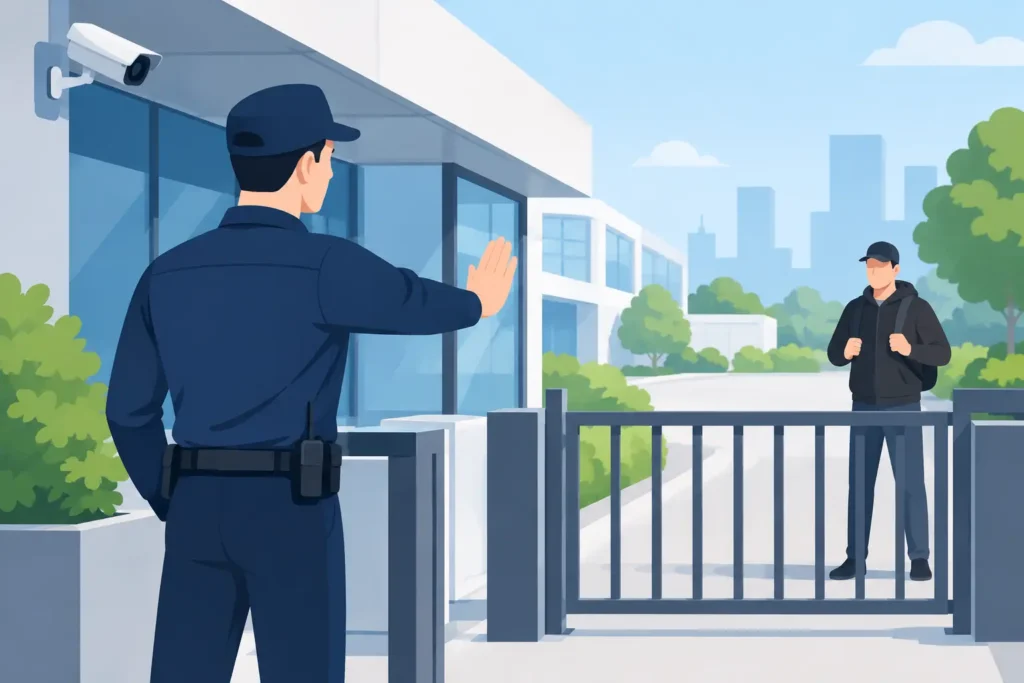
A trespasser does not need to steal equipment or damage property to create a serious exposure. An unlocked gate, an unauthorized person in a restricted area, or a former employee entering after hours can disrupt operations, create liability, and make employees feel unsafe. Knowing how to reduce trespassing incidents starts with treating access control as an active security function, not a sign on a fence.
For property managers, facility directors, construction supervisors, and business owners, the objective is straightforward: make unauthorized entry difficult, visible, and consistently addressed. That requires a site-specific plan built around the property’s layout, traffic patterns, operating hours, and known vulnerabilities.
Start With the Areas Trespassers Actually Use
Most trespassing does not occur through the most obvious entrance. Unauthorized individuals often look for weak perimeter points, open loading docks, poorly lit parking areas, unsecured stairwells, side gates, vacant units, or doors propped open for convenience. A security plan that focuses only on the front lobby leaves those areas exposed.
Conduct a practical site assessment during both operating and after-hours conditions. Walk the perimeter, inspect fencing and gates, identify blind spots, and note where employees, vendors, residents, or visitors enter without being checked. Review prior incident reports as well. Repeated activity at the same location is usually evidence of a predictable access weakness, not random bad luck.
At a construction site, that may mean an equipment yard behind temporary fencing. At a commercial property, it may be a delivery corridor that remains open too long. At a multifamily community, it may be a garage entrance that allows tailgating. The correct response depends on the property, but the process begins with identifying the real routes of entry.
Control Access Without Stopping Operations
A secure property still needs to function. Employees need to arrive, vendors need to make deliveries, and customers or residents need reasonable access. The goal is not to create unnecessary friction. It is to establish clear boundaries and ensure that exceptions are managed rather than ignored.
Physical measures such as maintained gates, working locks, access cards, visitor sign-in procedures, door alarms, and adequate lighting create the first layer of control. These measures are effective only when staff follow the procedures behind them. A locked gate loses its value when it is routinely left open. A visitor policy does little if no one verifies who visitors are meeting or where they are authorized to go.
Clear signage supports enforcement by communicating that the property is monitored, that unauthorized access is prohibited, and that violators may be removed or reported to law enforcement. Signs alone will not stop determined trespassers, but they help establish expectations and support a professional response when an incident occurs.
Use Visible Patrols to Deter Unauthorized Entry
Visible security presence is one of the strongest deterrents available to high-exposure properties. A trained officer conducting consistent foot patrols or marked vehicle patrols changes the risk calculation for a potential trespasser. The property appears observed, access points are checked, and suspicious behavior is more likely to be identified before it becomes a larger incident.
Patrols should not be random in the sense of unstructured. They should follow site-specific post orders that direct officers to inspect entrances, fence lines, parking areas, storage zones, common areas, loading docks, and other critical points. Patrol times can vary to avoid creating an easily predictable pattern, but accountability must remain consistent.
For larger properties, a combination of fixed-post coverage and mobile patrol may be appropriate. A guard stationed at a primary entrance can verify visitors and monitor access, while a patrol officer checks the perimeter and less-visible areas. Smaller sites may benefit from scheduled marked vehicle patrols during the hours when trespassing is most likely.
The right coverage level depends on the frequency of incidents, asset value, public access, neighborhood conditions, and the consequences of an unauthorized person entering the site. A warehouse holding high-value inventory requires a different deployment than an office building with limited after-hours activity.
Give Officers Clear Authority and Post Orders
Security officers cannot enforce rules that have not been clearly defined. Effective post orders identify restricted areas, authorized entry points, visitor procedures, escalation contacts, patrol expectations, and the steps officers should take when they encounter an unauthorized person.
This matters because trespassing incidents are rarely identical. Some involve a confused visitor or delivery driver. Others involve someone seeking shelter, attempting theft, scouting the property, or returning after being previously removed. Officers need the judgment to distinguish between these situations while maintaining a firm, professional approach.
A disciplined response generally begins with observation and communication. The officer verifies whether the person has legitimate business on site, directs them to leave when appropriate, and documents the contact. If the individual refuses to leave, becomes disruptive, threatens others, or commits a crime, the officer follows the established escalation procedure and contacts law enforcement when required.
Property leadership should confirm that guard instructions align with lease requirements, company policies, and applicable California laws. Professional security is not about unnecessary confrontation. It is about controlled access monitoring, early intervention, and properly documented action.
Improve Lighting, Visibility, and Site Maintenance
Poor visibility invites unauthorized activity. Dark parking corners, overgrown landscaping, obstructed camera views, broken fence panels, and discarded materials near a perimeter can all make a property easier to enter and harder to monitor.
Lighting should cover entry points, pedestrian routes, parking areas, dumpster enclosures, loading zones, and perimeter access points. Cameras can strengthen oversight, particularly when they cover known problem areas, but they work best as part of an active response plan. A camera recording an incident is useful for documentation. A guard identifying and addressing suspicious activity before entry is more effective for prevention.
Maintenance teams also play a role. Damaged locks, malfunctioning access readers, broken doors, and temporary openings created during repairs should be reported and corrected quickly. When repair timelines are longer, temporary security coverage may be necessary to protect the vulnerable area.
Train Employees and Tenants to Support the Plan
Many access-control failures are unintentional. Employees may hold doors open for strangers, allow former workers into restricted areas, leave gates unsecured, or fail to report suspicious activity because they assume someone else will handle it.
Set clear expectations for employees, tenants, contractors, and vendors. They should know which doors and gates must remain secured, how visitors are authorized, who to call when they observe suspicious conduct, and why they should not confront an unknown person on their own.
The message should be practical, not alarmist. Ask people to report concerns promptly and provide a defined reporting channel. Security personnel can then assess the situation, preserve a professional environment, and take action before the issue escalates.
Document Every Incident and Look for Patterns
Reliable incident reporting turns isolated encounters into useful operational intelligence. Each report should record the date, time, location, description of the individual, observed behavior, actions taken, witnesses, property conditions, and whether law enforcement was contacted.
Accurate documentation protects the client and helps management identify trends. If repeated trespassing occurs near the same gate, at the same time of night, or after a recurring delivery schedule, the security plan can be adjusted. That may involve changing patrol frequency, repairing a physical weakness, revising access procedures, or assigning coverage during a specific risk window.
Supervision matters here. Reports should be reviewed by security management and site leadership, not simply filed away. Accountable oversight confirms that officers are completing required rounds, following post orders, and communicating conditions that need correction.
When to Increase Security Coverage
A temporary increase in trespassing can signal a larger issue. Construction phases, vacancies, seasonal events, nearby disruptions, employee terminations, inventory deliveries, and changes to operating hours can all increase exposure. Waiting for damage, theft, or a safety incident before adjusting coverage is often the more expensive choice.
Professional guard services are especially valuable when a property needs an immediate, visible presence while longer-term access or maintenance improvements are completed. Broadway Security Services develops coverage around the site’s specific vulnerabilities, with licensed and trained guards, responsive supervision, controlled access monitoring, and detailed reporting that gives decision-makers a clear record of conditions and incidents.
The strongest trespass-prevention plan is not the one with the most equipment or the strictest rules. It is the one people follow every day: secure entry points, visible patrols, clear officer instructions, fast reporting, and management willing to correct weaknesses before they become incidents.