

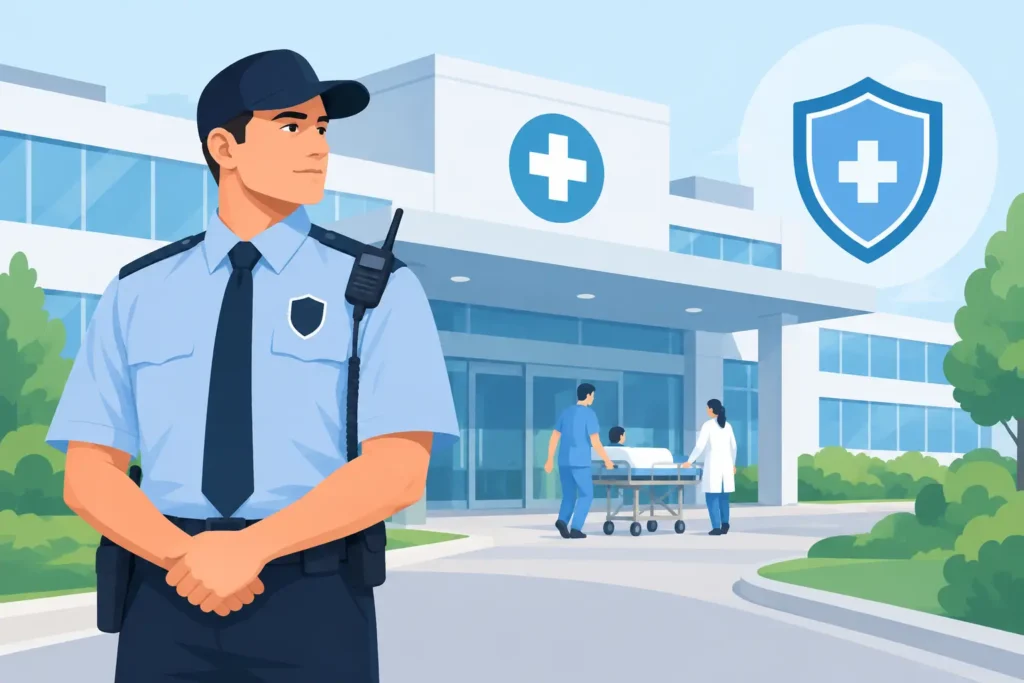
A hospital entrance can shift from routine to high pressure in minutes. A distressed family member needs direction, an unauthorized visitor attempts to enter a restricted unit, a patient becomes disruptive, or an ambulance bay becomes congested. Security guards for hospitals help the facility maintain order through visible presence, controlled access monitoring, calm intervention, and clear incident documentation.
Hospital security is not a generic guard assignment. The environment operates around patient care, privacy, clinical urgency, public access, and 24-hour activity. Coverage must support medical staff without interfering with treatment, while giving administrators a dependable response structure for daily security concerns and serious incidents alike.
Why Hospitals Need Site-Specific Security Coverage
Hospitals have multiple security environments under one roof. The emergency department, labor and delivery floor, behavioral health unit, visitor lobby, parking structure, pharmacy area, loading dock, and administrative offices each present different access and safety concerns. A single officer positioned at a front desk cannot adequately manage every risk across an active campus.
The right deployment begins with how the property actually operates. Security planning should account for visitor volume, entry points, shift changes, high-risk departments, after-hours traffic, parking conditions, and the location of sensitive records, medications, equipment, and supplies. It should also account for when tensions typically rise, such as during emergency department surges, visiting-hour transitions, or late-night arrivals.
A visible, professional guard presence can discourage trespassing, theft, disorderly conduct, and unauthorized access before those issues escalate. Just as important, guards give employees, patients, and visitors a clear point of contact when they need help finding a department, reporting suspicious activity, or responding to a conflict.
Security Guards for Hospitals Must Work Within Care Operations
Healthcare security requires sound judgment and professional restraint. Officers may encounter people who are frightened, grieving, confused, intoxicated, experiencing a behavioral health crisis, or under significant stress. Their role is to maintain safety and enforce facility rules while communicating in a controlled, respectful manner.
That means post orders must be specific. Officers need to know which departments require escort-only access, how visitor screening is handled, where they should position themselves during shift changes, who to contact during a patient-related event, and when an issue must be elevated to hospital leadership or law enforcement. Vague instructions produce inconsistent coverage. Clear post orders create accountability across every shift.
Security personnel are not clinical staff, and they should never attempt to replace medical judgment. Their value is in protecting the environment where care is delivered: managing access, observing conditions, supporting staff during disturbances, preserving a safe perimeter, and documenting events accurately. The best programs establish clear boundaries between security responsibilities, clinical responsibilities, and emergency response authority.
Core Posts That Deserve Attention
Not every hospital needs the same staffing model. A small outpatient center may need a controlled-access officer during operating hours and mobile patrol coverage after closing. A large medical campus may need fixed posts, foot patrols, vehicle patrols, and a supervisor coordinating activity across several buildings.
The emergency department is often a priority post because it combines public access, unpredictable arrivals, emotionally charged interactions, and high patient turnover. A trained officer can monitor the entrance, support visitor limits, identify unauthorized access attempts, and respond quickly when staff request assistance.
Labor and delivery, neonatal units, behavioral health areas, pharmacies, and medication storage locations may require tighter access procedures. In these areas, the guard assignment should focus on credential verification, visitor policy enforcement, escort procedures, and immediate reporting of irregular activity.
Parking lots and structures also require attention. Poor lighting, isolated areas, vehicle break-ins, loitering, and traffic congestion can affect both staff safety and patient confidence. Marked vehicle patrols and scheduled foot patrols increase visibility while allowing officers to identify hazards such as damaged gates, unsecured doors, blocked fire lanes, or suspicious vehicles.
Access Control Is More Than Checking Badges
Controlled access monitoring depends on consistent procedures, not just a person standing at a door. Officers should know how to verify visitor authorization, enforce sign-in requirements, direct guests to the correct area, and respond when someone refuses to follow facility rules. They must also understand which exceptions require approval rather than making assumptions during a sensitive situation.
Access procedures should remain practical. A hospital cannot operate like a closed industrial site, especially during emergencies or periods of high public demand. The objective is to manage entry without creating unnecessary delays for patients, families, vendors, and responding agencies. This balance depends on the facility’s layout, risk profile, and clinical needs.
For restricted areas, the security provider and hospital should establish a documented process for lost badges, tailgating, after-hours vendor access, visitor disputes, and contractor check-in. When officers know the procedure, they can act promptly and report exceptions to the right people.
Reporting and Supervision Protect the Hospital After an Incident
A guard’s presence matters at the moment of an incident. Reliable reporting matters afterward. Hospital leaders need a factual record of what occurred, when it occurred, who was notified, what action was taken, and whether follow-up is required. Poorly written reports create operational gaps and can make it difficult to identify recurring concerns.
Incident reports should be timely, objective, and detailed enough to support internal review. They should avoid speculation and clearly separate observed facts from statements made by others. Depending on the event, documentation may involve a visitor removal, damaged property, a missing item, an access-control violation, a parking incident, or a request for law enforcement assistance.
Responsive supervision is equally important. Supervisors should inspect posts, confirm officers are following post orders, address attendance issues, review incident activity, and adjust coverage when conditions change. A hospital security program cannot rely on staffing alone. It requires active management and consistent field accountability.
Armed or Unarmed Coverage: Make the Decision Deliberately
The question of armed versus unarmed coverage should be based on a documented risk assessment, not a default assumption. Many hospital posts are well served by unarmed licensed guards trained in de-escalation, access control, patrol procedures, and professional reporting. Their visible presence can address a wide range of daily concerns without changing the atmosphere of care.
Armed coverage may be considered for specific risk conditions, such as a facility’s history of serious threats, isolated locations, high-value controlled assets, or requirements established by the hospital’s security leadership. If armed officers are used, the provider must apply strict licensing, training, supervision, equipment, and post-order standards. The assignment should also be coordinated with the hospital’s policies and local law enforcement response procedures.
There is no one-size-fits-all answer. The right decision depends on the site, the role of existing in-house security, the level of public access, and the facility’s tolerance for risk.
What to Expect From a Contract Security Partner
Hospital administrators should expect more than filled shifts. A qualified contract security provider should evaluate the property before recommending posts, schedules, patrol routes, and access-control procedures. The provider should be able to explain how coverage will be supervised, how incidents will be documented, and how staffing changes will be communicated.
In California, licensing and insurance should be verified before deployment. Hospital leaders should also ask about officer training, supervisor availability, replacement procedures, report review, and the process for updating post orders after an incident or operational change. These details determine whether coverage remains dependable during nights, weekends, call-offs, and high-demand periods.
Broadway Security Services builds assignments around site conditions, clear post orders, visible patrol activity, and accountable reporting. For hospital environments, that disciplined approach helps security remain a reliable operational function rather than an afterthought.
A hospital’s security program should give clinicians more room to focus on care, not more uncertainty to manage. When guards are properly assigned, supervised, and prepared for the facility’s actual conditions, they protect the order and confidence that patients, families, and staff rely on every day.