


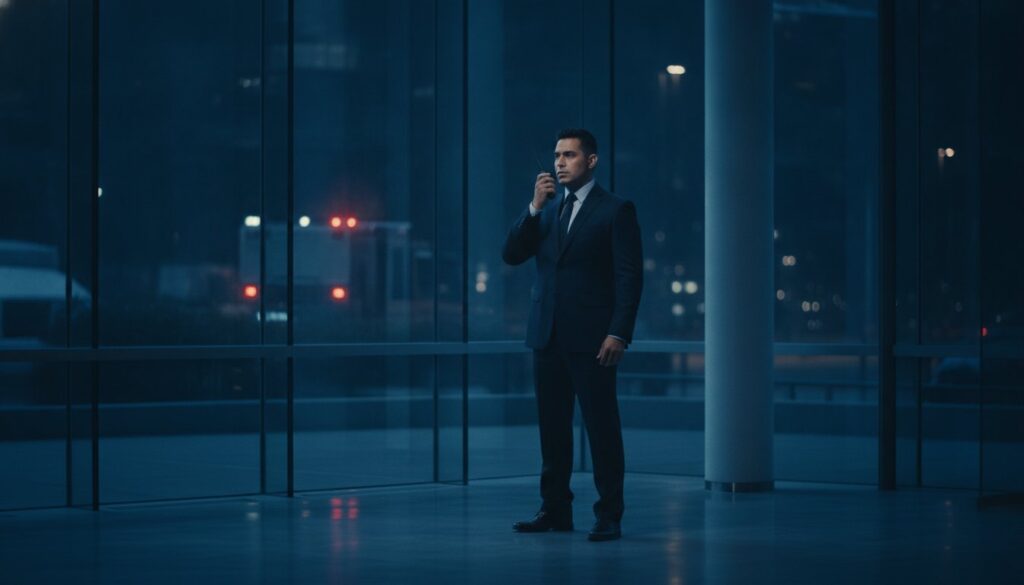
The difference between a controlled incident and a catastrophic failure isn’t found in the thickness of an emergency manual, but in the caliber of the personnel standing at the point of impact. In high-stakes environments, the role of security guards in crisis management serves as the structural framework for every successful response. When a threat emerges, a professional presence ensures that order replaces chaos and that established protocols are executed with military-like precision.
You’ve likely felt the weight of uncertainty regarding liability or the fear that personnel might panic when a real emergency strikes. It’s a valid concern for any stakeholder responsible for high-value assets in Southern California. This 2026 professional guide provides a clear understanding of how disciplined guards function as a vigilant shield during a crisis. You’ll discover a framework for integrating professional personnel into your corporate safety plans to ensure high-stakes reliability. We’ll explore the specific duties of Broadway Security Services guards in Canoga Park and the San Fernando Valley, ensuring your safety through rigorous operational standards and the assurance of an unyielding force.
Key Takeaways
- Understand how the role of security guards in crisis management has evolved from simple observation into a proactive, multi-phase disciplined process.
- Learn why effective crisis mitigation depends on identifying site-specific vulnerabilities long before an incident occurs to build a foundation of resilience.
- Master the tactical application of the OODA loop to ensure your security team executes protocols with precision when facing high-stakes pressure.
- Evaluate the strategic differences between armed and unarmed personnel, including the legal boundaries and psychological impacts relevant to California businesses.
- Discover how a philosophy of methodical oversight and regional expertise in Canoga Park creates a disciplined shield for your most valuable assets.
Defining the Role of Security Guards in Modern Crisis Management
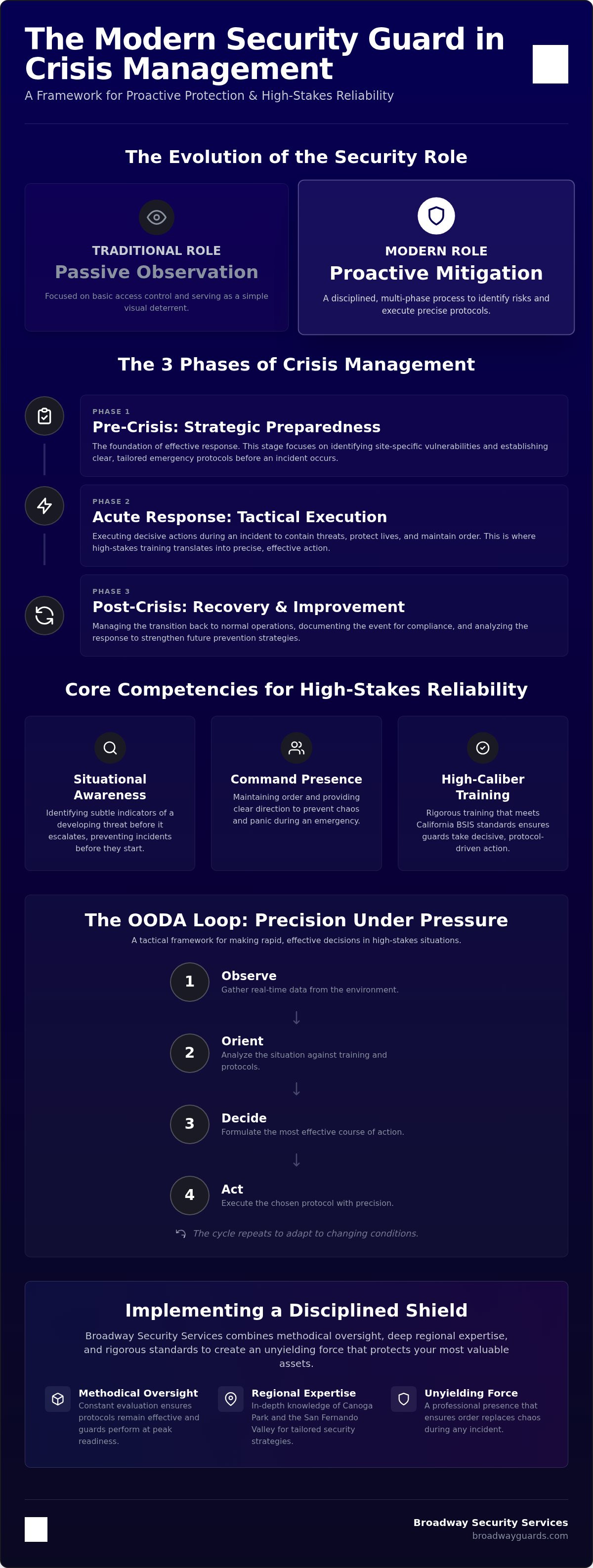
Crisis management is a methodical, multi-phase discipline designed to protect personnel and high-value assets. It isn’t a singular event; it’s a rigorous process that demands constant vigilance. The modern role of security guards in crisis management has shifted from passive observation to proactive mitigation. This evolution positions security personnel as a disciplined shield for organizations throughout the San Fernando Valley. By acting as an unyielding force, these professionals ensure that order is maintained even when external circumstances become volatile.
Effective management follows a structured lifecycle that requires different operational standards at each turn. This lifecycle consists of three distinct stages:
- Pre-crisis: Conducting site vulnerability evaluations and establishing clear emergency response protocols.
- Acute Response: Executing decisive actions to contain threats and protect lives during the heat of an incident.
- Post-crisis Recovery: Managing the transition back to normal operations and documenting the event for regulatory compliance and future prevention.
The Difference Between Security and Crisis Intervention
Standard patrol duties form the foundation of site safety, but these duties transform instantly during an emergency. On-site guards provide a critical first-on-scene advantage that remote monitoring cannot replicate. While the Security Guard Profession traditionally focused on basic access control, modern crisis intervention requires immediate, high-stakes decision-making. Guards act as the primary link to public emergency services, providing real-time data to police and fire departments during those first vital minutes. This professional presence prevents the chaos often associated with unmanaged incidents.
Essential Competencies for High-Stakes Reliability
Reliability in a crisis depends on specific, trained competencies that go beyond basic observation. Situational awareness is the most vital of these. A guard must identify subtle indicators of a developing threat before it reaches a boiling point. High-caliber training, which meets the 2026 California BSIS guard card requirements for crisis response, ensures that personnel don’t succumb to the bystander effect. Instead of waiting for others to act, they take command. This command presence is essential for maintaining order among panicking staff or members of the public. It creates an atmosphere of high-stakes reliability where assets are under the care of a vigilant force. Every action is calculated, methodical, and rooted in established safety protocols.
Strategic Preparedness: The Foundation of Crisis Mitigation
Effective crisis response is never an accident. It’s the calculated result of months of methodical preparation and rigorous oversight. The role of security guards in crisis management begins long before a threat materializes. It starts with identifying site-specific vulnerabilities and establishing a disciplined framework for protection. When guards are integrated into the planning phase, they transform from simple observers into a proactive shield. This strategic alignment ensures that the role of security guards in crisis management is fully optimized to prevent loss before it occurs.
Standard Operating Procedures (SOPs) are the backbone of this preparation. Generic templates often fail because they don’t account for the unique layout of a Canoga Park warehouse or a San Fernando Valley hospital. A professional security risk assessment CA ensures that every protocol is tailored to the specific environment. This assessment dictates guard placement and response priorities, ensuring that no blind spots remain in your defense strategy.
Integrating Guards into Your Emergency Response Plan
A successful response requires a clear chain of command. Management and security personnel must operate under a unified structure to avoid confusion during high-stakes events. Guards take ownership of the physical environment. They ensure that emergency exit paths remain unobstructed and that fire suppression equipment is fully operational. For facilities in the San Fernando Valley, this includes maintaining detailed evacuation maps that account for high-occupancy areas. Recent Campus Security Trends indicate that blending physical security with advanced communication protocols is essential for modern resilience in volatile environments.
The Value of Professional Risk Assessment
In Southern California, preparedness must account for regional environmental threats. Professional vulnerability evaluations include planning for seismic events and the specific requirements of fire watch services during wildfire seasons. These aren’t just theoretical possibilities; they are operational realities that demand a disciplined response. Retail environments and construction sites often harbor “blind spots” that opportunistic threats exploit. A professional assessment identifies these gaps, such as unmonitored delivery bays or poorly lit perimeter fencing. By addressing these weaknesses early, you build an unyielding defense. If you’re concerned about your current site vulnerabilities, a professional security risk assessment can provide the clarity needed to secure your assets. This methodical approach ensures that when a crisis occurs, your team is ready to act with precision.
Tactical Response: Execution Under High-Stakes Pressure
Execution is the standard by which all security programs are judged. Once a threat is identified, the role of security guards in crisis management transitions from methodical observation to immediate tactical intervention. This shift requires a mental framework known as the OODA loop: Observe, Orient, Decide, and Act. Guards first observe the anomaly, orient themselves to the specific nature of the danger, decide on the pre-established protocol, and act with unyielding precision. This cognitive cycle allows Broadway Security personnel to outpace the evolution of a threat, ensuring that the response remains controlled rather than reactive.
Establishing a secure perimeter is a primary objective during the acute phase of an incident. A disciplined guard doesn’t just watch a door; they control the flow of the entire environment. By maintaining a calm, authoritative command presence, guards serve as a psychological anchor that neutralizes panic among staff and visitors. This professional stoicism prevents the “stampede effect” and ensures that instructions are followed without hesitation. It’s the difference between a chaotic flight and a structured evacuation.
Communication Protocols During an Emergency
Information is the most valuable asset during a high-stakes event. Guards establish a Primary Communication Hub on-site to centralize data flow. They use standardized radio codes and clear-text reporting to eliminate ambiguity. This clarity is essential when providing real-time intelligence to incoming First Responders. By delivering precise details on the location and nature of the threat, security personnel act as the eyes and ears of public emergency services before they even arrive on the scene.
Crowd Management and Evacuation Control
Directing large groups in high-stress environments demands tactical expertise. Guards employ specific crowd-control formations to guide occupants toward safe zones while preventing bottlenecks. They simultaneously manage the risk of unauthorized entry by individuals attempting to return to the building during the chaos. Maintaining site security doesn’t stop because an alarm sounds. Personnel ensure that emergency vehicle lanes remain clear, facilitating a rapid response from local San Fernando Valley fire and police units while keeping the perimeter unyielding.
Armed vs. Unarmed Personnel in Crisis Scenarios
The presence of a uniformed professional fundamentally alters the environment during a crisis. The role of security guards in crisis management often centers on the deterrence factor. An armed presence signals a zero-tolerance threshold for violence, which can prevent a situation from escalating before it begins. Conversely, unarmed guards provide a reassuring, approachable layer of safety that is often more suitable for corporate or retail settings. Choosing between these options depends on the specific risk profile of the site and the expected nature of potential threats. Each choice represents a different strategic layer in your disciplined shield.
California law mandates strict tactical boundaries for both guard types. Businesses should transition to armed security guard services Los Angeles when the threat level includes potential armed robbery, workplace violence, or the protection of extremely high-value assets. This transition ensures that the organization has a disciplined force capable of meeting lethal threats with professional precision. The decision to deploy armed personnel is a strategic one, rooted in the need for high-stakes reliability and unyielding protection. It isn’t just about the weapon; it’s about the advanced training that guides its potential use.
The Role of Armed Guards in Active Threat Mitigation
Armed personnel follow specific protocols for neutralizing violent intruders. These guards undergo the rigorous training required for 2026 California BSIS armed guard certification, which includes firearms proficiency and legal use-of-force education. In high-risk asset protection, the disciplined force concept ensures that guards remain stoic and focused under extreme pressure. Their primary objective is to contain the threat and protect lives. They act as an unyielding shield until public law enforcement arrives. This level of oversight is essential for facilities where the risk of violent intervention is documented and high.
Unarmed Guards: The Experts in De-escalation
Professional unarmed security guards specialize in conflict management without escalation. They utilize techniques such as verbal judo and strategic presence to maintain order in retail or corporate crises. In many scenarios, unarmed visibility is the superior strategic choice. It maintains a safe atmosphere without the heightened tension that firearms can sometimes introduce. These guards are experts at diffusing verbal altercations and managing low-level physical threats with methodical oversight. If you are unsure which tier of protection your facility requires, explore our armed security guard services Los Angeles to compare the tactical benefits for your specific site.
Implementing a Disciplined Shield with Broadway Security
Methodical oversight defines the Broadway Security philosophy. Our approach treats the role of security guards in crisis management as a rigorous operational standard rather than a reactive task. This commitment to structure ensures that every guard functions as an unyielding force during high-stakes events. By prioritizing safety and peace of mind, we provide organizations with a foundation of trust built on visible results and military-like precision. Partnering with Broadway Security means moving beyond basic protection and adopting a framework of total organizational resilience.
Our operations maintain strict adherence to 2026 BSIS regulatory standards, grounding every professional claim in legal and operational reality. We don’t just offer guards; we provide a disciplined shield that integrates seamlessly into your corporate safety plans. This transition from a service provider to a strategic partner ensures that your assets are under the care of a vigilant and prepared force. Every protocol we execute is designed to reinforce order and maintain the integrity of your site, regardless of the external chaos.
Southern California Expertise: Why Local Knowledge Matters
Navigating the complex regulatory landscape of Los Angeles County requires a partner with deep regional roots. Our presence in the San Fernando Valley allows us to provide site-specific strategies that generic agencies cannot match. We understand the unique vulnerabilities of local industries, from high-shrink retail environments to exposed construction sites in Canoga Park. This geographic specialization ensures that our response protocols account for local traffic patterns, emergency service response times, and regional environmental risks. Local knowledge isn’t just a benefit; it’s a tactical requirement for effective crisis mitigation.
The Broadway Advantage: Training and Accountability
High-stakes reliability is the direct result of rigorous vetting and discipline-focused training. Every Broadway guard maintains full compliance with California BSIS requirements, ensuring they possess the legal and tactical knowledge to manage a crisis with self-assurance. We don’t just deploy personnel; we implement a system of absolute accountability. Our “Vigilant Force” reporting standards provide comprehensive post-crisis evaluation, documenting every action taken to ensure transparency and future prevention. This methodical oversight transforms a service into a disciplined shield for your most valuable assets. If you’re ready to secure your facility with a professional presence, contact Broadway Security for a professional risk assessment today. We provide the order and oversight necessary for a crisis-resilient future.
Securing Your Future Through Rigorous Operational Standards
A crisis doesn’t wait for a convenient moment to strike. It demands an immediate, disciplined response from personnel who’ve mastered the OODA loop and established clear chains of command. We’ve explored how the role of security guards in crisis management extends far beyond simple observation; it’s a strategic framework of prevention, tactical intervention, and recovery. By integrating site-specific SOPs and conducting professional vulnerability evaluations, you transform your facility into an unyielding fortress.
Reliability is built on a foundation of accountability and specialized training. Broadway Security brings decades of tactical security experience and California BSIS certified personnel to every engagement. We specialize in Southern California risk profiles, ensuring your organization is prepared for regional challenges. Don’t leave your resilience to chance when you can employ a disciplined shield. It’s time to prioritize the safety of your assets with a partner that values precision and methodical oversight above all else.
Secure Your Assets with Broadway’s Disciplined Crisis Management Solutions
Frequently Asked Questions
What is the primary role of a security guard during a fire emergency?
The primary role involves immediate detection and the execution of a disciplined evacuation protocol. Guards verify that fire suppression equipment is accessible and guide occupants toward designated safe zones. They maintain order to prevent panic while providing essential data to the Los Angeles Fire Department upon arrival. This methodical oversight ensures that life safety remains the highest priority during the acute phase of a fire incident.
Can security guards legally detain individuals during a crisis in California?
In California, security guards possess the legal authority to perform a citizen’s arrest under Penal Code Section 837. This allows for the detention of an individual who commits a public offense in their presence. However, the guard must immediately notify law enforcement and transfer custody to a peace officer. This action is a high-stakes responsibility that requires rigorous training to ensure legal compliance and minimize organizational liability.
How do security guards coordinate with the LAPD during an incident?
Coordination with the LAPD involves serving as a tactical link between the site and emergency responders. Guards provide critical intelligence regarding the location and nature of a threat before officers enter the premises. By maintaining clear access lanes and securing perimeters, the role of security guards in crisis management allows law enforcement to focus entirely on neutralizing the threat with maximum efficiency and precision.
What training do Broadway guards receive for crisis management?
Broadway guards undergo a rigorous training regimen that exceeds standard 2026 California BSIS requirements. Our personnel are instructed in site-specific vulnerability evaluations and advanced situational awareness. This discipline-focused education ensures that every guard can execute complex emergency protocols with military-like precision. We emphasize high-stakes reliability through continuous oversight and regular performance reporting to maintain a vigilant and unyielding force for our clients.
Is an armed guard necessary for every business crisis plan?
An armed presence isn’t mandatory for every crisis plan, but it’s essential for high-risk environments. The decision depends on a professional risk assessment of your specific site in Canoga Park or the San Fernando Valley. While unarmed guards are experts in de-escalation, armed personnel provide a necessary deterrent for facilities facing threats of violence or protecting high-value assets. Both roles contribute to a comprehensive and disciplined shield.
How does a security risk assessment improve crisis response?
A professional security risk assessment improves response by identifying structural blind spots and operational weaknesses before an incident occurs. This methodical evaluation dictates the strategic placement of guards and the development of site-specific SOPs. By understanding the unique vulnerabilities of a San Fernando Valley facility, we ensure that the role of security guards in crisis management is proactive rather than reactive, creating a foundation for organizational resilience.
What is the difference between fire watch and standard security during a crisis?
Fire watch services are a specialized, regulatory-mandated function focused exclusively on identifying fire hazards when automated detection systems are offline. Unlike standard security, which manages a broad range of threats, fire watch personnel maintain a continuous, documented patrol of every area to prevent ignition. This dedicated oversight is critical for maintaining compliance with California fire codes and ensuring site safety during system maintenance or malfunctions in Southern California.
How should a business evaluate a security firm’s crisis management capabilities?
Evaluating a firm requires a focus on regulatory credentials and documented performance standards. A reliable partner should demonstrate full BSIS compliance and possess deep regional expertise in Southern California. You should verify their training protocols, the rigor of their reporting systems, and their ability to provide site-specific consultation. A firm that prioritizes discipline and methodical oversight will offer the highest level of high-stakes reliability for your most valuable assets.