


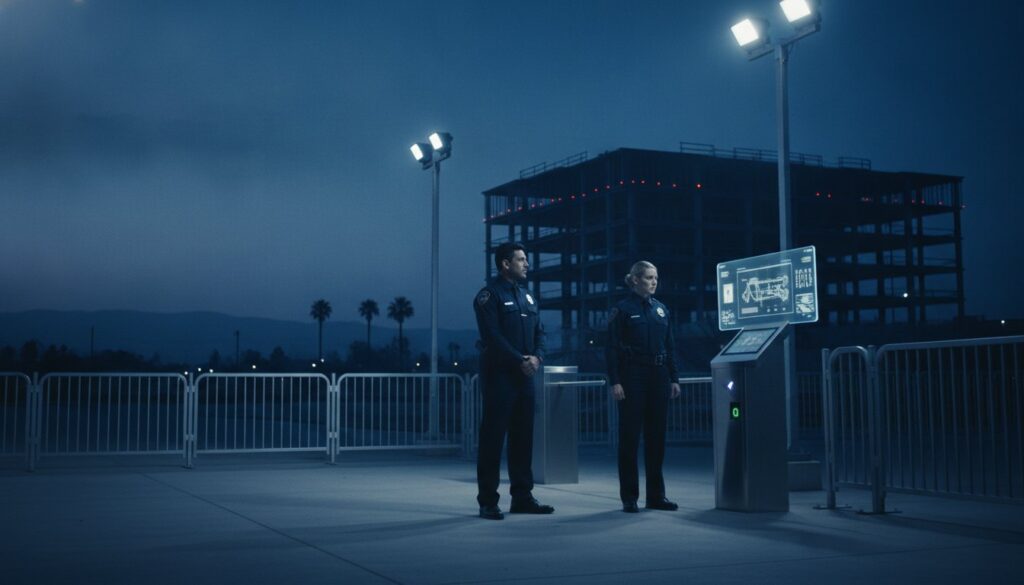
A perimeter is only as strong as the discipline governing its gates. In the high-stakes environment of the San Fernando Valley, an unlocked entry point or a falsified log isn’t just a lapse in protocol; it’s an invitation for catastrophic loss. Implementing robust construction site access control requires more than a simple fence. It demands a strategic fusion of elite personnel and unyielding technology to secure assets against rising theft rates and increasingly complex Cal/OSHA mandates.
You recognize that site safety isn’t a luxury; it’s a non-negotiable standard of operational excellence. The pressure to maintain a 24/7 monitored perimeter while reducing insurance liability can often lead to oversight gaps that threaten your bottom line. This 2026 guide provides the professional blueprint to bridge those gaps. You’ll learn how to integrate disciplined guard oversight with automated attendance tracking to eliminate site vulnerabilities. We’ll examine the current California regulatory landscape and show you how to transform your project into an impenetrable, compliant zone where safety and productivity coexist without compromise.
Key Takeaways
- Modern security requires a shift from passive fencing to active, systematic protocols that restrict entry to qualified and authorized personnel only.
- Technology serves as a valuable tool, but true security relies on the human intelligence of professional guards to manage high-stakes hardware and physical entry points.
- Implementing rigorous construction site access control ensures compliance with 2026 Cal/OSHA standards while reducing exposure to liability from unauthorized site entry.
- A multi-layered defense strategy begins with a professional risk assessment to identify vulnerabilities and secure both outer perimeters and inner sensitive zones.
- Professional discipline and a visible uniformed presence act as the primary deterrents against theft and unauthorized entry in high-risk areas like the San Fernando Valley.
Defining Strategic Access Control for Modern Construction Sites
Access control is the systematic restriction of site entry to authorized, qualified personnel only. It’s the first line of defense in a professional security posture. By 2026, the complexity of California projects has made the traditional perimeter fence an insufficient deterrent. A fence is a static object. True protection requires a dynamic, disciplined framework that monitors every entry and exit event with absolute precision. This approach ensures that every individual on the property has a legitimate reason to be there and has met all necessary safety qualifications.
The industry has shifted decisively from simple lock-and-key methods to integrated digital and physical oversight. Manual systems are vulnerable to duplication and human error; they don’t provide the real-time data required for modern project management. Current standards prioritize three critical objectives: the total prevention of material theft, strict adherence to construction site safety, and the aggressive elimination of liability gaps that can derail a project’s financial viability.
Beyond the Turnstile: A Holistic View of Security
Hardware alone fails without a disciplined management protocol. A turnstile or an electronic gate is merely a tool, not a complete solution. It requires the presence of trained professionals to manage hardware failures, prevent bypass attempts, and verify credentials that digital systems might misread. High-value materials like copper, lumber, and heavy machinery are frequent targets in the San Fernando Valley. Professional oversight ensures these assets stay within the secured zone. Modern access control is the intersection of digital credentials and physical presence.
Common Vulnerabilities in Unmanaged Construction Sites
Tailgating is a severe breach of protocol. It occurs when unauthorized individuals follow legitimate personnel through an encrypted entry point. This behavior is the primary cause of accidents involving unvetted persons in dangerous zones. Without a vigilant guard presence, these breaches often go unnoticed until an incident occurs.
Poor construction site access control also leads to “ghost workers” and labor fraud. Without a verifiable log, developers often pay for hours not worked or for personnel who lack required certifications. These gaps in oversight lead to increased insurance premiums and delayed project timelines. A disciplined shield prevents these losses by maintaining a transparent, real-time record of all site activity, ensuring that every dollar spent on labor is accounted for and every person on-site is legally permitted to be there.
The Hybrid Model: Integrating Technology with Professional Guard Oversight
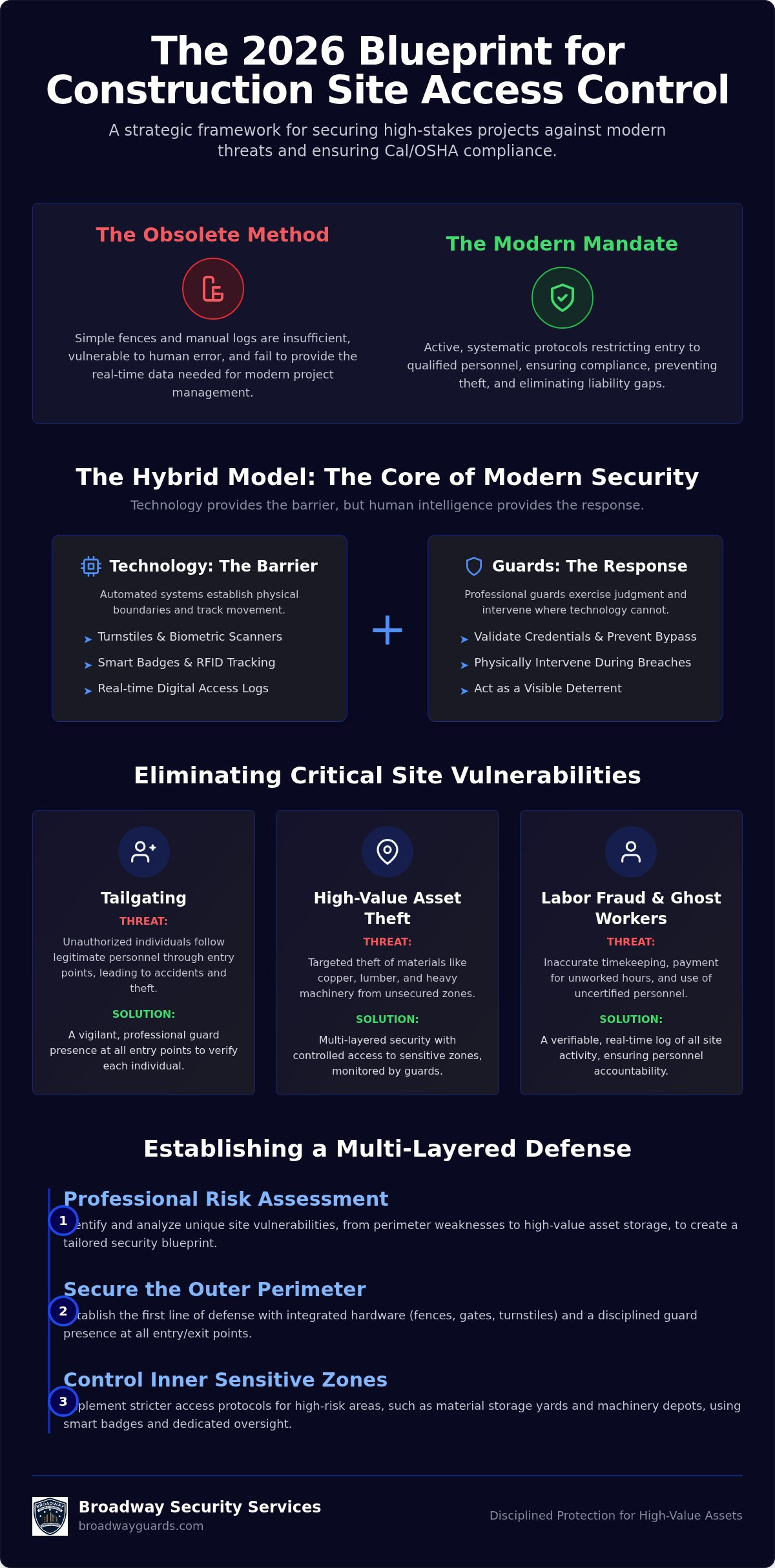
Reliance on automated systems alone creates a critical vulnerability. Software can track data, but it cannot exercise judgment or physically intervene during a breach. Effective construction site access control requires a hybrid model where professional oversight validates technological data. This synergy ensures that no unauthorized individual bypasses the perimeter through tailgating or hardware manipulation. A disciplined protector at the gate serves as the primary deterrent, signaling to potential intruders that the site is under constant, professional surveillance.
A disciplined approach to construction site access control demands that every technological tool is backed by professional accountability. Hardware provides the barrier, but human intelligence provides the response. This integrated strategy eliminates the “false sense of security” that often plagues projects relying solely on unmanned gates.
Leveraging Hardware for Maximum Efficiency
Hardware establishes the physical boundaries of your project. Turnstiles and biometric scanners create a mandatory checkpoint that prevents unvetted entry. Smart badges and RFID tracking allow for the granular management of movement within the site, particularly in high-risk areas. This technology is vital for complying with OSHA fall protection standards, which require strict oversight of controlled access zones to prevent accidents. To ensure total perimeter security, these fixed points should be integrated with mobile patrol services that monitor remote gaps where fencing may be compromised.
- Biometric Scanners: Eliminate badge sharing and ensure only certified personnel enter.
- RFID Tracking: Monitor movement into sensitive or dangerous zones in real-time.
- Mobile Patrols: Provide a visible presence in areas where fixed hardware is impractical.
The Role of the Disciplined Protector at the Gate
The presence of construction site security guards transforms hardware from a passive barrier into an active defense system. These professionals verify credentials and safety certifications with military-like precision, ensuring that every person who enters is qualified for duty. They manage visitor logs and vendor deliveries with rigorous attention to detail, preventing the labor reporting issues that often inflate project costs.
This human intelligence layer is essential for handling exceptions that software cannot resolve. Whether it’s a vendor with a lost badge or a hostile intruder attempting a physical bypass, a trained guard provides the immediate, decisive response necessary to maintain order. This level of oversight reduces the risk of liability and ensures that your project remains on schedule. For developers seeking to harden their perimeters, a comprehensive risk assessment is the first step toward establishing an unyielding shield.
Compliance, Liability, and Risk Mitigation in Southern California
California developers face some of the most rigorous regulatory hurdles in the nation. Operating without a disciplined construction site access control strategy isn’t just a security risk; it’s a legal liability. Cal/OSHA requires documented proof that every individual on-site has received necessary safety orientations and holds valid certifications for their specific tasks. A failure to produce these logs during a random audit can lead to immediate stop-work orders and heavy financial penalties. Precision in record-keeping is the only acceptable standard.
Meeting California Regulatory Standards
Access control serves as the primary gatekeeper for regulatory compliance. By mandating a professional check-in process, you ensure that no worker enters a hazardous zone without verified credentials. This methodical oversight aligns with broader NIOSH construction safety research, which highlights the direct correlation between controlled environments and reduced workplace injuries. To establish this level of order, developers must first undergo a security risk assessment CA to identify specific regulatory vulnerabilities and safety gaps before they become liabilities.
Maintaining digital and physical logs is a non-negotiable requirement for modern site management. These records provide a transparent audit trail that confirms every person on your property has been properly vetted. This level of accountability prevents the use of “ghost workers” and ensures that only insured, qualified personnel are active on your project. It’s a standard of discipline that protects both the workforce and the developer’s financial interests.
Reducing Insurance and Legal Exposure
Beyond state mandates, rigorous access control protects you from the “attractive nuisance” doctrine. Construction sites are frequent targets for unauthorized “urban explorers” and vandals. If an intruder is injured on your property due to a breach in the perimeter, you may be held liable for their legal fees and medical costs. A documented, 24/7 access protocol provides a defensive legal shield, demonstrating that you took every reasonable precaution to prevent unauthorized entry.
In regions like the San Fernando Valley, the theft of copper wiring and high-value tools has surged, impacting project timelines and budgets. Professional security personnel at entry points act as a psychological and physical barrier against these trends. This visible presence often results in lower general liability premiums, as insurance providers recognize the reduced risk profile of a site under professional guardianship. By maintaining a strict, unyielding entry log, you provide the accountability required to defend against fraudulent workers’ compensation claims and labor disputes.
Establishing a Multi-Layered Access Protocol: From Perimeter to Sensitive Zones
A disciplined approach to construction site access control requires a strategic, multi-layered defense. It begins with a comprehensive site vulnerability evaluation to identify weak points in the perimeter. Once identified, these gaps are closed using a combination of high-grade fencing and monitored gates. This creates a hard outer shell that serves as the first point of contact for all personnel and visitors. Effective security isn’t a single line; it’s a series of concentric circles that grow more restrictive as one moves closer to high-value assets.
Step 3 involves the creation of internal “Authorized Only” zones. These areas house sensitive materials like copper supplies, tool trailers, and specialized machinery. By restricting movement within the site, you prevent unauthorized personnel from wandering into dangerous or sensitive areas. After hours, the integrity of the perimeter is maintained through mobile patrol units that perform unpredictable sweeps. This ensures that the site remains secure while the main gates are closed, providing a continuous shield against intruders. Finally, clear incident response and lockdown protocols must be established to handle any breach with military-like precision.
Zone Management and Internal Restrictions
Securing tool trailers and material storage areas as high-security zones is essential for project continuity. You should manage subcontractor access to specific project phases to ensure that personnel are only present where they are required. In low-risk interior areas, you can deploy unarmed security guards to maintain a visible presence and enforce site rules. This tiered approach allows for maximum oversight without hindering the flow of labor. It ensures that every individual on the property is accounted for at all times.
Incident Response and Breach Protocols
Crisis management is a critical component of site security that software alone cannot address. When an unauthorized individual is detected, your team must execute a predetermined response plan immediately. This includes the activation of lockdown protocols and the notification of relevant authorities. A disciplined response prevents a minor breach from escalating into a major liability or safety incident. In addition to physical breaches, sites must be prepared for environmental risks, which is why integrating fire watch services California into your overall safety plan is a regulatory necessity. Establishing these protocols ensures that your project remains a secure and orderly environment, regardless of the challenge. To begin hardening your site’s defenses, contact us for a professional security consultation today.
Securing Your Assets with Broadway Security’s Disciplined Protection Force
Broadway Security Services understands that a construction site is a dynamic environment where assets are constantly at risk. We don’t just provide guards; we deploy a disciplined force trained to manage the complexities of modern construction site access control. Our personnel act as the elite managers of your site’s physical and digital barriers, ensuring that every gate, turnstile, and biometric scanner is backed by professional human oversight. California developers trust our team because we prioritize safety and order with military-like precision, transforming a vulnerable perimeter into an unyielding shield.
Effective protection requires more than a presence. It demands a rigorous operational standard where every entry event is verified and recorded without exception. Our guards are trained to identify the subtle signs of a breach that automated systems often miss. By maintaining this level of oversight, we help you eliminate the “ghost workers” and unauthorized personnel that inflate costs and increase liability. We operate with a focus on hierarchy and structure, ensuring that your project remains compliant and secure from groundbreaking to completion.
Unwavering Commitment to Site Integrity
Our guards serve as the first and last line of defense for your multi-million dollar investment. We bring deep local expertise to projects in Canoga Park and the broader San Fernando Valley, where high rates of material theft require a more vigilant security posture. We operate with a level of rigor that software alone cannot replicate. The presence of a disciplined shield ensures that your project remains a secure environment where safety and order are the highest priorities. By customizing every security contract to match the specific risk profile of your project, we ensure that your protection is never generic, but always precise.
Next Steps for Your Project Security
Integrating Broadway personnel into your existing infrastructure is a seamless process. Our team is trained to work alongside your current access control hardware, providing the human intelligence layer required to validate digital logs and manage physical breaches. We don’t believe in a one-size-fits-all approach. Instead, we align our protocols with your site’s specific safety requirements and project phases.
The process of onboarding professional security personnel starts with a tactical briefing and a comprehensive evaluation of your site’s current vulnerabilities. We analyze your perimeter, internal zones, and after-hours protocols to create a tailored security plan that eliminates liability. This methodical approach ensures that our presence enhances your project’s workflow while hardening its defenses. Schedule your professional construction site risk assessment today to secure your perimeter with the discipline your project deserves.
Securing the Future of Your Development
Achieving total site integrity requires a shift from passive observation to active, disciplined oversight. You’ve seen how the synergy between advanced technology and professional human intelligence creates an impenetrable barrier against theft and liability. By implementing multi-layered construction site access control, you protect your assets and ensure absolute compliance with 2026 Cal/OSHA standards.
Broadway Security Services provides the operational rigor necessary to maintain order in the San Fernando Valley’s high-stakes construction environment. Our California-licensed and insured security professionals offer specialized local expertise, delivering a level of protection that software alone cannot provide. Whether you require 24/7 mobile patrol services or a constant on-site presence, our team acts as your project’s disciplined shield.
It’s time to eliminate vulnerabilities and secure your bottom line with a partner committed to your site’s success. Secure your site with Broadway’s disciplined protection force and experience the peace of mind that comes with unyielding professional guardianship. Your project deserves the highest standard of safety.
Frequently Asked Questions
What is the most effective form of construction site access control?
The hybrid model, which integrates professional guard oversight with advanced hardware, is the most effective form of protection. This strategy ensures that digital logs are validated by human intelligence. While hardware creates a physical barrier, disciplined personnel prevent bypass attempts like tailgating or credential sharing. This approach provides a redundant, unyielding defense system that tech-only solutions cannot match. It establishes a standard of order that passive systems simply cannot replicate.
How does access control prevent construction site theft in Los Angeles?
Rigorous construction site access control prevents theft by establishing a visible uniformed presence and a mandatory entry protocol. In high-risk areas like the San Fernando Valley, professional guards act as a psychological deterrent to potential intruders. By maintaining strict, real-time logs of all personnel and material movements, we eliminate the anonymity that thieves rely on to operate. This disciplined framework ensures that every asset remains under constant, professional guardianship.
Are security guards necessary if I have turnstiles and cameras?
Turnstiles and cameras are passive tools that require professional management to be effective. Hardware can be physically bypassed, and cameras only record events without intervening. Robust construction site access control requires the decisive response of a trained guard to handle hostile intruders or hardware malfunctions. Guards provide the critical human intelligence layer necessary to verify that every individual on-site is authorized, qualified, and compliant with all project safety protocols.
What are the Cal/OSHA requirements for construction site access?
Cal/OSHA mandates that employers maintain an effective Injury and Illness Prevention Program, which includes controlling site access to protect workers and the public. You must ensure every individual on-site has completed a safety orientation and that their presence is documented in a verifiable log. Failure to maintain these records can result in significant regulatory fines and project delays. Orderly record-keeping is a non-negotiable requirement for modern California developers seeking to minimize legal exposure.
Can access control systems integrate with my existing workforce management software?
Modern access control systems are designed to integrate seamlessly with existing workforce management and payroll software. This connection allows for automated time and attendance tracking, ensuring that labor reporting is accurate and verifiable. Our personnel are trained to manage these digital interfaces, providing a bridge between physical site security and your project’s administrative requirements. This integration ensures that your project maintains a high standard of operational precision while reducing the risk of labor fraud.
How do I manage subcontractor access on a large-scale project?
Subcontractor access is managed through a multi-layered protocol that assigns specific credentials based on project phases and work zones. By restricting subcontractors to their designated areas, you prevent unauthorized wandering into sensitive or high-risk zones. This systematic approach ensures that every worker is accounted for and only present where their specific tasks are required. It reduces overall project liability and maintains a strict hierarchy of site movement that prioritizes both safety and productivity.
What happens during a security breach at a construction site?
During a security breach, our guards execute a predetermined incident response plan with military-like precision. This includes an immediate lockdown of all gates and the notification of local law enforcement. We prioritize the safety of all personnel while securing the perimeter to neutralize the threat. Every breach is documented in a detailed report to identify vulnerabilities. This process ensures that your site returns to an orderly, secure state while providing the documentation needed for insurance purposes.
How much does it cost to implement professional access control in California?
The cost of implementing professional security depends on your project’s scale, location, and specific risk profile. Factors such as the number of entry points and the need for mobile patrols influence the final investment. We recommend a professional risk assessment to determine the most cost-effective strategy for your site. This ensures you receive a customized protection plan that maximizes safety and compliance without exceeding your project’s budgetary requirements or compromising on the quality of oversight.