


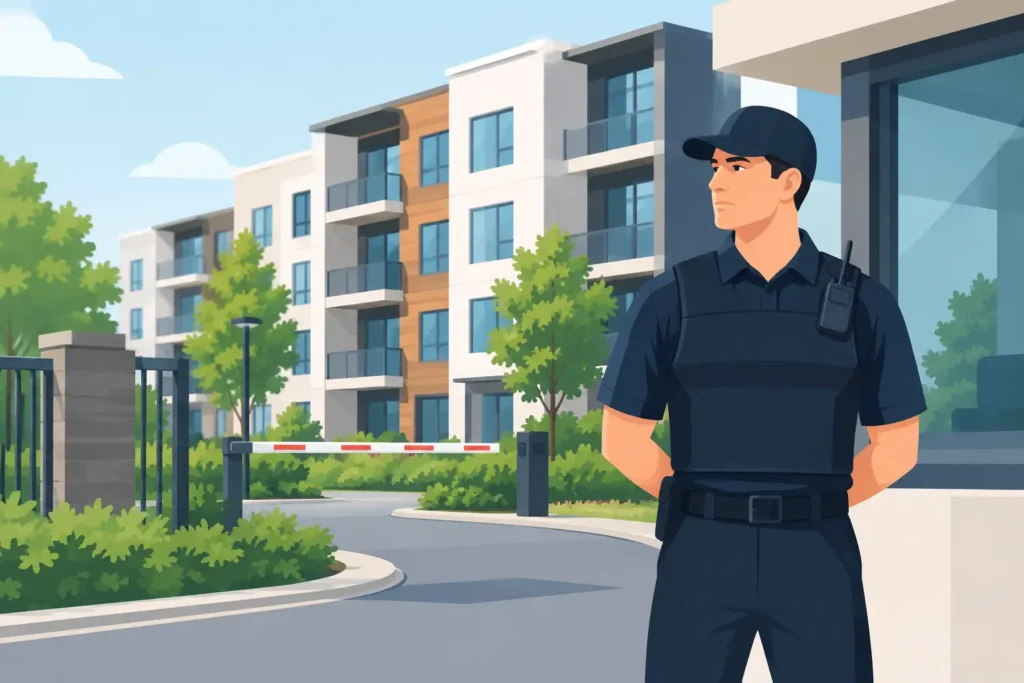
A resident finds an unfamiliar person testing a side gate after dark. A delivery driver is blocked from entering because the call box is damaged. A noise complaint turns into a confrontation in a parking structure. These are the operating conditions apartment complex security guards are hired to manage: not by replacing property management, but by providing a trained, visible presence when rules, access, and resident safety need consistent enforcement.
For Los Angeles-area multifamily properties, security needs rarely fit a generic staffing package. A 30-unit building with one controlled entrance has different exposure than a 300-unit community with open parking, package lockers, multiple pedestrian gates, vacant units, and late-night visitor traffic. The right guard plan starts with the property’s actual vulnerabilities, not a preset number of hours.
What Apartment Complex Security Guards Actually Do
Effective residential security is operational. Officers monitor access points, conduct documented patrols, address observable safety concerns, respond to disturbances, and report incidents to the designated property representative. Their presence can discourage trespassing, vandalism, vehicle break-ins, unauthorized parking, and other opportunistic activity that tends to increase when a site appears unmonitored.
A professional officer also gives residents and onsite staff a clear point of contact when a concern develops. That does not mean a guard should be expected to solve every resident dispute or act as law enforcement. Their role is to observe, communicate, de-escalate when appropriate, enforce established site rules, document facts, and contact emergency services when the situation requires it.
The difference is discipline. An officer working from clear post orders knows which gates must remain secured, how visitor access is handled, which areas require scheduled patrols, who receives an incident report, and when management must be notified immediately. Without those standards, a uniform alone does not provide meaningful protection.
Signs a Property Needs Guard Coverage
Some properties need a standing officer at a lobby, gate, or leasing area. Others are better served by scheduled patrols during evening and overnight hours. The decision depends on risk, resident expectations, layout, and the recurring problems management is trying to control.
Guard coverage deserves serious consideration when incidents are becoming repetitive rather than isolated. Frequent trespassing, vehicle damage, unauthorized occupants, package theft, after-hours disturbances, gate failures, and unsecured common areas are all indicators that the property needs a more visible control measure. A recent break-in or violent incident may also justify immediate temporary coverage while management addresses longer-term repairs or access-control improvements.
Properties undergoing renovation or turnover can face a separate set of concerns. Vacant units, contractor traffic, exposed materials, and temporarily disabled doors create openings that are not present during normal operations. Fire watch may be required in certain situations when a fire protection system is impaired, but it should be treated as a distinct compliance assignment with defined procedures, not as a substitute for general security planning.
Build Coverage Around the Site, Not a Standard Shift
The most useful security assessment follows the path a person would take through the property. Start at the perimeter, then examine vehicle entrances, pedestrian gates, parking areas, mail and package locations, laundry rooms, amenities, leasing offices, stairwells, elevator lobbies, trash enclosures, and vacant units. The goal is to identify where unauthorized entry is likely, where residents feel exposed, and where an officer can make the strongest deterrent impact.
Management should also review incident patterns by time and location. If calls peak between 9 p.m. and 3 a.m., a daytime lobby officer may look professional but fail to address the actual risk. If vehicle-related incidents occur across several lots, a marked patrol vehicle or foot patrol route may provide better coverage than a stationary post. If the issue is unauthorized access through a single gate, controlled entry monitoring may be the priority.
A site-specific plan should address four connected areas:
- Access control, including gates, keys, credentials, visitor procedures, deliveries, and vendor entry.
- Patrol procedures, including routes, frequency, checkpoint expectations, and areas requiring close inspection.
- Incident response, including emergency contacts, escalation thresholds, law enforcement coordination, and resident communication boundaries.
- Reporting, including daily activity records, patrol logs, maintenance hazards, photographs when authorized, and prompt incident reports.
These details turn guard coverage into an accountable operating function. They also help property managers measure whether the service is being performed as contracted.
Armed or Unarmed: Match the Assignment to the Risk
Most apartment communities benefit from professional unarmed officers. An unarmed guard can provide visible deterrence, access monitoring, patrol presence, policy enforcement, and incident documentation without introducing the heightened responsibility associated with an armed post. For many residential settings, that approach aligns with the community environment and the type of incidents commonly reported.
Armed coverage may be appropriate for a property facing a documented elevated threat, repeated violent activity, or a specific high-risk condition. It requires careful planning, properly licensed personnel, clear post orders, and strong supervision. It should not be selected merely because a property wants a more imposing appearance.
The same principle applies to uniforms and patrol vehicles. A marked vehicle can be highly effective for larger properties or locations with broad parking areas because it extends visibility across the site. A uniformed lobby officer may be more effective where visitor screening and resident interaction are the main concerns. The best deployment is the one that directly addresses the exposure.
Reporting Is Part of the Protection
Security coverage is difficult to manage if managers only hear about problems through resident complaints. Reliable reporting provides a record of what officers observed, what action they took, what conditions require maintenance attention, and whether a recurring issue is improving or escalating.
For example, a patrol report may show that a rear pedestrian gate was found unsecured on three separate nights. That information gives management a specific maintenance issue to correct and a documented basis for follow-up. A report that simply says “all clear” provides little operational value.
Incident reports should be factual, timely, and complete. They should identify the date, time, location, involved parties when known, observations, actions taken, notifications made, and any remaining risks. Accurate documentation supports management decisions, insurance matters, vendor coordination, and communication with law enforcement when needed.
Supervision Separates Coverage From Staffing
A contract security provider should not disappear after assigning an officer. Residential properties change constantly: a gate stops working, a construction crew begins arriving earlier, a resident complaint identifies a blind spot, or a nearby incident changes the property’s risk profile. Responsive supervision ensures post orders and patrol expectations are adjusted when conditions change.
Property managers should expect clear communication channels, field oversight, replacement procedures for call-offs, and accountability for officer performance. Ask how patrol activity is verified, who reviews reports, how quickly supervisors respond to concerns, and how the provider handles an officer who is not following post orders. These are practical questions, not administrative details.
At Broadway Security Services, coverage is built around disciplined deployment, licensed and trained guards, responsive supervision, and reporting that gives property management usable information. The objective is not to create unnecessary friction for residents. It is to maintain order, protect access points, and make the property less attractive to unauthorized activity.
Set Expectations With Residents and Staff
Security works best when residents understand what the officer can and cannot do. Management should communicate the purpose of coverage, how to report non-emergency concerns, and when residents should call 911 directly. Guards should be introduced as a safety resource, while their enforcement authority remains tied to property rules and management direction.
Leasing staff, maintenance teams, and vendors also need consistent procedures. If one employee routinely props open a secured door for convenience, or a contractor is allowed to enter without verification, the security plan weakens quickly. Access control only works when the people operating the property follow it.
A well-run guard program gives a property manager more than a person at a post. It creates a documented, visible standard of control at the hours and locations where the property is most exposed. Start with the problems that are actually occurring, define what an officer must do on every shift, and hold the service accountable for doing it.