


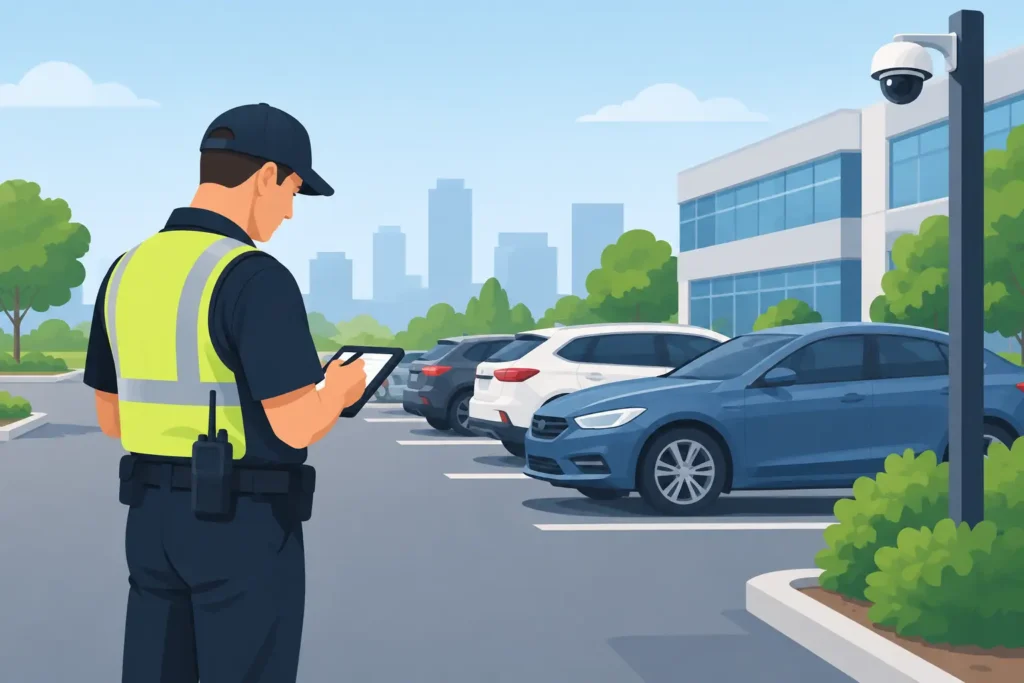
A parking lot can become a liability long before a serious incident occurs. Unauthorized vehicles occupy tenant spaces, delivery lanes are blocked, fire lanes become informal parking areas, and disputes begin at gates, entrances, and loading zones. Parking enforcement security services bring order to these high-traffic areas through a visible officer presence, controlled access monitoring, professional communication, and documented action.
For property managers and facility leaders, the goal is not simply issuing warnings or towing vehicles. Effective parking enforcement protects access, supports safety requirements, preserves customer and tenant experience, and keeps the property operating as intended. The right coverage plan balances firm rule enforcement with the judgment needed to avoid unnecessary disruption.
What Parking Enforcement Security Services Should Control
A parking enforcement assignment must begin with the actual use of the property. A medical office building has different priorities than a multifamily community, construction site, retail center, industrial yard, or event venue. Officers need clear direction on who may park, where they may park, when restrictions apply, and what action is authorized when a violation occurs.
At a commercial property, the immediate concern may be protecting customer parking during business hours and keeping delivery access clear. At an apartment community, the focus may shift to permit compliance, overnight parking, visitor rules, and repeated unauthorized vehicles. An industrial facility may require strict control of employee lots, truck staging areas, emergency routes, and restricted gates.
Professional officers can monitor and document conditions such as blocked fire lanes, disabled parking misuse, expired permits, vehicles left in restricted areas, unauthorized overnight parking, and suspicious activity around parked vehicles. Their presence also discourages vehicle break-ins, vandalism, illegal dumping, and unauthorized access through parking areas that are often less visible than the main building.
Parking enforcement is most effective when it is treated as part of the property’s security operation, not as an isolated task. Officers should understand pedestrian traffic, blind spots, access points, lighting conditions, tenant schedules, and the locations where conflicts regularly develop.
Clear Post Orders Prevent Inconsistent Enforcement
Inconsistent enforcement creates problems quickly. If one officer allows a vehicle to remain in a fire lane while another issues a notice for the same conduct, the property loses credibility and staff members are placed in difficult conversations with tenants, visitors, or vendors.
Site-specific post orders establish a consistent standard. They should identify restricted zones, permit and placard requirements, visitor parking procedures, loading rules, enforcement hours, approved warning methods, towing authorization procedures, escalation contacts, and emergency access requirements. They should also explain how officers should respond when a driver becomes argumentative or refuses to comply.
The best post orders are direct enough for officers to follow under pressure but detailed enough to reduce guesswork. They do not rely on vague instructions such as “keep the lot clear.” They define which areas must remain open, what documentation is required, and when management approval is needed.
This is especially important in Los Angeles-area properties, where parking demand can be high and a single blocked lane can affect deliveries, emergency response, resident access, or event traffic. A disciplined security program gives officers the authority and structure to act promptly while keeping clients informed.
Enforcement Must Be Firm and Professional
Parking enforcement often involves short, tense interactions. A driver may be late, frustrated, unfamiliar with the property, or convinced that an exception should apply. Officers must maintain control without escalating a routine violation into a larger incident.
Licensed and trained guards use a professional approach: identify the issue, communicate the applicable site rule, provide a reasonable direction when appropriate, and document the encounter. If the situation becomes hostile, the officer follows established escalation procedures and requests supervisory or law enforcement support when necessary.
Not every violation requires the same response. A first-time visitor who parked in the wrong area may need direction to the proper space. A vehicle blocking a fire lane, securing a gate from closing, or obstructing emergency access requires immediate action. Repeated violations by a known vehicle may justify stronger enforcement under the property’s approved policies.
That judgment is why security personnel should not be treated as informal parking attendants. They need training, clear authority, reliable supervision, and an understanding of the limits of their role.
Visible Patrols Reduce More Than Parking Violations
A marked patrol vehicle or uniformed officer walking the lot changes behavior. It signals that the area is monitored, that property rules are active, and that violations are likely to be observed and reported. This visible deterrence benefits the entire site.
During parking patrols, officers can identify broken gates, damaged fencing, inoperable lights, hazardous debris, open vehicle doors, abandoned property, and unauthorized persons moving through the lot. They can also monitor for suspicious vehicles circling the property, individuals checking door handles, or activity near loading areas after hours.
This broader awareness matters because parking lots are common transition points. Employees arrive early or leave late. Customers walk to their vehicles with purchases. Residents return after dark. Contractors move equipment through side entrances. A parking operation that only looks for permit violations misses risks that may affect people, property, and business continuity.
Patrol frequency should match the exposure. A quiet office complex may need scheduled checks during peak arrival and departure periods, while a retail center or residential community may benefit from recurring patrols throughout the evening. High-risk locations may require a dedicated on-site officer, gate control, or vehicle patrol coverage that can respond across a larger property.
Documentation Protects the Property and the Client
Accurate reporting is one of the strongest controls in a parking enforcement program. It provides a record of observed violations, warnings issued, requests for tow service, incidents involving drivers, hazards identified, and actions taken by security personnel.
A useful report records the date, time, location, vehicle description, license plate when authorized and appropriate, nature of the violation, photographs when required by policy, officer action, and any notification made to management or emergency services. Reporting should be factual and free of assumptions. It must state what the officer observed and what occurred, not what the officer believes may have happened.
Documentation supports management decisions when repeat offenders need to be addressed. It also helps identify patterns. If fire lane obstructions happen every evening near a particular tenant, the issue may be inadequate signage, poor delivery scheduling, or a site layout problem rather than individual noncompliance alone.
For clients, detailed reports create accountability. They show that officers completed required patrols, responded to concerns, and followed post orders. For the security provider, they support supervision and allow managers to correct gaps before they become recurring problems.
Towing Requires Controlled Procedures
Towing is often necessary, but it should never be handled casually. California properties must follow applicable laws, posted notice requirements, and property-specific authorization procedures. A security officer’s role is to observe, document, communicate, and coordinate within the authority granted by the client and the governing rules.
Before a tow is requested, officers should verify the violation, confirm that the location is covered by the property’s policy, document the vehicle and condition, and notify the appropriate contact when approval is required. The process should be consistent for every driver. Selective or poorly documented enforcement can create disputes and damage tenant or customer relationships.
There are situations where immediate removal is justified, particularly when a vehicle blocks emergency access, creates a safety hazard, or prevents essential operations. Even then, disciplined documentation remains necessary. The objective is to restore safe access, not to punish a driver.
Choosing the Right Level of Coverage
The right parking security plan depends on the property, the volume of vehicles, the hours of activity, and the consequences of uncontrolled access. Some sites need periodic checks by a marked vehicle patrol. Others need a uniformed officer at the entrance during operating hours, overnight enforcement rounds, or dedicated coverage during events and high-traffic periods.
When evaluating a provider, ask whether officers will receive site-specific post orders, who supervises field performance, how incidents are reported, and how quickly management can adjust coverage when conditions change. Also ask how the provider handles conflict, towing coordination, emergency access, and repeat violations. These operational details determine whether a program will remain consistent after the first week.
Broadway Security Services designs parking enforcement coverage around actual site conditions, including traffic patterns, access points, operating schedules, and known vulnerabilities. Licensed guards, responsive supervision, visible patrol procedures, and reliable incident reporting give clients a controlled approach to parking issues without losing sight of the wider security environment.
A well-managed parking area tells tenants, employees, visitors, and vendors that the property is actively protected. When rules are clear, officers are present, and every significant action is documented, parking stops being a daily source of friction and becomes a controlled part of site operations.