

A single four-hour window of fire system impairment is all it takes for California authorities to mandate an immediate site shutdown or an emergency professional intervention. You recognize that staying ahead of shifting fire watch regulations California enforces is no longer a matter of simple paperwork; it’s a rigorous operational discipline. The anxiety of facing a Cal/OSHA audit or a massive liability claim during a system outage is a reality for every responsible facility manager. You need more than just a checklist. You need a tactical strategy that ensures your site remains a fortified environment, regardless of technical failures.
This 2026 strategic guide promises to demystify the complexities of the new Wildland-Urban Interface standards and the mandatory digital documentation protocols now required for high-rise compliance. We’ll provide the clarity you need to bridge the gap between Title 8 and Title 19 requirements while maintaining uninterrupted business operations. We’ll detail the specific triggers for 2026 compliance, the role of certified oversight, and the methodical reporting standards that satisfy the most stringent fire marshal inspections. By the end of this briefing, you’ll understand how to implement a professional fire watch that serves as a disciplined shield, protecting your assets from both fire risks and legal repercussions.
Key Takeaways
- Identify the critical intersections between the California Fire Code and Cal/OSHA to maintain a legal and disciplined operational environment.
- Master the fire watch regulations California enforces to ensure your site remains operational during system failures or mandated hot work.
- Establish a methodical patrol rhythm and standardized documentation protocols that satisfy the most rigorous fire marshal inspections.
- Navigate the specialized requirements of the Los Angeles Fire Department (LAFD) and the unique wildfire risks specific to the San Fernando Valley.
- Ensure business continuity by deploying personnel who act as a disciplined shield against liability and catastrophic loss.
Understanding the California Fire Watch Legal Framework: Title 19 and CFC 901.7
The legal landscape for fire protection in California is a multi-layered hierarchy designed for absolute redundancy. At its core, the definition of fire watch serves as a proactive, human-led safety protocol initiated when automated systems fail. Compliance isn’t a suggestion; it’s a mandatory operational standard enforced by overlapping jurisdictions. You must understand the distinction between the California Fire Code (CFC), which governs the physical structure and its systems, and Cal/OSHA’s Title 8, which dictates the safety of the personnel within those structures. While Title 8 focuses on labor protection, the fire watch regulations California mandates under Title 19 and the CFC ensure the building itself doesn’t become a lethal hazard.
Local fire authorities hold the ultimate power to mandate 24/7 monitoring if they deem a site’s internal defenses compromised. This authority is absolute. If an inspector determines that your facility’s fire-suppression capabilities are inadequate, they can order an immediate fire watch or even a full evacuation. Professional oversight acts as a disciplined shield during these vulnerable periods. Broadway Security Services ensures that your property remains operational and compliant with the highest safety standards by providing constant, methodical observation.
The Role of the California Fire Code (CFC) Section 901.7
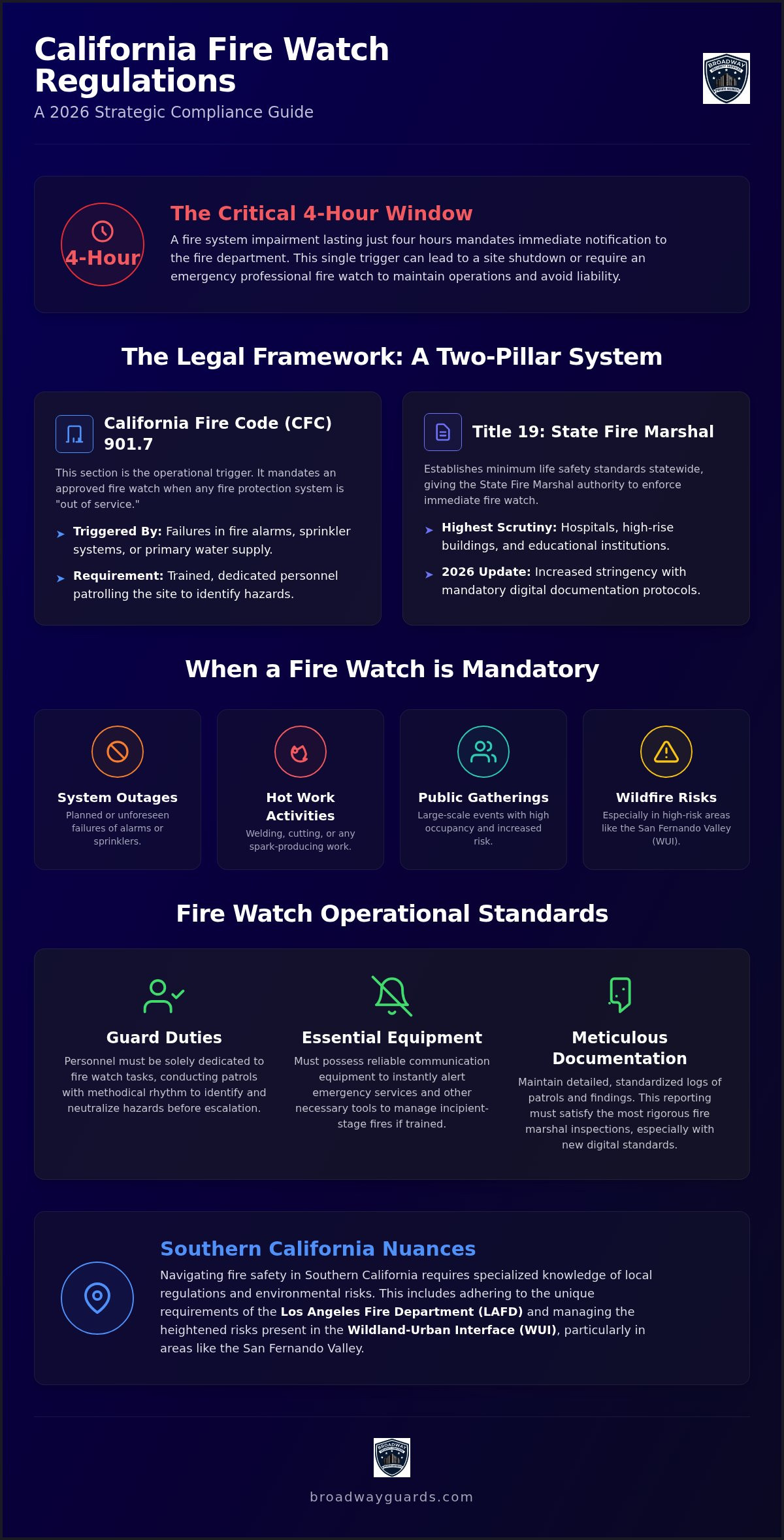
Section 901.7 of the CFC provides the operational trigger for fire watch deployment. When fire protection systems are “out of service,” the code demands an approved fire watch until the system is fully restored. A system is considered out of service if there’s a failure in the fire alarm, the automatic sprinkler system, or the primary water supply. Accuracy in reporting is critical. Under the 4-hour rule, you must notify the local fire department if a system remains impaired for four hours or more within a 24-hour period. This notification is a legal requirement that signals the transition from automated protection to human vigilance. An “approved” fire watch requires trained personnel who are solely dedicated to patrolling the site and identifying hazards. They must maintain detailed logs and possess the equipment necessary to alert emergency services instantly.
Title 19: The State Fire Marshal’s Mandate
Title 19 of the California Code of Regulations establishes the minimum standards for life safety across the state. This regulation grants the State Fire Marshal the authority to enforce immediate fire watch implementation in public-facing facilities. Hospitals, high-rise residential complexes, and educational institutions face the most rigorous oversight under Title 19. These environments require a higher standard of vigilance because the stakes of a failure are catastrophic. The State Fire Marshal’s mandate ensures that even if local resources are strained, the state’s baseline for human safety remains unyielding. As of 2026, these standards have become even more stringent with the integration of digital documentation requirements. Broadway Security Services aligns its protocols with these state-level mandates while navigating the evolving fire watch regulations California enforces for high-occupancy buildings. This ensures that all reporting meets the exact specifications of Title 19 inspectors.
Mandatory Triggers: When Does California Law Require a Fire Watch?
Compliance with fire watch regulations California mandates is not a matter of managerial discretion. It is a legal necessity triggered by specific environmental and operational shifts. Management must recognize three primary catalysts for an immediate fire watch: planned system outages, unforeseen equipment failures, and high-risk hot work activities. Ignoring these triggers invites immediate site shutdowns by the local Fire Marshal. Large-scale public gatherings also require a dedicated watch to manage the increased life-safety risks associated with high occupancy. These events demand a disciplined presence to ensure exit paths remain clear and hazards are neutralized before they escalate.
A single oversight during a system outage can lead to a complete operational freeze. These regulations are designed to bridge the gap between technical failure and human response. You must be prepared to deploy personnel the moment a trigger is identified. Whether it’s a planned upgrade or an emergency repair, the law is unyielding. Broadway Security Services provides the rigorous oversight necessary to satisfy every regulatory trigger. Our Fire Watch Services act as your site’s defensive perimeter when technical systems are down.
Hot Work Compliance Under Title 8 Section 4848
Under the California Code of Regulations, Title 8, any operation involving welding, cutting, or brazing is classified as hot work. This classification demands a dedicated fire watcher whose sole responsibility is fire detection. You cannot assign this task to the person performing the work. The mandate requires a continuous watch during the operation and for at least 30 minutes after the work concludes. If the environment contains significant combustible materials, local authorities may extend this observation period to several hours. This protocol prevents smoldering embers from igniting long after the crew has departed. Employers are responsible for providing a watcher who is fully trained in the use of fire extinguishers and emergency communication protocols.
System Impairments and Planned Maintenance
Scheduled maintenance shouldn’t lead to legal vulnerability. When you plan a fire system upgrade or a Tenant Improvement (TI) project, you must have a fire watch strategy in place before the first alarm is disabled. Emergency failures, such as a burst sprinkler pipe or a shorted control panel, require even faster deployment. Utilizing a professional security risk assessment CA allows you to identify these vulnerabilities before they result in a citation. A methodical checklist for TI projects should include notifying the fire department, securing professional guards, and verifying that all manual extinguishers are staged and functional. This structured approach ensures that your assets remain protected during periods of technical transition.
Operational Standards: Guard Duties, Equipment, and Documentation
Operational standards for fire watch are built on a foundation of unyielding discipline. Every guard must follow a strict patrol rhythm. This is not a casual walk-through; it is a methodical sweep of the entire property. The “No Other Duties” rule is absolute. Under the fire watch regulations California enforces, personnel assigned to this task must perform no other functions that distract from their primary mission. They are a dedicated force. Mandatory equipment for every guard includes a reliable means of communication, a high-powered flashlight, a timer, and a portable fire extinguisher. They must also wear appropriate Personal Protective Equipment (PPE) to ensure their own safety while protecting your assets. Adhering to the fire watch regulations California mandates ensures that your facility remains a safe and orderly environment.
A fire watch log is not merely a record. It is a legal shield in liability defense. If an incident occurs, your documentation proves that you maintained the required standard of care. These standards align with the California Code of Regulations, Title 8, which mandates that fire watch personnel remain vigilant and unencumbered by secondary tasks. Failure to maintain these standards can result in severe penalties and the immediate cessation of business activities. Professional oversight provides the accountability needed to satisfy both insurance carriers and fire marshals.
The Disciplined Patrol: Frequency and Scope
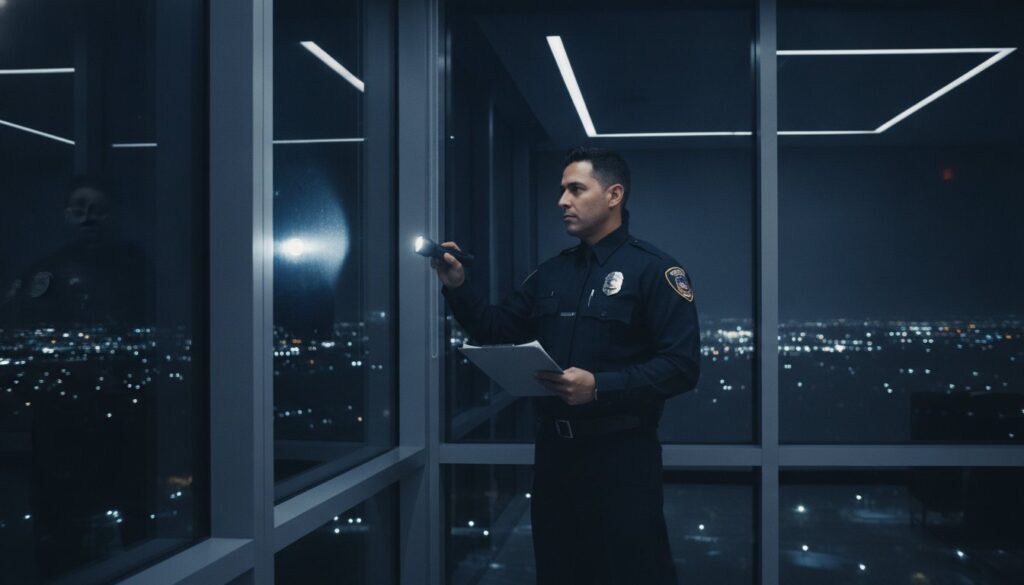
The frequency of patrols depends on the risk level of the site. High-risk environments, such as construction sites with active hot work or high-rise residential complexes with impaired systems, often require 15-minute intervals. Standard commercial sites may follow a 30-minute rhythm. During these rounds, guards must monitor for specific hazards like smoke, unusual odors, or sparks. They also ensure that all fire exits remain unobstructed and fire extinguishers are accessible. If a fire is detected, the protocol is immediate: activate the alarm, call 911, and assist with evacuation. There is no room for hesitation in a high-stakes environment.
Maintaining a Compliant Fire Watch Log
Every patrol must be documented with precision. A compliant log includes the date, the exact time of each round, the specific areas inspected, and the guard’s signature. These entries must be made in real-time to ensure accuracy. Local authorities, including the LAFD, have strict retention requirements for these logs, requiring they be kept on-site and available for inspection at all times. Utilizing professional fire watch services California ensures that every entry is time-stamped and stored in a secure environment. This automation removes the risk of human error and provides an indestructible trail of compliance for any future audit.
Southern California Nuances: LAFD and San Fernando Valley Requirements
Navigating fire watch regulations California mandates requires a deep understanding of local jurisdictions, particularly within the City of Los Angeles. The Los Angeles Fire Department (LAFD) maintains an uncompromising stance on life safety. In regions like the San Fernando Valley, the intersection of urban density and wildland-urban interface (WUI) zones creates a high-stakes environment. Local ordinances in neighborhoods such as Canoga Park often exceed state-level minimums. For example, the 2026 Los Angeles County Amendments require a fire watch if a fire alarm system is impaired for four or more hours in a 24-hour period. These localized pressures demand a security partner capable of rapid deployment and precise execution. Working with a locally based firm like Broadway Security Services ensures that guards arrive on-site before a temporary outage becomes a permanent shutdown.
LAFD Chief’s Regulation No. 4 and Fire Watch
Chief’s Regulation No. 4 (Reg 4) is the cornerstone of fire safety in Los Angeles. It mandates the rigorous testing of fire protection systems at specific intervals to ensure they function as designed. When these tests uncover impairments, the LAFD requires an immediate, professional fire watch. While some managers attempt to use in-house staff, the LAFD maintains high expectations for documentation and vigilance that internal employees rarely meet. In-house staff often lack the specialized training required to identify subtle fire hazards or manage complex evacuation protocols. Non-compliance within the City of Los Angeles results in steep fines and potential building closures. A disciplined, professional presence ensures that Reg 4 deficiencies don’t escalate into legal or physical catastrophes. Broadway Security Services provides the authoritative oversight needed to satisfy LAFD inspectors during these critical system outages.
High-Risk Monitoring for Canoga Park Construction
Construction projects in Canoga Park and the wider San Fernando Valley face unique vulnerabilities. The presence of combustible building materials and the frequency of hot work create a constant threat. Deploying specialized construction site security guards ensures that fire monitoring is integrated into a broader perimeter defense strategy. These professionals monitor for unauthorized entry while maintaining a methodical fire watch rhythm. This dual-layered approach is essential for large-scale urban developments where arson and accidental fires are equally dangerous risks. Broadway Security Services serves as the disciplined shield for Valley businesses, ensuring that local regulatory nuances never compromise operational continuity. For immediate compliance support in the San Fernando Valley, secure your site with the professional fire watch personnel from Broadway Security Services today.
Securing Your Assets with Broadway’s Disciplined Fire Watch Personnel
Broadway Security stands as the authoritative choice for environments where compliance is non-negotiable. We recognize that fire watch is not a passive task. It is a high-stakes security operation that requires unwavering attention. By deploying our personnel, you eliminate the human error factor that often leads to costly citations or site shutdowns. Our approach treats every assignment as a mission to preserve life and property. This disciplined oversight ensures that your facility remains fully aligned with the fire watch regulations California enforces, providing peace of mind during technical vulnerabilities. We act as a professional shield between your assets and the risks of non-compliance.
Professional oversight is the only reliable method to satisfy the rigorous demands of state and local fire authorities. Our personnel are trained to maintain a presence that is both observant and prepared. We don’t just fill a requirement; we establish a standard of safety that protects your business continuity. Every guard is an extension of our commitment to regulatory excellence and operational rigor.
The Broadway Standard: Training and Discipline
Our unarmed security guards undergo rigorous training that mirrors military-level protocols. They are taught to identify risks that others might overlook. This includes specific training in risk assessment, which serves as the first step in our compliance strategy. We prioritize order and hierarchy in our reporting. This ensures that every patrol is logged with absolute accuracy. Our commitment to professional discipline creates a secure environment where safety is the standard, not an afterthought. You can trust that our personnel will maintain their post with the vigilance your property requires.
Immediate Deployment for Emergency Compliance
When a Fire Marshal issues an immediate watch order, time is your greatest enemy. Broadway provides rapid response capabilities across Los Angeles and the San Fernando Valley to meet these emergency staffing needs. Our team manages the entire transition. We start with an immediate risk assessment to identify hazard zones. We then initiate active monitoring to maintain site continuity and satisfy the fire watch regulations California mandates. This fast-action protocol prevents the loss of operational hours and keeps your site within legal boundaries. Don’t risk a shutdown due to inadequate coverage or administrative delays. Contact Broadway Security for Emergency Fire Watch Services to secure your assets with a disciplined shield.
Fortifying Your Future: Achieving Unyielding Compliance
Maintaining a secure environment requires constant vigilance and a deep understanding of the fire watch regulations California enforces. You’ve seen that compliance is not merely about checking boxes; it’s a disciplined operational necessity. By mastering the triggers of system impairment and the specific mandates of the LAFD, you protect your business from both physical fire risks and severe legal penalties. Methodical patrols and precise documentation are the only ways to satisfy regulatory credentials and reduce liability during outages. These protocols ensure that your assets remain under the care of a vigilant and unyielding force.
Broadway Security provides the professional oversight needed to navigate these high-stakes requirements. We offer California-certified security personnel who deliver disciplined oversight for San Fernando Valley businesses. Our team ensures you have compliance-ready fire watch documentation that withstands the most rigorous inspections. You don’t have to face these regulatory pressures alone. Professional assistance is the most reliable way to ensure your site remains operational and secure. Take the first step toward total site security today.
Secure Your Site with Professional Fire Watch Services
Frequently Asked Questions
What is the difference between a fire watch and regular security patrol?
A fire watch is a specialized safety protocol mandated specifically when fire protection systems are offline or during high-risk activities like hot work. Unlike regular security, which focuses on access control and crime prevention, fire watch personnel have the sole responsibility of identifying fire hazards and ensuring immediate evacuation. They must remain unencumbered by secondary duties to maintain compliance with the rigorous fire watch regulations California enforces for property protection.
How long must a fire watch continue after hot work is completed in California?
California law requires a fire watch to be maintained for at least 30 minutes after all welding, cutting, or brazing operations conclude. This observation period is critical for detecting smoldering embers that could ignite long after the work ends. In high-risk environments or specific jurisdictions, the fire marshal may extend this requirement to several hours to ensure the environment is completely stabilized and safe for unmonitored occupancy.
Can my existing employees perform a fire watch under Cal/OSHA rules?
Existing employees can technically perform a fire watch provided they are fully trained and have no other duties during their patrol. Cal/OSHA and Title 19 require that personnel assigned to fire watch are dedicated exclusively to that task. If an employee is distracted by their normal job functions, your site is in violation of state safety standards. Most firms choose professional services to eliminate this inherent liability and ensure disciplined oversight.
What equipment is a fire watch guard legally required to carry in California?
Every fire watch guard must be equipped with a reliable means of communication, such as a two-way radio or cell phone, and a high-powered flashlight. They are also required to carry a portable fire extinguisher and a timer to ensure patrol intervals are met with precision. Proper Personal Protective Equipment (PPE) and a dedicated logbook for real-time documentation are mandatory to satisfy the operational standards of the fire watch regulations California mandates.
When should I notify the local fire department about a system outage?
You must notify the local fire department if a fire protection system is impaired for four hours or more within a 24-hour period. This is a standard requirement under the California Fire Code Section 901.7. Failing to report an outage of this duration can lead to immediate citations or an order to evacuate the premises until a professional watch is established and verified by an inspector.
What are the specific penalties for failing to provide a fire watch in Los Angeles?
Failure to provide a mandated fire watch in Los Angeles can result in steep financial penalties and immediate site shutdowns. The LAFD has the authority to issue violation orders that can lead to building closures if the life-safety risk is deemed extreme. Beyond government fines, the lack of a disciplined watch significantly increases your liability exposure and may result in the denial of insurance claims following an incident.
Is a fire watch required for residential complexes in the San Fernando Valley?
Yes, residential complexes in the San Fernando Valley must implement a fire watch if their alarm or sprinkler systems are compromised. This is particularly critical for high-occupancy buildings and those located within Wildland-Urban Interface (WUI) zones where brush fire risks are elevated. Adhering to these standards ensures that residents are protected even when automated technical defenses fail, maintaining an orderly and safe environment.
How does Broadway Security ensure fire watch logs are legally defensible?
Broadway Security utilizes a methodical approach to documentation that prioritizes accuracy and accountability. Every patrol entry is time-stamped and recorded in real-time to create an indestructible trail of compliance. This disciplined reporting removes the risk of human error and provides a robust defense against liability claims by proving that the required standard of care was maintained throughout the duration of the system outage.