


A single static guard cannot be everywhere at once, and criminals know it. If your California property sits exposed during off-hours, relying on a fixed post isn’t a security strategy; it’s a gamble. The businesses and property managers who’ve discovered the true power of mobile patrol services California understand a fundamental truth: unpredictable, high-visibility presence is one of the most effective deterrents a property can have.
You already know the frustration. Trespassing incidents spike after dark, traditional security staffing costs strain your budget, and your current provider can’t produce a clear record of what actually happened on your property last night. That accountability gap is where risk lives.
This guide is built to close that gap. You’ll learn exactly how a disciplined mobile patrol operation works, what separates a professional service from a drive-by checkbox, and what standards of reporting and response you should demand from any provider protecting your assets. From the initial risk assessment to the moment a patrol unit responds to a triggered alarm, you’ll leave with a clear framework for securing your property with precision, accountability, and visible force.
Key Takeaways
- Professional mobile patrol services California properties rely on go far beyond periodic drive-bys — disciplined tactical inspections with GPS-tracked routes are the standard that separates accountable providers from checkbox operations.
- The size of your perimeter and the nature of your assets determine whether mobile patrol, stationary guards, or a hybrid deployment is the right force structure for your property.
- Any patrol provider operating in California must hold a valid Private Patrol Operator (PPO) license issued through the Bureau of Security and Investigative Services (BSIS) — verifying this credential is a non-negotiable first step before signing any contract.
- Scannable, digital reporting transforms mobile patrol from a visible deterrent into a documented accountability system, closing the gap between what happened on your property and what you can prove.
- A professional risk assessment is the foundation of an effective patrol plan — understanding your specific threat profile before deployment is what converts general presence into precision protection.
The Strategic Necessity of Mobile Patrol Services in California
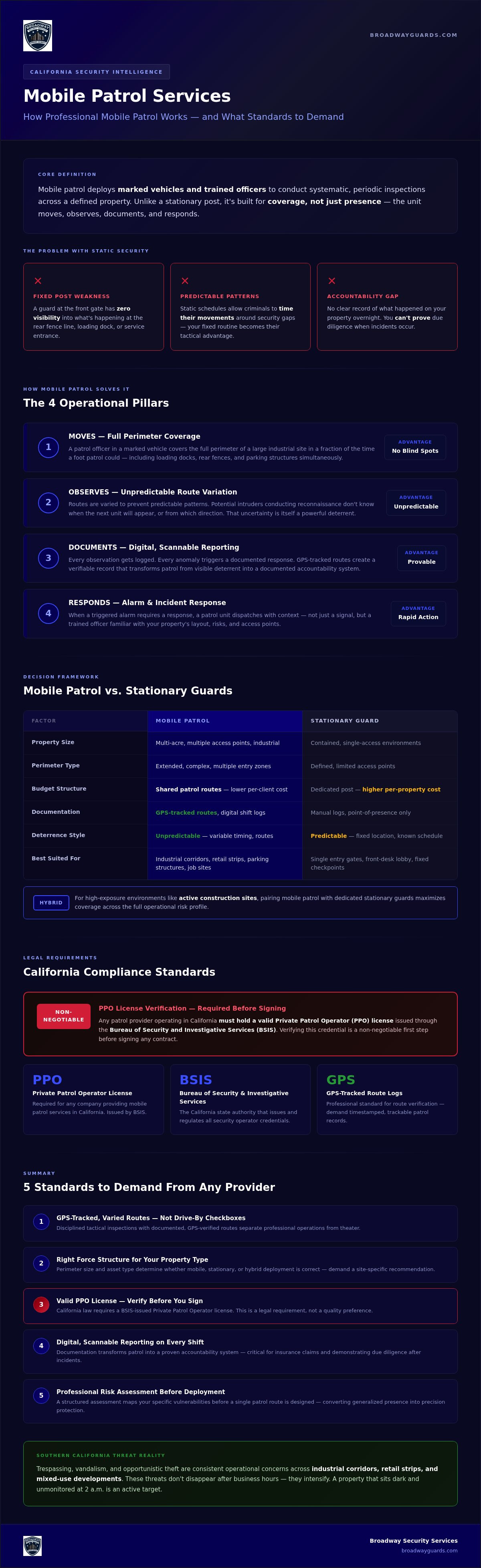
Mobile patrol is a tactical security solution that deploys marked vehicles and trained officers to conduct systematic, periodic inspections across a defined property or set of properties. Unlike a stationary post, it’s built for coverage, not just presence. The unit moves, observes, documents, and responds, creating a dynamic security perimeter that adapts to the actual geography of your risk.
Southern California’s commercial zones are under measurable pressure. Trespassing, vandalism, and opportunistic theft have become consistent operational concerns for property managers across industrial corridors, retail strips, and mixed-use developments. The conditions that drive these incidents don’t disappear after business hours; they intensify. A property that sits dark and unmonitored at 2 a.m. is a target. The question isn’t whether the threat exists. It’s whether your security architecture is structured to meet it.
Addressing the Vulnerabilities of Expansive Properties
Stationary security works well within defined, contained environments. Place a guard at a single access point, and that point is covered. But the moment your perimeter extends across multiple acres, loading docks, parking structures, and service entrances, fixed posts create blind spots by design. A patrol officer stationed at the front gate has no visibility into what’s happening at the rear fence line.
Mobile units resolve this structurally. A trained officer in a marked patrol vehicle can cover the full perimeter of a large industrial site in a fraction of the time it would take on foot, and the route can be varied to prevent predictable patterns. That unpredictability is itself a deterrent. Potential intruders conducting reconnaissance on a property don’t know when the next unit will appear, or from which direction. High-visibility patrol vehicles communicate one clear message: this property is actively monitored.
Cost-Efficiency Without Compromising Professionalism
For small to mid-sized businesses, the economics of dedicated stationary security can be prohibitive. Shared patrol routes offer a disciplined alternative: multiple properties within a defined zone receive regular, documented checks without each client bearing the full cost of a dedicated post. The result is professional-grade coverage at a structure that fits realistic operational budgets.
There’s also a liability dimension that’s easy to overlook. Consistent, documented property checks create a verifiable record of due diligence. When an incident does occur, that documentation matters, both for insurance purposes and for demonstrating that reasonable security measures were in place. For high-exposure environments like active job sites, pairing mobile patrol with purpose-built construction site security guards maximizes coverage across the full operational risk profile.
Effective deployment of mobile patrol services California properties depend on begins with a structured security risk assessment. That assessment maps your specific vulnerabilities before a single patrol route is designed, ensuring that every shift delivers precision protection rather than generalized presence.
Operational Rigor: The Mechanics of a Disciplined Shield
A patrol unit that simply drives past your property and continues down the road isn’t security. It’s theater. The standard that separates professional mobile patrol services California properties can rely on from a checkbox operation is operational rigor: the disciplined execution of tactical inspections, verifiable through documentation, on every single shift.
Marked vehicles and uniformed officers communicate presence. What clients can’t see from the outside is the systematic structure that makes that presence meaningful. Professional execution means every patrol hit follows a defined protocol, every observation gets logged, and every anomaly triggers a documented response. The vehicle is visible. The system behind it is what protects you.
Tactical Patrol Protocols and Unpredictable Routes
Fixed patrol schedules are a vulnerability, not a feature. A property receiving security checks at 10 p.m., 2 a.m., and 4 a.m. every night is a property that can be cased and exploited during the predictable gaps. Professional patrol operations eliminate that exposure through randomized interval deployment: patrol hits are varied in timing and sequence, so no observable pattern exists for a potential intruder to exploit.
This unpredictability is structural deterrence. Someone conducting reconnaissance on your facility cannot determine when the next unit will arrive or which entry point it will check first. Each patrol hit follows a structured Standard Operating Procedure that includes:
- Perimeter integrity checks: Physical inspection of fencing, gates, and access barriers for signs of tampering or forced entry
- Door and lock verification: Confirming all secured entry points remain locked and undisturbed
- Lighting and visibility assessment: Identifying dark zones or obstructions that create concealment opportunities
- Vehicle and occupancy verification: Noting unauthorized vehicles, individuals, or activity inconsistent with normal site conditions
GPS-tracked routes enforce accountability on every one of these checks. Every patrol unit’s position is logged in real time, creating an irrefutable record of where officers were, when they arrived, and how long each inspection took. There’s no ambiguity, and there’s no room for shortcuts.
Advanced Reporting and Accountability Systems
Documentation is where professional patrol operations separate themselves decisively from competitors who “briefly mention GPS tracking” without explaining what that data actually produces. A professional patrol report isn’t a handwritten note. It’s a timestamped digital log that includes officer location data, site condition observations, photographic verification of key checkpoints, and a clear incident notation protocol.
Photo and video verification captured during each patrol hit gives clients objective evidence of site conditions at the time of inspection. If a gate was secured at 1:47 a.m. and a break-in is reported at 3:15 a.m., the documentation establishes a precise timeline. That record matters for insurance claims, law enforcement reports, and liability defense.
Field supervision adds a second layer of accountability. Officers don’t operate in isolation; their performance is monitored against the documented patrol record, ensuring vigilance remains consistent across every shift and every property. If you want to understand how Broadway Security structures this accountability framework from the initial deployment stage, speak with their patrol operations team directly about their reporting standards before committing to any provider.
Mobile Patrol vs. Stationary Guards: Choosing the Right Force
The wrong deployment model doesn’t just waste budget; it creates false confidence. A stationary guard protecting a 40-acre industrial complex isn’t securing the property. They’re securing one point on it. Choosing between mobile patrol and stationary coverage isn’t a cost question. It’s a structural question that starts with an honest assessment of your property’s actual threat geography.
The core distinction is this: stationary guards deliver constant presence at a defined location, while mobile units deliver dynamic coverage across an entire perimeter. Neither is universally superior. What determines the right choice is the relationship between your perimeter size, the nature of your highest-value assets, and the specific threat patterns your property faces.
Properties where the primary risk is concentrated at a single, controlled access point, a high-security server room, a cash-handling facility, a VIP entrance, benefit from a dedicated stationary post. The guard’s constant visibility and immediate physical presence at that specific location is the right tool for that specific problem. Extend that same logic to a sprawling multi-building campus, and the model breaks down entirely.
When Mobile Patrol is the Superior Strategy
Certain property types are structurally suited to mobile patrol as the primary security layer. Gated communities with extended perimeter roads, multi-level parking structures, large warehouses with multiple loading dock access points, and vacant commercial properties all share a common characteristic: the threat can originate from any point along a wide perimeter, not just a single entry. Deploying a stationary officer in these environments means accepting that most of your property is unmonitored most of the time.
Mobile patrol also solves a problem that rarely gets discussed openly: complacency. A stationary officer assigned to the same post, same shift, same environment for months faces a documented psychological challenge. Alertness degrades. Routine breeds inattention. Mobile patrol officers, by contrast, are in constant motion, actively observing changing conditions across varied environments. The operational structure itself maintains vigilance in a way that a fixed post cannot replicate.
For property managers overseeing multiple adjacent sites, a single mobile patrol contract covering all locations under one structured route is operationally efficient and provides consistent documentation across every property. That consolidated accountability matters when you need to demonstrate due diligence across an entire portfolio.
The Hybrid Model: Total Perimeter Dominance
The most effective security architecture for high-risk properties isn’t a choice between mobile and stationary; it’s a deliberate integration of both. A static post controls the primary access point with constant, visible presence. Mobile units cover the perimeter, respond to alarm triggers, and conduct systematic inspections of secondary access points throughout the shift. Each layer reinforces the other.
This hybrid approach becomes critical when the threat profile demands an escalated response capability. Integrating mobile patrol units with armed security guard services Los Angeles properties require for high-risk environments creates a force structure with both deterrence and response capacity. The stationary armed officer holds the controlled point; the mobile unit extends command across the full perimeter.
Consider the operational demands of a 50-acre active construction site in the San Fernando Valley. Equipment theft, unauthorized access, and material loss are persistent risks across every perimeter point simultaneously. A single stationary post cannot address that exposure. The effective deployment model pairs a controlled entry post, staffed by a dedicated guard managing access credentials and contractor verification, with mobile patrol units conducting randomized perimeter checks throughout the night. When the site also carries fire watch obligations, those mobile units can integrate fire watch protocols directly into their patrol routes, eliminating the need for a separate deployment and ensuring continuous compliance without gaps in either security or fire watch coverage.
The rapid response dimension of mobile patrol is where the model proves its value most decisively. When an alarm triggers at 2 a.m., a stationary guard at the front gate cannot respond to a breach at the rear fence line without abandoning their post. A mobile unit in the field responds immediately, arrives at the triggered point within minutes, and documents conditions in real time. That response architecture is what separates genuine perimeter protection from a security presence that looks credible but can’t actually close the gap when it matters.
For properties evaluating this decision, pairing mobile patrol with unarmed security guards at interior high-value locations gives you full-spectrum coverage: mobile units own the perimeter, stationary officers protect the assets inside it. That’s the force structure that professional mobile patrol services California providers should be designing for you from the first risk assessment conversation.
Compliance and Standards for California Security Patrols
Choosing a patrol provider without verifying their regulatory standing isn’t just an oversight. It’s a liability. California maintains one of the most structured security licensing frameworks in the country, and any company offering mobile patrol services California properties depend on must operate under the direct authority of the Bureau of Security and Investigative Services (BSIS). That credential isn’t a formality. It’s the legal foundation that separates a professional operation from an unaccountable one.
Regulatory Credentials and Professional Legitimacy
Every patrol company operating in California must hold a valid Private Patrol Operator (PPO) license issued by BSIS. This is non-negotiable. Before signing any contract, verify the provider’s PPO license number directly through the BSIS public license lookup tool. An unlicensed operator exposes your property, your tenants, and your business to consequences that no security contract can protect you from.
BSIS training standards govern what every registered security officer must complete before stepping into the field. These include mandatory pre-assignment training hours covering legal powers of arrest, emergency response protocols, and professional conduct standards. Individual officers must also carry a valid BSIS guard card, which requires both initial training and ongoing continuing education to maintain. Patrol officers who interact with trespassers operate under California Penal Code Section 837, which defines the precise legal boundaries of a private person’s arrest authority. Professional providers train their officers to these standards with precision, because a violation of those boundaries creates legal exposure for the property owner, not just the officer.
Broadway Security structures its field personnel to exceed state-mandated minimums, not simply satisfy them. The distinction matters operationally: an officer trained only to the baseline threshold is prepared for compliance. An officer trained beyond it is prepared for the field conditions your property actually presents.
Liability Protection and Detailed Documentation
Professional patrol logs serve a function that extends well beyond shift records. In a legal dispute, a timestamped, GPS-verified patrol report is objective evidence of site conditions at a documented moment in time. It establishes what was observed, what was secured, and when. Insurance carriers increasingly require proof of regularly scheduled property inspections to validate coverage for theft, vandalism, and trespassing claims. A patrol provider that can’t produce verifiable documentation isn’t just operationally weak; it’s a gap in your policy compliance.
For properties with fire code obligations, this documentation standard extends further. Integrating fire watch services California regulations require into your patrol deployment creates a unified compliance record covering both security and fire watch protocols within a single documented framework. That consolidation matters when an insurer or a code enforcement officer asks for proof of diligence across both domains.
Compliance isn’t a background consideration. It’s the structural integrity of your entire security investment. Contact Broadway Security to verify credentials and review the reporting standards your patrol provider should be delivering on every shift.
Securing Your Perimeter with Broadway Security Services
Every security decision your business makes carries consequences. The provider you choose either closes your exposure or quietly extends it. Broadway Security Services exists to close it, deploying professional mobile patrol services California businesses in the San Fernando Valley and Canoga Park depend on to protect their assets, their people, and their operational continuity.
Localized Expertise in the San Fernando Valley
Canoga Park and the broader San Fernando Valley present a distinct security environment. Commercial corridors here face persistent challenges including catalytic converter theft, warehouse break-ins, and after-hours trespassing across industrial and retail properties. These aren’t abstract crime statistics; they’re the operational reality your property faces each night. Broadway Security’s deployment is structured around that local intelligence, not generic patrol templates imported from outside the region.
Localized deployment means faster response. When a patrol unit is already operating within your geographic zone, response times to triggered alarms or reported incidents are measured in minutes, not in the time it takes a distant provider to route a unit across the valley. That proximity is a tactical advantage, and it’s built into how Broadway structures its patrol coverage from the ground up.
Southern California firms need a disciplined shield, not a visible suggestion of security. Unpredictable patrol intervals, GPS-verified route documentation, and trained officers who understand the specific geography of your property aren’t optional features. They’re the baseline standard Broadway delivers on every shift.
Initiating Your Strategic Security Plan
Effective patrol protection doesn’t begin with a vehicle on your property. It begins with a professional consultation that maps your specific vulnerabilities before a single route is designed. Broadway Security’s process moves through a structured sequence:
- Site vulnerability assessment: Identifying perimeter gaps, lighting deficiencies, access point exposures, and patterns of prior incidents specific to your location
- Customized patrol route design: Building a route that maximizes visibility across your highest-risk zones while maintaining the unpredictable intervals that make patrol an effective deterrent
- Reporting framework configuration: Establishing the digital documentation standards your property requires, including checkpoint verification, incident notation protocols, and client-facing reporting access
- Deployment and ongoing oversight: Active patrol operations with field supervision maintaining performance standards across every shift
The transition from assessment to active protection is deliberate and documented. You don’t receive a patrol vehicle and a handshake. You receive a structured security architecture built around your property’s actual threat profile.
Your perimeter deserves more than a drive-by. Contact Broadway Security Services today to schedule your professional consultation and begin building a patrol plan that delivers authoritative presence, unyielding vigilance, and the transparent reporting your assets demand.
Your Perimeter Doesn’t Protect Itself: Take the Next Step
The threat landscape facing California commercial properties isn’t softening. Opportunistic crime targets what’s exposed, and properties without a documented, dynamic security presence remain the path of least resistance. Mobile patrol services California businesses rely on from Broadway Security close that exposure through three non-negotiable pillars: BSIS licensing that confirms legal legitimacy, military-grade reporting rigor that converts every patrol shift into verifiable evidence, and deep San Fernando Valley expertise that translates into faster response and smarter route design.
You don’t need a security presence that looks credible. You need one that performs, documents, and responds when it counts. Broadway Security’s patrol operations are built around that standard from the first risk assessment conversation forward.
Your assets deserve a disciplined shield, not a gamble. Contact Broadway Security Services today to schedule your consultation and put a precision patrol plan in place before the next incident forces your hand.
Frequently Asked Questions About Mobile Patrol Services in California
What exactly do mobile patrol officers do during a site visit?
During each site visit, a mobile patrol officer conducts a systematic physical inspection of your property rather than simply driving past it. This includes checking perimeter fencing for tampering, verifying that all doors and gates remain secured, assessing lighting conditions, and logging any vehicles or individuals present that don’t belong. Every observation is documented in a timestamped digital report.
Officers also note environmental conditions that could create future risk, such as obstructed sightlines or malfunctioning exterior lighting. That proactive documentation gives property managers actionable intelligence, not just a record of what went wrong after the fact.
How many times per night will a mobile patrol unit visit my California property?
The number of patrol visits per shift is determined during the initial risk assessment and depends on your property’s size, threat profile, and budget structure. Professional providers don’t apply a one-size-fits-all schedule. Higher-risk properties or those with prior incident histories typically receive more frequent checks, while lower-exposure sites may be incorporated into shared patrol routes with optimized visit intervals.
What matters as much as frequency is unpredictability. A disciplined patrol operation varies the timing of each visit deliberately so that no observable pattern exists for a potential intruder to exploit. Consistent randomization is a core operational standard, not an optional feature.
Can mobile patrol services respond to alarm triggers at my business?
Yes. Alarm response is one of the most operationally valuable functions mobile patrol units provide. When an alarm triggers at your property, a patrol unit already operating in your geographic zone can respond and arrive on-site within minutes, assess the situation, document conditions, and contact law enforcement if warranted. That response capability is structurally different from waiting for a distant central station to dispatch someone unfamiliar with your property.
The response is also documented in real time. Officers log their arrival time, site conditions observed, and any actions taken, creating a verifiable record that supports both insurance claims and law enforcement follow-up.
Are mobile patrol services more cost-effective than stationary guards?
For properties with large or multi-point perimeters, mobile patrol is typically the more cost-efficient model. A single stationary guard covers one fixed location; a mobile unit covers an entire perimeter across multiple access points within the same shift. When multiple properties share a defined patrol route, each client receives professional-grade coverage without bearing the full cost of a dedicated post.
The right comparison isn’t simply cost per hour. It’s cost per square foot of perimeter actually protected. Evaluated on that basis, mobile patrol services California property managers rely on for expansive sites consistently deliver stronger coverage-to-cost ratios than stationary deployments applied to the wrong property type.
How do I know if the security guard actually visited my property at the scheduled time?
GPS tracking eliminates the ambiguity entirely. Every patrol unit’s position is logged in real time, producing a verifiable record of exactly where the officer was, when they arrived at your property, and how long the inspection took. That data is captured automatically and cannot be manually altered after the fact.
Beyond GPS logs, professional patrol operations generate timestamped digital reports for each visit that include checkpoint verification, site condition observations, and photographic documentation of key access points. If you ever need to confirm what happened on your property during a specific window, that record exists and is retrievable. Providers who can’t produce this level of documentation aren’t operating at a professional standard.
What industries in California benefit most from mobile security patrols?
Industries with large physical footprints, high-value movable assets, or after-hours vulnerability benefit most. This includes commercial real estate and property management portfolios, active construction sites, industrial warehousing and logistics facilities, retail strip centers, gated residential communities, and vacant or transitional commercial properties. Each of these environments shares a common characteristic: the threat can originate from multiple perimeter points simultaneously, which stationary coverage can’t adequately address.
Healthcare campuses, auto dealerships, and multi-level parking structures also rely heavily on mobile patrol given the combination of extended perimeters and high-value asset concentrations. The common thread is geography: when your risk is distributed across a wide area, your security response needs to be equally mobile.
Is a mobile patrol guard armed or unarmed?
Mobile patrol officers can be deployed as either armed or unarmed depending on your property’s threat profile and the security architecture your risk assessment recommends. Unarmed patrol is appropriate for the majority of commercial and residential patrol deployments, where visible deterrence and documented response are the primary objectives. Armed patrol units are deployed when the threat level or asset value warrants an escalated response capability.
In California, armed security officers must meet additional BSIS licensing requirements beyond the standard guard card, including firearms qualification and ongoing training compliance. Any provider deploying armed personnel on your property should be able to confirm those credentials on request before deployment begins.
What happens if a mobile patrol officer finds a trespasser on my property?
A trained patrol officer follows a defined protocol when a trespasser is encountered. The immediate priority is de-escalation and assessment: the officer identifies the individual, establishes the nature of the intrusion, and issues a lawful warning to vacate. If the individual refuses or the situation presents a safety concern, the officer contacts law enforcement and documents the encounter in detail while maintaining a safe perimeter.
California Penal Code Section 837 defines the precise legal boundaries governing a private person’s authority in these situations. Professional patrol officers are trained to those boundaries specifically, because acting outside them creates legal exposure for the property owner. Every trespasser encounter is logged with timestamps, officer observations, and any law enforcement response details, producing a complete incident record for your files.