


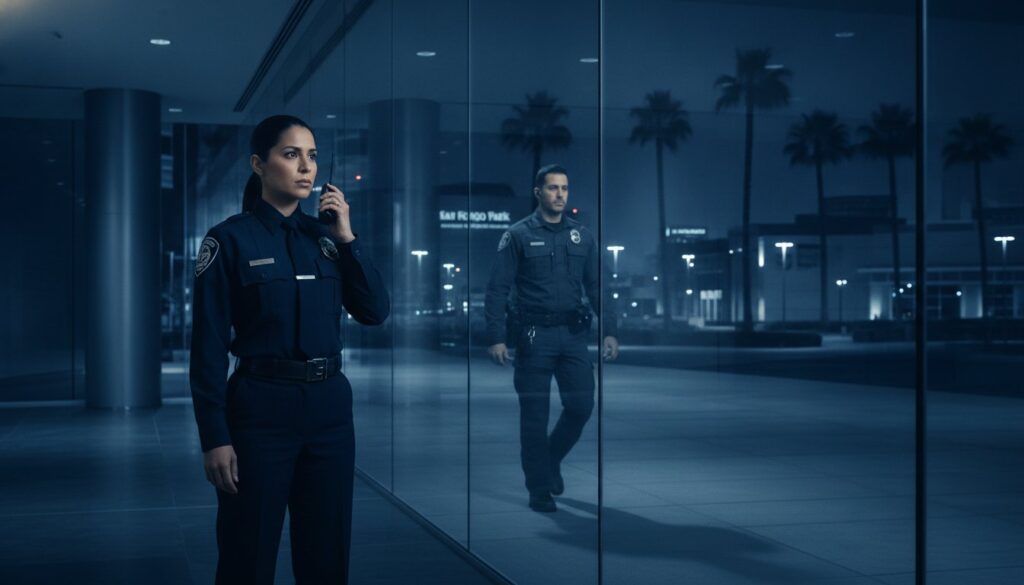
The presence of a uniform doesn’t guarantee the safety of your high-risk assets; only a disciplined tactical strategy can do that. Many stakeholders feel the weight of responsibility when choosing between different levels of protection, fearing that a lapse in judgment could leave their property vulnerable. You’re right to be cautious. Selecting the wrong personnel isn’t just a budget error; it’s a breach in your operational shield.
This article provides the definitive framework you need to evaluate armed vs unarmed security guards California regulations demand. You’ll gain a clear understanding of how to align professional roles with tactical requirements while remaining fully compliant with the latest BSIS standards and SB 652 training mandates. We’ll examine the specific psychological assessments required for armed roles, the legal limitations of field authority, and the methodical oversight necessary to maintain a secure perimeter in 2026. By the end of this guide, you’ll have the assurance required to tailor a security plan to your specific risk profile.
Key Takeaways
- Understand the tactical distinction between frontline security guards and supervisory officers to establish a clear hierarchy of protection for your assets.
- Identify the specific high-risk variables that determine whether you require the armed vs unarmed security guards California standards mandate for your industry and location.
- Utilize a structured vulnerability assessment framework to align your personnel’s tactical capabilities with the specific threats facing your San Fernando Valley facility.
- Evaluate the strategic advantages of mobile patrols and fire watch services to maintain site safety and regulatory compliance without unnecessary operational overhead.
- Ensure long-term asset safety through disciplined oversight and rigorous field performance standards that transform basic presence into a professional shield.
The Security Guard vs. Security Officer Distinction: Why Terminology Matters
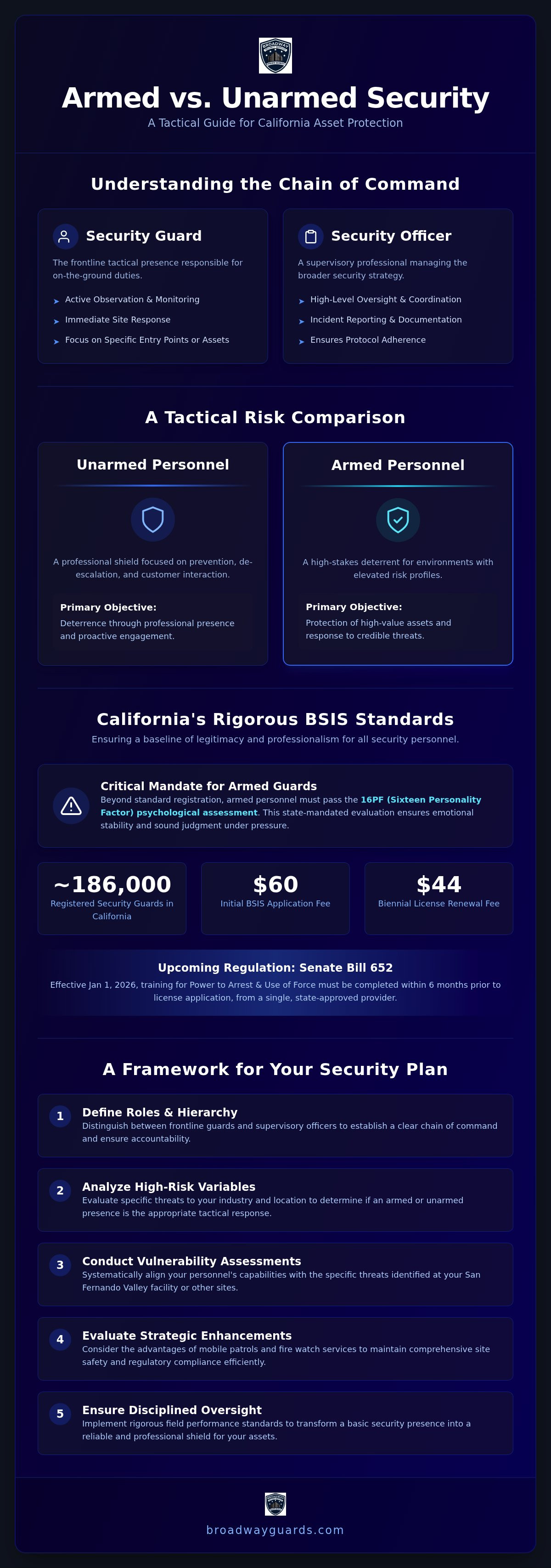
Professional security requires a clear chain of command. While the terms are often used interchangeably in casual conversation, the distinction between a security guard and a security officer serves a critical tactical purpose within a disciplined organization. A security guard typically represents the frontline tactical presence; these are the individuals tasked with active observation and immediate site response. In contrast, the title of security officer often identifies a supervisory professional responsible for high-level oversight, reporting, and the coordination of multiple posts. The foundational standards of the Security Guard Profession require more than just a uniform. Effective protection depends on looking past titles to evaluate the underlying training and discipline of the personnel assigned to your perimeter.
The California Regulatory Context
In California, the Bureau of Security and Investigative Services (BSIS) regulates all personnel regardless of their specific company title. Every individual must maintain a valid registration to operate legally. As of January 1, 2026, Senate Bill 652 introduced significant changes to these standards. The Power to Arrest and Appropriate Use of Force training must now be completed within the six months prior to applying for a license. Crucially, this training must be delivered and certified by a single, approved provider. When you evaluate armed vs unarmed security guards California requirements, these regulatory credentials act as a functional signature of legitimacy. The state mandates an initial application fee of $60 and a biennial renewal fee of $44 to ensure continuous oversight of the approximately 186,000 security guards currently employed across the region. Licensing and background checks are the only true baseline for professional legitimacy.
Scope of Authority and Responsibility
A static guard focuses on a specific entry point or high-value asset. A supervisory officer manages the flow of information and ensures that reporting protocols are followed with military-like precision. This hierarchy is vital for high-stakes reliability. When businesses evaluate armed vs unarmed security guards California standards, they must consider how these roles integrate into a broader unarmed security guards strategy. Effective protection isn’t just about a physical presence; it’s about the methodical oversight that ensures accountability. An officer’s role is to provide the vigilant and unyielding force that supports frontline guards, ensuring that every incident is documented and every protocol is executed without hesitation. This structured approach transforms a simple service into a disciplined shield for your assets.
Armed vs. Unarmed Personnel: A Tactical Risk Comparison
A disciplined approach to asset protection begins with a cold assessment of potential threats. The selection of armed vs unarmed security guards California businesses require is not a matter of preference; it is a tactical response to a specific risk profile. Armed personnel serve as a high-stakes deterrent, signaling that a facility is under the care of an unyielding force. Conversely, unarmed guards offer a professional shield for environments where customer interaction and de-escalation are the primary objectives. Every deployment must be grounded in operational rigor to ensure that safety never comes at the cost of excessive liability.
The training required for armed roles in California is significantly more intensive than for unarmed posts. Beyond standard registration, armed personnel must pass the 16PF (Sixteen Personality Factor) psychological assessment required by California’s Bureau of Security and Investigative Services (BSIS). This ensures that the individual carrying a firearm possesses the emotional stability and judgment necessary for high-pressure environments. When procurement managers evaluate armed vs unarmed security guards California standards, they’re not just choosing a tool; they’re choosing a level of psychological readiness and professional discipline that has been verified by state regulators.
Criteria for Armed Security Deployment
High-threat environments, such as facilities handling large volumes of cash or high-value physical assets, demand a heightened tactical posture. The psychological impact of an armed presence can neutralize a criminal actor before they initiate a breach. When utilizing armed security guard services Los Angeles, businesses gain a layer of protection that is both visible and prepared for immediate crisis management. This level of security is reserved for sites where the risk of violent confrontation or significant asset loss necessitates an armed response capability.
The Role of Unarmed Deterrence
Unarmed guards are the standard for most commercial and residential assignments across Southern California. These professionals focus on de-escalation, methodical observation, and precise reporting. In retail or corporate office settings, an unarmed presence provides a welcoming yet vigilant atmosphere. They act as a disciplined shield, preventing theft and unauthorized access through consistent patrol and presence. For many organizations, unarmed personnel represent the optimal balance of safety and operational efficiency, ensuring that assets remain secure without escalating the site’s tactical profile unnecessarily.
A professional risk assessment is the first step in determining your tactical needs; consider how a disciplined team can secure your perimeter by reviewing our specialized service options at Broadway Security Services.
Evaluating Site Requirements: A Framework for Procurement
Procurement managers in the San Fernando Valley must view security as an operational investment rather than a generic expense. Effective protection begins with a structured framework that identifies specific vulnerabilities before a single guard is posted. When determining the balance of armed vs unarmed security guards California businesses require, the decision must be data-driven and site-specific. A professional defense requires an unwavering commitment to operational excellence and a clear understanding of the threats facing your perimeter.
Risk Assessment and Vulnerability Evaluation
A disciplined defense starts with a comprehensive security risk assessment CA experts utilize to map every potential breach point. You must analyze perimeter safety, access control points, and internal asset locations to identify blind spots in your existing protocols. This methodical approach ensures that your security plan isn’t a generic template but a disciplined shield tailored to your facility’s unique risk profile. Identifying these gaps early prevents the fear of under-protecting high-risk assets during a crisis.
Staffing for Specific Industries
Security requirements vary significantly across sectors, and your staffing must reflect these tactical realities. Organizations like the California Association of Licensed Security Agencies, Guards and Associates (CALSAGA) provide the industry standards that guide these professional deployments.
- Retail and Loss Prevention: Focuses on high-visibility deterrence and de-escalation to prevent theft while maintaining a professional atmosphere.
- Healthcare and Hospitals: Requires a delicate balance between public access and strict safety protocols to protect staff and patients.
- Construction Sites: Demands vigilant overnight presence to secure high-value equipment and materials against organized theft.
- Event Security: Prioritizes crowd control, emergency response coordination, and VIP protection with military-like precision.
For complex commercial properties, a hybrid approach often provides the most robust protection. This strategy utilizes unarmed personnel for general oversight and customer interaction, while armed guards secure high-value transfer points or sensitive areas. This layered defense ensures you aren’t under-protecting high-risk assets while still managing budget constraints effectively. Navigating the choice of armed vs unarmed security guards California standards demand requires a focus on visible results and professional accountability.
Beyond Static Guards: Comparing Mobile Patrol and Fire Watch
Expansive perimeters require a more dynamic tactical footprint than a single stationary post can provide. When evaluating the armed vs unarmed security guards California standards demand, procurement managers must determine if a fixed presence or a mobile response better serves their risk profile. Static guards provide an unyielding post at specific entry points; however, mobile patrol units offer a cost-effective alternative for large-scale facilities. These units provide a visible deterrent that moves with methodical oversight, ensuring that every sector of a property remains under the care of a vigilant force.
Mobile Patrol Strategic Advantages
GPS tracking is the foundation of verifiable oversight in modern patrol operations. Our patrol vehicles utilize real-time monitoring to ensure every sector of your property receives disciplined attention. By implementing irregular patrol intervals, we eliminate the risk of criminal pattern recognition. This strategy is particularly effective for construction site security guards, where the landscape changes daily and vulnerabilities shift as the project progresses. Field performance is documented with military-like precision, providing clients with the assurance that their assets are under the care of an observant and unyielding force. Mobile units bridge the gap between fixed posts, creating a continuous shield across vast acreage.
Fire Watch Compliance and Prevention
California law is strict regarding fire safety protocols. When a building’s fire alarm or sprinkler system is compromised, professional fire watch personnel are legally mandated to maintain site safety. These guards perform continuous monitoring, detailed reporting, and immediate emergency coordination. Adhering to fire watch services California standards isn’t just about safety; it’s about maintaining regulatory compliance to avoid heavy fines or site closures. The duties are strictly defined by state protocols, requiring a high degree of self-assurance and structure from the personnel on site. Fire watch personnel act as a vigilant shield, ensuring that a mechanical failure doesn’t result in a catastrophic loss or a breach in operational order.
A unified security management plan integrates these specialized services to create a comprehensive defense. Whether you require the high-stakes deterrent of armed patrols or the steady oversight of unarmed fire watch guards, the choice of armed vs unarmed security guards California requires a focus on visible results. This layered approach ensures that no part of your risk profile is left exposed to chance. Establish a disciplined patrol strategy for your facility by contacting Broadway Security Services today.
Professional Standards and Oversight: The Broadway Security Advantage
Broadway Security Services operates with a level of military-like precision that sets the standard for Southern California. Selecting between armed vs unarmed security guards California requirements isn’t just about fulfilling a contract; it’s about establishing a perimeter that cannot be breached. Our approach prioritizes safety, trust, and peace of mind through a culture of unyielding order. We position ourselves as a disciplined shield for your assets, ensuring that every post is manned by a professional who values rules and protocols above all else. This commitment to structure creates an atmosphere of high-stakes reliability for every client we serve.
Training and Professional Discipline
Broadway’s training curriculum exceeds the baseline hours mandated by the State of California. While the 2026 BSIS standards provide a regulatory floor, our personnel engage in company-specific tactical drills and continuous education in crisis management and de-escalation. This ensures that whether you deploy armed or unarmed personnel, they are prepared for the specific challenges of your site. Our guards maintain a professional presence that reflects the gravity of their mission, behaving with the self-assurance and structure required to deter criminal actors effectively. We value visible results and an unwavering commitment to duty.
Accountability and Real-Time Reporting
Modern technology is the backbone of our field performance. We utilize advanced reporting tools to provide clients with verifiable site oversight and incident documentation in real-time. This level of transparency ensures that management oversight isn’t just a promise; it’s a documented reality. Our localized command structure in Canoga Park allows for rapid response and direct consultation across the San Fernando Valley. This regional expertise ensures that our security plans are tailored to the specific risk profiles of Los Angeles businesses, moving with a predictable cadence that mirrors methodical oversight.
When you partner with Broadway, you’re not just hiring staff; you’re enlisting a vigilant force committed to the intersection of legal compliance and operational rigor. The choice of armed vs unarmed security guards California depends on your specific vulnerabilities, but the quality of that protection should never be a variable. We provide a comprehensive and organized approach to security that guarantees visible results through rigorous operational standards. Your assets remain under the care of a vigilant and unyielding force, providing the peace of mind that only true professional discipline can deliver.
Securing Your Operational Perimeter
Establishing a secure environment requires more than just a visible presence; it demands a tactical strategy rooted in professional discipline. You now understand the critical distinction between administrative roles and frontline tactical personnel. Choosing between armed vs unarmed security guards California regulations mandate is a decision that must be guided by a comprehensive risk assessment and strict BSIS compliance. Whether your facility requires the high-stakes deterrent of armed personnel or the steady oversight of mobile patrols, the objective remains the same: unyielding protection of your assets.
Broadway Security Services provides this disciplined shield across Canoga Park and the San Fernando Valley. Our commitment to military-like precision ensures that every post is managed with accountability and rigorous operational standards. We provide comprehensive solutions that transition seamlessly from initial vulnerability assessments to professional deployment. It’s this focus on order and reliability that transforms a basic service into a vigilant force you can trust. Secure your assets with the disciplined protection of Broadway Security Services today.
Take the necessary steps to ensure your property doesn’t fall victim to preventable breaches by implementing a strategy defined by vigilance and results.
Frequently Asked Questions
What is the primary difference between a security guard and a security officer in California?
In California, the distinction is primarily hierarchical within a professional organization. A security guard represents the frontline tactical presence responsible for active observation and immediate site response. A security officer typically denotes a supervisory role with oversight responsibilities and reporting duties. While both are regulated by the BSIS, the title of officer often indicates a higher level of field experience and leadership required to manage multiple posts with military-like precision.
Does my business need armed or unarmed security guards?
The choice between armed vs unarmed security guards California businesses make depends on a site-specific risk assessment. Unarmed guards are the standard for retail and corporate environments where de-escalation is the priority. Armed guards are necessary for high-threat environments involving cash handling or high-value assets. Selecting the precise level of protection requires matching personnel capabilities to the specific vulnerabilities identified in your facility’s operational profile.
What qualifications should I look for when comparing security companies?
Verify that the agency maintains strict adherence to California BSIS regulatory standards and carries comprehensive insurance coverage. Look for a localized command structure that ensures rapid response and methodical oversight in Southern California. A professional firm should demonstrate a commitment to structure in their reporting and personnel management. Accountability is the foundation of trust; ensure the company uses verifiable field documentation and GPS tracking for all mobile operations.
How much does it cost to hire a security guard in Los Angeles?
The cost of security services in Los Angeles is influenced by regional factors, including the statewide minimum wage and local ordinances. Armed services command a higher rate due to the extensive training, psychological assessments, and increased insurance premiums required for firearm-carrying personnel. Businesses should avoid “low-bid” providers that may compromise on training or compliance. This creates significant liability risks for the client and undermines the safety of the site.
What are the training requirements for armed security personnel in California?
Armed personnel must complete rigorous state-mandated training, including the Power to Arrest and Appropriate Use of Force modules. Per 2026 regulations, applicants must pass the 16PF psychological assessment to ensure emotional stability in high-pressure scenarios. They also require a valid BSIS firearm permit, which involves initial classroom instruction and ongoing range qualification. Professional firms often supplement these requirements with company-specific tactical drills to ensure a higher standard of readiness.
Can a security guard perform fire watch duties?
Yes, a security guard can perform fire watch duties if they are specifically trained in fire safety monitoring and emergency coordination protocols. California law mandates these services when fire protection systems are compromised. The guard’s primary responsibility is to conduct continuous patrols, identify potential fire hazards, and maintain a detailed log for fire marshal inspection. This role requires a vigilant professional capable of coordinating with local emergency services during a crisis.
How does mobile patrol compare to having a static guard on-site?
Static guards provide a constant, unyielding presence at a specific entry point or high-value post. Mobile patrols offer a more dynamic solution, utilizing vehicles to cover large perimeters at irregular intervals. Mobile units are often more cost-effective for vast properties like construction sites or residential complexes. Integrating both services creates a layered defense strategy, combining the focused oversight of a static post with the broad deterrent effect of a mobile unit.
What industries benefit most from professional risk assessments?
Any industry managing high-value physical assets or public safety risks benefits from a professional risk assessment. This includes construction sites, healthcare facilities, and retail centers facing organized theft threats. A thorough assessment identifies blind spots in existing protocols, allowing for a tailored security plan. When evaluating armed vs unarmed security guards California requirements, a data-driven assessment ensures that your staffing levels align perfectly with the tactical demands of your specific industry.