


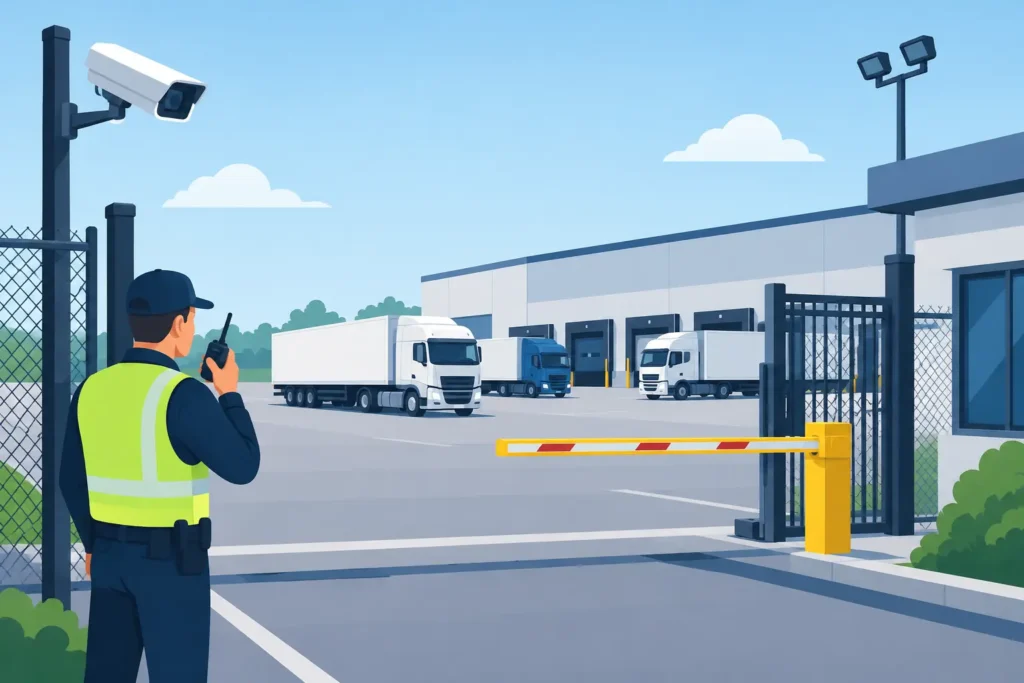
A logistics yard can lose control long before a trailer leaves the gate. An unfamiliar driver may enter behind an authorized vehicle, a loaded trailer may sit unobserved during a shift change, or a damaged fence may go unreported until cargo is missing. Effective logistics yard security measures address these everyday exposure points with visible personnel, controlled movement, and documented accountability.
For logistics operators, security is not limited to preventing theft. It supports driver safety, traffic flow, trailer integrity, shipment schedules, customer confidence, and business continuity. The right plan must fit the site’s operating hours, cargo value, traffic volume, layout, and level of public or vendor access.
Start With the Yard’s Actual Risk Profile
A security program should begin with a site assessment, not a standard guard schedule. A yard handling high-value electronics, pharmaceuticals, alcohol, or retail goods faces different threats than a facility moving building materials or empty containers. A 24-hour distribution facility has different vulnerabilities than a daytime cross-dock operation with limited overnight activity.
Review where trucks enter, where drivers wait, how trailers are staged, and which doors, gates, fences, and pedestrian areas create exposure. Security leadership should also identify the times when procedures are most likely to break down. Shift changes, late-night deliveries, weekend operations, employee departures, and high-volume receiving periods often require added attention.
In Los Angeles and surrounding freight corridors, congestion can add another layer of risk. Drivers may arrive early, wait off schedule, or look for instructions at busy gates. Clear access procedures and a professional security presence help keep confusion from becoming an unauthorized entry or traffic-control problem.
A useful assessment examines more than crime history. It should account for lighting failures, blind spots, aging perimeter barriers, contractor access, visitor procedures, emergency vehicle access, and the condition of parked trailers. The objective is to identify where a person can enter, move, conceal activity, or remove property without being challenged or documented.
Control Every Point of Entry and Exit
The gate is the yard’s first operational control point. If access is casual, the rest of the security plan will be forced to react to problems already inside the property. Gates should be staffed or actively monitored during operating periods, with a defined process for employees, drivers, vendors, visitors, and service personnel.
Guards assigned to access control should verify identification, delivery appointments, trailer numbers, and authorization before allowing entry. Depending on the operation, they may record vehicle details, issue visitor credentials, direct drivers to staging areas, and confirm departure information. The process needs to be firm without creating unnecessary delays for legitimate drivers.
Tailgating deserves specific attention. A vehicle entering immediately behind an authorized truck can bypass gate procedures in seconds. Physical gate timing, guard positioning, camera coverage, and clear driver instructions can reduce this risk. When an exception is made, it should be documented rather than handled informally.
Exit controls matter just as much. Security personnel may check outbound trailer numbers, seals, bills of lading, gate passes, or other release documentation based on client procedures. Not every yard needs the same inspection level. The appropriate standard depends on cargo sensitivity, carrier relationships, and how freight is released. What matters is that the process is consistent and that exceptions are escalated.
Put Clear Post Orders Behind the Gate
Guards cannot enforce vague expectations. Written post orders should establish what officers verify, what records they maintain, who can approve access exceptions, and when they contact site management or law enforcement. They should also define how officers respond to aggressive drivers, abandoned vehicles, intoxicated persons, delivery disputes, and equipment blocking emergency lanes.
Well-written post orders create consistency across shifts. They also give facility managers a reliable record of how security is expected to support operations.
Use Visible Patrols to Protect the Perimeter and Cargo
Fixed gates are essential, but they do not replace patrol coverage. A trained officer conducting documented patrols can identify an open pedestrian gate, cut fencing, a broken light, suspicious loitering, unsecured equipment, leaking fuel, or a trailer with compromised seals. These issues are easier and less costly to address before they become a theft, injury, or operational interruption.
Patrol frequency should reflect the site’s activity and exposure. A small, well-lit yard with limited after-hours operations may need periodic checks and marked vehicle patrols. A large facility with high-value cargo, multiple staging zones, and overnight traffic may require dedicated on-site officers making continuous rounds. The decision should be based on risk, not on the lowest staffing number.
Visible patrols also deter opportunistic activity. Marked vehicles, uniformed guards, and consistent movement communicate that the property is being actively managed. This is especially valuable in areas where trailers remain staged for long periods or where perimeter access is difficult to observe from the gate.
Patrol documentation is a critical part of accountability. Officers should record conditions found, doors or gates checked, vehicles contacted, safety hazards observed, and actions taken. Reliable incident reporting gives management a factual basis for repairs, disciplinary action, insurance support, and future security decisions.
Protect Trailer Integrity and High-Value Freight
Cargo theft often relies on ordinary-looking activity. A thief may use a tractor that resembles a legitimate carrier vehicle, target a trailer parked in a low-visibility area, or exploit confusion over a scheduled pickup. Security procedures should make it difficult to remove a trailer without a verifiable authorization trail.
Trailer inventories, seal checks, designated staging zones, and controlled keys can all reduce exposure. Security officers should know which trailers require heightened attention and what discrepancies must be reported immediately. If a seal number does not match documentation, a trailer door appears disturbed, or a driver arrives without confirmed release information, the issue should be escalated before the vehicle moves.
Technology can support this work, but it does not replace it. Cameras, access-control systems, GPS data, alarms, and lighting are most effective when trained personnel are responsible for monitoring alerts, verifying activity, and documenting the response. A camera that records an incident after cargo is gone is useful evidence, but it is not active prevention.
Keep Drivers, Employees, and Visitors Safe
Security and safety overlap throughout a busy yard. Pedestrians move near tractors, forklifts, trailers, and backing vehicles. Drivers may be unfamiliar with site routes. Visitors may not understand restricted areas or required protective equipment. Guards help maintain order by enforcing check-in requirements, directing traffic, protecting fire lanes, and reporting unsafe conditions.
A professional officer should be prepared to communicate clearly under pressure. The role may involve redirecting a driver who is blocking a lane, separating a dispute at a dispatch window, assisting during a medical event, or preserving the scene after an accident. Calm, disciplined interaction protects the property while helping operations continue.
Emergency procedures should be site-specific. Officers need clear instructions for fire alarms, hazardous material concerns, workplace violence, severe weather, power failures, and evacuations. They should know who to notify, where to direct responders, and which areas must remain accessible. Fire watch coverage may also be necessary when required fire-protection systems are impaired.
Build Accountability Into the Security Contract
The difference between coverage on paper and protection in practice is supervision. A security provider should establish clear post orders, staffing expectations, patrol procedures, reporting standards, and management contacts before deployment begins. Managers should have a way to confirm that officers are present, trained for the assignment, and following site procedures.
Ask prospective providers how they supervise overnight posts, respond to call-offs, document incidents, and address performance concerns. Ask whether officers receive site-specific orientation and whether supervisors review recurring issues with facility leadership. Generic staffing may fill a post, but it rarely provides the operational discipline required in an active logistics environment.
Broadway Security Services builds coverage around the conditions of each property, including traffic patterns, access points, operating activity, and identified vulnerabilities. Licensed and trained guards, visible patrol procedures, responsive supervision, and reliable incident reporting give logistics operators a clearer line of control over a complex site.
Review the Plan as Operations Change
A security plan should change when the operation changes. New tenants, added shifts, seasonal volume, revised carrier relationships, construction activity, cargo changes, or repeated access issues can all affect the level of coverage a yard needs. Regular review helps management correct weak points before they become routine.
The most effective logistics yard security measures are not the most complicated. They are the measures that officers can apply consistently, managers can verify, and drivers can understand. Start with the next vulnerable gate, trailer row, or shift transition, then put accountable control in place before that small gap becomes a costly incident.