


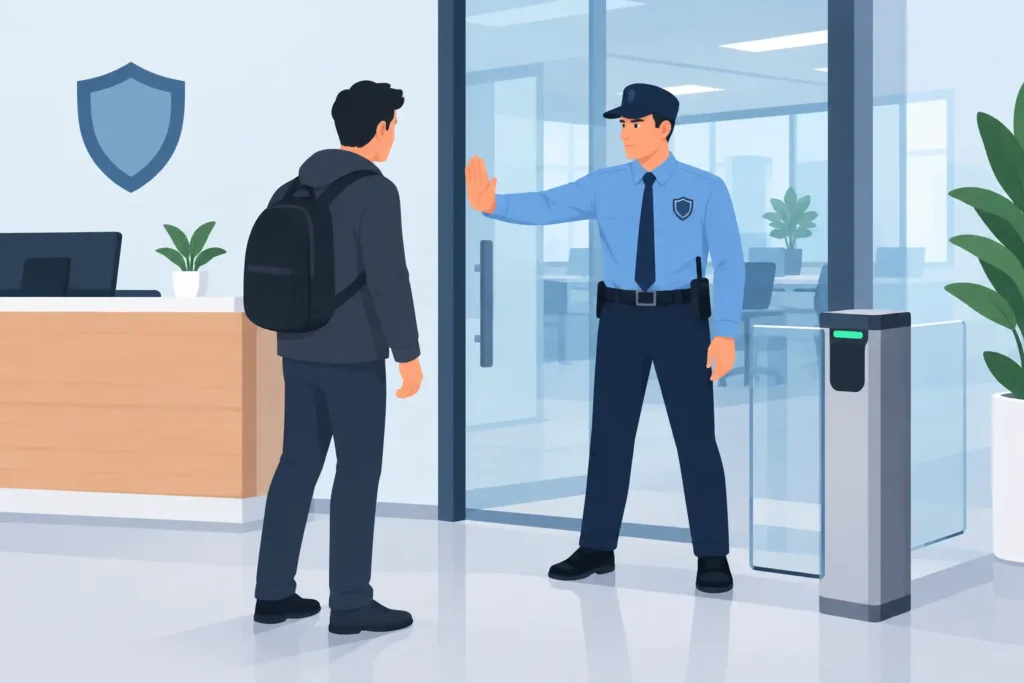
A delivery door left propped open at 6:15 p.m., an unfamiliar person following an employee through a lobby, or someone walking a construction site after hours can quickly become more than a minor rule violation. Knowing how to deter workplace trespassing means closing the gaps that make unauthorized access easy while giving staff a clear, professional way to respond.
Trespassing can expose a property to theft, vandalism, workplace violence, safety hazards, confidential information loss, and liability concerns. The right approach is not simply placing a sign at the gate. It is a site-specific security plan that combines physical controls, visible security presence, trained personnel, and reliable incident documentation.
Start With the Access Points People Actually Use
Every workplace has an access pattern. Employees may enter through the main lobby, vendors may use a loading dock, contractors may come through a side gate, and visitors may park near a rear entrance that receives little supervision. A security plan built only around the front door leaves the most vulnerable areas unprotected.
Begin with a practical review of the property during operating hours and after hours. Identify public entrances, employee-only doors, stairwells, parking areas, rooftops, loading zones, storage yards, temporary construction access points, and any door that is routinely left unsecured for convenience. Pay attention to recurring conditions, such as shift changes, deliveries, breaks, events, or early-morning arrivals.
Controlled access should match the location’s operations. An office may need visitor check-in procedures and badge-controlled floors. A warehouse may require truck verification, controlled gate entry, and inspection of trailer areas. A retail center may benefit from visible patrols near rear corridors and parking areas. The goal is to make it clear where people may enter, who has permission to be there, and what happens when access cannot be verified.
Doors, gates, locks, lighting, cameras, and access credentials all matter. However, equipment only works when it is used consistently. A secured door defeated by a wedge, a gate left open after a delivery, or a shared access card can undermine an otherwise sound system.
How to Deter Workplace Trespassing Through Visible Presence
Most trespassers look for opportunity, not confrontation. A property that appears monitored, organized, and actively managed is less attractive than one with dark corners, unclear boundaries, and no visible oversight.
Licensed and trained security officers provide a direct deterrent because they can observe activity, verify access, enforce site rules, and respond before an issue escalates. A professional officer should know the property boundaries, authorized entry procedures, restricted areas, emergency contacts, and the specific concerns that affect the site. Post orders turn that knowledge into consistent field action.
A stationary officer at a lobby desk may be appropriate for a building with concentrated visitor traffic. A marked vehicle patrol may be more effective for a large industrial property, shopping center, apartment community, or construction site with multiple access points. Many locations need both: controlled entry at key times and scheduled or randomized patrols throughout the grounds.
Patrol patterns require balance. Predictable checks confirm that officers are present, but a schedule that never varies can be easy to work around. Supervisors should establish required patrol zones and reporting intervals while allowing officers to adjust their observations based on activity, open gates, suspicious vehicles, or changing site conditions.
Professional presence is not about unnecessary confrontation. It is about making accountability visible. A uniformed officer conducting access checks, documenting patrols, and addressing policy violations calmly sends a clear message that the site is actively protected.
Set Clear Rules for Employees, Visitors, and Vendors
Security procedures fail when employees do not understand their role. Staff members are often the first to notice a person who does not belong, a damaged fence line, an unsecured door, or repeated loitering near a restricted area. They need a simple reporting process and confidence that their concerns will be handled appropriately.
Employees should know not to hold secured doors open for unknown individuals or allow tailgating through access-controlled entry points. Visitor and vendor procedures should state where people check in, what identification is required, who must authorize entry, and whether an escort is needed in restricted areas. For properties with recurring contractors, pre-approved rosters can reduce delays without weakening control.
Managers should also address the common exceptions that create risk. A vendor arriving after normal hours, a former employee returning to collect property, or an unannounced maintenance technician should not be admitted based on a verbal claim alone. Verification through an authorized company contact is usually faster and safer than trying to resolve uncertainty after someone has entered the facility.
Communication should be direct and repeated when procedures change. New access rules, temporary construction barriers, event traffic plans, and holiday closures create confusion if they are not clearly communicated to staff, tenants, vendors, and security personnel.
Define a Safe Response to Unauthorized Entry
A trespassing incident should not depend on an individual employee deciding how much risk to take. Establish a response procedure that identifies who observes the person, who makes contact when appropriate, who notifies management, and when law enforcement should be called.
Security officers should use professional verbal engagement, observation, and clear direction within the scope of their training and post orders. They can ask the individual to identify their purpose, verify authorization, direct them to leave restricted areas, and document their actions. If a person refuses to leave, appears impaired, becomes threatening, attempts theft, or creates an immediate safety concern, escalation should follow the property’s emergency plan.
Employees who are not assigned security responsibilities should avoid physical intervention. Their role is to report the issue promptly, provide accurate details, and move to a safe area if there is a threat. This protects employees from unnecessary harm and keeps the response coordinated.
In California, property managers and employers should ensure their trespass procedures align with applicable laws, lease obligations, and company policies. Security staff need clear authority from the client regarding restricted areas, visitor rules, removal procedures, and incident escalation. Unclear instructions can create inconsistent enforcement and unnecessary exposure.
Use Reporting to Find the Weak Points
One documented incident can reveal a larger pattern. If unauthorized individuals repeatedly enter through the same rear gate, approach the same loading dock, or appear near a parking structure during the same time window, the property has an operational weakness that needs correction.
Reliable incident reporting captures the time, location, description of the person or vehicle, observed behavior, actions taken, witnesses, notifications, and any available camera reference. This record supports management decisions, helps identify repeat activity, and provides useful documentation if law enforcement or insurance representatives become involved.
Reports should lead to action. A supervisor may recommend changing a patrol route, repairing a gate latch, improving lighting, adding signage, modifying delivery hours, or assigning an officer during a recurring vulnerability period. The most effective security programs are reviewed and adjusted rather than left unchanged after the initial deployment.
Match Coverage to the Property’s Risk Level
There is no single staffing model for every workplace. A small professional office with controlled entry may only need after-hours mobile patrols and a defined visitor policy. A distribution facility with high-value cargo, large vehicle traffic, and overnight operations may need gate officers, interior patrols, and detailed access logs. A construction site may need overnight coverage because equipment, materials, and unfinished structures create different risks than an occupied building.
Consider what a trespasser could access, when the property is least supervised, how quickly assistance can arrive, and whether an incident could interrupt operations. The cost of dedicated guard coverage should be weighed against the potential cost of theft, shutdowns, property damage, injury, tenant complaints, or repeated police calls.
For high-exposure properties in Los Angeles and surrounding areas, a site assessment by Broadway Security Services can establish practical post orders, access procedures, patrol expectations, and reporting requirements based on the property’s real conditions.
A secure workplace is built through daily discipline: doors are checked, visitors are verified, officers are visible, concerns are reported, and small weaknesses are corrected before they become an open invitation. That consistency protects the property while allowing legitimate employees, customers, and vendors to keep business moving.