


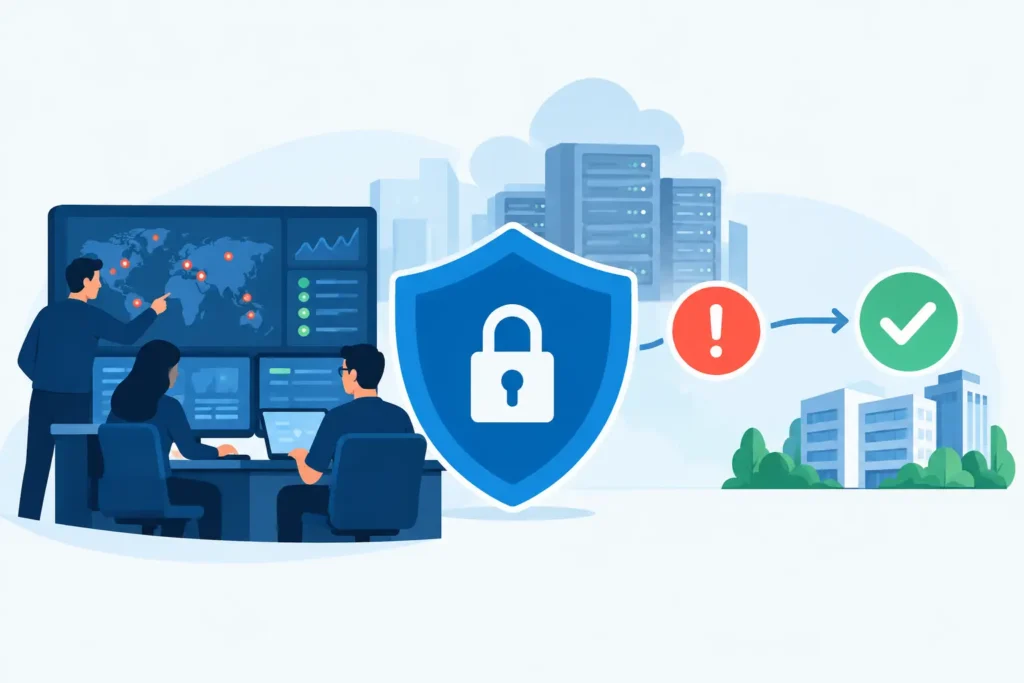
A security incident rarely arrives on a convenient schedule. It may begin with a tailgating visitor at a side entrance, an argument in a parking area, an alarm after closing, a water leak near sensitive equipment, or suspicious activity around a loading dock. Effective incident response gives on-site personnel a disciplined way to assess the issue, protect people, notify the right parties, and document what occurred without creating additional disruption.
For property managers, facility directors, and business owners, the question is not whether an incident can happen. The question is whether the site has trained personnel, clear authority, and reliable reporting when it does. A visible guard presence can deter many problems. A structured response process controls the problems that still occur.
What Incident Response Means in Private Security
Incident response is the organized process used to identify, assess, contain, escalate, document, and follow up on a security, safety, or operational event. In a contract security environment, it is not limited to criminal conduct. It includes medical concerns, fire and life-safety hazards, access-control failures, property damage, workplace disputes, unauthorized vendors, traffic issues, and suspicious behavior.
The purpose is not for a guard to replace law enforcement, fire personnel, or emergency medical providers. The purpose is to provide immediate, professional on-site action until the appropriate authority or emergency service takes control. That distinction matters. Guards should know their post orders, stay within their training and legal authority, protect the scene when necessary, and avoid turning a manageable issue into a greater liability.
A strong response also protects business continuity. A damaged gate, blocked fire lane, unverified delivery, or disturbance in a lobby can interrupt operations long before it becomes a police matter. Prompt action keeps access controlled, communication organized, and decision-makers informed.
The First Minutes Set the Direction
When an incident occurs, the initial response should be calm, deliberate, and based on verified observations. Officers should avoid assumptions. They assess what is happening, where it is happening, who may be at risk, and whether the condition is escalating.
For example, a guard responding to an after-hours door alarm should not simply silence the alert and move on. The officer should check the area safely, look for signs of forced entry or unauthorized presence, preserve relevant observations, notify supervision or the client according to post orders, and request law enforcement when conditions warrant. The action taken depends on the site, the available information, and the immediate risk.
A response plan should establish a clear priority order: life safety first, then control of the immediate hazard, protection of property, notification, and documentation. This prevents a common failure point where a guard becomes overly focused on a minor rule violation while missing a larger safety concern nearby.
Clear Escalation Prevents Delays
Not every event requires a 911 call, but every event should have an escalation path. Officers need to know which situations require emergency services, which require immediate supervisor notification, and which can be managed through routine client reporting.
A medical emergency, fire, active threat, violent confrontation, or credible threat to life requires immediate emergency action. A recurring access violation, noncompliant contractor, minor property damage, or parking issue may call for site management notification and documented follow-up instead. The details should be defined in post orders rather than left to guesswork during a stressful moment.
Responsive supervision is especially valuable when the circumstances are unclear. A field supervisor can support an officer’s decision-making, coordinate relief coverage, communicate with the client, and confirm that procedures are being followed. This level of oversight separates accountable security coverage from a guard left alone with no operational support.
Site-Specific Post Orders Make Response Consistent
Generic instructions produce generic performance. Each location has different access points, tenant activity, traffic patterns, operating hours, critical assets, and public-facing risks. A warehouse with overnight cargo movement needs a different response protocol than a residential property, medical office, construction site, or special event venue.
Site-specific post orders should identify emergency contacts, assembly areas, restricted zones, camera locations, alarm procedures, access rules, and reporting requirements. They should also explain when officers should observe and report, when they should intervene verbally, and when they should immediately request law enforcement or emergency services.
Consider an office building with multiple vendors arriving before business hours. If an unverified driver requests access to a loading area, the correct response is not based on the driver’s confidence or urgency. It is based on established authorization procedures. The officer verifies credentials, contacts the designated representative, maintains controlled access, and records the interaction if access is denied or conditions appear suspicious.
That consistency matters after the incident as well. Clients need to know that site rules are enforced fairly, sensitive areas are protected, and exceptions are documented instead of handled informally.
Documentation Is Part of the Security Response
Reliable incident reporting is not paperwork for its own sake. It creates an accurate record for management review, insurance matters, law enforcement coordination, tenant communication, and future risk reduction. A report should state facts, not opinions.
A useful report identifies the date, time, location, involved parties, observed behavior, actions taken, notifications made, and final disposition. It should distinguish what the officer personally observed from what another person reported. If video footage, photographs, access logs, or witness information are relevant, the report should note their availability and the steps taken to preserve them according to site policy.
Vague language weakens the value of a report. “Everything was handled” provides no operational record. “At 9:42 p.m., officer observed an unsecured west-side pedestrian gate; officer secured the gate, notified the on-call property contact, and conducted a perimeter check with no unauthorized persons located” gives management information they can act on.
Accurate reporting also reveals patterns. Repeated gate issues, recurring trespass attempts, frequent delivery disputes, or similar after-hours alarms may indicate that the site needs a change in patrol frequency, lighting, access procedures, signage, or staffing coverage.
Common Gaps That Increase Risk
Many response failures begin before the incident itself. The most common gap is unclear responsibility. If officers do not know who has authority to approve access, receive notifications, or make operational decisions after hours, delays are likely.
Another gap is inadequate communication between security, property management, and site personnel. A guard cannot effectively enforce a revised visitor policy, construction schedule, or restricted area if the change was never communicated. Regular updates to post orders and shift briefings keep security aligned with current site activity.
Overreliance on technology can also create exposure. Cameras, alarms, and access-control systems are valuable tools, but they do not physically assess a person in distress, separate a confrontation, secure an open door, or provide a visible deterrent. Technology works best when supported by trained personnel who can verify conditions and take appropriate action.
Finally, understaffing can undermine even a well-written plan. One officer may be sufficient for a low-traffic property with limited access points. A large facility, active construction project, high-volume event, or logistics operation may require multiple posts, vehicle patrols, or supervisory coverage. The appropriate deployment depends on the actual risk, not a one-size-fits-all staffing model.
Building a Response Plan That Works Under Pressure
An effective plan should be tested in practical terms. Can an officer reach emergency contacts quickly? Are access keys, gate codes, and emergency equipment current? Does the client know what information will be provided after an incident? Are officers briefed on the difference between a routine service call and an event requiring immediate escalation?
Broadway Security Services builds coverage around site conditions, defined post orders, controlled access monitoring, patrol procedures, responsive supervision, and detailed reporting. For clients in Los Angeles and surrounding service areas, that operational discipline helps ensure security personnel are prepared to respond with professionalism when routine conditions change.
A response plan should also be reviewed after meaningful incidents. This is not about assigning blame for every unexpected event. It is about identifying what was effective, what created delay, and what needs to change before the next shift. Sometimes the answer is additional training. Sometimes it is a revised patrol route, a better contact list, a repaired gate, or clearer vendor procedures.
The best time to improve incident response is before an officer has to make a difficult decision in real time. Clear expectations, trained licensed guards, active supervision, and factual reporting give a property the control it needs when normal operations are interrupted.