

Licensure is a legal mandate, but professional discipline is an operational choice that separates a mere observer from a true protector. You likely recognize that the path to wearing a uniform is paved with rigorous standards and complex regulatory hurdles. For organizations focused on hiring licensed security guards California requires a level of oversight that ensures every officer on duty meets the highest threshold of accountability. It’s common to feel concerned about confusing bureaucratic acronyms like the BSIS and BPC, or the strict 40-hour training timeline mandated for all new personnel.
This guide provides the tactical roadmap you need to master these requirements with military-like precision. You’ll gain a clear understanding of the 8-hour versus 40-hour rule, the specific costs associated with the $60 initial application fee, and the protocols for obtaining armed permits. We’ll detail the impact of SB 652 regulations and the mandatory 16PF psychological assessment to ensure you move forward with absolute confidence in your state compliance. By the end of this professional briefing, you’ll possess the knowledge to navigate background checks and training blocks without the fear of disqualification.
Key Takeaways
- Identify the specific BSIS foundational standards and identity requirements necessary to initiate the professional licensing process in 2026.
- Execute the phased 40-hour training roadmap, including the critical modules for Power to Arrest and mandatory Appropriate Use of Force protocols.
- Navigate the rigorous Live Scan fingerprinting and background clearance protocols essential for hiring licensed security guards California businesses rely on for protection.
- Analyze the advanced certification requirements for armed personnel, including specialized firearms training and mandatory psychological assessments.
- Bridge the gap between regulatory compliance and operational excellence by implementing a disciplined, military-standard approach to civilian security.
Foundational Eligibility: Who Can Become a California Security Professional?
The Bureau of Security and Investigative Services (BSIS) serves as the primary regulatory gatekeeper for the private security industry in 2026. This agency enforces the standards established under the Business and Professions Code to ensure that every individual tasked with protection is both capable and qualified. As of May 2026, the BSIS manages over 655,000 active licenses, a figure that underscores the scale of the state’s security apparatus. When hiring licensed security guards California organizations must recognize that these foundational requirements are not mere suggestions. They are essential protocols designed to establish a disciplined shield between your assets and potential threats.
A critical distinction exists between a private security guard and a proprietary private security officer. Private security guards are employed by Private Patrol Operators (PPOs) to provide services to third-party clients. In contrast, proprietary officers are employed directly by a single business to protect only that business’s property. To understand the broader scope of these duties, a Security Guard Profession Overview reveals that foundational standards are universal for maintaining order and preventing loss. Adhering to these standards ensures that the individual on post is an unyielding force for safety rather than a liability.
Age and Citizenship Prerequisites
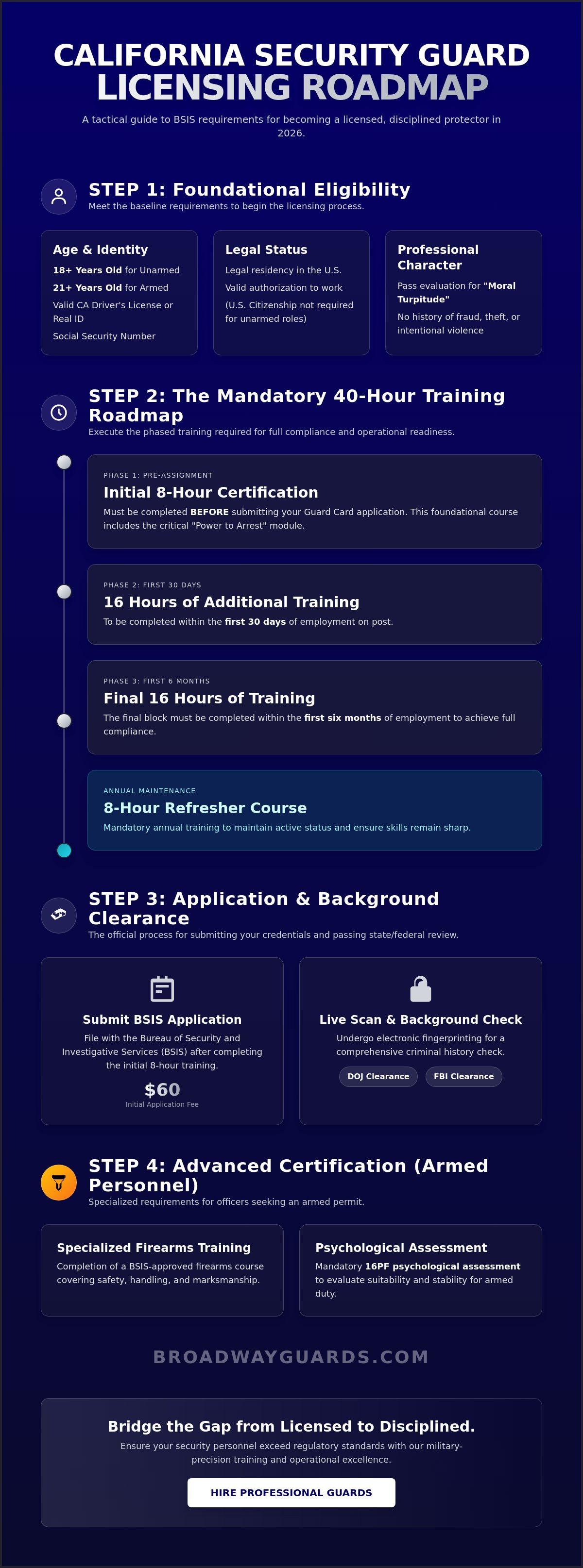
Integrity begins with verification. To qualify for an unarmed registration, an applicant must be at least 18 years old. Those seeking armed positions must be at least 21. Every candidate must provide valid identification, typically a California driver’s license or a federally recognized Real ID, alongside a Social Security number. While U.S. citizenship isn’t a strict requirement for unarmed roles, every applicant must possess legal residency and a valid authorization to work in the United States. These identity checks prevent the infiltration of unauthorized personnel into sensitive environments, ensuring that the process of hiring licensed security guards California businesses undertake remains legally sound and operationally secure.
The Concept of Moral Turpitude in Security
The State of California demands more than a clean criminal record; it requires a demonstrated history of professional character. The BSIS evaluates fitness for duty based on the concept of moral turpitude, which refers to acts that are inherently base, vile, or contrary to the accepted rules of morality. Crimes involving fraud, theft, or intentional violence are primary grounds for disqualification. This rigorous screening process ensures that honesty and integrity are present from the moment an application is filed. Maintaining these high-stakes reliability standards is the only way to build a foundation of trust. Professional discipline isn’t just about following orders. It’s about having the character to stand firm when protocols are tested.
The Mandatory 40-Hour Training Roadmap: Phased Compliance
Professional security isn’t a static state; it’s a continuous pursuit of operational readiness. In California, the path to full licensure is a phased deployment of training modules designed to build a capable protector. This roadmap ensures that every officer remains sharp, legally compliant, and strategically prepared for the field. When your organization is hiring licensed security guards California law mandates a total of 40 hours of instruction. This isn’t a suggestion. It’s a mandatory legal framework that separates casual observers from disciplined professionals.
The timeline is strict. The initial 8 hours must be completed before the Guard Card application is even submitted. Once an officer is on post, they must complete an additional 16 hours of training within the first 30 days of employment. The final 16-hour block must be finalized within the first six months. To maintain an active status, every guard must undergo 8 hours of annual refresher training. This structure guarantees that the personnel protecting your perimeter are always operating at peak efficiency. Selecting a partner like Broadway Security Services ensures your personnel have mastered these phases with precision.
Initial 8-Hour Certification: The ‘Power to Arrest’
Integrity starts with a firm legal foundation. The Power to Arrest module defines the precise boundaries of a guard’s authority. It teaches officers how to detain suspects within the confines of the law while minimizing liability. As of January 1, 2026, SB 652 mandates that this initial 8-hour block, which includes the Appropriate Use of Force modules, must be completed through a single BSIS-approved provider. This change eliminates fragmented training and ensures a unified standard of performance. This certificate is the fundamental requirement for any individual seeking a position as an unarmed security professional. The process of hiring licensed security guards California businesses trust depends on this rigorous 8-hour adherence.
Mandatory Continuing Education (The 32-Hour Gap)
The remaining 32 hours of the roadmap allow for specialized skill development. While some modules are mandatory, others are elective, allowing guards to focus on communication, public relations, or liability management. For those moving into high-stakes roles, understanding the California Firearms Permit Requirements is essential for armed service eligibility. Employers bear the responsibility of tracking these hours and verifying that their staff meets every state-mandated milestone. This oversight creates an atmosphere of accountability where every officer’s credentials are beyond reproach. It ensures that your assets are under the care of a vigilant and unyielding force.
The Background Clearance Process: DOJ and FBI Protocols
Reliability is the cornerstone of effective protection. For organizations engaged in hiring licensed security guards California law mandates a rigorous vetting process that extends far beyond a simple resume review. Every candidate must undergo a comprehensive criminal history background check through both the California Department of Justice (DOJ) and the Federal Bureau of Investigation (FBI). This dual-layered screening ensures that individuals tasked with safeguarding your assets possess a history that aligns with the highest standards of professional integrity. It’s a methodical oversight process that eliminates high-risk applicants before they ever step foot on your property.
The Bureau of Security and Investigative Services (BSIS) utilizes this background data to confirm an applicant’s fitness for duty. This isn’t just a formality. It’s a disciplined shield designed to protect the public and your commercial interests. By cross-referencing national and state databases, the state ensures that a guard’s past doesn’t compromise your future security. This level of scrutiny creates an atmosphere of high-stakes reliability that clients demand from professional security providers.
Navigating the Live Scan System
The Live Scan process serves as the digital gateway for background verification. Candidates must visit authorized operators to submit their fingerprints electronically. For those operating in the San Fernando Valley or Canoga Park, numerous certified sites provide these services. The financial commitment for this vetting is precise. The DOJ and FBI background check fees total approximately $49. Additionally, Live Scan providers charge a “rolling fee” for the fingerprinting service, which typically ranges from $36 to $40. Turnaround times for clearance vary based on the complexity of the applicant’s history, but results are generally transmitted to the BSIS within 72 hours to several weeks. This consistent and methodical approach maintains the rhythm of operational readiness.
Automatic Disqualifiers and Criminal History
Integrity is non-negotiable in the security sector. The BSIS maintains strict protocols regarding criminal records to ensure public safety. Felony convictions are significant barriers to licensure. Certain misdemeanors, particularly those involving violence, weapons, or theft, also trigger immediate scrutiny. If an applicant has a history of firearms-related offenses, their aspirations for armed guard roles are effectively terminated. While the BSIS may consider evidence of rehabilitation for past incidents, the burden of proof rests entirely on the applicant. If a background check reveals a disqualifying event, the state issues a Letter of Denial. Applicants have the right to appeal, but the standard for overturning a decision is exceptionally high. This uncompromising stance ensures that every guard on duty remains an unyielding force for order.
Advanced Certifications: Armed Permits and Specialized Training
A standard Guard Card represents the baseline of professional entry. However, high-risk environments demand a more sophisticated level of tactical deterrence. For commercial entities hiring licensed security guards California regulatory standards provide a framework for advanced certifications that elevate an officer’s capability. These permits, ranging from exposed firearm carry to chemical agent deployment, transform a standard observer into a specialized asset. This transition requires rigorous testing and a commitment to ongoing proficiency that aligns with military-standard oversight. Without these advanced credentials, a security presence remains incomplete in the face of modern threats.
Advanced training isn’t just about equipment. It’s about the discipline required to manage high-stakes scenarios with precision. Whether securing a construction site or providing executive protection, the presence of an officer with specialized permits provides a unique psychological advantage. This level of preparation ensures that your assets are under the care of a vigilant and unyielding force. If your operational needs require this level of expertise, you can secure advanced protection services here to ensure your site remains impenetrable.
The Path to Becoming an Armed Guard
Transitioning to an armed role involves a demanding certification process that prioritizes public safety. Applicants must complete a 14-hour BSIS Firearms Training Course, which balances classroom instruction on legal liability with live-range qualification. Compliance with AB 2515 is mandatory. This requires every armed applicant to pass the 16PF psychological assessment. This evaluation, which carries a $69 fee paid to PSI Services LLC, ensures that only those with the appropriate temperament carry a weapon in a professional capacity. To maintain the integrity of this permit, guards must complete a firearm qualification every six months. This repetitive, methodical oversight guarantees that every armed professional remains sharp, accountable, and ready for deployment.
Specialized Roles: Fire Watch and Mobile Patrol
Specialized services like Fire Watch and Mobile Patrol require more than basic licensing. When hiring licensed security guards California stakeholders must look for certifications that match their specific environmental risks. Fire Watch personnel must be trained in specific fire safety protocols and hazard identification to prevent catastrophic loss. In high-risk asset protection, tactical communication and crisis management are essential skills that go beyond the 40-hour roadmap. Broadway Security integrates these advanced permits into a comprehensive oversight strategy. Our officers utilize baton and chemical agent certifications to provide a layered defense for retail, hospital, and residential environments. This disciplined approach ensures that every specialized role is executed with the highest degree of operational rigor and precision.
Operational Excellence: Transitioning from Licensed to Disciplined
Obtaining a Guard Card serves as the legal baseline for entry into the profession. It does not, however, guarantee the level of vigilance required to protect high-value assets. When hiring licensed security guards California organizations must look beyond the basic BSIS registration to find a partner that prioritizes operational rigor. True security is a disciplined choice. It requires an unwavering commitment to protocols that extend far beyond the classroom. A license proves you’ve met the state’s minimums; discipline proves you can hold the line when a threat emerges.
The Broadway Security standard is defined by military-like precision in civilian protection. We view every assignment as a mission where failure is not an option. This philosophy demands more than just presence. It requires an active, result-oriented posture that emphasizes accountability at every level of the hierarchy. By linking professional discipline directly to the outcome of protection, we create an atmosphere of high-stakes reliability. Our clients feel their assets are under the care of a vigilant and unyielding force because we treat compliance as a starting point, not a finish line.
The Importance of On-Site Protocols
Effective oversight in locations like Canoga Park requires site-specific protocols that address local risks. Disciplined reporting and the use of digital logs are non-negotiable standards for modern security oversight. These tools provide a transparent, real-time record of activity. They ensure that every patrol is verified and every incident is documented with surgical precision. Additionally, a professional appearance serves as a primary tool for vandalism deterrence. A guard in a crisp, authoritative uniform sends a clear message of order and prevention. This visible presence often neutralizes a threat before it manifests, providing peace of mind through a posture of constant readiness. For businesses facing sophisticated organized theft, understanding the full scope of high-value asset security San Fernando Valley protocols is essential to closing the gaps that standard licensing alone cannot address.
Joining an Authoritative Security Force
Top-tier firms demand more than a clean background check or a completed 40-hour training block. They look for a proactive mindset capable of sophisticated risk assessment and crisis management. This level of readiness is maintained through continuous training that directly impacts client trust and site safety. A disciplined protector remains observant, prepared, and ready to act within the established chain of command. If you possess the required drive and wish to join a team defined by discipline and professional rigor, the standards are clear. Excellence is not an act; it is a habit of unyielding service. We prioritize those who understand that in the world of security, order is the only acceptable outcome.
Establishing an Unyielding Standard of Protection
Mastering the regulatory roadmap is the first step toward achieving operational readiness. From navigating the 40-hour training timeline to passing rigorous DOJ and FBI background protocols, the requirements for California security professionals are designed to ensure public trust. However, a Guard Card is merely the legal baseline. True safety is found in the transition from basic licensure to professional discipline. This shift ensures that every officer on post acts with military-like precision and maintains the highest standards of reporting and visibility at all times.
When you’re hiring licensed security guards California law provides the framework, but your choice of provider determines the final outcome. We are BSIS Licensed and Compliant specialists in high-risk asset protection, serving Canoga Park and the broader Southern California region. Our force is built on a foundation of rigorous oversight and unyielding vigilance. You’ve now mastered the roadmap; the next step is implementation. Secure your assets with Californias most disciplined guard force and experience the peace of mind that comes with professional order. Your safety is our primary mission.
Frequently Asked Questions
How long does it take to get a California Guard Card in 2026?
Clearance times depend on the efficiency of the background check process and the volume of applications at the BSIS. While the Bureau often updates its registry within 72 hours of receiving digital Live Scan results, manual reviews can extend the timeline to several weeks. Applicants must complete the initial 8-hour training block before filing. This methodical oversight ensures that only vetted personnel enter the field, maintaining the high-stakes reliability required for professional protection.
Can I work as a security guard while my application is still pending?
No individual may perform security duties until they possess a valid Guard Card or a hard-copy printout of an approved registration from the BSIS website. Operating without this credential is a violation of the Business and Professions Code. For organizations focused on hiring licensed security guards California regulations are uncompromising. Every officer must be fully cleared and registered before deployment to ensure legal compliance and operational integrity.
What is the total cost of becoming a security guard in California?
The total investment includes a $60 BSIS application fee and approximately $85 to $89 in Live Scan fingerprinting costs. Training provider fees for the mandatory 40-hour curriculum vary by institution. These costs represent the financial threshold for entry into a disciplined profession. Maintaining these standards ensures that every guard has undergone the necessary vetting to act as a reliable shield for high-value assets and personnel.
Does a California Guard Card expire, and how do I renew it?
A California Guard Card expires every two years. To maintain active status, guards must submit a renewal application and pay a $44 fee before the expiration date. Late renewals incur a delinquency fee, and guards cannot work with an expired license. This cycle of renewal reinforces accountability. It ensures that all personnel remain in good standing with state regulatory bodies and continue to meet the professional standards of the industry.
What is the difference between an armed and unarmed security guard permit?
An unarmed permit allows for general observation and reporting, while an armed permit requires an additional Exposed Firearm Permit. Armed applicants must be at least 21 years old and complete a 14-hour firearms course. They must also pass a $69 psychological assessment and undergo semi-annual range qualifications. This distinction represents the transition from standard prevention to high-risk tactical deterrence and specialized asset protection.
Can a previous misdemeanor prevent me from getting a Guard Card?
A previous misdemeanor can result in a denial if the offense involves violence, weapons, theft, or moral turpitude. The BSIS conducts a comprehensive review of all criminal history via DOJ and FBI databases. While the state may consider evidence of rehabilitation, the primary goal is to ensure public safety. Every applicant is held to a professional character standard that prioritizes honesty and operational integrity above all else.
Are online training courses valid for the BSIS 40-hour requirement?
Online training is valid for certain modules, but the initial 8-hour Power to Arrest and Use of Force training must be completed through a single BSIS-approved provider under SB 652 regulations. Hybrid models often combine digital instruction with in-person range time for armed certifications. This structured approach ensures consistency in training quality. It guarantees that the personnel you are hiring licensed security guards California depends on have mastered the necessary tactical protocols.
What additional permits do I need to work as a Fire Watch guard?
Working as a Fire Watch guard requires a valid BSIS Guard Card as the foundational credential. While the state does not issue a separate Fire Watch license, specialized training in fire safety, hazard identification, and emergency reporting is mandatory for these roles. Officers must demonstrate proficiency in site-specific protocols to prevent catastrophic loss. This specialized knowledge ensures that high-risk environments remain under the care of a vigilant and unyielding force.