A uniform is merely fabric, but a disciplined operational framework is a shield. Most organizations have experienced the liability of unreliable personnel who lack the vigilance required for high-stakes protection. True professional security guards are defined by more than a badge; they’re the result of rigorous training protocols and a commitment to order that mirrors military precision. If you’ve struggled with unreliable oversight or confusing regulatory hurdles, you understand that safety isn’t a passive state. It’s an active result of superior standards.
You’ll learn the specific frameworks that define modern security excellence in 2026. We examine the rigorous 40-hour California training mandates, including the critical 8-hour Power to Arrest and Appropriate Use of Force certification required by the BSIS. This article provides a clear structure for evaluating guard quality and choosing between armed or unarmed utility with complete confidence. We’ll preview the oversight systems that eliminate confusion and ensure your provider remains compliant and unyielding in the face of risk.
Key Takeaways
- Understand why a uniform alone is insufficient and how disciplined operational readiness establishes the baseline for true protection.
- Explore the transition from passive observation to active intervention through specialized training modules designed for high-risk environments.
- Learn to align force with specific site risks by evaluating the psychological deterrent effects of both armed and unarmed professional security guards.
- Identify the critical role of field supervision and dispatch centers in maintaining a continuous, invisible layer of operational oversight.
- Master a professional vetting framework that prioritizes BSIS PPO licensing and proven industry-specific experience to ensure total compliance.
Defining the Standards of Professional Security Guards
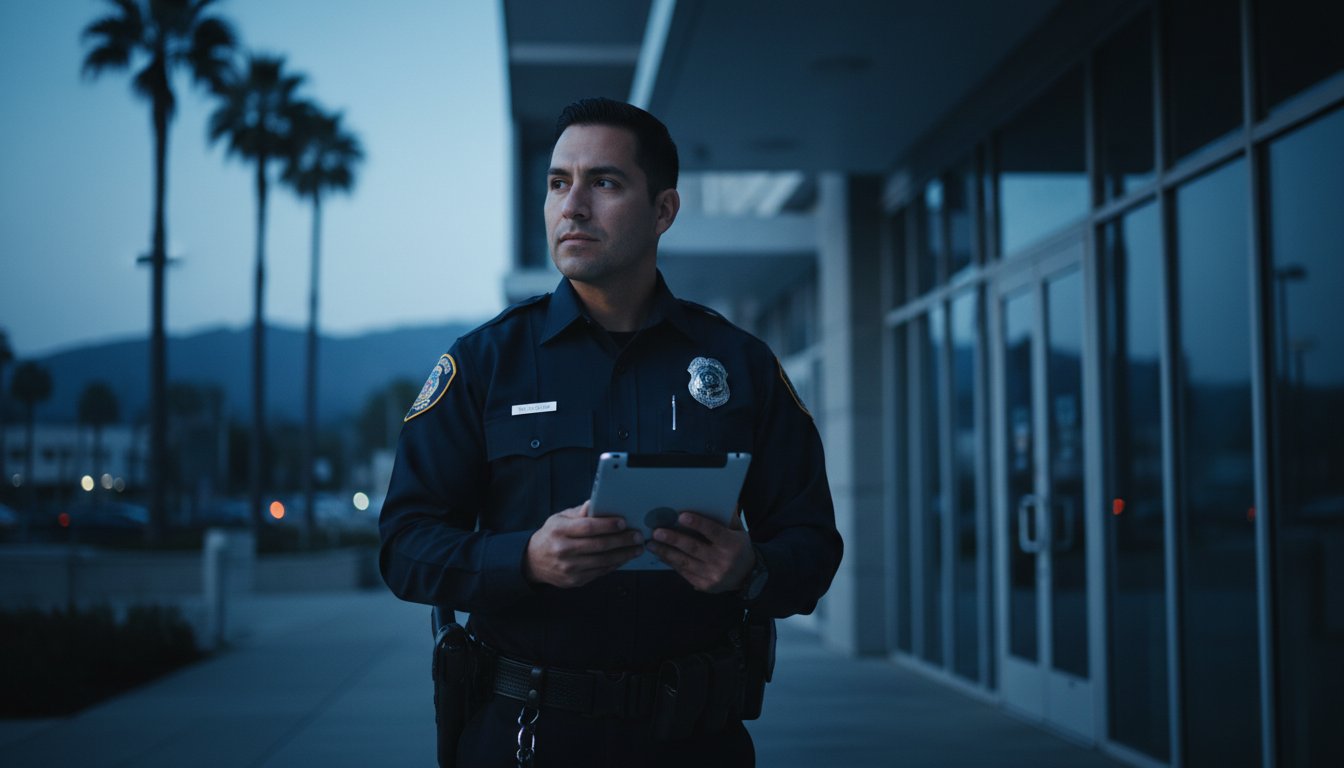
Professionalism in the security industry is a disciplined shield built on regulatory rigor and field oversight. A professional security guard is a licensed individual trained in risk mitigation and conflict resolution. While some organizations rely on a uniform to signal safety, a uniform is not a substitute for operational readiness. True protection involves a vigilant force capable of acting as both a first responder and a brand ambassador. This Overview of security guard roles highlights how these responsibilities have evolved beyond simple observation. Professional guards provide more than a presence; they represent the client’s commitment to order and safety.
Beyond the Uniform: Core Competencies
Elite protection requires high-level critical thinking and situational awareness. Professional security guards don’t just stand watch; they interpret digital data and identify emerging threats before they escalate. Effective communication and incident reporting accuracy are the foundations of accountability. A disciplined, authoritative presence creates a psychological deterrent that prevents crime through visible order. This level of readiness ensures that every interaction reinforces the client’s reputation while maintaining a hard perimeter. Guards must possess the soft skills necessary to de-escalate tension while maintaining the physical readiness to intervene if protocols require it.
The Regulatory Landscape: BSIS and California Compliance
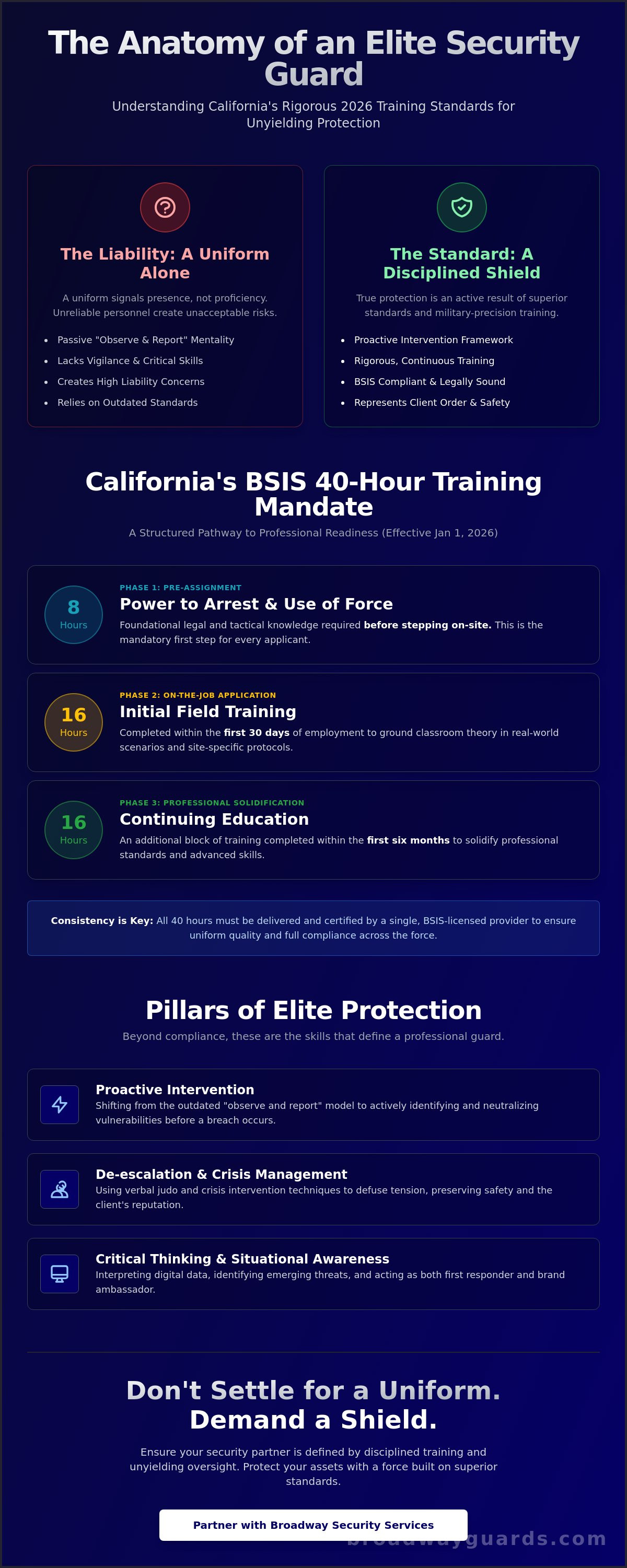
In California, the Bureau of Security and Investigative Services (BSIS) sets the baseline for legitimacy. As of January 1, 2026, the standards for a Guard Card have become significantly more rigorous. Every applicant must complete an 8-hour Power to Arrest and Appropriate Use of Force training course within six months of their application. This initial step is only the beginning of a mandatory 40-hour training curriculum. The state now requires that this specific training is delivered and certified by a single, BSIS-licensed provider to ensure consistency across the force.
Compliance requires a structured approach to education:
- Initial 8-hour pre-assignment training: Foundational legal and tactical knowledge required before stepping on-site.
- 16 hours of on-the-job training: Completed within the first 30 days of employment to ground theory in reality.
- 16 additional hours: Completed within the first six months to solidify professional standards.
A license alone is often insufficient for high-risk environments. Professional security guards must bridge the gap between basic state requirements and the reality of modern threats through continuous training. This commitment to regulatory rigor ensures that personnel are legally compliant and operationally superior. Relying on outdated licensing standards creates high liability concerns that no modern business can afford to ignore.
The Anatomy of Training: How Elite Guards Are Developed
Training isn’t a one-time checkbox; it’s a continuous hardening process that separates a mere observer from a disciplined protector. The industry has shifted away from the outdated “observe and report” model toward a framework of proactive intervention. Modern security guard training and duties now incorporate advanced technology literacy, predictive analytics, and rapid response tactics. Professional security guards aren’t just bodies in boots. They’re highly trained assets capable of identifying and neutralizing vulnerabilities before a breach occurs. Professional training must include legal ‘Use of Force’ boundaries to ensure every action remains within the strict confines of California law.
Elite development relies on a combination of classroom theory and simulation-based learning. While standardized modules provide the legal baseline, specialized training for high-risk environments differentiates a guard from a professional. Recurring drills ensure that emergency protocols become instinctual. This level of preparation converts a standard employee into a vigilant protector capable of high-stakes reliability. When an incident occurs, there’s no time for hesitation. A guard’s effectiveness is the direct result of the pressure-tested simulations they’ve endured long before they step onto your property.
De-escalation and Crisis Management Protocols
Conflict resolution is a core discipline for any modern force. Verbal judo allows personnel to defuse tension without resorting to physical force, preserving both safety and the client’s brand reputation. Training must include crisis intervention for mental health scenarios or high-stress environments where irrational behavior is a factor. Strict Standard Operating Procedures (SOPs) dictate the exact sequence of emergency responses. These protocols ensure that order is maintained even during chaos. By prioritizing communication, professional security guards can often resolve a threat before it requires a physical response.
Site-Specific Training vs. General Guarding
A professional’s utility is defined by their ability to adapt to unique environments. Securing a retail storefront requires a different tactical approach than managing construction site security. During the onboarding process, elite providers conduct a facility-specific vulnerability assessment to ground their strategy in reality. Personnel learn the specific ingress points, fire watch requirements, and high-value asset locations of your property. This granular focus ensures that guards aren’t just present; they’re integrated into the site’s unique operational flow. If you’re seeking a team that understands these nuances, it’s vital to partner with a firm that prioritizes rigorous training protocols for every deployment.
Armed vs. Unarmed Personnel: Aligning Force with Risk
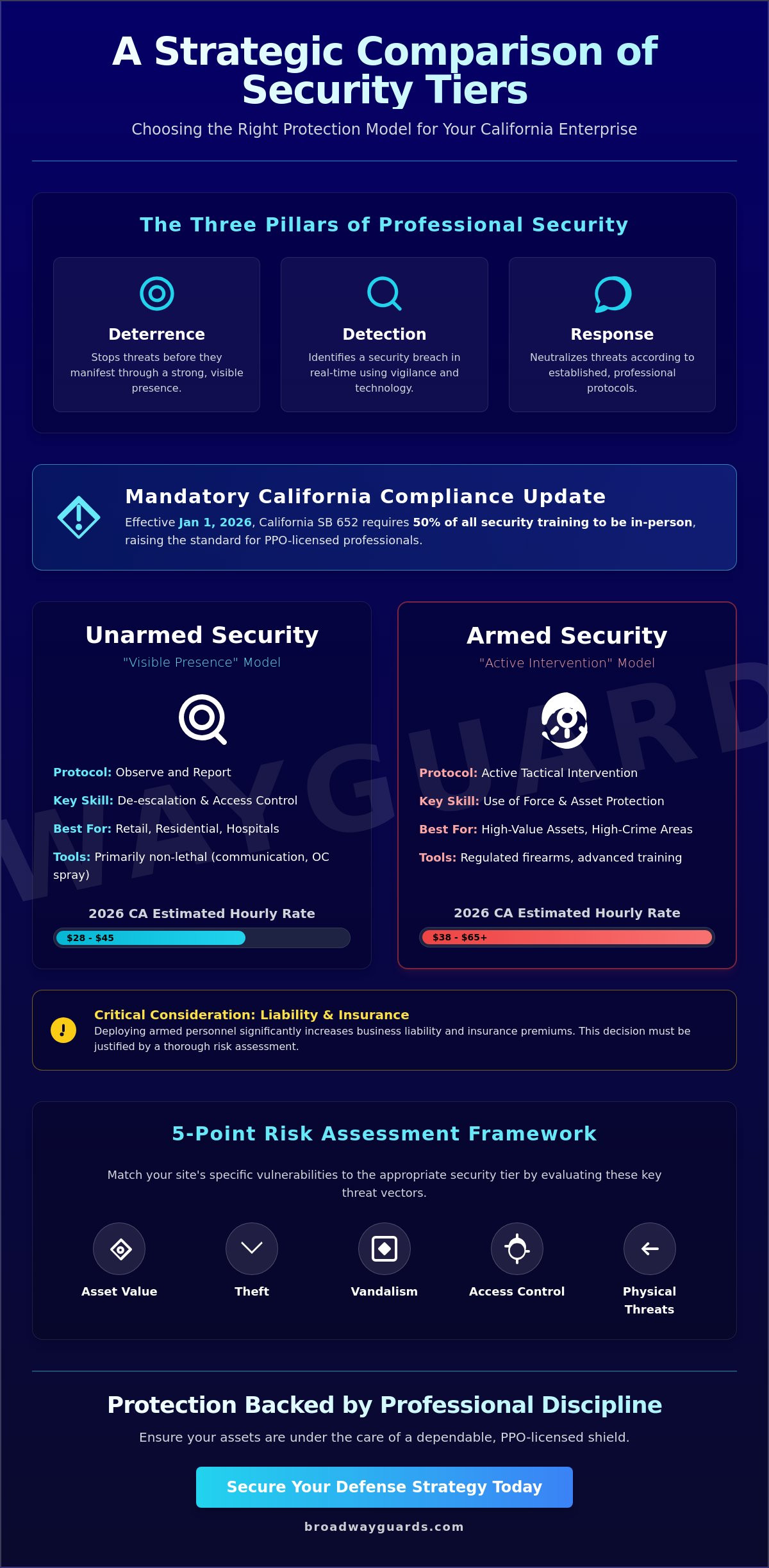
Risk management is a precise calculation of force against potential threats. In regions like the San Fernando Valley, the decision to deploy armed or unarmed personnel depends on local crime data and asset vulnerability. Deploying professional security guards requires a strategic understanding of how presence influences behavior. While an armed presence offers the highest level of deterrence, it also introduces complex legal and insurance implications for business owners. Selecting the wrong tier of protection can leave an organization exposed to high liability or physical breach. A disciplined approach ensures that the level of force remains proportional to the identified risk.
A comprehensive assessment of a facility’s needs often involves analyzing the detailed tasks of security guards to determine the necessary response capability. The psychological deterrent effect of an armed guard is undeniable in high-threat environments, yet unarmed personnel are often more suitable for maintaining a welcoming brand image in retail or residential settings. Organizations must verify that their provider carries the specific insurance endorsements required for armed deployments. Failure to align your security contract with your insurance policy can result in catastrophic financial exposure in the event of an incident.
When Armed Presence is Mission-Critical
Certain environments demand a higher threshold of protection to ensure safety. High-value asset protection, financial institutions, and jewelry retail operations require the immediate intervention capabilities of armed security guard services Los Angeles providers. These roles are filled by personnel who have secured a California Exposed Firearm Permit, a process that involves rigorous background checks and firearms proficiency testing. For executive protection and high-profile events, an armed presence provides the unyielding force necessary to neutralize professional threats. It’s a mission-critical choice for assets that cannot be replaced.
The Strategic Value of Unarmed Deterrence
Unarmed vigilance remains the standard for many commercial and residential applications. Residential complex safety and customer-facing retail roles benefit from a professional who prioritizes de-escalation over physical force. Unarmed guards are the primary choice for fire watch services, where the focus is on methodical oversight and early detection of environmental hazards. This tier of service offers a cost-effective balance for businesses that require a vigilant eye without the high-stakes liability of a weapon. Choosing unarmed personnel doesn’t mean sacrificing quality; it means prioritizing observation and prevention in lower-risk environments.
Operational Oversight: The Invisible Layer of Protection
Operational oversight is the differentiator between a passive presence and a disciplined shield. While many providers focus solely on the individual at the post, field supervision is often the missing link in modern security contracts. Professional security guards require a structured environment of accountability to maintain peak vigilance over long shifts. Technology serves as a force multiplier in this regard, but it cannot replace the necessity of human command. A rigorous oversight framework ensures that every patrol is performed and every incident is documented with military-like precision.
Accountability software provides the data necessary to verify field performance without ambiguity. Geofencing is a digital boundary tool used to verify that personnel remain within their assigned patrol zones in real-time. This system alerts management immediately if a guard leaves their designated area, ensuring constant coverage. Supporting these on-site assets is a 24/7 Dispatch Center that serves as the strategic hub for all field operations. This center provides a lifeline for personnel, offering rapid coordination during emergencies and maintaining a continuous link between the site and executive management.
Digital Reporting and Real-Time Accountability
Transparency is a requirement of high-stakes reliability. Electronic Daily Activity Reports (DARs) have replaced outdated paper logs, allowing for instant incident alerts and digital archiving. GPS tracking for mobile patrol vehicles and foot patrols provides a verifiable breadcrumb trail of all security movements. Clients have a fundamental right to transparent, on-demand security data to confirm their assets are protected. If you require a provider that prioritizes this level of visibility, you should evaluate our operational reporting standards to see how we maintain total site control.
Chain of Command and Field Supervision
A disciplined force operates within a clear, military-like hierarchy. This structure moves from the Guard to the Field Supervisor and finally to Senior Management, ensuring multiple layers of accountability. Unannounced site inspections are a core component of this system, keeping personnel sharp and compliant with all post orders. These inspections verify uniform standards, equipment readiness, and knowledge of site-specific protocols. Clear crisis management escalation paths ensure that when a threat is identified, the response is rapid and coordinated. Order is maintained through this relentless cycle of inspection and reinforcement.
Selecting Your Security Partner: A Professional Vetting Framework
Selecting a security provider is a strategic decision that carries significant legal and operational weight. A methodical vetting process ensures your assets are under the care of a disciplined force rather than a mere staffing agency. The primary credential for any provider in California is the Private Patrol Operator (PPO) license issued by the BSIS. This license confirms that the company has met the state’s rigorous standards for operational management and insurance. Without a verified PPO license, an agency cannot legally provide professional security guards to the public. Vetting must extend beyond a simple review of credentials to include a deep analysis of industry-specific experience.
Management responsiveness serves as a leading indicator of field performance. During the proposal phase, observe the speed and precision of their communication. A provider that fails to respond quickly to a request for information will likely falter during a real-world crisis. Operational rigor starts at the executive level and filters down to the guard on post. You should verify that the firm has a proven track record in your specific sector, whether you require hospital security or residential complex protection. A specialized approach ensures that the protocols deployed are relevant to your unique vulnerabilities. For organizations seeking a structured approach to safeguarding their facilities, a comprehensive corporate security planning framework provides the risk-first checklist necessary to align guard services, compliance mandates, and operational oversight into a single, cohesive strategy.
Evaluating Liability Coverage and Insurance
Liability protection is the bedrock of professional risk management. You must verify that your partner carries both General Liability and Workers’ Compensation insurance. General Liability protects your business from third-party claims, while Workers’ Comp ensures that you aren’t held liable for injuries sustained by guards on your property. Always demand an ‘Additional Insured’ endorsement for your specific location. This legal document links the provider’s insurance directly to your assets. Hiring uninsured or ‘under-the-table’ personnel creates a catastrophic exposure that can bankrupt an organization in the event of an incident.
The Broadway Standard: Disciplined Shield of Southern California
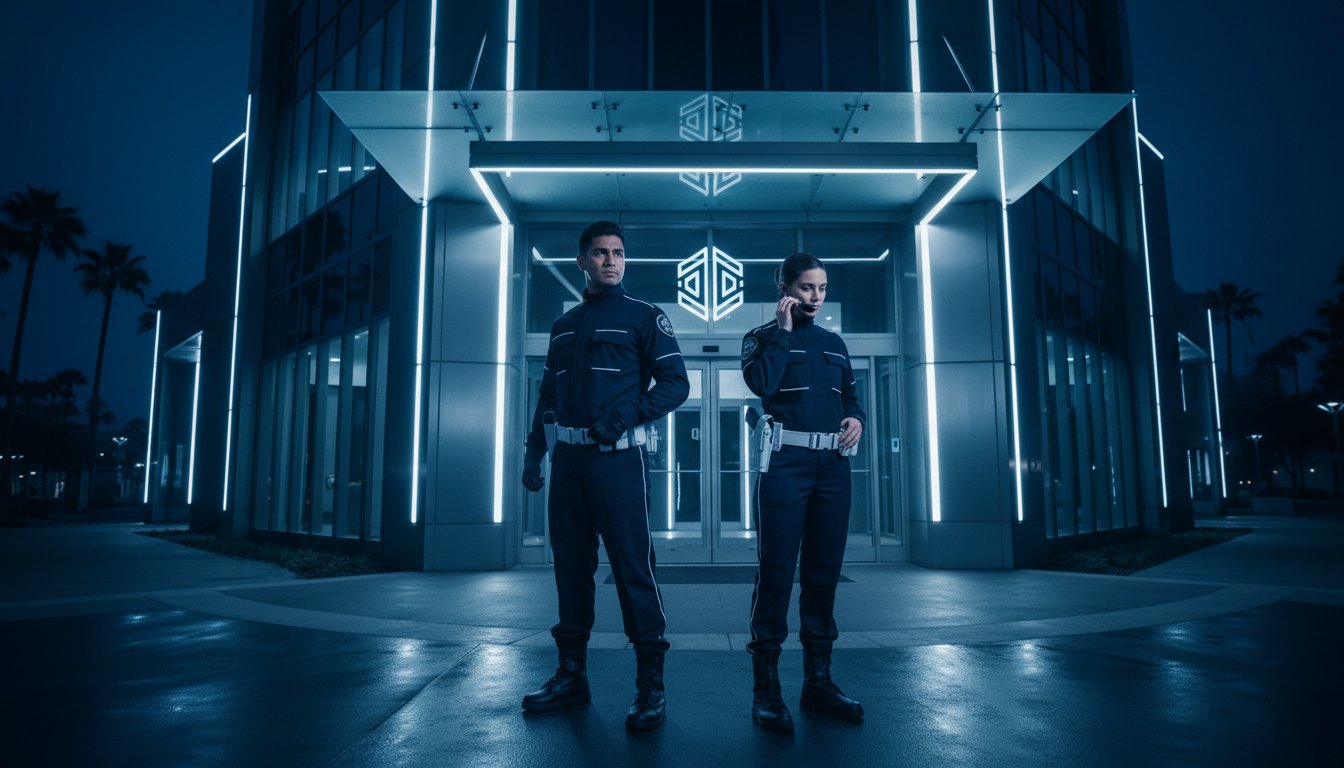
Broadway Security Services operates with military-like precision across Southern California, including Canoga Park and surrounding regions. Our approach is defined by a commitment to order and unyielding vigilance. We provide customized security management that aligns with the specific needs of commercial and residential clients. Every deployment is governed by the rigorous operational standards discussed throughout this guide. Safety isn’t a byproduct of chance; it’s the result of methodical oversight and elite training. Secure your assets with Broadway Security Services today to ensure your property is protected by a professional force that values duty above all else.
Securing Your Future with Operational Excellence
The standards for protection in 2026 demand a transition from passive observation to active, disciplined intervention. You’ve seen how professional security guards are forged through rigorous 40-hour training blocks and supported by digital accountability tools like geofencing. True safety isn’t a suggestion; it’s the direct result of strategic alignment between site-specific risks and a provider’s operational rigor. By prioritizing BSIS compliance and military-grade oversight, you eliminate the liability of unreliable personnel and establish a hard perimeter around your assets.
Broadway Security Services serves as a disciplined shield throughout Southern California and the San Fernando Valley. As a BSIS Licensed PPO, we prioritize the intersection of legal compliance and field performance to ensure your peace of mind. It’s time to replace confusion with confidence by choosing a partner that values order and unyielding duty. Hardening your property begins with a commitment to these definitive standards. Request a Professional Security Consultation with Broadway Security to ensure your assets remain under the care of a vigilant and unyielding force.
Frequently Asked Questions
What is the difference between a security guard and a private patrol officer?
A security guard is an individual employee who performs protection duties, while a Private Patrol Operator (PPO) is the licensed business entity authorized to provide those services. The PPO holds the legal responsibility for maintaining insurance, managing payroll, and ensuring all personnel meet state regulatory standards. Organizations must contract with a PPO to ensure their security force is legally compliant and fully insured.
How do I verify if a security guard company is licensed in California?
License verification is conducted through the Bureau of Security and Investigative Services (BSIS) online search tool. You must enter the company name or their specific PPO license number to confirm their status is “Clear” and “Active.” This verification step is critical when vetting professional security guards to ensure they’re backed by a legitimate, regulated organization.
Is it better to hire armed or unarmed security guards for a retail store?
The decision depends on the specific risk profile and inventory value of your location. Unarmed guards are often the standard for customer-facing retail roles where de-escalation and a welcoming brand image are the priorities. Armed personnel are reserved for high-threat environments or luxury retail sites where the deterrent of force is necessary to protect high-value assets and neutralize professional criminal activity.
What kind of training are professional security guards required to have?
California law requires professional security guards to complete a total of 40 hours of BSIS-certified training. This curriculum begins with an 8-hour course on the Power to Arrest and Appropriate Use of Force. Personnel must then complete 16 hours of on-the-job training within their first 30 days and an additional 16 hours of continuing education within their first six months of employment.
How much does it cost to hire professional security guards in Los Angeles?
Pricing for security services is influenced by the required level of expertise, the threat level of the site, and the specific equipment needs of the post. Armed services generally command a higher rate than unarmed vigilance due to the increased insurance and licensing requirements. You should request a detailed proposal from a licensed provider to understand the specific investment required for your facility’s safety.
Can a security guard make a citizen’s arrest in California?
Security guards have the authority to perform a citizen’s arrest under California Penal Code Section 837. This legal action is permitted when a public offense is committed in the guard’s presence or when a felony has been committed and there’s reasonable cause to believe the person arrested is responsible. Professional training ensures that guards understand the strict legal boundaries and liability risks associated with this process.
What should be included in a professional security guard’s daily report?
A professional Daily Activity Report (DAR) must provide a chronological log of all patrol rounds and site observations. It should include detailed accounts of any unusual incidents, maintenance issues, or safety hazards identified during the shift. Accurate reports also document all visitor interactions and deliveries to ensure a complete, transparent record of site activity for management review.
How quickly can security guards be deployed for an emergency fire watch?
Deployment speed for fire watch services is determined by the provider’s operational capacity and the proximity of available personnel to your location. When a fire suppression system fails, establishing a vigilant presence is a regulatory requirement to avoid facility closure. You should contact a local provider immediately to coordinate the fastest possible arrival of a disciplined guard to maintain site safety.