

Would your organization remain operational if California’s $200 million mobile crisis funding shift, reported by CalMatters on May 5, 2026, suddenly left your local assets vulnerable? With crisis calls in local Southern California communities already increasing by 15% in early 2026, you recognize that a single operational disruption from fire, theft, or civil unrest can jeopardize years of growth. It’s natural to feel concerned about the lack of a structured response team or the complex web of local regulatory compliance. Protection backed by professional discipline is the only way to ensure your assets remain secure. Implementing robust crisis management strategies is now a mandatory requirement for those who value order and high-stakes reliability.
This guide will help you master the essential crisis management strategies and tactical frameworks required to maintain operational continuity and protect your organization’s physical and reputational assets. We’ll provide a clear, scannable template for response and demonstrate how physical security and proactive governance create a disciplined shield for your brand. Partner with us to see how Broadway Security Services, your licensed PPO partner, can secure your future. You’ll gain the peace of mind that comes with a vigilant and unyielding force.
Key Takeaways
- Understand why modern crisis management strategies must integrate digital reputation management with physical site vulnerability to ensure total asset protection.
- Learn to distinguish between the three pillars of response, moving from proactive risk assessment to active site-specific deterrence and comprehensive recovery protocols.
- Discover the “Shield and Speaker” approach, which aligns a visible security presence with professional communication to maintain organizational authority.
- Identify the essential members of your Crisis Management Team and establish rigorous “Post Orders” for high-stakes scenarios like fire, medical emergencies, or security breaches.
- Gain a strategic framework for implementing military-like precision in your security operations to achieve operational continuity and lasting peace of mind.
Defining Crisis Management Strategies in a High-Stakes Environment
Effective crisis management strategies aren’t merely reactions to trouble. They’re proactive frameworks designed to identify, assess, and mitigate threats before they compromise your organization. In the San Fernando Valley, businesses face a unique set of regional pressures that demand a disciplined approach. From seismic activity to sudden civil unrest, the local environment requires a strategy that prioritizes safety and operational continuity. This isn’t just about survival; it’s about maintaining a position of strength when others falter.
In 2026, a high-stakes environment means your strategy must cover more than just physical walls. It has to account for both digital reputation and physical site vulnerability. To understand the broader context, one might ask, What is Crisis Management? and find it involves complex planning across multiple departments. True protection requires a unified front where your online presence and your physical perimeter are equally defended. We provide the professional discipline needed to bridge these gaps, ensuring your assets remain secure under any conditions.
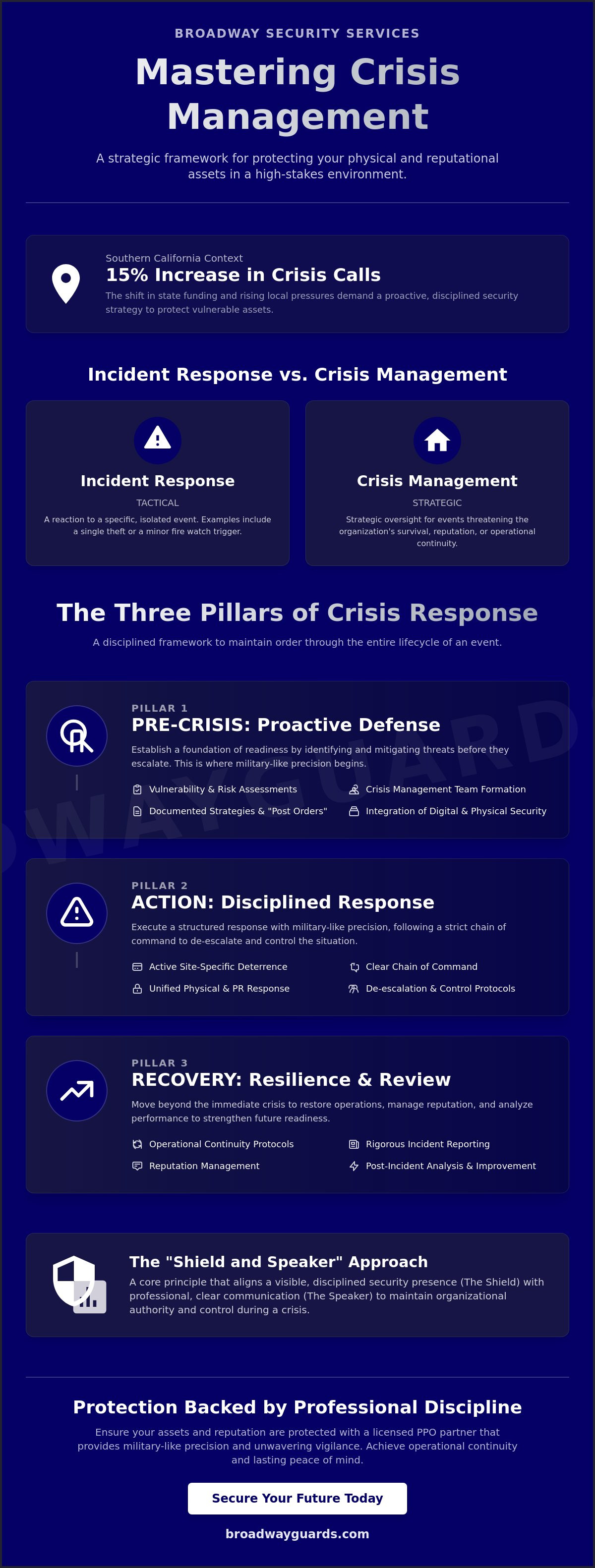
There’s a vital distinction between incident response and true crisis management in a professional security context. An incident response is a tactical reaction to a specific, isolated event, like a single retail theft or a minor fire watch trigger. Crisis management is the strategic oversight of events that threaten the very survival or reputation of the business. It’s the difference between putting out a localized fire and ensuring the entire organization remains resilient against systemic failure. Southern California businesses face unique risks, including specific regional fire watch requirements and volatile local enforcement landscapes, which make localized protocols a necessity.
The Role of Professional Discipline in Crisis Mitigation
Professional discipline is the foundation of effective mitigation. When an emergency strikes, military-like precision reduces response times and prevents chaos from spreading throughout your facility. Our “Disciplined Guardian” persona ensures that your response team doesn’t just react; they follow a strict, pre-established chain of command. This hierarchy ensures accountability at every level, from the guard on the perimeter to the executive team. By establishing order early, we provide the visible deterrence needed to de-escalate high-pressure situations quickly.
Why Every California Business Needs a Documented Strategy
California businesses operate under strict legal and regulatory frameworks that leave no room for error. In Los Angeles and the San Fernando Valley, failing to have a documented strategy can lead to severe liability and regulatory penalties. The cost of inaction is too high for any serious organization to ignore. Reputational damage often outlasts physical asset loss, making a prepared defense essential for long-term viability. Crisis management is a disciplined shield that protects your organization against both predictable risks and unforeseen disruptions. Protection Backed by Professional Discipline is the only way to safeguard your future. Let’s Touch With Us to secure your SFV operations today.
The Three Pillars of Crisis Response: Pre-Crisis, Action, and Recovery
The architecture of any resilient organization rests on three distinct pillars. These pillars ensure that crisis management strategies remain operational rather than theoretical. Every phase requires licensed protection and rigorous incident reporting to maintain a foundation of legal and operational legitimacy. Without a structured approach, response efforts become fragmented and ineffective. We provide the disciplined framework necessary to maintain order throughout the entire lifecycle of an event.
Success in high-stakes environments depends on the seamless integration of these stages. While many organizations focus only on the moment of impact, the most dependable systems prioritize what happens before and after the event. By utilizing professional discipline, we transform a chaotic situation into a managed process. This methodical rhythm is what separates a prepared organization from one that is merely lucky.
Phase 1: Vulnerability Assessment and Prevention
The first pillar focuses on identifying weak points before they’re exploited. We conduct project-based risk assessments to analyze perimeters and internal protocols. This proactive governance is essential because crisis calls in Monterey County, California, increased by 15% in early 2026. This data suggests that environmental volatility is rising across the state. By deploying fire watch services and mobile patrols, you create a layer of prevention that stops an incident from escalating into a full-scale crisis. Training your personnel to recognize early warning signs is a core component of professional discipline. It’s about maintaining a constant state of readiness.
Phase 2: Tactical Execution During an Emergency
When an event occurs, the transition to active response must be instantaneous. This phase involves the immediate deployment of armed or unarmed security guards to secure the scene. Order is maintained through disciplined crowd control and strict access management. While tactical physical security is the priority, integrating crisis communication strategies ensures that the organizational narrative remains under your control. We coordinate seamlessly with San Fernando Valley law enforcement to manage the transition from private security to public safety response. If you’re uncertain about your current readiness, you can request a professional security consultation to evaluate your site-specific protocols.
Phase 3: The After-Action Review (AAR)
Recovery isn’t simply a return to the status quo. It’s an opportunity to strengthen the shield. We conduct a field performance audit to analyze incident reports and identify gaps in the initial execution. This analysis leads to the updating of post orders to prevent a recurrence of the specific crisis. Communicating these corrective actions to stakeholders with transparency and authority rebuilds trust. This methodical approach ensures that every incident serves as a lesson for future protection. Protection Backed by Professional Discipline means we never stop refining our methods. Let’s Touch With Us to begin building your organization’s three pillars of resilience.
Physical Security vs. Communication: Integrating Tactical and PR Response
A professional PR message is hollow if the physical site remains vulnerable. While digital communication manages your reputation, tactical security manages your reality. We utilize a “Shield and Speaker” approach to ensure your perimeter is as secure as your statement. Effective crisis management strategies recognize that a secure environment provides the necessary foundation for any public relations effort. Without a disciplined physical presence, words of reassurance often fail to resonate with stakeholders who see chaos on the ground. It’s a matter of aligning what you say with what people see.
Visible security acts as a secondary deterrent against looting or unauthorized access during operational disruptions. When fire or civil unrest threatens your facility, the sight of uniformed guards signals that order is being maintained. This presence has a profound psychological impact on public perception. It transforms a site from a target of opportunity into a fortified zone of professional discipline. Our guards provide the visible deterrence required to prevent secondary crises before they manifest. This proactive stance ensures that your organization remains a symbol of stability rather than a victim of circumstance.
Deterrence as a Communication Strategy
The presence of a Disciplined Guardian communicates stability more effectively than any press release. Mobile patrols and executive protection serve as “hard” signals of your organization’s resilience. These visible markers show that you’re prepared for high-stakes challenges. We balance this transparency with strict operational security (OPSEC) to protect sensitive movements and personnel. This approach ensures your message of strength is backed by a tangible, unyielding force. It’s about projecting power through presence.
Coordinating Security Management with Legal Counsel
Tactical response must align with legal requirements to protect your long-term interests. In 2023, individuals with mental health and substance use disorders accounted for 20% of all emergency department visits in California. This statistic highlights the high-stress nature of public-facing environments where our personnel operate. We ensure all incident reporting meets California Private Patrol Operator (PPO) legal standards, grounding your defense in regulatory reality. Security logs and field performance data are vital when navigating legal considerations post-crisis. By protecting physical evidence and sensitive data, we safeguard your organization against potential litigation. Protection Backed by Professional Discipline means every action is documented with military-like precision. Let’s Touch With Us to integrate tactical security into your broader response plan.
Step-by-Step: Creating a Crisis Management Strategy Template
A plan without a structured template is merely a list of intentions. For San Fernando Valley organizations, effective crisis management strategies require a documented blueprint that transforms reactive panic into disciplined action. This template serves as your operational manual during high-stakes events. It ensures that every personnel member knows their exact position and responsibility when the perimeter is challenged. By codifying these protocols, you establish a standard of order that preserves both life and property.
The transition from monitoring to active response depends on a clearly defined trigger point. In California, the proposed $200 million shift in mobile crisis response funding, reported by CalMatters on May 5, 2026, means businesses must take greater internal accountability for their security. You can’t rely solely on public resources to manage immediate site threats. Your template must be ready to deploy the moment an incident is detected. This level of preparation is what defines a resilient organization.
The Crisis Management Team (CMT) Hierarchy
Structure is the antidote to chaos. Your CMT must have a clear hierarchy, starting with a Crisis Lead who holds ultimate decision-making authority. A Safety Officer oversees the physical security of the site, while a Communications Coordinator manages the “Speaker” aspect of the response. Every member must understand that professional discipline is the baseline requirement for their role. Accountability is non-negotiable. When the trigger point is reached, the CMT moves from a state of vigilance to tactical execution without hesitation.
Essential Tactical Checklists for the Template
- The Fire Watch Checklist: This protocol is activated when fire suppression systems are compromised. It requires continuous monitoring of high-risk zones and immediate reporting of thermal anomalies.
- The Perimeter Breach Checklist: On-site guards and mobile patrols use this to secure entry points and neutralize unauthorized access. It follows a strict sequence of observation, de-escalation, and containment.
- The Incident Reporting Template: This captures the “who, what, where, and when” with military precision. It serves as the official record for legal counsel and California Private Patrol Operator (PPO) regulatory compliance.
Regular drills are the only way to test the readiness of your team. A strategy on paper is useless if it hasn’t been pressure-tested in the field. Schedule these exercises quarterly to ensure every staff member can find evacuation routes and safe zones instinctively. If your current plan lacks this level of detail, secure your facility with a professional crisis plan today. Protection Backed by Professional Discipline ensures your organization is never caught off guard. Let’s Touch With Us to refine your tactical template.
Implementing Professional Discipline: How Broadway Security Services Safeguards Your Assets
Broadway Security Services provides more than just a presence. We deliver a disciplined shield. Our commitment to creating secure environments is built on highly trained personnel who operate with military-like precision. Protection Backed by Professional Discipline is the foundation of every strategy we develop. This isn’t a generic service. It’s a rigorous application of order designed to protect your organization’s physical and reputational assets. We position ourselves as a vigilant and unyielding force, ensuring that your operations continue without interruption.
Crisis management strategies must be tailored to the specific needs of your industry. A retail environment facing loss prevention challenges requires a different tactical approach than a construction site or a hospital. In healthcare settings, the stakes are exceptionally high. For example, the Fairfax-Falls Church Community Services Board projected a cost of $1,445 per individual served in emergency services for FY 2026. This highlights the significant financial and operational pressure on institutions during a crisis. Whether you require retail security or executive protection, we customize our response to ensure your assets remain uncompromised.
Our California Private Patrol Operator (PPO) license is a functional signature of our legitimacy. It grounds our professional claims in legal and regulatory reality. Following the April 30, 2026, revisions to the Medi-Cal fee schedules by the California Department of Health Care Services, the landscape of behavioral health and emergency response continues to shift. Staying compliant with these evolving standards is non-negotiable. We ensure that every guard, patrol, and incident report meets the highest standards of accountability. This focus on hierarchy and structure is what makes our protection dependable.
Our Approach to Risk Assessment and Strategy Development
We begin every partnership with a comprehensive site vulnerability evaluation. This isn’t a surface-level walk-through. It’s a project-based risk assessment that informs your entire crisis plan. We integrate armed and unarmed security guards into your broader organizational strategy to provide a unified front. Our mobile patrol services offer dependable oversight for commercial properties across Southern California. This visible deterrence is a core component of our professional discipline. We identify weak points in your perimeter and establish “Post Orders” that leave nothing to chance.
Ensuring Long-Term Resilience and Peace of Mind
Resilience is maintained through continuous training and strict field performance monitoring. We don’t just set protocols and walk away. We provide constant oversight to ensure our standards never waver. This commitment to duty provides the peace of mind you need to focus on your core operations. You deserve to know that your assets are under the care of a vigilant force that values rules and results above all else. Our communication rhythm is steady and methodical, mirroring the nature of the security patrols we provide.
Let’s Touch With Us to begin your professional security consultation today. Our team is ready to analyze your current protocols and implement a more disciplined approach to your safety. Secure your assets with Broadway Security Services’ professional crisis management strategies.
Fortify Your Operations Through Tactical Readiness
Maintaining operational continuity in 2026 demands the implementation of robust crisis management strategies with military-like precision. You’ve learned that a “Shield and Speaker” approach integrates visible site deterrence with professional communication to protect both physical and reputational assets. By establishing a clear hierarchy and utilizing tactical checklists for fire watch or perimeter breaches, your organization becomes a fortified zone of order. This disciplined structure is the only way to safeguard your future against the unpredictable nature of the current regulatory and operational landscape.
True peace of mind comes from knowing your protection is backed by professional discipline. Broadway Security Services provides California PPO Licensed Protection and highly trained Disciplined Guardians who are prepared for any high-stakes scenario. We’ve served Canoga Park and Southern California for over 2026 years, maintaining a legacy of unyielding reliability. Don’t wait for a disruption to test your readiness. Secure your perimeter and your reputation by taking the first step toward a more resilient future. Request a Professional Security Consultation & Risk Assessment today to ensure your assets remain under the care of a vigilant force. Let’s touch with us to begin.
Frequently Asked Questions
What are the four stages of crisis management strategies?
Crisis management strategies consist of four critical stages: mitigation, preparedness, response, and recovery. Mitigation involves proactive steps to reduce risks, while preparedness ensures your team is trained and equipped. The response phase focuses on tactical execution during an event, followed by a recovery stage to restore operations. Each stage requires a foundation of professional discipline to ensure that the organization’s physical and reputational assets remain under constant, vigilant care.
Is crisis management different from emergency response?
Emergency response is a tactical component of the broader crisis management framework. While emergency response addresses the immediate physical threat, crisis management oversees the strategic, legal, and reputational consequences. A security guard handling a perimeter breach performs an emergency response. The leadership team managing the long-term operational continuity and stakeholder trust is practicing crisis management. Both levels of action must work in a unified, military-like precision to be effective.
What should be included in a crisis management template?
A comprehensive template must include a Crisis Management Team hierarchy, specific trigger points for activation, and detailed post orders. You should also incorporate communication protocols for stakeholders and precise evacuation routes. Including incident reporting forms ensures that every action is documented for legal and regulatory compliance. This structured approach transforms a general plan into a dependable operational manual that your personnel can follow with absolute certainty during high-stakes disruptions.
How can security guards help in a crisis management situation?
Security guards provide the visible deterrence and tactical control necessary to stabilize a scene. Whether armed or unarmed, these professionals manage access points and implement crowd control protocols to prevent secondary incidents like looting. By following strict post orders, guards ensure that the perimeter remains secure while the management team focuses on strategic recovery. Their presence communicates a sense of order and high-stakes reliability to both employees and the public.
Why is professional discipline important during a business crisis?
Professional discipline is vital because it establishes a clear chain of command and ensures accountability when chaos threatens. It eliminates hesitation by providing a structured environment where every individual knows their duty. Protection Backed by Professional Discipline means that response times are reduced and protocols are followed without exception. This military-like precision is what allows a business to maintain operational continuity and protect its assets during the most volatile circumstances.
Can a small business in Canoga Park afford professional crisis management?
Small businesses in Canoga Park can access professional protection through scalable solutions like mobile patrol and retail security services. You don’t need a full-time battalion to benefit from a disciplined shield. By utilizing project-based risk assessments, a small organization can identify its most critical vulnerabilities and implement targeted crisis management strategies. This focused approach provides the same level of licensed protection as larger corporations while remaining within a manageable operational budget.
What is the role of a risk assessment in crisis planning?
A risk assessment serves as the diagnostic tool that identifies vulnerabilities in your physical and operational perimeters. It provides the raw data needed to build a site-specific strategy rather than relying on generic templates. By evaluating weak points like unsecured entryways or gaps in fire watch coverage, the assessment allows you to allocate resources where they’re most needed. This proactive governance is the first step in creating a dependable shield for your assets.
How often should crisis management strategies be reviewed?
You should review your crisis management strategies at least once every 12 months or immediately following any significant operational drill. Regular updates are necessary to account for shifts in California regulatory standards or changes in your local risk profile. Conducting an After-Action Review (AAR) after a real-world incident also provides critical data for refining your post orders. Continuous improvement ensures that your defense remains as unyielding and prepared as the day it was established.