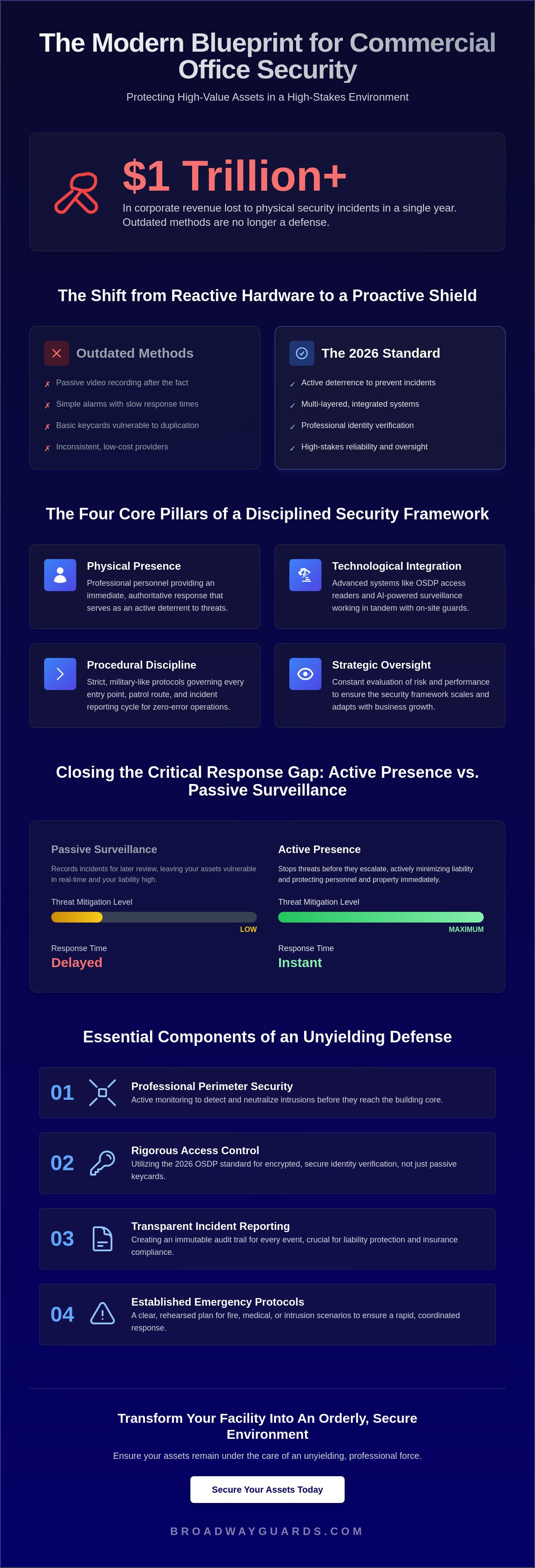

A standard security presence is no longer enough to protect a high-value corporate asset in the current San Fernando Valley climate. In an era where commercial districts face rising crime and evolving liability risks, passive observation has become a liability itself. You understand that protecting your tenants and assets requires more than a uniform; it demands a disciplined operational shield. Investing in professional loss prevention services Los Angeles businesses trust is the only way to ensure your property remains a secure, orderly environment.
You’re likely concerned about the difficulty of finding reliable staff who can adhere to the strict SB 652 training requirements that took effect on January 1, 2026. This guide provides a clear roadmap for implementing a multi-layered security strategy that reduces insurance premiums through documented risk mitigation. We’ll explore how integrated platforms and rigorous oversight transform security from a line-item expense into a strategic asset. This article outlines the specific protocols necessary to maintain a vigilant, unyielding force that prioritizes safety and peace of mind.
Key Takeaways
- Understand the shift toward proactive protection and why a comprehensive security framework is essential for the 2026 Southern California market.
- Evaluate the strategic deployment of armed and unarmed guards to determine the most effective force level for your specific office floor plan.
- Utilize professional risk assessments to identify and neutralize hidden security gaps in parking structures and corporate entry points.
- Secure the specialized loss prevention services Los Angeles assets require to ensure full compliance with California regulatory standards and insurance mandates.
- Position your property under the care of a disciplined, unyielding force that prioritizes accountability and rigorous operational standards.
The Strategic Importance of Office Building Security Services
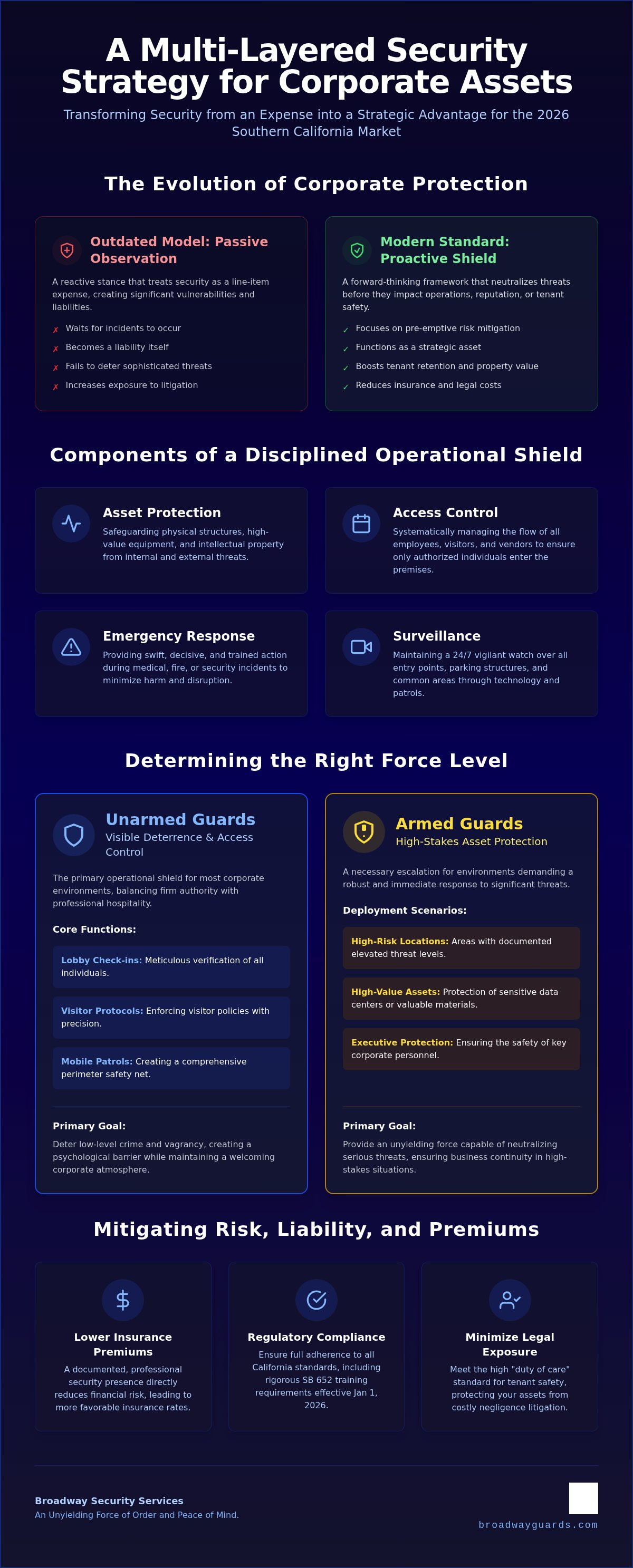
Office building security is a comprehensive framework of personnel, technology, and protocols. It’s designed to safeguard commercial assets, intellectual property, and human lives. In the Southern California market, the approach has shifted from reactive response to proactive prevention. Owners can’t afford to wait for an incident to occur. They need loss prevention services Los Angeles providers offer that focus on pre-emptive risk mitigation. This evolution ensures that threats are neutralized before they disrupt business operations or damage a property’s reputation.
Implementing robust physical security measures serves as a direct investment in the building’s financial health. High-quality security leads to increased tenant retention and higher property valuations. Tenants prioritize safety when choosing their corporate headquarters. A visible, disciplined presence acts as a powerful deterrent against low-level crime, unauthorized access, and vagrancy. It communicates a standard of order that protects the building’s prestige and ensures a stable environment for commerce.
- Asset Protection: Securing physical structures and high-value equipment.
- Access Control: Managing the flow of employees, visitors, and vendors.
- Emergency Response: Providing immediate action during medical or fire incidents.
- Surveillance: Maintaining a 24/7 vigilant eye on all entry points and common areas.
Mitigating Corporate Liability and Risk
A documented security presence is a fundamental requirement for modern risk management. It helps reduce insurance premiums and minimizes legal exposure. California property managers face a high “duty of care” standard for tenant safety. Negligence in this area results in significant liability and potential litigation. The cost of a single breach far outweighs the investment in a disciplined shield. Professional loss prevention services Los Angeles buildings utilize ensure that every incident is reported and every protocol is followed. This level of accountability protects the building owner from the financial fallout of unforeseen security events.
Maintaining Professionalism in a Corporate Environment
Effective security in a high-rise setting utilizes a “Concierge-Style” approach. This model balances firm authority with professional hospitality. Military-like discipline and professional attire are essential for maintaining a corporate image. Broadway Security focuses on creating an atmosphere of order through rigorous training and oversight. Our guards are trained to be both a vigilant force and a helpful resource for tenants. This dual role ensures that safety is maintained without compromising the tenant experience. It’s a standard of performance that prioritizes both protection and presence, making certain that everyone who enters the building feels the weight of an unyielding force of order.
Core Personnel: Unarmed vs. Armed Guard Deployment
Determining the appropriate force level for a commercial facility requires a methodical evaluation of risk factors. A high-rise in the San Fernando Valley faces different threats than a suburban office park. Property managers must align their personnel strategy with their specific vulnerability profile. This decision distinguishes between general presence and high-stakes asset protection. Utilizing the right loss prevention services Los Angeles experts provide ensures that your building is neither under-protected nor unnecessarily militarized. Force deployment is a strategic calculation, not a guess.
Unarmed Guards: Visible Deterrence and Access Control
For many corporate environments, unarmed security guards serve as the primary operational shield. These professionals manage lobby check-ins and visitor protocols with absolute precision. Their presence creates a psychological barrier for potential intruders while maintaining a welcoming atmosphere for authorized personnel. When integrated with mobile patrols, unarmed guards provide a comprehensive perimeter safety net that deters low-level crime and vagrancy. They act as the vigilant eyes of your property, ensuring every person entering the premises is accounted for and authorized.
Armed Personnel: High-Stakes Asset Protection
Certain environments demand a more robust response. You should consider escalating to armed security guard services Los Angeles when your facility houses high-value physical assets, sensitive data, or high-profile executives. Broadway’s armed guards maintain a stoic, professional image while providing an unyielding layer of protection. These personnel undergo rigorous training beyond the standard requirements to handle high-stakes interventions with composure and discipline. This level of security is reserved for environments where the threat of violent crime or significant asset theft is a documented risk.
According to the Security Industry Association, industry standards are evolving to meet more complex urban threats. In California, all guards must adhere to Bureau of Security and Investigative Services (BSIS) mandates. As of January 1, 2026, SB 652 requires the initial 8-hour “Powers to Arrest and Appropriate Use of Force” course to be completed through a single, BSIS-approved provider. Total training remains 40 hours, ensuring every guard on your property possesses the necessary legal and tactical foundation. If you’re uncertain which force level your building requires, a professional consultation can clarify your operational needs. Review our personnel options to find the right fit for your facility.
Establishing a Disciplined Shield: Risk Assessment and Protocols
Effective security isn’t a commodity you purchase; it’s a strategic framework you build. A building can’t be protected if its weaknesses remain unknown to those tasked with its defense. This is why every professional engagement must initiate with a security risk assessment CA property managers utilize to gain total site clarity. This foundation allows for the development of site-specific protocols that mirror military-grade order. Without this initial intelligence phase, security remains reactive and vulnerable to the evolving local threats in the San Fernando Valley.
The loss prevention services Los Angeles market requires a higher standard of oversight than simple patrol rounds. We identify hidden vulnerabilities in complex office floor plans and multi-level parking structures that others miss. By establishing a disciplined shield, we ensure that every square foot of your corporate asset is under methodical observation. This process isn’t a one-time event. Recurring evaluations are mandatory to adapt to shifting crime patterns and ensure your protection remains unyielding and relevant.
Vulnerability Evaluation and Site Hardening
Our evaluation process involves a granular analysis of all physical entry points, lighting levels, and surveillance blind spots. We don’t just look for doors; we look for the path of least resistance an intruder might take. Following a risk assessment, we provide concrete recommendations for physical security improvements. This might include hardening access points or repositioning cameras for maximum field-of-view. Broadway Security’s approach to site oversight focuses on vigilant protection that eliminates opportunities for breach before they can be exploited.
Crisis Management and Emergency Response
Order is most critical during a chaotic event. We develop actionable strategies for a range of contingencies, including fire, medical emergencies, or active threats. Our guards are trained to coordinate seamlessly with local Canoga Park law enforcement during incidents to ensure a swift, organized response. This high-stakes reliability is further supported by our specialized fire watch services California mandates for commercial office safety. When systems fail or threats emerge, our personnel act as the decisive force that maintains safety and mitigates liability. This level of professional loss prevention services Los Angeles ensures that your tenants remain safe and your corporate reputation stays intact.
Operational Standards: Evaluating a California Security Provider
Selecting a security provider is a high-stakes decision that dictates the safety of your corporate environment. You must look beyond marketing claims and verify the operational foundations of any potential partner. A disciplined shield is built on legal compliance and rigorous oversight. Every reputable provider of loss prevention services Los Angeles property managers hire must maintain a valid Private Patrol Operator (PPO) license. This isn’t just a formality; it’s a legal safeguard that ensures the agency meets California’s strict insurance and liability requirements.
Training standards differentiate a professional force from a “warm body” model. As of January 1, 2026, California’s SB 652 mandates that the initial 8-hour training for new guards be completed through a single, BSIS-approved provider. This law ensures a consistent foundation in the powers to arrest and appropriate use of force. We ensure all personnel exceed these minimums, maintaining a state of constant readiness and professional discipline. Operational standards determine the effectiveness of your defense. A provider without local expertise cannot respond with the speed required during a crisis.
Licensing and Regulatory Compliance
California’s regulatory landscape is complex and unforgiving. A PPO license signifies that a provider has passed rigorous background checks and possesses the necessary industry experience. You should always verify that a provider’s license is active and in good standing with the Bureau of Security and Investigative Services (BSIS). Broadway Security maintains strict adherence to these legal realities, ensuring that our presence on your property is fully compliant and legally sound. This commitment to regulatory rigor protects you from the liability of hiring uncertified or under-insured staff. It’s a non-negotiable foundation for any corporate security contract.
Reporting and Accountability
Transparency is the cornerstone of trust in the security industry. A professional provider utilizes technological integration to offer real-time reporting and GPS-tracked patrols. This ensures that every guard is exactly where they should be at all times. Detailed daily activity reports (DARs) and incident logs provide a clear, chronological record of building activity. These documents are essential for measuring security performance and identifying long-term trends in building safety. We prioritize clear communication channels between our guards and your property management team. You’re never left in the dark regarding the status of your assets. When you evaluate loss prevention services Los Angeles options, prioritize those that link professional discipline directly to the outcome of protection. Secure your building with a licensed provider today.
Customized Protection: Why Broadway Security is the Premier Choice
Broadway Security Services operates as a disciplined shield for corporate assets across Southern California. We don’t offer generic watchman services; we provide a structured defensive framework. By linking safety with rigorous operational standards, we ensure that every client receives a level of oversight that prioritizes accountability and peace of mind. Our scalable solutions are designed to adapt to the specific needs of your property, whether you manage a single-tenant office or a sprawling corporate campus. This commitment to professional excellence defines our role as a premier provider of loss prevention services Los Angeles businesses rely on for asset protection.
The San Fernando Valley Advantage
Our base in Canoga Park provides a strategic advantage for clients throughout the San Fernando Valley. We possess a deep familiarity with the commercial landscape of Woodland Hills and surrounding districts. This local expertise allows for rapid deployment capabilities that national providers simply cannot match. We understand the specific local threats and regulatory nuances that impact loss prevention services Los Angeles property managers require. Our personnel embody a disciplined protector persona that resonates with the professionalism of high-value corporate firms. We don’t just patrol; we secure the environment with an unyielding presence.
Getting Started with Broadway Security
Initiating your defense begins with a project-based risk assessment. This methodical evaluation identifies the specific vulnerabilities of your site and establishes the foundation for your security protocols. We transition from this initial consultation to active, vigilant protection with military-like precision. Our commitment to duty ensures that your assets are under the care of a vigilant and unyielding force. We prioritize rules, hierarchy, and visible results above all else to maintain an atmosphere of high-stakes reliability. Every engagement is grounded in legal and regulatory reality, ensuring your property remains a secure, orderly environment.
Your corporate assets deserve the care of a company that takes its responsibilities with the utmost gravity. We provide the expertise and oversight necessary to mitigate risk and ensure tenant safety. Don’t leave your property’s safety to chance or under-trained staff. Secure your office building with Broadway Security today and experience the peace of mind that comes from a professional, disciplined shield.
Securing Your Corporate Future with a Disciplined Shield
Effective office security requires a transition from passive observation to an unyielding, disciplined shield. You’ve seen how a multi-layered approach, beginning with a professional risk assessment, identifies and neutralizes vulnerabilities before they become liabilities. Whether deploying armed or unarmed personnel, the standard of protection must remain consistent and methodical. Relying on loss prevention services Los Angeles property managers trust ensures your building meets the rigorous 2026 California regulatory standards.
Broadway Security Services provides this high-stakes reliability from our base in Canoga Park. We’re a California PPO Licensed and Insured provider dedicated to serving the San Fernando Valley with military-style training standards. Our focus on hierarchy and protocol guarantees that your assets are under the care of a vigilant force. Don’t leave your tenant safety or asset protection to chance. Professional oversight is the only way to maintain a secure and orderly corporate environment.
Request a Strategic Security Consultation for Your Office Building and secure your property today with an unyielding force of order.
Frequently Asked Questions
What are the primary duties of an office building security guard?
Primary duties include managing access control points, conducting methodical patrols, and providing immediate emergency response. Guards act as a vigilant presence to deter criminal activity and ensure all corporate assets remain secure. They maintain detailed logs and monitor surveillance systems to identify potential threats before they escalate. This role prioritizes the safety of tenants and visitors while upholding the building’s operational standards through consistent oversight and professional discipline.
How do security guards handle unauthorized access in a commercial setting?
Guards handle unauthorized access by immediately intercepting the individual and verifying their credentials. If the person has no authorization, the guard follows established protocols to escort them from the premises firmly and professionally. Every incident of unauthorized entry is documented in an incident log to identify recurring vulnerabilities. This disciplined approach ensures that only approved personnel enter the facility, maintaining a secure and orderly corporate environment for all tenants and staff.
Is it better to have armed or unarmed guards for a corporate office?
The choice between armed and unarmed personnel depends entirely on your building’s specific risk profile. Unarmed guards are ideal for visible deterrence and managing lobby check-ins in standard corporate settings. Armed guards are necessary for high-stakes environments involving significant physical assets or high-profile executives. Professional loss prevention services Los Angeles providers help determine the appropriate force level through a comprehensive risk assessment, ensuring your property is protected without unnecessary escalation.
What should be included in a commercial property risk assessment?
A thorough risk assessment must include a granular analysis of all entry points, surveillance coverage, and lighting levels. It identifies blind spots in parking structures and evaluates existing access control protocols. The assessment also reviews emergency response plans for fire or medical incidents. By documenting these vulnerabilities, property managers can implement site-specific hardening measures. This methodical evaluation serves as the foundation for an unyielding defensive strategy that protects both physical and intellectual assets.
How does Broadway Security ensure the quality of its personnel?
We ensure personnel quality through rigorous, military-style training standards and strict adherence to California BSIS requirements. Every guard undergoes thorough background checks and specialized training in risk assessment and crisis management. We utilize technological integration, such as GPS-tracked patrols and real-time reporting, to maintain absolute accountability. This disciplined approach guarantees that our staff remains a vigilant force, prioritizing the safety and peace of mind of every client we serve.
Can you provide temporary security for corporate events or high-risk meetings?
Yes, we provide specialized event security and executive protection for corporate gatherings and high-risk meetings. Our team develops a custom protection plan to manage crowd control, access points, and personnel safety during the event. This temporary deployment maintains the same high standards of discipline and oversight as our long-term contracts. We ensure that your high-stakes meetings proceed without disruption, providing an unyielding shield for your executives and sensitive company information.
What is the response time for emergency security staffing in Canoga Park?
Our base in Canoga Park allows for rapid deployment and superior response times throughout the San Fernando Valley. Local expertise ensures that emergency staffing needs are met with precision and speed, minimizing potential downtime or liability. We maintain a state of constant readiness to address urgent security breaches or system failures. This proximity allows us to provide the immediate loss prevention services Los Angeles businesses require when a threat emerges or a crisis occurs.
How do security guards assist with fire safety and compliance?
Security personnel assist with fire safety by conducting regular checks of fire suppression equipment and ensuring all exits remain unobstructed. We provide specialized fire watch services when alarm systems are compromised, maintaining compliance with California fire codes. Guards are also trained to coordinate orderly evacuations and assist local fire departments during an emergency. This proactive oversight reduces the risk of fire-related damage and ensures the continued safety of all building occupants.