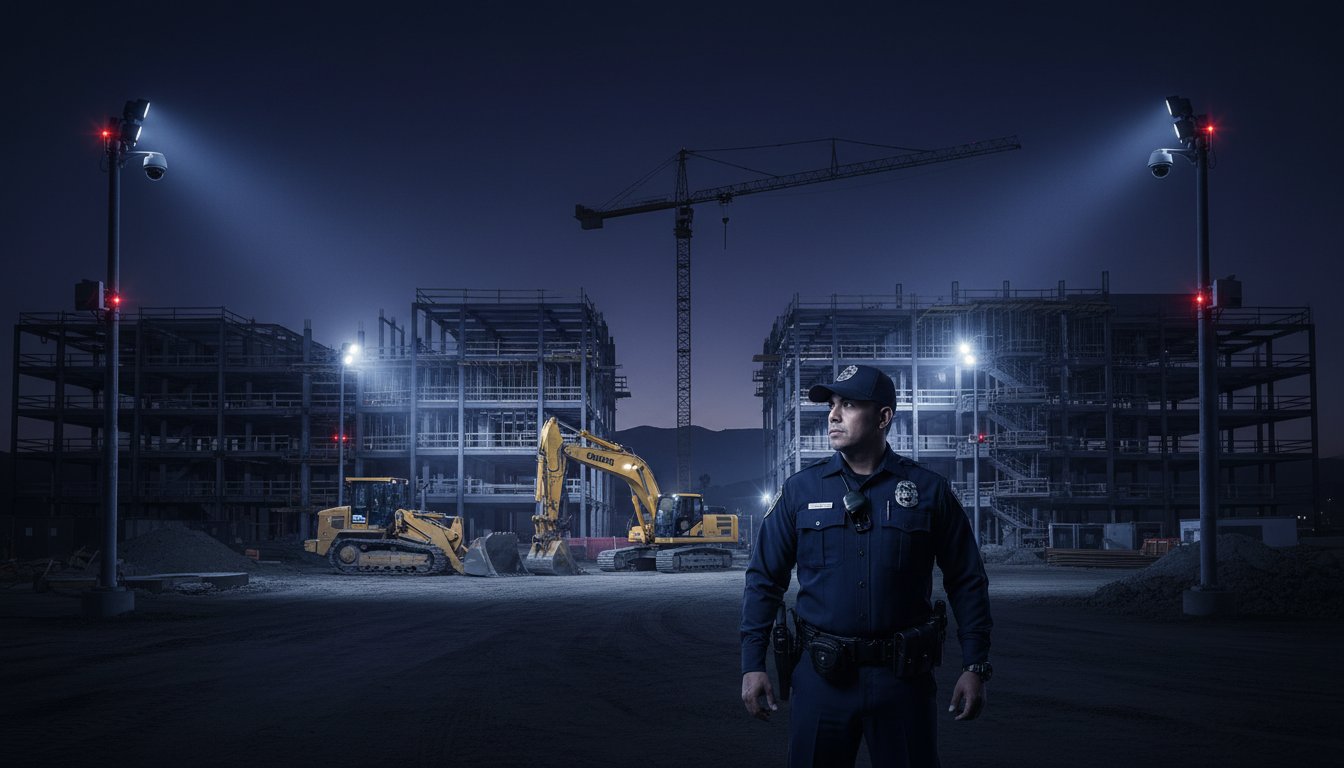
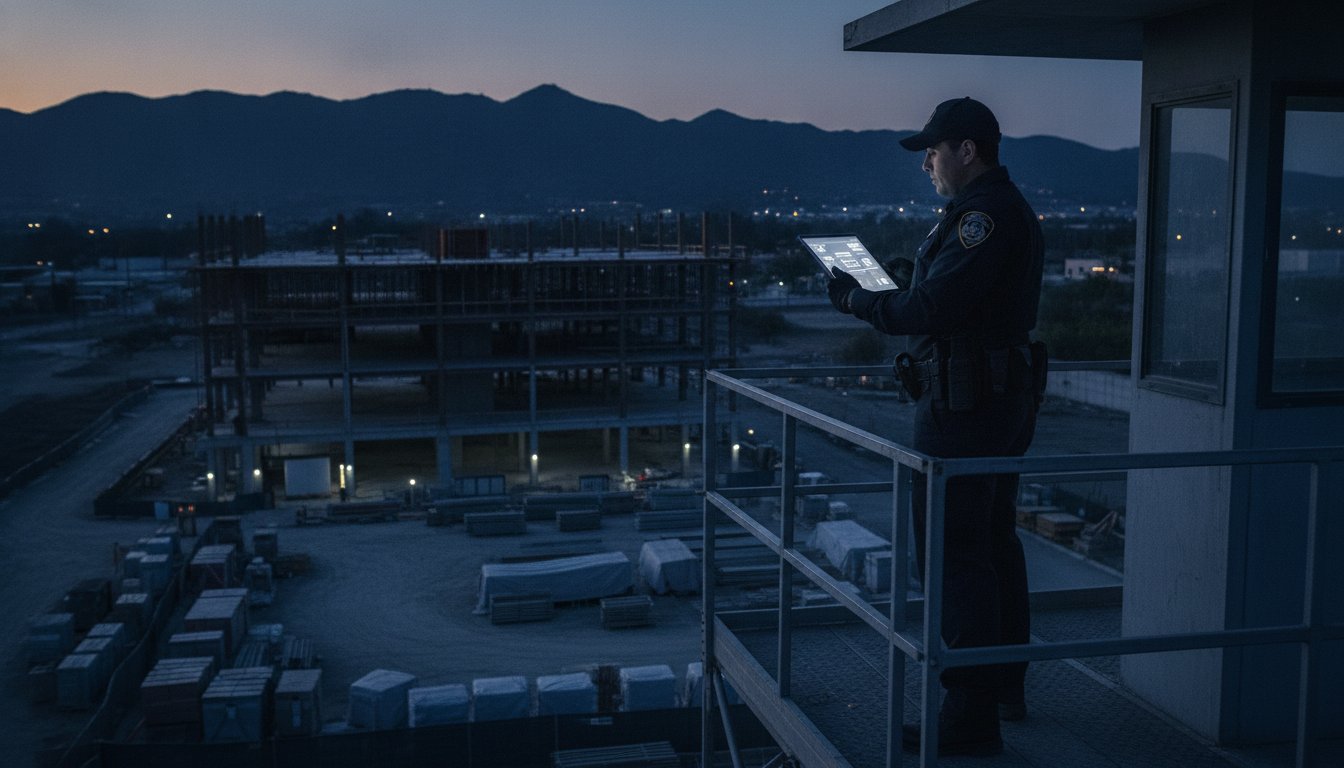
Construction Site Risk Assessment: 2026 Security Guide

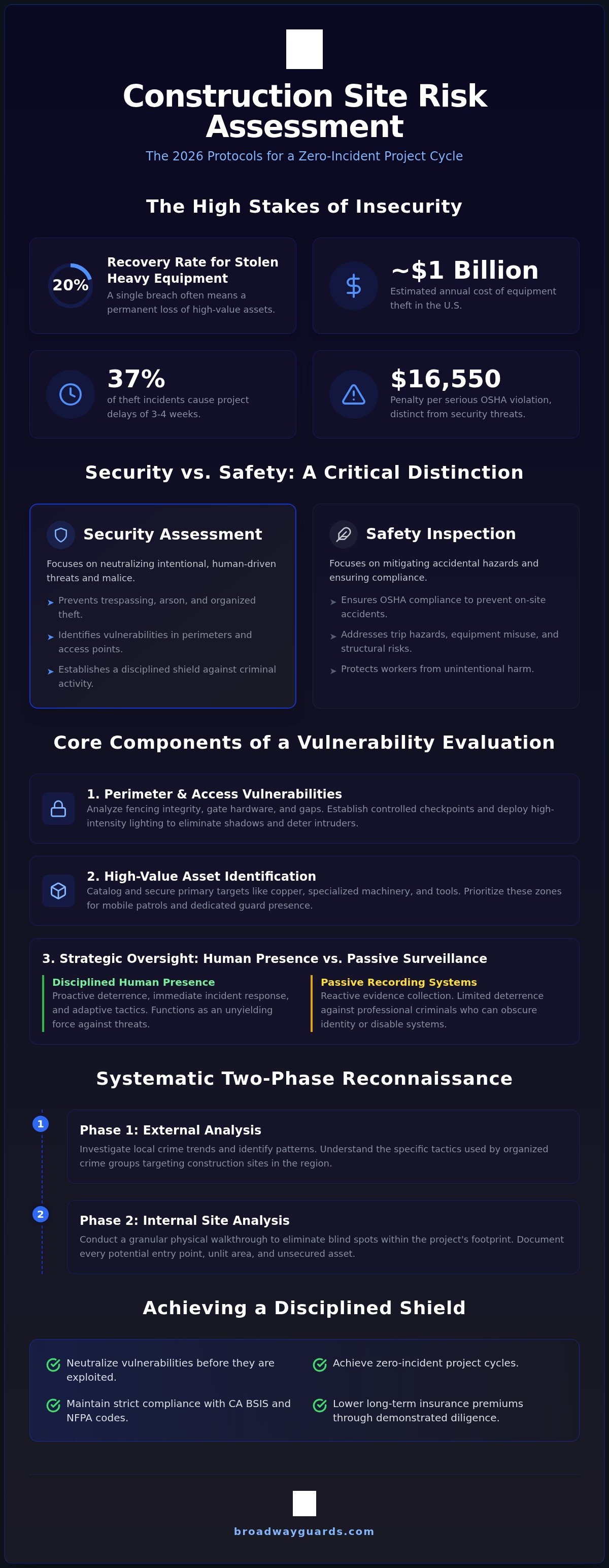
With only 20% of stolen heavy equipment ever recovered, a single security breach is often the difference between a profitable venture and a stalled project. You recognize that rising copper prices and equipment theft aren’t just inconveniences; they are direct threats to your project’s continuity and insurance standing. Conducting a rigorous construction site risk assessment is the only way to establish a disciplined perimeter that withstands modern criminal tactics. We understand that your site requires more than passive observation; it demands a professional framework that prioritizes order and accountability.

This 2026 guide provides the exact protocols needed to secure your high-value assets and maintain a zero-incident project cycle. We’ll show you how to identify site vulnerabilities, adhere to California BSIS standards, and navigate updated NFPA fire codes to avoid the $16,550 penalties associated with serious OSHA violations. By the end of this article, you’ll have a clear, actionable security plan that functions as a disciplined shield for your investments. We’ll move from broad oversight strategies to the specific mobile patrol and guard protocols that ensure your assets remain under the care of an unyielding force.

Key Takeaways

  • Learn why a rigorous construction site risk assessment serves as the essential first step in neutralizing vulnerabilities and preventing project-stalling theft.
  • Identify the critical components of site integrity by categorizing high-value materials and reinforcing perimeter access points against unauthorized entry.
  • Evaluate the psychological and operational impact of disciplined security professionals compared to the inherent limitations of passive recording systems.
  • Implement a systematic two-phase reconnaissance process to analyze local crime trends and eliminate blind spots within your project’s footprint.
  • Achieve zero-incident project cycles and maintain strict compliance with California BSIS and insurance standards through professional oversight.

Why Construction Site Risk Assessments are Non-Negotiable in 2026

A professional construction site risk assessment is a systematic, methodical evaluation designed to identify security vulnerabilities before they are exploited. It’s not a mere checklist or a passive observation; it’s a strategic operation that prioritizes the protection of high-value assets and project continuity. In the high-stakes Southern California market, where organized crime groups target machinery and materials with military-like precision, an assessment serves as your first line of defense. It establishes a disciplined perimeter that protects your bottom line from the rising costs of copper theft and site vandalism.

When a site is breached, the fallout triggers a destructive domino effect. A single theft incident often results in immediate insurance premium hikes and significant project delays. Data from 2025 indicates that 37% of theft incidents caused project delays of three to four weeks. These aren’t just minor inconveniences; they are structural threats to your project’s success. By conducting a rigorous construction site risk assessment, you move from a reactive posture to one of unyielding prevention. This proactive approach ensures that your site remains a hard target, discouraging opportunistic criminals and organized syndicates alike.

The Financial Reality of Site Vulnerability

The financial impact of a security failure is staggering. The estimated annual cost of construction equipment theft in the United States reaches up to $1 billion. In Southern California, high-value materials like copper and specialized machinery are primary targets for organized theft rings. Beyond the replacement cost, you must account for “hidden” delays. These include labor downtime while waiting for replacement parts and the administrative burden of filing police reports and insurance claims. A professional assessment identifies these high-risk zones, allowing for the deployment of mobile patrols or guards that lower long-term insurance premiums by demonstrating a commitment to rigorous oversight.

Security vs. Safety: Understanding the Distinction

It’s vital to distinguish between a safety inspection and a security evaluation. While a Construction Site Safety Overview focuses on mitigating accidental hazards and ensuring OSHA compliance, a security assessment focuses on intentional human-driven threats. Safety is about preventing accidents; security is about neutralizing malice. An OSHA safety walk-through won’t stop a professional thief from breaching your perimeter at 2:00 AM. A security-first mindset requires a disciplined shield that accounts for trespassing, arson, and organized theft. At Broadway Security Services, we treat every assessment as a mission to identify blind spots that technology alone cannot cover. This professional rigor ensures your site isn’t just safe for workers, but secure against those who wish to disrupt your progress.

The Core Components of a Professional Security Vulnerability Evaluation

A professional construction site risk assessment demands a granular focus on the physical and operational landscape. It moves beyond general safety to address the specific mechanics of criminal entry. This evaluation identifies exactly where a site’s defenses are likely to fail under pressure. By dissecting the site into manageable sectors, security professionals can deploy resources with military-like precision. This methodical approach ensures that every vulnerability is documented and neutralized before it can be exploited by external threats.

Perimeter and Access Vulnerabilities

The perimeter is the first line of engagement in any security doctrine. We analyze site fencing for structural integrity, specifically looking for the weakest link in gate hardware or gaps in the chain-link fabric. Effective site access management ensures that every entry point is a controlled checkpoint rather than an invitation for unauthorized entry. High-intensity lighting plays a critical role in this sector. It eliminates the shadows that intruders rely on for cover; it transforms the site into a visible, high-risk environment for potential vandals. A disciplined shield is only as strong as its most vulnerable access point.

High-Value Asset Mapping

Asset categorization involves mapping the location of high-value materials to minimize exposure. We identify an Inner Sanctum for sensitive items like copper wiring, power tools, and specialized components. These assets must be stored in reinforced containers away from the perimeter. If a passerby can easily see your heavy machinery or material stacks from the road, your site is already at risk. Following established HSE Risk Assessment Steps allows project managers to prioritize protection based on the financial impact of a specific loss. Inventory management acts as a powerful deterrent when combined with visible, professional oversight.

Environmental factors such as site topography and blind spots created by storage containers must be neutralized through strategic placement of personnel. We also review sign-in protocols and subcontractor movement to prevent unauthorized access during high-traffic hours. A disciplined security professional provides the oversight needed to manage these complex human variables. This approach ensures your project remains a hard target. If you require a professional evaluation of these components, our construction site security guards can provide the necessary boots-on-the-ground expertise to safeguard your investment.

Strategic Oversight: Evaluating Human Presence vs. Passive Surveillance

A comprehensive construction site risk assessment must determine the necessary balance between technological monitoring and physical intervention. While digital surveillance provides a record of events, it lacks the immediate capability to neutralize a threat in real-time. Sophisticated criminals in Southern California often target sites that rely solely on passive technology. They understand that a camera is a witness, not an obstacle. Integrating human intelligence into your security doctrine ensures that vulnerabilities identified during the assessment phase are addressed with decisive action rather than delayed observation.

The Limitations of Passive Technology

Cameras often fail in “dark site” scenarios where lighting is insufficient or when intruders wear masks to evade facial recognition. The primary weakness of passive surveillance is the response gap. There is often a significant delay between a camera alert and the arrival of law enforcement, providing thieves ample time to extract high-value copper or equipment. Following authoritative guidance on risk assessment, project managers must account for the specific vulnerabilities of building construction where time is the most critical factor. Proactive deterrence is the immediate, physical neutralization of a threat before it results in loss or property damage. Relying on recording devices alone is a reactive strategy that frequently leads to unrecovered assets and project-stalling insurance claims.

The Power of Professional Presence

The psychological impact of a uniformed, disciplined security professional on-site cannot be overstated. A visible presence signals to potential intruders that the site is under methodical oversight and that any breach will meet an immediate response. For many developments, unarmed security guards provide a sufficient deterrent by maintaining strict access control and conducting regular perimeter sweeps. However, high-risk developments in areas with elevated crime trends may require armed personnel to ensure a higher standard of protection. We maintain accountability through the following protocols:

  • Rigorous Patrol Logs: Detailed reporting of every perimeter check and gate activity.
  • Strategic Force Deployment: Choosing between stationary guards and mobile patrols based on site topography and size.
  • Real-Time Reporting: Immediate notification of site anomalies to project stakeholders.

This integration of human intelligence and modern reporting is what we define as the “Disciplined Shield” approach. It ensures that every guard is not just a presence, but an active component of your risk mitigation strategy. By prioritizing professional oversight over passive recording, you establish a standard of quality that protects your assets and ensures project continuity.
Construction Site Risk Assessment: 2026 Security Guide

Step-by-Step: Conducting Your Construction Site Risk Assessment in California

A methodical construction site risk assessment follows a strict operational sequence. It moves from initial observation to decisive mitigation. This process ensures that no vulnerability remains unaddressed. By following a structured framework, project managers can establish a baseline of security that scales as the project advances. This disciplined approach is essential for identifying the specific threats that technology alone might miss.

Phase 1 begins with site reconnaissance. This involves a physical walk of the perimeter to identify blind spots created by topography or temporary structures. Phase 2 moves into threat modeling. We analyze local crime data for regions like Canoga Park and the wider San Fernando Valley to anticipate specific criminal tactics. In Phase 3, we conduct asset valuation. This quantifies the financial risk by mapping the current value of on-site machinery and materials. Phase 4 focuses on mitigation planning, where we deploy guards, lighting, and access protocols. Finally, Phase 5 requires continuous review. A construction site is a dynamic environment; the security requirements for a grading phase differ significantly from those during the finishing stages.

California Regulatory Compliance and BSIS Standards

Adhering to state regulations is a functional necessity for insurance and legal standing. All security measures must meet the rigorous security risk assessment CA standards established by the Bureau of Security and Investigative Services (BSIS). This includes maintaining proper documentation for use-of-force protocols and ensuring that all private property signage meets legal requirements. Failure to maintain these standards can lead to significant liability, matching the $16,550 penalties associated with serious OSHA violations. Rigorous record-keeping is often the primary factor in successful insurance claims following a neutralized incident. Our personnel are trained to maintain these high standards of professional rigor at all times.

Local Context: San Fernando Valley Security Dynamics

The San Fernando Valley presents unique security challenges, particularly for high-density urban infill projects. We address specific theft trends prevalent in the Canoga Park and Woodland Hills areas by coordinating with local law enforcement. This local expertise allows us to adapt our security posture to regional crime shifts. For large perimeter sites, we often recommend mobile patrols to ensure consistent oversight across expansive areas. This localized approach ensures that your project remains a hard target within the specific context of the Southern California market.

Establishing a disciplined perimeter begins with professional oversight. If you are ready to secure your assets with a professional framework, schedule your construction site risk assessment with our expert team today.

The Broadway Advantage: Implementing Your Security Doctrine

Broadway Security Services translates technical data into an unyielding force of protection. We don’t just identify threats; we neutralize them through a disciplined security doctrine. Every construction site risk assessment we conduct serves as the blueprint for our “Disciplined Shield” strategy. This framework ensures that your high-value assets remain under the care of a vigilant, unyielding force that prioritizes order and accountability above all else. Our approach is defined by military-like precision, moving from broad oversight to specific, categorical protection.

We believe that reliability is the foundation of trust. By repeating key thematic motifs regarding operational standards across every shift, we create a rhythmic reinforcement of safety on your site. Our personnel don’t just occupy a space; they command it. This methodical oversight is what distinguishes a Broadway contract from standard security providers. We provide the structure and hierarchy necessary to manage complex construction environments in the San Fernando Valley.

Professionalism, Presence, and Prevention

Our reputation is built on the caliber of our personnel and our rigorous training standards. We maintain the highest expectations for our armed security guard services Los Angeles, ensuring every officer is BSIS-licensed and trained in specialized construction protocols. This level of training provides the peace of mind that comes from knowing your site is managed by experts who understand the nuances of Southern California crime trends. In areas like Canoga Park, our presence has repeatedly prevented large-scale asset loss by interrupting organized theft attempts before they could result in project-stalling breaches. We provide a visible, professional deterrent that passive systems simply cannot match.

Securing Your Project’s Future

A partnership with Broadway is a strategic investment in your project’s continuity and long-term success. We provide comprehensive reporting that ensures total accountability for every patrol shift. You’ll receive documented evidence of our methodical oversight, which is critical for maintaining insurance compliance and defending against liability claims. Our local expertise allows us to anticipate regional shifts in criminal activity, ensuring your security posture remains effective throughout the project’s lifecycle. We move with a predictable cadence that mirrors the nature of professional oversight: consistent and methodical.

The next step in securing your investment is a professional consultation. We’ll evaluate your site’s topography, analyze local threat vectors, and implement a customized security plan designed for zero-incident project cycles. Don’t leave your assets vulnerable to the rising costs of theft and vandalism. Secure your construction site with a Broadway Risk Assessment today and experience the reliability of a disciplined protector.

Establishing a Disciplined Perimeter for Project Continuity

A rigorous construction site risk assessment is more than a regulatory requirement; it’s a strategic necessity for project continuity. You’ve seen how identifying perimeter vulnerabilities and mapping high-value assets prevents the project-stalling delays caused by theft and vandalism. By prioritizing professional human presence over passive surveillance, you ensure that every threat is met with an immediate, disciplined response. It’s the difference between recording a crime and preventing one from occurring.

Maintaining site security requires a partner that values order and accountability. Broadway Security Services provides the structure needed to protect your investments through 24/7 disciplined oversight and specialized protocols. Our California BSIS licensed personnel act as a disciplined shield, ensuring your site remains a hard target in the Southern California market. We translate military-precision security protocols into tangible results for your development.

Request a Professional Construction Site Risk Assessment and secure your project’s future today. Your assets deserve the care of a vigilant and unyielding force.

Frequently Asked Questions

What is a construction site risk assessment?

A construction site risk assessment is a systematic evaluation of physical vulnerabilities and potential security threats. It identifies blind spots in perimeters and high-risk zones where valuable materials are stored. This professional framework allows project managers to implement a disciplined shield that neutralizes threats before they result in loss or project delays.

How often should a security risk assessment be updated during a project?

You should update your security protocols at every major project milestone. The transition from grading to vertical construction introduces new blind spots and higher asset density. A dynamic site requires a dynamic security posture. Regular updates ensure your oversight remains consistent with the current physical landscape and evolving regional crime trends.

Do I need armed or unarmed guards for my construction site?

The decision depends on the specific threat profile established during your initial construction site risk assessment. Unarmed guards provide a professional presence and effective access control for most standard developments. However, high-risk developments in Southern California often require armed guards to provide an unyielding force against organized criminal elements targeting high-value machinery.

What are the most commonly stolen items from California job sites?

Copper wiring, specialized power tools, and heavy equipment are the primary targets for organized theft rings in California. Materials with high resale value and low traceability are prioritized by criminals. Mapping these assets and securing them in a reinforced storage area is a critical step in neutralizing these specific threats and ensuring project continuity.

Does a professional risk assessment reduce insurance premiums?

Implementing a professional construction site risk assessment often results in reduced insurance premiums. Insurance providers recognize documented security protocols and BSIS-licensed oversight as significant risk reducers. By proving your site is a hard target, you demonstrate the professional rigor that underwriters require to offer more favorable rates and lower deductibles.

Can security cameras replace the need for a risk assessment?

Cameras are recording devices; they aren’t a security strategy. They provide a record of events but cannot replace the methodical identification of vulnerabilities found in a professional assessment. A camera without a human response plan creates a delay that criminals exploit. True security requires human intelligence to interpret threats and take immediate, decisive action.

What are the BSIS requirements for construction site security in California?

The Bureau of Security and Investigative Services (BSIS) mandates that all security personnel hold a valid Guard Card. This certification requires rigorous background checks and training in legal liability and power to arrest. Using BSIS-licensed personnel ensures your site meets California’s legal standards and maintains the professional accountability necessary for insurance compliance.

How do mobile patrols improve site security compared to stationary guards?

Mobile patrols offer flexible, unpredictable oversight for expansive project footprints. While stationary guards are essential for gate control, mobile units provide a visible deterrent across the entire perimeter. This methodical movement ensures that no area remains unobserved, creating an atmosphere of high-stakes reliability that discourages intruders from attempting a breach.
Construction Vandalism Security: Strategic Deterrence and Asset Protection in 2026

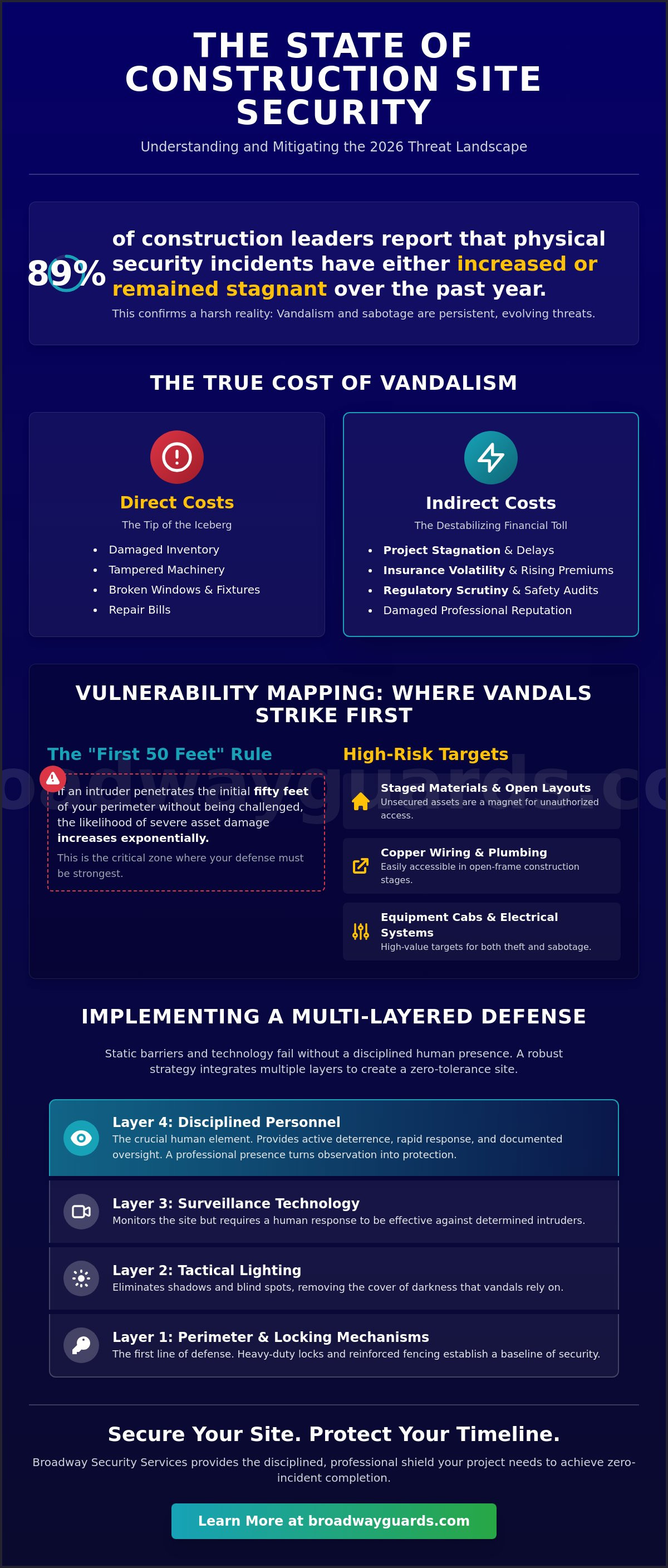
A staggering 89% of construction leaders reported in a September 2025 survey that physical security incidents have either increased or remained stagnant over the previous year. For project managers, this data confirms a harsh reality; vandalism is a crime of perceived anonymity that thrives in the shadows of unsecured sites. When unauthorized access leads to damaged inventory or tampered machinery, the result isn’t just a repair bill. It’s a compromised project timeline and a direct hit to your insurance standing. Maintaining effective construction vandalism security requires more than a perimeter fence. It demands a disciplined, visible presence that functions as an unyielding shield against site destruction.

You recognize that protecting high-value assets is a matter of operational rigor and professional oversight. This article details the latest trends in site protection and explains how to implement a multi-layered security framework designed for the demands of 2026. We’ll examine how documented security protocols and mobile patrol services lead to zero-incident project completion, providing the peace of mind you require during after-hours and weekends. By establishing a culture of vigilance, you can ensure your assets remain under the care of a professional and unyielding force.

Key Takeaways

  • Assess the evolving landscape of site sabotage to understand why indirect project delays often carry a higher financial toll than direct asset loss.
  • Master the “First 50 Feet” rule to identify site blind spots and prevent perimeter breaches from escalating into structural damage.
  • Understand why surveillance technology requires a disciplined human presence and how specialized construction vandalism security ensures a rapid response to unauthorized access.
  • Implement a multi-layered defense framework that integrates heavy-duty locking mechanisms with tactical lighting to establish a zero-tolerance site.
  • Discover how military-like operational standards and rigorous training protocols provide the documented oversight necessary to lower insurance premiums.

The 2026 Landscape of Construction Vandalism and Asset Risk

The 2026 landscape for Southern California development projects has shifted toward higher stakes and more aggressive site interference. While theft remains a concern, the primary threat has evolved into malicious sabotage and structural damage. By defining vandalism as a deliberate act of destruction, developers can better prepare for the psychological shift from opportunistic looting to targeted disruption. In 2026, urban density in areas like the San Fernando Valley creates an environment where unauthorized access occurs with alarming frequency. Modern construction vandalism security must address these threats with a disciplined framework that prioritizes asset protection over simple observation. It’s no longer enough to react after a breach occurs; you need a strategy that eliminates the opportunity for destruction entirely.

Direct vs. Indirect Costs of Vandalism

Direct losses, such as the cost of a broken window or damaged skid steer, are only the surface of the problem. The true financial toll lies in the indirect consequences that destabilize a project’s budget. Repairing specialized equipment or remediating structural sabotage takes time that your schedule doesn’t have. This delay pushes back completion dates, leading to liquidated damages and increased labor costs. Frequent insurance claims also erode your bonding capacity, making it harder to secure future high-value contracts. For developers in the San Fernando Valley, a single night of unchecked vandalism can damage a professional reputation that took years to build. Consider the following indirect impacts:

  • Project Stagnation: Every day spent on repairs is a day lost on progress.
  • Insurance Volatility: Rising premiums following multiple site incidents can compromise your profit margins.
  • Regulatory Scrutiny: Repeated breaches may trigger safety audits or municipal oversight.

Why Traditional Fencing is No Longer Sufficient

Standard chain-link barriers are a baseline requirement, but they don’t deter a determined intruder. In the current climate, vandalism has become a thrill crime for some and a professional sabotage operation for others. Fencing is easily bypassed or cut, providing only a false sense of security. Site vulnerability in 2026 is defined as the gap between physical barriers and the active oversight required to monitor high-density urban environments effectively. Relying on static obstacles without a disciplined shield leaves your assets exposed to those who view a construction site as an anonymous playground for destruction. You need a presence that commands respect and ensures accountability across every square foot of the development.

Vulnerability Mapping: Where Vandals Strike First

Professional risk assessment is the foundation of a disciplined security posture. You can’t protect what you haven’t identified as a target. Mapping site blind spots requires a methodical approach that looks beyond the obvious. The “First 50 Feet” rule states that if an intruder penetrates the initial fifty feet of your perimeter without challenge, the likelihood of severe asset damage increases exponentially. This critical zone is where the psychological barrier must be strongest. A breach that goes undetected for even sixty seconds allows an intruder to reach high-value targets like equipment cabs or exposed electrical wiring. Effective construction vandalism security depends on identifying these vulnerabilities before the first intruder arrives.

High-value targets aren’t just limited to expensive machinery. Vandals often focus on plumbing fixtures and copper wiring because they’re easily accessible in open-frame stages of construction. Staged materials left in open-layout developments act as a magnet for unauthorized access. Leaving these assets unsecured overnight signals a lack of oversight. Implementing effective approaches to vandalism prevention involves hardening these specific targets through strategic staging and a visible guard presence. A disciplined shield doesn’t just react; it removes the intruder’s confidence entirely.

Identifying High-Risk Zones on Your Jobsite

Multi-story developments present unique challenges, specifically in dark corners and unmonitored stairwells. These areas offer vandals the cover of anonymity. Environmental design plays a vital role in reducing criminal opportunity by eliminating shadows and creating clear lines of sight. When developing a security plan, it’s beneficial to coordinate with local Canoga Park authorities to understand regional crime hotspots. This localized intelligence allows for a more focused deployment of construction site security assets, ensuring that personnel are stationed where they’re needed most.

Psychology of Deterrence

The “Broken Windows” theory suggests that visible signs of disorder invite further criminal activity. A site that appears neglected is a site that invites intrusion. Conversely, a workspace maintained with military-like precision signals that every square foot is under professional oversight. Visible signage and a disciplined order act as a psychological deterrent. When an intruder sees a professional guard presence, the risk of detection becomes too high to ignore. This shift in the intruder’s decision-making process is the direct result of a documented security protocol that prioritizes presence and prevention. Your assets deserve the care of a vigilant and unyielding force.

The Deterrence Gap: Why Technology Alone Fails Without Disciplined Personnel

Many developers fall into the trap of believing that high-definition cameras alone constitute a complete security strategy. This is a dangerous myth. Masked vandals in 2026 are fully aware that cameras are passive observers. They often proceed with structural sabotage regardless of being filmed, knowing that remote monitoring cannot physically intervene. The reality of response times is often the difference between a minor trespass and a total site shutdown. While AI can flag an intruder instantly, the critical minutes between detection and police arrival are when the most damage occurs. Effective construction vandalism security relies on closing this response lag with a physical, disciplined presence that commands the site.

Professional guards provide immediate crisis management that technology cannot replicate. When a breach occurs, a guard doesn’t just watch; they execute a predetermined tactical response to secure the area and protect assets. This active intervention prevents the escalation of damage and ensures that unauthorized individuals are removed before they can target critical infrastructure. A camera records your loss, but a disciplined protector prevents it. By positioning a vigilant force on-site, you replace the uncertainty of remote monitoring with the reliability of professional oversight.

The Limitations of Remote Monitoring

Remote monitoring systems are prone to connectivity failures and inevitable blind spots in the ever-changing geography of a jobsite. As scaffolding rises and materials are moved, static camera angles become obsolete. A lens might see an intruder, but it cannot stop a sledgehammer or a spray can. There’s a profound psychological difference between being watched by a lens and being confronted by a uniformed professional. A disciplined human shield is the ultimate deterrent because it replaces the passive recording of a crime with the active prevention of one.

Integrating Guards with Smart Surveillance

AI surveillance should be viewed as a force multiplier that enhances the capabilities of professional personnel. By utilizing construction patrol services to verify AI-triggered alerts in real-time, developers ensure that every notification receives an immediate physical response. This is the Broadway standard: technical oversight fused with military-like precision. In a recent San Fernando Valley project, a developer faced repeated incursions despite having a full camera suite. After integrating a hybrid model of smart sensors and mobile patrols, the site achieved a zero-incident record for the remainder of the build. This structured approach provides the documented oversight required to reduce insurance liability and protect your bottom line. Our commitment to rigorous operational standards ensures your project moves forward without the threat of costly delays.

Construction Vandalism Security: Strategic Deterrence and Asset Protection in 2026

Implementing a Layered Defense Strategy for Zero-Tolerance Sites

Establishing a zero-tolerance site requires a methodical transition from passive observation to active deterrence. A disciplined shield doesn’t just watch the gate; it controls every point of entry with military-like precision. Implementing a comprehensive construction vandalism security framework involves five critical steps designed to eliminate opportunity and enforce order. This protocol ensures that your project remains a hard target, deterring both opportunistic vandals and professional saboteurs who seek to disrupt your timeline.

  • Step 1: Establish a rigid perimeter using heavy-duty locking mechanisms that resist brute-force entry and tampering.
  • Step 2: Deploy tactical lighting and motion-sensor technology to strip away the cover of darkness.
  • Step 3: Implement strict access control for all personnel, contractors, and deliveries.
  • Step 4: Schedule unpredictable mobile patrols to disrupt any surveillance conducted by potential intruders.
  • Step 5: Enforce a culture of accountability where every worker understands and follows site security protocols without exception.

By following this structured approach, you create multiple hurdles that an intruder must overcome. Each layer adds a new level of risk for the vandal, making the site an unattractive target. Reliability isn’t a byproduct of luck; it’s the result of rigorous operational standards and a commitment to methodical oversight. Secure your project with professional construction site security that prioritizes asset protection through disciplined oversight.

Rigorous Access Control Protocols

Managing the flow of contractors and vendors requires more than a simple sign-in sheet. In 2026, biometric identifiers and RFID portals provide the necessary verification to prevent unauthorized after-hours entry. These systems ensure that only vetted personnel can cross the threshold of your development. Standardizing reporting procedures for every individual on-site ensures a documented trail of activity, which is essential for maintaining a zero-incident environment. When access is tightly controlled, the risk of internal sabotage or “inside job” vandalism is significantly mitigated.

Mobile Patrol and Perimeter Vigilance

Fixed security positions are often predictable, allowing intruders to wait for a lapse in attention. Randomized patrol schedules provide a tactical advantage by preventing vandals from timing their breaches. Mobile units offer a visible, unyielding presence across expansive perimeters, ensuring that every corner of the site is inspected. This oversight is especially critical during high-risk holiday and weekend windows when sites are traditionally most vulnerable. Understanding the strategic differences between mobile and static models is essential; a detailed comparison of construction patrol services and security models for LA job sites can help you determine the right deployment for your project. This proactive stance is the hallmark of a professional security operation that values presence and prevention above all else.

Securing the Perimeter: The Broadway Security Professional Standard

Broadway Security Services operates as the disciplined shield for Southern California developers. We recognize that high-stakes projects require more than just presence; they require an unyielding force committed to professional oversight. Our approach to construction vandalism security is rooted in the intersection of legal compliance and operational rigor. We utilize industry-specific terminology and high-value standards to ensure every asset remains under vigilant care. This commitment to duty transforms your jobsite from a vulnerable target into a secure, methodical environment. Our team doesn’t just watch; we protect with a focus on hierarchy and structure that ensures accountability at every level.

Our customized risk assessments are the first step in developing a site-specific crisis management strategy. We don’t rely on generic security templates. Instead, we analyze the specific geography of your development to identify blind spots and high-risk zones. This professional consultation is essential for reducing long-term liability and ensuring project continuity. By grounding our professional claims in legal and regulatory reality, we provide a foundation of trust that sets a standard of quality across the industry. Reliability is our signature, and we maintain it through methodical oversight.

The Broadway Difference: Discipline and Accountability

Field performance is monitored through a structured hierarchy that prioritizes results. We utilize a framework that links professional discipline directly to the outcome of protection. Our guards are trained for high-stakes reliability in Canoga Park, where regional crime trends demand a higher standard of vigilance. We provide real-time reporting that offers documented proof of perimeter integrity and operational standards. This rhythmic reinforcement of identity ensures that every member of our team adheres to the Broadway standard of excellence in construction vandalism security. We prioritize safety and peace of mind by maintaining a stoic, professional image that commands respect from intruders and contractors alike.

Next Steps for Your Site Protection

Preparing your development for a zero-incident construction phase requires proactive planning and a commitment to rules. You can request a project-based risk assessment today to identify vulnerabilities before they are exploited by unauthorized individuals. Our team remains serious, observant, and prepared to secure your perimeter against all forms of interference. We move with a predictable cadence that mirrors the nature of methodical oversight, ensuring your assets are never left exposed. Contact Broadway Security Services for a professional consultation to establish a disciplined shield around your high-value assets. Take the necessary steps to ensure your project moves forward under the care of a vigilant and unyielding force.

Hardening Your Site for Zero-Incident Completion

Maintaining a secure jobsite in 2026 requires a transition from passive observation to active deterrence. You’ve seen that while AI and surveillance provide valuable data, they lack the physical presence needed to stop structural sabotage in real-time. Effective construction vandalism security is built on a foundation of professional risk assessments and a multi-layered defense strategy. By integrating highly trained guards with randomized mobile patrols, you eliminate the anonymity that vandals rely on. This disciplined approach ensures your project moves forward without the burden of costly delays or rising insurance liabilities.

Broadway Security Services provides the unyielding force necessary to protect your high-value assets in Canoga Park and the San Fernando Valley. Our commitment to military-like precision and rigorous operational standards creates a site culture of total accountability. We specialize in developing site-specific crisis management strategies that prioritize peace of mind and operational rigor. Don’t leave your project’s success to chance or unmonitored lenses. Secure Your Assets with Broadway Security Services and ensure your development remains under the care of a vigilant protector. You can achieve a zero-incident project phase through methodical oversight and professional vigilance.

Frequently Asked Questions

What is the most effective way to prevent construction site vandalism?

The most effective prevention method is a multi-layered security shield that integrates physical barriers with a disciplined human presence. Relying on a single measure leaves gaps in your perimeter. By combining heavy-duty locking mechanisms, tactical lighting, and professional construction vandalism security, you create an environment where the risk of detection exceeds the potential gain for any intruder. This structured approach ensures that every square foot of your project is under constant, methodical oversight.

How much does construction site security usually cost in Southern California?

Security costs in Southern California are determined by the specific requirements of the jobsite, including the scale of the development and the level of risk. Rates for mobile patrol services differ significantly from dedicated on-site guard coverage. While industry costs for unarmed guards or specialized patrols vary, project managers should prioritize the value of asset protection over the initial expense. You should request a customized risk assessment to receive an accurate quote tailored to your operational standards.

Can security cameras alone stop vandals from entering my site?

Cameras are passive observers and don’t physically stop a determined intruder from entering your site. While high-definition surveillance provides documentation, it doesn’t offer the immediate crisis management required to prevent structural damage or equipment sabotage. A camera records the loss, but it’s the disciplined presence of a professional guard that acts as a physical barrier. Effective construction vandalism security requires an unyielding force capable of active intervention during a breach.

What should I do if my construction site has already been vandalized?

If your site has been compromised, you must immediately secure the perimeter and document all damage for law enforcement and insurance purposes. Following the initial report, it’s critical to perform a professional risk assessment to identify the specific blind spots that allowed the breach. Implementing more rigorous operational standards will prevent future incidents. Securing your assets with a disciplined shield ensures that your project remains a hard target for any subsequent attempts at sabotage.

Are armed or unarmed guards better for construction site security?

The choice between armed and unarmed guards is determined by the specific threat level and the value of the assets being protected. Armed security guards are often deployed for high-stakes environments where the risk of violent intrusion or high-value theft is elevated. Unarmed guards provide excellent perimeter vigilance and access control for most standard development projects. A professional security consultation will determine which level of force is appropriate for maintaining a zero-incident construction phase.

How does professional security reduce my construction insurance premiums?

Insurance carriers often offer lower premiums when developers provide documented proof of rigorous security protocols and GPS-verified patrols. By maintaining a disciplined shield, you reduce the likelihood of costly builder’s risk claims. Professional security demonstrates a commitment to risk mitigation that lowers your overall liability. This proactive oversight is a signal to insurance providers that your assets are under the care of a vigilant force, leading to more favorable bonding terms.

What specific areas of a construction site are most vulnerable to vandalism?

Vandals typically target unlit corners, equipment cabs, and areas where high-value materials are staged overnight. Multi-story developments with open access points are also highly vulnerable during after-hours and weekends. These locations offer the cover of anonymity that intruders seek. A methodical security plan focuses on hardening these specific zones through tactical lighting and randomized patrol schedules. By eliminating these zones, you disrupt the intruder’s surveillance and protect your site’s integrity.

How quickly can Broadway Security deploy guards to a new construction project?

Deployment timelines for new projects are established following a comprehensive risk assessment of the site’s current security posture. The process involves identifying the specific needs of the development and assigning personnel who meet our rigorous training standards. While we prioritize a prompt response, we ensure that every deployment is handled with the necessary operational rigor to guarantee long-term reliability. You should contact a professional consultant to begin the mapping of your site-specific defense strategy.

Construction Theft Prevention: A Comprehensive Guide to Site Protection

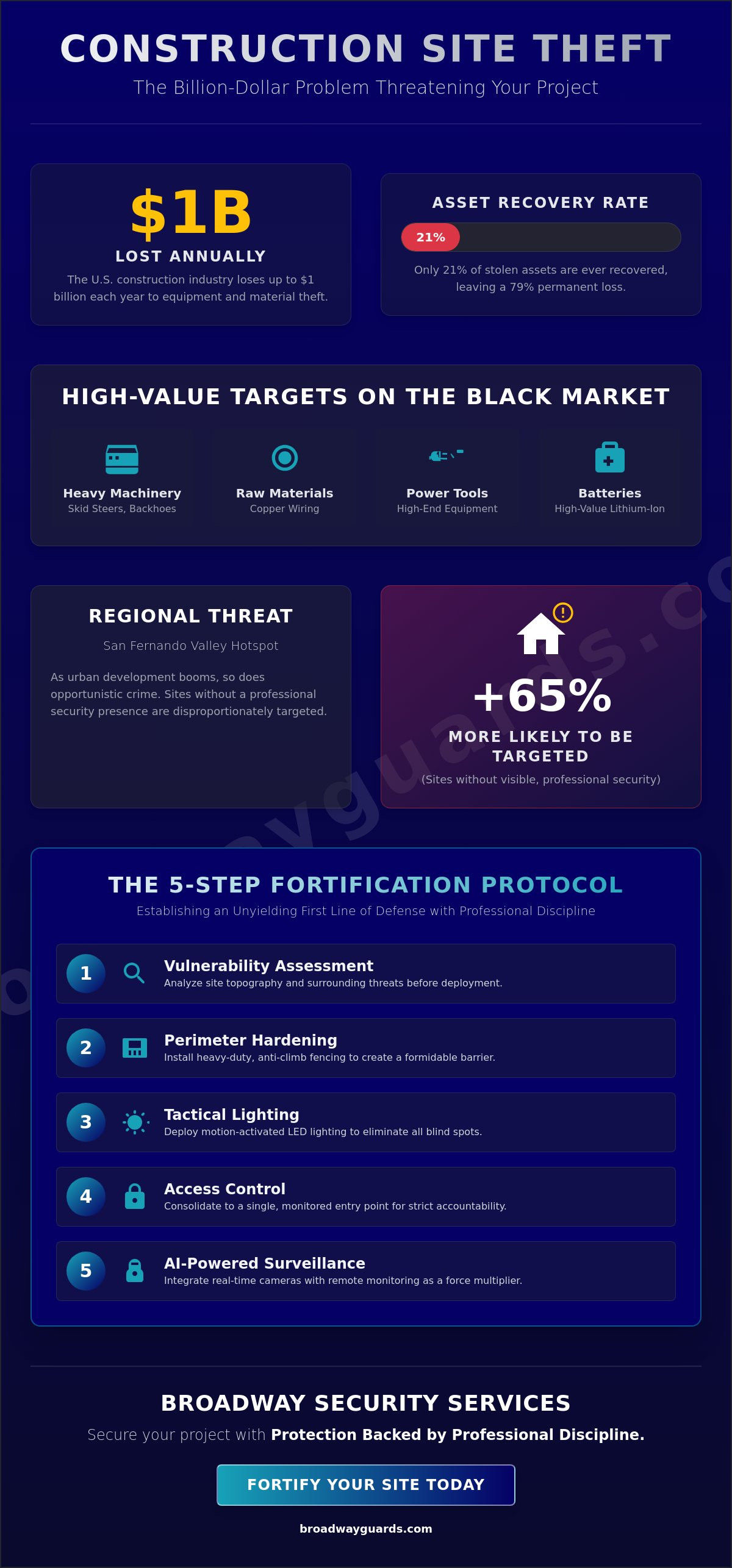
Did you know that the U.S. construction industry loses up to $1 billion annually to equipment theft, yet only 21% of stolen assets are ever recovered? For project managers in the San Fernando Valley, these aren’t just statistics; they’re daily threats that cause massive project delays and skyrocketing insurance premiums. Effective construction theft prevention isn’t a product you buy. It’s a disciplined protocol of layered defense that combines physical barriers with professional human oversight.

You’ve likely felt the frustration of arriving at a job site to find expensive heavy machinery missing or materials vandalized. It’s a high-stakes environment where any lapse in security results in a direct hit to your bottom line. This guide provides the professional strategies required to achieve zero theft incidents and maintain a disciplined, orderly job site. We’ll outline how to implement Protection Backed by Professional Discipline through AI-powered surveillance, remote monitoring, and the strategic deployment of licensed guards. By the end of this article, you’ll understand how to secure your assets under the care of a vigilant and unyielding force. Contact Broadway Security Services today to ensure your site remains a fortress.

Key Takeaways

  • Define construction theft prevention as a multi-layered strategy that integrates physical barriers with professional human presence to eliminate asset loss.
  • Learn the five-step process for hardening your job site perimeter to establish an unyielding first line of defense against unauthorized entry.
  • Evaluate the critical role of licensed guards in providing visible deterrence and immediate incident reporting that technology alone cannot achieve.
  • Implement daily operational protocols and inventory management habits that foster a culture of accountability and reduce the opportunity for internal theft.
  • Secure your project with Protection Backed by Professional Discipline to ensure your assets are under the care of a vigilant and unyielding force.

Understanding the Realities of Construction Theft in 2026

Effective construction theft prevention is not a single product or a passive alarm system. It is a disciplined, multi-layered strategy designed to deter unauthorized access and ensure asset preservation through rigorous protocols. The U.S. construction industry currently reports over 11,000 incidents of theft annually. These reports represent a national economic impact ranging from $300 million to $1 billion in direct asset losses. In Southern California, these figures manifest as a constant threat to project timelines and profit margins. Professional discipline ensures that every gate, piece of machinery, and spool of copper remains under the care of a vigilant and unyielding force.

Construction sites are frequently classified as soft targets because they remain largely unoccupied during off-hours and weekends. Criminal elements exploit these windows of vulnerability when site supervision is absent. In 2026, we’ve observed a tactical shift in criminal behavior. Thieves now prioritize high-value lithium-ion batteries and copper over bulkier materials. Copper theft alone accounts for an estimated $1 billion in annual losses across the industry. Without a visible, disciplined shield, your site is merely an inventory of unrecovered assets waiting for removal.

High-Value Targets: Tools, Materials, and Heavy Machinery

The black market for specialized equipment remains lucrative because the recovery rate for construction equipment theft is stagnant at 21%. Skid steers, backhoes, and high-end hand tools are the primary targets due to their high resale value and ease of transport. Beyond the immediate cost of replacement, which averages between $6,000 and $30,000 per incident, the secondary consequences are often more damaging. Theft typically adds 1% to 5% to overall project costs when you factor in labor downtime, schedule delays, and increased insurance premiums. Maintaining an orderly job site requires a commitment to accountability that extends beyond basic fencing.

Regional Trends: The San Fernando Valley Security Landscape

Canoga Park and the broader San Fernando Valley are experiencing a surge in opportunistic crime driven by rapid urban development. As more projects break ground in Los Angeles, the number of vulnerable perimeters increases. Local crime patterns indicate that sites without a professional security presence are targeted 65% more frequently than those with visible deterrence. Our operational rigor focuses on eliminating these opportunities before they occur. A disciplined guardian on-site provides the high-stakes reliability needed to keep your project on schedule. To secure your assets with a professional shield, Let’s Touch With Us today.

Building a Fortified Perimeter: Physical and Technical Deterrents

A fortified perimeter serves as the primary barrier against unauthorized entry and is the cornerstone of effective construction theft prevention. We define this as the First Line of Defense. It’s established through a rigorous five-step hardening process that must be executed before a single piece of heavy machinery arrives on site. This sequence ensures that security is an integrated protocol rather than an afterthought. A disciplined guardian approach requires these steps:

  • Conduct a comprehensive vulnerability assessment of the site’s topography and surrounding neighborhood.
  • Install heavy-duty, anti-climb fencing around the entire perimeter to prevent breach attempts.
  • Deploy tactical LED lighting at all entry points and storage areas to eliminate blind spots.
  • Consolidate site entry to a single, monitored access point for strict access control.
  • Integrate real-time surveillance with remote monitoring capabilities to act as a force multiplier.

The psychological impact of an organized site can’t be overstated. A clean, well-lit, and orderly job site signals to potential intruders that the area is under the care of a vigilant force. Chaos suggests neglect. Neglect invites opportunistic crime. Implementing a strict access control protocol is a mandatory requirement for maintaining site integrity and ensuring accountability for everyone who enters the project area.

Fencing and Lighting: The Foundation of Deterrence

Perimeter fencing must be high-quality and secured with anti-climb features. Tactical placement of motion-activated LED lighting is essential to eliminate areas where thieves might hide. These lights should be positioned to illuminate both the interior and exterior of the fence line. Additionally, “No Trespassing” signage must be clearly displayed at 20-foot intervals. This isn’t just a suggestion; it’s a legal prerequisite for enforcement and prosecution in California. Don’t leave your assets to chance by overlooking these basic physical barriers.

Surveillance Technology and Remote Monitoring

High-definition CCTV provides clear evidence, but thermal imaging is superior for night-time detection in low-visibility environments. Unmonitored cameras are passive. They only record a crime while it occurs. In contrast, real-time alert systems allow for immediate intervention. Advancements in AI in construction security allow systems to distinguish between routine site activity and genuine threats. While a self-installed hardware system can cost between $1,000 and $9,000, technology works best when it supports human intelligence. Implementing these protocols ensures your site is a fortress. Let’s Touch With Us at Broadway Security Services to finalize your defensive plan and achieve Protection Backed by Professional Discipline.

The Human Element: Why Professional Guards are Irreplaceable

Technology records evidence; professional guards prevent crime. While surveillance cameras provide a digital trail, they lack the capacity for immediate intervention or de-escalation. Effective construction theft prevention requires more than a passive recording. It demands a physical presence capable of responding to threats with military-like precision. This human element is the core of our operational rigor. A problem-oriented policing project demonstrates that active human oversight is the most effective variable in reducing site-specific crime. Professional Discipline at Broadway Security Services means every guard adheres to strict post orders and methodical incident reporting, ensuring your assets remain under the care of a vigilant and unyielding force.

Accountability is the foundation of our service. Unlike automated systems, a licensed security professional provides real-time field performance data and immediate observation. This creates an atmosphere of high-stakes reliability where every movement on your site is scrutinized. For sites requiring 24/7 coverage, the investment ensures a disciplined shield remains active during the highest-risk hours. Round-the-clock protection from a single guard post typically costs over $20,000 per month, but this expense is an ROI-positive asset when compared to the $30,000 loss often incurred from a single equipment theft incident.

Armed vs. Unarmed Guards: Selecting the Right Protocol

Selecting the correct security protocol depends on the value of your assets and the local threat level. Unarmed guards, typically costing between $25 and $40 per hour, are essential for access control, fire watch services, and general loss prevention. However, when your site houses high-value heavy machinery or significant copper inventory, the presence of armed personnel may be required. Armed guards start at approximately $35 per hour and exceed $55 per hour for specialized protection. All Broadway Security Services professionals meet rigorous training standards and operate under our California Private Patrol Operator (PPO) license. Let’s Touch With Us to determine which tier of protection fits your project’s specific risk profile.

Mobile Patrol Services for Large-Scale Developments

Large-scale construction projects with vast perimeters require a dynamic defensive strategy. Stationary posts are necessary for access points, but mobile patrol services cover more ground with greater efficiency. Our vehicle patrols utilize a randomized strategy to ensure thieves cannot predict or time guard movements. This unpredictability is a cornerstone of visible deterrence. If an alarm triggers or a breach occurs, mobile units provide rapid response capabilities that stationary systems cannot match. This approach ensures your site receives Protection Backed by Professional Discipline, regardless of its size or complexity.

Construction Theft Prevention: A Comprehensive Guide to Site Protection

Operational Best Practices for Daily Loss Prevention

Operational discipline is the final layer of a comprehensive construction theft prevention strategy. While physical barriers and professional guards provide external defense, internal protocols ensure that no vulnerabilities exist within your daily workflow. Theft often occurs because of a breakdown in routine. A disciplined guardian approach requires a “Clean Site” policy where every shift concludes with a rigorous security sweep. All handheld tools must be secured in anchored, steel lockboxes. Heavy machinery should be clustered in a well-lit, central “mosh pit” to make individual asset removal difficult. These habits reduce the opportunity for opportunistic crime and signal that the site is under the care of a vigilant force.

Coordination with local law enforcement is a professional prerequisite. Don’t wait for a crime to occur before establishing contact. Provide the local precinct with a site map, 24-hour contact information, and a list of authorized after-hours personnel. This proactive engagement ensures that responding officers have the necessary context to identify suspicious activity. In 2026, California’s Assembly Bill 1002 increases the stakes for contractor accountability. Maintaining an orderly, documented job site is no longer just about asset protection; it’s about legal compliance and professional legitimacy. High-stakes reliability is achieved when every person on site understands that their actions are part of a disciplined shield.

Inventory Management and Equipment Identification

Effective inventory management serves as a powerful deterrent for both external and internal theft. GPS trackers are mandatory for heavy machinery and high-value trailers. Since the recovery rate for stolen equipment remains low at 21%, identification is critical. Etch or mark all tools with permanent company identifiers to destroy their resale value on the black market. We recommend a strict “Check-In/Check-Out” system for expensive handheld equipment. This protocol creates a transparent chain of custody and ensures that every asset is accounted for at the start and end of each workday. Accountability is the foundation of site order.

Toolbox Talks: Training Your Crew in Vigilance

A disciplined crew is an extension of your security force. Integrate security awareness into your weekly toolbox talks to foster a “See Something, Say Something” culture. Workers should be trained to identify and report suspicious behavior, such as vehicles circling the perimeter or unauthorized individuals asking specific questions about site equipment. Establish a formal protocol for handling delivery drivers and visitors. Every visitor must sign in at a single access point and be escorted by authorized personnel. This level of operational rigor ensures that your project remains a hard target. To integrate these protocols into your workflow, Let’s Touch With Us at Broadway Security Services for professional loss prevention services backed by professional discipline.

Partnering with Broadway Security for Unyielding Protection

Securing a project in the San Fernando Valley requires more than a simple perimeter fence. It demands a partnership with a disciplined guardian who understands the regional threat landscape. Broadway Security Services positions itself as that shield for Canoga Park developments. We provide the operational rigor necessary to achieve zero theft incidents and maintain a professional, orderly job site. Our core philosophy, Protection Backed by Professional Discipline, is the foundation of every contract we execute. We ensure that your assets remain under the care of a vigilant and unyielding force from groundbreaking to project completion.

Legal compliance is a non-negotiable standard for professional security. Broadway Security Services operates under a strictly maintained California Private Patrol Operator (PPO) license. This certification is a functional signature of our legitimacy and commitment to regulatory reality. In an environment where California’s Assembly Bill 1002 increases contractor accountability, partnering with a licensed and disciplined firm is a prerequisite for risk management. We provide the high-stakes reliability that insurance carriers require when offering premium discounts for verified construction theft prevention protocols.

Customized Site Security Management

Every development has a unique risk profile that evolves as the project progresses. Broadway Security Services initiates every partnership with a comprehensive, project-based risk assessment. We analyze the topography, local crime data, and specific site vulnerabilities. This allows us to tailor guard schedules to match critical project milestones. For example, we increase visible deterrence when high-value copper inventory or heavy machinery is first delivered to the site. We also provide specialized Fire Watch services to ensure 24/7 compliance with safety regulations during high-risk construction phases. This methodical approach ensures that security resources are deployed with maximum efficiency.

The Broadway Standard: Training and Accountability

Accountability is the anchor of our field performance. Every guard in our force undergoes rigorous training to meet the Broadway Standard. We don’t rely on passive observation; our personnel follow detailed post orders and provide transparent incident reporting. This creates a steady, repetitive rhythm of protection that mirrors the nature of a professional security patrol. You’ll receive consistent updates and methodical documentation of all site activity. This level of transparency ensures that you’re never in the dark about the safety of your assets. To secure your site with a professional shield, visit Broadway Security Services for a consultation. Let’s Touch With Us today to schedule your customized site risk assessment and implement a defensive strategy that works.

Securing Your Project with Unyielding Operational Rigor

Protecting a job site requires more than passive surveillance. It demands a strategy where physical barriers, smart technology, and professional human presence converge. By implementing a five-step hardening process and maintaining a “Clean Site” policy, you eliminate the vulnerabilities that lead to $1 billion in annual industry losses. Effective construction theft prevention is achieved through high-stakes reliability and constant vigilance. Professional discipline ensures your assets remain under the care of a vigilant and unyielding force at all times.

Broadway Security Services provides this defensive shield through military-grade discipline and accountability. As a licensed California Private Patrol Operator (PPO), we offer specialized construction site security expertise that ensures your project remains on schedule. Our commitment to field performance and incident reporting provides the peace of mind necessary to focus on your build. Don’t leave your high-value assets to chance. Secure the future of your development with a dependable guardian.

Secure Your Assets with Professional Discipline – Contact Broadway Security Today. Let’s Touch With Us to establish an unyielding defensive protocol for your next project.

Frequently Asked Questions

What is the most effective way to prevent theft on a construction site?

The most effective approach to construction theft prevention is the implementation of a multi-layered security protocol that integrates physical barriers, AI-surveillance, and professional human oversight. While fencing provides a basic boundary, only a disciplined guardian can interpret and respond to real-time threats. This strategy ensures that every asset is protected by a visible deterrence that discourages opportunistic criminals before they attempt a breach.

Does insurance cover theft on construction sites in California?

Insurance typically covers theft on California construction sites, provided the policyholder demonstrates “reasonable care” in securing the project. Carriers increasingly require documented security plans and often offer premium discounts for sites utilizing licensed security patrols. Maintaining detailed incident reporting and post orders serves as evidence of operational rigor. This documentation is vital for claims processing and ensuring your high-stakes reliability is recognized by underwriters.

How much does it cost to hire a security guard for a construction site?

Hiring a licensed security guard for a construction site in 2026 involves specific hourly rates based on the required level of protection. Unarmed security guards cost between $25 and $40 per hour. If your project houses high-value assets that necessitate armed security guards, rates start at approximately $35 and can exceed $55 per hour. These rates ensure that your site is under the care of a trained and disciplined professional.

Can I use GPS trackers to prevent heavy equipment theft?

GPS trackers are a critical tool for asset recovery but function primarily as a reactive measure rather than a preventative one. While they help locate machinery after it’s been removed, they don’t stop the initial breach or the resulting project delays. Integrating trackers with on-site security ensures that your recovery efforts are supported by proactive prevention. This combination creates a comprehensive shield for your heavy equipment and trailers.

Is a security camera system enough to stop construction site vandalism?

A security camera system is rarely enough to stop determined vandalism. Cameras record the event for later review; however, they cannot physically intervene to stop damage in progress. Vandalism often occurs in seconds, making real-time intervention essential. Professional guards provide the immediate response needed to de-escalate situations and protect your site from costly property damage that cameras alone can’t prevent.

What should I do immediately if my construction site is robbed?

Immediately following a robbery, you must notify local law enforcement and secure the perimeter to prevent further loss. Document the scene and preserve any surveillance footage or incident reports for the investigation. Contact your insurance provider to initiate the claims process. It’s also necessary to review your security protocols and identify vulnerabilities. Let’s Touch With Us to conduct a post-incident risk assessment and restore site order.

What are the California requirements for construction site fire watch?

California requires a dedicated fire watch when a building’s fire protection system is impaired or during “hot work” activities like welding. These personnel must be trained to identify fire hazards and must have no other duties during their patrol. Broadway Security provides licensed professionals who maintain continuous surveillance and detailed logs to ensure 24/7 compliance with state fire codes. This operational rigor prevents catastrophic loss and legal liability.

How do mobile patrols differ from stationary security guards?

Mobile patrol services differ from stationary guards by providing dynamic, randomized coverage over a larger geographic area. While a stationary guard maintains a fixed post at a specific access point, mobile units use vehicles to monitor vast perimeters. This unpredictability prevents thieves from timing guard movements. Mobile units also offer rapid response capabilities across the entire site, making them an ideal force multiplier for large-scale developments.