
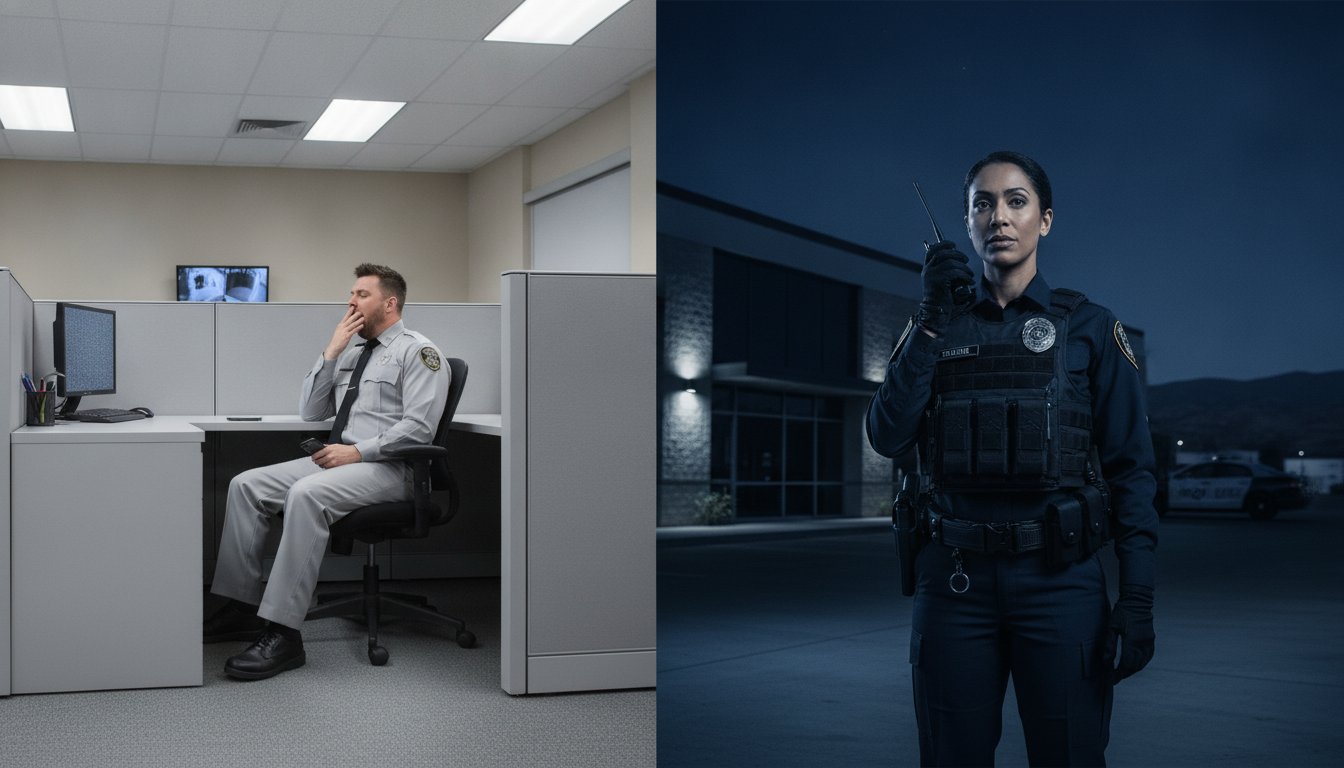
In-House vs. Contract Security: 2026 Strategic Guide

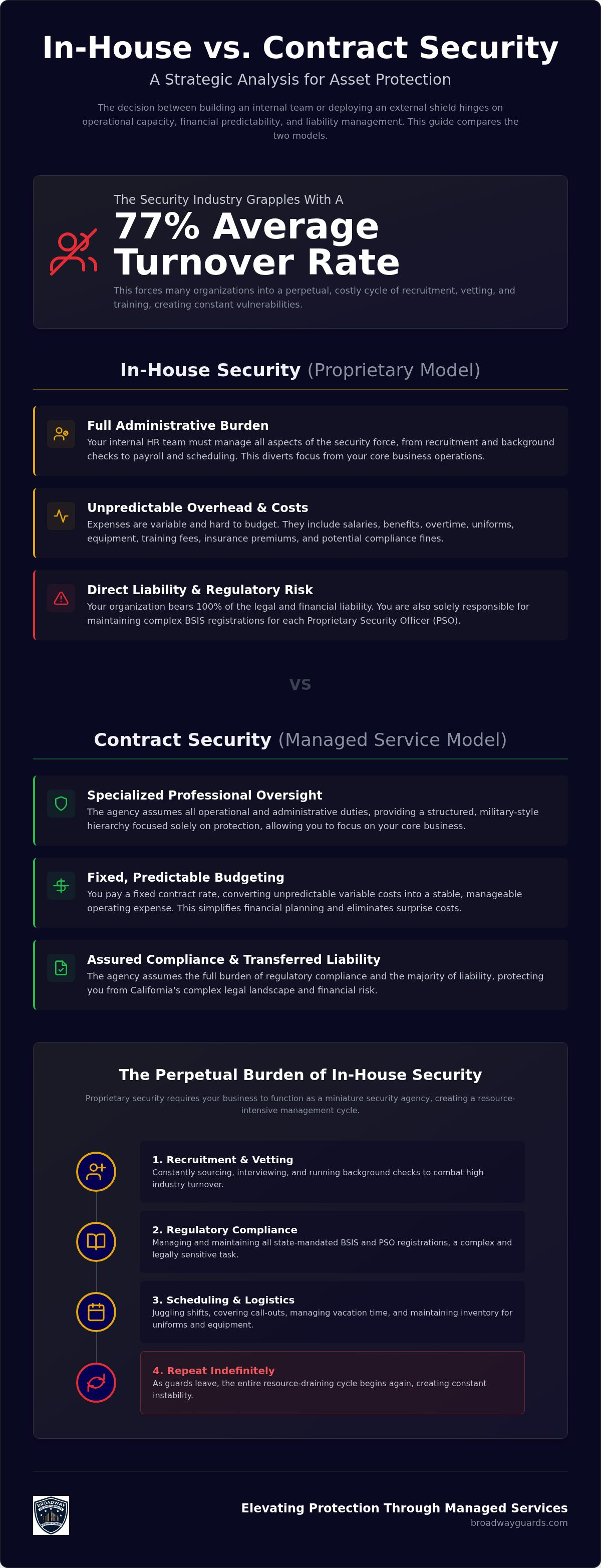
The security industry is currently grappling with a staggering 77% average turnover rate, forcing many organizations to spend more time on recruitment than on actual protection. You understand that maintaining a vigilant perimeter requires more than just bodies in uniforms; it demands a level of discipline and oversight that often clashes with internal HR capabilities. When evaluating in-house vs contract security guards, the decision often hinges on whether your business is equipped to function as a miniature security agency or if you require a dedicated, external shield.

This 2026 strategic guide provides a rigorous analysis of the operational, financial, and legal frameworks governing modern security forces. You’ll gain a clear ROI comparison and learn how to mitigate liability through professional oversight and strict regulatory compliance. We’ll examine the specific advantages of contracted precision, including how specialized firms manage the complexities of California’s evolving data privacy laws and BSIS registration requirements. Our analysis moves from broad operational standards to specific industry applications to ensure your assets remain under the care of a vigilant and unyielding force.

Key Takeaways

  • Understand the fundamental operational differences between in-house vs contract security guards to determine which model aligns with your organization’s risk profile.
  • Identify the hidden administrative burdens of proprietary teams, specifically the rigorous BSIS training and compliance standards required in 2026.
  • Evaluate the financial advantages of fixed contract rates over the unpredictable overhead and liability risks associated with direct employment.
  • Determine the necessity of agency-level training for high-risk deployments, ensuring your assets are protected by personnel with specialized tactical expertise.
  • Learn how to transition from basic guard placement to a managed service model that prioritizes military-style precision and unyielding oversight.

The Strategic Divide: Defining In-House vs. Contract Security Operations

The choice between in-house vs contract security guards represents a critical juncture for any organization focused on asset protection. In Southern California, the 2026 security environment is defined by rigorous regulatory standards and heightened operational complexity. Leaders must determine if their organization is better served by building an internal security department or by deploying a disciplined shield through a professional agency. This decision is frequently obscured by the “Control vs. Capability” debate. Many executives mistakenly believe that direct employment yields superior oversight. In practice, the lack of specialized management structures often results in reduced accountability and increased risk.

Proprietary security involves personnel hired directly by the entity they protect. These individuals are employees on your payroll. Contract security, however, utilizes a third-party Private Patrol Operator to provide comprehensive security services. Establishing a foundation by Defining Security Guard Roles helps clarify why a specialized approach is often the more reliable path to safety and peace of mind.

Proprietary Security: The ‘Direct Hire’ Model

Under California law, in-house personnel must hold a Proprietary Security Officer (PSO) registration. These guards are managed by your internal human resources team, which creates a perceived benefit of brand alignment and cultural integration. You might feel that direct hires are more loyal to your specific mission. Yet, the administrative weight of this model is significant. Managing background checks, drug testing, and payroll for a security force is a complex task. When security is not your primary business, these responsibilities often become HR headaches that lead to unpredictable costs and gaps in coverage.

Contract Security: The ‘Managed Service’ Model

The contract model functions as a disciplined managed service where the agency assumes all operational risks and administrative duties. Licensed agencies provide a professional presence that is difficult to replicate internally. This expertise is particularly evident in the deployment of unarmed security guards, where professional agencies maintain high standards of discipline and field reporting. By utilizing a contract service, you gain access to a structured hierarchy and military-like precision. The agency handles the training and oversight, ensuring that your assets remain under the care of a vigilant and unyielding force without the burden of direct employee management.

The Operational Burden of Proprietary Security Management

Maintaining a proprietary security force requires an immense commitment to administrative precision. When Comparing In-House and Contracted Guarding, the primary differentiator is the volume of non-core tasks shifted onto your management team. Recruitment alone is a constant struggle. With industry turnover rates averaging 77% as of 2024, an in-house department often finds itself in a perpetual cycle of vetting and drug testing. This isn’t just an HR inconvenience; it’s a security vulnerability. Every vacancy in the schedule represents a weakness in your perimeter.

The logistical requirements extend far beyond personnel. You must manage uniforms, communication equipment, and protective gear. Each piece of hardware requires maintenance and inventory tracking. If a guard calls out or requests vacation, the burden of finding coverage falls on your staff. This scheduling nightmare is particularly acute during emergency Fire Watch Services needs, where immediate deployment is a legal necessity. Professional agencies remove this burden by maintaining a deep roster of disciplined personnel ready for rapid deployment.

HR and Regulatory Compliance in California

California’s regulatory environment is exceptionally demanding. The Bureau of Security and Investigative Services (BSIS) mandates specific registration for Proprietary Security Officers (PSO). Maintaining these records for legal audits is a full-time professional pursuit. Most HR departments don’t realize that security guard training CA standards require ongoing education and annual refresher courses. Gaps in these records don’t just result in fines; they create catastrophic legal exposure for your organization.

Infrastructure and Oversight Costs

The financial reality of in-house vs contract security guards involves significant invisible costs. You aren’t just paying an hourly wage. You’re paying for worker’s compensation, payroll taxes, and specialized liability insurance premiums. If an in-house guard makes a tactical error, your organization bears the full weight of the legal consequences. The total cost of ownership for an in-house guard typically exceeds the hourly rate of a contract service by 15% to 35% once all overhead and liability risks are factored in. By shifting to a managed model, you transfer these risks to a disciplined protector equipped to handle them.

Performance Metrics: Comparing Cost, Liability, and Scalability

Measuring the efficacy of in-house vs contract security guards requires a focus on measurable outcomes. For a professional organization, safety is a product of rigorous oversight and financial clarity. Contract security models offer a level of fiscal predictability that proprietary departments struggle to match. When you engage a professional agency, you replace variable HR costs with a fixed hourly rate. This shift allows for precise budgeting. It removes the financial volatility associated with staffing shortages, equipment maintenance, or sudden training requirements. A disciplined protector provides results that are both visible and verifiable.

Proprietary models often lack the operational depth necessary for high-stakes environments. Professional agencies maintain specialized units ready for immediate deployment. Whether you require executive protection or rapid response, a managed service provides a level of readiness that internal teams rarely achieve. This operational readiness ensures your assets remain under the care of a vigilant and unyielding force, regardless of the threat level.

The Cost Efficiency Analysis

A true comparison requires looking beyond the base hourly wage. In-house guards carry a “burdened” cost that includes payroll taxes, healthcare, and worker’s compensation. Contract services eliminate the “Overtime Trap” that occurs when internal staff members call out or take leave. The agency absorbs these costs, providing a consistent presence without inflating your budget. Professional oversight also includes a continuous security risk assessment CA to ensure resources are deployed where they are most effective. This strategic approach prevents loss and maximizes your return on investment.

Scalability and Emergency Response

Scalability is a critical metric for 2026. A proprietary team is rigid; hiring new personnel takes weeks of vetting and training. Professional agencies offer instant scalability. You can deploy mobile patrol services to cover new construction phases or expanded perimeters without delay. This flexibility is vital for managing seasonal spikes in retail or large-scale event security needs.

Emergency situations demand immediate action. Contract firms are uniquely equipped for emergency fire watch services, maintaining a roster of guards who are trained and ready for short-term projects. When a fire system fails, you don’t have time to interview new hires. You need a disciplined shield that can be on-site within hours. This rapid deployment capability is a hallmark of professional managed services, providing peace of mind when your assets are most vulnerable.
In-House vs. Contract Security: 2026 Strategic Guide

Industry-Specific Deployment: Matching the Model to Your Risk Profile

Selecting the correct protection model requires an objective assessment of your environment’s specific threats. A corporate lobby in Woodland Hills demands a different tactical approach than a high-value industrial site. When comparing in-house vs contract security guards, the primary factor is whether your internal team can sustain the specialized training required for your specific industry. For high-risk facilities, the stakes are too high for generalist HR management. These environments require armed security guard services Los Angeles, where personnel are subjected to agency-level oversight and continuous tactical drills that exceed standard proprietary requirements.

Corporate offices often struggle to balance a concierge-style presence with professional deterrence. In-house guards may become too familiar with regular staff, which often leads to a dangerous erosion of security protocol. Contracted guards maintain a necessary distance that preserves the integrity of the post. This third-party objectivity is equally vital in retail and loss prevention. A disciplined protector remains focused on the mission of prevention rather than workplace social dynamics. This professional separation ensures that rules and protocols are followed without exception.

Construction and Industrial Site Needs

Construction sites are notoriously difficult to secure with proprietary teams due to high personnel turnover and shifting perimeters. Managed services provide a scalable solution that adapts as the project evolves through various phases. By integrating construction site security guards with mobile patrol, you ensure comprehensive coverage of large industrial areas. In regions like Canoga Park and the San Fernando Valley, vandalism and theft deterrence require a visible, mobile force. Professional agencies provide the specialized vehicles and communication technology needed to maintain a unyielding presence across expansive sites.

Events and High-Traffic Venues

Staffing a major venue is a logistical challenge that proprietary departments are rarely equipped to handle. Attempting to hire and vet 50 or more in-house guards for a single day is a logistical impossibility for most businesses. Organizations instead leverage event security Los Angeles to access a disciplined pool of crowd control specialists. This model prioritizes presence and prevention, ensuring that public-facing roles are filled by professionals who understand the intersection of safety and service. You don’t just get bodies; you get a structured hierarchy designed for high-stakes reliability.

If you’re ready to deploy a disciplined shield tailored to your specific industry, contact Broadway Security Services to secure your assets effectively.

The Broadway Security Standard: Elevating Protection Through Managed Services

Broadway Security Services operates on the principle of the “Disciplined Protector.” We move beyond simple guard placement to establish a strategic safety framework. This approach is rooted in the belief that security is not a commodity; it is a rigorous operational standard. When organizations evaluate in-house vs contract security guards, they often overlook the necessity of constant, high-level oversight. Our 24/7 management structure ensures a level of accountability that internal supervisors rarely achieve. We provide a structured hierarchy where every officer understands their role within a larger, unyielding shield.

Our Southern California operations are defined by military-style precision. We conduct rigorous vetting and background checks that exceed standard HR protocols. This commitment to excellence extends to our strategic integration of services. We don’t just provide personnel; we coordinate armed guards, unarmed guards, and fire watch units into a unified defense. This ensures your assets remain under the care of a force that is as vigilant as it is professional. Our methodology prioritizes presence and prevention, creating an atmosphere of high-stakes reliability for every client.

Our Commitment to San Fernando Valley Businesses

Our localized expertise in Woodland Hills and Canoga Park allows us to navigate regional safety protocols with ease. We understand the specific threats facing businesses in the San Fernando Valley. This knowledge informs our staffing levels and tactical deployments. Every engagement begins with a professional security risk assessment. This assessment is the foundation of our operational rigor. It ensures that your security plan is not based on guesswork but on documented requirements and regulatory compliance. The Broadway promise is one of reliability grounded in field-tested experience and a stoic commitment to duty.

Making the Transition to Managed Security

Phasing out an in-house team for an agency model requires a methodical approach. We provide step-by-step guidance to ensure there is no gap in your protection during the transition. The process begins with a comprehensive audit of your current protocols and personnel. When evaluating a security contract, look for transparency regarding training hours and reporting structures. A professional contract should hold the agency to specific, measurable performance metrics. This ensures that your organization transitions from a vulnerable internal model to a professional managed service without operational friction.

We invite you to experience the Broadway standard of protection. Secure your assets with a force that values discipline, order, and visible results above all else. Contact Broadway Security Services today for a professional consultation and take the first step toward a more secure future.

Securing Your Future With Strategic Precision

The decision between in-house vs contract security guards ultimately determines whether your organization focuses on its core mission or on the exhausting complexities of guard management. You’ve discovered how professional agencies provide a vital liability shield and financial predictability that proprietary teams often fail to achieve. By shifting the administrative weight of recruitment, training, and 2026 BSIS compliance to a dedicated provider, you ensure your perimeter remains unyielding. Protection is our duty. This strategic transition allows you to replace HR headaches with a disciplined, military-style presence that prioritizes safety above all else.

As a California BSIS Licensed Private Patrol Operator, Broadway Security Services provides highly trained armed and unarmed personnel with specialized expertise in San Fernando Valley risk mitigation. Our standards don’t waver. Our methodical oversight transforms security from a variable expense into a reliable professional asset. Secure your assets with a professional security consultation from Broadway Security Services today. Take command of your safety strategy and experience the peace of mind that comes with a vigilant and unyielding shield protecting your interests.

Frequently Asked Questions

Is contract security cheaper than in-house security in California?

Contract security is frequently more cost-effective because it eliminates the hidden overhead of direct employment. You pay a fixed hourly rate that covers recruitment, uniforms, and specialized insurance. This model removes the financial unpredictability of employee benefits and administrative management. It allows your organization to allocate resources toward core business functions while maintaining a professional presence.

What are the legal liabilities of hiring an in-house security team?

Hiring an in-house team exposes your organization to direct vicarious liability for every action your guards take. If a proprietary officer makes a tactical error or a legal misstep, your business bears the full legal and financial consequences. This includes potential lawsuits for wrongful detention or use of force. Contract agencies absorb a significant portion of this risk through their own comprehensive liability policies.

Do contract security guards receive the same training as in-house guards?

Contract guards typically undergo more frequent and specialized training than their proprietary counterparts. While both must meet state minimums, professional agencies implement rigorous tactical drills and crisis management protocols. This ensures that the personnel protecting your assets are prepared for high-stakes scenarios. When comparing in-house vs contract security guards, the depth of agency-level oversight often results in a more disciplined and prepared force.

Can I have a mix of in-house and contract security guards?

Implementing a hybrid model is a viable strategy for many large organizations. You might retain a small in-house management team to handle internal culture while utilizing contract guards for perimeter mobile patrols or high-traffic event security. This approach provides the flexibility to scale your force rapidly during periods of increased risk. It balances internal control with the operational depth of a professional agency.

What is a California Proprietary Security Officer (PSO) registration?

A California PSO registration is a legal requirement for unarmed security personnel employed directly by a business rather than a security agency. The Bureau of Security and Investigative Services (BSIS) mandates that these individuals complete a criminal background check and specific training hours. Failing to maintain current PSO records for your staff can result in significant regulatory fines and increased legal vulnerability during an audit.

How quickly can a contract security firm deploy guards for an emergency?

Professional agencies can typically deploy personnel within a few hours for emergency scenarios. This rapid response is essential for critical needs like fire watch services or sudden site breaches. Because contract firms maintain a deep roster of vetted officers, they can provide a disciplined shield much faster than an internal HR department can recruit and vet new hires. Reliability in a crisis is a hallmark of managed services.

Which industries benefit most from contract security services?

Industries with high turnover or fluctuating risk profiles, such as construction and retail, benefit the most from managed protection. These sectors require the scalability and specialized expertise that proprietary teams often lack. Healthcare facilities and high-traffic event venues also rely on contract services to manage complex crowd control and compliance requirements. A professional agency provides the unyielding oversight necessary to secure these diverse environments effectively.

What should I look for in a security guard contract for my business?

Your agreement should prioritize transparency regarding training standards, insurance limits, and field reporting protocols. Ensure the contract clearly defines the Private Patrol Operator’s responsibility for liability and regulatory compliance. When evaluating in-house vs contract security guards, a strong contract acts as a framework for accountability. It should include specific performance metrics and a clear hierarchy for communication to ensure your assets remain under vigilant care.

Site Access Management: A Professional Guide to Physical Security & Perimeter Control

A porous perimeter isn’t just a maintenance oversight; it’s a direct invitation to operational failure. You understand that manual sign-in logs and inconsistent gate protocols are liabilities, not security measures. When unauthorized personnel breach restricted zones, the resulting theft or vandalism creates a ripple effect of financial loss and legal exposure. Effective site access management is the only way to ensure your assets remain under the care of a vigilant and unyielding force.

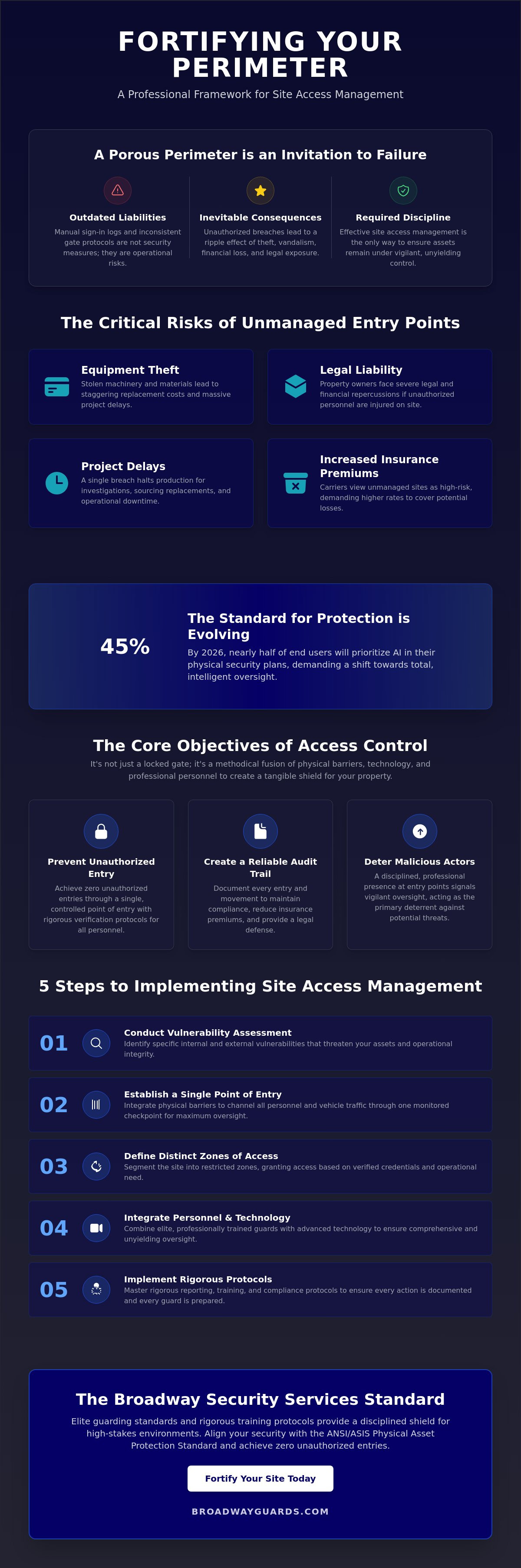
This guide provides the professional framework needed to transform your facility into a fortified environment where every entry is verified and every movement is documented. With 45% of end users prioritizing AI in their physical security plans for 2026, the standard for protection is rapidly evolving toward total oversight. You’ll gain the discipline required to maintain operational integrity against even the most persistent threats while ensuring your protocols meet modern industry benchmarks.

We’ll examine how to align your physical security with the ANSI/ASIS Physical Asset Protection Standard. You’ll learn to integrate professional personnel with rigorous reporting protocols to achieve zero unauthorized entries, accurate real-time data, and a significant reduction in operational liability through strict compliance and methodical oversight.

Key Takeaways

  • Define the systematic control of personnel and assets to maintain a secure geographic perimeter and operational order.
  • Identify the specific internal and external vulnerabilities that threaten your assets and lead to significant financial loss.
  • Implement a disciplined framework for site access management by integrating physical barriers with a single point of entry for maximum oversight.
  • Master the five-step methodology for conducting professional vulnerability assessments and defining distinct zones of access.
  • Recognize how elite guarding standards and rigorous training protocols provide a disciplined shield for high-stakes environments.

What is Physical Site Access Management?

Site access management is the systematic control of personnel, vehicles, and assets entering and exiting a specific geographic location. While many modern organizations focus heavily on digital firewalls and encrypted passwords, physical site access management represents the tangible shield that protects your actual property. Access control systems in the digital world protect data; however, physical access control protects human lives and high-value hardware. It’s the difference between a secure server and a secure perimeter.

A common failure in security planning is the confusion between digital permissions and physical entry. A password cannot stop a trespasser from entering a loading dock. A firewall cannot prevent the theft of copper from a job site. True site access management requires a disciplined fusion of physical barriers, advanced technology, and professional personnel. This creates an environment where every individual is accounted for and every asset is tracked. For businesses in the San Fernando Valley, this visibility is the primary deterrent. A disciplined presence at entry points signals that the facility is under vigilant oversight. It’s not just about a locked gate; it’s about a methodical approach to presence and prevention.

The Core Objectives of Site Access Control

The primary goal is the absolute prevention of unauthorized entry and trespassing. This is achieved through a single point of entry that forces all traffic through a rigorous verification process. Professional standards require the verification of credentials for every contractor, visitor, and employee. Beyond immediate protection, these protocols create a reliable audit trail. This documentation is essential for maintaining compliance, reducing insurance premiums, and providing a legal defense in the event of a liability claim. Accountability is the foundation of this process.

Common Environments Requiring Access Management

Different facilities face unique threats that require specialized oversight. In Canoga Park, construction sites with high-value materials are frequent targets for organized theft. These sites require strict perimeter control to prevent the loss of heavy machinery and raw materials. Gated residential communities in the San Fernando Valley utilize access management to maintain the safety and privacy of their residents. Commercial office complexes and high-risk industrial facilities also rely on these systems to manage high volumes of daily traffic while keeping restricted zones secure. Each environment demands a tailored, unyielding approach to protection.

The Critical Risks of Unmanaged Entry Points

Unmanaged entry points represent a failure in operational discipline. These vulnerabilities allow both external intruders and internal threats to compromise your assets. External threats often involve organized theft or opportunistic vandalism. Internal threats are more subtle, involving unauthorized access by contractors or employees to restricted zones. Without rigorous site access management, these risks remain unmitigated. Site access management provides the necessary friction to prevent these losses by ensuring that only verified individuals pass through your perimeter.

In Southern California, the financial impact of equipment theft is staggering. Construction projects are particularly vulnerable to these breaches. Stolen machinery doesn’t just cost the price of the asset; it leads to massive project delays and secondary costs. A porous perimeter allows unauthorized individuals to enter, scout, and eventually remove high-value materials. This lack of oversight also creates significant liability issues. If a non-compliant contractor enters a high-risk zone without proper verification and suffers an injury, the property owner faces severe legal and financial repercussions. Consider the following risks of a neglected entry strategy:

  • Equipment theft and high replacement costs.
  • Legal liability from unauthorized contractor injuries.
  • Increased insurance premiums due to a lack of oversight.
  • Project delays stemming from investigative downtime.

The Cost of Security Lapses

A single breach can stall an entire production schedule. When materials are stolen or equipment is damaged, work stops while investigations occur and replacements are sourced. These incidents also trigger a rise in insurance premiums. Carriers view unmanaged sites as high-risk environments, demanding higher rates to cover potential losses. The broken window theory as applied to site access states that unmonitored perimeters serve as a visual cue that a facility lacks the discipline to defend its assets. For project managers overseeing job sites, a comprehensive approach to construction theft prevention is essential to avoiding these cascading financial consequences.

Addressing the ‘Security Theater’ Misconception

Many facility managers fall into the trap of security theater. This involves installing passive barriers like chain-link fences or unmonitored electronic keypads that provide a false sense of safety. A fence without oversight is merely an obstacle that can be bypassed. Unmonitored keypads are easily compromised through shared codes or social engineering. These tools are only effective when integrated into a broader strategy of site access management.

Professional personnel turn a passive barrier into an active deterrent. By maintaining a vigilant presence, unarmed security guards ensure that every entry point is a hard target rather than a porous opening. They provide the human judgment necessary to identify anomalies that technology alone might miss. This level of professional oversight is the difference between a site that looks secure and one that actually is.

The Framework of a Disciplined Access Strategy

A high-security environment functions as a disciplined shield. This framework integrates three critical layers: physical barriers, advanced technology, and professional personnel. Site access management is most effective when these elements operate with military-like precision. Without a structured fusion of these components, your perimeter remains a suggestion rather than a command. A methodical approach ensures that every individual and vehicle is vetted before they gain proximity to your assets.

Establishing a single point of entry is the first requirement of a disciplined strategy. Funneling all traffic through a centralized checkpoint ensures maximum oversight. It eliminates the risk of unmonitored side-door entries that compromise the entire facility. This centralized approach allows for the rigid application of Standard Operating Procedures for every individual seeking entry. Consistency in these protocols removes the element of human error and ensures that security standards never waver.

Technological Integration in 2026

Technology serves as the sensory system for your perimeter. In 2026, 45% of end users are prioritizing AI in their physical security plans to detect anomalies in real-time. Biometric scanners and RFID systems provide rapid verification, while digital logging replaces unreliable paper books. These tools provide the necessary data, but they must be integrated into a broader site access management strategy that includes mobile patrol services to ensure a rapid response to any detected breach. A digital log is only as useful as the force that can act upon the information it provides.

The Human Factor: Professional Guarding

Software cannot manage a crisis. While digital systems identify threats, professional guarding provides the decisive action needed to neutralize them. Many security plans fail because they rely too heavily on automated stacks while overlooking the necessity of human intervention. A uniformed presence creates a psychological deterrent that no camera can replicate. It signals that the facility is under the care of a vigilant and unyielding force, prepared to enforce the rules of the site.

Verification protocols must be absolute. Professional guards don’t just check identification; they cross-reference manifest lists and verify credentials against pre-approved schedules. This methodical approach ensures that contractors and visitors are where they’re supposed to be, exactly when they’re supposed to be there. In high-stakes environments, this commitment to duty is what maintains operational integrity and provides peace of mind to stakeholders.

Site Access Management: A Professional Guide to Physical Security & Perimeter Control

5 Steps to Implementing Site Access Management

Implementation is a tactical operation. It requires a structured progression from assessment to execution. Successful site access management depends on a methodical approach that leaves no room for ambiguity. By following a tiered implementation strategy, you ensure that your security posture is both proactive and resilient. This process transforms a passive property into a fortified facility under the care of an unyielding force.

Phase 1: Risk Assessment and Planning

The foundation of any disciplined strategy is a comprehensive site vulnerability and risk assessment. You must identify every weak spot in the existing perimeter, such as unlit corners, damaged fencing, or unmonitored service entrances. Utilizing the ASIS Security Risk Assessment Standard provides a professional framework for this analysis. During this phase, you must determine the necessary level of force required for protection. Some high-risk environments in Canoga Park necessitate armed security guards to deter sophisticated threats, while other commercial sites may rely on unarmed personnel. Coordination with local law enforcement standards ensures your protocols are legally grounded and operationally sound.

Once the risks are identified, you must define clear zones of access. A disciplined site categorizes areas into three distinct tiers:

  • Public Zones: Areas with minimal restrictions where visitors are first greeted.
  • Restricted Zones: Operational areas requiring credential verification for entry.
  • High-Risk Zones: Locations housing high-value assets or sensitive data that demand secondary authentication.

This zoning ensures that even if a perimeter is breached, internal layers of protection remain unyielding. It creates a depth of defense that prioritizes safety and order.

Phase 2: Operational Execution

Operational execution begins with the installation of physical and technological barriers. Gates, biometric scanners, and high-intensity lighting provide the hardware necessary for control. However, these tools are secondary to the personnel who manage them. Training is non-negotiable. Every guard must be briefed on site-specific security protocols to ensure a consistent response to every entry request. This level of preparation prevents the lapses in judgment that lead to unauthorized access.

The final step is the establishment of a rigorous reporting and audit cadence. You must maintain an accurate real-time log of all movements to ensure accountability. Testing the system through simulated unauthorized entry attempts is a critical component of this phase. These drills reveal hidden vulnerabilities and confirm that your personnel are prepared for high-stakes scenarios. A disciplined shield requires constant maintenance and a commitment to duty that never wavers. This methodical oversight provides the peace of mind that your assets are under professional care.

Professional Guarding: The Broadway Security Services Standard

Broadway Security Services defines the standard for physical protection in the San Fernando Valley. Our approach to site access management isn’t a passive service; it’s a disciplined operation. We position our personnel as the final, unyielding layer of your security framework. While technology provides data, our guards provide the decisive action required to maintain order. Every contract we execute is a commitment to duty and high-stakes reliability. Broadway Security Services acts as a disciplined shield, ensuring that your perimeter is never compromised by neglect or inconsistency.

Our personnel undergo rigorous training that exceeds California regulatory requirements. This ensures that every guard on your site possesses the tactical discipline needed to enforce protocols without compromise. We don’t just occupy a post; we command it. This level of oversight is essential for firms that value safety and peace of mind above all else. By adhering to military-like precision in our reporting and presence, we provide a foundation of trust that automated systems alone cannot establish. It’s a professional standard rooted in accountability.

The Advantage of Trained Personnel

Professional guards offer capabilities that automated systems simply cannot match. They possess the expertise required for effective de-escalation and crisis management. A uniformed presence at your entry point serves as a visible deterrent, preventing incidents before they occur. Beyond deterrence, our personnel provide reliable reporting through detailed daily logs and incident documentation. This methodical oversight ensures that your site access management strategy remains transparent and accountable. It’s about creating an atmosphere of total control where every anomaly is identified and addressed immediately.

Securing Your Site Today

Local expertise is a critical component of effective protection. Broadway Security Services understands the specific security challenges facing businesses in Woodland Hills and Canoga Park. Our team tailors site access protocols to the unique requirements of construction, retail, and corporate environments. Whether you require armed security guards for high-risk assets or unarmed security guards for residential complexes, we provide a customized solution that prioritizes your operational integrity. We don’t believe in one-size-fits-all security; we believe in a disciplined approach tailored to your specific geography.

We offer specialized services including construction site security and loss prevention services to ensure your perimeter remains a hard target. Our presence signals that your facility is under the care of a vigilant force. We invite you to secure your perimeter with Broadway Security Services and experience our professional standard of protection. Our commitment to discipline ensures that your assets remain secure and your liability remains low. Reliability is our signature, and protection is our duty.

Fortify Your Perimeter with Disciplined Oversight

Effective site access management isn’t a luxury; it’s a fundamental requirement for maintaining a secure and productive facility. You’ve explored how unmanaged entry points invite theft and legal liability, while a disciplined framework of physical barriers and advanced technology creates a resilient shield. The human element remains the most critical component in this strategy. Professional guarding provides the vigilant oversight and decisive action necessary to identify threats that automated systems alone might miss. It’s the difference between a passive deterrent and an active defense.

Broadway Security Services delivers military-grade operational discipline to every client in the San Fernando Valley. We employ California BSIS Licensed Personnel who are trained to uphold the highest standards of professional conduct and vigilance. Our presence ensures your assets remain under the care of an unyielding force that prioritizes your safety and peace of mind. By implementing these rigorous standards, you eliminate operational ambiguity and establish a culture of total accountability across your entire perimeter.

Take the final step in securing your facility today. Request a Professional Risk Assessment for Your Site and ensure your perimeter reflects the discipline of your organization. Secure your property now to maintain the operational integrity you demand.

Frequently Asked Questions

What is the difference between site access control and site access management?

Site access control refers to the physical hardware and software tools, such as gates and card readers, used to restrict entry. In contrast, site access management is the comprehensive strategy that integrates these tools with professional personnel and rigorous protocols. It involves the systematic oversight of every individual and vehicle to ensure total operational integrity across your entire perimeter.

Do I need armed guards for my construction site access management?

The requirement for armed personnel is determined by a professional risk assessment of your specific location. High-value construction site security often necessitates armed guards when the threat of organized theft or violent intrusion is elevated. Unarmed guards are typically sufficient for standard perimeter monitoring and visitor verification in lower-risk environments where visible deterrence is the primary goal.

How does site access management reduce liability for property owners?

Professional management reduces liability by establishing a verifiable audit trail of every person who enters the premises. By maintaining accurate digital logs and enforcing strict credential verification, you demonstrate a standard of due diligence that protects against legal claims. This methodical oversight ensures that only compliant contractors and authorized visitors gain access, significantly lowering the risk of workplace accidents and unauthorized incidents.

What technologies are most effective for site access in 2026?

Modern site access management utilizes biometric scanners, RFID credentials, and AI-powered video analytics to provide rapid and accurate verification. These technologies eliminate the vulnerabilities associated with traditional keys or shared passcodes. When integrated with a professional guarding force, these tools allow for real-time monitoring and an immediate response to any detected anomalies at your entry points.

Can site access management be integrated with existing fire watch services?

Yes, your access protocols can be seamlessly integrated with fire watch services to provide a unified safety framework. Personnel assigned to entry points can monitor for fire hazards while managing visitor logs, ensuring a comprehensive approach to facility protection. This fusion of duties maintains a disciplined shield over your assets while fulfilling critical regulatory requirements for fire safety and perimeter control.

What are the California requirements for security guard training at entry points?

California requires all security personnel to be licensed through the Bureau of Security and Investigative Services (BSIS). This involves completing a rigorous Power to Arrest course and ongoing continuing education in tactical communication and legal authority. Professional firms exceed these standards by implementing site-specific training that focuses on the unique entry protocols and reporting requirements of your specific facility.

How do professional guards handle unauthorized entry attempts?

A disciplined response to a breach involves immediate identification, verbal de-escalation, and the enforcement of site-specific detention protocols. Professional guards are trained to neutralize threats without escalating the situation unnecessarily, prioritizing the safety of all personnel on-site. Every incident is documented with military-like precision to ensure a clear record for law enforcement and insurance purposes.

Is site access management necessary for small businesses in Canoga Park?

Vigilance is a requirement for any business, regardless of scale, that maintains physical assets or inventory. Small businesses in Canoga Park are often targets for opportunistic vandalism and theft when their perimeters appear unmanaged. Implementing professional access protocols signals to the community that your property is under the care of a vigilant force, effectively deterring criminal activity before it occurs.