
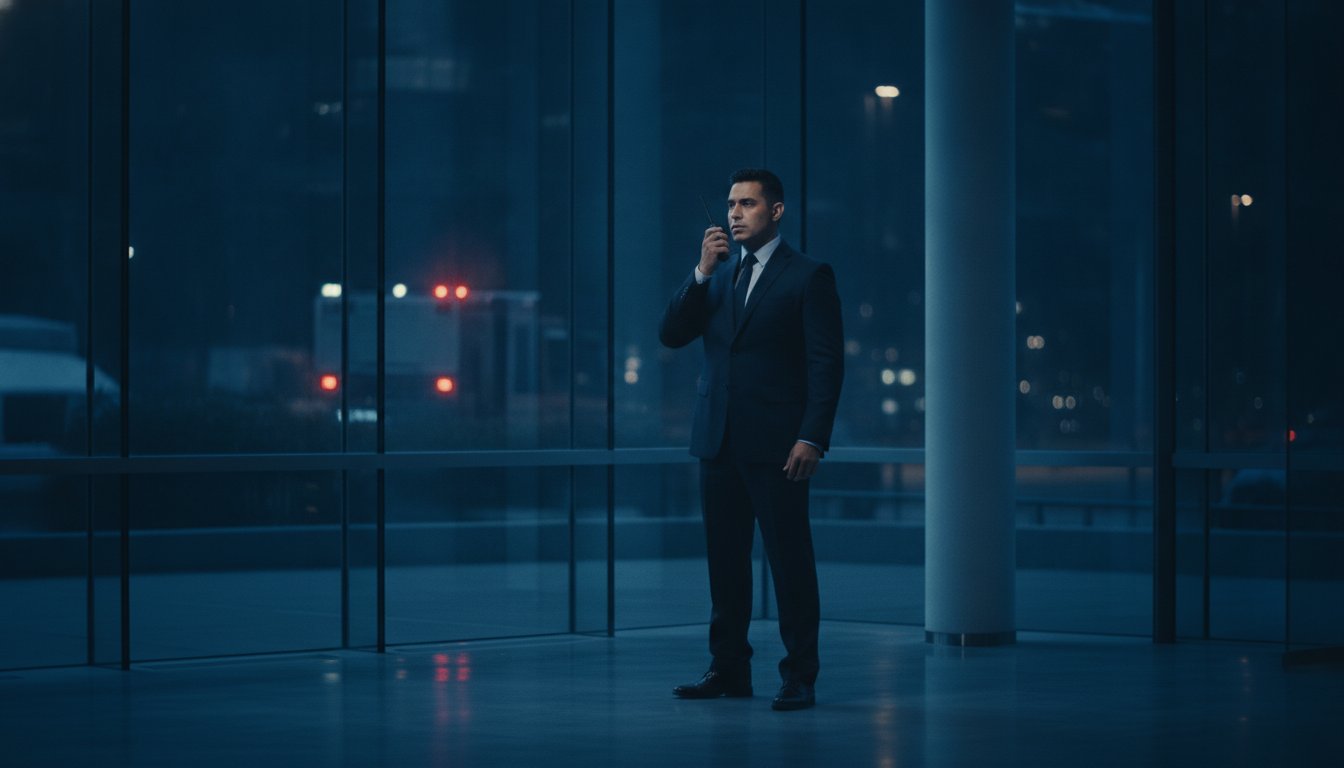
The Strategic Role of Security Guards in Crisis Management: A 2026 Professional Guide

The difference between a controlled incident and a catastrophic failure isn’t found in the thickness of an emergency manual, but in the caliber of the personnel standing at the point of impact. In high-stakes environments, the role of security guards in crisis management serves as the structural framework for every successful response. When a threat emerges, a professional presence ensures that order replaces chaos and that established protocols are executed with military-like precision.

You’ve likely felt the weight of uncertainty regarding liability or the fear that personnel might panic when a real emergency strikes. It’s a valid concern for any stakeholder responsible for high-value assets in Southern California. This 2026 professional guide provides a clear understanding of how disciplined guards function as a vigilant shield during a crisis. You’ll discover a framework for integrating professional personnel into your corporate safety plans to ensure high-stakes reliability. We’ll explore the specific duties of Broadway Security Services guards in Canoga Park and the San Fernando Valley, ensuring your safety through rigorous operational standards and the assurance of an unyielding force.

Key Takeaways

  • Understand how the role of security guards in crisis management has evolved from simple observation into a proactive, multi-phase disciplined process.
  • Learn why effective crisis mitigation depends on identifying site-specific vulnerabilities long before an incident occurs to build a foundation of resilience.
  • Master the tactical application of the OODA loop to ensure your security team executes protocols with precision when facing high-stakes pressure.
  • Evaluate the strategic differences between armed and unarmed personnel, including the legal boundaries and psychological impacts relevant to California businesses.
  • Discover how a philosophy of methodical oversight and regional expertise in Canoga Park creates a disciplined shield for your most valuable assets.

Defining the Role of Security Guards in Modern Crisis Management

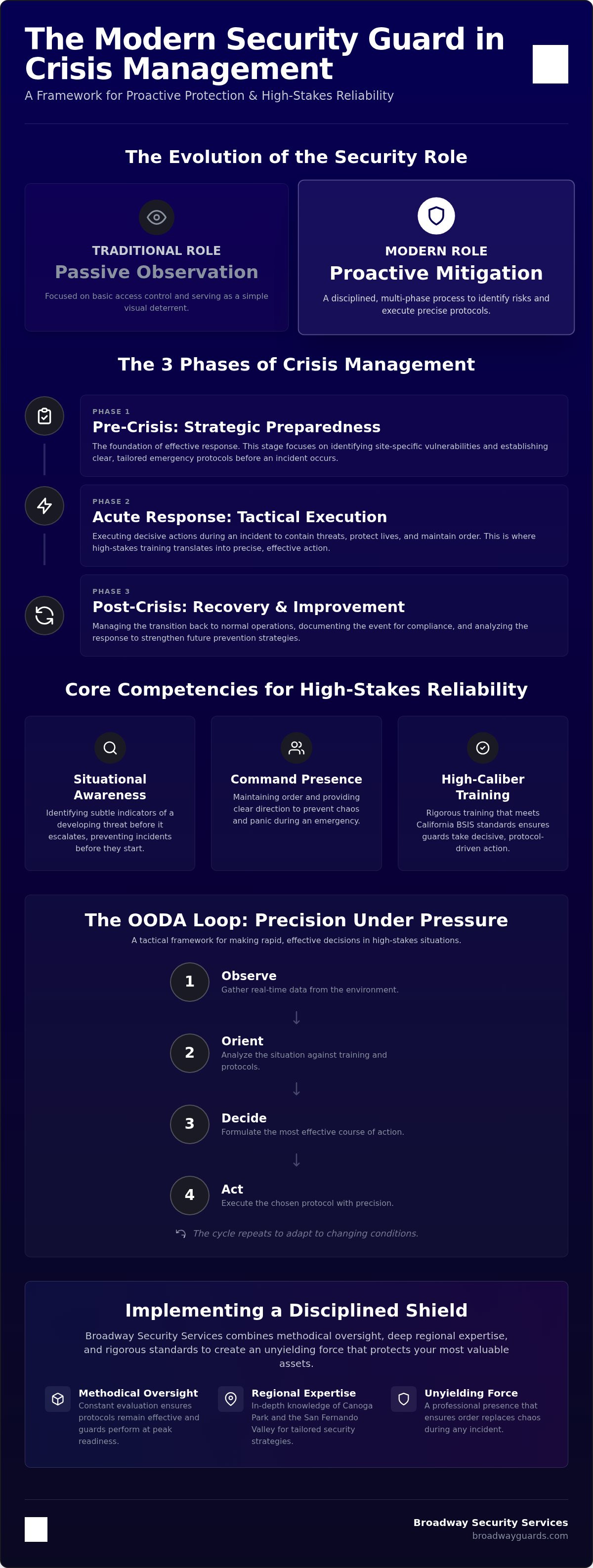
Crisis management is a methodical, multi-phase discipline designed to protect personnel and high-value assets. It isn’t a singular event; it’s a rigorous process that demands constant vigilance. The modern role of security guards in crisis management has shifted from passive observation to proactive mitigation. This evolution positions security personnel as a disciplined shield for organizations throughout the San Fernando Valley. By acting as an unyielding force, these professionals ensure that order is maintained even when external circumstances become volatile.

Effective management follows a structured lifecycle that requires different operational standards at each turn. This lifecycle consists of three distinct stages:

  • Pre-crisis: Conducting site vulnerability evaluations and establishing clear emergency response protocols.
  • Acute Response: Executing decisive actions to contain threats and protect lives during the heat of an incident.
  • Post-crisis Recovery: Managing the transition back to normal operations and documenting the event for regulatory compliance and future prevention.

The Difference Between Security and Crisis Intervention

Standard patrol duties form the foundation of site safety, but these duties transform instantly during an emergency. On-site guards provide a critical first-on-scene advantage that remote monitoring cannot replicate. While the Security Guard Profession traditionally focused on basic access control, modern crisis intervention requires immediate, high-stakes decision-making. Guards act as the primary link to public emergency services, providing real-time data to police and fire departments during those first vital minutes. This professional presence prevents the chaos often associated with unmanaged incidents.

Essential Competencies for High-Stakes Reliability

Reliability in a crisis depends on specific, trained competencies that go beyond basic observation. Situational awareness is the most vital of these. A guard must identify subtle indicators of a developing threat before it reaches a boiling point. High-caliber training, which meets the 2026 California BSIS guard card requirements for crisis response, ensures that personnel don’t succumb to the bystander effect. Instead of waiting for others to act, they take command. This command presence is essential for maintaining order among panicking staff or members of the public. It creates an atmosphere of high-stakes reliability where assets are under the care of a vigilant force. Every action is calculated, methodical, and rooted in established safety protocols.

Strategic Preparedness: The Foundation of Crisis Mitigation

Effective crisis response is never an accident. It’s the calculated result of months of methodical preparation and rigorous oversight. The role of security guards in crisis management begins long before a threat materializes. It starts with identifying site-specific vulnerabilities and establishing a disciplined framework for protection. When guards are integrated into the planning phase, they transform from simple observers into a proactive shield. This strategic alignment ensures that the role of security guards in crisis management is fully optimized to prevent loss before it occurs.

Standard Operating Procedures (SOPs) are the backbone of this preparation. Generic templates often fail because they don’t account for the unique layout of a Canoga Park warehouse or a San Fernando Valley hospital. A professional security risk assessment CA ensures that every protocol is tailored to the specific environment. This assessment dictates guard placement and response priorities, ensuring that no blind spots remain in your defense strategy.

Integrating Guards into Your Emergency Response Plan

A successful response requires a clear chain of command. Management and security personnel must operate under a unified structure to avoid confusion during high-stakes events. Guards take ownership of the physical environment. They ensure that emergency exit paths remain unobstructed and that fire suppression equipment is fully operational. For facilities in the San Fernando Valley, this includes maintaining detailed evacuation maps that account for high-occupancy areas. Recent Campus Security Trends indicate that blending physical security with advanced communication protocols is essential for modern resilience in volatile environments.

The Value of Professional Risk Assessment

In Southern California, preparedness must account for regional environmental threats. Professional vulnerability evaluations include planning for seismic events and the specific requirements of fire watch services during wildfire seasons. These aren’t just theoretical possibilities; they are operational realities that demand a disciplined response. Retail environments and construction sites often harbor “blind spots” that opportunistic threats exploit. A professional assessment identifies these gaps, such as unmonitored delivery bays or poorly lit perimeter fencing. By addressing these weaknesses early, you build an unyielding defense. If you’re concerned about your current site vulnerabilities, a professional security risk assessment can provide the clarity needed to secure your assets. This methodical approach ensures that when a crisis occurs, your team is ready to act with precision.

Tactical Response: Execution Under High-Stakes Pressure

Execution is the standard by which all security programs are judged. Once a threat is identified, the role of security guards in crisis management transitions from methodical observation to immediate tactical intervention. This shift requires a mental framework known as the OODA loop: Observe, Orient, Decide, and Act. Guards first observe the anomaly, orient themselves to the specific nature of the danger, decide on the pre-established protocol, and act with unyielding precision. This cognitive cycle allows Broadway Security personnel to outpace the evolution of a threat, ensuring that the response remains controlled rather than reactive.

Establishing a secure perimeter is a primary objective during the acute phase of an incident. A disciplined guard doesn’t just watch a door; they control the flow of the entire environment. By maintaining a calm, authoritative command presence, guards serve as a psychological anchor that neutralizes panic among staff and visitors. This professional stoicism prevents the “stampede effect” and ensures that instructions are followed without hesitation. It’s the difference between a chaotic flight and a structured evacuation.

Communication Protocols During an Emergency

Information is the most valuable asset during a high-stakes event. Guards establish a Primary Communication Hub on-site to centralize data flow. They use standardized radio codes and clear-text reporting to eliminate ambiguity. This clarity is essential when providing real-time intelligence to incoming First Responders. By delivering precise details on the location and nature of the threat, security personnel act as the eyes and ears of public emergency services before they even arrive on the scene.

Crowd Management and Evacuation Control

Directing large groups in high-stress environments demands tactical expertise. Guards employ specific crowd-control formations to guide occupants toward safe zones while preventing bottlenecks. They simultaneously manage the risk of unauthorized entry by individuals attempting to return to the building during the chaos. Maintaining site security doesn’t stop because an alarm sounds. Personnel ensure that emergency vehicle lanes remain clear, facilitating a rapid response from local San Fernando Valley fire and police units while keeping the perimeter unyielding.
The Strategic Role of Security Guards in Crisis Management: A 2026 Professional Guide

Armed vs. Unarmed Personnel in Crisis Scenarios

The presence of a uniformed professional fundamentally alters the environment during a crisis. The role of security guards in crisis management often centers on the deterrence factor. An armed presence signals a zero-tolerance threshold for violence, which can prevent a situation from escalating before it begins. Conversely, unarmed guards provide a reassuring, approachable layer of safety that is often more suitable for corporate or retail settings. Choosing between these options depends on the specific risk profile of the site and the expected nature of potential threats. Each choice represents a different strategic layer in your disciplined shield.

California law mandates strict tactical boundaries for both guard types. Businesses should transition to armed security guard services Los Angeles when the threat level includes potential armed robbery, workplace violence, or the protection of extremely high-value assets. This transition ensures that the organization has a disciplined force capable of meeting lethal threats with professional precision. The decision to deploy armed personnel is a strategic one, rooted in the need for high-stakes reliability and unyielding protection. It isn’t just about the weapon; it’s about the advanced training that guides its potential use.

The Role of Armed Guards in Active Threat Mitigation

Armed personnel follow specific protocols for neutralizing violent intruders. These guards undergo the rigorous training required for 2026 California BSIS armed guard certification, which includes firearms proficiency and legal use-of-force education. In high-risk asset protection, the disciplined force concept ensures that guards remain stoic and focused under extreme pressure. Their primary objective is to contain the threat and protect lives. They act as an unyielding shield until public law enforcement arrives. This level of oversight is essential for facilities where the risk of violent intervention is documented and high.

Unarmed Guards: The Experts in De-escalation

Professional unarmed security guards specialize in conflict management without escalation. They utilize techniques such as verbal judo and strategic presence to maintain order in retail or corporate crises. In many scenarios, unarmed visibility is the superior strategic choice. It maintains a safe atmosphere without the heightened tension that firearms can sometimes introduce. These guards are experts at diffusing verbal altercations and managing low-level physical threats with methodical oversight. If you are unsure which tier of protection your facility requires, explore our armed security guard services Los Angeles to compare the tactical benefits for your specific site.

Implementing a Disciplined Shield with Broadway Security

Methodical oversight defines the Broadway Security philosophy. Our approach treats the role of security guards in crisis management as a rigorous operational standard rather than a reactive task. This commitment to structure ensures that every guard functions as an unyielding force during high-stakes events. By prioritizing safety and peace of mind, we provide organizations with a foundation of trust built on visible results and military-like precision. Partnering with Broadway Security means moving beyond basic protection and adopting a framework of total organizational resilience.

Our operations maintain strict adherence to 2026 BSIS regulatory standards, grounding every professional claim in legal and operational reality. We don’t just offer guards; we provide a disciplined shield that integrates seamlessly into your corporate safety plans. This transition from a service provider to a strategic partner ensures that your assets are under the care of a vigilant and prepared force. Every protocol we execute is designed to reinforce order and maintain the integrity of your site, regardless of the external chaos.

Southern California Expertise: Why Local Knowledge Matters

Navigating the complex regulatory landscape of Los Angeles County requires a partner with deep regional roots. Our presence in the San Fernando Valley allows us to provide site-specific strategies that generic agencies cannot match. We understand the unique vulnerabilities of local industries, from high-shrink retail environments to exposed construction sites in Canoga Park. This geographic specialization ensures that our response protocols account for local traffic patterns, emergency service response times, and regional environmental risks. Local knowledge isn’t just a benefit; it’s a tactical requirement for effective crisis mitigation.

The Broadway Advantage: Training and Accountability

High-stakes reliability is the direct result of rigorous vetting and discipline-focused training. Every Broadway guard maintains full compliance with California BSIS requirements, ensuring they possess the legal and tactical knowledge to manage a crisis with self-assurance. We don’t just deploy personnel; we implement a system of absolute accountability. Our “Vigilant Force” reporting standards provide comprehensive post-crisis evaluation, documenting every action taken to ensure transparency and future prevention. This methodical oversight transforms a service into a disciplined shield for your most valuable assets. If you’re ready to secure your facility with a professional presence, contact Broadway Security for a professional risk assessment today. We provide the order and oversight necessary for a crisis-resilient future.

Securing Your Future Through Rigorous Operational Standards

A crisis doesn’t wait for a convenient moment to strike. It demands an immediate, disciplined response from personnel who’ve mastered the OODA loop and established clear chains of command. We’ve explored how the role of security guards in crisis management extends far beyond simple observation; it’s a strategic framework of prevention, tactical intervention, and recovery. By integrating site-specific SOPs and conducting professional vulnerability evaluations, you transform your facility into an unyielding fortress.

Reliability is built on a foundation of accountability and specialized training. Broadway Security brings decades of tactical security experience and California BSIS certified personnel to every engagement. We specialize in Southern California risk profiles, ensuring your organization is prepared for regional challenges. Don’t leave your resilience to chance when you can employ a disciplined shield. It’s time to prioritize the safety of your assets with a partner that values precision and methodical oversight above all else.

Secure Your Assets with Broadway’s Disciplined Crisis Management Solutions

Frequently Asked Questions

What is the primary role of a security guard during a fire emergency?

The primary role involves immediate detection and the execution of a disciplined evacuation protocol. Guards verify that fire suppression equipment is accessible and guide occupants toward designated safe zones. They maintain order to prevent panic while providing essential data to the Los Angeles Fire Department upon arrival. This methodical oversight ensures that life safety remains the highest priority during the acute phase of a fire incident.

Can security guards legally detain individuals during a crisis in California?

In California, security guards possess the legal authority to perform a citizen’s arrest under Penal Code Section 837. This allows for the detention of an individual who commits a public offense in their presence. However, the guard must immediately notify law enforcement and transfer custody to a peace officer. This action is a high-stakes responsibility that requires rigorous training to ensure legal compliance and minimize organizational liability.

How do security guards coordinate with the LAPD during an incident?

Coordination with the LAPD involves serving as a tactical link between the site and emergency responders. Guards provide critical intelligence regarding the location and nature of a threat before officers enter the premises. By maintaining clear access lanes and securing perimeters, the role of security guards in crisis management allows law enforcement to focus entirely on neutralizing the threat with maximum efficiency and precision.

What training do Broadway guards receive for crisis management?

Broadway guards undergo a rigorous training regimen that exceeds standard 2026 California BSIS requirements. Our personnel are instructed in site-specific vulnerability evaluations and advanced situational awareness. This discipline-focused education ensures that every guard can execute complex emergency protocols with military-like precision. We emphasize high-stakes reliability through continuous oversight and regular performance reporting to maintain a vigilant and unyielding force for our clients.

Is an armed guard necessary for every business crisis plan?

An armed presence isn’t mandatory for every crisis plan, but it’s essential for high-risk environments. The decision depends on a professional risk assessment of your specific site in Canoga Park or the San Fernando Valley. While unarmed guards are experts in de-escalation, armed personnel provide a necessary deterrent for facilities facing threats of violence or protecting high-value assets. Both roles contribute to a comprehensive and disciplined shield.

How does a security risk assessment improve crisis response?

A professional security risk assessment improves response by identifying structural blind spots and operational weaknesses before an incident occurs. This methodical evaluation dictates the strategic placement of guards and the development of site-specific SOPs. By understanding the unique vulnerabilities of a San Fernando Valley facility, we ensure that the role of security guards in crisis management is proactive rather than reactive, creating a foundation for organizational resilience.

What is the difference between fire watch and standard security during a crisis?

Fire watch services are a specialized, regulatory-mandated function focused exclusively on identifying fire hazards when automated detection systems are offline. Unlike standard security, which manages a broad range of threats, fire watch personnel maintain a continuous, documented patrol of every area to prevent ignition. This dedicated oversight is critical for maintaining compliance with California fire codes and ensuring site safety during system maintenance or malfunctions in Southern California.

How should a business evaluate a security firm’s crisis management capabilities?

Evaluating a firm requires a focus on regulatory credentials and documented performance standards. A reliable partner should demonstrate full BSIS compliance and possess deep regional expertise in Southern California. You should verify their training protocols, the rigor of their reporting systems, and their ability to provide site-specific consultation. A firm that prioritizes discipline and methodical oversight will offer the highest level of high-stakes reliability for your most valuable assets.
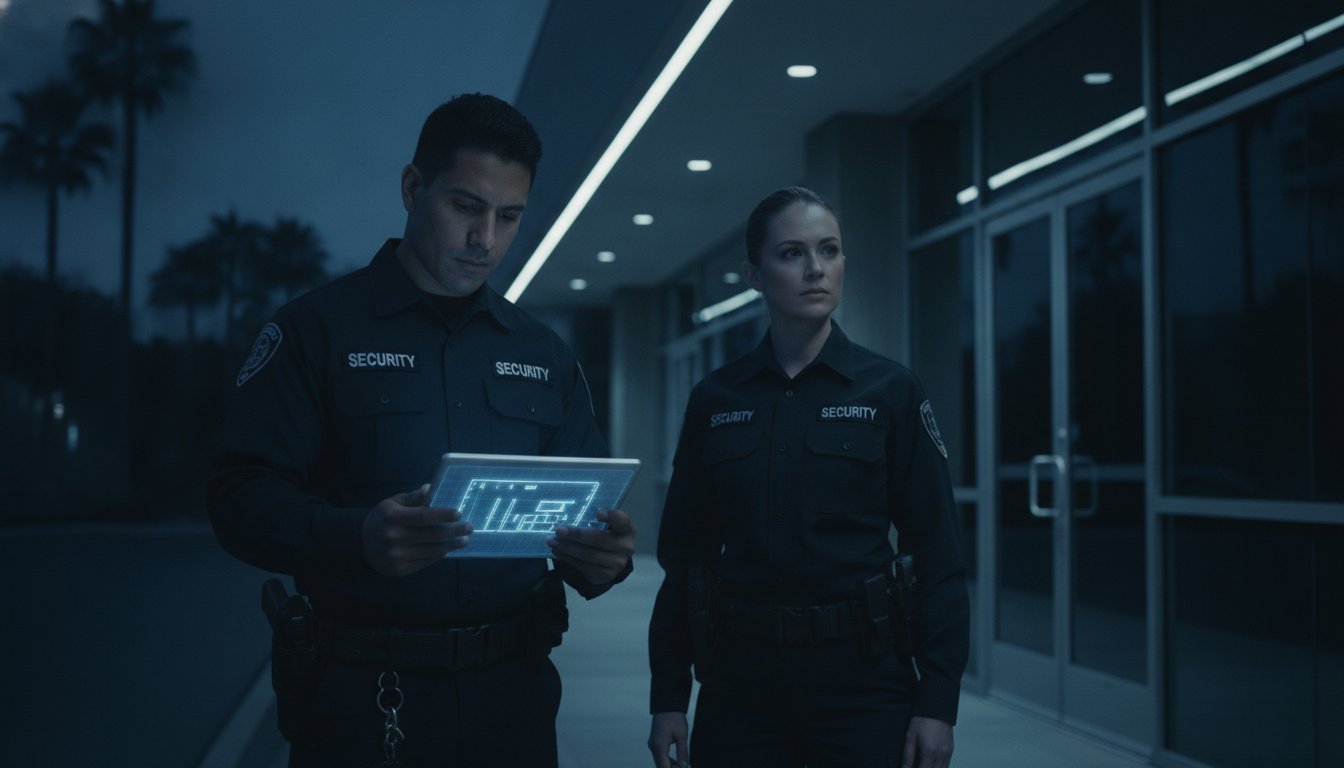
Securing a Building After a Threat: A Strategic Post-Incident Protocol

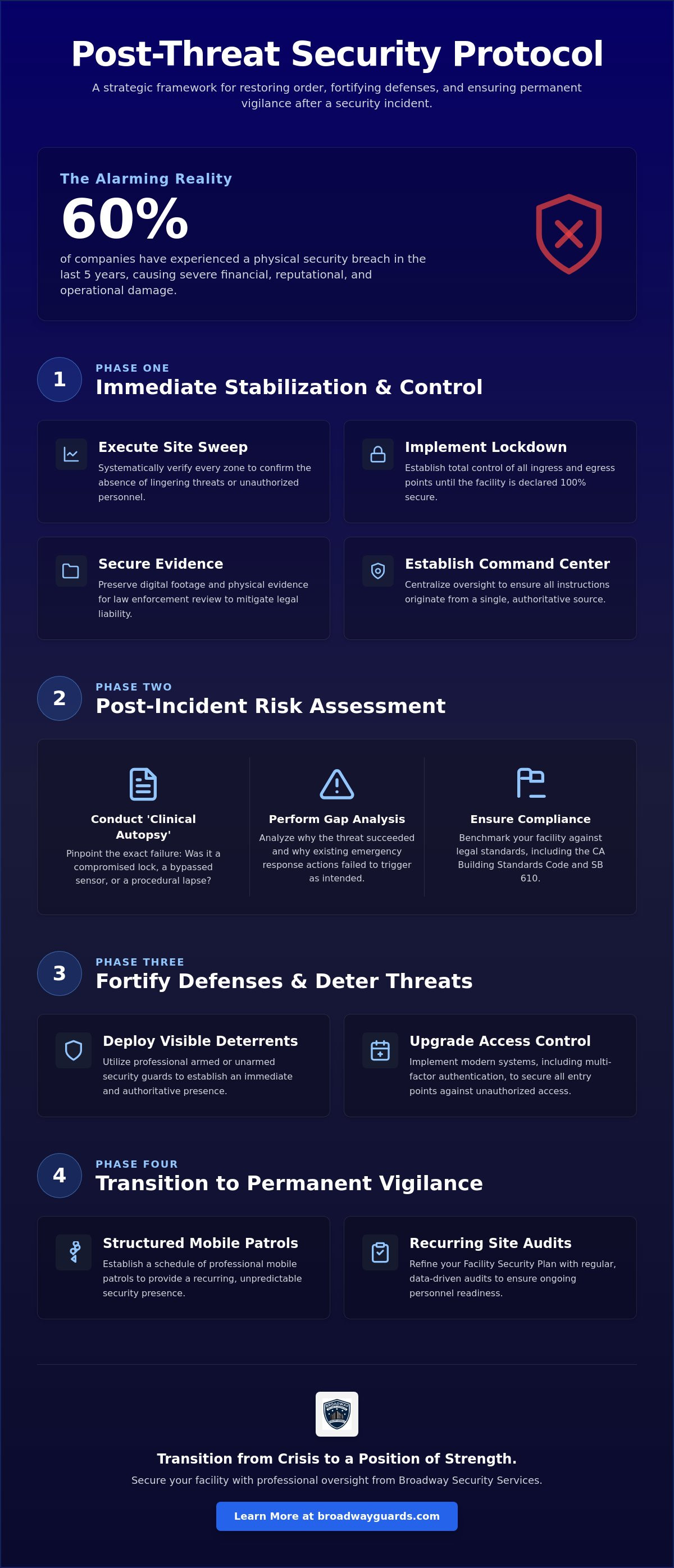
Sixty percent of companies have experienced a physical security breach in the last five years. While the immediate financial impact is severe, the long-term damage to employee trust and professional reputation is often far worse. You understand that a security incident isn’t just a lapse in hardware; it’s a compromise of the order and safety your organization depends on. Securing a building after a threat requires more than temporary fixes. It demands a transition into a state of disciplined, permanent vigilance that addresses both physical vulnerabilities and legal liabilities under the 2025 California Building Standards Code.

This article outlines the precise, step-by-step procedures to restore a secure environment and fortify your facility against future incursions. You’ll learn how to conduct a rigorous post-incident audit, analyze existing security gaps, and ensure compliance with California Senate Bill 610 regarding disaster remediation. We’ll provide a clear roadmap to move your operations from a state of crisis back to a position of strength and total oversight. By the end of this protocol, you’ll have the strategic framework necessary to prove your facility is a demonstrably safer environment for every occupant.

Key Takeaways

  • Execute a methodical site sweep and establish immediate lockdown protocols to stabilize the facility and neutralize lingering risks.
  • Master the disciplined steps for securing a building after a threat by identifying specific failure points and auditing current response effectiveness.
  • Deploy visible deterrents, such as professional armed or unarmed security guards, while upgrading access control systems with multi-factor authentication.
  • Refine your Facility Security Plan based on incident data to ensure alignment with legal standards and enhance personnel readiness.
  • Establish a permanent state of vigilance through a structured schedule of professional mobile patrols and recurring site audits.

Immediate Protocols: Stabilizing the Facility After a Breach or Threat

The moments following a security breach are a critical window for establishing control. A disciplined response prevents a single incident from cascading into a prolonged operational failure. Securing a building after a threat starts with the transition from tactical response to methodical stabilization. This phase requires a rigid adherence to protocol to ensure every vulnerability is identified and contained. Order must be restored through a series of non-negotiable actions designed to protect both the physical assets and the organization’s legal standing.

To stabilize the environment, management must execute the following actions with military-like precision:

  • Execute a Comprehensive Site Sweep: Every zone must be verified to confirm the absence of lingering threats or unauthorized personnel.
  • Implement a Temporary Lockdown: Total control of all ingress and egress points is mandatory until the facility is declared secure.
  • Secure Evidence: Both digital surveillance footage and physical evidence must be cordoned off for law enforcement review to mitigate liability.
  • Establish a Command Center: Centralized oversight ensures that all instructions originate from a single, authoritative source.

The Site Clearing Process

A building isn’t secure until every square inch has been visually and physically inspected. This process requires coordination with professional Armed Security Guards or Unarmed Security Guards who understand the nuances of physical security measures. Personnel must verify the status of all entry points, including secondary service doors and roof access hatches that are often overlooked during a crisis. You should document the integrity of every locking mechanism and physical barrier. If a door’s hardware was compromised during the breach, it must be guarded or boarded immediately. This level of rigor ensures that the “all-clear” signal is based on data rather than assumptions.

Stakeholder Communication and Transparency

Restoring employee trust is just as vital as fixing a broken lock. Uncertainty breeds fear, which can paralyze operations. Leaders must provide clear, authoritative updates to staff to signal that the environment is stabilized. For residential properties or retail spaces, formal statements should be issued to residents or clients regarding the current safety status. Under California Senate Bill 610, landlords and property managers have expanded responsibilities after declared disasters or significant incidents. This includes the removal of hazards and environmental remediation. Maintaining a detailed log of all post-incident communications isn’t just good management; it’s a requirement for legal compliance and protection against premises liability claims. Transparency doesn’t mean sharing tactical secrets; it means demonstrating that a disciplined shield is back in place.

Conduct a Professional Post-Incident Security Risk Assessment

Stabilization is only the beginning of recovery. To prevent a recurrence, you must conduct a clinical autopsy of the security failure. Securing a building after a threat requires identifying the exact moment the perimeter was compromised. This isn’t a time for generalities. You must pinpoint if a specific lock failed, a sensor was bypassed, or if a procedural lapse created an opening. Analyzing the response time of your current team is equally vital. If the transition to a lockdown was delayed, you need to understand why the established emergency response actions didn’t trigger as intended.

A rigorous evaluation must extend to the physical vulnerabilities of both your perimeter and interior zones. In high-stakes environments, a simple walkthrough isn’t sufficient. You should perform a comprehensive security risk assessment CA to benchmark your facility against 2026 standards. This process ensures that your defense isn’t just reactive but is built on a foundation of documented reliability and professional oversight.

Gap Analysis: Why the Threat Succeeded

A successful breach usually reveals a disconnect between technology and human performance. You must distinguish between a technological failure, such as a malfunction in an AI-powered surveillance system, and human error, like a propped-open service door. Review your surveillance footage meticulously to map the intruder’s path. This visual evidence often reveals blind spots where the deterrent value of your existing security signage or lighting was insufficient. Mapping these gaps allows you to move from a state of uncertainty to one of controlled resolution. If your current protocols didn’t hold, it’s a signal that your professional security presence needs immediate reinforcement.

Regulatory Compliance in California

In California, post-incident recovery is governed by strict legal frameworks. All assessments must align with the standards set by the Bureau of Security and Investigative Services (BSIS). Since January 1, 2026, the updated California Building Standards Code (Title 24) has imposed new requirements for fire safety and means of egress. You must verify that your post-threat lockdown procedures don’t violate these codes, particularly regarding door locking mechanisms in occupied spaces. If your incident involved a fire risk or system failure, ensure your Fire Watch Services remain compliant with local Los Angeles County ordinances. Aligning your site safety with these state-mandated protections isn’t just about safety; it’s about mitigating the legal liability that follows any documented breach.

Strengthening Perimeter Defenses and Access Control Measures

Fortification is the visible manifestation of your commitment to safety. While a risk assessment identifies where the shield cracked, the implementation of perimeter defenses ensures the shield is rebuilt stronger. Securing a building after a threat requires a multi-layered approach that prioritizes immediate deterrence over passive observation. Electronic systems like CCTV provide data, but they don’t stop an intruder in real-time. Professional human presence is the only unyielding force capable of immediate intervention. This transition from emergency response to professional staffing is what separates a vulnerable facility from a secure one.

To establish a demonstrably safer environment, you must deploy visible Armed Security Guards or Unarmed Security Guards at all primary access points. This psychological barrier is often enough to prevent a secondary attempt. For facilities with expansive perimeters or multi-level parking structures, Mobile Patrol Services provide the consistent oversight necessary to eliminate blind spots. If your electronic monitoring systems were compromised during the initial breach, Fire Watch Services are mandatory to maintain compliance with Los Angeles fire codes while repairs are finalized. You shouldn’t leave the safety of your assets to luck while hardware is offline.

The Role of Professional Guard Staffing

The presence of a disciplined protector at your gate changes the risk profile of your property. You must evaluate the need for armed security guard services Los Angeles for high-risk sites or facilities handling high-value assets. Guards should be positioned at primary choke points to manage visitor verification with military-like precision. It’s not enough to have a person in a uniform. These professionals must be trained in the specific crisis management strategies of your facility. They act as the first line of defense, ensuring that every individual entering the property is authorized and vetted against current threat data.

Technological Integration and Oversight

Modern defense relies on the intersection of human intelligence and technological rigor. You should upgrade physical access control systems to include multi-factor authentication (MFA). In 2026, the cost for enterprise-level door access control ranges from $1,500 to $3,500 per door. This investment is small compared to the $100,000 average cost of a physical security breach. Integrate high-definition surveillance with real-time guard reporting to ensure management has total visibility. Every perimeter fence and lighting fixture must meet tactical standards to eliminate shadows and concealment points. Establish a redundant communication loop between field personnel and management. This ensures that if a threat is detected, the response is instantaneous and coordinated. Reliability is the result of constant, methodical oversight.

Securing a Building After a Threat: A Strategic Post-Incident Protocol

Refining Crisis Management Strategies and Personnel Readiness

Hardware and physical barriers are only as effective as the people who manage them. While previous sections focused on stabilization and perimeter fortification, securing a building after a threat ultimately depends on the “human firewall.” A disciplined organization doesn’t rely on luck; it relies on a rigorous Facility Security Plan (FSP) that evolves with every new challenge. Your FSP shouldn’t be a static document gathering dust. It must be a living strategy that incorporates the specific data and failure points identified during your recent post-incident audit. If a breach occurred because of a procedural lapse, the protocol must be rewritten to eliminate that specific vulnerability.

Establishing a clear hierarchy of command is paramount for future emergency responses. In the heat of a crisis, confusion is a force multiplier for the threat. Every staff member must know exactly who holds the authority to initiate a lockdown or contact emergency services. Standardizing your reporting procedures ensures that suspicious activity is communicated with military-like precision. This rapid intervention capability is what prevents a minor observation from escalating into a full-scale security failure. To ensure your facility’s readiness meets these high standards of oversight, you should partner with professional security management to audit your internal response protocols.

Staff Training and Mental Readiness

Crisis Management Documentation

Transitioning to Long-Term Vigilance with Broadway Security Services

Vigilance isn’t a temporary reaction. It’s a permanent operational standard. Securing a building after a threat requires moving beyond the initial shock into a structured rhythm of protection. Broadway Security Services provides this through consistent schedules of professional patrols and site audits. We don’t just watch. We observe and report with a focus on pre-empting vulnerabilities before they’re exploited. This methodical approach ensures that the order restored in the wake of an incident becomes the new baseline for your facility’s daily operations.

Leveraging contractual security management ensures ongoing personnel oversight that internal teams often struggle to maintain. This isn’t just about staffing; it’s about maintaining a disciplined shield. We achieve this through continuous training and rigorous field performance reviews that hold every guard accountable to the highest standards. In Southern California, risk factors evolve rapidly. Your security presence must scale accordingly to meet these shifting threats, whether you require Mobile Patrol Services for sprawling campuses or Retail Security for high-traffic environments. Reliability is the result of this constant, methodical oversight.

A professional partnership transforms security from a line-item expense into a strategic asset. By integrating field intelligence with management oversight, you create a feedback loop that identifies risks before they manifest as breaches. This proactive stance is the hallmark of a secure organization. It demonstrates to employees, clients, and legal stakeholders that your commitment to safety is absolute. When the human element is managed with precision, the entire facility operates with a sense of calm and order that passive systems simply cannot provide.

The Broadway Security Standard

Our approach is defined by the quality of our personnel. We utilize highly trained individuals who prioritize presence and prevention above all else. These protectors aren’t just a physical barrier; they’re a psychological deterrent that signals total control. You benefit from professional consultation that adapts to your specific facility needs, ensuring your protocols are never generic or outdated. This partnership provides the peace of mind that comes from unyielding reliability. When you work with us, you aren’t just hiring a service; you’re enlisting a disciplined force committed to your protection.

Next Steps for Facility Fortification

Your journey toward permanent security begins with an honest evaluation of your current defenses. You should review your coverage against our unarmed security guards strategic guide to see how professional staffing can close existing gaps. Once you’ve identified your primary needs, schedule a comprehensive site evaluation with a Broadway security expert to map out a long-term strategy. Don’t wait for another breach to expose the cracks in your shield. Secure your facility today by contacting Broadway Security Services.

Establishing Permanent Operational Order

Transitioning from a state of crisis to a state of unyielding protection requires a commitment to disciplined protocol. Securing a building after a threat isn’t a one-time event; it’s the beginning of a higher standard of oversight. You now have the strategic framework to stabilize your facility through methodical site sweeps, identify specific failure points with professional risk assessments, and fortify your perimeter with visible deterrents. This approach ensures your organization remains compliant with California safety regulations while restoring the trust of your employees and stakeholders.

Broadway Security Services stands ready to act as your disciplined shield. As a Licensed California Security Firm specialized in high-risk asset protection, we bring proven crisis management expertise to every engagement. We help you move beyond temporary fixes to establish a permanent, reliable defense. Take the first step toward a demonstrably safer environment today. Request a Professional Post-Incident Security Consultation to verify your facility’s integrity. You have the roadmap to move forward with confidence and restore total order to your operations.

Frequently Asked Questions

What is the first thing I should do after a security breach?

The immediate priority is stabilizing the facility through a methodical site sweep and lockdown. This ensures no lingering threats remain and allows you to establish a temporary command center for coordination. Securing a building after a threat begins with this transition from chaos to controlled oversight. You must also secure all physical and digital evidence, such as surveillance footage, to mitigate future legal liability and assist law enforcement.

How do I know if I need armed or unarmed security guards after a threat?

The decision depends on your specific risk profile and the nature of the assets you protect. Armed security guards are necessary for high-risk sites where there is a credible threat of violence or high-value inventory. Unarmed security guards are effective for standard access control and establishing a visible deterrent. A professional consultation will help you determine the appropriate level of force required to maintain a disciplined shield over your property.

What are the legal requirements for securing a commercial building in California?

Commercial facilities must comply with the 2025 California Building Standards Code (Title 24) and BSIS regulations. These laws mandate specific standards for fire safety, means of egress, and door locking mechanisms. Additionally, California Senate Bill 610 requires property owners to manage hazard removal and remediation after significant incidents. Failure to align your post-incident protocols with these legal requirements can result in severe premises liability and regulatory penalties.

Can mobile patrols effectively replace stationary guards for building security?

Mobile patrol services are a tactical supplement rather than a direct replacement for stationary guards. Patrols are highly effective for securing large perimeters and parking structures where constant movement is a deterrent. However, stationary guards are required at primary choke points to manage visitor verification and immediate access control. A strategic combination of both services ensures comprehensive oversight and eliminates blind spots that intruders might exploit.

How often should a building security risk assessment be updated?

You should update your security risk assessment annually or immediately following a breach. Securing a building after a threat requires a clinical analysis of why previous protocols failed. Regular audits ensure your facility remains compliant with evolving California laws and accounts for new regional risk factors. This methodical approach transforms security from a reactive measure into a permanent state of high-stakes reliability and professional vigilance.

What role does fire watch play in post-incident building security?

Fire watch services are mandatory if your building’s electronic fire monitoring or suppression systems are compromised during an incident. These professionals provide continuous manual oversight to detect smoke or fire risks while repairs are underway. This is a critical component of post-incident security because it maintains compliance with local Los Angeles County fire ordinances. You shouldn’t leave your assets vulnerable to environmental hazards while your primary systems are offline.

How can I restore employee confidence after a major security incident?

Restoring confidence requires a combination of transparent communication and a visible increase in professional security presence. Employees need to see that management has taken decisive action to close the gaps that allowed the threat to manifest. Conduct mandatory training sessions on threat recognition and response to empower your staff. When personnel see a disciplined protector on-site, it rebuilds the sense of order and safety required for operational normalcy.

What are the most common vulnerabilities found in San Fernando Valley commercial buildings?

Common vulnerabilities include outdated access control systems and inadequate lighting in parking structures. Many facilities in the San Fernando Valley still rely on basic key-fob systems that lack multi-factor authentication, making them susceptible to unauthorized duplication. Blind spots in remote perimeter zones also provide concealment for intruders. Addressing these gaps with high-definition surveillance and professional mobile patrols is essential for establishing a demonstrably safer environment in high-risk regional areas.