The Critical Role of Security Guards in Emergency Response: A Strategic Guide

In a crisis, the interval between the initial alarm and the arrival of public emergency services is a period of extreme vulnerability where every second dictates the safety of your personnel and the preservation of your assets. You recognize that waiting for municipal authorities is not a complete safety strategy, especially when chaos and panic threaten to overwhelm your facility. Understanding the role of security guards in emergency response is essential for any stakeholder who refuses to leave their liability to chance.

Professional security personnel act as a disciplined shield, providing the immediate stabilization required to protect lives before first responders arrive. This strategic guide explores how rigorous protocols ensure a seamless handoff to emergency services, reduces your exposure to liability, and maintains order when it matters most. By prioritizing professional oversight and methodical crisis management, you ensure that your property remains under the care of a vigilant and unyielding force, regardless of the situation.

Key Takeaways

  • Understand how private security acts as a situational first responder to stabilize high-risk environments during the critical first minutes of a crisis.
  • Identify the specific role of security guards in emergency response when managing diverse threats such as fire, medical emergencies, or active intruders.
  • Learn the tactical methods used to transition chaos into order through disciplined crowd control and pre-defined evacuation protocols.
  • Discover how professional guards serve as a strategic liaison, providing essential intelligence and hazard reporting to public emergency services.
  • Recognize why a professional risk assessment is the foundation of a robust Emergency Action Plan that protects both lives and assets.

Defining the Role: Security Guards as Situational First Responders

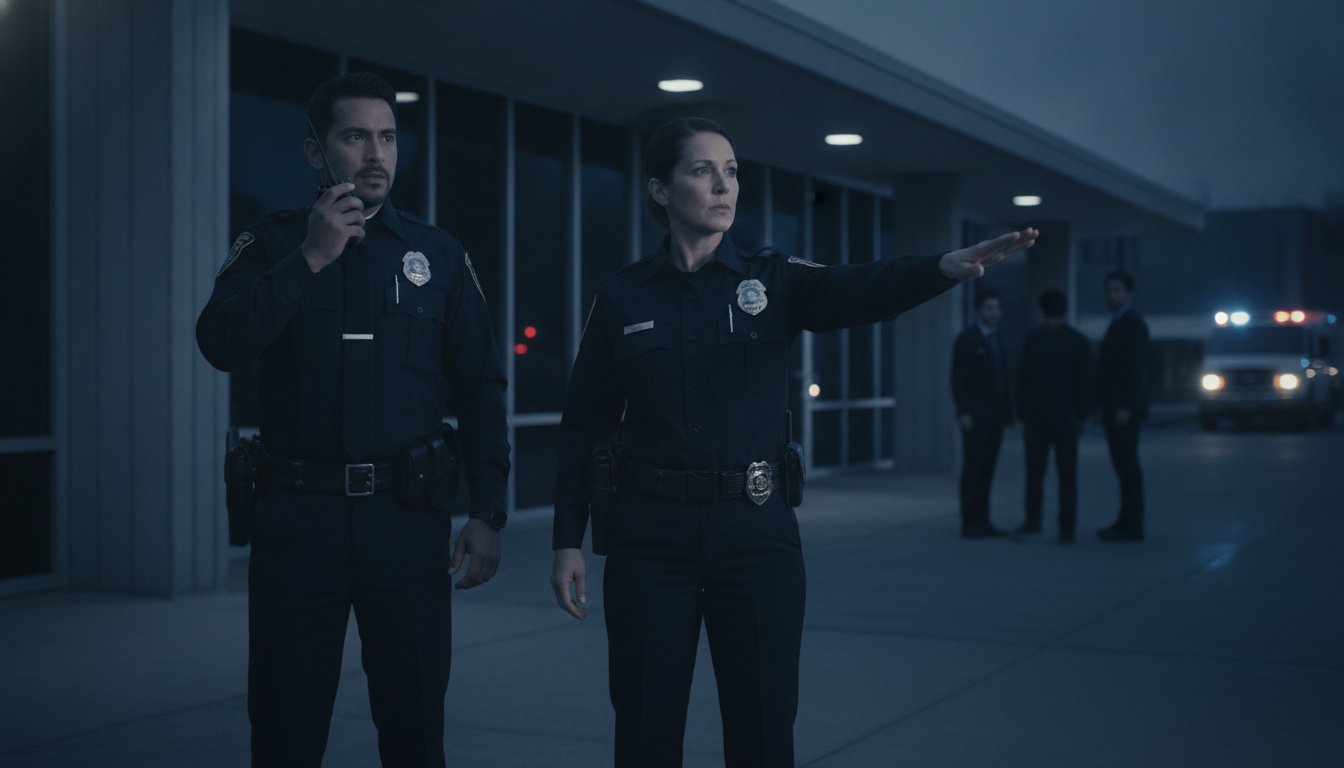
In a private commercial setting, the designation of situational first responder describes the personnel already positioned behind the perimeter when a crisis begins. While public emergency services are the ultimate authority, they’re often minutes away. The role of security guards in emergency response centers on their ability to pivot instantly from proactive patrolling to high-stakes reactive management. This transition requires a mindset of disciplined oversight where the guard transforms from a deterrent into an active stabilizer. Chaos is a vacuum; professional guards fill that vacuum with established protocols and a visible, uniform presence.

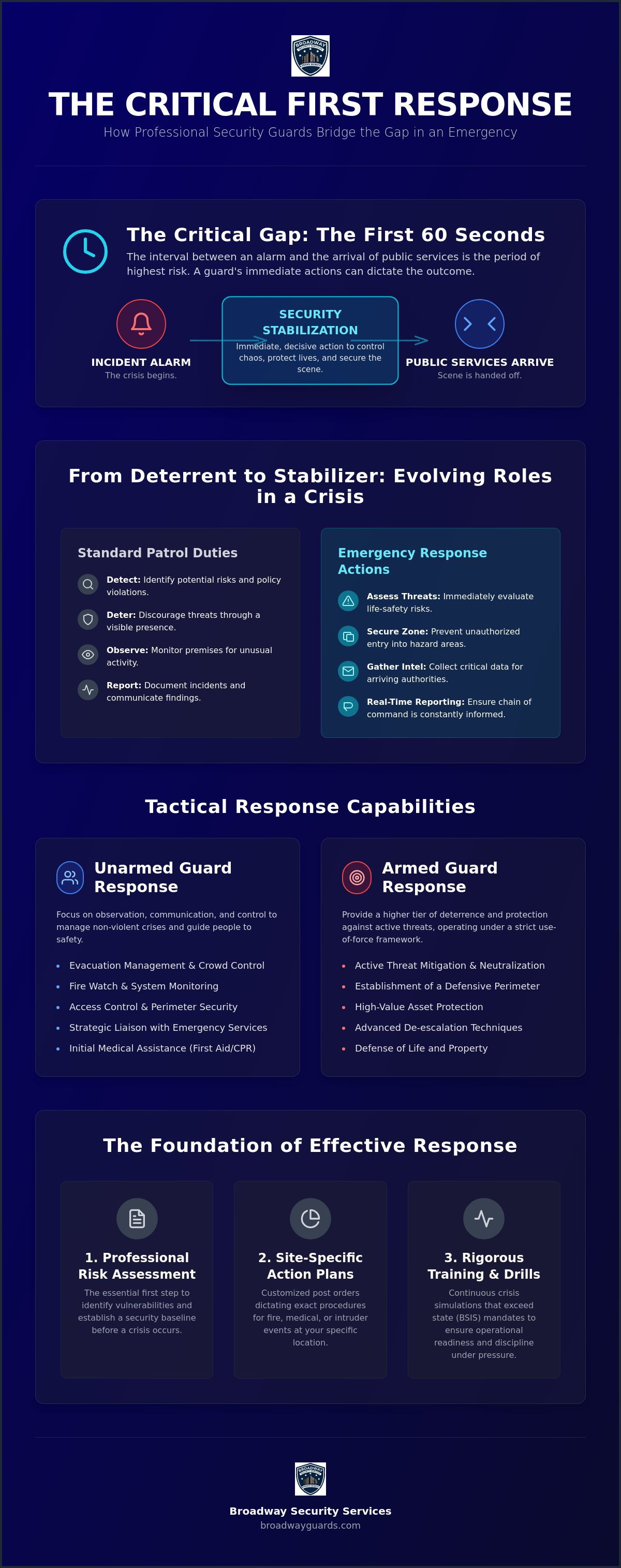
The core responsibilities of a professional Security guard are traditionally defined as detect, deter, observe, and report. During an emergency, these duties are refined for maximum speed and accountability. Detection becomes an immediate assessment of life-safety threats. Deterrence shifts to preventing unauthorized entry into a hazard zone. Observation involves gathering high-value intelligence for arriving authorities. Reporting happens in real time, ensuring that the chain of command remains informed. Data indicates that the first 60 seconds of an incident often determine the total liability and physical damage. A disciplined guard uses those seconds to execute pre-set orders rather than reacting with hesitation.

The Immediate Response Bridge

Professional security personnel function as the bridge between the initial alarm trigger and the arrival of public emergency services. This interval is the period of highest risk for asset loss and human injury. By maintaining a stoic, disciplined presence, guards prevent the escalation of panic that often leads to secondary injuries. The stabilization phase consists of the immediate, tactical actions taken to neutralize secondary threats and secure the perimeter before external agencies assume command. This bridge ensures that when the LAPD or LAFD arrives, they find a controlled environment rather than a chaotic scene.

Regulatory Standards and Training

California law requires specific training standards through the Bureau of Security and Investigative Services (BSIS). These mandates ensure that every guard understands the legal limits of their authority and the basics of emergency preparedness. Broadway Security exceeds these baseline requirements by implementing rigorous crisis simulations and site-specific training. This preparation begins long before an incident occurs, often starting with a detailed security risk assessment CA to identify vulnerabilities. We rely on site-specific post orders that dictate exact movements during fire, medical, or intruder events. This methodical approach ensures that the role of security guards in emergency response is grounded in legal compliance and operational rigor.

Tactical Response: Armed vs. Unarmed Roles in a Crisis

The tactical role of security guards in emergency response depends entirely on the nature of the crisis. A fire requires immediate evacuation and system management, while an active intruder demands containment and threat mitigation. Professional security agencies deploy personnel based on these specific risk profiles, ensuring that the response matches the high-stakes reality of the situation. This tiered approach allows for a disciplined shield that adapts to various environmental or human-driven disasters with military-like precision. It’s not just about presence; it’s about the specific training required to handle life-safety protocols under extreme pressure.

Armed Guard Capabilities

Armed personnel are deployed when the threat level involves potential violence or high-value asset targets. Their specific mandate focuses on active threat mitigation and the establishment of a defensive perimeter. According to Department of Justice research on private security, the integration of private forces into broader safety strategies has become a critical component of modern crime control. In Los Angeles, specialized armed security guard services Los Angeles provide a higher tier of deterrence through tactical positioning and rigorous de-escalation training. These guards operate within a strict legal framework for the use of force, prioritizing the defense of life and property while maintaining a stoic, vigilant presence. Their presence alone serves as a psychological barrier to criminal intent, often preventing an incident from escalating into a full-scale emergency.

Unarmed Guard Efficiency

While armed guards handle high-risk mitigation, unarmed security guards are the masters of communication and logistical control. In many emergency scenarios, such as medical incidents or fire alarms, the primary need is for rapid coordination and system oversight. Unarmed guards are trained in medical first aid, CPR, and the deployment of Automated External Defibrillators (AEDs), acting as the first point of care before paramedics arrive. They also manage critical building systems, including:

  • Monitoring and resetting fire alarm panels to provide accurate data to the LAFD.
  • Controlling elevator recall and service modes to ensure safe passage for first responders.
  • Securing access control points to facilitate the entry of public emergency services while keeping unauthorized persons out.

Their role of security guards in emergency response is indispensable in low-to-medium risk environments where orderly evacuation and clear communication are the priorities. They act as the eyes and ears of the facility, ensuring that every detail is recorded and communicated with professional clarity. For businesses in the San Fernando Valley, ensuring your site is protected by a professional force means understanding which tactical role best suits your specific operational needs.

Crowd Control and Evacuation: Transitioning Chaos to Order

Human psychology in a crisis is predictably volatile. When an alarm sounds or a threat is identified, the natural response often oscillates between paralysis and frantic, uncoordinated movement. The role of security guards in emergency response is to replace this panic with a rigid structure of movement. A disciplined voice doesn’t just provide information; it provides a psychological anchor for occupants who are looking for leadership. By establishing a clear chain of command, professional guards prevent the secondary injuries that occur when crowds converge on single exit points or disregard safety protocols.

Effective evacuation management requires more than just pointing toward an exit. It involves the strategic oversight of assembly points and the management of “Shelter-in-Place” orders. In scenarios involving external hazardous leaks or nearby active threats, the safest course of action is often to seal the perimeter rather than evacuate. Guards must be prepared to secure all entry points instantly and move occupants to internal safe zones. This responsibility extends to the protection of vulnerable populations, including non-ambulatory individuals or those with sensory sensitivities, ensuring that no person is left behind during the transition to safety.

The Evacuation Protocol

A methodical evacuation follows a three-step tactical framework to ensure total site clearance and accountability:

  • Immediate Notification: Guards use authoritative direction to override the noise of the emergency, moving groups toward pre-verified primary and secondary routes.
  • Zone Sweeping: Personnel conduct a physical sweep of designated areas, including restrooms and storage facilities, to confirm that all personnel have vacated the danger zone.
  • Perimeter Security: Once at the assembly point, guards maintain order and prevent frantic individuals from attempting to re-enter the building before it’s cleared by authorities.

Fire Watch and Early Detection

The role of security guards in emergency response is particularly critical when a building’s automated safety systems fail. In these instances, specialized fire watch services California become a legal and operational necessity. These guards provide the human oversight required to monitor hot spots and ensure that fire lanes remain unobstructed for the LAFD. They maintain rigorous fire watch logs that serve as both a safety record and a regulatory compliance document. This vigilant oversight ensures that even if a sprinkler system or smoke detector is offline, your assets remain under the care of a proactive, unyielding force that is ready to act at the first sign of combustion.

The Critical Role of Security Guards in Emergency Response: A Strategic Guide

The Strategic Liaison: Coordinating with Public Authorities

When public emergency services arrive on the scene, the role of security guards in emergency response evolves from active stabilization to strategic coordination. The LAPD and LAFD depend on immediate, actionable intelligence to execute their missions safely. Professional guards serve as the eyes and ears on the ground, providing details that sensors and cameras might miss. This includes real-time suspect descriptions, last known locations of individuals, and the identification of hidden hazards like chemical storage or structural weaknesses. By serving as a disciplined point of contact, security personnel ensure that responding officers don’t enter a situation blind.

Efficiency during this handoff prevents delays that could result in further asset loss or injury. Our personnel facilitate rapid site access by providing master keys and bypass protocols, ensuring that first responders don’t lose precious seconds forced to breach locked perimeters. After the incident concludes, the guard’s duty continues through the creation of a comprehensive post-incident report. This document establishes the legal and operational record of the event, which is essential for insurance claims and liability defense. A precise record demonstrates that all protocols were followed with the utmost gravity.

Information Handover Procedures

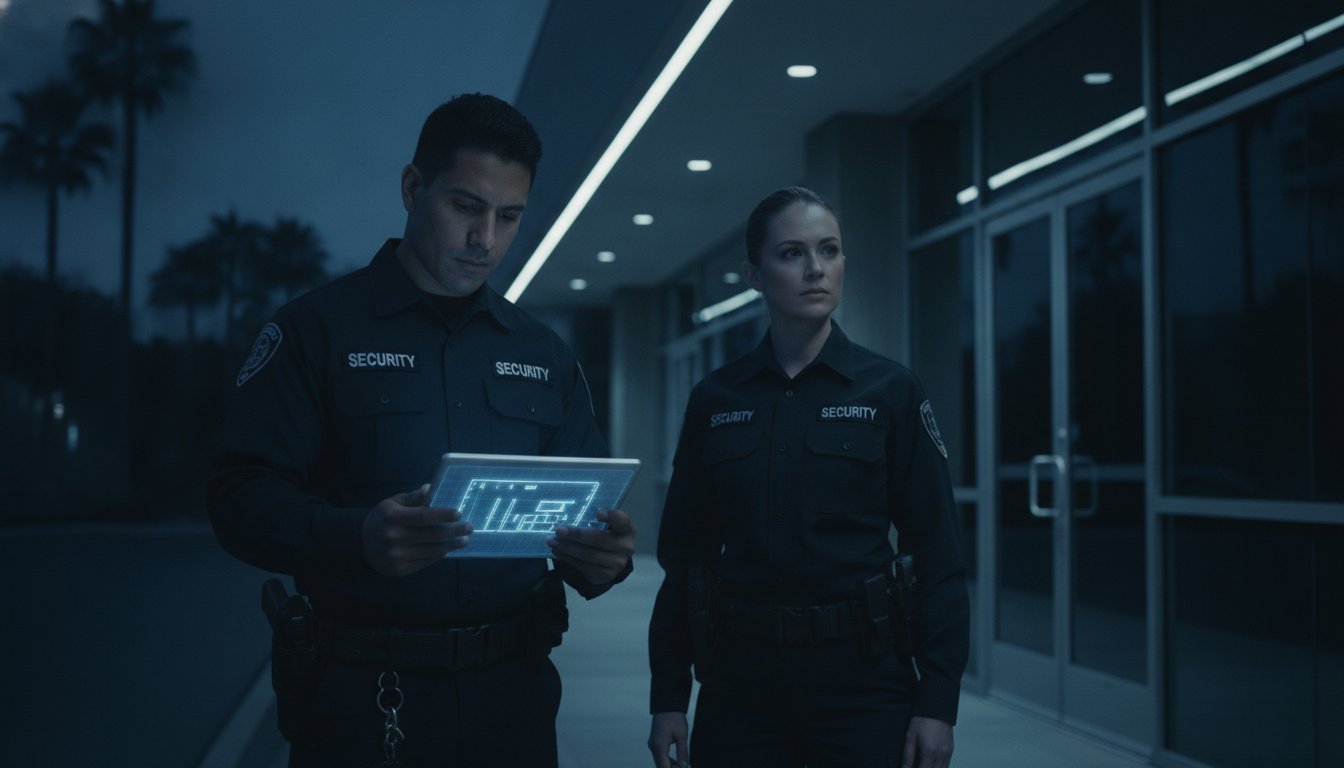
A disciplined handover requires concise, accurate radio and verbal briefings. Broadway Security personnel are trained to provide floor plans and digital access to responding officers immediately upon their arrival. We utilize the S.A.L.U.T.E. report format to ensure that intelligence is structured and free of ambiguity. This reporting standard captures the Size, Activity, Location, Unit, Time, and Equipment involved in the incident, giving authorities a complete tactical picture in seconds. To ensure your facility is prepared for this level of coordination, consider the professional oversight provided by Broadway Security Services.

Traffic and Perimeter Management

Congested areas in the San Fernando Valley can significantly delay emergency vehicle access. Security guards take immediate control of traffic flow, clearing paths for LAFD engines and LAPD cruisers to ensure they reach the heart of the crisis without obstruction. Beyond traffic, maintaining a secure perimeter is vital for the safety of the public and the efficiency of the response. Guards manage media presence and curious bystanders at the scene boundary, allowing first responders to work unimpeded by external interference. This level of methodical oversight ensures that the transition from private security to public authority is seamless and secure.

Crisis Management: Strategic Preparation with Broadway Security

The role of security guards in emergency response is fundamentally defined by the work performed months before a crisis occurs. Reactive measures alone are insufficient for modern high-stakes environments. True safety is built on a foundation of rigorous foresight and methodical planning. This process begins with a comprehensive security risk assessment CA to identify every potential failure point. By mapping vulnerabilities ahead of time, we ensure that our guards aren’t guessing when an incident triggers; they’re executing a pre-validated tactical plan.

Developing site-specific Emergency Action Plans (EAPs) is a core component of our disciplined shield approach. These plans provide a clear, unyielding framework for every foreseeable scenario, from natural disasters to active human threats. This level of strategic preparation directly impacts your bottom line by reducing insurance premiums and limiting legal liability. Underwriters recognize that professional oversight and documented protocols significantly lower the risk profile of a commercial facility. When you prioritize professional discipline, you’re investing in long-term asset protection and institutional peace of mind.

Identifying Vulnerabilities in Canoga Park

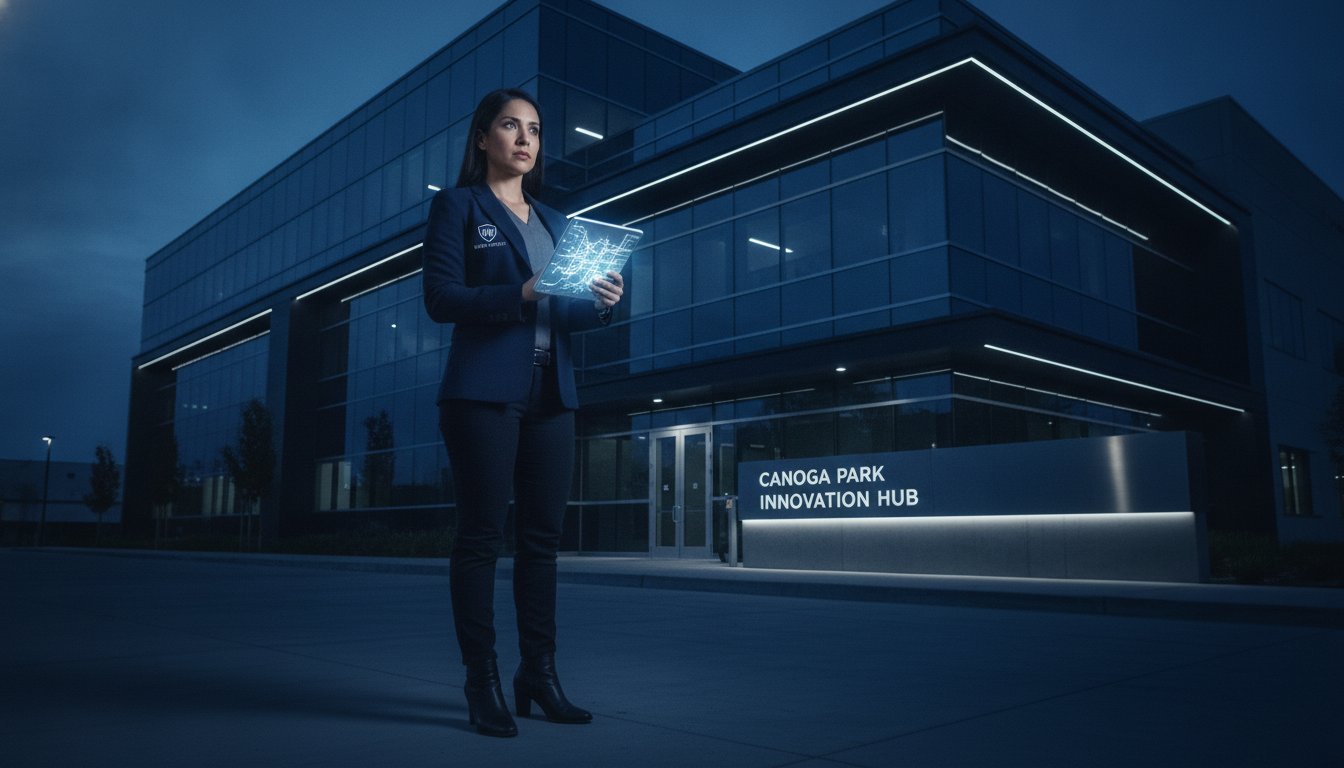
Operating in the San Fernando Valley requires an understanding of specific regional risks. These range from seismic activity and wildfires to the urban security challenges inherent in a major metropolitan area. For high-value projects, our construction site security guards are trained to manage these specific environmental and logistical threats. We integrate mobile patrol services to provide large-scale facility oversight, ensuring that even sprawling perimeters remain under vigilant care. This localized expertise allows us to tailor response protocols that address the unique hazards of your specific location.

The Broadway Security Advantage

Broadway Security represents a commitment to military-like precision and unyielding vigilance. Our personnel don’t just stand watch; they serve as a proactive force dedicated to the preservation of life and property. We maintain the Broadway standard through continuous oversight and disciplined training updates that exceed state mandates. This ensures that every guard remains sharp and every protocol remains current. We invite you to elevate your safety standards through professional consultation and long-term crisis management strategies. Secure your facility with a professional risk assessment from Broadway Security.

Securing Your Future Through Strategic Readiness

Operational safety is never a matter of chance; it’s the direct result of methodical oversight and rigorous training. You’ve seen how the transition from proactive patrolling to tactical crisis management requires a disciplined shield that can withstand the pressure of an evolving threat. Whether managing a complex evacuation or serving as a strategic liaison for public authorities, the professional role of security guards in emergency response provides the stability your organization needs to protect life and property. Chaos is neutralized when protocols are executed with military-like precision.

As a Licensed California Security Provider with deep expertise in high-stakes crisis management, Broadway Security delivers disciplined personnel trained for immediate response. We prioritize legal compliance and operational rigor to ensure your assets remain under the care of an unyielding force. Don’t wait for a crisis to expose vulnerabilities in your perimeter. Request a Strategic Security Consultation for Your Property today and ensure your facility is prepared for any scenario. Your safety is our unwavering commitment.

Frequently Asked Questions

Are security guards legally considered first responders in California?

Security guards are not legally classified as public first responders in the state of California. They function as situational responders who provide immediate stabilization on private property until public authorities arrive. This distinction is critical for understanding the legal scope of their authority and the specific role of security guards in emergency response within a commercial or residential context.

Can security guards perform CPR or use an AED during a medical emergency?

What is the difference between armed and unarmed guards during a fire emergency?

During a fire emergency, both armed and unarmed guards prioritize evacuation and communication, though their tactical focus may differ. Unarmed guards often manage fire panels and guide occupants to safety. Armed guards maintain a defensive perimeter to prevent unauthorized entry and protect assets during the chaos. Both roles emphasize the methodical oversight required to ensure a total site clearance.

How do security guards assist the police during an active shooter situation?

Security guards assist law enforcement by providing real-time intelligence and facilitating immediate site access. They communicate suspect descriptions, last known locations, and the status of wounded individuals through structured reporting formats. By securing perimeters and managing access control, they allow responding officers to focus entirely on neutralizing the threat without logistical delays.

Does having a security guard reduce my business liability during an emergency?

Implementing professional security services can significantly reduce your business liability by ensuring that emergency protocols are followed with precision. Documentation provided by guards serves as a legal record that the property owner took reasonable steps to protect occupants and assets. This adherence to rigorous operational standards demonstrates a commitment to safety that is essential for insurance and legal defense.

What training do Broadway Security guards receive for crisis management?

Broadway Security guards undergo comprehensive training that exceeds the baseline California BSIS requirements for emergency preparedness. Our personnel engage in site-specific crisis simulations that cover fire response, medical emergencies, and intruder mitigation. This continuous oversight ensures that every guard is prepared to act as a disciplined shield, maintaining order regardless of the situation’s complexity.

How quickly can Broadway Security deploy emergency fire watch services?

Broadway Security maintains a structured deployment protocol to address urgent fire watch requirements in the San Fernando Valley. We recommend that clients contact our office to discuss specific site needs and deployment timelines. Our team is prepared to mobilize disciplined guards to monitor hot spots and maintain fire logs whenever building safety systems are compromised.

What information should a security guard provide to the fire department upon arrival?

Guards must provide the fire department with immediate data regarding the location of the alarm trigger and the status of the fire panel. They also deliver floor plans, identify hazardous materials on-site, and confirm whether all occupants have been accounted for at assembly points. This role of security guards in emergency response ensures that the LAFD has the tactical intelligence needed to begin operations immediately.

Security Risk Assessment CA: A Strategic Framework for Facility Protection in 2026

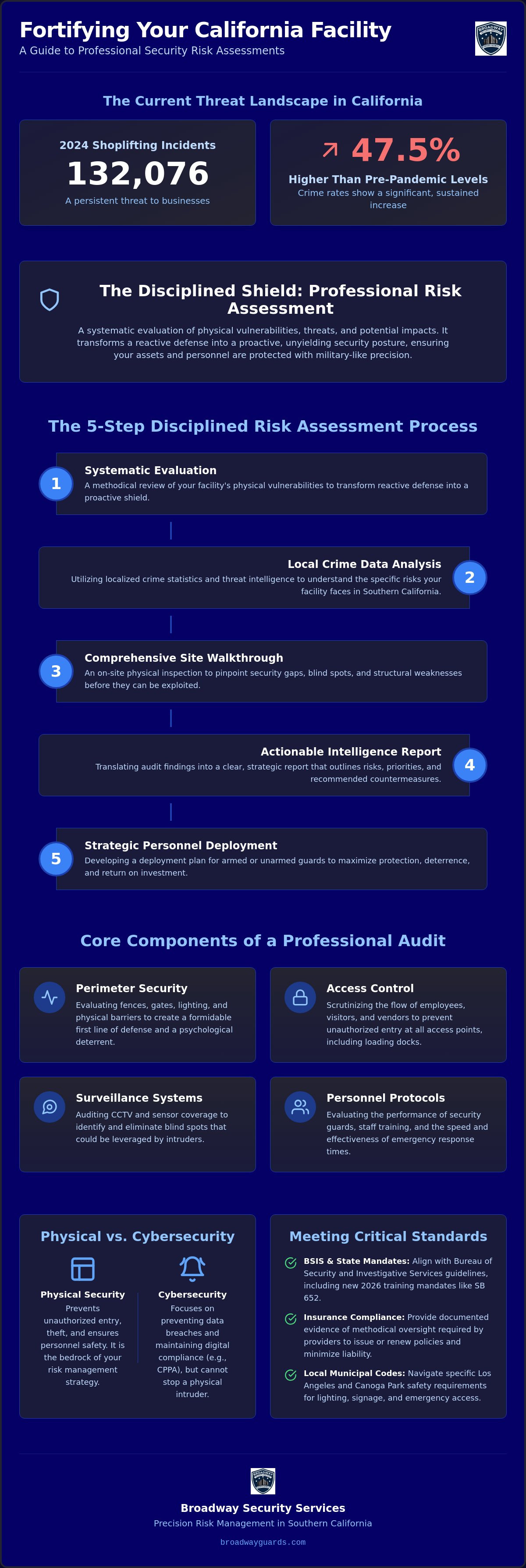
California reported 132,076 shoplifting incidents in 2024, a figure that remains 47.5% higher than pre-pandemic levels. For facility managers and owners in Southern California, these statistics represent a persistent threat to operational order and personnel safety. You likely recognize that rising property crime and the complexity of new 2026 regulations, such as the SB 652 training mandates, have fundamentally changed the requirements for effective protection. Engaging a professional business security consultation California is the primary step in establishing a disciplined shield that prioritizes asset safety and professional oversight.

We understand the pressure of maintaining insurance compliance while mitigating the risk of workplace violence liability. This guide will provide the essential framework for conducting a California-compliant physical security risk assessment to safeguard your assets against modern threats. You will receive a clear roadmap for facility hardening that ensures legal adherence and provides the peace of mind that comes from a rigorous, methodical approach to defense. We will examine the convergence of physical oversight and regulatory standards to ensure your facility remains secure in an evolving landscape.

Key Takeaways

  • Learn how a systematic evaluation of physical vulnerabilities transforms reactive defense into a proactive, disciplined shield for your facility.
  • Identify the critical advantages of a professional business security consultation California to ensure full compliance with 2026 BSIS standards and insurance requirements.
  • Master a methodical 5-step process that utilizes local crime data and site walkthroughs to pinpoint security gaps before they are exploited.
  • Discover how to translate audit findings into a strategic deployment plan for armed or unarmed guards to maximize protection and return on investment.
  • Understand why high-risk site evaluations require localized expertise and military-grade precision to effectively mitigate modern Southern California threats.

What is a Security Risk Assessment in California?

A professional What is a Security Risk Assessment involves a systematic evaluation of physical vulnerabilities, threats, and potential impacts on a specific facility. It’s not a mere checklist of locks and cameras. It’s a strategic framework designed to transform a vulnerable site into a disciplined shield. For any San Fernando Valley business, this audit serves as the foundation of an unyielding security posture. A comprehensive business security consultation California ensures that every entry point, blind spot, and operational protocol is scrutinized with military-like precision.

Physical vs. Cybersecurity Assessments

There’s a distinct difference between digital and physical defense. Cybersecurity focuses on preventing data breaches and maintaining CPPA compliance. While these are vital, they don’t stop a physical intruder. Physical assessments prioritize unauthorized entry, theft, and the safety of your personnel. We believe physical hardening is the first line of defense in 2026. If your perimeter is breached, your digital assets and staff are immediately compromised. A disciplined approach treats physical security as the bedrock of your entire risk management strategy.

Regulatory Standards and BSIS Guidelines

The Bureau of Security and Investigative Services (BSIS) sets the standard for security reporting and guard conduct in California. Professional assessments must align with these expectations to remain valid for insurance and legal purposes. Beyond state mandates, businesses in Los Angeles and Canoga Park must navigate local municipal safety requirements that govern lighting, signage, and emergency access. Insurance providers frequently require these professional site evaluations before issuing or renewing policies. They seek evidence of methodical oversight. A documented assessment demonstrates that you’ve taken every reasonable step to protect your premises and minimize liability.

Core Components of a Professional Physical Security Audit

A professional physical security audit is a methodical operation that identifies and neutralizes weaknesses before they’re exploited. This process moves beyond surface-level observations to provide a granular analysis of a facility’s defenses. Utilizing a 5-Step Disciplined Risk Assessment Process allows property managers to establish a baseline of security that meets both legal and operational standards. A thorough business security consultation California prioritizes the integrity of the physical environment through four core pillars: perimeter security, access control, surveillance, and personnel protocols.

Perimeter security involves evaluating fences, gates, and lighting to ensure a formidable first line of defense. Access control focuses on monitoring the precise flow of employees, visitors, and vendors to prevent unauthorized entry. Surveillance systems must be audited to identify blind spots in CCTV and sensor coverage that could be leveraged by intruders. Finally, personnel protocols evaluate the performance of guards and the speed of emergency response times. This structured approach ensures that every defensive layer is functioning at peak efficiency.

Structural and Perimeter Vulnerabilities

Operational and Human Factors

Security is as much about people as it is about hardware. We evaluate internal theft risks and refine loss prevention strategies to protect your bottom line from within. Reviewing crisis management plans for workplace violence or civil unrest is a mandatory component of modern liability reduction. The presence of unarmed security guards serves as a vital tool for visible deterrence and professional reporting. These officers act as the eyes and ears of the facility, providing a reassuring presence for staff while upholding strict operational standards. For those seeking to fortify their operations, a professional site vulnerability audit provides the actionable intelligence needed to deploy resources effectively.

The 5-Step Disciplined Risk Assessment Process

Effective security is never accidental. It is the result of a methodical operation that follows a rigorous, five-step cycle. This structured approach transforms raw data into a disciplined shield, ensuring that resources are allocated where they are most needed. Engaging a professional business security consultation California ensures that this cycle is executed with precision, moving from initial intelligence gathering to active deployment and oversight. By following this framework, facility managers can replace uncertainty with a documented, unyielding defensive posture.

  • Threat Identification: We begin by analyzing local crime data and industry-specific risks. This involves identifying potential adversaries and their likely methods of operation.
  • Vulnerability Analysis: Our team conducts a comprehensive physical walkthrough of the facility. We look for gaps in the perimeter, access control failures, and blind spots in surveillance.
  • Risk Calculation: This step determines the likelihood and potential impact of a breach. We prioritize risks based on the criticality of the assets involved.
  • Mitigation Strategy: We develop a tailored plan to address identified gaps. This includes hardware upgrades, protocol changes, and personnel deployment.
  • Implementation and Review: After deploying resources, we schedule annual re-evaluations. Security is a continuous process that must adapt to new threats.

Threat Modeling for San Fernando Valley Businesses

Precision threat modeling requires localized intelligence. We use police data to map regional crime trends specifically in Canoga Park and the surrounding San Fernando Valley. In the first two months of 2026, the California Highway Patrol’s Organized Retail Crime Task Force recovered over 33,000 stolen items valued at more than $3.3 million. We use these figures to identify “soft targets” within a commercial footprint. By developing a threat matrix based on asset criticality, we ensure that high-value areas receive the highest level of vigilance.

Vulnerability Walkthrough Best Practices

A walkthrough must be exhaustive to be effective. We believe nighttime audits are essential for evaluating patrol routes and lighting effectiveness. Shadows and low-light conditions often reveal vulnerabilities that are invisible during daylight hours. Our team tests all access control hardware for latency or mechanical failure to ensure entry points remain secure. Additionally, we integrate fire watch services California into the safety audit. This ensures that your facility remains compliant with both security and fire safety regulations, providing a comprehensive layer of protection. A professional business security consultation California leaves no variable to chance.

Security Risk Assessment CA: A Strategic Framework for Facility Protection in 2026

Mitigating Risk Through Strategic Personnel Deployment

A professional business security consultation California is only as effective as the personnel deployed to execute the audit findings. We translate raw vulnerability data into a tactical staffing plan designed for maximum return on investment. This isn’t about filling posts with bodies; it’s about establishing a disciplined shield where each officer understands the specific threats identified during the initial assessment. Every deployment is a direct response to a calculated risk, ensuring that your assets are under the care of a vigilant and unyielding force.

Mobile patrols are essential for large-scale perimeters and expansive construction sites where static guards cannot maintain total visibility. These patrols provide a dynamic, unpredictable presence that disrupts an intruder’s planning and reconnaissance. By utilizing GPS-tracked vehicles and rigorous reporting protocols, we maintain a consistent cadence of methodical oversight. This approach ensures that expansive properties receive the same level of military-grade precision as a single-point facility. A mobile presence extends the reach of your security infrastructure, covering blind spots that technology alone might miss.

Armed vs. Unarmed: Making the Strategic Choice

Determining the necessity of armed vs. unarmed presence is a strategic choice based on threat level and asset criticality. High-value environments often require armed security guard services Los Angeles to provide a decisive deterrent against violent crime or organized theft. However, de-escalation is often the superior tool in retail or hospital settings. Professional unarmed personnel are trained to manage conflict through presence and communication, reducing the likelihood of a physical altercation. We account for all legal and liability considerations to ensure your choice of personnel aligns with your risk tolerance and operational requirements.

Protecting Specialized Assets

Specialized environments demand custom-tailored protocols to ensure absolute protection. For instance, construction site security guards follow strict off-hours procedures to prevent the theft of high-value machinery and materials. Risk mitigation for high-profile events or executive protection requires a higher degree of hierarchy and structure to manage crowds and secure ingress points. Implementing site-specific protocols directly reduces organizational liability by establishing a documented standard of professional oversight. For a comprehensive business security consultation California and precision-matched guard deployment, contact Broadway Security to secure your facility.

Broadway Security Services: Precision Risk Management in Canoga Park

Broadway Security Services operates with an unwavering commitment to order and structure. Our methodology combines military-grade discipline with localized California expertise to provide a definitive defensive framework for your assets. Based in Canoga Park, our team leverages deep regional knowledge to address the specific criminal patterns affecting the San Fernando Valley. A professional business security consultation California through Broadway Security Services ensures your facility is not just guarded, but strategically hardened against the sophisticated threats of 2026. We position ourselves as a disciplined shield, ensuring that your operations remain uninterrupted by external chaos.

Our presence in Canoga Park allows for rapid response and methodical oversight across local commercial corridors. This proximity is vital for maintaining the high standards of field performance and reporting our clients expect. By conducting a professional consultation, we help businesses reduce long-term security overhead by identifying precisely where resources should be concentrated. We ensure every assessment and guard deployment remains fully compliant with the latest 2026 California safety regulations. Our goal is to provide high-stakes reliability that translates into total peace of mind for property owners.

A Disciplined Approach to Vulnerability

Our project-based risk assessment fees provide transparent, one-time value that establishes a roadmap for long-term safety. We don’t believe in generic solutions; we believe in a disciplined approach to vulnerability that prioritizes presence and prevention through rigorous training. Every officer at Broadway Security Services is prepared to act as a vigilant and unyielding force on your property. We’ve successfully hardened numerous facilities across the San Fernando Valley, transforming high-risk sites into secure environments through methodical auditing and precise personnel placement. Our reporting protocols provide the documentation required to satisfy insurance mandates and regulatory oversight, grounding our professional claims in legal reality.

Securing Your Facility Today

Securing your assets begins with a comprehensive site evaluation conducted by our disciplined experts. We analyze your perimeter, internal protocols, and historical crime data to build your strategic shield. Waiting for an incident to occur is the most costly security mistake a business can make in the current environment. Proactive defense is the only way to mitigate the rising costs of liability and property crime. Every day without a professional business security consultation California is a day your facility remains exposed to avoidable risk. To begin the process of fortifying your premises and establishing a foundation of trust, Contact Broadway Security Services for a professional risk assessment in CA.

Establishing a Disciplined Shield for Your Operations

Securing a facility in 2026 requires more than reactive measures; it demands a systematic framework that addresses the intersection of criminal intent and site accessibility. By mastering the 5-step risk assessment process, you ensure that your defense is rooted in data rather than guesswork. A professional business security consultation California provides the actionable intelligence needed to transform identified vulnerabilities into fortified assets. This methodical approach is the only way to achieve true peace of mind while meeting the rigorous insurance and legal standards of the current landscape.

Broadway Security Services stands ready to act as your unyielding protector. Our BSIS-compliant methodology and deep expertise in high-risk California sectors ensure that your facility receives military-grade oversight. Based in Canoga Park, we provide the localized knowledge and rapid response required to maintain order across the San Fernando Valley. Don’t wait for a breach to expose the gaps in your perimeter. Take the decisive step toward professional hardening and long-term liability reduction. Schedule Your Strategic Security Risk Assessment Today and ensure your assets remain under the care of a vigilant force.

Frequently Asked Questions

What is included in a professional security risk assessment in California?

A professional assessment includes an exhaustive physical walkthrough, a vulnerability analysis of perimeters and access control, and a threat model based on regional crime data. We provide a BSIS-compliant report that outlines specific gaps and recommended mitigation strategies. This documented oversight serves as a strategic blueprint for facility hardening. It ensures every defensive layer is scrutinized with military-grade precision to prevent unauthorized ingress and maintain operational order.

How often should a California business conduct a physical security audit?

Most businesses should conduct a physical security audit annually to maintain a disciplined defensive posture. However, high-risk sectors like healthcare or high-value retail often require semi-annual evaluations due to shifting criminal tactics. You should also schedule a new business security consultation California whenever your facility undergoes structural changes or significant staff turnover. Regular audits ensure your safety protocols remain unyielding against evolving threats in the San Fernando Valley.

Do I need a security risk assessment for insurance compliance?

Yes, many insurance carriers require a documented physical security risk assessment to validate general liability coverage and specialized policies. Professional site evaluations demonstrate that a facility manager has taken every reasonable step to mitigate workplace violence and property crime. Providing a formal report to your provider often helps verify compliance with policy mandates. This documentation acts as a functional signature of your commitment to operational safety and risk reduction.

What is the difference between a security audit and a risk assessment?

A security audit evaluates your current performance against existing protocols, while a risk assessment identifies future threats and physical vulnerabilities. The audit confirms if your guards are following orders and if hardware is functioning. The risk assessment looks for ways an adversary might exploit your perimeter in the future. Both processes are essential components of a methodical oversight strategy that prioritizes asset protection and military-like precision in defense.

Can a risk assessment help reduce my security staffing costs?

A professional business security consultation California often reduces long-term staffing costs by optimizing guard deployment. Instead of blanket coverage, we identify high-risk zones and peak threat hours that require specialized attention. This strategic approach allows you to shift from a broad, inefficient presence to a targeted, disciplined shield. By focusing resources on actual vulnerabilities, you maximize the return on your security investment while maintaining a high standard of safety.

Are there specific security requirements for Canoga Park businesses?

Businesses in Canoga Park must adhere to Los Angeles municipal safety requirements regarding emergency access, lighting, and signage. Local ordinances often dictate the specific standards for perimeter fencing and public-facing surveillance systems. Our team utilizes regional knowledge of San Fernando Valley crime trends to ensure your facility meets both state BSIS standards and local city codes. This localized expertise prevents regulatory failures and strengthens your site’s defense against regional threats.

How long does a typical physical security assessment take to complete?

The duration of a typical physical security assessment depends on the complexity and square footage of the facility. A standard commercial walkthrough usually takes one to three days to complete with methodical precision. Following the site visit, our experts require one to two weeks to analyze findings and produce a comprehensive analytical report. This structured timeline ensures that every vulnerability is documented and addressed within your final strategic plan for facility protection.

Strategic Access Control Security Guard Services in Canoga Park

You’ll learn how rigorous protocols and professional oversight protect your assets from operational disruption. We’ll explore the impact of verified visitor logs and the necessity of immediate response to unauthorized access attempts. Our analysis covers the intersection of operational rigor and site safety. We ground our standards in California regulatory requirements, including the mandatory 40 hours of BSIS training and recent mandates like Senate Bill 652. This ensures your perimeter remains an unyielding shield against liability and loss. Discover how a structured security presence transforms a standard entry point into a reliable barrier against unauthorized entry.

Key Takeaways

  • Recognize why passive systems like fences and locks fail without the active oversight of a disciplined security presence.
  • Master the protocols for rigorous visitor verification and credential screening to maintain absolute control over your facility’s interior.
  • Evaluate the decision-making capabilities of an access control security guard Canoga Park compared to easily bypassed automated systems.
  • Gain insights into implementing a professional security risk assessment to identify vulnerabilities and establish strict authorization standards.
  • Understand how high-level training and military-grade discipline ensure consistent protection at critical high-traffic access points.

The Critical Role of Access Control in Canoga Park Facility Security

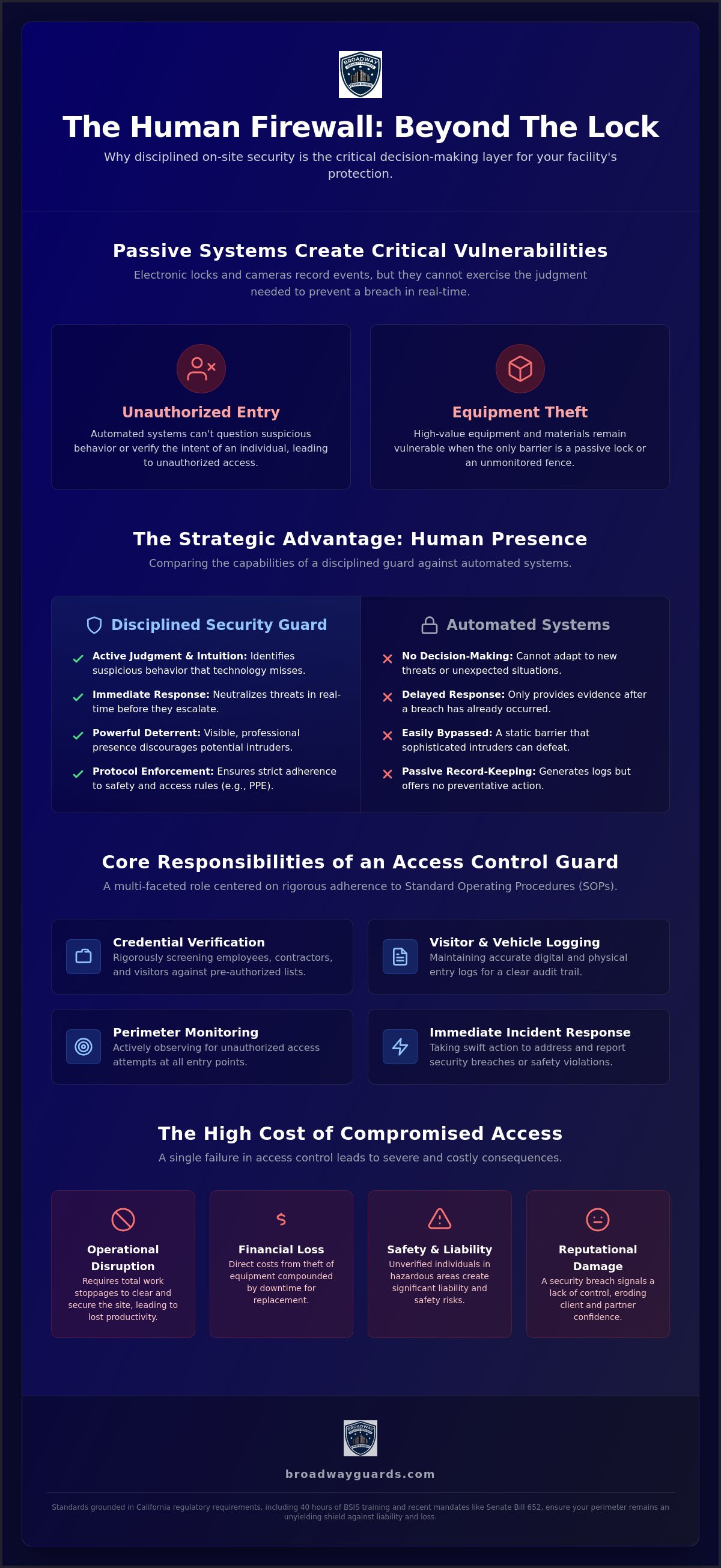
Access control is the primary mechanism for maintaining order within a commercial or industrial facility. It’s far more than a locked door or a perimeter fence; it’s a strategic system of verification designed to protect high-value assets. Passive security measures like digital keypads or high-tensile fencing offer only a static barrier. These systems don’t adapt to evolving threats and they certainly don’t question the intent of an intruder. An access control security guard Canoga Park provides the active oversight necessary to identify and neutralize threats before they cross the threshold. This human element transforms a simple gate into a disciplined checkpoint where judgment and protocol intersect.

The psychological impact of a visible, professional security presence is profound. Criminals and unauthorized visitors typically seek the path of least resistance. When they encounter a guard stationed with military-like precision, the perceived risk of detection increases exponentially. This visibility acts as a powerful deterrent, signaling that the site is under the care of a vigilant force. Effective access control ensures that the perimeter remains an unyielding shield rather than a mere suggestion of a boundary.

Canoga Park’s Unique Security Landscape

The geography of Canoga Park presents specific operational challenges. The zones surrounding Topanga Canyon Blvd feature a dense mix of light industrial facilities, aerospace manufacturing, and retail centers. These industrial corridors in the San Fernando Valley are frequent targets for unauthorized entry due to the specialized equipment and materials stored on-site. Maintaining a professional image at these entry points is vital. A security presence must be authoritative to deter intruders while remaining professional to reflect the corporate standards of the client. Local property crime trends necessitate a higher standard of perimeter integrity than a simple lock can provide.

The Consequences of Compromised Access Points

Failure to secure a perimeter leads to immediate and costly operational disruption. If an unauthorized individual enters a restricted zone, it often requires a total work stoppage to clear the site and verify that no assets were tampered with. This results in lost productivity and compromised safety protocols. Furthermore, unverified visitors represent a significant liability risk, particularly in hazardous industrial or construction environments. The financial impact of equipment theft is often compounded by the downtime required to replace specialized machinery. An effective access control security guard Canoga Park mitigates these risks through unyielding adherence to entry protocols and real-time response to breaches.

Core Responsibilities of an Access Control Security Guard

The tactical execution of gatekeeping requires more than a simple presence. It demands a rigorous adherence to established Standard Operating Procedures (SOPs) that leave no room for error. An access control security guard Canoga Park functions as the primary filter for your facility, ensuring that every individual crossing the threshold has a legitimate, verified reason for entry. This role involves a complex set of duties ranging from digital credential screening to the physical inspection of delivery vehicles. High-stakes reliability is the standard, as even a single lapse in protocol can expose a facility to significant liability or loss.

Adhering to Access control best practices ensures that your site remains an unyielding shield against intrusion. Guards are responsible for maintaining accurate, real-time digital and physical entry logs that provide a clear audit trail for management. Beyond simple entry, they enforce facility-specific safety regulations, including PPE compliance for contractors entering hazardous zones. This comprehensive oversight ensures that your operational standards are maintained from the very first point of contact.

Credential Verification and Visitor Management

The protocol for screening employees, contractors, and guests is the foundation of site integrity. Every individual must present valid, pre-authorized credentials before gaining access to restricted zones. When unauthorized individuals attempt entry, our personnel handle the situation with professional authority and proven de-escalation techniques. Utilizing advanced visitor management software, guards track time-on-site and ensure that guests are escorted or directed only to authorized areas. This methodical approach prevents unverified visitors from wandering into sensitive or dangerous sectors of your property.

Perimeter Integrity and Patrol Integration

Access control doesn’t end at the gatehouse. Our guards are trained to coordinate seamlessly with mobile patrol services to ensure total site coverage. They are particularly vigilant against “tailgating” and “piggybacking,” where unauthorized persons attempt to follow a legitimate vehicle or employee through a closing gate. Regular perimeter sweeps allow guards to identify breached or weakened access points, such as structural vulnerabilities in fencing or doors. Reporting these issues immediately allows for rapid repair, maintaining the “disciplined shield” persona of your facility. If you require this level of unyielding oversight, consider a professional security assessment to fortify your perimeter.

Managing delivery vehicle logistics is another critical layer of the access control security guard Canoga Park mission. Loading docks are high-risk areas where equipment theft and unauthorized entry are common. Guards verify shipping manifests, inspect vehicle cabins if required, and log license plates to ensure accountability. This structured rhythm of oversight mirrors the methodical nature of military checkpoints, providing peace of mind that your high-value assets are under constant, vigilant care.

Human Presence vs. Automated Systems: The Strategic Advantage

Technology is a tool, not a total solution. While digital systems provide valuable data, they lack the cognitive ability to interpret nuance or intent. An access control security guard Canoga Park fills this critical gap by providing a layer of human intelligence that machines cannot replicate. A camera might record a theft, but a disciplined guard prevents it by recognizing suspicious behavior before the crime occurs. This proactive stance is the difference between a forensic record and a secure perimeter.

The decision-making capability of a professional guard is most apparent during a system failure or a power outage. Electronic locks often default to specific modes that can either trap authorized personnel or leave a facility completely vulnerable. In these high-stakes moments, a vigilant protector maintains order through manual verification and physical presence. This ensures that your operational standards don’t falter when the technology does.

The Limitations of Passive Security Technology

Unmonitored CCTV often creates a false sense of security. It’s a passive system that requires someone to watch the footage, often after an incident has already concluded. Electronic access systems are also vulnerable; stolen, shared, or duplicated keycards allow intruders to bypass digital barriers without triggering an alarm. Remote monitoring also suffers from a significant delay in response time. By the time a remote operator identifies a breach and contacts local authorities, the intruder has likely already exited the site with your assets.

Human Intelligence as a Deterrent

The Presence Principle is a cornerstone of our security philosophy. A uniformed guard alters the behavior of potential intruders simply by being visible and observant. Unlike a silent sensor, our personnel perform a real-time assessment of activity near Canoga Park facility borders. They detect behavioral red flags, such as loitering or unusual questioning, that automated sensors simply cannot perceive. This allows for an immediate, authoritative intervention during unauthorized entry attempts.

Beyond deterrence, human personnel provide a professional entry experience for authorized guests. For executives and clients, a polite yet firm greeting reinforces your company’s commitment to safety and order. This combination of customer-service-oriented professionalism and unyielding security standards ensures that your facility remains a disciplined shield. You don’t just get a gatekeeper; you get a vigilant force capable of adapting to any threat in real time.

Strategic Access Control Security Guard Services in Canoga Park

Implementing an Access Control Protocol for Your Canoga Park Business

A protocol is the operational framework that converts individual vigilance into a systemic shield. Establishing a professional access control security guard Canoga Park presence requires a structured approach that begins with a comprehensive security risk assessment. This evaluation identifies structural weak points and operational gaps before they can be exploited by determined intruders. Once vulnerabilities are mapped, management must define clear, non-negotiable criteria for authorized versus unauthorized personnel. This eliminates ambiguity at the gate and empowers guards to enforce standards with absolute authority.

Consistency is maintained through weekly audits of entry logs to identify anomalies or recurring unauthorized access attempts. These audits ensure that the established rhythm of oversight remains unbroken and that every entry is accounted for. Additionally, emergency lockdown and evacuation procedures must be documented, distributed, and regularly tested. Training your internal staff on these protocols is just as critical as training the security team itself. When your employees understand the necessity of rigorous screening, company-wide compliance becomes a powerful force multiplier for site safety and operational continuity.

Step 1: Perimeter and Entry Point Evaluation

Step 2: Defining Post Orders and Guard Protocols

Post orders serve as the definitive manual for guard conduct and decision-making. Each access control security guard Canoga Park receives specific, written instructions for their station, including “Challenge Procedures” for any unverified individual. This ensures a uniform and professional response to potential threats, regardless of who is on duty. For facilities with high fire risk or those with compromised alarm systems, we integrate fire watch services into standard access patrols. This dual-layered approach maximizes protection and ensures that every square inch of the perimeter is under constant, disciplined observation. To secure your perimeter and implement these standards today, contact our specialists to begin your site fortification.

Broadway Security Services: Disciplined Access Control in Canoga Park

Broadway Security Services operates as a disciplined shield for local enterprises. We don’t just provide staffing; we deploy a structured system of protection designed to neutralize threats before they reach your assets. Every access control security guard Canoga Park we station serves as an extension of our commitment to military-grade order and operational precision. Our personnel understand that their presence is the final barrier against unauthorized entry and operational disruption. This high-stakes reliability is built upon a foundation of rigorous oversight and an unyielding adherence to site-specific protocols.

Our standards are grounded in strict California regulatory compliance. In a state with approximately 186,000 security professionals, the Broadway Security Services distinction lies in the caliber of our training and field performance. Every guard we deploy completes the mandated 40 hours of BSIS training and adheres to the latest requirements of Senate Bill 652. As a licensed Private Patrol Operator (PPO), we maintain the necessary liability insurance and qualified management experience to ensure our professional claims are backed by legal reality. This level of accountability ensures your facility is under the care of a vigilant and unyielding force. Utilizing an access control security guard Canoga Park from our ranks ensures that your site meets these rigorous state standards without compromise.

High-traffic environments like Canoga Park construction sites require a specialized approach to access management. These perimeters are often fluid and vulnerable to the theft of high-value equipment. We provide customized security management that addresses these specific operational risks through rigorous visitor verification and delivery vehicle logistics. Our guards manage loading docks and perimeter integrity with the same precision applied to corporate lobbies, ensuring that no asset is left unmonitored.

The Broadway Security Services Standard of Vigilance

Accountability is our cornerstone. We ensure our guards remain alert and professional during long shifts through a structured hierarchy and regular field inspections. Our focus on real-time field reporting provides management with immediate data on entry logs and potential vulnerabilities. This “Disciplined Shield” approach ensures that asset protection is a constant, measurable outcome rather than a passive hope. We don’t guess; we verify. Every checkpoint is a commitment to site integrity and the safety of your personnel.

Securing Your Canoga Park Operations Today

Local businesses trust Broadway Security Services because we provide a visible, authoritative security presence that deters criminal intent. Whether you require armed or unarmed staffing, our personnel are prepared to handle unauthorized access attempts with professional authority. A secure entry point is the first step in protecting your professional reputation and your bottom line. To fortify your perimeter and establish a reliable barrier against loss, Contact Broadway Security Services for a professional consultation and begin your site fortification today.

Fortifying Your Operational Perimeter

Securing a facility requires moving beyond passive barriers. It demands the active, intelligent oversight of personnel who understand the gravity of asset protection. By integrating human judgment with structured entry protocols, you eliminate the vulnerabilities inherent in unmonitored electronic systems. A professional access control security guard Canoga Park ensures that every individual crossing your threshold is verified against strict authorization criteria, leaving no room for error or unauthorized entry. This methodical approach transforms your facility from a target into a disciplined environment where order is the standard.

Broadway Security provides this unyielding oversight through military-grade training protocols and 24/7 professional oversight. As a licensed California PPO, we ground every operational claim in regulatory reality to ensure your peace of mind. We maintain a constant state of readiness to protect your high-value assets and personnel from operational disruption. It’s time to replace uncertainty with a visible, authoritative presence that reinforces your commitment to safety. Secure Your Perimeter with Broadway Security Services today and ensure your facility remains under the care of a vigilant, professional force. Establishing this unyielding shield now preserves your site’s integrity for the long term.

Frequently Asked Questions

What is the difference between physical access control and electronic access control?

Physical access control involves the structural barriers and personnel that manage movement; electronic access control refers to the digital systems like biometric scanners or RFID readers used for identification. A professional guard bridges the gap between these two by providing the cognitive oversight needed to validate digital signals. This ensures that a stolen credential does not grant entry, as the guard provides a final layer of visual and verbal verification before any barrier is cleared.

Do I need an armed or unarmed guard for my Canoga Park facility access point?

The requirement for an armed or unarmed access control security guard Canoga Park is determined by the specific risk variables of your site, such as the presence of high-value electronics or hazardous materials. Armed guards provide a maximum-tier deterrent for high-risk industrial zones, while unarmed guards are ideal for corporate lobbies where professional image and rigorous visitor screening are the primary objectives. A site-specific risk assessment will define which level of force is appropriate for your perimeter.

How do security guards manage visitor logs in a modern facility?

Guards utilize advanced visitor management systems to create a real-time, digital audit trail of every individual who enters or exits the property. This process includes scanning government-issued identification, logging vehicle license plates, and verifying the host’s authorization before granting access. This methodical documentation provides facility managers with a precise record of occupancy, which is essential for both operational accountability and emergency response coordination during a site-wide incident.

Can a security guard assist with emergency evacuations in Canoga Park?

Security guards are trained to function as the primary coordinators during emergency evacuations by directing personnel to safe assembly areas and ensuring that all restricted zones are cleared. Their role is to maintain order and prevent bottlenecks at primary exit points, utilizing their knowledge of the facility’s specific floor plans and safety protocols. This disciplined leadership is critical in high-density environments where a structured response is necessary to mitigate the risk of injury or panic.

How does Broadway Security Services ensure guards are trained for specific access control software?

Broadway Security Services implements a site-specific onboarding program that includes exhaustive training on the proprietary access control and reporting software utilized at your facility. We don’t rely on generalized technical knowledge; instead, we ensure our personnel are proficient in the exact digital ecosystem they will manage daily. This specialized focus ensures that our guards can troubleshoot minor system issues and maintain an unbroken rhythm of oversight without requiring constant technical support from your staff.

What happens if someone tries to force entry past a security guard?

If a forced entry is attempted, the guard immediately executes established “Challenge Procedures” designed to neutralize the threat while notifying local law enforcement and site management. Our personnel are trained in professional de-escalation and the legal limitations of their authority, ensuring that any intervention is handled with the necessary gravity and legal compliance. This rapid response prevents an unauthorized individual from reaching sensitive interior zones where they could cause significant operational disruption or physical harm.

How often should a security risk assessment be performed for access points?

A comprehensive security risk assessment should be conducted annually or whenever there is a significant change in facility occupancy, tenant mix, or local crime patterns in the San Fernando Valley. These evaluations allow for the adjustment of post orders and the identification of new structural vulnerabilities, such as compromised fencing or outdated lighting. Maintaining a dynamic perimeter requires constant re-evaluation to ensure that your access protocols remain an unyielding shield against evolving external threats.

Is access control security necessary for residential complexes in Canoga Park?

Access control is essential for residential complexes to prevent unauthorized visitors from entering common areas and to mitigate the risk of property theft or liability. A professional access control security guard Canoga Park provides residents with a verified entry point, ensuring that only authorized guests and service providers are permitted on-site. This visible, authoritative presence reinforces a sense of order and community safety, directly addressing the pain points of unmonitored entry and potential asset loss in multi-family environments.

Securing a Building After a Threat: A Strategic Post-Incident Protocol

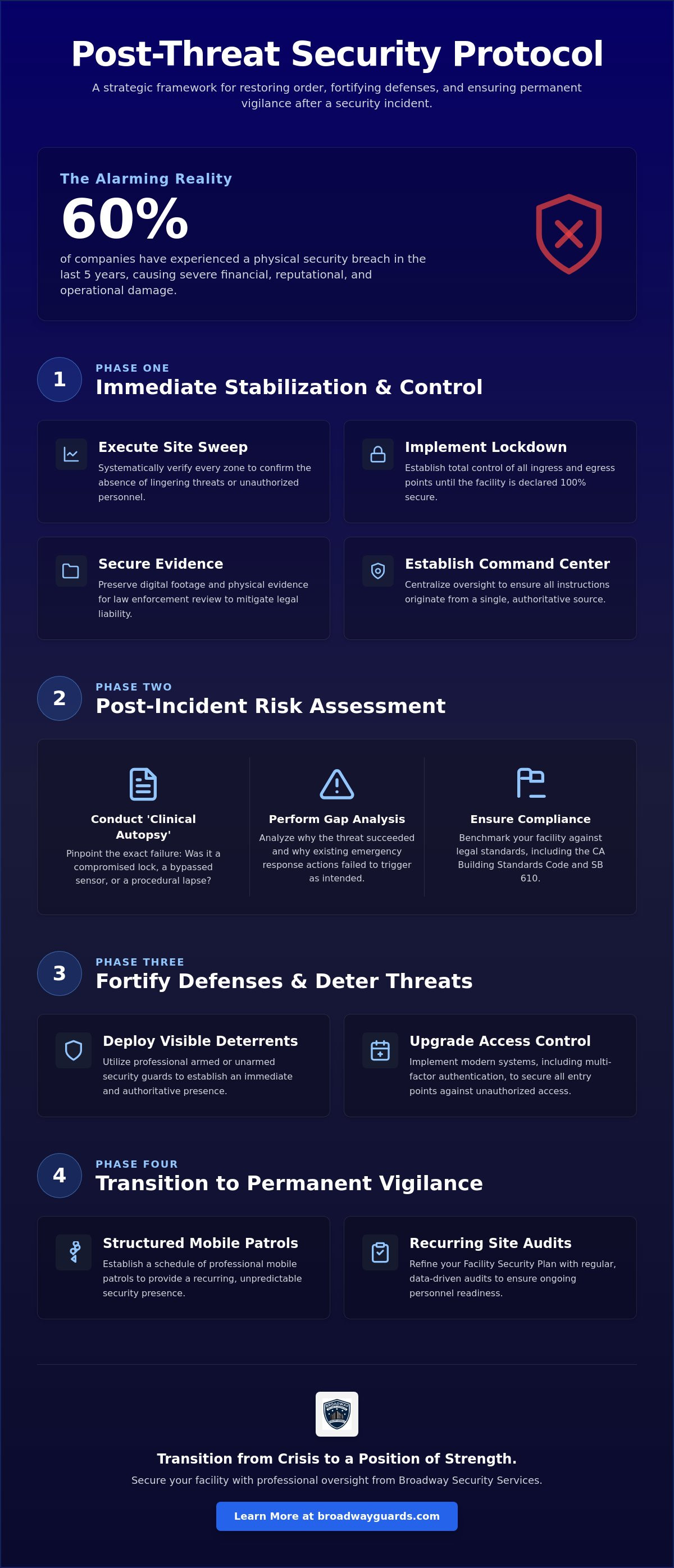
Sixty percent of companies have experienced a physical security breach in the last five years. While the immediate financial impact is severe, the long-term damage to employee trust and professional reputation is often far worse. You understand that a security incident isn’t just a lapse in hardware; it’s a compromise of the order and safety your organization depends on. Securing a building after a threat requires more than temporary fixes. It demands a transition into a state of disciplined, permanent vigilance that addresses both physical vulnerabilities and legal liabilities under the 2025 California Building Standards Code.

This article outlines the precise, step-by-step procedures to restore a secure environment and fortify your facility against future incursions. You’ll learn how to conduct a rigorous post-incident audit, analyze existing security gaps, and ensure compliance with California Senate Bill 610 regarding disaster remediation. We’ll provide a clear roadmap to move your operations from a state of crisis back to a position of strength and total oversight. By the end of this protocol, you’ll have the strategic framework necessary to prove your facility is a demonstrably safer environment for every occupant.

Key Takeaways

  • Execute a methodical site sweep and establish immediate lockdown protocols to stabilize the facility and neutralize lingering risks.
  • Master the disciplined steps for securing a building after a threat by identifying specific failure points and auditing current response effectiveness.
  • Deploy visible deterrents, such as professional armed or unarmed security guards, while upgrading access control systems with multi-factor authentication.
  • Refine your Facility Security Plan based on incident data to ensure alignment with legal standards and enhance personnel readiness.
  • Establish a permanent state of vigilance through a structured schedule of professional mobile patrols and recurring site audits.

Immediate Protocols: Stabilizing the Facility After a Breach or Threat

The moments following a security breach are a critical window for establishing control. A disciplined response prevents a single incident from cascading into a prolonged operational failure. Securing a building after a threat starts with the transition from tactical response to methodical stabilization. This phase requires a rigid adherence to protocol to ensure every vulnerability is identified and contained. Order must be restored through a series of non-negotiable actions designed to protect both the physical assets and the organization’s legal standing.

To stabilize the environment, management must execute the following actions with military-like precision:

  • Execute a Comprehensive Site Sweep: Every zone must be verified to confirm the absence of lingering threats or unauthorized personnel.
  • Implement a Temporary Lockdown: Total control of all ingress and egress points is mandatory until the facility is declared secure.
  • Secure Evidence: Both digital surveillance footage and physical evidence must be cordoned off for law enforcement review to mitigate liability.
  • Establish a Command Center: Centralized oversight ensures that all instructions originate from a single, authoritative source.

The Site Clearing Process

A building isn’t secure until every square inch has been visually and physically inspected. This process requires coordination with professional Armed Security Guards or Unarmed Security Guards who understand the nuances of physical security measures. Personnel must verify the status of all entry points, including secondary service doors and roof access hatches that are often overlooked during a crisis. You should document the integrity of every locking mechanism and physical barrier. If a door’s hardware was compromised during the breach, it must be guarded or boarded immediately. This level of rigor ensures that the “all-clear” signal is based on data rather than assumptions.

Stakeholder Communication and Transparency

Restoring employee trust is just as vital as fixing a broken lock. Uncertainty breeds fear, which can paralyze operations. Leaders must provide clear, authoritative updates to staff to signal that the environment is stabilized. For residential properties or retail spaces, formal statements should be issued to residents or clients regarding the current safety status. Under California Senate Bill 610, landlords and property managers have expanded responsibilities after declared disasters or significant incidents. This includes the removal of hazards and environmental remediation. Maintaining a detailed log of all post-incident communications isn’t just good management; it’s a requirement for legal compliance and protection against premises liability claims. Transparency doesn’t mean sharing tactical secrets; it means demonstrating that a disciplined shield is back in place.

Conduct a Professional Post-Incident Security Risk Assessment

Stabilization is only the beginning of recovery. To prevent a recurrence, you must conduct a clinical autopsy of the security failure. Securing a building after a threat requires identifying the exact moment the perimeter was compromised. This isn’t a time for generalities. You must pinpoint if a specific lock failed, a sensor was bypassed, or if a procedural lapse created an opening. Analyzing the response time of your current team is equally vital. If the transition to a lockdown was delayed, you need to understand why the established emergency response actions didn’t trigger as intended.

A rigorous evaluation must extend to the physical vulnerabilities of both your perimeter and interior zones. In high-stakes environments, a simple walkthrough isn’t sufficient. You should perform a comprehensive security risk assessment CA to benchmark your facility against 2026 standards. This process ensures that your defense isn’t just reactive but is built on a foundation of documented reliability and professional oversight.

Gap Analysis: Why the Threat Succeeded

A successful breach usually reveals a disconnect between technology and human performance. You must distinguish between a technological failure, such as a malfunction in an AI-powered surveillance system, and human error, like a propped-open service door. Review your surveillance footage meticulously to map the intruder’s path. This visual evidence often reveals blind spots where the deterrent value of your existing security signage or lighting was insufficient. Mapping these gaps allows you to move from a state of uncertainty to one of controlled resolution. If your current protocols didn’t hold, it’s a signal that your professional security presence needs immediate reinforcement.

Regulatory Compliance in California

In California, post-incident recovery is governed by strict legal frameworks. All assessments must align with the standards set by the Bureau of Security and Investigative Services (BSIS). Since January 1, 2026, the updated California Building Standards Code (Title 24) has imposed new requirements for fire safety and means of egress. You must verify that your post-threat lockdown procedures don’t violate these codes, particularly regarding door locking mechanisms in occupied spaces. If your incident involved a fire risk or system failure, ensure your Fire Watch Services remain compliant with local Los Angeles County ordinances. Aligning your site safety with these state-mandated protections isn’t just about safety; it’s about mitigating the legal liability that follows any documented breach.

Strengthening Perimeter Defenses and Access Control Measures

Fortification is the visible manifestation of your commitment to safety. While a risk assessment identifies where the shield cracked, the implementation of perimeter defenses ensures the shield is rebuilt stronger. Securing a building after a threat requires a multi-layered approach that prioritizes immediate deterrence over passive observation. Electronic systems like CCTV provide data, but they don’t stop an intruder in real-time. Professional human presence is the only unyielding force capable of immediate intervention. This transition from emergency response to professional staffing is what separates a vulnerable facility from a secure one.

To establish a demonstrably safer environment, you must deploy visible Armed Security Guards or Unarmed Security Guards at all primary access points. This psychological barrier is often enough to prevent a secondary attempt. For facilities with expansive perimeters or multi-level parking structures, Mobile Patrol Services provide the consistent oversight necessary to eliminate blind spots. If your electronic monitoring systems were compromised during the initial breach, Fire Watch Services are mandatory to maintain compliance with Los Angeles fire codes while repairs are finalized. You shouldn’t leave the safety of your assets to luck while hardware is offline.

The Role of Professional Guard Staffing

The presence of a disciplined protector at your gate changes the risk profile of your property. You must evaluate the need for armed security guard services Los Angeles for high-risk sites or facilities handling high-value assets. Guards should be positioned at primary choke points to manage visitor verification with military-like precision. It’s not enough to have a person in a uniform. These professionals must be trained in the specific crisis management strategies of your facility. They act as the first line of defense, ensuring that every individual entering the property is authorized and vetted against current threat data.

Technological Integration and Oversight

Modern defense relies on the intersection of human intelligence and technological rigor. You should upgrade physical access control systems to include multi-factor authentication (MFA). In 2026, the cost for enterprise-level door access control ranges from $1,500 to $3,500 per door. This investment is small compared to the $100,000 average cost of a physical security breach. Integrate high-definition surveillance with real-time guard reporting to ensure management has total visibility. Every perimeter fence and lighting fixture must meet tactical standards to eliminate shadows and concealment points. Establish a redundant communication loop between field personnel and management. This ensures that if a threat is detected, the response is instantaneous and coordinated. Reliability is the result of constant, methodical oversight.

Securing a Building After a Threat: A Strategic Post-Incident Protocol

Refining Crisis Management Strategies and Personnel Readiness

Hardware and physical barriers are only as effective as the people who manage them. While previous sections focused on stabilization and perimeter fortification, securing a building after a threat ultimately depends on the “human firewall.” A disciplined organization doesn’t rely on luck; it relies on a rigorous Facility Security Plan (FSP) that evolves with every new challenge. Your FSP shouldn’t be a static document gathering dust. It must be a living strategy that incorporates the specific data and failure points identified during your recent post-incident audit. If a breach occurred because of a procedural lapse, the protocol must be rewritten to eliminate that specific vulnerability.

Establishing a clear hierarchy of command is paramount for future emergency responses. In the heat of a crisis, confusion is a force multiplier for the threat. Every staff member must know exactly who holds the authority to initiate a lockdown or contact emergency services. Standardizing your reporting procedures ensures that suspicious activity is communicated with military-like precision. This rapid intervention capability is what prevents a minor observation from escalating into a full-scale security failure. To ensure your facility’s readiness meets these high standards of oversight, you should partner with professional security management to audit your internal response protocols.

Staff Training and Mental Readiness

Crisis Management Documentation

Transitioning to Long-Term Vigilance with Broadway Security Services

Vigilance isn’t a temporary reaction. It’s a permanent operational standard. Securing a building after a threat requires moving beyond the initial shock into a structured rhythm of protection. Broadway Security Services provides this through consistent schedules of professional patrols and site audits. We don’t just watch. We observe and report with a focus on pre-empting vulnerabilities before they’re exploited. This methodical approach ensures that the order restored in the wake of an incident becomes the new baseline for your facility’s daily operations.

Leveraging contractual security management ensures ongoing personnel oversight that internal teams often struggle to maintain. This isn’t just about staffing; it’s about maintaining a disciplined shield. We achieve this through continuous training and rigorous field performance reviews that hold every guard accountable to the highest standards. In Southern California, risk factors evolve rapidly. Your security presence must scale accordingly to meet these shifting threats, whether you require Mobile Patrol Services for sprawling campuses or Retail Security for high-traffic environments. Reliability is the result of this constant, methodical oversight.

A professional partnership transforms security from a line-item expense into a strategic asset. By integrating field intelligence with management oversight, you create a feedback loop that identifies risks before they manifest as breaches. This proactive stance is the hallmark of a secure organization. It demonstrates to employees, clients, and legal stakeholders that your commitment to safety is absolute. When the human element is managed with precision, the entire facility operates with a sense of calm and order that passive systems simply cannot provide.

The Broadway Security Standard

Our approach is defined by the quality of our personnel. We utilize highly trained individuals who prioritize presence and prevention above all else. These protectors aren’t just a physical barrier; they’re a psychological deterrent that signals total control. You benefit from professional consultation that adapts to your specific facility needs, ensuring your protocols are never generic or outdated. This partnership provides the peace of mind that comes from unyielding reliability. When you work with us, you aren’t just hiring a service; you’re enlisting a disciplined force committed to your protection.

Next Steps for Facility Fortification

Your journey toward permanent security begins with an honest evaluation of your current defenses. You should review your coverage against our unarmed security guards strategic guide to see how professional staffing can close existing gaps. Once you’ve identified your primary needs, schedule a comprehensive site evaluation with a Broadway security expert to map out a long-term strategy. Don’t wait for another breach to expose the cracks in your shield. Secure your facility today by contacting Broadway Security Services.

Establishing Permanent Operational Order

Transitioning from a state of crisis to a state of unyielding protection requires a commitment to disciplined protocol. Securing a building after a threat isn’t a one-time event; it’s the beginning of a higher standard of oversight. You now have the strategic framework to stabilize your facility through methodical site sweeps, identify specific failure points with professional risk assessments, and fortify your perimeter with visible deterrents. This approach ensures your organization remains compliant with California safety regulations while restoring the trust of your employees and stakeholders.

Broadway Security Services stands ready to act as your disciplined shield. As a Licensed California Security Firm specialized in high-risk asset protection, we bring proven crisis management expertise to every engagement. We help you move beyond temporary fixes to establish a permanent, reliable defense. Take the first step toward a demonstrably safer environment today. Request a Professional Post-Incident Security Consultation to verify your facility’s integrity. You have the roadmap to move forward with confidence and restore total order to your operations.

Frequently Asked Questions

What is the first thing I should do after a security breach?

The immediate priority is stabilizing the facility through a methodical site sweep and lockdown. This ensures no lingering threats remain and allows you to establish a temporary command center for coordination. Securing a building after a threat begins with this transition from chaos to controlled oversight. You must also secure all physical and digital evidence, such as surveillance footage, to mitigate future legal liability and assist law enforcement.

How do I know if I need armed or unarmed security guards after a threat?

The decision depends on your specific risk profile and the nature of the assets you protect. Armed security guards are necessary for high-risk sites where there is a credible threat of violence or high-value inventory. Unarmed security guards are effective for standard access control and establishing a visible deterrent. A professional consultation will help you determine the appropriate level of force required to maintain a disciplined shield over your property.

What are the legal requirements for securing a commercial building in California?

Commercial facilities must comply with the 2025 California Building Standards Code (Title 24) and BSIS regulations. These laws mandate specific standards for fire safety, means of egress, and door locking mechanisms. Additionally, California Senate Bill 610 requires property owners to manage hazard removal and remediation after significant incidents. Failure to align your post-incident protocols with these legal requirements can result in severe premises liability and regulatory penalties.

Can mobile patrols effectively replace stationary guards for building security?

Mobile patrol services are a tactical supplement rather than a direct replacement for stationary guards. Patrols are highly effective for securing large perimeters and parking structures where constant movement is a deterrent. However, stationary guards are required at primary choke points to manage visitor verification and immediate access control. A strategic combination of both services ensures comprehensive oversight and eliminates blind spots that intruders might exploit.

How often should a building security risk assessment be updated?

You should update your security risk assessment annually or immediately following a breach. Securing a building after a threat requires a clinical analysis of why previous protocols failed. Regular audits ensure your facility remains compliant with evolving California laws and accounts for new regional risk factors. This methodical approach transforms security from a reactive measure into a permanent state of high-stakes reliability and professional vigilance.

What role does fire watch play in post-incident building security?

Fire watch services are mandatory if your building’s electronic fire monitoring or suppression systems are compromised during an incident. These professionals provide continuous manual oversight to detect smoke or fire risks while repairs are underway. This is a critical component of post-incident security because it maintains compliance with local Los Angeles County fire ordinances. You shouldn’t leave your assets vulnerable to environmental hazards while your primary systems are offline.

How can I restore employee confidence after a major security incident?

Restoring confidence requires a combination of transparent communication and a visible increase in professional security presence. Employees need to see that management has taken decisive action to close the gaps that allowed the threat to manifest. Conduct mandatory training sessions on threat recognition and response to empower your staff. When personnel see a disciplined protector on-site, it rebuilds the sense of order and safety required for operational normalcy.

What are the most common vulnerabilities found in San Fernando Valley commercial buildings?

Common vulnerabilities include outdated access control systems and inadequate lighting in parking structures. Many facilities in the San Fernando Valley still rely on basic key-fob systems that lack multi-factor authentication, making them susceptible to unauthorized duplication. Blind spots in remote perimeter zones also provide concealment for intruders. Addressing these gaps with high-definition surveillance and professional mobile patrols is essential for establishing a demonstrably safer environment in high-risk regional areas.