


In a state where over 167,000 security professionals are currently active, the distinction between a disciplined shield and a significant legal liability often rests on a single regulatory oversight. You understand that mere presence is not protection. You require a force that maintains order without exposing your assets to the risks of guard misconduct or BSIS non-compliance. Learning how to hire security guards in California is no longer a simple procurement task; it’s a strategic necessity that demands adherence to the rigorous standards updated as of January 1, 2026.
We recognize the burden of navigating complex state mandates while attempting to secure your perimeter. This guide provides the expert framework required to identify professional, compliant protection for your specific environment. You’ll gain clarity on the latest SB 652 training requirements, the essential verification of Private Patrol Operator licenses, and the methodology for distinguishing operational excellence from “security theatre.” By following this disciplined approach, you ensure your assets remain under the care of a vigilant and unyielding force that prioritizes safety, trust, and peace of mind.
Key Takeaways
- Verify the legal legitimacy of your security provider by confirming current BSIS credentials and a valid Private Patrol Operator (PPO) license.
- Master the strategic framework for how to hire security guards in California to ensure your assets are protected by compliant and professional personnel.
- Mitigate significant legal risks and vicarious liability by understanding the “Deep Pocket” theory associated with unlicensed or negligent security services.
- Align your operational requirements with the correct personnel by conducting a professional security risk assessment to determine the necessity of armed versus unarmed guards.
- Establish a disciplined shield for your organization by prioritizing providers that emphasize military-like oversight and unyielding operational standards.
Understanding California Security Regulations: The BSIS and PPO Standard
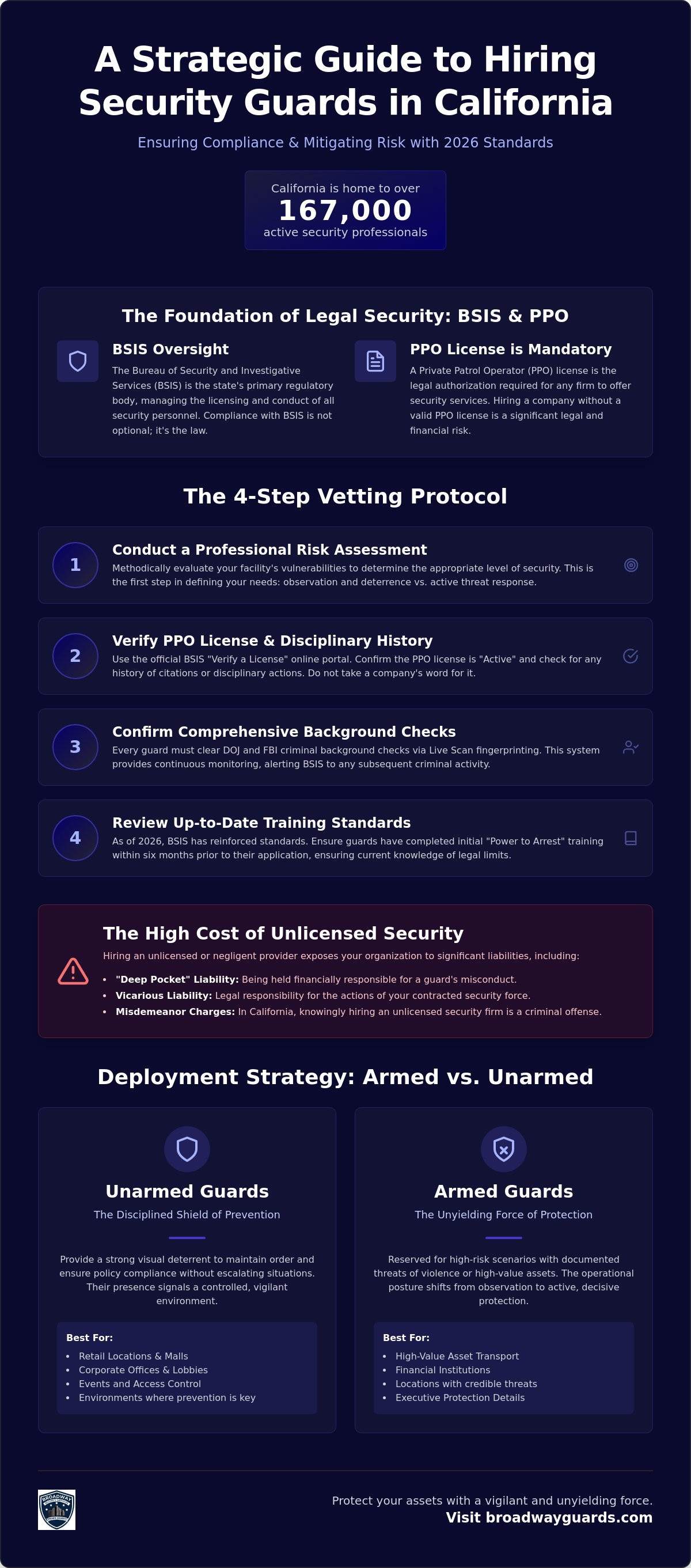
The Bureau of Security and Investigative Services (BSIS) remains the primary regulatory force ensuring the California security industry operates within strict legal parameters. In 2026, its oversight is more critical than ever, managing the licensing and conduct of a workforce that exceeds 167,000 individuals. When you begin the process of learning how to hire security guards in California, you’re looking for more than a uniform. You’re seeking a firm that operates under the strict mandate of Business and Professions Code Section 7582.1. This statute ensures that every entity providing patrol or protection services is properly insured, vetted, and bonded. For a property owner, this code is your first line of defense against the chaos of unlicensed and unaccountable operators.
A Private Patrol Operator (PPO) license is the legal authorization required for any security firm to provide protection services for hire within the state of California. Without this credential, a company cannot legally contract their services to you. Regulatory compliance isn’t a suggestion; it’s the foundation of safety. In 2026, the BSIS has reinforced training standards, requiring that initial “Power to Arrest” training be completed within six months prior to any guard application. This ensures that the personnel protecting your assets are current on their legal authorities and limitations. Order requires rules, and rules require rigorous enforcement.
Verifying the PPO License
Don’t take a company’s word for their legitimacy. Utilize the BSIS “Verify a License” portal to confirm their current standing. An active license means the firm has met the state’s testing, experience, and insurance requirements. You must also scrutinize their disciplinary history. A pattern of citations indicates a failure in leadership and oversight. In California, hiring an unlicensed security firm isn’t just a civil risk; it’s a misdemeanor. Protect your brand by ensuring your provider maintains a flawless regulatory record. When researching how to hire security guards in California, this verification step is your non-negotiable starting point.
Background Checks and Live Scan Requirements
Reliability begins with a clean record. Every professional guard in California must clear a criminal history background check through the Department of Justice (DOJ) and the FBI. This process uses Live Scan technology to verify fingerprints against national databases. This Security Guard Overview provides context on how these background standards form the baseline for the industry’s legal authority. Live Scan isn’t a one-time event. It establishes a permanent link between the guard and the BSIS. This ensures the agency receives automatic notifications if any subsequent criminal activity occurs. Verify that your provider manages this process with precision. Correct coding is essential for the continuous monitoring that keeps your facility safe and your liability low.
Defining Your Security Requirements: Armed vs. Unarmed Personnel
A strategic defense begins with an accurate assessment of your specific threat landscape. Determining how to hire security guards in California requires more than a casual glance at a budget; it necessitates a methodical evaluation of your facility’s vulnerability and the profile of potential risks. For many environments, unarmed security guards serve as the primary disciplined shield. They provide a visible deterrent that maintains order and ensures policy compliance without the high-stakes escalation inherent in carrying a firearm. Their presence signals a controlled, vigilant environment, which is often the most effective tool for retail locations or corporate offices where prevention is the priority.
Escalation to armed security guard services Los Angeles is reserved for high-risk scenarios where the threat of violent crime or high-value asset theft is documented. In these situations, the operational posture shifts from observation and reporting to active protection. Armed personnel undergo rigorous oversight and must possess a valid firearm permit issued by the California Bureau of Security and Investigative Services (BSIS). This distinction is critical. An armed guard isn’t just a guard with a weapon, but a highly trained professional capable of making split-second decisions under extreme pressure. If you’re uncertain about which level of force is appropriate, a professional security consultation can clarify your specific needs.
Training Standards for California Guards
The standard for protection in California is defined by rigorous training mandates that prioritize accountability. All registrants must complete the “Power to Arrest” and “Appropriate Use of Force” training before they’re ever assigned to a post. As of January 1, 2026, this initial eight-hour training must be completed within the six months prior to submitting a security guard application. Beyond this, guards must complete an additional 32 hours of training within their first six months of employment. Armed personnel face even stricter requirements, including specialized firearms training and biennial renewals to ensure their skills remain sharp and compliant with state law.
Industry-Specific Security Applications
Security requirements vary significantly across sectors, requiring a tailored approach to personnel deployment. Retail loss prevention focuses on identifying and neutralizing theft in real-time, while construction site asset protection relies on methodical patrols to prevent vandalism and equipment theft. When physical safety systems or sprinklers fail, fire watch services California provide the necessary human oversight to satisfy legal and insurance requirements. For high-profile individuals, executive protection offers a discreet but unyielding layer of safety. Each application demands a specific tactical mindset where professional discipline is directly linked to the outcome of protection.
The Hidden Risks of Unlicensed Security: Liability and Compliance
Hiring a security firm involves more than just filling a post; it’s a transfer of risk. In the legal world, the “Deep Pocket” theory often dictates that when a security incident results in injury or property damage, the plaintiff’s counsel targets the entity with the most significant assets. This is typically you, the client. If you haven’t mastered how to hire security guards in California through a rigorous vetting process, you’re essentially inviting a lawsuit. A disciplined shield isn’t just about physical presence; it’s about building a legal fortress around your organization through absolute compliance.
Vicarious liability is a serious threat to any business owner. Under California law, you can be held responsible for the misconduct or negligence of a guard if it’s determined that you failed in your duty to hire a competent, licensed provider. This is known as negligent hiring. To mitigate this risk, you must ensure every individual on your property meets the BSIS Security Guard Requirements. These standards aren’t optional. They are the baseline for professional protection. When guards wear professional uniforms and carry valid identification, they’re not just signaling authority; they’re fulfilling a legal requirement that establishes their status as authorized agents of a licensed Private Patrol Operator.
Proper incident reporting serves as your primary defensive paper trail. A professional firm uses methodical oversight to document every interaction and observation. These reports aren’t mere administrative tasks. They are evidentiary logs that can prove your organization took reasonable steps to prevent harm. Without this level of detail, your defense in a liability case is significantly weakened. Understanding how to hire security guards in California means prioritizing firms that treat reporting with the same gravity as field performance.
Insurance and Workers’ Compensation
Legitimate protection requires substantial financial backing. Every California PPO must maintain general liability insurance to protect against claims of bodily injury or property damage. You should always request a Certificate of Insurance (COI) that names your business as “additionally insured.” This ensures the provider’s policy covers you directly in the event of a guard’s error. Equally critical is Workers’ Compensation. In California, if a guard is injured on your property and the security firm doesn’t have proper coverage, the financial responsibility may fall on you. Verify these documents before any contract is signed.
The Cost of Non-Compliance
The penalties for cutting corners are severe. Utilizing unlicensed security workers can lead to heavy fines from the BSIS and potential site shutdowns by the Fire Marshal. This is especially true for fire watch services, where a lack of certified personnel can result in immediate evacuation orders for your building. Beyond the immediate legal fees, the long-term brand damage from a high-profile security failure is often irreparable. Real protection requires an unyielding commitment to regulatory rigor. Choosing a firm that values rules and protocols above all else is the only way to ensure your assets remain truly secure.
A Strategic Step-by-Step Guide to Hiring California Security Guards
Step 1: Conduct a Site Vulnerability Evaluation
Before deploying personnel, you must identify exactly what you are protecting and where your weaknesses lie. A professional security risk assessment CA is the essential first step in identifying blind spots in your perimeter and access control systems. You must determine if your facility requires the mobility of patrol units or the constant presence of standing guards. In high-stakes environments like Canoga Park or across the San Fernando Valley, reviewing historical incident data allows you to tailor your defense to specific regional threats. Order begins with an accurate understanding of the battlefield.
Step 2: Vetting the Security Firm’s Infrastructure
A guard is only as effective as the command structure supporting them. When evaluating how to hire security guards in California, you must scrutinize the firm’s management oversight and field supervision protocols. Inquire about their 24/7 dispatch capabilities and the frequency of unannounced field inspections. A disciplined firm provides rigorous training that exceeds BSIS minimums, ensuring guards are prepared for the nuances of your specific industry. This high-stakes reliability is particularly vital for specialized roles such as construction site security guards, who must protect high-value assets in dynamic and often hazardous environments.
Step 3: Negotiating the Service Agreement
The final service agreement must serve as a blueprint for your protection. You must clearly distinguish between hourly staffing fees and management fees to understand the full scope of the firm’s commitment to oversight. Define site-specific post orders that outline exact protocols for crisis management and daily reporting. Establishing clear Key Performance Indicators (KPIs) regarding attendance, patrol frequency, and incident reporting accuracy ensures ongoing accountability. For a partner that values rules, protocols, and visible results, request a professional security proposal from Broadway Security Services to begin securing your perimeter with military-like precision.
The Broadway Standard: Professionalism and Precision in Southern California
Broadway Security Services serves as the definitive standard for firms that refuse to compromise on safety. When researching how to hire security guards in California, the choice eventually narrows to those who can demonstrate an unyielding commitment to duty. We position ourselves as more than a service provider; we are a disciplined shield for your organization. Our operational rhythm is steady and methodical, ensuring that every post is manned by a professional who understands the gravity of their responsibility. For businesses in Canoga Park, Woodland Hills, and the San Fernando Valley, we offer a level of military-like precision that transforms security from a line item into a strategic asset.
Vigilant Protection for High-Stakes Assets
Our deployment methodology ensures that every guard is a proactive risk manager rather than a passive observer. We integrate a professional risk assessment into every security management plan, allowing us to align our armed and unarmed personnel with the specific threats facing your facility. This targeted approach eliminates gaps in your defense and provides a visible deterrent to criminal activity. We prioritize presence and prevention, ensuring that your assets are protected by a force that operates with absolute accountability. The Broadway guarantee provides the order and peace of mind you require to focus on your core operations without fear of liability or misconduct.
Contact Broadway Security Services Today
Take the first step toward a more secure and compliant future for your organization. Our expert team is ready to provide the methodical oversight and professional discipline your facility deserves. Don’t wait for a security failure to expose your vulnerabilities or compromise your assets. Schedule a professional consultation and request a comprehensive risk assessment to see how our unyielding standards can protect your perimeter. We are ready to serve as your unyielding force in an unpredictable world.
Secure your assets with Broadway Security Services and establish the disciplined protection your organization requires. Contact us today to begin your partnership with Southern California’s premier security force.
Securing Your Perimeter with Disciplined Precision
Securing your assets in an increasingly complex regulatory environment requires more than just a contract; it’s a commitment to unyielding standards. You now possess the strategic framework needed to navigate BSIS mandates and distinguish true professional protection from mere presence. By prioritizing verified PPO licensing and conducting thorough site vulnerability evaluations, you establish a foundation of safety that mitigates liability and ensures order across your operations.
Mastering the process of how to hire security guards in California is the first step toward achieving total peace of mind. Broadway Security Services stands as a disciplined shield for firms throughout the San Fernando Valley and Southern California. As a BSIS Licensed PPO, we specialize in both armed and unarmed protection, delivering results through military-like precision and methodical oversight. It’s time to harden your facility against evolving threats and ensure your perimeter remains secure.
Request a Professional Security Consultation and Risk Assessment to align your defense with the highest industry standards. Your assets deserve the care of a vigilant and unyielding force. We look forward to securing your perimeter and providing the protection you require.
Frequently Asked Questions
What is a PPO license and why is it required in California?
A Private Patrol Operator (PPO) license is the legal authorization required by the BSIS for any business to provide security guard services to others. This license serves as a guarantee that the firm has met rigorous experience, insurance, and examination standards. It’s the primary indicator of a company’s legitimacy and operational capability. Hiring a firm without a valid PPO license is a criminal offense and creates immense liability risks.
Can I hire a security guard as an independent contractor?
Hiring a security guard as an independent contractor is illegal under California law. Personnel must be employees of a licensed PPO or a proprietary employer. Attempting to hire 1099 workers avoids mandatory oversight and exposes your business to severe penalties from the BSIS and Department of Industrial Relations. A professional security posture requires the accountability and structure that only a legitimate employment relationship provides.
How much does it typically cost to hire a security guard in Los Angeles?
The cost of hiring security guards in California is determined by several operational factors, including the threat level and geographic location. Rates are influenced by the choice between armed and unarmed personnel and the depth of management oversight required. When evaluating how to hire security guards in California, prioritize value and liability protection over the lowest bid to ensure your assets remain under the care of a professional force.
What training are California security guards required to have?
Guards must complete the “Power to Arrest” and “Appropriate Use of Force” training before being assigned to a post. As of 2026, the BSIS requires an additional 32 hours of professional development within the first six months of employment. Armed guards must undergo further firearms training and pass the state-mandated psychological evaluation. This structured approach ensures every professional on your site maintains the highest standards of discipline and legal compliance.
What is the difference between armed and unarmed guards for my business?
Unarmed guards act as professional deterrents for environments where policy enforcement and observation are the primary goals. Armed personnel are reserved for high-stakes scenarios involving documented threats or high-value asset protection. Every management plan should begin with a risk assessment to determine the appropriate level of force. This ensures your security posture is both effective and legally defensible for your specific Southern California location.
How do I verify if a security company is properly insured?
To confirm a firm is properly insured, you must request a Certificate of Insurance (COI) that specifically names your organization as additionally insured. This document provides proof that the firm’s general liability and workers’ compensation policies are active. A professional provider will also have their insurance information on file with the BSIS. Verifying these credentials is a non-negotiable step in maintaining a secure and legally compliant perimeter.
What happens if a security guard is injured on my property?
When a guard is injured, a legitimate PPO’s workers’ compensation policy acts as the primary shield for your business. If the provider lacks this coverage, the financial and legal burden of the injury can shift directly to you as the property owner. This vicarious liability is a significant risk when dealing with unlicensed or unproven firms. Always verify that your partner maintains unyielding insurance standards to protect your interests.
How quickly can security guards be deployed for an emergency?
Emergency deployment times are governed by a firm’s operational scale and the complexity of the site requirements. While a disciplined provider strives for a rapid response, they won’t bypass the essential protocols of briefing and post-order establishment. This methodical approach ensures that even in urgent situations, the security force remains a controlled and effective shield rather than a disorganized presence. Reliability is built on consistent and methodical preparation.