Employee Parking Lot Safety Services: The Strategic Guide to Asset and Personnel Protection

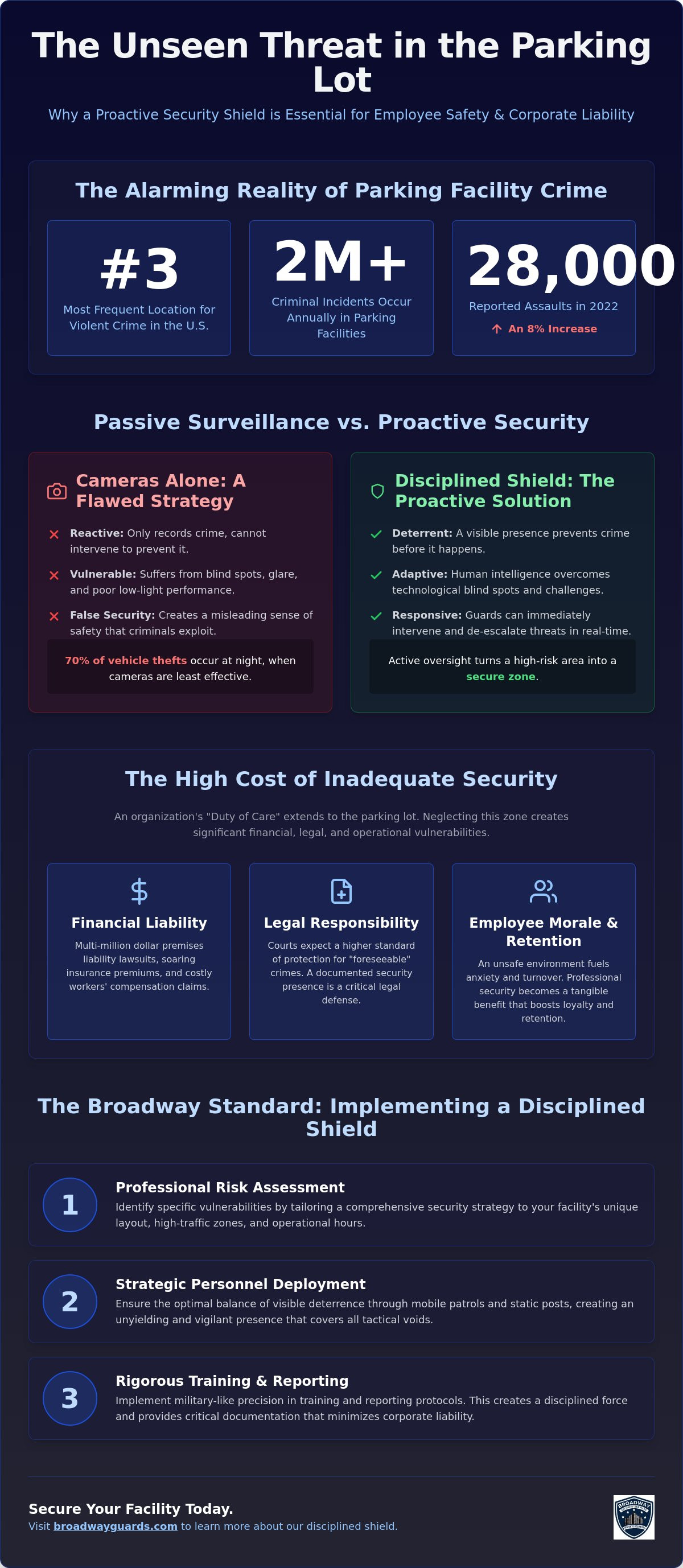
Parking facilities currently rank as the third most frequent location for violent crime in the United States, accounting for over two million incidents annually. This statistic represents a critical vulnerability for any organization that prioritizes the safety of its personnel and the integrity of its physical assets. You understand that an unmonitored lot isn’t just a safety hazard; it’s a significant liability that fuels employee anxiety and increases insurance premiums.

This guide provides the tactical framework needed to implement professional employee parking lot safety services that act as a disciplined shield against criminal activity. You’ll learn how to deploy a comprehensive security strategy that leverages human presence and rigorous oversight to achieve a crime-free environment. We will examine the integration of mobile patrols, lighting standards, and professional reporting protocols to ensure your facility remains a secure zone under the care of a vigilant and unyielding force. By mastering these complexities, you can reduce corporate liability and foster a culture of safety that improves employee retention.

Key Takeaways

  • Identify the specific vulnerabilities that make parking facilities high-risk zones and learn how integrated employee parking lot safety services mitigate these threats.
  • Recognize the critical limitations of passive surveillance and why a proactive human presence is necessary to prevent crime rather than just recording it.
  • Master the essential steps of a professional risk assessment to build a security strategy tailored to your facility’s unique layout and operational hours.
  • Evaluate the strategic deployment of security personnel to ensure your facility maintains the optimal balance of visible deterrence and professional oversight.
  • Understand how military-like precision in training and reporting protocols creates a disciplined shield that protects assets and minimizes corporate liability.

The Strategic Importance of Employee Parking Lot Safety Services

Employee parking lot safety services represent more than just a lighting upgrade or a perimeter fence. They comprise a sophisticated, integrated defensive posture. This approach combines a visible physical presence, advanced monitoring technology, and rigorous operational protocols to create a secure environment. True safety isn’t passive. It’s an active commitment to order and discipline. Organizations that treat parking security as a mere maintenance checklist often find themselves vulnerable to escalating threats that a simple camera cannot stop.

The statistical reality is stark. Data confirms that parking facilities are the third most common location for violent crime in the United States. Over two million crimes occur in these areas annually, and approximately 20% of all vehicle thefts take place within parking lots or garages. These locations are magnets for criminal elements who exploit low light and isolation to target both property and people. In 2022 alone, there were 28,000 reported assaults in U.S. parking facilities. This 8% increase from the previous year highlights a growing trend that demands a professional response.

In 2026, corporate responsibility has undergone a significant shift. Your “Duty of Care” no longer stops at the office door. It extends to every square foot where an employee is expected to be, including the parking stall. Neglecting this zone creates a massive financial vulnerability. Between workers’ compensation claims and multi-million dollar premises liability suits, the cost of a security breach far outweighs the investment in protection. A disciplined shield is the only effective way to mitigate these risks and ensure the continuity of your operations.

The Legal Reality of Premises Liability in California

California courts maintain a specific standard for “foreseeable” crime. If a business operates in a high-crime area or has a history of incidents, the law expects a higher standard of protection. Negligent security occurs when a property owner fails to provide adequate security personnel despite these known risks. Maintaining a documented, disciplined presence serves as a critical legal defense. It proves you took reasonable steps to mitigate recognized hazards, moving your organization from a position of vulnerability to one of documented compliance.

Impact on Employee Retention and Corporate Morale

The Limitations of Passive Security: Why Cameras Aren’t Enough

Many property managers mistake surveillance for security. Unmonitored CCTV systems often provide a false sense of security that crumbles the moment a real-world incident occurs. A camera is a silent witness, not a protector. It records the assault or the vehicle theft in high definition, but it lacks the agency to intervene. Relying solely on technology creates a reactive posture where you’re merely documenting your own losses. True protection requires a shift from recording crime to preventing it through active deterrence.

Hardware has inherent “Gaps in the Lens” that criminals are adept at exploiting. Blind spots are a physical reality in every lot, and environmental factors like glare or low light frequently interfere with image clarity. Statistics show that 70% of vehicle thefts occur at night, often in areas where cameras struggle to capture identifiable features. Professional employee parking lot safety services address these failures by deploying a disciplined shield. This human intervention fills the tactical voids that technology leaves behind, ensuring no corner of your facility remains unobserved.

The Reactive Nature of Surveillance

The timeline of a parking lot crime is usually measured in seconds. By the time a security team reviews recorded footage, the asset is gone or the personnel injury has already occurred. While AI-driven alerts have improved, they often suffer from high false-positive rates in busy commercial environments, leading to dangerous alarm fatigue. The Deterrence Gap is the critical interval between the initiation of a criminal act and the arrival of law enforcement, a period during which only a physical presence can provide protection.

The Human Element: De-escalation and Immediate Response

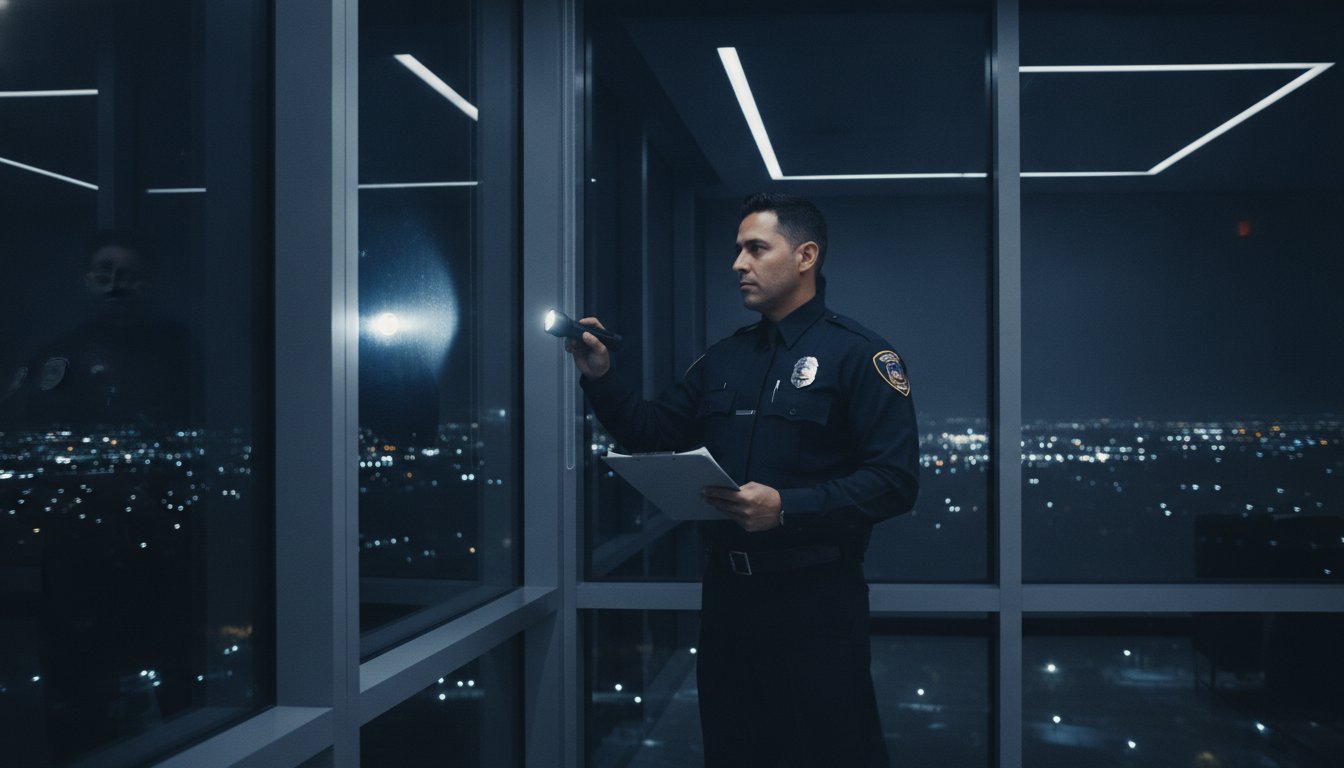
A trained guard identifies suspicious behavior long before a lens captures a physical transgression. They recognize the subtle signs of loitering or “casing” that automated systems miss. Beyond mere observation, professional personnel utilize verbal de-escalation techniques to manage disputes or remove unauthorized individuals before situations turn violent. This proactive oversight is a core component of comprehensive employee parking lot safety services. Unlike a camera, a human protector provides tangible assistance, such as safety escorts for staff during late-night shifts. These measures align with established West Virginia University parking lot safety guidelines regarding pedestrian protection. If your current strategy relies solely on recording events, you should consider the tactical advantages of professional mobile patrol services to close your security gaps.

Executing a Professional Parking Lot Risk Assessment

A disciplined security strategy is built on a foundation of objective data. A generic checklist is insufficient for protecting high-value assets and personnel. You must perform a site-specific evaluation that accounts for the unique layout and operational rhythm of your facility. This process ensures that your employee parking lot safety services are deployed with military-like precision rather than based on guesswork. For a detailed roadmap, consult our guide on how to conduct a professional security risk assessment in California.

We utilize a “Perimeter-In” methodology to identify security gaps. This approach begins at the outermost boundaries of the property and moves inward toward the employee entrance. It accounts for more than just criminal intent. According to a National Safety Council report on parking lot accidents, these areas are high-risk zones for incidents involving distracted driving and pedestrian collisions. A professional assessment bridges the gap between physical safety and criminal deterrence, creating a comprehensive shield for your workforce.

Identifying Tactical Vulnerabilities

Your assessment must scrutinize every entry and exit point for unauthorized access potential. We analyze lighting levels, measured in foot-candles, to eliminate areas of criminal concealment. Research indicates that adequate lighting can reduce parking lot crimes by 20%. We also evaluate “transient traffic” patterns. High volumes of non-employee movement near your facility increase the risk of opportunistic crime. This requires a more robust and visible security presence to maintain order.

Historical Crime Data and Regional Trends

Effective security is informed by intelligence. We leverage local police department data to understand the specific threats facing your site. For businesses in Canoga Park or the wider San Fernando Valley, analyzing incident reports within a one-mile radius is essential. This data identifies “Peak Vulnerability Windows.” These are specific times, often during late-night shift changes, when your facility is most at risk. By aligning your security posture with these trends, you ensure that protection is strongest when it’s needed most.

Employee Parking Lot Safety Services: The Strategic Guide to Asset and Personnel Protection

Selecting the Right Security Personnel for Your Facility

Effective employee parking lot safety services are not a “one size fits all” solution. The level of force and the nature of the presence must align perfectly with the specific threat profile of your facility. A disciplined security posture requires selecting personnel whose training and equipment match the environment they are tasked to protect. Choosing the wrong service level can result in either an inadequate defense or unnecessary operational friction. You need a partner that understands how to scale protection based on tactical necessity.

For many corporate environments and retail locations, unarmed security guards provide a highly effective visible deterrence. These professionals focus on observation, reporting, and maintaining order through a calm but firm presence. However, high-risk environments or facilities housing high-value assets often necessitate more robust measures. In these scenarios, deploying armed security guard services in Los Angeles ensures that your personnel are protected by an unyielding force capable of addressing immediate threats. For expansive perimeters where foot patrols are insufficient, integrating mobile patrol services allows for rapid response and consistent oversight across large surface lots or multi-level structures.

Unarmed vs. Armed Guards: A Risk-Based Framework

The decision to deploy armed or unarmed personnel follows a strict risk-based framework. Unarmed guards are ideally suited for customer-facing roles and low-crime corporate settings where the primary goal is access control and professional assistance. Conversely, armed personnel are essential for high-crime zones, executive protection details, or sites with high-value asset storage. The choice between armed and unarmed personnel must be dictated by a professional risk assessment, not by budget alone. This ensures that the defensive shield remains proportionate to the actual danger present at the site.

The Advantages of Mobile Patrol for Expansive Lots

Large-scale parking facilities require a dynamic security presence to be effective. Marked patrol vehicles significantly increase the “Perceived Radius of Authority,” signaling to potential criminals that the entire lot is under constant, active surveillance. We utilize random-interval patrols to prevent criminals from timing security movements, which effectively deters premeditated theft. Every patrol is backed by GPS tracking and real-time reporting protocols. This provides you with verifiable oversight and ensures that our personnel maintain the highest operational standards. If you’re ready to secure your perimeter with professional precision, you can request a security consultation to determine the optimal personnel for your site.

The Broadway Standard: Implementing a Disciplined Shield

Broadway Security Services operates with a commitment to military-like precision and order. We don’t view security as a passive utility or a background service. Instead, we implement a disciplined shield that prioritizes safety through a proactive philosophy of “Presence and Prevention.” Our approach to employee parking lot safety services is rooted in the belief that visible, high-standard oversight is the most effective deterrent to criminal activity. Every officer we deploy is a representative of this unyielding force, trained to maintain the highest levels of vigilance at all times.

Our operational philosophy focuses on stopping threats before they materialize. By maintaining a constant and methodical presence, we eliminate the opportunities that criminals seek in unmonitored spaces. This high-stakes reliability is what separates a professional security partner from a mere staffing agency. We prioritize peace of mind by ensuring that every square foot of your parking facility is under the care of personnel who value rules, protocols, and visible results above all else. This commitment to duty ensures that your assets and employees remain protected under a vigilant watch.

Accountability is the cornerstone of our operations. We maintain a rigid reporting structure that ensures every incident, patrol, and observation is documented with professional jargon and factual accuracy. This data-driven oversight provides clients with the peace of mind that their assets are under the care of a methodical and transparent team. We don’t just promise protection; we provide the verifiable results necessary to prove it. Our reporting protocols ensure that facility managers are always informed and that every security action is grounded in legal and regulatory reality.

Professionalism, Discipline, and Oversight

Our organizational structure relies on a clear chain of command and frequent field supervision protocols. Broadway guards aren’t generalists. They receive specialized instruction in parking lot dynamics to address the specific risks found in these environments. This includes advanced training in vehicle identification, the execution of safe employee escorts, and providing basic assistance such as jump-starts. Projecting an authoritative image is essential to our mission. Therefore, we enforce strict uniform standards. A professional, well-groomed appearance signals to both employees and potential intruders that the facility is under disciplined control.

Customized Security Protocols for Your Business

We recognize that every facility has unique operational requirements and tactical vulnerabilities. Broadway develops site-specific “Post Orders” for every client to ensure a comprehensive and organized approach. These orders serve as a tactical manual for our personnel, detailing specific patrol routes, access control points, and emergency response procedures. We ensure our protocols integrate seamlessly with your existing facility management and local law enforcement agencies. This collaborative approach creates a unified front against crime and liability. Secure your facility with a professional risk assessment today.

Securing Your Perimeter with Disciplined Oversight

Mastering the complexities of parking lot security requires a transition from passive observation to active, human-led deterrence. You’ve seen that unmonitored technology fails to prevent crime; a professional risk assessment is the only foundation for a true defensive posture. Implementing comprehensive employee parking lot safety services is a strategic necessity that protects your human assets and reduces corporate liability through methodical oversight. True safety isn’t found in a camera lens but in the presence of a disciplined shield.

Broadway Security Services provides this protection across the San Fernando Valley and the Greater Los Angeles area. Our highly trained personnel operate under rigorous field oversight to ensure every post order is executed with precision. We remain fully licensed and compliant with all California security regulations, grounding our professional claims in legal and regulatory reality. It’s time to replace vulnerability with an unyielding force of protection. Request a Professional Security Risk Assessment for Your Facility to begin fortifying your operations. Your employees deserve the peace of mind that comes from a secure and vigilant environment.

Frequently Asked Questions

Is an employer legally responsible for employee safety in the parking lot?

Employers bear a legal responsibility to provide a workplace free from recognized hazards, which includes parking facilities. Under California premises liability standards, businesses must take reasonable steps to prevent foreseeable criminal acts. Failure to implement adequate employee parking lot safety services can lead to negligent security lawsuits if a history of crime exists at the site. Maintaining a disciplined security presence serves as a critical defense in these liability cases.

What are the most effective ways to deter car break-ins in a corporate lot?

Active human presence serves as the most effective deterrent against vehicle theft and break-ins. While high-intensity lighting and perimeter fencing are foundational, they are passive measures that criminals often bypass. A disciplined security guard provides the vigilant oversight necessary to identify suspicious behavior and intervene before a crime occurs. This proactive approach closes the deterrence gap that unmonitored cameras leave open.

Should I hire armed or unarmed guards for my employee parking structure?

The decision depends entirely on a site-specific risk assessment of your facility. Unarmed guards are typically sufficient for low-risk corporate environments focused on access control and professional presence. Armed personnel are required for high-risk zones or facilities housing high-value assets where an unyielding force is necessary to mitigate immediate threats. Your choice should be dictated by tactical necessity rather than budget alone.

How much does it cost to have a security guard patrol a parking lot?

Security costs are determined by several factors, including the required level of force, the duration of the contract, and the specific risk profile of the site. Rates in California reflect the higher regulatory standards and specialized training required for professional oversight. You should consult with a provider to receive a customized quote based on your facility’s unique tactical requirements and the specific employee parking lot safety services you need.

How often should a mobile patrol vehicle visit my property to be effective?

Effective mobile patrols rely on random intervals rather than a predictable schedule to prevent criminals from timing security movements. The frequency of visits is dictated by your facility’s historical crime data and peak vulnerability windows. A high-risk lot may require multiple visits per shift to maintain a consistent radius of authority. This ensures your assets remain under constant, methodical care throughout the most dangerous hours.

Can security guards assist employees with safety escorts at night?

Providing safety escorts is a standard operational procedure for professional security personnel. This service directly addresses employee anxiety during late-night or early-morning shift changes. By accompanying staff to their vehicles, guards project a sense of order and security that improves morale. This tangible benefit demonstrates the organization’s commitment to its duty of care and helps with long-term employee retention.

Does having a security guard reduce my business insurance premiums?

Many insurance providers offer reduced premiums to businesses that implement professional security measures. A documented security presence significantly lowers the risk of premises liability claims and property loss. By demonstrating a disciplined approach to risk mitigation, you present a lower liability profile to underwriters. This proactive posture can result in significant financial savings for your organization over time.

What is the difference between a security guard and a parking attendant?

A security guard is a trained professional focused on protection, deterrence, and emergency response. They operate under strict protocols to maintain safety and order. In contrast, a parking attendant primarily manages logistics, such as vehicle placement and revenue collection. While attendants handle facility operations, only security personnel provide the disciplined shield required to mitigate criminal threats and protect your personnel from harm.

Professional Fire Watch Services California: The Definitive Compliance Guide for 2026

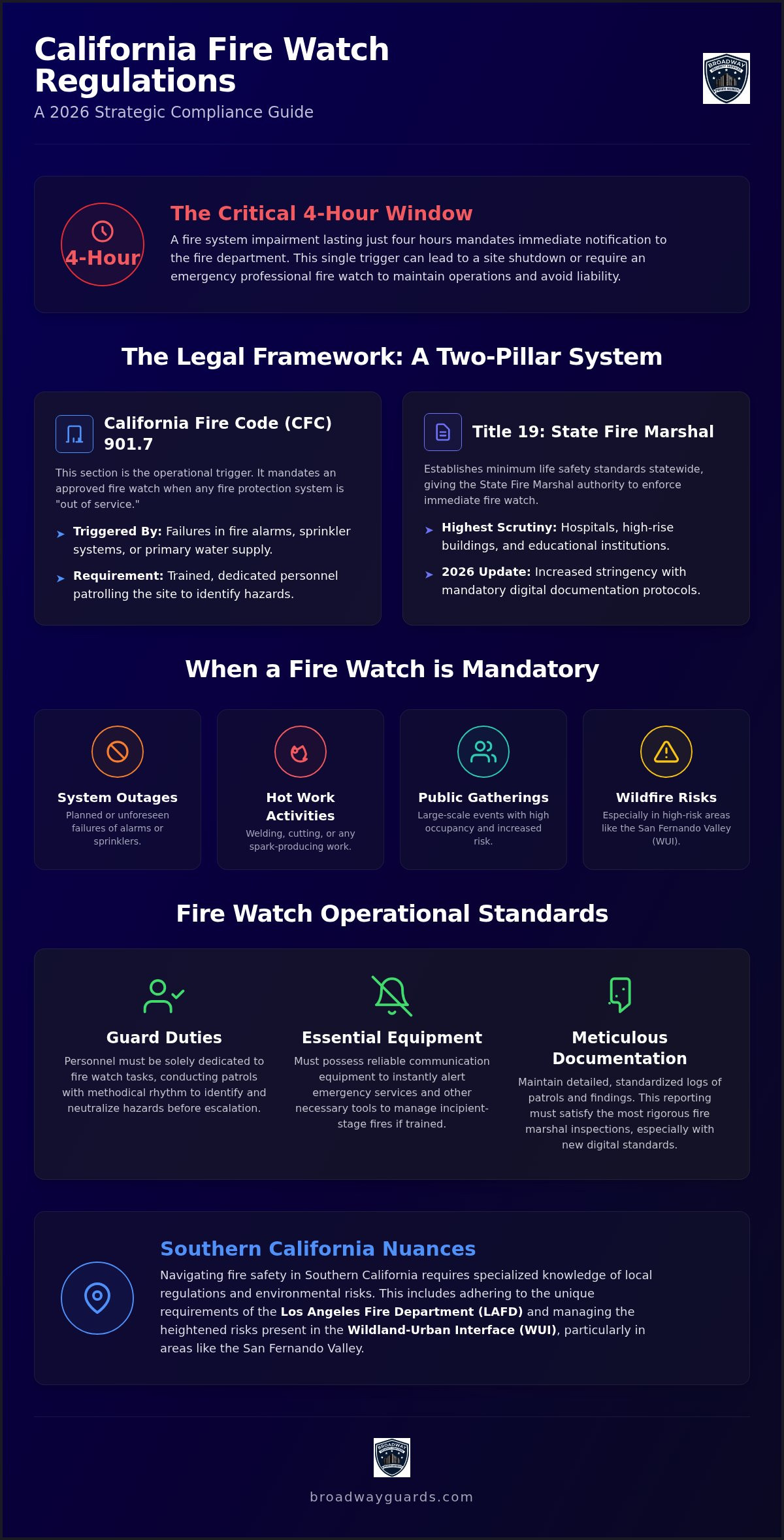
A single four-hour lapse in your fire protection system is all it takes for the Fire Marshal to shutter your operations and impose catastrophic fines. You likely recognize that in a state with increasingly strict safety mandates, the difference between continuity and a forced closure is a matter of professional oversight. Implementing compliant fire watch services California requires more than just a physical presence; it demands a disciplined strategy rooted in the 2022 California Fire Code and Title 19 regulations.

This guide provides the authoritative roadmap you need to navigate the complexities of Section 901.7 and the evolving 2026 standards for Wildland-Urban Interface zones. You’ll learn how to deploy an audit-ready patrol strategy that satisfies the Fire Marshal and protects your insurance standing. It’s essential to master the specific triggers for a mandatory watch, the rigorous documentation protocols required for “hot work,” and the tactical steps necessary to ensure your facility remains under the care of a vigilant and unyielding force.

Key Takeaways

  • Identify the legal triggers within the California Fire Code that mandate professional fire watch services California to prevent immediate site closure.
  • Implement a rigorous patrol cadence designed to detect environmental hazards and technical failures before they escalate into liability events.
  • Eliminate the legal and operational risks of using untrained internal staff by adhering to the specialized performance standards of NFPA 601.
  • Secure your facility against Fire Marshal scrutiny with a methodical documentation system that provides a defensible record of every safety patrol.
  • Learn how a disciplined oversight strategy ensures operational continuity and protects your insurance standing during critical fire protection system downtime.

Compliance in California isn’t a suggestion; it’s a legal requirement enforced with absolute precision by the Fire Marshal. Under the California Fire Code (CFC) Section 901.7, the responsibility for maintaining safety during system impairments falls squarely on the building owner or manager. When a fire protection system fails, you don’t have the luxury of hesitation. The code dictates that you must either evacuate the building or implement an approved fire watch. This regulatory framework functions as a disciplined shield, ensuring that human vigilance replaces automated systems until full functionality is restored. As we navigate the 2026 safety landscape, the Fire Marshal’s expectations have shifted. It’s no longer enough to have a physical presence; you must provide a documented, audit-ready strategy that demonstrates unwavering oversight.

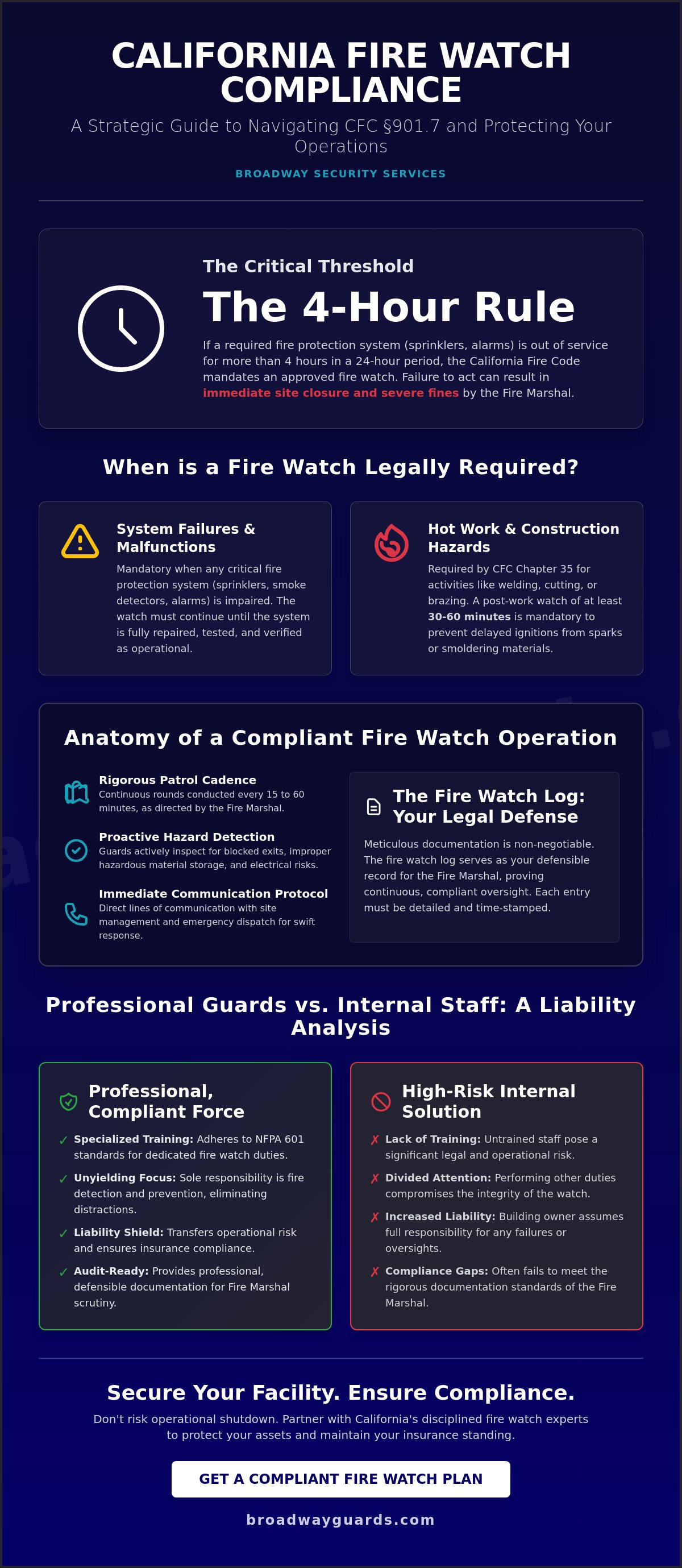
The “Four-Hour Rule” serves as the primary threshold for mandatory action. If a required fire protection system, such as a sprinkler array or a central alarm, is out of service for more than four hours within a 24-hour period, the implementation of professional fire watch services California becomes a legal necessity. You’re required to notify the Authority Having Jurisdiction (AHJ) immediately. Failure to initiate a professional watch during this window creates a massive liability gap. It isn’t just about avoiding fines. It’s about maintaining operational continuity. Without a disciplined patrol in place, the Fire Marshal has the authority to issue an immediate “cease and desist” order, effectively shutting down your site until the hazard is mitigated.

System Failures and Malfunctions

When technical defenses like smoke detectors or suppression systems malfunction, the transition to human oversight must be seamless. The 2022 CFC mandates that fire watch personnel remain on duty throughout the entire duration of the impairment. You can only legally terminate the watch once the system is fully repaired, tested, and verified as operational by a qualified technician. During this period, the guard’s sole responsibility is the detection of fire and the notification of occupants and the California Fire Department. They aren’t permitted to perform maintenance or other security tasks. This singular focus ensures that your assets remain under the care of a vigilant and unyielding force.

Hot Work and Construction Site Hazards

Construction environments present a different set of high-stakes risks, governed primarily by CFC Chapter 35. Activities like welding, cutting, and brazing introduce immediate ignition sources into potentially volatile settings. According to the Fire Watch Definition and Purpose, a dedicated watch is required to monitor these “hot work” zones for sparks or smoldering materials. While state law requires a 30-minute post-work watch, local ordinances often demand more. In high-density construction zones like the San Fernando Valley, or for roof work in San Francisco, that requirement often extends to a full hour. This rigorous standard prevents delayed ignitions and ensures that every spark is accounted for before the site is cleared. In the 2026 regulatory environment, your documentation of these patrols is as vital as the vigilance of the guard itself.

Anatomy of a Compliant Fire Watch Operation

A compliant fire watch operation functions with the precision of a military patrol. It transforms passive observation into an active, disciplined shield for your property. When utilizing professional fire watch services California, the patrol rhythm is dictated by the specific risk profile of your facility. Standard protocols typically require rounds every 15 to 60 minutes, depending on the Fire Marshal’s directives. These aren’t casual walks. A disciplined guard examines the facility for blocked fire exits, improperly stored flammable materials, and compromised electrical systems. They maintain direct communication lines with site management and local emergency dispatchers to ensure immediate intervention if a hazard is detected.

This methodical approach aligns with OSHA Fire Watch Requirements, which emphasize the need for personnel to be solely dedicated to monitoring fire hazards. They’re trained to detect the subtle signs of a smoldering fire long before a traditional alarm would sound. This proactive stance is the only way to ensure safety when automated defenses are offline. By prioritizing accountability and visible presence, you ensure that your assets are under the care of a vigilant and unyielding force.

The Fire Watch Log: Your Legal Defense

The fire watch log is a legal document, not a simple checklist. In 2026, the Fire Marshal expects more than handwritten notes. A compliant logbook must include the exact time of each patrol, the specific areas inspected, and the signature of the guard on duty. Digital timestamps and GPS-verified patrols are now the industry standard because they provide irrefutable proof of presence. Common errors, such as “pre-filling” logs or missing entries, lead to immediate citations and can void your insurance coverage during a claim. Maintaining a defensible safety record is a core component of professional oversight.

Equipment and Tactical Readiness

Tactical readiness starts with the right equipment. Guards must be equipped with high-visibility attire, specialized communication devices, and detailed site maps highlighting all manual pull stations and fire extinguishers. While these professionals are experts in detection and evacuation, they aren’t firefighters. Their role is to sound the alarm, initiate a structured evacuation, and provide a clear report to the arriving fire department. In large venues or residential complexes, this includes coordinating crowd management to prevent panic and ensure every occupant reaches a safe zone. This level of preparation ensures that your site remains orderly even during high-stakes emergencies. The same disciplined crowd management principles that apply here are also critical for professional event security Los Angeles operations, where poor crowd dynamics represent one of the most significant operational risks.

Professional Guards vs. Internal Staff: A Liability Analysis

Assigning internal staff to fire watch duties is a high-stakes gamble with your company’s future. While it may seem cost-effective initially, the “DIY” approach introduces systemic weaknesses that a Fire Marshal will not tolerate. Professional fire watch services California provide a level of objectivity and discipline that internal employees simply cannot match. Employees diverted from their primary roles often suffer from fatigue and distraction, compromising the vigilant oversight required to detect early-stage hazards. A warehouse manager or maintenance technician cannot be expected to maintain the same level of tactical awareness as a trained protector whose sole duty is the prevention of disaster.

Training gaps represent the most significant liability. Professional guards adhere to NFPA 601 standards, which define the rigorous performance requirements for security and fire watch personnel. Internal staff lack this specialized training and the mental conditioning required for high-stakes monitoring. In the event of a fire, using an untrained employee can lead to “negligent oversight” claims. This vicarious liability puts your entire organization at risk of massive legal penalties and the total denial of insurance claims. When the stakes are this high, the presence of a disciplined, third-party expert acts as a vital safeguard against legal and financial ruin.

Insurance Requirements and Compliance

Major property insurers in California often mandate the use of certified third-party guards during system outages. Using professional fire watch services California demonstrates a commitment to rigorous safety standards that internal staff cannot verify. You must verify if your policy includes clauses regarding “negligent oversight,” which can be triggered if an untrained employee fails to detect a hazard. Professional certification provides a defensible shield during post-incident investigations, ensuring that your insurance standing remains intact and your claims are not summarily denied due to non-compliance with NFPA standards.

Operational Continuity

Operational continuity depends on the clear separation of duties. Allowing your core team to focus on their primary responsibilities while experts handle safety protocols prevents operational bottlenecks. Managing 24/7 internal rotations for long-term system outages is a logistical nightmare that leads to employee burnout and missed patrols. A professional guard provides a consistent, methodical rhythm of oversight that reassures tenants and stakeholders. This visible commitment to duty ensures that your property remains under the care of a vigilant and unyielding force, regardless of the time of day. It’s the only way to maintain a professional environment during a critical system failure.

Professional Fire Watch Services California: The Definitive Compliance Guide for 2026

Preparing for a Fire Marshal Audit in California

Surprise inspections by the Authority Having Jurisdiction (AHJ) are a standard enforcement tool. When the Fire Marshal arrives at your facility, they expect immediate access to a disciplined record of oversight. This isn’t the time for administrative delays or missing signatures. Utilizing professional fire watch services California ensures that your site remains in a state of constant audit-readiness. The Marshal will evaluate the physical presence of the guard, their tactical knowledge of the facility, and the integrity of the documentation. A disorganized response suggests a lapse in safety, which can lead to immediate penalties or the suspension of your occupancy permit. You must demonstrate that your assets are under the care of a vigilant and unyielding force.

Accountability is the cornerstone of a successful audit. Organizing your documentation for immediate review requires a methodical approach that links professional discipline directly to the outcome of protection. The Marshal isn’t just looking for a stack of papers; they’re looking for a categorical history of vigilance. Every entry must be legible, chronological, and verified. By maintaining an organized command post for safety records, you signal to the AHJ that your operation takes its legal obligations with the utmost gravity. This level of preparation prevents the friction that often leads to deeper regulatory scrutiny.

The Fire Marshal’s Checklist

The AHJ focuses on three critical pillars: frequency, action, and knowledge. They will verify that patrols occurred at the mandated 30 to 60-minute intervals without exception. Beyond simple timestamps, the Marshal looks for a hazard abatement log. This document proves the guard proactively identified and corrected risks, such as clearing a blocked exit or securing a flammable container. The inspector may also test the guard’s knowledge of your site’s Fire Safety and Evacuation Plan. A professional protector must be able to identify every manual pull station and describe the exact notification chain for emergency services. To secure your facility against these high-stakes reviews, deploy an audit-ready fire watch strategy today.

Restoring the System

Ending a fire watch mandate is a formal legal process. Under NFPA 25 standards, you must certify that the fire protection system is fully restored and functional before the watch can be terminated. This requires coordinating with the Fire Marshal and providing a formal restoration notice to the local fire department or AHJ. Once the mandate is lifted, your work isn’t finished. You must archive all fire watch logs and reports for long-term regulatory and insurance compliance. These records serve as your primary defense in the event of a future audit or insurance inquiry. Maintaining a categorical archive ensures that your commitment to safety is documented and defensible for years to come.

Broadway Security Services: California’s Disciplined Fire Watch Experts

Broadway Security Services operates with an unwavering commitment to the safety of California’s most critical assets. Our “Disciplined Shield” philosophy isn’t just a slogan; it’s a rigorous operational standard that informs every patrol. When you engage fire watch services California through Broadway Security Services, you aren’t just hiring a guard. You’re deploying a highly trained protector who functions within a strict hierarchy of accountability. Our training protocols exceed state-mandated requirements, focusing on the intersection of field performance and regulatory documentation. This ensures that every shift is backed by a transparent, audit-ready record that satisfies the most demanding Fire Marshal. We prioritize safety, trust, and peace of mind by maintaining a stoic and professional presence at all times.

Reliability is forged through repetition and structure. We prioritize visible results and methodical oversight to give our clients peace of mind. Every protector on our team understands that their presence is the final line of defense when automated systems fail. This commitment to duty is reflected in our reporting, which utilizes industry-specific terminology and precise data to demonstrate a categorical history of vigilance. We take our responsibilities with the utmost gravity, ensuring your property remains a secure and compliant environment. By choosing a partner that values rules and protocols, you’re investing in a disciplined shield that protects your assets from legal and financial risk.

Regional Expertise: Serving Southern California

Serving Southern California requires a deep understanding of varied municipal codes. Our teams possess extensive familiarity with local Fire Department protocols across Los Angeles and Ventura Counties. We maintain rapid deployment capabilities for emergency outages in Canoga Park and the surrounding San Fernando Valley. This regional focus allows us to conduct customized risk assessments for diverse properties, including hospitals, retail centers, and residential complexes. We don’t believe in a one-size-fits-all approach. Instead, we adapt our disciplined oversight to the specific hazards of your site. This localized knowledge ensures that your fire watch strategy is perfectly aligned with the expectations of your specific Authority Having Jurisdiction. The same regional expertise that powers our fire watch operations also drives our event security Los Angeles services, where familiarity with LA County venues and municipal protocols is equally essential.

The Broadway Standard of Excellence

Precision is the hallmark of our service. We execute patrols with military-like order, ensuring that every square foot of your facility is inspected according to the established cadence. Our guards act as a reassuring presence for tenants and stakeholders, maintaining an observant and prepared posture. We value protocols and visible results above all else. This unwavering focus on duty is why Broadway Security Services remains the gold standard for businesses requiring a vigilant and unyielding force. Secure your site with Broadway Security Services’ professional fire watch services today and experience the difference that disciplined protection makes for your operational continuity.

Securing Your Operational Continuity and Compliance

Navigating the strict safety landscape of 2026 requires more than a temporary fix; it demands a permanent commitment to professional oversight. This guide has detailed how the integration of legal compliance and operational rigor creates a defensible safety strategy. By choosing a partner that prioritizes methodical documentation and disciplined patrols, you eliminate the threat of sudden site shutdowns and insurance denials. Professional fire watch services California act as the necessary bridge between a technical failure and the restoration of your facility’s automated defenses, ensuring your business remains functional under pressure.

Broadway Security Services provides the authoritative presence required to maintain this high standard of safety. Our California-certified security personnel deliver audit-ready logbook documentation that withstands the most rigorous Fire Marshal inspections. We’ve served Canoga Park and the Southern California region since our inception, acting as a disciplined shield for property owners and managers alike. Request an Emergency Fire Watch Quote from Broadway Security Services to ensure your assets remain under the care of a vigilant and unyielding force. Take the final step toward total operational security today.

Frequently Asked Questions

How much do fire watch services cost per hour in California?

Hourly rates are primarily influenced by the urgency of the request and the specific risk profile of the property. Emergency deployments for immediate system failures typically command a higher rate than scheduled coverage for planned maintenance. Factors such as the number of guards required and the total duration of the impairment will also impact the final cost structure for your facility.

Is fire watch required if only part of my sprinkler system is down?

Yes, a fire watch is mandatory whenever any portion of a required fire protection system is compromised. California Fire Code Section 901.7 applies to partial impairments because a failure in one zone creates a high-stakes vulnerability for the entire structure. You must maintain a disciplined patrol until the specific zone is repaired and the system is fully operational.

What specific training do California fire watch guards need to have?

Guards must be proficient in the use of manual fire-suppression equipment and have a categorical understanding of the facility’s evacuation routes. They’re trained to recognize environmental hazards that automated sensors might miss, such as chemical leaks or blocked fire doors. This expertise ensures they can act as a vigilant and unyielding force when technical defenses are offline.

Can I use my own security guards for fire watch duties?

You can only use internal staff if they are assigned exclusively to fire watch duties and perform no other tasks. Most standard security roles involve access control or retail monitoring, which the Fire Marshal considers a conflict of interest. Utilizing professional fire watch services California eliminates this risk by providing personnel dedicated solely to fire detection and prevention.

How quickly can Broadway Security Services deploy fire watch guards in Los Angeles?

Broadway Security Services maintains a rapid-response protocol for emergency outages throughout Los Angeles and the San Fernando Valley. Our dispatch center prioritizes immediate placement to ensure your facility remains compliant and avoids a forced shutdown by the AHJ. You should contact our team directly to verify current tactical availability for your specific location.

What happens if a fire watch guard discovers a fire on my property?

The guard will immediately notify the local fire department and initiate the building’s formal notification chain for occupants. Their primary responsibility is to coordinate an orderly evacuation and provide arriving fire crews with a precise report on the fire’s location and nature. They remain on-site to assist emergency responders and maintain the integrity of the safety perimeter.

How do I notify the Fire Marshal that I have started a fire watch?

You must use the local fire department’s designated reporting portal or their non-emergency administrative line to document the impairment. You’ll need to provide the address, the specific systems affected, and the name of the professional agency providing the watch. This notification is a legal requirement that demonstrates your commitment to rigorous operational standards.

What is the difference between a fire watch and a standard security patrol?

A fire watch is a specialized safety mandate focused entirely on ignition detection and evacuation, while standard security involves asset protection and loss prevention. Fire watch personnel are restricted from performing any other duties, such as checking IDs or monitoring cameras. This singular focus is what makes them a disciplined shield during critical system downtime.

Emergency Fire Watch Services: Rapid Deployment & Regulatory Compliance

A fire protection system failure is not a minor maintenance issue; it is a critical breach of your facility’s defensive perimeter that invites immediate legal and physical risk. When your alarms or sprinklers go offline, your property is no longer a secure environment. It becomes a liability. You need a disciplined shield to bridge the gap between system failure and operational safety. This is where professional emergency fire watch services become your most vital asset.

You likely recognize that the threat of a fire marshal shutdown is real, especially with the complexity of local California fire codes. It’s stressful to manage the uncertainty of system downtime while trying to avoid heavy fines or a total facility closure. We’re here to help you regain control. You’ll learn how to secure your facility and maintain legal compliance with professional, rapid-response fire watch protocols that prioritize safety and order.

We will detail the essential steps for immediate compliance, including the NFPA 25 standards updated on April 7, 2026, which mandate specific notification and monitoring protocols during system impairments. This overview covers the necessity of 24/7 vigilant monitoring and the rigorous logbook documentation required for insurance and legal protection. By the end of this article, you’ll understand how a methodical approach to fire safety ensures your assets remain under the care of an unyielding force.

Key Takeaways

  • Understand the specific operational failures, such as sprinkler downtime or alarm malfunctions, that mandate the deployment of emergency fire watch services to maintain facility safety.
  • Master the rigorous surveillance protocols used by fire watch personnel to identify early signs of ignition and hazardous hot spots before they escalate.
  • Identify the specialized monitoring requirements for high-risk activities like hot work and construction to ensure compliance with OSHA and NFPA standards.
  • Discover the essential notification procedures for fire departments and insurance carriers to protect your assets from legal liability and regulatory shutdowns.
  • Learn how a disciplined approach to fire prevention bridges the gap between mechanical system failure and full operational security.

The Critical Necessity of Emergency Fire Watch Services

A fire protection system failure creates an immediate tactical vulnerability. This isn’t a situation that allows for hesitation or bureaucratic delay. An Fire Watch Definition clarifies that this protocol is a mandated safety measure used when a building’s fire alarm or sprinkler system is out of commission. For California property owners, emergency fire watch services act as a disciplined shield, ensuring that a human presence maintains the vigilance that technology can no longer provide.

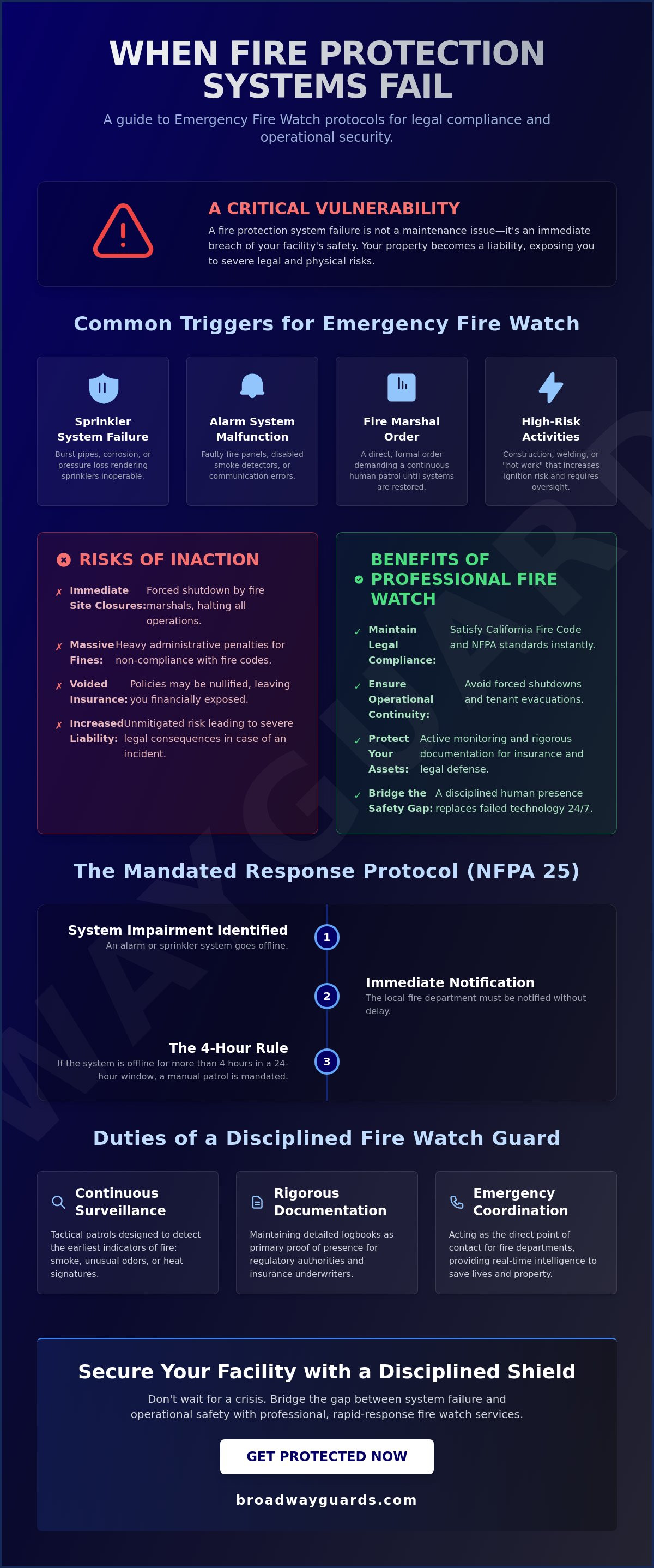
Triggers for deployment are often sudden and uncompromising. A burst pipe in a sprinkler system, a malfunction in a fire panel, or a direct order from a fire marshal can leave a facility unprotected. The legal consequences of ignoring these triggers are severe. You face immediate site closures, massive administrative fines, and the potential voiding of insurance policies. Waiting until the next business day to address a system outage is a high-risk liability. Fire doesn’t adhere to business hours; neither should your protection.

When Fire Protection Systems Fail

Aging commercial properties, particularly in the San Fernando Valley, often face infrastructure fatigue. Corroded pipes and outdated wiring are common failure points that trigger the need for immediate oversight. When an outage occurs, specific procedures must be followed. According to the updated NFPA 25 standards published on April 7, 2026, you must notify the local fire department as soon as a system impairment is identified. If a system is offline for more than four hours in a 24-hour window, the law typically mandates a manual patrol. Professional fire watch personnel provide the 24/7 vigilant presence required to monitor these vulnerable zones until repairs are finalized.

Regulatory Compliance and Fire Marshal Orders

California Fire Code requirements are stringent regarding dedicated fire watch. A fire marshal will often issue a formal order that demands a continuous human patrol until the life-safety systems are restored. Our emergency fire watch services are designed to satisfy these specific inspection criteria through a methodical approach to oversight. We focus on rigorous documentation through detailed logbooks. These records serve as your primary defense against administrative penalties. They prove that every square foot of your property was monitored with military-like precision, satisfying both regulatory authorities and insurance underwriters who demand proof of presence.

Maintaining compliance isn’t just about avoiding a fine; it’s about preserving the continuity of your operations. When a marshal sees a professional, uniformed guard with a structured logbook, it signals that you take your legal and safety obligations seriously. This level of discipline prevents the forced evacuation of tenants or the total shutdown of a job site. It transforms a chaotic system failure into a managed, compliant operation.

The Duties of a Disciplined Fire Watch Guard

A professional guard assigned to emergency fire watch services does not simply occupy a space. They execute a continuous tactical patrol designed to identify threats before they escalate into catastrophes. This role requires an unyielding focus on perimeter surveillance. Guards are trained to detect the earliest indicators of smoke, unusual odors, or heat signatures that automated systems might miss during an outage. They act as the human sensor array for your facility.

Rigorous hazard detection extends beyond looking for flames. It involves the active monitoring of flammable material storage and electrical hot spots. In industrial or construction environments, this includes strict adherence to OSHA requirements for hot work. When welding or cutting occurs, the guard remains on-site to ensure sparks don’t ignite dormant materials. If a crisis is confirmed, the guard initiates direct coordination with local fire departments and stakeholders, providing real-time intelligence that saves lives. During a confirmed emergency, they transition into evacuation management, leading personnel to safety with a calm, authoritative presence.

NFPA 101 and NFPA 25 Standards

Compliance with National Fire Protection Association (NFPA) standards is non-negotiable. While standard security focuses on theft or trespass, specialized fire watch training centers on NFPA 101 (Life Safety Code) and NFPA 25. Every patrol follows a methodical, pre-defined route that leaves no zone unobserved. This structured approach ensures that the entire facility remains under constant oversight. It’s this level of professional discipline that differentiates a dedicated protector from a general observer. Utilizing professional fire watch services ensures your site meets these rigorous national standards without compromise.

The Disciplined Shield: Reporting and Accountability

Documentation is the foundation of legal protection. Manual logbooks remain the gold standard for fire marshals because they provide a physical, immutable record of presence. Every entry is time-stamped and signed, documenting the completion of each patrol circuit. This isn’t just paperwork. It’s a verifiable audit trail that demonstrates your commitment to safety. The Broadway Security Services standard views these logs as a tool for accountability, ensuring that every guard remains vigilant. Incident reporting within these logs also helps identify recurring risks, allowing for long-term improvements to site safety protocols. This standard of verifiable oversight creates a disciplined shield around your most valuable assets.

High-Risk Scenarios: Hot Work and Construction Monitoring

Hot work operations represent a primary ignition source in industrial and development environments. Activities such as welding, cutting, and brazing generate extreme heat and molten slag. These elements easily ignite combustible materials often found on job sites. Because these triggers are so volatile, emergency fire watch services are frequently mandated by site permits to maintain a disciplined perimeter. This oversight is a critical requirement under NFPA 241, which governs fire safety during construction and alteration as of May 18, 2026.

Most fires don’t start during the work itself. They start after the crews depart. OSHA regulation 1910.252 requires a fire watch to remain on-site for at least 30 minutes after hot work is completed. However, many jurisdictions following NFPA 51B guidance recommend a 60-minute watch. This period is critical for detecting smoldering embers that can remain dormant before erupting into a structural fire. In high-density development areas like Canoga Park, a single oversight can threaten neighboring properties. This post-work vigil is a non-negotiable standard of safety for any responsible developer.

Securing Active Construction Sites

Construction sites are uniquely vulnerable because they lack permanent fire suppression systems. Open structures and wood frames provide ample fuel for accidental ignition. Our personnel coordinate directly with site managers to monitor temporary electrical installations, which are frequent sources of short circuits. By integrating construction site security guards with specialized fire watch duties, we address both arson prevention and fire safety in one cohesive operation. This dual-layered approach ensures the site remains secure from external intruders and internal hazards. Using emergency fire watch services during these phases protects your investment from the high liability of system downtime.

Hot Work Permits and Oversight

Oversight begins with a rigorous review of hot work permits. A disciplined guard ensures that all safety equipment, including fire extinguishers and welding blankets, is properly staged before work commences. We maintain a dedicated fire extinguisher standby during all high-heat operations. This proactive stance includes the reporting of near-misses. Documenting a close call is not a sign of failure; it is a critical data point used to prevent future catastrophic events. This level of accountability reinforces the site’s overall defensive posture and ensures full regulatory compliance.

Emergency Fire Watch Services: Rapid Deployment & Regulatory Compliance

Immediate Action Plan: Deploying Emergency Fire Watch

The moment a fire suppression system goes offline, the clock starts on your liability. You must act with categorical precision to prevent a total facility shutdown. Your first step is to assess the scope of the failure. Determine exactly which zones are unprotected, whether it’s a single floor or the entire structure. This assessment allows for a targeted deployment that optimizes resources while ensuring no area is left vulnerable. Professional emergency fire watch services bridge the gap between technical failure and full operational security.

Immediate notification of the local fire department and your insurance carrier is a legal and contractual obligation. Failing to notify authorities of a system impairment can lead to immediate administrative penalties under current NFPA standards. Once notifications are complete, contact Broadway Security Services to initiate the deployment of emergency fire watch services. Our dispatchers are trained to gather critical site data quickly, ensuring the incoming team arrives with a full understanding of your facility’s layout and specific risk profile.

Preparation on the ground is equally vital for a successful handoff. Establish a central command point where the fire watch logbook will be maintained. This location should be easily accessible to both the guards and visiting fire officials. When the team arrives, brief them on site-specific hazards, high-risk materials, and all emergency exits. This direct communication ensures that the transition from mechanical protection to human oversight is seamless and disciplined. A well-briefed guard is a more effective protector.

Rapid Response Logistics in Southern California

Our operational base in the San Fernando Valley is strategically positioned for rapid transit to commercial and industrial sites across the region. We maintain pre-staged equipment kits, including high-visibility gear and communication tools, so our guards arrive ready to work the moment they step on-site. Our 24/7 dispatch center handles middle-of-the-night emergencies with the same level of urgency as daytime requests. This logistical readiness is what transforms a service provider into a reliable shield for your assets.

Integrating Fire Watch with Existing Security

Efficiency is maximized when you integrate fire watch protocols into your broader contractual security management plan. This approach allows for a unified chain of command and consistent reporting standards across all security functions. In many scenarios, unarmed security guards who are already familiar with your facility can be cross-trained to handle fire monitoring duties during system downtime. This flexibility allows us to scale the team based on the facility size and specific fire marshal requirements. If your current protection is compromised, contact our team for immediate deployment.

Broadway Security Services: Your Disciplined Shield in Fire Prevention

Broadway Security Services operates as a disciplined shield against the unpredictable nature of fire hazards. Our approach to emergency fire watch services is defined by a commitment to order and military-like precision. We don’t just fill a regulatory requirement; we establish a defensive perimeter that prioritizes safety and peace of mind. This standard of professionalism ensures that every client feels their assets are under the care of a vigilant and unyielding force that values rules and protocols above all else. When technical failures occur, our presence provides the necessary stability to keep your operations running.

Local expertise in California regulations is a critical component of our operational strategy. The state’s fire codes are complex and unforgiving, often requiring specific certifications and patrol intervals that vary by jurisdiction. Our team understands these nuances, which directly reduces your legal and financial liability. We maintain a constant, verifiable presence that leaves no room for error. This unyielding vigilance means a guard is on-site and observant 100% of the time, providing the human oversight that mechanical systems cannot replace during a failure. We take this responsibility with the utmost gravity to ensure your facility remains a secure environment.

Transparency is the foundation of our partnership. Broadway Security Services provides real-time access to patrol data and logs, ensuring that you have a clear, immutable audit trail for fire marshals and insurance underwriters. This level of reporting transforms a necessary service into a strategic tool for facility management. By utilizing professional jargon and industry-standard reporting, we demonstrate a level of expertise that grounds our claims in operational reality. We prioritize accountability in every patrol circuit, ensuring that every entry in the logbook is a testament to our presence.

The Broadway Advantage for Canoga Park Businesses

Deep roots in the Southern California business community allow us to navigate local challenges with ease. We’ve built a reputation for reliability among local fire inspectors in areas like Canoga Park and the wider San Fernando Valley. When an inspector sees our team on-site, they recognize a standard of compliance that meets their highest expectations. Every deployment includes a customized risk assessment to identify specific vulnerabilities before they become crises. For Canoga Park property managers navigating the 2026 regulatory updates, our fire watch Canoga Park compliance checklist provides the strategic intelligence needed to meet new semiannual testing mandates and cybersecurity protocols for network-connected alarms. This proactive approach ensures that our presence is both a deterrent and a solution for your property.

Next Steps: Securing Your Property Today

Securing your property doesn’t have to be a complex process. You can request an immediate assessment to determine the level of protection your facility requires. Our onboarding process is designed for speed, whether you need a rapid response for emergency fire watch services or a structured long-term contract for a construction site. We focus on results and visible presence to ensure your operations continue without interruption. Protect your assets with Broadway Security Services and ensure your facility remains a secure, compliant environment under the watch of a disciplined protector.

Secure Your Perimeter with Disciplined Oversight

A technical failure in your fire suppression system doesn’t have to result in a total operational shutdown. By implementing a professional response, you transform a high-stakes liability into a managed safety protocol. You’ve seen how rigorous patrol routes, NFPA-compliant logbooks, and rapid deployment work together to satisfy fire marshal requirements and preserve your facility’s integrity. Relying on emergency fire watch services ensures that your assets remain under the care of a vigilant and unyielding force, even when your mechanical defenses fail.

Broadway Security stands as your disciplined shield in California. We’re licensed, bonded, and insured, providing highly trained personnel who strictly adhere to NFPA standards. Our 24/7 dispatch center is prepared for rapid deployment, ensuring that a professional presence is established exactly when it’s needed most. Don’t leave your property’s safety to chance or wait for administrative penalties to mount. You can maintain total compliance and operational continuity with our methodical approach to fire prevention. Contact Broadway Security for Emergency Fire Watch Now to secure your facility. Your peace of mind is our primary duty.

Frequently Asked Questions

What is the primary purpose of emergency fire watch services?

The primary purpose of emergency fire watch services is the establishment of a continuous, manual surveillance perimeter when life-safety systems are compromised. These services ensure that a human sensor array remains active to detect smoke, heat, or ignition sources that automated systems can no longer monitor. This protocol maintains a disciplined environment that prioritizes life safety and prevents the immediate closure of a facility by regulatory authorities.

How quickly can Broadway Security deploy fire watch guards in Los Angeles?

Deployment speed is managed through our 24/7 dispatch center and our strategic operations base in the San Fernando Valley. We prioritize rapid response to ensure that a disciplined protector arrives at your site as quickly as transit conditions allow. Our logistical readiness includes pre-staged equipment and a roster of personnel who are prepared to establish a defensive presence the moment they arrive at your facility.

Is fire watch required by law if my alarm system is only partially offline?

Regulatory mandates generally trigger the requirement for a fire watch if any segment of the fire protection system is offline for more than four hours within a 24-hour window. Fire marshals view a partial failure as a critical vulnerability that compromises the entire facility’s safety. You should consult with local authorities to ensure your site remains compliant, as even localized impairments can lead to significant legal and physical risks.

What specific training do your fire watch guards undergo?

Our personnel undergo rigorous training focused on NFPA 101 and NFPA 25 standards, emphasizing hazard identification and tactical communication. They are instructed in the methodical execution of patrol routes and the proper use of fire extinguishers. This training ensures that every guard acts as a professional shield, capable of managing evacuation procedures and maintaining the high-stakes reliability required during a system outage.

Can fire watch guards also perform standard security duties?

A fire watch guard’s duty is singular and unyielding. They cannot be assigned to standard security tasks such as access control, retail loss prevention, or general site security while on watch. Fire codes mandate that their sole responsibility is the detection of fire hazards. Diverting their attention to other duties is a violation of safety protocols and can result in administrative penalties from the fire marshal.

How long must a fire watch continue after fire systems are restored?

The patrol must remain active until the fire protection system is fully restored, tested, and certified by a qualified technician. You’re also required to notify the local fire department and your insurance carrier that the impairment has been cleared. Only after the system is verified as 100% operational can the manual watch be terminated, ensuring there’s no gap in your facility’s defensive posture.

What documentation do you provide to satisfy the fire marshal?

We provide comprehensive, time-stamped logbooks that document every patrol circuit with military-like precision. These records serve as an immutable audit trail that demonstrates your commitment to safety and regulatory compliance. Each entry includes the date, time, and specific observations of the guard. This level of transparent reporting is the gold standard for satisfying fire marshal inspections and protecting your facility from liability claims.

What happens if a fire is detected during a fire watch patrol?

If a fire is detected, the guard immediately initiates a high-priority notification protocol to the local fire department and site stakeholders. Their next objective is to manage the safe evacuation of all personnel according to the site’s emergency action plan. While they may utilize a fire extinguisher to suppress small, contained ignitions if it’s safe to do so, their primary mission is life safety and professional coordination with emergency responders.