What if the most significant threat to your facility isn’t a fire, but a single missing entry in a compliance log? For California healthcare administrators, the risk of an immediate shutdown by the Fire Marshal is a constant pressure, especially when critical fire suppression systems fail. You know that in a “defend-in-place” environment, the safety of non-ambulatory patients depends entirely on the precision of your interim life safety measures. It’s a high-stakes responsibility where non-compliance during a CMS survey can result in devastating fines or the loss of accreditation.
Broadway Security Services delivers the disciplined hospital fire watch services necessary to secure your perimeter and your reputation. We promise to provide more than just a presence; we offer a professional, military-grade shield that ensures continuous CMS compliance while maintaining a quiet atmosphere that doesn’t alarm your patients. This article explores how our rapid, reliable deployment and Marshal-ready documentation help you navigate the 2025 California Fire Code with absolute peace of mind. You’ll learn how structured oversight transforms a regulatory burden into a standard of excellence.
Key Takeaways
- Learn how to align your facility with the 2025 California Fire Code to prevent immediate Marshal shutdowns and maintain CMS accreditation.
- Discover why specialized hospital fire watch services are the essential foundation of any Interim Life Safety Measures (ILSM) plan during system impairments.
- Understand the “Defend-in-Place” doctrine and how professional oversight protects non-ambulatory patients without disrupting clinical operations.
- Master a 5-step emergency protocol for the rapid deployment of certified personnel to avoid the high costs of non-compliance.
- See how Broadway Security Services applies military precision and rigorous reporting to ensure your facility remains surveyor-ready at all times.
Hospital Fire Watch Services: Why Healthcare Facilities Require Specialized Protection
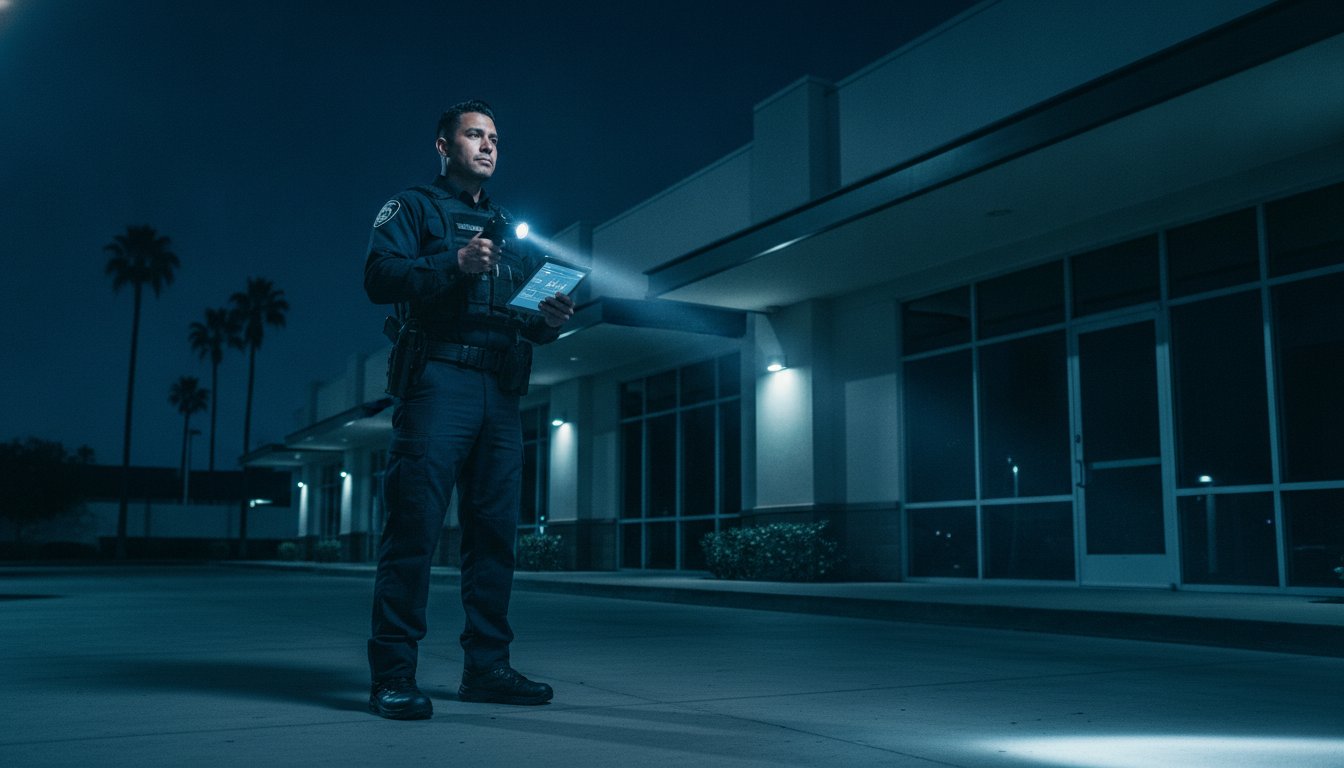
Hospital fire watch services are not a luxury; they’re a critical operational necessity when life safety systems fail. Unlike standard commercial properties, a hospital cannot simply evacuate when an alarm system goes offline. The “defend-in-place” strategy makes human vigilance the primary line of defense. Broadway Security Services provides a disciplined shield that ensures your facility remains operational and compliant with the 2025 California Fire Code. Relying on standard security patrols for these specialized tasks invites disaster. Professional fire watch requires specific training in smoke compartment identification and rapid communication protocols that general guards often lack.
Failure to provide adequate oversight leads to catastrophic consequences. CMS surveyors treat fire safety impairments with zero tolerance, often issuing “Immediate Jeopardy” findings that threaten federal funding. A local Fire Marshal in Canoga Park or Los Angeles has the authority to shut down entire wings if your documentation is insufficient. Our approach prioritizes order and precision to eliminate these risks. We provide the authoritative presence needed to maintain safety without disrupting the clinical environment.
Understanding the Vulnerability of Healthcare Environments
Hospitals house fragile populations where mass evacuation creates significant clinical risk. Because many patients are non-ambulatory or tethered to life-support systems, the facility must rely on sophisticated fire protection strategies that compartmentalize threats. High-oxygen environments and sensitive medical electronics further increase the volatility of the space. In these 24/7 operating environments, a fire watch specialist acts as an unyielding force, monitoring for ignition sources and ensuring that exit paths remain unobstructed. This level of oversight provides the peace of mind required for medical staff to focus on patient care during system impairments.
When is a Fire Watch Legally Required in a Hospital?
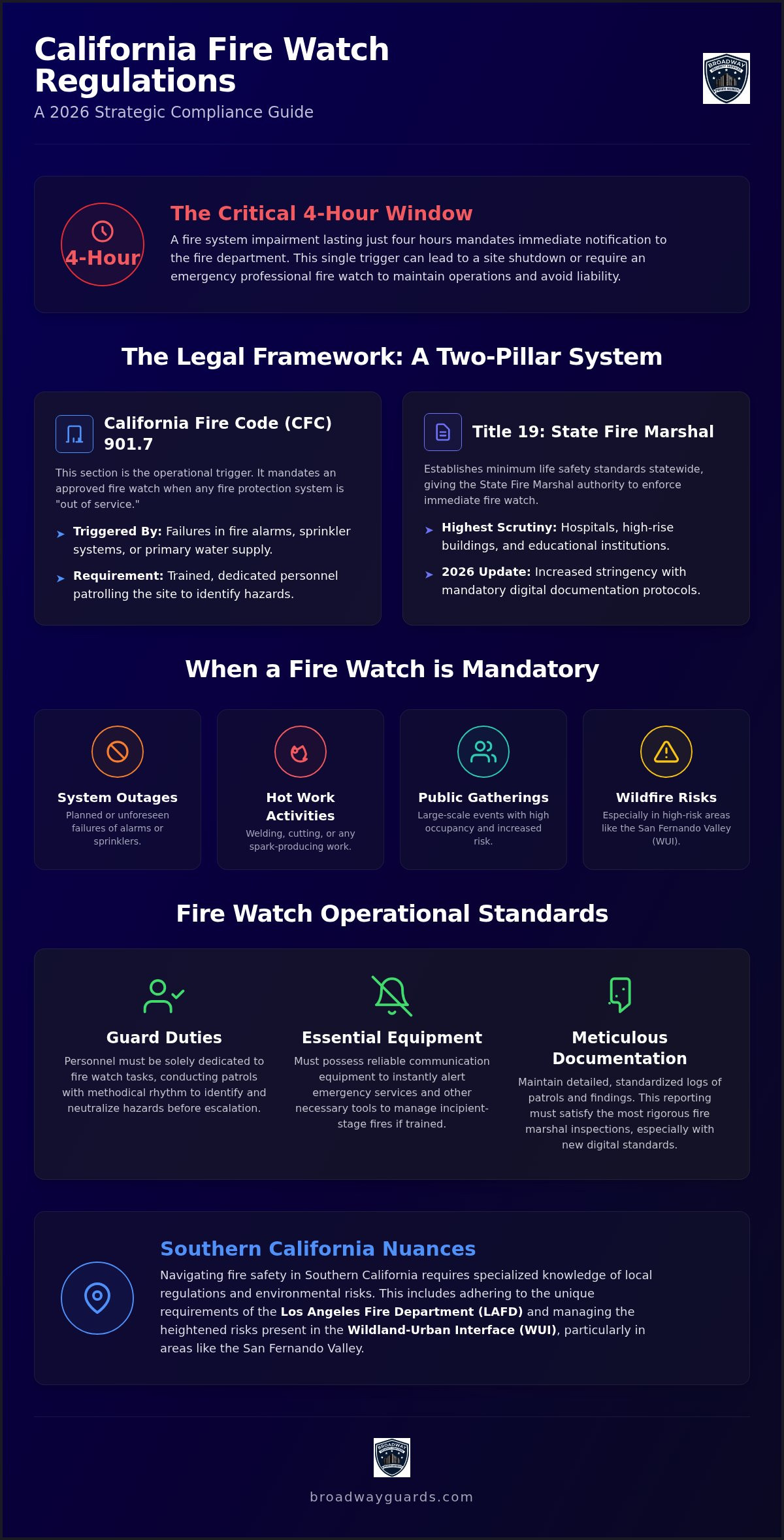
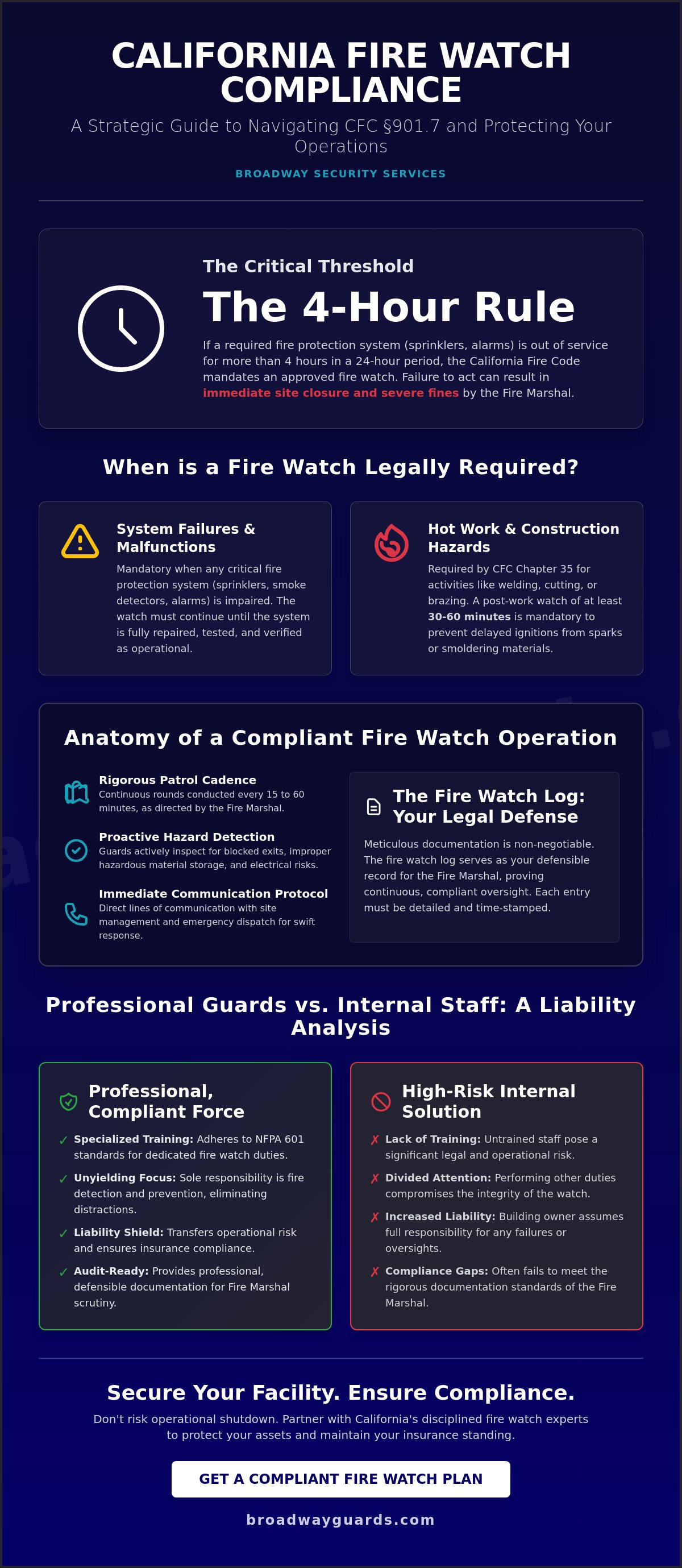
Regulatory mandates for a fire watch are strict and time-sensitive. Per the 2025 California Fire Code and current CMS regulations, a healthcare facility must implement a fire watch under the following conditions:
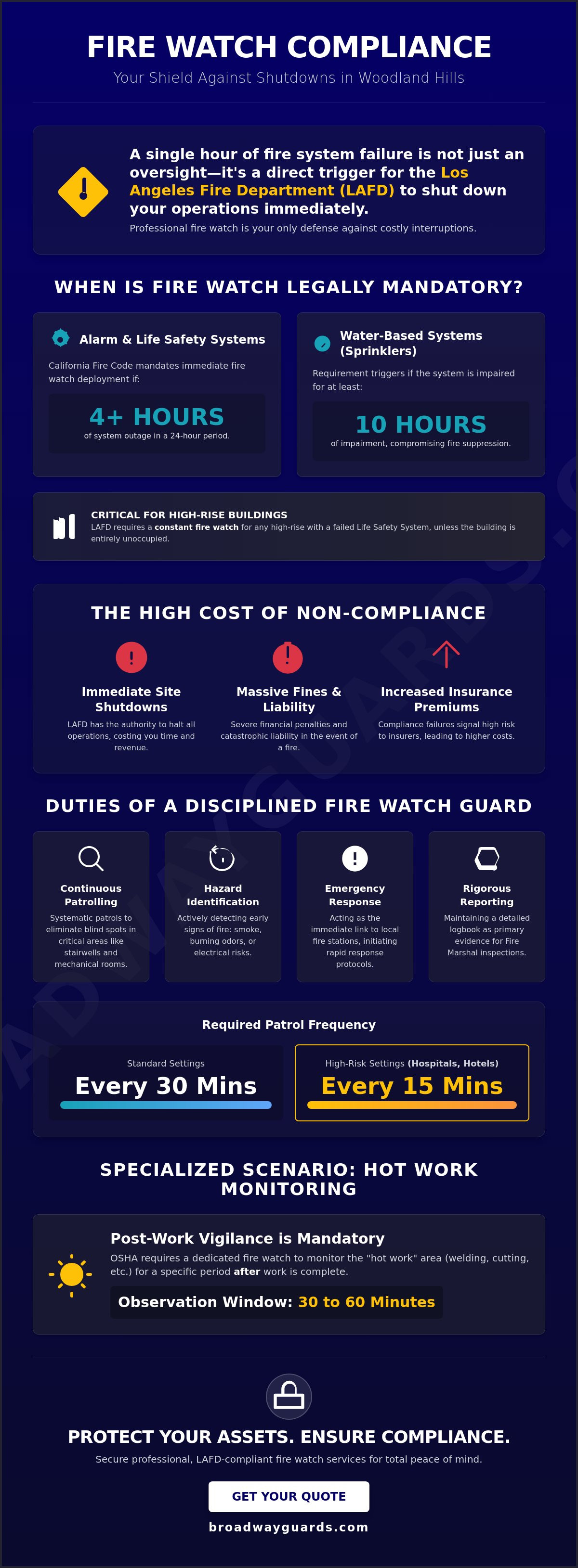
- System Impairment: Any time a fire alarm or automatic sprinkler system is out of service for more than four hours within a 24-hour period.
- Planned Maintenance: During scheduled upgrades or repairs that compromise active suppression systems in critical smoke compartments.
- Regulatory Orders: When the California State Fire Marshal or local Canoga Park authorities identify a specific hazard that necessitates interim life safety measures.
Our team provides the rapid deployment needed to meet these legal triggers instantly. We ensure your facility remains a safe harbor for patients while satisfying every regulatory demand with meticulous documentation.
Navigating Compliance: NFPA 101, CMS, and ILSM Requirements
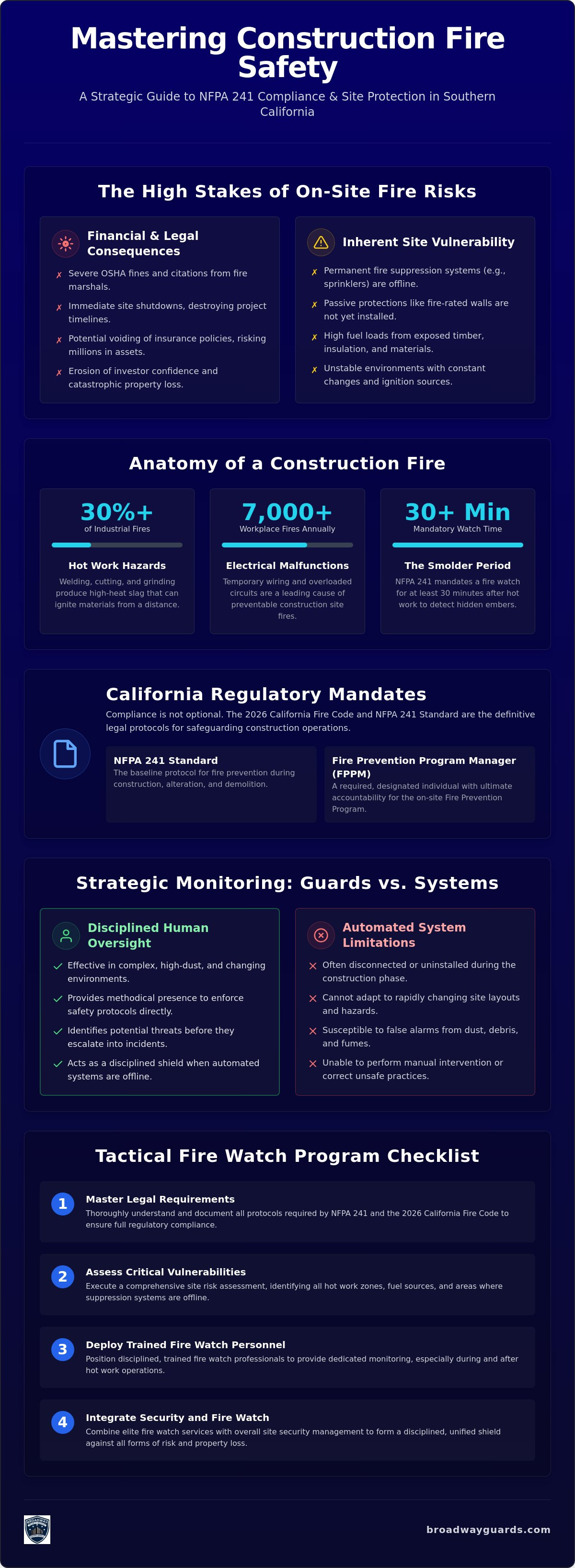
Compliance in healthcare is a matter of administrative survival. The intersection of NFPA 101 and CMS reimbursement requirements creates a rigid framework for facility managers that leaves no room for error. For those Navigating Compliance in California, the standards are unyielding and demand constant vigilance. CMS currently mandates adherence to the 2012 edition of the Life Safety Code, and any lapse in active fire protection triggers an immediate need for hospital fire watch services to maintain federal funding eligibility.
When a system fails, the facility must implement Interim Life Safety Measures (ILSM). This isn’t a suggestion; it’s a prerequisite for continued operation under high-stakes regulatory pressure. Broadway Security Services provides the disciplined oversight required to transform these regulatory demands into a verifiable shield. Our hospital fire watch services are designed to satisfy these specific documentation requirements, providing the “Marshal-Ready” evidence your facility needs to withstand unannounced audits. We prioritize a reporting structure that mirrors the military precision of our personnel, ensuring every patrol is documented with surgical accuracy.
The Anatomy of a Compliant Fire Watch Log
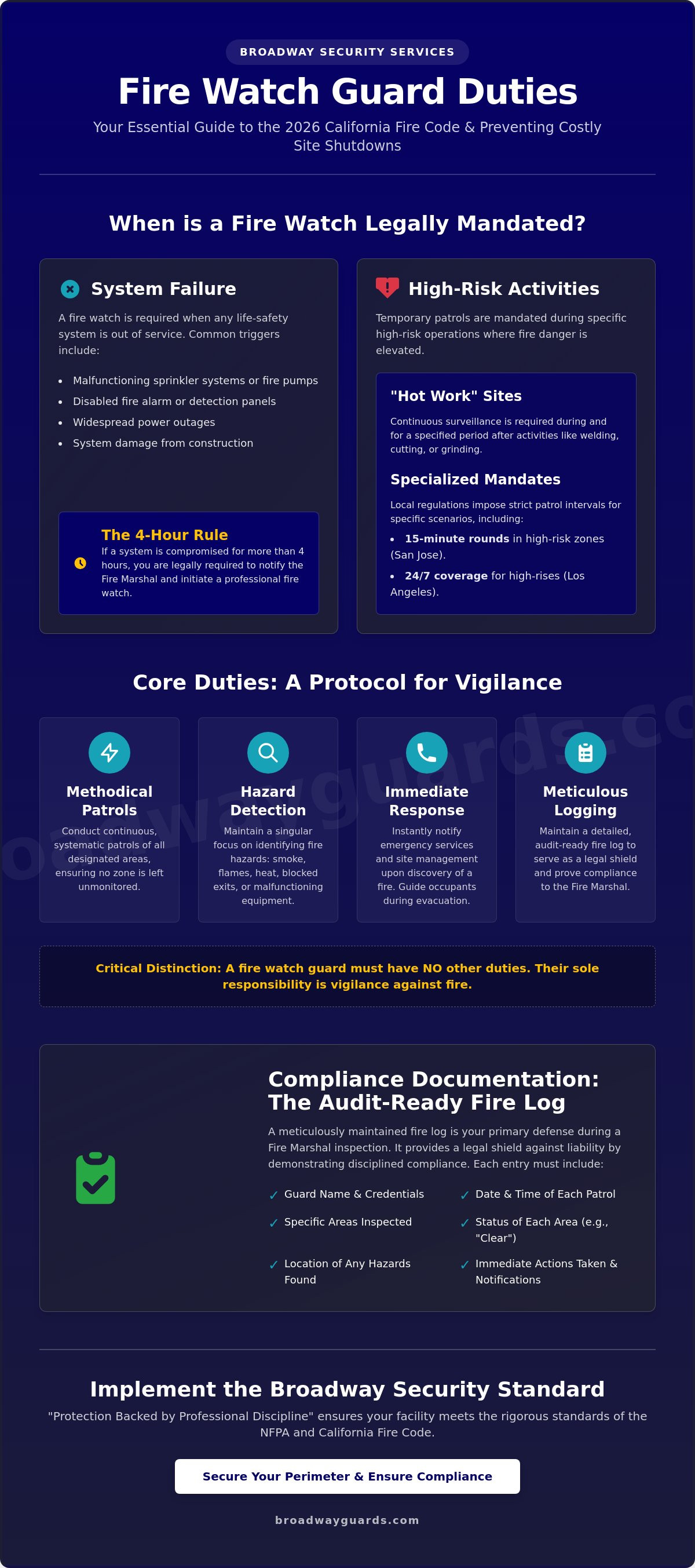
A fire watch log is a legal document, not a simple checklist. To withstand a CMS audit, every entry must include precise patrol times, the specific smoke compartments inspected, and clear hazard identification. Digital logs offer a superior level of accountability over paper systems by providing time-stamped verification of patrols that surveyors can’t dispute. These records must be readily available for inspection at a moment’s notice, reflecting a state of constant preparedness. The ILSM framework serves as the primary regulatory bridge that maintains facility safety and legal standing during fire system downtime.
CMS Survey Preparedness: Avoiding Costly Findings
Professional fire watch guards serve as your front-line defense during unannounced inspections. Surveyors look for gaps in coverage and signs of untrained personnel who don’t understand the gravity of their post. If a guard cannot articulate their specific duties within the ILSM protocol, the facility faces immediate citations that can lead to “Immediate Jeopardy” status. Conducting a thorough security risk assessment CA is the first step in establishing these protocols. By utilizing a disciplined force, you eliminate the common pitfalls of incomplete logs and inconsistent patrols. You can trust the experts at Broadway Security Services to maintain the rigorous standards your facility requires to avoid costly findings.
The Defend-in-Place Doctrine: How Professional Fire Watch Supports Clinical Care
The “defend-in-place” doctrine is the cornerstone of modern healthcare safety. It acknowledges that evacuating critically ill patients often presents a greater risk to life than the fire itself. Consequently, hospitals rely on structural compartmentalization to protect patients while bringing the response directly to the hazard. When active suppression systems fail, specialized hospital fire watch services become the mobile extension of those fire walls. By deploying a disciplined shield of personnel, Broadway Security Services ensures the facility remains a secure environment without the trauma of mass relocation. This approach aligns with federal CMS fire safety requirements, which prioritize patient stability alongside rigorous monitoring.
The presence of a professional guard has a profound psychological effect on both staff and patients. Nurses and physicians must focus on clinical outcomes, not scanning hallways for smoke or heat. A vigilant protector allows medical teams to operate with full concentration, knowing every corridor is under methodical oversight. Our personnel are trained to integrate into hospital workflows with clinical sensitivity. They maintain a quiet, professional presence that respects the healing environment while providing high-stakes reliability in every wing of the facility.
Tactical Patrols in Sensitive Clinical Areas
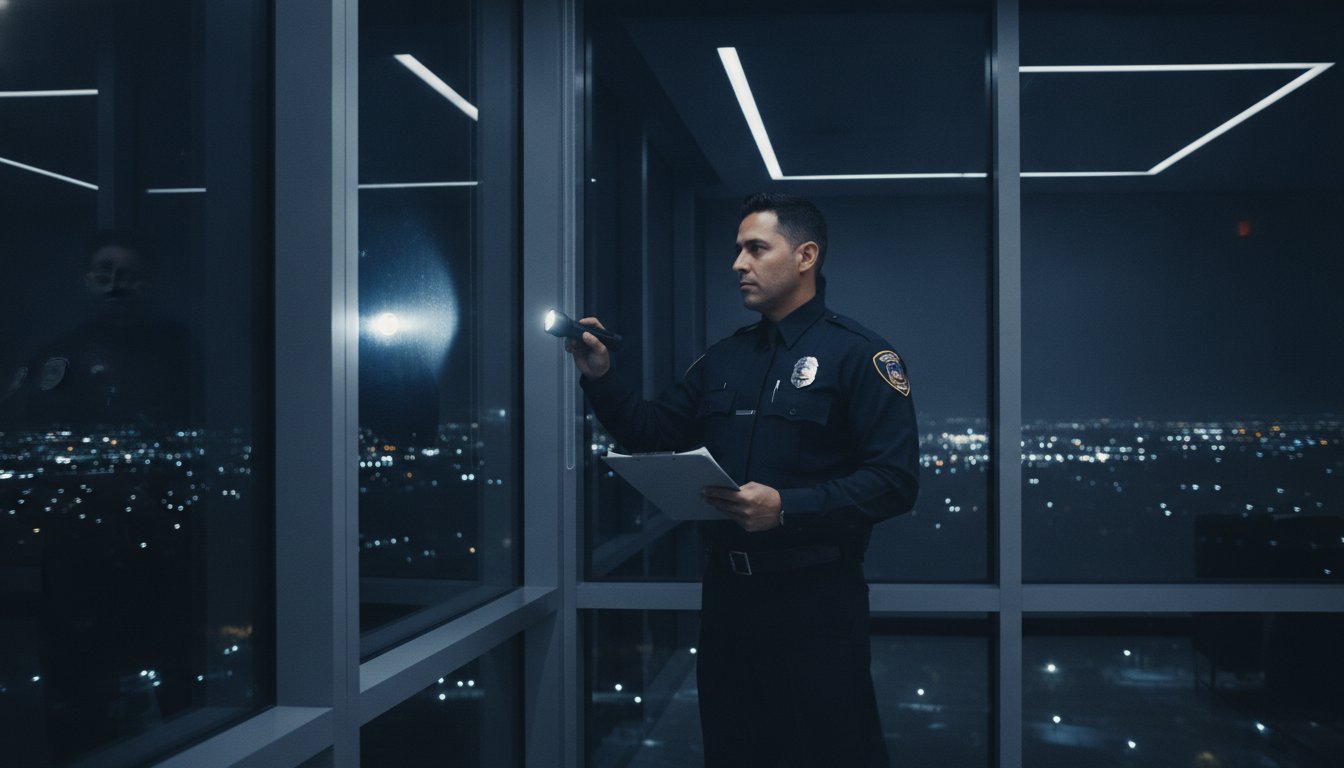
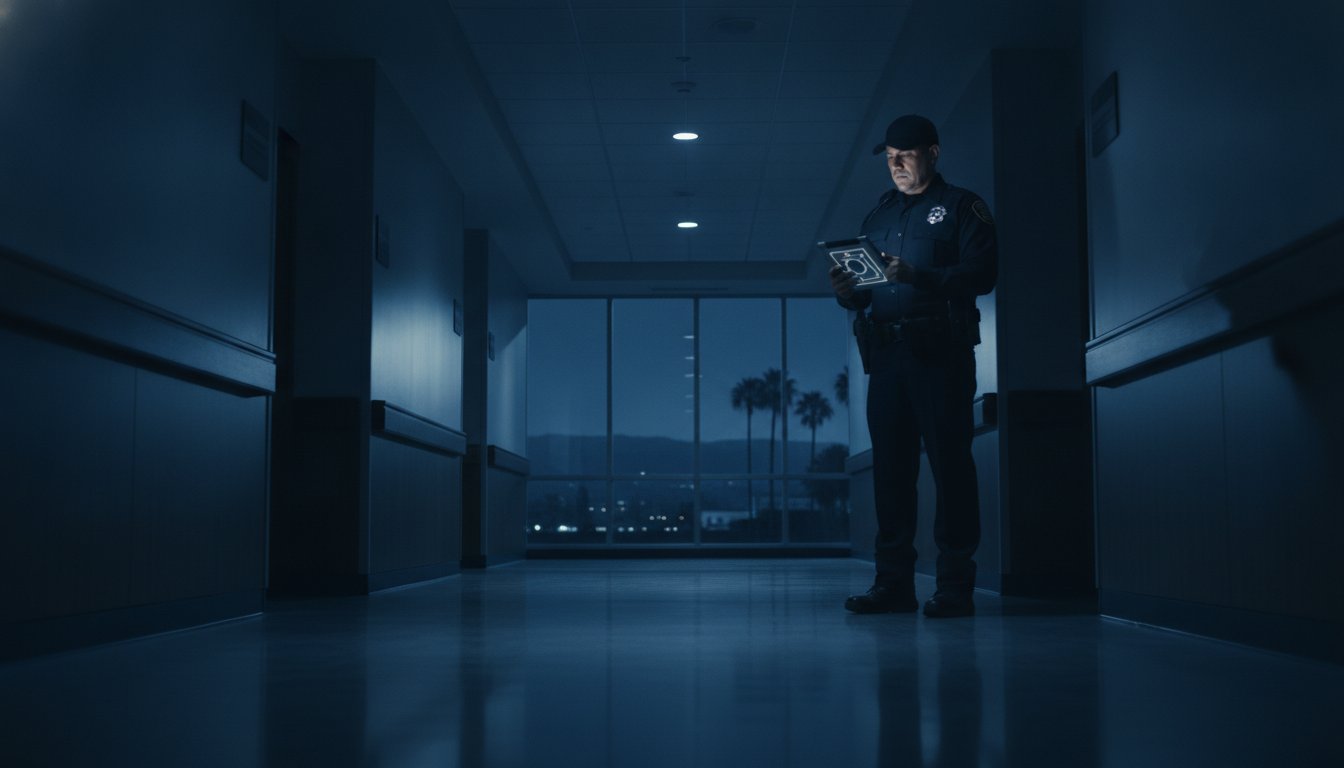
Patrolling an ICU, NICU, or surgical suite requires more than just a walking route; it demands an understanding of medical-specific hazards. Our guards receive specialized training to recognize the risks associated with pressurized gases, hazardous materials, and sensitive electronic equipment. This “silent vigilance” ensures that the most vulnerable zones receive the highest level of protection without disturbing patient rest or recovery. Broadway Security Services personnel move with purpose and discretion, ensuring every patrol reinforces the safety of the clinical mission through unwavering observation.
Communication Protocols Between Guards and Hospital Staff
Effective fire watch relies on a rigid chain of command and clear communication. In the event of an actual emergency, our guards act as an organized force to assist hospital staff with internal patient relocation. They provide the direct, authoritative communication needed to execute horizontal evacuations across smoke compartments efficiently. By establishing these protocols before an incident occurs, we bridge the gap between security and clinical care. Every patrol is a disciplined shield, protecting both the physical assets of the facility and the lives within its walls.

Implementing an Emergency Fire Watch: A 5-Step Rapid Response Protocol
When a fire suppression system fails, the window for action is narrow. A structured response is the only way to maintain safety and avoid the heavy hand of regulatory enforcement. Broadway Security Services operates with a sense of urgency and order, ensuring your facility transitions from impairment to a state of vigilant oversight without delay. Following a specific protocol prevents the confusion that often leads to CMS citations or Fire Marshal intervention. Our hospital fire watch services provide the disciplined framework necessary to manage these high-stakes transitions with military precision.
- Step 1: Immediate Notification. Inform the Fire Marshal and your insurance providers. This creates the legal record of the impairment and your intent to comply with safety standards.
- Step 2: Rapid Deployment. Mobilize certified personnel immediately. Having a professional force on-site before the four-hour mark is critical to maintaining facility operational status.
- Step 3: Site Orientation and ILSM Briefing. Conduct a thorough briefing on Interim Life Safety Measures. Every guard must understand the specific hazards and “defend-in-place” protocols of the facility.
- Step 4: Commencement of Continuous Patrols. Begin documented rounds across all impaired zones. Vigilance must be constant, with no gaps in observation or reporting.
- Step 5: Daily Log Review. Audit fire watch logs every 24 hours. This ensures ongoing compliance and allows for the immediate mitigation of any newly identified hazards.
Rapid Deployment for Southern California Facilities
Our strategic proximity to Woodland Hills and Canoga Park ensures that we can provide an emergency response that outpaces generic security firms. We manage the logistics of 24/7 staffing to ensure zero lapses in coverage during shift changes. A disciplined shield is only effective if it remains unbroken. Our fire watch services California pillar guide serves as the foundation for this rapid response, providing a clear roadmap for facility managers under pressure. We prioritize reliability so you can focus on clinical care.
Site Orientation: More Than Just a Walkthrough
A professional guard must know the terrain to protect it. Our orientation process involves identifying critical shut-off valves, fire exits, and high-risk utility rooms that standard patrols might overlook. We brief our personnel on the specific smoke compartments and “defend-in-place” zones unique to your healthcare environment. This level of detail allows our guards to integrate seamlessly into the hospital’s existing incident command system. By understanding the facility’s geography, our team acts as a vigilant extension of your internal safety department. Contact Broadway Security Services today to secure a disciplined response for your facility.
Broadway Security: Disciplined Fire Watch Solutions for Southern California Healthcare
Broadway Security Services stands as the premier provider of hospital fire watch services for the San Fernando Valley and the greater Los Angeles area. Our deep roots in Canoga Park and Woodland Hills allow us to offer a level of accountability that national firms cannot match. We understand the specific expectations of local Fire Marshals and the nuances of Southern California regulatory scrutiny. This local expertise ensures that our response is not only rapid but also perfectly aligned with the standards of your specific jurisdiction. We provide a disciplined presence that acts as an unyielding force against the risks of fire and non-compliance.
Facility safety often requires a multi-layered approach that extends beyond fire observation. To achieve total facility security, we offer the ability to integrate our fire watch personnel with armed security guard services Los Angeles. This combination creates a comprehensive shield for your institution, addressing both life safety impairments and physical security threats simultaneously. By consolidating these functions under a single, disciplined partner, you ensure a unified chain of command and a consistent standard of professional conduct across your entire campus.
The Broadway Standard: Training and Discipline
Our guards undergo a rigorous vetting process specifically designed for high-stakes healthcare assignments. We do not deploy generalists; we deploy specialists who understand the gravity of their post. Every member of our team receives training in clinical sensitivity and the technical requirements of hospital smoke compartments. To maintain patrol integrity, we implement constant field supervision and unannounced site checks. This oversight ensures that every entry in your fire watch log is accurate and every corridor is monitored with military precision. We position our guards as the disciplined shield of your institution, valuing rules and protocols above all else.
Securing Your Facility Today
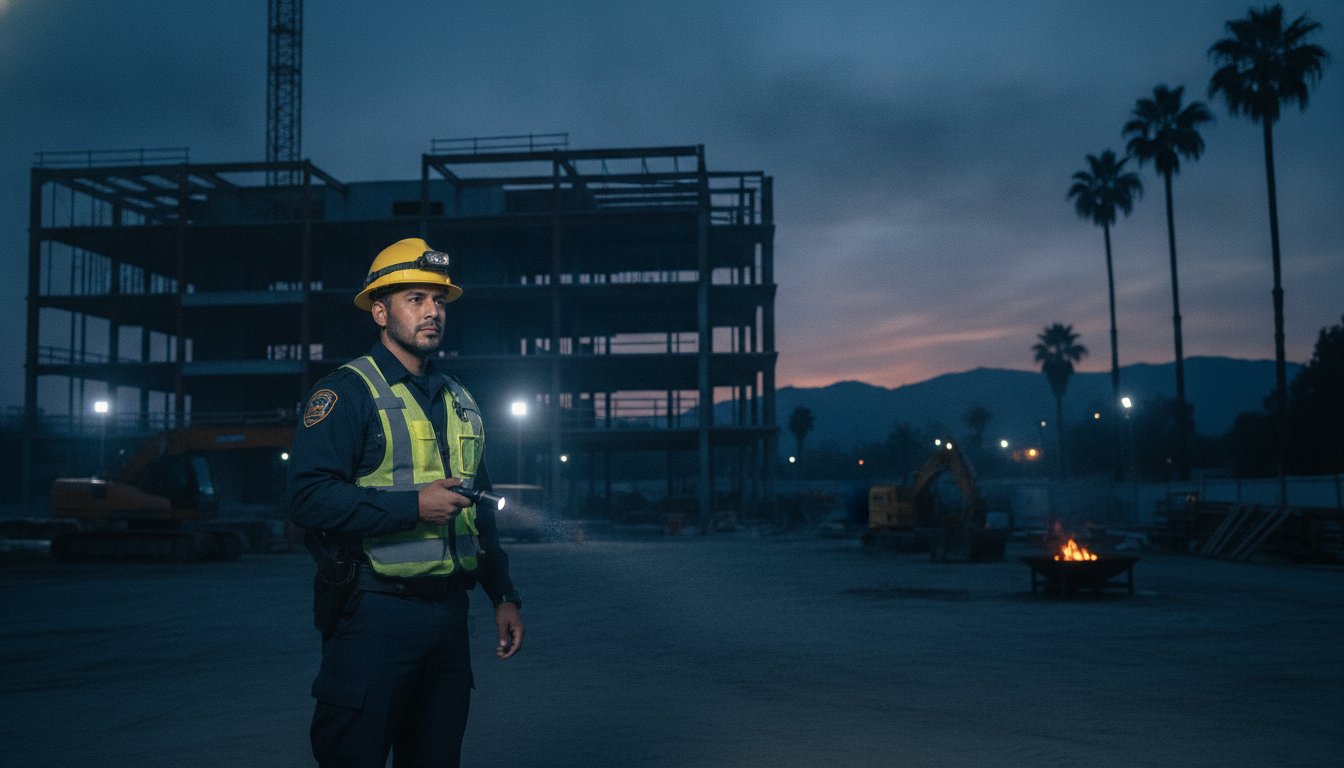
Initiating a contract for hospital fire watch services with Broadway Security Services is a direct and efficient process. We offer customizable solutions that scale to your specific needs, whether you face a sudden system impairment or a multi-year construction project requiring “hot work” oversight. Our team is prepared to deploy certified personnel to your facility at a moment’s notice, ensuring you never exceed the critical four-hour impairment window. This responsiveness is backed by a commitment to safety through operational rigor that defines our brand identity.
Don’t leave your accreditation or patient safety to chance. Contact our Canoga Park office for immediate healthcare fire watch deployment. Secure your perimeter now.
Securing Your Facility’s Compliance and Patient Safety
Maintaining facility operational status during fire system impairments requires more than just meeting a legal requirement. It demands a commitment to the defend-in-place doctrine and the unwavering oversight of trained professionals. You’ve seen how rigorous documentation and rapid deployment protocols prevent CMS Immediate Jeopardy findings. Reliable hospital fire watch services bridge the gap between technical failure and clinical excellence.
Broadway Security Services provides this bridge with a Woodland Hills headquarters designed for rapid Southern California deployment. Our team brings specialized expertise in ILSM and CMS compliance to every wing of your institution. We deploy disciplined, professional security personnel who act as a vigilant shield for your assets and your patients. Trust our local accountability and military-grade precision to maintain your facility safety standards without compromise.
Secure Your Healthcare Facility with Broadway’s Disciplined Fire Watch Services. Your facility remains a safe harbor under our watch.
Frequently Asked Questions
What is the difference between standard fire watch and hospital fire watch?
Hospital fire watch services differ significantly from standard commercial patrols because they operate within a “defend-in-place” framework. While standard guards might focus on evacuation, healthcare specialists prioritize the protection of non-ambulatory patients and the maintenance of smoke compartments. These guards must understand medical-specific hazards, such as pressurized oxygen and sensitive electronics. This specialized oversight ensures that clinical operations continue without disruption while satisfying the rigorous demands of CMS and the California State Fire Marshal.
How quickly can Broadway Security Services deploy to a hospital in Canoga Park?
Broadway Security Services maintains its headquarters in Woodland Hills, which allows for rapid deployment to Canoga Park and the surrounding San Fernando Valley. Our strategic location ensures that we can mobilize certified personnel to your facility well within the critical four-hour impairment window. This proximity is a core component of our disciplined shield, providing healthcare administrators with the high-stakes reliability needed to avoid immediate facility shutdowns and costly regulatory fines during system failures.
Does CMS require a specific format for fire watch logs?
CMS does not mandate a specific visual template, but it requires that documentation adheres to the 2012 edition of NFPA 101. Every log must be auditable, showing precise patrol times, specific smoke compartments visited, and any hazards identified. Broadway Security Services utilizes a reporting structure that mirrors military precision, ensuring every entry is time-stamped and Marshal-ready. Digital logs are preferred for modern auditing because they provide verifiable proof of presence that paper records cannot match.
Can fire watch guards perform other security duties while on patrol?
A guard assigned to a fire watch post cannot perform other security duties simultaneously. Regulatory standards from the NFPA and CMS require fire watch personnel to remain dedicated solely to the detection and prevention of fire hazards. Any distraction from this primary duty compromises the safety of the “defend-in-place” population and risks an Immediate Jeopardy finding during a survey. Our personnel focus exclusively on their patrol routes to ensure the integrity of your facility’s interim life safety measures.
How long can a hospital operate under a fire watch before needing system repairs?
A hospital can operate under a fire watch as long as the Authority Having Jurisdiction or Fire Marshal permits, provided the interim life safety measures are fully maintained. However, fire watch is intended as a temporary solution while system repairs are expedited. Prolonged reliance on manual patrols may draw increased scrutiny from surveyors. Broadway Security Services provides the professional oversight needed for both short-term emergency impairments and long-term construction projects, ensuring continuous compliance until your systems are restored.
Are Broadway’s fire watch guards trained in NFPA 101 standards?
Our guards receive specialized training that covers the requirements of the NFPA 101 Life Safety Code, specifically the 2012 edition mandated by CMS. This training ensures that every member of our force understands the technical aspects of smoke barriers, exit access, and hazard identification within a clinical setting. By maintaining these high standards of personnel management, we provide a disciplined protector for your facility. This expertise grounds our professional claims in legal and regulatory reality for California healthcare.
What happens if a fire watch guard discovers a hazard during a patrol?
When a guard discovers a hazard, they follow a rigid communication protocol to ensure immediate mitigation. This includes notifying the hospital’s incident command and the facility manager while simultaneously documenting the event in the fire watch log. If the hazard presents an immediate threat, the guard initiates the facility’s internal emergency response plan to protect patient areas. Every action is recorded with surgical accuracy to provide a clear audit trail for future Fire Marshal inspections or CMS surveys.
Is a fire watch required for planned fire alarm maintenance?
A fire watch is legally required during planned maintenance if the fire alarm or sprinkler system will be out of service for more than four hours in a 24-hour period. This requirement applies even if the maintenance is scheduled in advance. Implementing professional hospital fire watch services during these windows ensures that your facility remains compliant with the 2025 California Fire Code. Proactive deployment prevents the risk of accidental system triggers or undetected ignitions while technicians work on the primary suppression infrastructure.