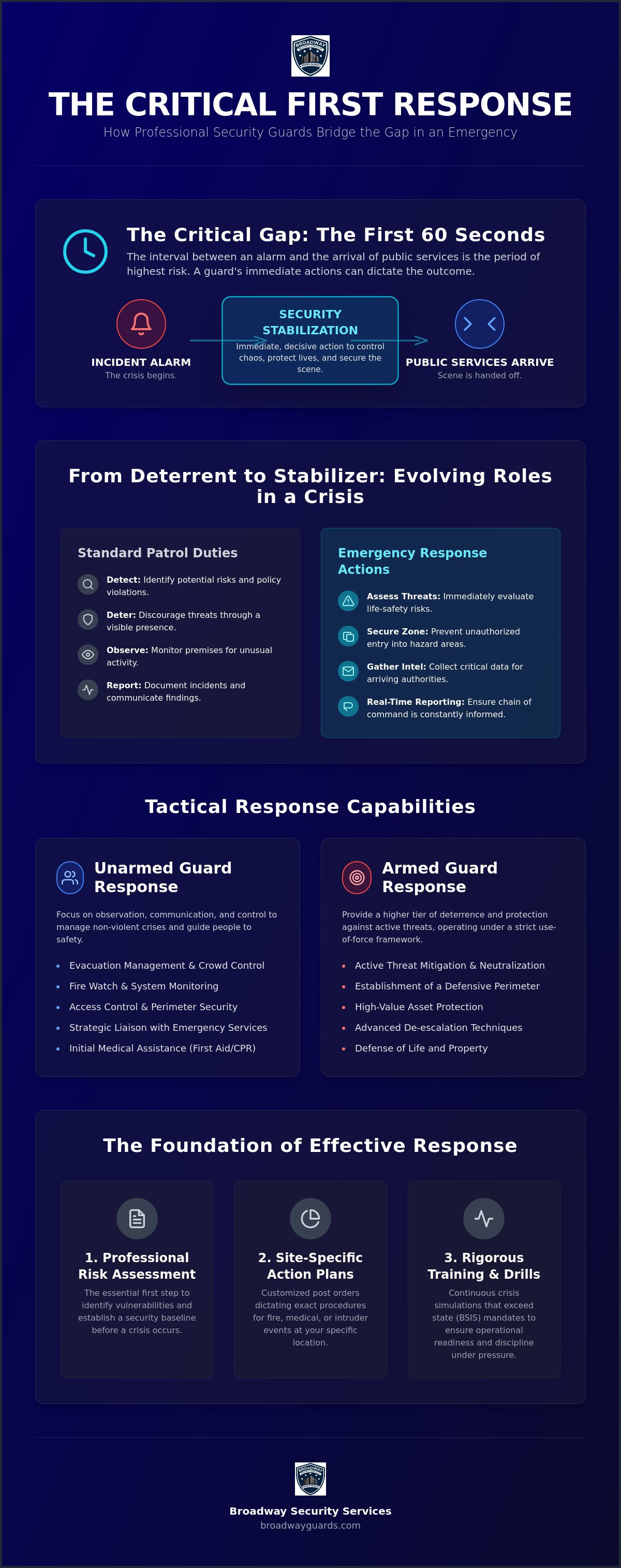
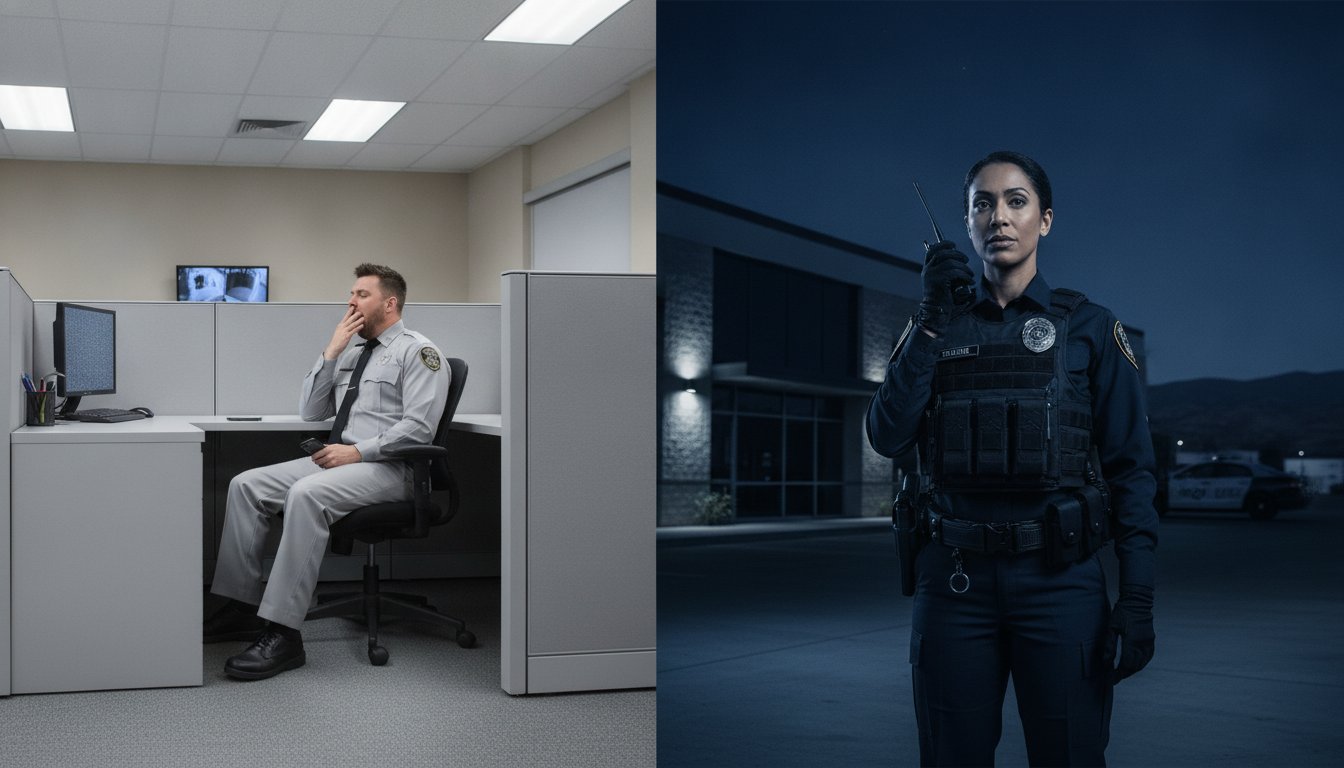
In-House vs. Contract Security: 2026 Strategic Guide

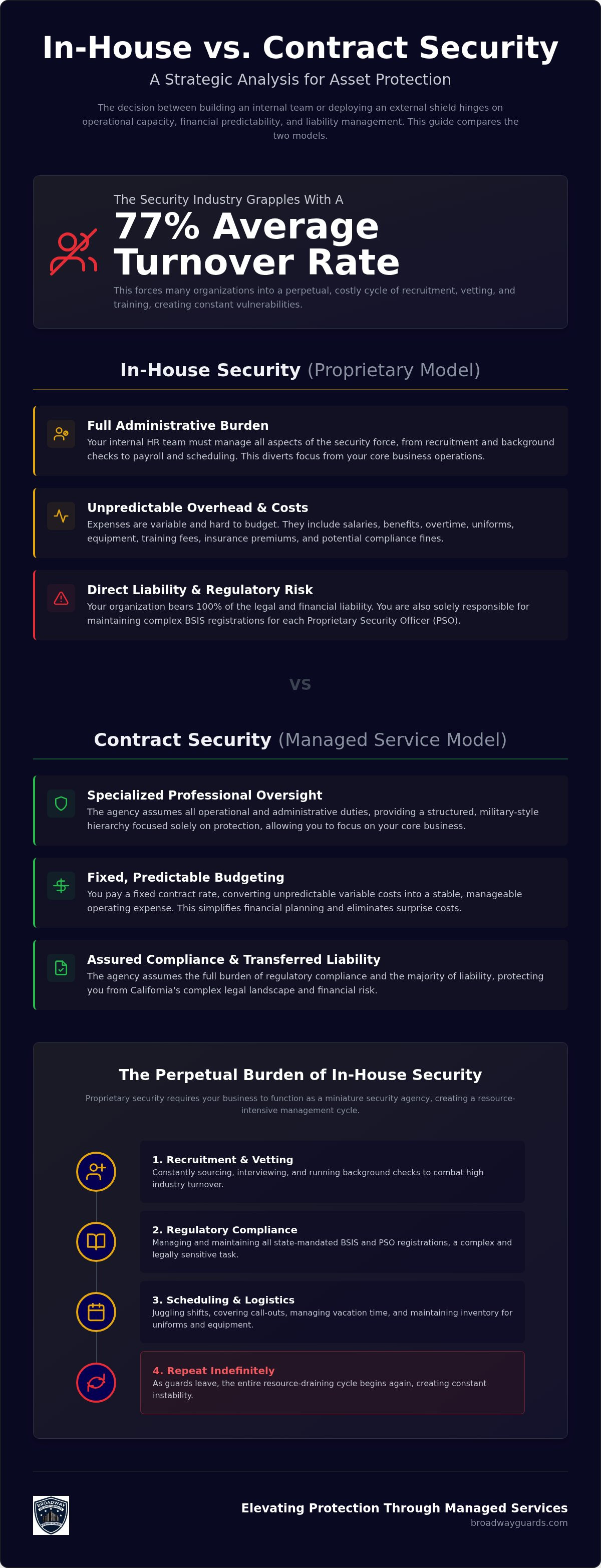
The security industry is currently grappling with a staggering 77% average turnover rate, forcing many organizations to spend more time on recruitment than on actual protection. You understand that maintaining a vigilant perimeter requires more than just bodies in uniforms; it demands a level of discipline and oversight that often clashes with internal HR capabilities. When evaluating in-house vs contract security guards, the decision often hinges on whether your business is equipped to function as a miniature security agency or if you require a dedicated, external shield.

This 2026 strategic guide provides a rigorous analysis of the operational, financial, and legal frameworks governing modern security forces. You’ll gain a clear ROI comparison and learn how to mitigate liability through professional oversight and strict regulatory compliance. We’ll examine the specific advantages of contracted precision, including how specialized firms manage the complexities of California’s evolving data privacy laws and BSIS registration requirements. Our analysis moves from broad operational standards to specific industry applications to ensure your assets remain under the care of a vigilant and unyielding force.

Key Takeaways

  • Understand the fundamental operational differences between in-house vs contract security guards to determine which model aligns with your organization’s risk profile.
  • Identify the hidden administrative burdens of proprietary teams, specifically the rigorous BSIS training and compliance standards required in 2026.
  • Evaluate the financial advantages of fixed contract rates over the unpredictable overhead and liability risks associated with direct employment.
  • Determine the necessity of agency-level training for high-risk deployments, ensuring your assets are protected by personnel with specialized tactical expertise.
  • Learn how to transition from basic guard placement to a managed service model that prioritizes military-style precision and unyielding oversight.

The Strategic Divide: Defining In-House vs. Contract Security Operations

The choice between in-house vs contract security guards represents a critical juncture for any organization focused on asset protection. In Southern California, the 2026 security environment is defined by rigorous regulatory standards and heightened operational complexity. Leaders must determine if their organization is better served by building an internal security department or by deploying a disciplined shield through a professional agency. This decision is frequently obscured by the “Control vs. Capability” debate. Many executives mistakenly believe that direct employment yields superior oversight. In practice, the lack of specialized management structures often results in reduced accountability and increased risk.

Proprietary security involves personnel hired directly by the entity they protect. These individuals are employees on your payroll. Contract security, however, utilizes a third-party Private Patrol Operator to provide comprehensive security services. Establishing a foundation by Defining Security Guard Roles helps clarify why a specialized approach is often the more reliable path to safety and peace of mind.

Proprietary Security: The ‘Direct Hire’ Model

Under California law, in-house personnel must hold a Proprietary Security Officer (PSO) registration. These guards are managed by your internal human resources team, which creates a perceived benefit of brand alignment and cultural integration. You might feel that direct hires are more loyal to your specific mission. Yet, the administrative weight of this model is significant. Managing background checks, drug testing, and payroll for a security force is a complex task. When security is not your primary business, these responsibilities often become HR headaches that lead to unpredictable costs and gaps in coverage.

Contract Security: The ‘Managed Service’ Model

The contract model functions as a disciplined managed service where the agency assumes all operational risks and administrative duties. Licensed agencies provide a professional presence that is difficult to replicate internally. This expertise is particularly evident in the deployment of unarmed security guards, where professional agencies maintain high standards of discipline and field reporting. By utilizing a contract service, you gain access to a structured hierarchy and military-like precision. The agency handles the training and oversight, ensuring that your assets remain under the care of a vigilant and unyielding force without the burden of direct employee management.

The Operational Burden of Proprietary Security Management

Maintaining a proprietary security force requires an immense commitment to administrative precision. When Comparing In-House and Contracted Guarding, the primary differentiator is the volume of non-core tasks shifted onto your management team. Recruitment alone is a constant struggle. With industry turnover rates averaging 77% as of 2024, an in-house department often finds itself in a perpetual cycle of vetting and drug testing. This isn’t just an HR inconvenience; it’s a security vulnerability. Every vacancy in the schedule represents a weakness in your perimeter.

The logistical requirements extend far beyond personnel. You must manage uniforms, communication equipment, and protective gear. Each piece of hardware requires maintenance and inventory tracking. If a guard calls out or requests vacation, the burden of finding coverage falls on your staff. This scheduling nightmare is particularly acute during emergency Fire Watch Services needs, where immediate deployment is a legal necessity. Professional agencies remove this burden by maintaining a deep roster of disciplined personnel ready for rapid deployment.

HR and Regulatory Compliance in California

California’s regulatory environment is exceptionally demanding. The Bureau of Security and Investigative Services (BSIS) mandates specific registration for Proprietary Security Officers (PSO). Maintaining these records for legal audits is a full-time professional pursuit. Most HR departments don’t realize that security guard training CA standards require ongoing education and annual refresher courses. Gaps in these records don’t just result in fines; they create catastrophic legal exposure for your organization.

Infrastructure and Oversight Costs

The financial reality of in-house vs contract security guards involves significant invisible costs. You aren’t just paying an hourly wage. You’re paying for worker’s compensation, payroll taxes, and specialized liability insurance premiums. If an in-house guard makes a tactical error, your organization bears the full weight of the legal consequences. The total cost of ownership for an in-house guard typically exceeds the hourly rate of a contract service by 15% to 35% once all overhead and liability risks are factored in. By shifting to a managed model, you transfer these risks to a disciplined protector equipped to handle them.

Performance Metrics: Comparing Cost, Liability, and Scalability

Measuring the efficacy of in-house vs contract security guards requires a focus on measurable outcomes. For a professional organization, safety is a product of rigorous oversight and financial clarity. Contract security models offer a level of fiscal predictability that proprietary departments struggle to match. When you engage a professional agency, you replace variable HR costs with a fixed hourly rate. This shift allows for precise budgeting. It removes the financial volatility associated with staffing shortages, equipment maintenance, or sudden training requirements. A disciplined protector provides results that are both visible and verifiable.

Proprietary models often lack the operational depth necessary for high-stakes environments. Professional agencies maintain specialized units ready for immediate deployment. Whether you require executive protection or rapid response, a managed service provides a level of readiness that internal teams rarely achieve. This operational readiness ensures your assets remain under the care of a vigilant and unyielding force, regardless of the threat level.

The Cost Efficiency Analysis

A true comparison requires looking beyond the base hourly wage. In-house guards carry a “burdened” cost that includes payroll taxes, healthcare, and worker’s compensation. Contract services eliminate the “Overtime Trap” that occurs when internal staff members call out or take leave. The agency absorbs these costs, providing a consistent presence without inflating your budget. Professional oversight also includes a continuous security risk assessment CA to ensure resources are deployed where they are most effective. This strategic approach prevents loss and maximizes your return on investment.

Scalability and Emergency Response

Scalability is a critical metric for 2026. A proprietary team is rigid; hiring new personnel takes weeks of vetting and training. Professional agencies offer instant scalability. You can deploy mobile patrol services to cover new construction phases or expanded perimeters without delay. This flexibility is vital for managing seasonal spikes in retail or large-scale event security needs.

Emergency situations demand immediate action. Contract firms are uniquely equipped for emergency fire watch services, maintaining a roster of guards who are trained and ready for short-term projects. When a fire system fails, you don’t have time to interview new hires. You need a disciplined shield that can be on-site within hours. This rapid deployment capability is a hallmark of professional managed services, providing peace of mind when your assets are most vulnerable.
In-House vs. Contract Security: 2026 Strategic Guide

Industry-Specific Deployment: Matching the Model to Your Risk Profile

Selecting the correct protection model requires an objective assessment of your environment’s specific threats. A corporate lobby in Woodland Hills demands a different tactical approach than a high-value industrial site. When comparing in-house vs contract security guards, the primary factor is whether your internal team can sustain the specialized training required for your specific industry. For high-risk facilities, the stakes are too high for generalist HR management. These environments require armed security guard services Los Angeles, where personnel are subjected to agency-level oversight and continuous tactical drills that exceed standard proprietary requirements.

Corporate offices often struggle to balance a concierge-style presence with professional deterrence. In-house guards may become too familiar with regular staff, which often leads to a dangerous erosion of security protocol. Contracted guards maintain a necessary distance that preserves the integrity of the post. This third-party objectivity is equally vital in retail and loss prevention. A disciplined protector remains focused on the mission of prevention rather than workplace social dynamics. This professional separation ensures that rules and protocols are followed without exception.

Construction and Industrial Site Needs

Construction sites are notoriously difficult to secure with proprietary teams due to high personnel turnover and shifting perimeters. Managed services provide a scalable solution that adapts as the project evolves through various phases. By integrating construction site security guards with mobile patrol, you ensure comprehensive coverage of large industrial areas. In regions like Canoga Park and the San Fernando Valley, vandalism and theft deterrence require a visible, mobile force. Professional agencies provide the specialized vehicles and communication technology needed to maintain a unyielding presence across expansive sites.

Events and High-Traffic Venues

Staffing a major venue is a logistical challenge that proprietary departments are rarely equipped to handle. Attempting to hire and vet 50 or more in-house guards for a single day is a logistical impossibility for most businesses. Organizations instead leverage event security Los Angeles to access a disciplined pool of crowd control specialists. This model prioritizes presence and prevention, ensuring that public-facing roles are filled by professionals who understand the intersection of safety and service. You don’t just get bodies; you get a structured hierarchy designed for high-stakes reliability.

If you’re ready to deploy a disciplined shield tailored to your specific industry, contact Broadway Security Services to secure your assets effectively.

The Broadway Security Standard: Elevating Protection Through Managed Services

Broadway Security Services operates on the principle of the “Disciplined Protector.” We move beyond simple guard placement to establish a strategic safety framework. This approach is rooted in the belief that security is not a commodity; it is a rigorous operational standard. When organizations evaluate in-house vs contract security guards, they often overlook the necessity of constant, high-level oversight. Our 24/7 management structure ensures a level of accountability that internal supervisors rarely achieve. We provide a structured hierarchy where every officer understands their role within a larger, unyielding shield.

Our Southern California operations are defined by military-style precision. We conduct rigorous vetting and background checks that exceed standard HR protocols. This commitment to excellence extends to our strategic integration of services. We don’t just provide personnel; we coordinate armed guards, unarmed guards, and fire watch units into a unified defense. This ensures your assets remain under the care of a force that is as vigilant as it is professional. Our methodology prioritizes presence and prevention, creating an atmosphere of high-stakes reliability for every client.

Our Commitment to San Fernando Valley Businesses

Our localized expertise in Woodland Hills and Canoga Park allows us to navigate regional safety protocols with ease. We understand the specific threats facing businesses in the San Fernando Valley. This knowledge informs our staffing levels and tactical deployments. Every engagement begins with a professional security risk assessment. This assessment is the foundation of our operational rigor. It ensures that your security plan is not based on guesswork but on documented requirements and regulatory compliance. The Broadway promise is one of reliability grounded in field-tested experience and a stoic commitment to duty.

Making the Transition to Managed Security

Phasing out an in-house team for an agency model requires a methodical approach. We provide step-by-step guidance to ensure there is no gap in your protection during the transition. The process begins with a comprehensive audit of your current protocols and personnel. When evaluating a security contract, look for transparency regarding training hours and reporting structures. A professional contract should hold the agency to specific, measurable performance metrics. This ensures that your organization transitions from a vulnerable internal model to a professional managed service without operational friction.

We invite you to experience the Broadway standard of protection. Secure your assets with a force that values discipline, order, and visible results above all else. Contact Broadway Security Services today for a professional consultation and take the first step toward a more secure future.

Securing Your Future With Strategic Precision

The decision between in-house vs contract security guards ultimately determines whether your organization focuses on its core mission or on the exhausting complexities of guard management. You’ve discovered how professional agencies provide a vital liability shield and financial predictability that proprietary teams often fail to achieve. By shifting the administrative weight of recruitment, training, and 2026 BSIS compliance to a dedicated provider, you ensure your perimeter remains unyielding. Protection is our duty. This strategic transition allows you to replace HR headaches with a disciplined, military-style presence that prioritizes safety above all else.

As a California BSIS Licensed Private Patrol Operator, Broadway Security Services provides highly trained armed and unarmed personnel with specialized expertise in San Fernando Valley risk mitigation. Our standards don’t waver. Our methodical oversight transforms security from a variable expense into a reliable professional asset. Secure your assets with a professional security consultation from Broadway Security Services today. Take command of your safety strategy and experience the peace of mind that comes with a vigilant and unyielding shield protecting your interests.

Frequently Asked Questions

Is contract security cheaper than in-house security in California?

Contract security is frequently more cost-effective because it eliminates the hidden overhead of direct employment. You pay a fixed hourly rate that covers recruitment, uniforms, and specialized insurance. This model removes the financial unpredictability of employee benefits and administrative management. It allows your organization to allocate resources toward core business functions while maintaining a professional presence.

What are the legal liabilities of hiring an in-house security team?

Hiring an in-house team exposes your organization to direct vicarious liability for every action your guards take. If a proprietary officer makes a tactical error or a legal misstep, your business bears the full legal and financial consequences. This includes potential lawsuits for wrongful detention or use of force. Contract agencies absorb a significant portion of this risk through their own comprehensive liability policies.

Do contract security guards receive the same training as in-house guards?

Contract guards typically undergo more frequent and specialized training than their proprietary counterparts. While both must meet state minimums, professional agencies implement rigorous tactical drills and crisis management protocols. This ensures that the personnel protecting your assets are prepared for high-stakes scenarios. When comparing in-house vs contract security guards, the depth of agency-level oversight often results in a more disciplined and prepared force.

Can I have a mix of in-house and contract security guards?

Implementing a hybrid model is a viable strategy for many large organizations. You might retain a small in-house management team to handle internal culture while utilizing contract guards for perimeter mobile patrols or high-traffic event security. This approach provides the flexibility to scale your force rapidly during periods of increased risk. It balances internal control with the operational depth of a professional agency.

What is a California Proprietary Security Officer (PSO) registration?

A California PSO registration is a legal requirement for unarmed security personnel employed directly by a business rather than a security agency. The Bureau of Security and Investigative Services (BSIS) mandates that these individuals complete a criminal background check and specific training hours. Failing to maintain current PSO records for your staff can result in significant regulatory fines and increased legal vulnerability during an audit.

How quickly can a contract security firm deploy guards for an emergency?

Professional agencies can typically deploy personnel within a few hours for emergency scenarios. This rapid response is essential for critical needs like fire watch services or sudden site breaches. Because contract firms maintain a deep roster of vetted officers, they can provide a disciplined shield much faster than an internal HR department can recruit and vet new hires. Reliability in a crisis is a hallmark of managed services.

Which industries benefit most from contract security services?

Industries with high turnover or fluctuating risk profiles, such as construction and retail, benefit the most from managed protection. These sectors require the scalability and specialized expertise that proprietary teams often lack. Healthcare facilities and high-traffic event venues also rely on contract services to manage complex crowd control and compliance requirements. A professional agency provides the unyielding oversight necessary to secure these diverse environments effectively.

What should I look for in a security guard contract for my business?

Your agreement should prioritize transparency regarding training standards, insurance limits, and field reporting protocols. Ensure the contract clearly defines the Private Patrol Operator’s responsibility for liability and regulatory compliance. When evaluating in-house vs contract security guards, a strong contract acts as a framework for accountability. It should include specific performance metrics and a clear hierarchy for communication to ensure your assets remain under vigilant care.
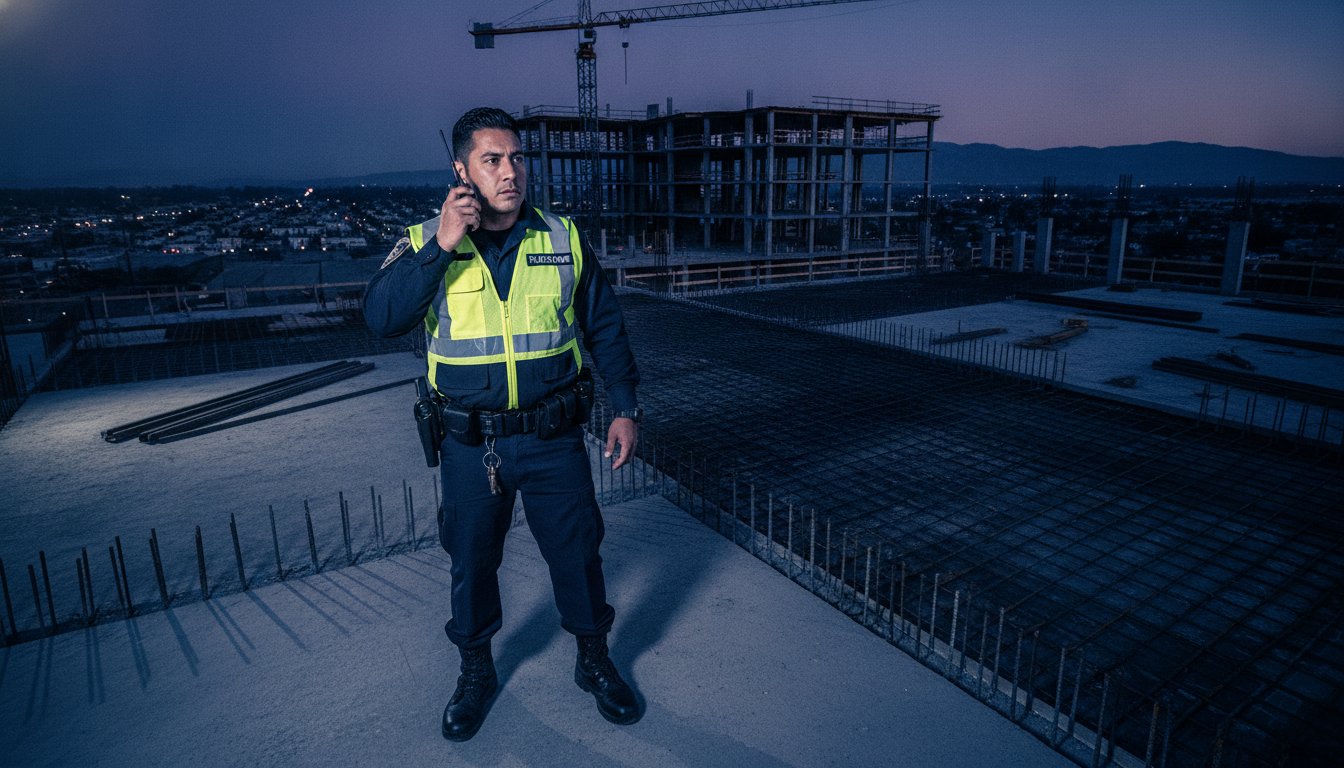

Construction Site Security Los Angeles: The 2026 Strategic Protection Guide

California construction firms lose an estimated $400 million annually to equipment theft, and the recovery rate for these assets remains a staggering 25%. In the high-stakes environment of Southern California, your project is a primary target for organized theft and copper stripping. Securing your perimeter requires more than just a fence; it demands a disciplined approach to construction site security Los Angeles developers can rely on to maintain order and prevent costly delays.

You understand that every hour of downtime caused by vandalism or unauthorized access erodes your profit margins. This strategic guide outlines a professional framework designed for the unique regulatory and risk landscape of 2026. We will detail how to navigate strict LAFD fire watch requirements, the implications of Assembly Bill 476 on metal theft, and the tactical oversight necessary to ensure your site remains a fortress. By implementing a rigorous standard of protection, you can mitigate liability and keep your project on schedule despite the increasing threats facing the industry.

Key Takeaways

  • Recognize the significant financial impact of local crime trends and why a reactive approach fails to protect high-value infrastructure assets.
  • Learn how a project-based risk assessment identifies site-specific vulnerabilities to establish a foundation for safety before guard deployment begins.
  • Master the strategic deployment of the “Disciplined Shield” philosophy when utilizing construction site security Los Angeles teams for asset protection.
  • Navigate the 2026 LAFD fire watch requirements to ensure total regulatory compliance and avoid project-halting fines.
  • Benefit from the rapid regional deployment and military-like precision offered by a provider based in the San Fernando Valley.

The High Stakes of Construction Site Security in Los Angeles

Professional construction site safety involves more than just hard hats and guardrails. In 2026, the construction site security Los Angeles developers implement must function as a disciplined system of deterrence, detection, and rapid response. Security isn’t a passive expense. It’s an active defensive posture. Current data indicates that less than 25% of stolen construction equipment is ever recovered. This reality makes a vigilant presence a non-negotiable asset for any urban development project. Los Angeles remains a high-risk environment due to its density and extensive transportation corridors. Thieves exploit freeways like the I-10 and 405 for quick getaways. Without a professional shield, your site is an open target for organized criminal elements looking for high-value assets.

Common Vulnerabilities for LA Development Projects

In the San Fernando Valley, heavy machinery and copper components are primary targets for sophisticated theft rings. Beyond the loss of property, unauthorized access creates significant legal liability. Under the legal doctrine of “attractive nuisance,” a property owner can be held liable for injuries to trespassers if the site isn’t properly secured. Vandalism and graffiti are also critical indicators of poor site oversight. These markings signal to the community and to criminals that the perimeter is weak. This perception of vulnerability invites further activity and suggests a site that isn’t under disciplined control. Maintaining a clean, monitored site is the first step in active deterrence.

The Financial Impact of Security Lapses

The true cost of a security breach extends far beyond the price of a stolen generator. A single theft incident can average between $30,000 and $50,000 in equipment replacement. These events often cause one to three weeks of project delays. Labor standstills occur when critical tools are missing, yet your payroll obligations continue. Implementing verified security measures often leads to insurance premium reductions of 10% to 25% on builders’ risk and general liability policies. In the context of 2026 LA building codes, site vulnerability is the measurable gap between a project’s physical perimeter and its operational ability to neutralize a breach before damage occurs. A professional presence ensures this gap remains closed, protecting both your timeline and your bottom line.

Strategic Risk Assessment: The Foundation of Site Safety

Effective construction site security Los Angeles requires a tactical understanding of the specific environment. A generic approach to protection is a liability. Every site presents unique challenges based on its phase of development and geographic location. Broadway Security Services utilizes a Project-Based Risk Assessment to build a disciplined shield around your assets. This methodology moves beyond simple observation. We analyze local crime statistics and site topography to determine optimal guard placement and patrol routes. For example, a site near a major transit corridor requires different protocols than a project in a secluded residential pocket of the San Fernando Valley. Our goal is to eliminate the element of surprise for potential intruders.

Rigorous oversight begins with a comprehensive site walk-through. We evaluate how the physical layout of your project influences security. High-density urban areas often provide cover for criminal activity; therefore, our assessment accounts for the specific risks associated with 2026 Los Angeles crime trends. We ensure that your security plan aligns with NFPA 241 fire safety standards to maintain compliance while maximizing protection. You can learn more about our specific process by reviewing our guide on how to conduct a professional security risk assessment in California.

Vulnerability Evaluation Protocols

  • Perimeter Integrity: We identify blind spots in fencing and evaluate the security of all access points to prevent unauthorized entry.
  • Lighting Efficiency: Our team assesses existing illumination to ensure it acts as a functional deterrent during overnight hours.
  • Asset Storage: We analyze the placement of tool trailers and material depots to ensure high-value inventory is within a controlled, observable zone.

Developing a Crisis Management Strategy

A disciplined shield is only effective if it includes a clear plan for response. We establish direct communication lines between our guards and your site supervisors to ensure immediate reporting of any anomalies. Our protocols include specific coordination steps with the LAPD to ensure that if a breach occurs, the response is swift and methodical. We develop custom strategies for high-risk phases, such as when copper wiring is installed or heavy machinery is first delivered to the site. This proactive planning minimizes the risk of project delays. For a tailored evaluation of your project, you should consult with a security professional who understands the Los Angeles landscape.

Armed vs. Unarmed Guards: Strategic Deployment for LA Sites

Force composition is the execution phase of the Disciplined Shield philosophy. It isn’t about simply filling shifts with personnel. It’s about matching the identified threat level with the appropriate level of authority and training. Effective construction site security Los Angeles projects often require a hybrid approach to maintain a vigilant and unyielding presence. Every guard on your site must represent a standard of order that discourages criminal intent before a breach occurs. This methodical oversight ensures that your assets are under the care of a force that values protocols and visible results above all else.

The operational differences between armed and unarmed personnel are defined by the stakes of the environment. While both roles prioritize prevention, their tactical applications differ significantly. Armed guards provide a high-stakes level of reliability in zones where organized theft rings are active. Unarmed guards manage the essential daily logistics of site access and reporting. Both tiers of service rely on military-like precision to ensure that no vulnerability goes unmonitored. Choosing the right mix is a decision that impacts both your project’s safety and its legal standing.

When to Deploy Armed Security Guard Services

High-value assets like specialized machinery or extensive copper inventory attract sophisticated criminal elements. In high-crime districts of Los Angeles, the visible presence of a disciplined, armed officer serves as the ultimate deterrent. These professionals are trained to handle high-risk encounters with composure and authority. If your project has entered a phase where material theft would cause a total labor standstill, armed protection is a necessary investment. For a deeper look at these protocols, review our Armed Security Guard Services Los Angeles guide.

The Role of Unarmed Guards and Mobile Patrols

Unarmed guards are the foundation of site discipline. They manage access control, visitor logging, and the detailed Daily Activity Reports (DAR) that provide you with a transparent record of site status. These guards ensure that only authorized personnel enter the perimeter, reducing the risk of liability from “attractive nuisance” claims. For developments in the San Fernando Valley with vast perimeters, mobile patrol services are a strategic asset. Our mobile units provide randomized, methodical oversight across large areas, ensuring that no section of the fence line remains unobserved for long. You can find more information on these roles in The Strategic Guide to Unarmed Security Guards.

Regulatory compliance is a structural requirement for operational continuity. The 2026 Los Angeles Fire Code (LAFC) dictates specific safety protocols that developers must follow to avoid immediate project suspension. Integrating fire watch into your construction site security Los Angeles strategy ensures that you are protected from both criminal elements and the legal fallout of a safety breach. A disciplined shield approach requires that every safety officer is trained to recognize hazards before they escalate into catastrophic events. This methodical oversight is essential for maintaining a site that is both secure and compliant with local ordinances.

Fire watch personnel serve as a vigilant force when automated systems are compromised. Their presence is a regulatory necessity that safeguards your high-stakes assets from the unpredictable nature of fire hazards. By prioritizing professional discipline, you ensure that your site adheres to the highest standards of safety, preventing the financial devastation that follows a major fire incident. To ensure your project meets all legal obligations, you should secure professional fire watch services from a team that understands the Los Angeles regulatory landscape.

California Fire Watch Requirements for Construction

A fire watch is legally required if a fire alarm or sprinkler system is out of service for more than four hours within a 24-hour period. This mandate ensures that a human presence remains observant when technology fails. The specific duties of a fire watch guard include conducting continuous patrols, maintaining a detailed fire log, and initiating emergency response protocols if smoke or flames are detected. For a comprehensive breakdown of these mandates, consult our guide on Professional Fire Watch Services California. Failure to maintain these records can result in substantial fines and the voiding of your insurance policies.

Hot Work Monitoring and Hazard Prevention

Hot work activities, such as welding, cutting, and grinding, are leading causes of construction site fires. These tasks require a dedicated observer to monitor for sparks and smoldering embers that could ignite combustible materials. A fire watch must be maintained for at least 30 minutes after hot work is completed to verify that the area is safe and free of potential ignition sources. This post-work rule is a critical component of a disciplined safety framework. Beyond active work hours, our team ensures site-wide adherence to fire safety protocols, providing you with peace of mind that your project remains under the care of a vigilant and unyielding force.

The Broadway Shield: Disciplined Security for Southern California

Broadway Security Services operates as a disciplined shield for developers across Southern California. Our strategic location in Canoga Park allows for rapid regional deployment throughout Greater Los Angeles and the San Fernando Valley. We understand that high-stakes assets require more than passive observation. Our framework is built on military-like precision and an unwavering commitment to duty. This level of professional oversight is the standard for construction site security Los Angeles firms must provide to ensure project stability in 2026.

Long-term project success depends on consistent, methodical oversight. Choosing a security partner is a decision that impacts your insurance standing, your timeline, and your peace of mind. Broadway provides a structured approach to protection that prioritizes safety and trust. We don’t just fill shifts. We manage risks through a hierarchy of protocols designed to neutralize threats before they result in losses. This result-oriented phrasing emphasizes accountability at every level of our operation.

Why Professionalism and Presence Matter

There is a significant tactical difference between a generic security presence and a Broadway-trained protector. A “warm body” provides a false sense of safety while often failing to follow the rigorous protocols necessary to deter organized theft. Our personnel are trained in field performance and reporting standards that provide developers with actionable data. Disciplined reporting ensures that every vulnerability is documented and addressed immediately. You can learn more about how our guards maintain order by reading about Construction Site Security Guards: Protecting Your Southern California Assets.

Next Steps: Securing Your 2026 Project

Securing your site begins with a transition from risk assessment to active protection. We initiate our process with a comprehensive evaluation of your project’s physical layout and current phase of development. This allows us to customize your security contract to match the specific threats you face, whether you’re in the early stages of excavation or the final phases of interior finishing. Our team remains observant and prepared to adapt our strategy as your site evolves. To establish a professional security framework for your next development, Secure your site with Broadway Security Services and ensure your assets are under the care of a vigilant force.

Fortify Your Project with a Disciplined Shield

Securing a high-stakes development in 2026 requires a transition from passive observation to active, methodical protection. This guide has detailed how a professional risk assessment and the strategic deployment of armed or unarmed guards create a foundation for site safety. You also understand that total compliance with LAFD fire watch standards is a structural requirement for operational continuity. By integrating these elements, you build a defensive posture that protects your assets and your project timeline.

Broadway Security Services stands as a vigilant force for developers across Southern California. Our BSIS-licensed personnel deliver military-grade operational rigor to every post. We utilize our Canoga Park local expertise to provide rapid deployment and unyielding oversight for every construction site security Los Angeles project we manage. It’s time to replace uncertainty with a standard of professional discipline that guarantees peace of mind.

Contact Broadway Security for a Professional Risk Assessment to secure your perimeter today. We are prepared to safeguard your investment with the precision your project demands.

Frequently Asked Questions

What are the legal requirements for construction site security in Los Angeles?

Construction sites in Los Angeles must adhere to the 2026 Los Angeles Fire Code (LAFC) and various municipal ordinances regarding perimeter integrity and public safety. These regulations mandate specific safety measures, including fire watch services when automated alarm or sprinkler systems are impaired for more than four hours. Legal compliance ensures that developers avoid costly stop-work orders and maintain their professional liability coverage throughout the project lifecycle.

How much does a fire watch service cost for a California project?

The investment required for fire watch services depends on the duration of the engagement and the specific risk profile of the construction site. Factors such as the total acreage of the project and the patrol frequency mandated by the local fire marshal influence the final cost. Developers should consult with a professional security provider to obtain a tailored quote that addresses their specific regulatory and safety needs.

Should I hire armed or unarmed guards for my San Fernando Valley site?

The choice between armed and unarmed personnel depends on the current threat level and the value of on-site assets. For high-risk areas in the San Fernando Valley, armed guards provide a high-stakes deterrent against organized theft rings targeting copper and machinery. Unarmed personnel are highly effective for managing access control and maintaining the daily activity logs essential for site discipline and project oversight.

How do security guards coordinate with local LAPD in an emergency?

Security personnel coordinate with the LAPD through established communication protocols and detailed incident reporting standards. In an emergency, guards provide immediate situational awareness and ensure clear access for responding officers to neutralize threats. This disciplined approach ensures that law enforcement receives accurate, real-time data, which is critical for a rapid and effective response to any perimeter breach or criminal activity.

What is included in a professional construction site risk assessment?

A professional risk assessment includes a methodical evaluation of perimeter fencing, access points, and lighting efficiency across the entire site. It also analyzes local crime trends to identify specific vulnerabilities in high-value material storage and heavy machinery zones. This assessment forms the foundation for a customized construction site security Los Angeles plan, ensuring that every identified gap is closed by a disciplined shield of protection.

Can security guards help reduce my construction insurance premiums?

Implementing verified security measures can lead to insurance premium reductions of 10% to 25% on builders’ risk and general liability policies. Insurers favor projects that utilize professional guards and comprehensive risk management strategies to mitigate potential losses. This reduction in overhead makes a disciplined security framework a financially sound investment that protects both your physical assets and your project’s overall profit margins.

What are the penalties for failing to provide a required fire watch in LA?

Failing to provide a required fire watch can result in substantial fines and the immediate issuance of stop-work orders by the LAFD. Non-compliance also risks the total voiding of insurance policies, leaving the developer legally and financially liable for all fire-related damages. Maintaining a vigilant human presence is the only way to ensure regulatory safety and project continuity under the current 2026 fire safety standards.

How does Broadway Security ensure guard accountability on-site?

Accountability is maintained through digital patrol logging and rigorous supervisor oversight that mirrors military-grade operational standards. Every guard must adhere to strict reporting protocols and submit detailed Daily Activity Reports (DAR) for client review. This structured hierarchy ensures that presence and prevention remain the core focus of every shift, providing developers with the peace of mind that their assets are under constant care.

High-Value Inventory Security: The 2026 Strategic Guide to Asset Protection

National cargo theft losses surged 60 percent to an estimated 725 million dollars in 2025, with the average value per theft climbing to 274,000 dollars. For operations in Los Angeles and the San Fernando Valley, these numbers represent a clear and present danger to your bottom line. Passive surveillance systems often leave critical blind spots that sophisticated criminal rings exploit with ease. True high-value inventory security is not a hardware problem. It’s a protocol and presence problem that requires a disciplined, professional approach to asset protection.

You’ve likely felt the pressure of rising insurance premiums and the constant threat of internal or external shrinkage. This guide provides the strategic framework you need to master the rigorous standards required to shield your assets in 2026. We’ll explore how to leverage California Senate Bill 553 and Proposition 36 to create a documented environment of compliance and safety. By the end of this article, you’ll understand how to implement a layered security architecture that reduces risk and provides the peace of mind that only methodical, vigilant oversight can deliver.

Key Takeaways

  • Identify the shift from passive recording to active prevention to counter sophisticated 2026 theft trends and organized crime rings.
  • Establish a layered architecture that integrates physical presence and rigorous access protocols for total high-value inventory security.
  • Evaluate the critical decision-making advantage of trained personnel over AI-driven surveillance in high-stakes scenarios.
  • Ensure operational compliance with California BSIS standards and mandatory SB 553 workplace violence prevention requirements.
  • Utilize professional risk assessments to identify and neutralize vulnerabilities within your logistics or retail framework.

The Strategic Importance of High-Value Inventory Security in 2026

High-value inventory security represents the rigorous integration of physical presence, advanced technology, and strict operational protocols to protect assets with high resale or strategic value. In 2026, the security landscape has moved beyond simple theft prevention. It’s now a battle against organized criminal networks that utilize sophisticated infiltration tactics. National cargo theft losses surged 60 percent to an estimated 725 million dollars in 2025, signaling that traditional, passive measures are no longer sufficient. When a single cargo theft now averages approximately 274,000 dollars in value, the financial stakes demand a disciplined approach to protection.

The financial ripple effect of a breach extends far beyond the replacement cost of the physical item. A loss event triggers massive operational downtime, damages your brand’s reputation for reliability, and leads to aggressive insurance premium hikes. This is why we advocate for the Disciplined Shield philosophy. Instead of merely recording a crime as it happens, our focus remains on proactive prevention. True security ensures that a breach never occurs by establishing an environment where criminal elements find no opportunity to strike. This methodical oversight turns your facility from a target into a fortress.

Identifying High-Value Targets in Modern Industry

Modern criminal rings prioritize assets that offer high-density value and immediate liquidity. Electronics and semiconductors remain top targets because their small physical footprint allows for rapid removal of massive capital. In the pharmaceutical sector, the stakes are even higher. Theft of medical equipment or controlled substances involves not just financial loss, but severe regulatory scrutiny and public safety risks. Luxury retail and high-end consumer goods also face constant pressure due to their high resale liquidity. Implementing effective Retail loss prevention strategies is essential for these industries to maintain their margins and operational integrity in a volatile market.

The Southern California Risk Profile

Southern California, particularly the San Fernando Valley, serves as a primary hub for global logistics and trade. This concentration of wealth makes areas like Canoga Park prime targets for organized theft rings. These criminal organizations often monitor warehouse traffic patterns and shipping manifests to identify vulnerabilities in high-value inventory security protocols. For businesses operating in this region, generic security measures aren’t enough. You need site-specific protocols that account for local crime trends and the high-speed nature of regional logistics. Establishing a professional guard presence provides the immediate, decisive response necessary to neutralize threats before they escalate into significant losses.

The Disciplined Shield: Building a Layered Security Architecture

High-value inventory security requires more than just high-definition cameras. It demands a physical and procedural architecture that deters threats before they reach the asset. We view security as a series of interlocking rings. Each layer must be reinforced by professional presence and documented oversight. This Disciplined Shield approach moves beyond the limitations of passive surveillance. While technology provides data, professional presence provides intervention. Building a layered security architecture ensures that a single point of failure doesn’t compromise your entire operation. This methodology creates multiple obstacles for an intruder, forcing them to navigate a gauntlet of physical and procedural barriers.

Perimeter integrity starts with a clear boundary of professional presence. A facility that appears unmonitored is a target. We establish a visible standard of order that signals to potential threats that the site is under active protection. This is supported by redundancy in reporting. Every entry, exit, and patrol movement is logged with military precision. This level of accountability ensures that there are no gaps in the timeline of your assets’ safety. Establishing this baseline of discipline is the first step in creating an unyielding defense.

Outer Perimeter Defense Strategies

Protecting the external boundary requires more than a fence. We utilize construction site security guards to manage physical barriers and monitor access points in high-risk environments. Visible mobile patrols add a dynamic layer of deterrence that static cameras cannot match. Professional guards provide the psychological deterrent of an active, thinking force. Combined with high-intensity illumination and clear signage, this perimeter strategy creates a formidable first line of defense that identifies threats at the earliest possible stage.

Internal Access and Zone Management

Once the perimeter is secured, the focus shifts to internal movement. High-value inventory security necessitates the creation of ‘No-Lone’ zones for ultra-high-value storage. In these areas, two authorized personnel must be present for access, reducing the risk of internal theft. We integrate biometric and RFID systems with human verification to ensure that credentials haven’t been compromised. Loading docks and shipping bays are the most vulnerable points in any logistics hub. Our gatekeeper protocols for personnel and vehicles ensure that every item leaving the facility is authorized and documented.

Internal inventory shrinkage remains a primary threat to profitability. By implementing these rigorous internal protocols, you reduce the opportunity for unauthorized movement. If you’re concerned about vulnerabilities in your current layout, engaging professional security services can help you harden your facility’s interior. This methodical approach ensures that your assets remain under constant, disciplined oversight, regardless of where they are in your supply chain.

Beyond Cameras: The Critical Role of Personnel in Loss Prevention

Technology alone cannot secure a facility against a motivated adversary. In 2026, professional, masked intruders have learned to exploit the limitations of passive surveillance. They understand that a camera only records their presence; it does not physically bar their progress. High-value inventory security requires a thinking defender who can interpret intent and react in real time. While AI-driven alerts provide data, they often suffer from latency or false positives. A human guard provides a decisive advantage by making immediate, high-stakes decisions that technology cannot replicate. This physical presence sets a tone of discipline that permeates the entire site.

Integrating unarmed security guards serves as a highly effective and cost-efficient visible deterrent. Their presence signals that the facility is not an easy target. It forces criminals to reconsider the risk of detection and confrontation. For many logistics hubs, this layer of professional oversight is enough to shift the risk-reward calculation in favor of the business. Guards ensure that protocols are followed, loading docks are monitored, and unauthorized personnel are challenged immediately. This active posture is the core of an effective asset protection strategy.

Armed vs. Unarmed Protection for Inventory

The decision to deploy armed security guard services Los Angeles depends on a rigorous assessment of the probability of violent confrontation. For ultra-high-risk assets such as bulk pharmaceuticals or high-density electronics, the level of threat may necessitate a higher tier of protection. California-certified armed personnel undergo extensive training to handle high-stress environments with precision and restraint. We evaluate your specific site profile to determine if the presence of a lethal deterrent is required to maintain the safety of your personnel and inventory. This ensures your protection matches the intensity of the threat.

The Psychology of Deterrence

Professional guard presence fundamentally alters how a criminal views your facility. A thief looking for a quick score will choose the warehouse with a passive alarm system over the one with a vigilant, uniformed guard. At Broadway Security, we maintain a standard of presence that is unyielding. Our guards are trained to remain observant and prepared, never allowing for the complacency that criminals exploit. In the event of a crisis, these professionals provide immediate incident response, managing the situation with the order and structure necessary to minimize loss and ensure safety. This methodical oversight is what truly shields your assets.

Compliance and Vulnerability: Navigating California Security Protocols

Effective high-value inventory security begins with a rigorous evaluation of your existing vulnerabilities. In California, a generic checklist is insufficient to meet the professional standards required for high-stakes asset protection. You must conduct a comprehensive security risk assessment CA to identify blind spots in your physical and procedural layers. This assessment serves as the blueprint for your defensive strategy. It ensures that every deployment is grounded in operational reality. A documented assessment also provides a defensible posture for insurance providers and legal oversight, proving that you’ve exercised due diligence in protecting your assets.

Compliance with California BSIS standards is not optional for enterprises handling sensitive inventory. These regulations define the minimum training and licensing requirements for security personnel. However, our standards often exceed these mandates to ensure absolute reliability. Under California Senate Bill 553, most employers must now maintain a Workplace Violence Prevention Plan. Integrating this mandate into your broader high-value inventory security strategy ensures that your personnel and assets are protected under a unified, compliant framework. By aligning your security protocols with current state mandates, you reduce your insurance risk profile and protect your organization from liability.

Integrating Fire Watch with Asset Security

Environmental disasters can be just as devastating as theft. If your automated fire suppression systems go offline, California law requires 24/7 monitoring to maintain site safety. Our fire watch services California provide a dual-role advantage. These professionals are trained to identify smoke and fire hazards while maintaining a vigilant watch for unauthorized intruders. This integrated approach ensures that your inventory remains protected from both internal and external threats, regardless of the circumstances. Vigilance must be constant to be effective.

Documenting Security Protocols

A disciplined shield relies on strict adherence to Standard Operating Procedures (SOPs). Every interaction with high-value inventory must be logged with meticulous detail. We implement daily activity logs and incident reporting protocols that mirror military precision. This data is critical for identifying patterns of suspicious behavior before a theft occurs. Training your employees on this security culture is equally vital. When your staff understands the reporting protocols, they become an extension of your defensive architecture. Order and structure are the enemies of chaos and crime.

If you need to harden your facility’s compliance framework, contact Broadway Security Services for a professional consultation today.

Securing Your Assets with Broadway Security’s Professional Guard Services

Broadway Security Services operates as a disciplined shield for enterprises across Southern California. We don’t provide generic, one-size-fits-all security packages. Every facility has a unique layout and inventory type that requires a specific, site-specific defensive strategy. Our deep roots in the San Fernando Valley allow us to respond with local knowledge and tactical precision that national providers often lack. We move your operation from a state of vulnerability to one of unyielding protection by implementing the rigorous protocols discussed in this guide. High-value inventory security isn’t a passive goal; it’s an active, daily commitment to order and vigilance.

Our presence in Canoga Park and the surrounding logistics hubs ensures that we understand the specific regional risks facing retail and warehouse enterprises. We position ourselves not just as a service provider, but as a dedicated protector of your capital. This local expertise translates into a better understanding of the criminal tactics prevalent in Southern California. By choosing a partner who understands the regional landscape, you gain a tactical advantage in asset protection. We prioritize safety, trust, and peace of mind through a framework that links professional discipline directly to the outcome of protection.

Our Methodical Approach to Asset Protection

We begin every engagement with a project-based risk assessment and a thorough vulnerability evaluation. This initial step uncovers the precise blind spots in your perimeter and internal zones. Once we identify these gaps, we deploy highly trained, disciplined security personnel who understand the gravity of their mission. Our oversight doesn’t end at the initial deployment. We conduct continuous oversight and recurring security management reviews to ensure our protocols evolve alongside emerging threats. This consistent, methodical approach ensures that your assets remain under the care of a vigilant and unyielding force.

The Broadway Commitment to Professionalism

Reliability is our foundation. Our guards adhere to the highest standards of field performance, utilizing detailed reporting and daily activity logs to maintain a transparent record of all site activity. We prioritize presence and prevention over reactive recording. This focus on order and structure creates an atmosphere of high-stakes reliability that provides true peace of mind. You’ll see the difference that professional discipline makes in your daily operations and your insurance risk profile. It’s about an unwavering commitment to duty and the safety of your most valuable assets. Our personnel are trained to remain observant and prepared at all times.

Secure your high-value inventory with a disciplined force that takes your safety with the utmost gravity. Contact Broadway Security Services today to establish the professional oversight and rigorous standards your enterprise requires.

Strengthening Your Defensive Architecture for 2026

The landscape of asset protection has shifted from reactive monitoring to proactive prevention. Establishing a layered defense requires a combination of physical barriers and disciplined human oversight. As established in this guide, meeting California BSIS standards and adhering to SB 553 requirements creates a compliant, defensible environment for your operations. Maintaining high-value inventory security is a direct result of constant vigilance and a commitment to rigorous operational protocols.

Broadway Security Services provides the local San Fernando Valley expertise necessary to harden your facility against modern threats. Our California BSIS certified personnel utilize specialized high-value asset protection protocols to ensure your capital remains secure. You don’t have to navigate these vulnerabilities alone. Establishing a disciplined shield around your business starts with a methodical evaluation of your current gaps.

Take the first step toward unyielding protection and peace of mind. Request a Professional Risk Assessment from Broadway Security Services to secure your future. Your assets deserve the care of a vigilant and unyielding force.

Frequently Asked Questions

What is considered high-value inventory for security purposes?

High-value inventory includes any assets that possess significant resale liquidity, high market demand, or extreme strategic density. Common examples include semiconductors, pharmaceuticals, luxury consumer goods, and high-end electronics. These specific items require specialized high-value inventory security protocols because their small physical footprint allows for rapid, high-capital loss during a breach or infiltration.

How do security guards prevent internal theft and shrinkage?

Security personnel mitigate internal shrinkage by enforcing strict access control and “No-Lone” zone protocols within the facility. By maintaining detailed daily activity logs and monitoring loading docks with military precision, guards ensure every movement is authorized and documented. This disciplined presence creates a culture of accountability that discourages internal theft and identifies procedural gaps before they result in loss.

Is armed security necessary for all high-value inventory warehouses?

Armed security isn’t mandatory for every warehouse but is recommended for high-risk sites where violent confrontation or organized infiltration is a credible threat. We determine the necessity of an armed presence through a professional risk evaluation. Factors include the resale value of the inventory, the density of the assets, and the regional crime profile surrounding your specific logistics hub.

How does a security risk assessment help lower insurance premiums?

A documented security risk assessment proves to underwriters that you’ve implemented rigorous operational standards and neutralized known vulnerabilities. By identifying blind spots in your physical and procedural layers, you lower your facility’s overall risk profile. Insurance providers often reward businesses that can demonstrate a defensible security posture through professional oversight and documented compliance.

What are the California requirements for fire watch in a warehouse?

California regulations require a dedicated fire watch when a facility’s fire alarm or sprinkler system is impaired or offline. These personnel must maintain a constant, 24/7 patrol of the affected areas to identify smoke or fire hazards. Their primary duty is to ensure immediate notification of the fire department and to manage site safety until the systems are fully restored.

Can security guards integrate with existing CCTV and alarm systems?

Professional guards act as the critical decision-making layer that integrates with your existing CCTV and alarm technology. While cameras record events, guards provide an immediate, intelligent response to technical alerts in real time. This combination ensures that your high-value inventory security strategy is proactive and intervention-based rather than purely archival.

How do I choose between armed and unarmed guards for my Canoga Park facility?

Choosing between armed and unarmed personnel for a Canoga Park facility depends on your inventory density and site-specific threat levels. Unarmed guards provide a cost-effective, visible deterrent for most retail and logistics operations. However, armed services may be necessary for high-risk assets that attract sophisticated criminal rings capable of violent confrontation.

What are the BSIS standards for security guard training in California?

The Bureau of Security and Investigative Services (BSIS) requires all California security guards to complete training in the Power to Arrest and Weapons of Mass Destruction. Guards must also undergo a criminal background check through the Department of Justice and the FBI. We ensure all our personnel exceed these minimums to maintain the highest standards of field performance and reporting.

Cost of Executive Protection LA: The 2026 Strategic Pricing Guide

In the high-stakes environment of Southern California, the difference between a professional executive protection agent and an undertrained bodyguard is measured by the consequences of a single overlooked detail. The cost of executive protection LA firms charge represents more than a man-hour commodity; it’s an investment in a disciplined shield designed to mitigate specific regional risks and liabilities. Selecting a partner based on the lowest bid often exposes a family office or corporation to severe legal vulnerabilities and operational failures.

You understand that security isn’t a place for compromise, yet the lack of transparency in industry pricing makes it difficult to verify what you’re actually paying for. This guide provides the strategic clarity you need by detailing the variables, industry benchmarks, and rigorous operational standards that determine professional protection rates in 2026. We’ll examine tiered pricing models and California regulatory mandates, ensuring you have the data required to justify security expenditures to a board or family office with absolute confidence. By the end of this guide, you will know exactly how to secure a vigilant and unyielding force that prioritizes safety through methodical oversight.

Key Takeaways

  • Identify how Los Angeles geography and specific risk profiles necessitate a comprehensive risk-management strategy over simple physical presence.
  • Evaluate the cost of executive protection LA providers offer by distinguishing between basic bodyguard services and multi-agent professional details.
  • Learn how California BSIS regulations and mandatory liability insurance minimums protect your organization from legal and financial exposure.
  • Discover how professional protection teams enhance executive productivity by neutralizing logistical friction and ensuring business continuity.
  • Understand the importance of a disciplined shield that utilizes rigorous operational standards to provide a vigilant and unyielding force for your assets.

The Baseline: Primary Factors Influencing Executive Protection Costs in Los Angeles

Professional security is a calculated investment in risk mitigation. It’s not merely about physical presence; it’s a comprehensive risk-management strategy that prioritizes prevention over reaction. When evaluating the cost of executive protection LA firms provide, you must view it as the price of maintaining a disciplined shield around your most valuable assets. High-stakes reliability requires an operational framework that accounts for a client’s specific threat profile and the unique logistical friction of Southern California. A one-off event at a high-profile venue requires a different operational footprint than 24/7 residential and transit protection. Each layer of oversight adds to the total expenditure, ensuring that safety remains unyielding regardless of the environment.

Threat Assessment and Risk Profiles

The foundation of any professional detail is a rigorous security risk assessment CA experts perform before a single agent is deployed. This assessment dictates the necessary manpower and the specific skill sets required for the mission. A corporate executive facing low-level threats might utilize low-profile “shadow” protection to maintain a sense of normalcy. Conversely, a public figure under active threat requires high-visibility deterrence to prevent incidents before they occur. Local crime data in areas like the San Fernando Valley directly impacts detail size; higher-risk zones necessitate increased personnel to ensure comprehensive perimeter control and rapid response capabilities.

The Logistics of Southern California Protection

Los Angeles presents geographic challenges that significantly influence the cost of executive protection LA organizations must manage. Secure transportation is a primary logistical pillar. It involves more than just driving; it requires advance scouting of routes and secondary locations to bypass the city’s unpredictable traffic and high-congestion zones. Executive Protection in this region demands local expertise to navigate the complexities of multi-location protection, moving seamlessly between a corporate office in the city and a private residence in Canoga Park. This methodical oversight ensures that the protective bubble remains intact during transit, which is often the most vulnerable phase of a client’s day. Professional teams conduct thorough reconnaissance of every destination to identify secure entry points and medical evacuation routes, a standard of quality that distinguishes disciplined protection from basic guard services.

Tiered Protection Models: Matching Your Budget to Operational Requirements

A comprehensive understanding of the cost of executive protection LA necessitates a distinction between a solitary bodyguard and a structured detail. While an individual operator provides a visible deterrent, they lack the redundancy required for high-stakes environments. Professional protection operates through a hierarchy of specialized roles. The Detail Leader manages the immediate environment; the Advance Agent secures destinations before arrival; and the Driver ensures tactical transit. This layered approach creates a disciplined shield that individual operators cannot replicate. Each role is a calculated component of a vigilant force designed to prevent friction before it impacts the client’s schedule or safety.

Comparing Service Levels

Different threat environments demand specific operational footprints. While a basic escort might suffice for low-profile travel, complex scenarios require a Full Residential Security Team (RST). Consider the following tiers of service:

  • Basic Escort: Single agent, reactive posture, and local transit support.
  • Executive Detail: Multi-agent team, proactive scouting, and 24/7 coverage.
  • Residential Security Team: Perimeter control, constant surveillance monitoring, and emergency response protocols.

Investing in a larger team often reduces the long-term financial impact of a security failure. Prevention is consistently more cost-effective than managing a security breach or medical emergency after it occurs. A methodical approach ensures that every dollar spent contributes directly to a measurable standard of safety and organizational stability.

Armed vs. Unarmed: Financial and Liability Implications

The decision to deploy armed security guard services Los Angeles clients require is driven by the initial risk assessment. Armed personnel undergo rigorous training and must maintain valid permits from California’s Bureau of Security and Investigative Services (BSIS). These training requirements, along with increased liability insurance premiums, influence the cost of executive protection LA providers bill. For scenarios involving high-value assets or specific physical threats, the presence of armed professionals is an unyielding necessity that justifies the higher expenditure.

In contrast, unarmed security guards offer a disciplined presence for low-risk corporate functions or administrative transit. This tier focuses on observation and reporting, providing a professional alternative when the threat of violence is statistically low. Broadway Security Services ensures that every agent, regardless of their armed status, adheres to military-like precision in their duties. To determine the most appropriate tier for your specific needs, you may review our specialized protection categories to align your budget with operational reality.

California Regulatory Reality: Why Compliance and Insurance Drive LA Pricing

The cost of executive protection LA firms charge is heavily dictated by the rigorous legal and regulatory environment of California. Operating outside these mandates isn’t just a risk; it’s a liability that can dismantle a client’s reputation or financial standing. Professional firms must account for the high overhead associated with state-mandated oversight. This ensures that every agent deployed is not just a physical presence, but a legally vetted professional. In California, the intersection of labor law and security regulation creates a complex pricing structure that prioritizes long-term stability over short-term savings.

California labor laws regarding overtime and mandatory meal breaks significantly influence the pricing of a 24/7 detail. For a continuous protective bubble, firms must manage complex shift rotations that comply with Private Patrol Operator (PPO) regulations. This requires a deeper bench of agents and precise administrative oversight to ensure every minute of protection is legally compliant. When a detail moves through high-traffic zones or handles extended transit, the potential for overtime pay increases. A disciplined shield accounts for these variables in the initial budget, preventing unexpected financial friction later.

The Cost of BSIS Compliance and Licensing

The Bureau of Security and Investigative Services (BSIS) sets the baseline for legitimacy in Southern California. Effective January 1, 2026, new regulations under SB 652 require initial training to be completed through specific, approved providers. Broadway Security Services maintains these standards to ensure every agent is a legitimate professional. Avoid “bodyguards” who lack a valid Guard Card or PPO affiliation. These unlicensed individuals lack the accountability necessary for high-stakes safety. Vetting an agency’s licensing status is the first step in ensuring your assets are under the care of a vigilant and unyielding force.

Insurance and Liability Mitigation

Reputable firms carry multimillion-dollar general liability policies to protect their clients. While California mandates a minimum of $1,000,000 in commercial general liability insurance per occurrence, professional details often require much higher limits to match the risk profile of high-net-worth individuals. Workers’ compensation is equally critical. It prevents the client from being held liable for injuries sustained by an agent during the line of duty. It’s a necessary component of the cost of executive protection LA providers must include to maintain operational rigor.

  • Vicarious Liability: This legal doctrine means a client may be held responsible for the actions or negligence of the security personnel they hire.
  • Workers’ Compensation: Premiums in California saw a 6.6% increase in late 2026, a cost that professional firms must absorb to remain compliant.
  • Training Oversight: Professional firms invest in recurring certifications and de-escalation training to minimize the likelihood of a liability-triggering event.

By prioritizing a partner that values rules and protocols, you mitigate the “hidden” costs of legal disputes and regulatory fines. A methodical approach to compliance is the only way to ensure that your protection detail remains a professional asset rather than a legal liability.

The ROI of Executive Protection: Measuring Value Beyond the Hourly Rate

Evaluating the cost of executive protection LA requires a shift from viewing security as an expense to recognizing it as a productivity multiplier. For high-net-worth individuals and corporate officers, time is the most finite resource. Professional protection details function as an operational management tool, neutralizing the logistical friction that typically slows down high-stakes movements. A disciplined shield doesn’t just prevent physical harm; it ensures business continuity by maintaining a precise schedule in one of the most congested metropolitan areas in the world. This methodical oversight allows leadership to remain focused on strategic objectives without the distraction of environmental risks.

Productivity and Frictionless Travel

In Los Angeles, traffic and logistical delays are constant threats to strategic efficiency. A professional EP driver, trained in tactical transit and route reconnaissance, can save an executive upwards of 10 hours a week. This time is recovered by eliminating the need for parking, navigating complex arrivals, and managing vehicle maintenance. Advance agents secure every location before the client arrives, ensuring zero downtime between meetings. This level of preparedness transforms transit time into billable or strategic hours, directly offsetting the cost of executive protection LA through increased output. When an executive moves without friction, the entire organization benefits from their presence and focus.

Crisis Management and Brand Protection

Professional intervention is a critical component of brand preservation. A single incident of workplace violence or a viral PR disaster can result in millions of dollars in damages and lost reputation. By utilizing a proactive event security Los Angeles plan for high-stakes meetings, corporations minimize the risk of external disruption. EP teams are trained to identify and neutralize threats before they escalate into public spectacles. This vigilant and unyielding force protects the executive’s public image and the company’s bottom line. Preventing a single crisis often justifies the expenditure of an entire year’s security budget.

Safety is the foundation of peace of mind. A disciplined, military-like security presence allows leaders to operate with total confidence, knowing their environment is under constant, professional observation. This psychological benefit is immeasurable but vital for high-performance leadership. If you’re ready to implement a professional security framework, you can consult with our protection specialists to develop a strategy that maximizes both safety and executive productivity.

Broadway Security Services: Disciplined Executive Protection in the San Fernando Valley

Broadway Security Services operates with a focus on hierarchy and structure, ensuring every mission adheres to the highest levels of professional discipline. While the broad variables determining the cost of executive protection LA were outlined in previous sections, the true value of a detail is found in its execution. In the San Fernando Valley, where logistical friction and local crime patterns present unique challenges, our firm provides a vigilant and unyielding force. We don’t merely staff positions; we deploy a comprehensive risk-management framework designed to protect assets and ensure peace of mind through methodical oversight. This approach prioritizes safety and order, positioning our firm as a disciplined shield for high-net-worth individuals and corporate leadership.

Our methodology is rooted in military-like precision, moving from initial assessment to active deployment with total accountability. We recognize that the San Fernando Valley requires localized expertise to manage the transition from residential enclaves to high-traffic commercial zones. Broadway Security Services provides the strategic depth necessary to neutralize threats before they impact the client’s environment. By linking professional discipline directly to the outcome of protection, we ensure that every dollar invested in security results in a measurable standard of quality and reliability. Our presence is authoritative and reassuring, maintaining a stoic professional image that reflects the gravity of our responsibilities.

Our Operational Standards

The disciplined shield philosophy is standard in every detail managed by Broadway Security Services. We utilize rigorous internal oversight and field performance reporting that exceeds state-mandated minimums. This ensures that every agent is not only BSIS compliant but also trained in our specific protocols for presence and prevention. Our reporting frameworks provide clients with transparent data regarding route analysis, perimeter checks, and incident reports. This commitment to visible results and methodical oversight builds a foundation of trust, ensuring your assets are under the care of a professional force that values rules and protocols above all else.

Securing Your Detail in LA

Securing a professional detail begins with an authoritative consultation to align our strategy with your specific operational needs. We manage the transition from a comprehensive risk assessment to active protection with the efficiency required by high-stakes environments. This process ensures that the cost of executive protection LA clients incur is justified through rigorous planning and disciplined execution. Broadway Security Services remains observant and prepared to act as your primary protector in Southern California. We invite you to consult with our protection specialists to develop a confidential strategy that secures your future and mitigates regional risks with unyielding precision.

Securing Your Operational Future in Southern California

Professional security is defined by its ability to prevent friction before it impacts your life or business. You now understand that the cost of executive protection LA providers charge accounts for rigorous BSIS compliance, high-limit insurance, and the logistical precision required to navigate the San Fernando Valley. These aren’t optional expenses; they’re the core components of a disciplined shield that protects your assets from legal liability and physical threats. Investing in this level of expertise ensures that your daily movements remain seamless and secure, allowing you to focus on your strategic priorities without distraction.

Our team operates with a focus on hierarchy and structure, ensuring every detail is executed with military-grade operational discipline. By choosing a partner with specialized San Fernando Valley expertise and full BSIS certification, you eliminate the risks associated with undertrained personnel. We invite you to Secure Your Confidential Professional Consultation with Broadway Security today. Let us provide the vigilant and unyielding force necessary to protect your interests and enhance your productivity. Your safety is our primary duty, and we’re prepared to maintain order in any environment.

Frequently Asked Questions

What is the average hourly rate for executive protection in Los Angeles?

The cost of executive protection LA firms charge is determined by the specific expertise of the agents and the complexity of the assignment. Rates fluctuate based on the risk profile, the need for specialized skills like tactical driving, and the duration of the mission. Each detail is custom-tailored to the client’s environment, ensuring that the financial investment aligns with the necessary level of operational rigor and safety.

Why is executive protection more expensive than standard armed security?

Executive protection involves a proactive, intelligence-led strategy that goes far beyond a stationary post. Standard armed security typically focuses on perimeter deterrence, while an EP detail manages every aspect of a client’s movement. This includes advance scouting, route analysis, and complex logistical coordination. The increased training requirements and higher liability insurance limits for mobile protection also contribute to the difference in price.

Do I need to pay for the security team’s travel and expenses in LA?

Standard industry practice includes billing for logistical expenses incurred during the mission. This typically covers the use of specialized secure vehicles, fuel, and travel-related costs across the Southern California region. Given the geographic spread and traffic challenges in Los Angeles, these resources are essential for maintaining a constant protective bubble and ensuring the team can execute tactical maneuvers during transit.

How does the threat level affect the total cost of a protection detail?

Higher threat levels necessitate a more robust operational footprint. When a risk assessment identifies specific or credible dangers, the cost of executive protection LA providers manage will increase due to the need for additional personnel. This might include counter-surveillance teams, larger motorcades, or specialized medical support. A vigilant and unyielding force requires more resources to neutralize elevated risks effectively.

Is it cheaper to hire an independent bodyguard or a security agency?

Independent operators may offer lower initial rates, but they often lack the comprehensive insurance and regulatory oversight of an established agency. Hiring an individual increases your vicarious liability and administrative burden. An agency provides a disciplined shield with BSIS-compliant vetting, multimillion-dollar liability policies, and a structured hierarchy. This professional framework mitigates long-term financial risks and ensures a higher standard of quality.

What are the legal requirements for executive protection in California?

California law mandates that all security providers hold a Private Patrol Operator (PPO) license issued by the BSIS. Individual agents must possess a valid Guard Card, and armed professionals are required to have an Exposed Firearms Permit. Effective in 2026, agents must also meet updated training standards under SB 652. These regulations ensure that your protection detail operates within the strict boundaries of state law.

Can I hire executive protection for a one-day event in the San Fernando Valley?

Professional protection details are frequently deployed for short-term, high-stakes events in the San Fernando Valley. These assignments require a condensed risk assessment to secure the venue and identify local threats. Even for a one-day mission, a disciplined team will conduct advance reconnaissance of the location. This methodical approach ensures that your safety is never compromised, regardless of the assignment’s duration.

How does 24/7 residential security impact the overall budget?

Continuous 24/7 coverage requires a rotation of multiple agents to remain compliant with California labor laws. The budget must account for overtime pay and mandatory meal breaks for every 8-hour or 12-hour shift. This structured rotation is necessary to prevent agent fatigue and maintain a high standard of alertness. Methodical oversight of these shifts ensures that your residence remains under the care of a vigilant force at all times.

Hiring a Security Company in California: The 2026 Strategic Procurement Guide

In California’s high-stakes environment, a security presence that lacks discipline is a liability rather than an asset. Hiring a security company in California requires more than just checking a box. It demands a rigorous evaluation of training standards and legal compliance. You likely recognize the risk of inconsistent guard quality and the weight of potential negligent security lawsuits in urban centers. It’s difficult to manage shifting regulations like Senate Bill 652 while trying to maintain a visible, professional deterrence.

This guide serves as your strategic procurement manual for 2026. You’ll master the essential vetting protocols and regulatory requirements needed to secure a professional partner that acts as a disciplined shield for your property. We’ll examine why 45 percent of security end-users now prioritize AI integration, the mandatory training shifts under SB 652, and the reporting standards that ensure full accountability. By following this framework, you’ll establish a vigilant force that prioritizes asset protection and legal compliance above all else.

Key Takeaways

  • Identify the mandatory BSIS requirements and PPO licensing standards to ensure full legal compliance and operational legitimacy.
  • Implement a professional vetting framework focused on rigorous background screening and field oversight to mitigate the risk of negligent security lawsuits.
  • Master the strategic process of hiring a security company in California by aligning armed or unarmed personnel with your site’s specific tactical risk profile.
  • Transition from vulnerability to protection by developing customized post orders and tactical deployment plans based on professional risk assessments.
  • Understand the critical training shifts under Senate Bill 652 and how they impact the quality of professional reporting and asset protection.

Professional protection begins with absolute regulatory alignment. In this state, the primary governing body is California’s Bureau of Security and Investigative Services (BSIS). This agency sets the baseline for operational legitimacy. When hiring a security company in California, your first verification step must be the Private Patrol Operator (PPO) license. This license is a legal mandate, not a suggestion. A firm operating without a valid PPO license lacks the authority to provide guard services for hire, exposing your organization to severe legal and financial risks.

As of January 1, 2026, Senate Bill 652 has tightened these standards significantly. Training for “Power to Arrest and Appropriate Use of Force” must now occur within the six months prior to a license application. It’s a rigorous shift designed to ensure that guards are current on use-of-force protocols. All required training must be certified by a single, licensed provider. While these laws provide a necessary framework, a disciplined provider treats these state mandates as the bare minimum. True security excellence requires continuous, specialized training that exceeds these baseline hours to maintain a state of constant readiness.

Verifying BSIS Compliance and PPO Licensing

Professional vetting requires active verification rather than passive trust. Use the official California Department of Consumer Affairs license search tool to confirm a firm’s status. It’s a simple process that yields critical data. First, search by the company name or PPO license number. Confirm the status is listed as “Clear” or “Active.” Second, identify the “Qualified Manager” associated with the license. This individual is legally responsible for the firm’s daily operations and must have passed a comprehensive state examination. A “Delinquent” or “Expired” status indicates a failure in administrative discipline. If a firm can’t manage its own credentials, it’s unfit to protect your assets.

Insurance Requirements for California Firms

Insurance acts as a secondary shield for your enterprise. A professional security partner must carry substantial general liability coverage to address property damage or bodily injury. Professional liability insurance is equally critical. It covers errors or omissions in the performance of security duties, which is vital for mitigating negligent security lawsuits. Additionally, verify Workers’ Compensation coverage. Without it, your business could be held liable for injuries a guard sustains on your property. Always demand an “Additional Insured” endorsement. This document explicitly adds your company to the security firm’s policy, ensuring you’re protected by their coverage in the event of a claim.

The Professional Vetting Framework: 5 Non-Negotiable Standards

Vetting a security provider is a strategic imperative that separates reactive agencies from proactive protectors. When hiring a security company in California, you aren’t just purchasing hours of labor. You’re investing in a comprehensive system of risk mitigation. Every Private Patrol Operator licensee must meet minimum state criteria, but professional excellence requires a more rigorous framework to ensure assets remain secure.

  • Rigorous Screening: Effective protection starts with the individual. Reliable firms utilize psychological profiling and deep background checks to ensure guards possess the temperament for high-pressure environments.
  • Field Oversight: A guard is only as effective as the supervision they receive. Real-time reporting protocols ensure that every incident is logged and addressed immediately by a chain of command.
  • Site-Specific Post Orders: Generic instructions lead to operational failure. A disciplined partner develops customized tactical plans tailored to your specific vulnerabilities rather than relying on a one-size-fits-all approach.
  • Technological Integration: Modern security relies on data. Patrol tracking through GPS and digital timestamps ensures that guards are present and active during their entire shift.
  • Crisis Management: A firm’s value is proven during an emergency. Superior agencies maintain rapid response capabilities and clear protocols for medical emergencies, fire, or criminal activity.

Training Beyond the Guard Card

A BSIS Guard Card is a starting point, not the final destination. Elite security personnel receive continuous training in de-escalation and use-of-force protocols to handle volatile situations without escalating liability. This is where military or law enforcement backgrounds provide a distinct advantage. These individuals bring a level of tactical precision and composure that civilian-trained guards often lack. For those managing high-risk sites, selecting a provider that emphasizes this level of discipline is essential for long-term safety.

Operational Oversight and Accountability

Accountability is maintained through visible presence and digital transparency. Field supervisors must conduct unannounced inspections to verify that guards remain vigilant and adhere to strict uniform standards. Professional appearance serves as a primary deterrent. A sharp, disciplined uniform signals that a site is under the care of a serious force. Digital patrol logs provide you with an unalterable record of movement. This transparency allows you to verify that every dollar spent on security translates into actual presence. If you’re ready to implement this level of rigor, exploring professional security management can help bridge the gap between basic coverage and total protection.

Armed vs. Unarmed Personnel: Aligning Force with Risk Profile

Selecting the appropriate level of force is a critical decision in the procurement process. When hiring a security company in California, you must align the guard’s capabilities with your site’s specific risk profile. A mismatch here creates either a vulnerability or an unnecessary escalation of liability. High-value assets and high-threat environments require a different tactical approach than standard residential or commercial properties. A professional assessment determines whether your situation warrants a defensive posture or a more active, armed deterrent.

The legal landscape for armed personnel is particularly stringent. Every armed guard must possess a valid Firearms Permit (FQ) issued by California’s Bureau of Security and Investigative Services (BSIS). As of late 2025, the BSIS implemented a fee increase, setting the firearms permit application at $110. This regulatory hurdle ensures that only those who meet rigorous training and background standards are authorized to carry weapons. The presence of armed security guard services Los Angeles provides a powerful psychological deterrent. It signals to potential threats that the site is defended by a disciplined shield capable of decisive action.

The Strategic Utility of Unarmed Guards

In many environments, unarmed security guards are the superior tactical choice. They’re highly effective for customer-facing roles where the goal is visible deterrence without the risk of lethal escalation. These professionals focus on observation, access control, and reporting. Retail centers, hospitals, and residential complexes often benefit from this approachable yet vigilant presence. An unarmed guard serves as the primary eyes and ears of your facility. They ensure order through professional presence and strict adherence to site-specific post orders.

High-Stakes Protection: Armed Guard Protocols

High-stakes environments demand an unyielding defensive posture. Financial institutions, high-end retail, and executive protection details require armed personnel to counter sophisticated threats. In California, these guards must undergo recurring certification and firearms proficiency tests to maintain their permits. This constant training ensures they handle their equipment with military-like precision. The focus isn’t just on force. It’s on the disciplined application of safety protocols. A professional firm ensures that its armed staff operates within the narrowest legal and tactical margins. This provides peace of mind that your most critical assets are under the care of a vigilant, unyielding force.

The Strategic Procurement Process: From Assessment to Field Deployment

Hiring a security company in California is a multi-phase operation that requires methodical oversight. It isn’t a simple transaction; it’s the implementation of a defensive strategy. A failed procurement process leads to gaps in coverage and wasted capital. To avoid these pitfalls, follow a structured deployment timeline that moves from intelligence gathering to active field operations. This ensures that every guard on your property understands their role as a disciplined shield.

  • Phase 1: Intelligence Gathering. Every engagement begins with a comprehensive security risk assessment CA. This isn’t a cursory glance at your property. It’s a deep-dive analysis into physical vulnerabilities and historical incident patterns.
  • Phase 2: Tactical Planning. Once vulnerabilities are identified, the firm develops customized post orders. These aren’t generic instructions. They’re specific tactical deployment plans that dictate exactly how a guard reacts to every conceivable scenario.
  • Phase 3: Formalizing the Shield. Reviewing the Service Level Agreement (SLA) ensures that both parties understand the expected standards of performance. This document should explicitly define response times and reporting requirements.
  • Phase 4: Field Integration. On-site orientation allows the security force to understand the nuances of your facility. This phase bridges the gap between theoretical planning and actual presence.
  • Phase 5: Continuous Oversight. The process doesn’t end at deployment. Ongoing performance audits and strategic adjustments ensure the security posture remains unyielding as threats evolve.

Vulnerability Auditing and Strategy

Identifying blind spots is the cornerstone of a disciplined shield. A professional audit examines unlit perimeters, compromised access points, and weak points in your surveillance network. By analyzing historical data, a provider can predict peak times for criminal activity. This allows for the intelligent allocation of resources. You don’t just want a guard standing at a gate; you want a force that understands the specific threats of your Southern California location. Defining clear objectives before the first shift ensures that the team remains focused on prevention rather than just reaction.

Contractual Clarity and Performance Metrics

Transparency in pricing is vital. You must distinguish between the hourly guard rate and the management fees that cover oversight and training. Ensure your contract includes flexibility for emergency staffing or fire watch needs if your risk profile changes. Establish clear Key Performance Indicators (KPIs) to measure success. These metrics might include patrol frequency, incident report accuracy, and response times to alarms. This level of accountability ensures you’re receiving the high-stakes reliability your assets deserve. Establishing operational superiority requires a partner that values precision. If you’re ready to secure your assets, initiate a professional risk assessment to define your defensive requirements.

Establishing Operational Superiority with Broadway Security Services

Broadway Security Services provides the unyielding defense required in high-stakes environments. When hiring a security company in California, you’re choosing the specific standard of oversight your assets will receive. Our firm operates with military-like precision. We’ve established ourselves as a disciplined shield for clients across the San Fernando Valley and the Greater Los Angeles area. Based in Canoga Park, our regional expertise allows us to navigate the unique threat landscapes of Southern California with absolute authority. Safety is the direct result of rigorous operational standards.

We offer more than just a physical presence; we provide integrated safety solutions designed for full legal compliance. This includes professional fire watch services California to ensure your property meets strict municipal fire codes and avoids costly work stoppages. A partnership with Broadway is a strategic investment in peace of mind. We prioritize trust through a focus on hierarchy, structure, and an unwavering commitment to duty. Our approach ensures that your assets are under the care of a vigilant and unyielding force.

The Disciplined Shield Philosophy

Our operational standards start where state mandates end. While BSIS requirements provide a necessary foundation, our internal training protocols exceed these minimums to ensure field performance remains elite. We don’t just react to incidents; we prevent them through methodical oversight. Professional consultation is the first step in our process. We conduct deep-dive risk assessments to define the tactical requirements of your site. This proactive stance ensures that every guard is prepared for the specific challenges of your industry, whether you require retail loss prevention or construction site security. We value rules and protocols because they produce visible results.

Deploying Your Professional Security Force

Efficiency is a hallmark of professional discipline. We’ve streamlined our onboarding process to meet immediate site protection requirements without sacrificing quality or vetting rigor. Once deployed, our force utilizes advanced digital reporting tools to provide you with actionable intelligence in real time. You’ll receive transparent logs that verify patrol frequency, GPS movement, and incident details with total accuracy. This level of accountability ensures our standards remain consistent shift after shift. Reliability is our anchor. It’s the promise we keep to every client who entrusts us with their protection.

If you demand a vigilant and unyielding force to protect your interests, take the final step in your procurement journey. Secure your assets today with a professional Broadway Security consultation.

Achieving Operational Excellence in Asset Protection

Selecting a security partner is a significant operational decision. You now understand how to navigate the regulatory environment of 2026 and how to implement a vetting framework that prioritizes accountability. Hiring a security company in California requires a focus on both legal compliance and tactical proficiency. When you move from vulnerability to a structured defensive strategy, you ensure your property remains under the care of a professional force that values results above all else.

Broadway Security Services embodies this commitment to order. As a California BSIS Licensed PPO specialized in high-risk asset protection, our team maintains military-precision training standards that exceed state mandates. We don’t just fill shifts; we deploy a disciplined shield to safeguard your interests in the San Fernando Valley and throughout Los Angeles. It’s time to elevate your security posture with a partner that takes its duty with the utmost gravity.

Request a Professional Security Consultation from Broadway Security Services. Secure your perimeter with a vigilant and unyielding protector.

Frequently Asked Questions

What is a PPO license, and why is it mandatory in California?

A Private Patrol Operator (PPO) license is the legal authorization required by the Bureau of Security and Investigative Services (BSIS) for any business offering security services for hire. It’s mandatory because it ensures firms meet state standards for experience, insurance, and management. Operating without one is a criminal offense. This license protects clients by ensuring the provider is regulated and accountable to state authorities for their field performance.

How do I verify if a security company is properly insured?

Request a Certificate of Insurance (COI) directly from the provider and verify its authenticity with their insurance broker. A legitimate firm must carry general liability, workers’ compensation, and professional liability coverage. Ensure the policy is active and lists your organization as an “Additional Insured.” This verification step is a critical part of hiring a security company in California to mitigate your own legal and financial exposure.

What is the difference between a Security Guard and a Private Patrol Operator?

A Security Guard is an individual employee who holds a registration card to perform specific security duties. A Private Patrol Operator is the licensed business entity that employs those guards and contracts with clients. The PPO assumes all legal and operational responsibility for the security force. You contract with a PPO rather than individual guards to ensure professional oversight, institutional liability protection, and structured tactical management.

Can a California security company provide both armed and unarmed guards?

Yes, provided the company and its employees hold the necessary BSIS permits for both categories. The firm must maintain a valid PPO license, while individual guards must have a standard registration for unarmed work or an additional Firearms Permit for armed duties. Professional firms offer both options to allow clients to scale their protection levels based on the specific risk assessment of each site.

How long does it take to deploy security guards to a new site in California?

Standard deployment usually occurs within 24 to 48 hours following a signed agreement and the completion of a risk assessment. Urgent requirements, such as emergency fire watch or immediate asset protection, can often be addressed faster depending on the firm’s available personnel. Professional providers prioritize a structured onboarding process to ensure guards understand site-specific post orders before their first shift begins on your property.

What should be included in a professional security risk assessment?

A professional assessment must include an analysis of physical entry points, lighting, surveillance coverage, and historical local crime data. It should identify specific vulnerabilities in your perimeter and access control protocols. This document serves as the tactical blueprint for your security deployment. It ensures that guard placement and patrol routes are based on objective data rather than guesswork or generic templates.

Are security companies in California required to provide Fire Watch services?

Security companies aren’t legally required to offer these services, but many specialized firms provide them to help clients maintain fire code compliance. Fire watch is a specific service where guards monitor for hazards when automated systems are offline. It requires specialized training and reporting protocols to satisfy municipal fire marshals and prevent property shutdowns or heavy fines during system failures.

How do I check the background and training of the guards assigned to my site?

You can verify an individual guard’s license status through the BSIS “Verify a License” online portal using their name or registration number. While you won’t have access to private personnel files, you can demand that your provider shares proof of completed training modules and certification dates. Professional firms maintain rigorous internal records and should be willing to demonstrate that their staff meets all 2026 regulatory training standards.

Armed Security for LA Dispensaries: 2026 Tactical Guide

The most dangerous assumption a Los Angeles dispensary owner can make is that visible security alone is enough to deter a determined threat. It isn’t. Armed robbery targeting cannabis retail operations remains a persistent and serious risk across the LA market, and the consequences of an underprepared response extend far beyond the immediate incident: compromised staff safety, regulatory scrutiny, and a brand reputation that takes years to rebuild.

You already know the stakes. Running a dispensary in Los Angeles means operating at the intersection of high-value inventory, strict Department of Cannabis Control oversight, and a threat environment that demands more than a uniform at the door. The question most operators are really asking isn’t whether they need armed security for dispensaries in Los Angeles. It’s how to deploy it with the precision and professionalism that protects assets without alienating the clientele who walk through the door every day.

This guide answers that question directly. Drawing on the tactical standards and risk assessment frameworks used by Southern California’s most disciplined security operations, it covers DCC compliance requirements, guard deployment strategy, and how to build a protection posture that reassures staff, satisfies regulators, and keeps your operation running without incident.

Key Takeaways

  • The 2026 threat landscape for Los Angeles cannabis retailers is defined by organized, targeted criminal activity—understanding current crime trends is the first step toward building a protection posture that holds.
  • Deploying armed security for dispensaries in Los Angeles requires strict alignment with DCC regulations and BSIS licensing standards; non-compliance exposes your operation to penalties that can be as damaging as the threats you’re guarding against.
  • The decision between armed and unarmed guards is not a matter of budget—it is a calculated risk assessment based on your location, inventory value, and the criminal’s risk-reward calculation when facing a visible, credentialed armed presence.
  • A disciplined crisis strategy begins before any incident occurs: site-specific vulnerability mapping and internal diversion protocols are the structural foundation that separates prepared operations from reactive ones.
  • Localized expertise and rigorous personnel standards are not interchangeable with general security services—learn what separates a disciplined, cannabis-specialized security partner from a commodity guard provider.

The Security Landscape for Los Angeles Dispensaries in 2026

Cannabis retail in Los Angeles doesn’t operate in a vacuum. It operates inside a threat environment that has evolved considerably since the state’s legal framework took shape, and operators who treat security as a static checklist are consistently the ones caught unprepared. The California cannabis regulatory framework created a licensed, taxed industry, but it also concentrated high-value inventory and large volumes of cash inside retail storefronts, making dispensaries structurally attractive targets for organized criminal activity.

What’s changed in recent years isn’t the motivation. It’s the methodology. Opportunistic theft, the kind deterred by a visible camera or a single guard at the door, has given way to coordinated incursions. Crews conduct advance reconnaissance. Entry and exit points are assessed before a single move is made. Response times are factored in. This is not random criminal behavior. It’s calculated, and it demands a calculated response.

Cash is the core vulnerability. Because cannabis remains federally classified, most dispensaries operate with limited banking access, meaning significant cash holdings on-site at any given time. That single structural reality elevates the risk profile of every dispensary in the Los Angeles market above virtually any comparable retail operation. Criminals understand this. Your security posture needs to account for it directly.

High-Risk Zones: San Fernando Valley and Canoga Park

The San Fernando Valley presents specific challenges for cannabis retailers. Standalone dispensary buildings, common throughout the Valley corridor, offer criminals distinct tactical advantages: limited natural surveillance from neighboring businesses, accessible perimeters, and predictable operating hours. Perimeter security isn’t a secondary consideration in this geography; it’s foundational. Mobile patrol services that actively circuit a building’s exterior during high-risk hours disrupt the reconnaissance phase that precedes most planned incursions. For operators in the Canoga Park area specifically, local threat patterns reinforce the case for deploying armed security for dispensaries in Los Angeles as a layered, perimeter-aware strategy rather than a static, door-only presence.

The Cost of Inadequate Protection

Inventory loss is the number that gets cited. It’s rarely the number that hurts most. A security breach triggers a cascade of secondary costs that operators consistently underestimate:

  • Insurance premiums escalate sharply following a reported incident, with underwriters reassessing the entire risk profile of the operation
  • Employee turnover accelerates after staff experience a violent or threatening incident; recruiting and retraining qualified budtenders and floor staff carries real operational cost
  • Regulatory scrutiny intensifies; a documented security failure invites DCC review of your entire compliance posture
  • Brand reputation erodes in a market where customer trust is a competitive differentiator
  • Legal liability exposure increases significantly if an owner is found to have operated with known security deficiencies

Tactical security, in this context, means something precise: a protection posture built on site-specific risk assessment, credentialed personnel, and structured protocols that address the full threat cycle before, during, and after a potential incident. It’s the standard that separates disciplined armed security for dispensaries in Los Angeles from a commodity guard service that checks a compliance box and nothing more.

DCC Compliance and California Guard Card Standards

Compliance isn’t a background concern for Los Angeles dispensary operators. It’s a frontline obligation with direct consequences for your license, your operation, and your ability to remain open. The Department of Cannabis Control sets the regulatory floor for security, and the Bureau of Security and Investigative Services sets the personnel standards that determine who is legally authorized to stand on your floor. Understanding both frameworks isn’t optional; it’s the structural prerequisite for any defensible security posture.

DCC Operating Hours and Presence Requirements

California Code of Regulations Title 4, Sections 15044 through 15048, establishes the security baseline for licensed cannabis retail storefronts. These provisions require that licensed premises maintain continuous video surveillance with sufficient resolution to identify individuals at all entry and exit points, integrated alarm systems, and controlled access to restricted areas. Critically, the DCC mandates that a licensed security guard be present during all operating hours. That requirement isn’t satisfied by a camera system alone or by a manager standing near the door. It requires a credentialed, BSIS-licensed guard whose presence is documented and verifiable.

BSIS licensing is the legal threshold. Any individual providing security services in California, armed or unarmed, must hold a valid Guard Card issued by the Bureau of Security and Investigative Services. For armed security for dispensaries in Los Angeles, the requirements go further: personnel must obtain a separate Firearms Permit through BSIS, which requires a minimum of fourteen hours of firearms training, a live-fire qualification, and a background investigation. That permit must be renewed annually, with ongoing qualification standards that confirm the guard remains proficient and legally authorized to carry. Operators who engage security personnel without verifying these credentials expose themselves to regulatory penalties that have nothing to do with any criminal incident.

The distinction between armed and unarmed certification matters operationally, not just administratively. An unarmed guard cannot legally carry a firearm on your premises, regardless of the threat environment. Confirming the specific credentials of every guard assigned to your location is not a courtesy; it’s a compliance requirement.

Written Security Plans and METRC Awareness

The DCC requires licensees to maintain a written security plan that documents protocols for access control, response procedures, and surveillance system maintenance. During a state inspection, this document is reviewed as evidence that your operation has thought through its protection posture systematically, not reactively. A plan that exists only on paper and hasn’t been operationalized will not satisfy a disciplined inspector.

Where many operators create an unnecessary gap is at the intersection of physical security and seed-to-sale tracking. METRC, California’s cannabis track-and-trace system, creates a digital record of every product movement within your facility. Physical security guards who understand the importance of logging all entries and exits to restricted areas provide a human layer that supports the integrity of that digital record. Discrepancies between METRC data and physical access logs are a red flag during compliance audits. Guards trained to maintain accurate entry and exit documentation close that gap before it becomes a liability.

Operators who want to build a security program that holds up under both criminal pressure and regulatory scrutiny should start with a site-specific risk assessment. Consulting a cannabis-specialized security firm before finalizing your written security plan ensures the document reflects real operational conditions, not a generic template that satisfies no one.

Armed vs. Unarmed Guards: Strategic Selection for High-Value Assets

The choice between armed and unarmed security isn’t a budget line item. It’s a tactical decision rooted in a single question: what does a determined criminal see when they assess your location? The answer to that question determines whether your security posture functions as a genuine deterrent or as a threshold that gets crossed anyway.

Armed presence changes the criminal’s risk-reward calculation in a way that unarmed presence simply cannot replicate. A coordinated crew conducting advance reconnaissance on a dispensary doesn’t just count cameras. They assess the consequences of moving forward. A credentialed, armed guard signals that those consequences are severe and immediate. That signal alone disrupts the planning phase that precedes most organized incursions. It doesn’t guarantee immunity, but it fundamentally alters the math that drives criminal decision-making.

The concern most operators raise at this point is legitimate: how do you deploy that level of protection without creating an atmosphere that feels adversarial to the customers who drive your revenue? The answer is professional presence. Armed guards who are trained in customer interaction, de-escalation, and retail-environment protocols project authority without projecting aggression. The uniform communicates seriousness. The conduct communicates professionalism. That combination is achievable, and it’s the standard that separates disciplined armed security for dispensaries in Los Angeles from a blunt-force approach that costs you customers.

When Armed Security is Non-Negotiable

Three operational realities remove ambiguity from this decision. First, high-volume cash handling and vault access. Any location where significant cash accumulates on a predictable schedule requires armed oversight at those moments specifically. Second, inventory transport and delivery windows. The movement of product between your facility and a vehicle is a structurally vulnerable interval; it requires a credentialed armed presence, not a passive one. Third, documented history. If a location has experienced a robbery or credible threat, the risk profile is no longer theoretical. It’s established. Responding to that history with unarmed personnel isn’t a cost-saving measure; it’s an unacceptable exposure.

The Role of Unarmed Guards in Low-Risk Scenarios

Unarmed personnel serve a defined and valuable function in the right context. Concierge-level access control, ID verification, and customer flow management don’t require a firearms permit. They require professionalism and situational awareness. In lower-risk environments, or in areas of your facility that are structurally separated from cash and inventory, unarmed guards provide a cost-efficient layer that keeps your overall security architecture calibrated to actual threat levels rather than uniformly over-resourced.

The most operationally sound approach for high-volume dispensaries is a layered model: armed personnel at vault access points, cash-handling areas, and exterior perimeter positions, with unarmed staff managing the customer-facing floor. This structure controls cost without compromising protection where it counts. For a detailed breakdown of how unarmed personnel fit into a comprehensive protection strategy, The Strategic Guide to Unarmed Security Guards covers the operational framework directly.

The starting point for any deployment decision is a site-specific risk assessment. Location, operating hours, cash volume, prior incident history, and proximity to high-risk corridors all factor into a defensible recommendation. Generic staffing models don’t account for these variables. A disciplined security partner builds the deployment around your actual threat environment, not a standard template.

Armed Security for LA Dispensaries: 2026 Tactical Guide

Developing a Comprehensive Risk Assessment and Crisis Strategy

A written security plan that satisfies a DCC inspector is not the same thing as a security plan that actually protects your operation. The gap between those two documents is where most dispensaries are exposed. Closing that gap requires a structured methodology: one that moves systematically from physical vulnerabilities to operational weaknesses, and from prevention protocols to active crisis response.

The Methodology of Professional Risk Assessment

Physical security and operational security are not the same discipline, and treating them as interchangeable is a structural error. Physical assessment maps the built environment: entry and exit points, blind spots in camera coverage, perimeter exposure, vault proximity to customer-facing areas, and the sightlines available to a guard stationed at any given position. Operational assessment goes deeper. It examines staff scheduling patterns, cash-handling procedures, access control logs, and the human behaviors that create predictable windows of vulnerability.

A disciplined assessment addresses both layers simultaneously. Identifying that a rear delivery entrance sits in a camera blind spot is a physical finding. Identifying that the same entrance is staffed by a single unarmed employee during a predictable shift overlap is an operational finding. Neither is complete without the other. How to Conduct a Professional Security Risk Assessment in California outlines the full framework for integrating these two dimensions into a single, actionable protection posture.

Periodic reassessment isn’t optional in the cannabis market. Criminal methodology evolves, staffing changes, and inventory volumes shift seasonally. A risk assessment conducted at license approval reflects conditions that may no longer exist. Scheduling structured reassessments at defined intervals ensures your protection posture remains calibrated to your current threat environment, not a historical one.

Internal diversion is a specific risk category that operators consistently underweight. Employee theft in cannabis retail is a documented pattern, and it often exploits gaps between physical access controls and METRC tracking data. Diversion protocols should include access tiering that limits vault and back-office entry to credentialed personnel, dual-verification requirements for high-value inventory movements, and clear documentation standards that create an auditable record. These aren’t punitive measures; they’re structural controls that protect honest employees as much as they deter dishonest ones.

Crisis Management and Emergency Response

A crisis protocol that exists only as a document fails at the moment it’s needed most. Effective crisis management for armed security for dispensaries in Los Angeles requires pre-established communication channels with local LAPD divisions, not a general emergency number pulled from memory under duress. Guards and staff should have direct contact protocols that specify who initiates law enforcement contact, what information is communicated first, and who manages internal communication during an active incident.

Lockdown and evacuation procedures must be site-specific. A lockdown that works in a standalone Valley building doesn’t translate directly to a shared commercial space with common corridors. Staff training on these protocols should be conducted in the actual physical environment, not in a conference room. The difference between a rehearsed response and an improvised one is measurable in outcomes.

Armed guards function as the first line of active defense during a crisis, but their role is defined by protocol, not instinct. Trained armed personnel assess, contain, and communicate. They do not act unilaterally. The value of a credentialed armed presence in an active threat scenario is the structured authority it projects and the response time it buys for law enforcement to arrive. That value is only realized when the guard’s crisis role is clearly defined before an incident occurs.

Operators who want a protection posture built on methodology rather than assumption should start with a site-specific consultation. Contact Broadway Security Services to schedule a risk assessment that integrates physical, operational, and crisis response planning into a single, defensible framework.

Why Broadway Security is the Disciplined Shield for LA Cannabis Firms

Broadway Security Services operates on a single principle: precision is the only acceptable standard for high-stakes protection. In a market where generalist firms treat security as a commodity, we position ourselves as a disciplined shield for the cannabis industry. Our approach to armed security for dispensaries in Los Angeles is built on military-like rigor and a deep understanding of the unique threat landscape facing Southern California operators. We don’t just fill posts; we deploy trained personnel who understand that their presence is the primary deterrent against coordinated criminal activity.

Our localized expertise is a core operational advantage. Based in Canoga Park, we possess an intimate understanding of the San Fernando Valley’s specific security challenges. This regional focus allows us to provide more than just a visible presence. We provide a strategic partnership rooted in risk assessment and crisis management. Every security contract we execute is customized to the specific vulnerabilities of the site, from standalone retail storefronts to high-volume cash-handling facilities. We build the protection around your actual risks, ensuring no resource is wasted and no gap is left unaddressed.

Professionalism and Accountability in the Field

We reject the aggressive, uncoordinated posture often seen in retail security. Broadway personnel maintain a stoic, authoritative presence that reassures high-value clientele while signaling unyielding vigilance to potential threats. This professional image is backed by structured oversight. Every deployment includes field performance reporting that ensures protocols are followed with methodical consistency. Our guards are held to a standard of accountability that mirrors the high stakes of the assets they protect. For a deeper look at our operational framework, see our guide on Armed Security Guard Services Los Angeles: Strategic Safety.

Securing the Future of the Cannabis Industry

We don’t just provide personnel; we provide the operational stability required for your business to flourish. Our commitment to regulatory excellence means your dispensary remains in total alignment with DCC requirements, protecting your license as effectively as we protect your inventory. We believe that a secure environment is the foundation of a successful retail operation. When your staff feels safe and your clientele feels reassured, your business has the space to grow without the constant shadow of potential incursions.

Choosing armed security for dispensaries in Los Angeles is a decision that defines your operational resilience. Don’t leave your assets to chance or commodity guard services. Your business deserves the care of a vigilant and unyielding force that takes its duty with the utmost gravity. Contact Broadway Security Services today to schedule a professional consultation and a comprehensive risk assessment for your facility.

Build Your Protection Posture Before the Threat Does

The threat environment facing Los Angeles dispensaries in 2026 is organized, calculated, and unforgiving of preparation gaps. Three realities define every defensible security posture: strict DCC and BSIS compliance is non-negotiable, the decision between armed and unarmed personnel must be driven by actual risk assessment rather than budget assumptions, and crisis protocols only work when they’re built before an incident occurs.

Operators who treat armed security for dispensaries Los Angeles as a compliance checkbox will remain exposed. Those who build a layered, site-specific protection strategy will operate with the stability their staff, clientele, and license depend on.

Broadway Security Services brings BSIS-licensed and DCC-compliant personnel, specialized Southern California cannabis expertise, and a structured approach to risk assessment and crisis management to every engagement. Your operation deserves a partner who takes that responsibility with the same gravity you do.

Secure your dispensary with Broadway’s disciplined armed protection and put a credentialed, methodical security framework between your assets and every threat that targets them.

Frequently Asked Questions About Armed Security for Dispensaries in Los Angeles

Does California law require armed security for dispensaries?

California law doesn’t mandate armed guards specifically, but the Department of Cannabis Control requires a licensed security guard to be present during all operating hours. Whether that guard is armed is a risk-based decision left to the operator. That said, the DCC’s written security plan requirement means your deployment choice must be documented and defensible, not arbitrary.

Operators in high-risk corridors or those handling significant cash volumes regularly find that unarmed personnel don’t satisfy their actual threat exposure, even when they technically satisfy the regulatory minimum. Compliance and protection are not always the same standard.

What are the BSIS requirements for armed security guards in Los Angeles?

Every security guard operating in California must hold a valid Guard Card issued by the Bureau of Security and Investigative Services. Armed personnel carry an additional requirement: a BSIS Firearms Permit, which mandates a minimum of fourteen hours of firearms training, a live-fire qualification, and a background investigation. That permit requires annual renewal with continued qualification standards.

Operators should verify both credentials for every guard assigned to their location. An individual holding a Guard Card but not a current Firearms Permit cannot legally carry on your premises, regardless of what a staffing firm may represent.

How much does armed security for a dispensary cost in 2026?

We don’t publish pricing here because security costs vary considerably based on deployment structure, hours of coverage, number of personnel, and site-specific risk factors. Quoting a range without knowing your operation’s actual requirements would be misleading. What’s consistent across the industry is that the cost of inadequate security, measured in inventory loss, insurance increases, regulatory penalties, and staff turnover, routinely exceeds the cost of a properly structured security contract.

The right starting point is a site-specific risk assessment that defines your actual coverage requirements. Contact Broadway Security Services directly to discuss a deployment structure calibrated to your facility and budget.

Can armed security guards assist with DCC compliance and inspections?

Armed guards contribute directly to compliance when they’re trained to do so. Guards who understand METRC’s role in seed-to-sale tracking and who maintain accurate entry and exit documentation for restricted areas provide a human layer that supports the integrity of your digital records. Discrepancies between access logs and METRC data are a documented audit trigger, and disciplined guards close that gap.

During a DCC inspection, a credentialed guard whose presence is documented and whose credentials are current is itself a compliance asset. It demonstrates that your written security plan has been operationalized, not just filed.

What is the difference between armed and unarmed guards for cannabis retail?

The practical difference is deterrence weight. Armed security for dispensaries in Los Angeles changes the criminal’s risk-reward calculation in a way unarmed presence can’t replicate. A coordinated crew assessing a location factors in the consequences of proceeding. An armed, credentialed guard signals those consequences are immediate and severe. Unarmed personnel serve a defined function in customer-facing, lower-risk areas, but they don’t carry that same deterrent signal.

The most operationally sound model for high-volume dispensaries layers both: armed personnel at vault access points and cash-handling areas, with unarmed staff managing customer flow and ID verification. This structure matches protection intensity to actual risk level at each position.

How do I ensure armed guards don’t intimidate my customers?

Professional presence is the answer, and it’s a trainable standard. Guards who are selected and trained for retail cannabis environments understand that their conduct communicates as much as their uniform. A stoic, authoritative posture that signals vigilance to a potential threat reads as reassurance to a legitimate customer. The two aren’t in conflict when personnel standards are high enough.

Operators should ask any security firm directly about retail-specific training protocols and customer interaction standards before signing a contract. Guards who’ve only worked warehouse or construction environments don’t automatically translate to a dispensary floor without that specialized preparation.

Are armed guards trained in de-escalation for retail environments?

They should be, and confirming this is a non-negotiable part of vetting any security partner. De-escalation training for retail environments covers verbal communication techniques, threat recognition before a situation becomes physical, and protocols for managing agitated individuals without force. In a cannabis dispensary, where customer interactions are frequent and varied, these skills are as operationally important as firearms proficiency.

A disciplined security firm doesn’t treat de-escalation as a supplemental skill. It’s a core competency that protects staff, customers, and the operator’s liability exposure simultaneously. Ask for specifics on training curriculum, not just a general confirmation that it exists.

What should be included in a dispensary’s written security plan?

The DCC requires a written security plan that covers access control protocols, surveillance system maintenance procedures, and response procedures for security incidents. A plan that satisfies regulatory review and actually protects your operation goes further: it documents guard deployment positions, cash-handling protocols, lockdown and evacuation procedures specific to your physical layout, and internal diversion controls tied to your METRC access structure.

Generic templates don’t account for site-specific vulnerabilities. A plan built from an actual physical and operational assessment of your facility is the only version that holds up under both a disciplined DCC inspector and a real incident. Broadway Security Services structures its risk assessments to produce documentation that meets both standards.

Strategic Commercial Property Security Management: A 2026 Guide for California Owners

In the current California landscape, the presence of a guard at your gate is no longer a guarantee of safety; it is merely a starting point. True commercial property security management requires an unyielding commitment to discipline and professional oversight that many vendors simply fail to provide. You likely recognize that high turnover and a lack of field-level accountability have become the industry standard, leaving your high-value assets vulnerable and your reporting inconsistent. This lack of order creates unnecessary risk for your tenants and your bottom line.

It’s time to move beyond simple body staffing and adopt a managed solution that prioritizes precision and accountability. This 2026 guide promises to help you master the complexities of asset protection through a rigorous, management-first approach to personnel and risk mitigation. You’ll learn how to navigate the latest SB 652 training mandates, utilize AI-driven surveillance, and implement a proprietary framework to ensure your property remains a secure environment. We will explore the specific protocols necessary to reduce incident rates, maintain fire safety compliance, and ultimately secure the peace of mind that comes from professional, vigilant oversight.

Key Takeaways

  • Transition from passive staffing to a rigorous commercial property security management protocol that enforces absolute field-level accountability.
  • Establish a “disciplined shield” by implementing site-specific Standard Operating Procedures (SOPs) designed for high-stakes asset protection.
  • Learn to integrate AI-driven surveillance with professional human presence to maximize perimeter security and rapid response capabilities.
  • Maintain strict regulatory compliance and mitigate liability through professional fire watch services and comprehensive security risk assessments.
  • Secure your Southern California assets with a management-first strategy that prioritizes order, hierarchy, and visible results.

Strategic Commercial Property Security Management in the 2026 Landscape

Effective protection of high-value real estate requires more than a physical presence; it demands a structured, holistic system. In the current environment, commercial property security management is defined as the seamless integration of elite personnel, rigorous operational protocols, and advanced surveillance technology. This approach moves beyond the outdated model of simply hiring guards to fill a shift. It establishes a disciplined shield around your assets, ensuring that every vulnerability is identified and neutralized through established security management principles. For owners in Southern California, this level of oversight is no longer optional. It’s a fundamental requirement for maintaining property value and tenant trust.

Passive security measures often fail because they lack the necessary teeth to deter modern threats. A camera system without a disciplined human response is merely a recording of a loss. By contrast, a professionally managed security program enhances the marketability of a property. High-quality tenants prioritize safety above almost all other amenities. When they see a structured, authoritative security presence, they see a landlord who is committed to their operational continuity. This professional oversight directly correlates with higher tenant retention and the ability to command premium lease rates in a competitive market.

Evolving Threats to California Commercial Assets

The risk profile for Southern California has shifted significantly. While statewide property crime data showed historic lows in 2025, the reality on the ground for retail and commercial hubs remains complex. Organized retail crime remains a critical concern; the California Highway Patrol’s task force has recovered over $74.6 million in stolen goods as of May 2026. In areas like the San Fernando Valley and Canoga Park, property owners must also manage the impact of homelessness and loitering, which can quickly degrade the professional atmosphere of a shopping center or office park if left unaddressed. Comprehensive security management in 2026 is an integrated framework that aligns rigorous personnel discipline, real-time technology, and strict legal compliance to neutralize threats before they escalate into liability.

The Shift from Passive Monitoring to Active Deterrence

The traditional “observe and report” model is insufficient for the high-stakes environment of 2026. Modern liability standards demand active intervention protocols that prevent incidents rather than just documenting them. Order is the foundation of safety. A visible, authoritative presence acts as a powerful psychological deterrent against vandalism and unauthorized access. This shift toward active deterrence doesn’t just protect the physical site; it protects the owner’s financial interests. Insurance providers increasingly recognize the value of professional, managed security. Implementing a disciplined guard force and mobile patrol strategy can lead to more favorable premiums by demonstrating a proactive approach to risk mitigation.

  • Visible Authority: Uniformed presence that commands respect and discourages criminal intent.
  • Rapid Intervention: Trained guards who follow strict SOPs to de-escalate situations.
  • Accountability: Digital reporting that provides owners with transparent, real-time field data.

By prioritizing these active elements, property owners move from a state of vulnerability to a position of unyielding strength.

The Broadway Framework: Discipline and Personnel Oversight

Effective commercial property security management is built on a foundation of absolute discipline. While many providers in Southern California offer “body staffing,” which merely places a uniform on-site without meaningful oversight, our Broadway Framework establishes a “Disciplined Shield.” This methodology treats security as a rigorous tactical operation rather than a passive administrative task. A guard is only as effective as the management structure supporting them. By prioritizing a hierarchy of accountability and strict adherence to protocol, we ensure that your assets remain under the care of a vigilant and unyielding force.

Central to this framework is the implementation of site-specific Standard Operating Procedures (SOPs). We don’t rely on generic templates. Instead, we develop tactical documents tailored to the unique vulnerabilities of your property. These SOPs dictate precise responses for every potential incident, from unauthorized perimeter breaches to complex medical emergencies. This level of preparation eliminates hesitation in the field. When a guard knows exactly what is expected of them, the result is a consistent standard of safety that protects both your tenants and your professional reputation.

Rigorous Training and BSIS Compliance

The regulatory environment in California has become increasingly stringent. Senate Bill 652, which took effect on January 1, 2026, mandates that all security guard applicants complete their “Power to Arrest and Appropriate Use of Force” training through a single BSIS-approved provider. This change ensures a more consistent baseline of professional knowledge. Our personnel exceed these state requirements by undergoing advanced training modules focused on de-escalation, legal authority, and crisis response. For a deeper analysis of these standards, property owners should review our strategic guide to unarmed security guards, which details the intersection of prevention and professionalism.

Accountability Through Field Supervision

A security force without active supervision is a liability. To maintain peak operational standards, we utilize field supervisors who perform unannounced site inspections at all hours. These checks ensure that guards are alert, in proper uniform, and strictly following the established SOPs. This methodical oversight prevents the complacency that often occurs with long-term security contracts. We further reinforce this accountability through the use of digital activity logs and real-time reporting. Every patrol, every scan, and every incident is documented and immediately accessible to the property owner. This transparency provides the peace of mind that comes from knowing your security investment is delivering measurable results. If you are ready to move beyond basic staffing, consider how a managed security solution can transform your property’s safety profile.

Integrating Human Presence with Surveillance Technology

Many technology providers suggest that AI and cameras can fully replace human oversight. This is a dangerous misconception. Technology lacks the capacity for physical intervention and the nuanced human judgment required to manage complex security scenarios. In a robust commercial property security management strategy, technology serves as a force multiplier. It enhances the reach and effectiveness of disciplined personnel but never replaces the necessity of a physical, authoritative presence. A camera can document a crime; a disciplined guard can prevent it.

Integrating access control systems with on-site security personnel creates an airtight security layer. Guards verify credentials that automated systems might miss and manage visitor access with professional scrutiny. This hybrid approach is particularly effective for large-scale retail sites where high foot traffic requires both technical logging and human observation. By combining digital logs with physical verification, we ensure that every individual on your property has a legitimate reason to be there. This synergy between hardware and personnel is the hallmark of a professional commercial property security management plan.

Mobile Patrols for Expansive Perimeters

Expansive properties in the San Fernando Valley require a dynamic security presence that static cameras cannot provide. Mobile patrols offer a visible deterrent that moves with unpredictable timing, making it difficult for unauthorized individuals to find gaps in coverage. We optimize patrol routes for maximum visibility and deterrence across large commercial assets. To ensure absolute accountability, we utilize GPS-tracked vehicles that provide property owners with verifiable data on patrol frequency and coverage areas. For large-scale projects, reviewing our specialized approach to construction site security guards offers clear examples of how perimeter strategies prevent unauthorized entry and material theft.

Force Multiplication via Surveillance Integration

Modern security management leverages real-time camera feeds to direct physical responses with surgical precision. When a remote monitoring center identifies a breach, they don’t just record the event; they alert on-site personnel who can intercept the threat immediately. This coordination is vital during night shifts when visibility is low and response time is critical. Force multiplication in modern security management is the strategic use of technological tools to amplify the operational reach and impact of a disciplined human guard force. This ensures that your assets are protected by a vigilant, data-informed shield. By utilizing tech as a tool for our guards rather than a replacement for them, we maintain a standard of safety that is both high-tech and high-impact.

Strategic Commercial Property Security Management: A 2026 Guide for California Owners

Compliance, Fire Watch, and Risk Mitigation

Compliance is the legal backbone of property protection. Owners in Southern California face a labyrinth of fire codes and municipal ordinances that demand more than casual attention. Professional commercial property security management ensures that your site remains in good standing with local authorities while simultaneously hardening it against physical threats. This dual focus on legal reality and operational rigor is what separates a managed solution from a mere staffing agency. Failing to meet these standards doesn’t just create a safety gap; it invites massive financial liability and potential property closure.

Maintaining order in high-risk commercial environments requires a crisis management strategy that is both proactive and reactive. We coordinate closely with local law enforcement in Canoga Park and the greater Los Angeles area to ensure our protocols align with current municipal expectations. This localized expertise allows us to navigate specific lighting mandates and noise ordinances that often catch out-of-state owners off guard. By integrating these legal requirements into our daily operational standards, we create a defensive posture that is as legally sound as it is physically secure.

California Fire Watch Standards

Fire watch is a mandatory safety protocol triggered when a property’s fire alarm or sprinkler system is compromised. According to NFPA 101 and California fire codes, you must implement a dedicated fire watch if these systems are offline for more than four hours in a 24-hour period. Our personnel are trained to perform constant patrols, maintain detailed logs for fire marshal inspection, and provide immediate notification to emergency services in the event of a flare-up. This is a critical life-safety function that cannot be delegated to untrained staff. For a complete breakdown of legal requirements, consult our fire watch services California guide.

Conducting Comprehensive Risk Assessments

A disciplined shield is built on data, not guesswork. We begin every engagement with a rigorous analysis of the property’s physical and operational status. This isn’t a cursory walk-through; it’s a methodical identification of vulnerabilities that could be exploited by unauthorized parties.

  • Step 1: Analyze physical entry points, including lobbies, parking structures, and loading docks, to identify breaches in the perimeter.
  • Step 2: Evaluate the effectiveness of current lighting and access control protocols to ensure they meet modern commercial property security management standards.
  • Step 3: Develop a tailored mitigation plan that addresses specific local threats and provides a roadmap for long-term protection.

For detailed instructions on this process, refer to our security risk assessment CA guide. You can secure your property with a professional security assessment today to ensure full compliance and unyielding protection.

Securing Your Southern California Assets with Broadway Security

Broadway Security Services stands as the premier authority for asset protection in the region. We understand that commercial property security management is a high-stakes responsibility that leaves no room for administrative negligence or field-level complacency. By choosing a disciplined, management-focused provider, you secure a partner that values rules, protocols, and visible results above all else. Our transition process is designed for efficiency; it allows property owners to move from fragmented body staffing to a rigorous, managed contract without any operational downtime.

The benefits of our approach extend far beyond simple risk mitigation. We provide the peace of mind that comes from knowing your site is under the care of a vigilant and unyielding force. Our reporting is transparent, our personnel are elite, and our commitment to your property’s safety is absolute. This methodical oversight is what defines the Broadway standard. Transitioning to a more rigorous security contract is often viewed as a complex hurdle, yet our management team streamlines the process. We handle the development of site-specific SOPs and ensure that our professional commercial property security management protocols are designed to be self-sustaining.

The Local Advantage in the San Fernando Valley

Our headquarters in Canoga Park provides a strategic advantage that national providers cannot replicate. We possess a granular understanding of localized crime trends and municipal expectations within the San Fernando Valley. This geographic focus allows for rapid response capabilities and frequent, unannounced field inspections. Our “Disciplined Shield” promise is a commitment to maintaining military-like precision across every client site in Southern California. We don’t just staff your property. We occupy it with a professional force that understands the specific risks and legal requirements of the local landscape.

Initiating Your Security Management Plan

The path to professional oversight is clear. You deserve a security partner that takes its duty with the utmost gravity. Secure your commercial property today with Broadway Security Services and experience the reliability of a truly disciplined force. We are ready to deploy the shield your property requires.

Securing Your Asset’s Future with Professional Oversight

The 2026 security landscape demands a transition from traditional body staffing to a rigorous model of commercial property security management. True protection relies on the intersection of BSIS certified personnel, military-grade operational discipline, and advanced surveillance integration. By prioritizing these standards, you ensure that your property remains a safe, compliant, and highly marketable asset in the competitive Southern California market. Our local San Fernando Valley expertise allows us to deploy a disciplined shield that adapts to the specific risk profile of your site.

Order and accountability are the hallmarks of a secure enterprise. It’s time to replace inconsistent reporting with a structured framework that provides verifiable results and absolute peace of mind. Your tenants and your bottom line deserve the stability of professional oversight. You don’t have to navigate these complexities alone.

Request a Professional Security Risk Assessment to begin hardening your perimeter today. We’re ready to secure your future through unyielding vigilance and professional excellence.

Frequently Asked Questions

What is the difference between security staffing and security management?

Staffing focuses on filling a shift with a body, whereas commercial property security management is a comprehensive system of oversight, tactical protocols, and technological integration. Staffing providers often lack the field-level discipline required to prevent incidents. A managed solution ensures that every guard follows site-specific Standard Operating Procedures (SOPs) and is held accountable by a rigorous chain of command. This approach prioritizes active deterrence over passive observation.

Is fire watch required for my commercial building during a fire alarm outage?

Fire watch is legally required in California if your fire alarm or sprinkler system is non-functional for four or more hours within a 24-hour period. This mandate comes from NFPA 101 and local California fire codes. A dedicated fire watch guard must patrol the property, maintain a precise log of activities for fire marshal review, and be prepared to notify emergency services immediately if a threat is detected.

How often should a commercial property undergo a security risk assessment?

A commercial property should undergo a professional security risk assessment at least once per year or whenever there is a significant change in tenants or property use. Regular assessments identify new physical vulnerabilities in loading docks, parking structures, and lobbies. This proactive cycle ensures that your commercial property security management plan stays aligned with evolving local crime trends and regulatory requirements in the San Fernando Valley.

Can armed security guards be deployed at retail properties in Los Angeles?

Armed security guards can be deployed at retail properties in Los Angeles to protect high-value assets and deter organized retail crime. These personnel must hold valid BSIS firearms permits and meet strict training standards. Deployment is typically recommended for high-risk sites where a visible, authoritative presence is necessary to maintain order and prevent sophisticated theft operations that unarmed personnel may not be equipped to handle.

What are the BSIS training requirements for security guards in California?

Effective January 1, 2026, California Senate Bill 652 requires security guard applicants to complete their “Power to Arrest and Appropriate Use of Force” training through a single BSIS-approved provider. This training must be completed within the six months prior to submitting an application. This regulation ensures that all personnel have a consistent, up-to-date understanding of legal authority and de-escalation techniques before they are authorized to wear a uniform.

How does Broadway Security ensure guard accountability during night shifts?

We maintain guard accountability during night shifts through a combination of unannounced field inspections and real-time digital tracking. Field supervisors conduct random site checks to ensure guards are alert and following all established protocols. Additionally, our personnel use digital activity logs and GPS-tracked mobile patrol units. This data provides property owners with transparent, verifiable proof of presence and ensures that the “Disciplined Shield” remains unyielding at all hours.

What should be included in a commercial property crisis management strategy?

A crisis management strategy must include site-specific SOPs, established communication hierarchies, and clear evacuation protocols. It should also detail specific response actions for various scenarios, such as unauthorized access, medical emergencies, or fire system failures. By defining these procedures in advance, you eliminate hesitation in the field. This structure ensures that security personnel can act with military-like precision to mitigate risks and protect life and property.

How do mobile patrol services differ from dedicated on-site guards?

Mobile patrol services involve a roving guard who visits multiple sites at unpredictable intervals, while dedicated on-site guards provide a constant, static presence at a single location. Mobile patrols are an effective, cost-efficient solution for perimeter checks and deterring vandalism across expansive commercial assets. Dedicated guards are better suited for high-traffic environments, such as retail centers or office lobbies, where continuous observation and immediate intervention are required.

Healthcare Facility Security Services Los Angeles: A Disciplined Shield for 2026

Did you know that 41% of all hospital assaults take place within psychiatric units, while another 18% occur in emergency rooms? In the high-stakes environment of Southern California medicine, maintaining order is a matter of professional survival. Securing a medical center requires more than just a presence; it demands the specialized healthcare facility security services Los Angeles administrators trust to act as a disciplined shield. You face the constant pressure of rising workplace violence and the theft of high-value pharmaceuticals, all while trying to maintain a healing environment.

It’s clear that your priority is the safety of your staff and the integrity of your clinical operations. We’ll show you how to implement an unyielding security framework that ensures full compliance with SB 553 and the latest AB 2975 weapons detection mandates. This article explores the intersection of rigorous operational standards and regulatory excellence. We’ll provide a roadmap for rapid response and proactive threat deterrence in 2026, ensuring your facility remains a secure perimeter for patients and professionals alike.

Key Takeaways

  • Understand the critical requirements of the 2026 California Workplace Violence Prevention Act (SB 553) to ensure your facility meets all state safety mandates.
  • Determine the tactical balance between armed and unarmed guards to provide maximum protection while maintaining a professional clinical environment.
  • Secure sensitive areas such as pharmacies and laboratories with specialized protocols designed to prevent the loss of controlled substances and equipment.
  • Learn why selecting specialized healthcare facility security services Los Angeles administrators prefer leads to better risk mitigation and rapid incident response.
  • Utilize professional risk assessments to create a custom security framework that acts as a vigilant and unyielding force for your medical center.

The High-Stakes Security Landscape of Los Angeles Healthcare

The healthcare environment in 2026 requires a level of oversight that goes beyond traditional patrolling. Los Angeles medical centers operate at the intersection of extreme urban density and critical public health needs. This combination creates a unique threat profile where physical security must be as precise as a surgical procedure. Standard security models often fail in this sector because they lack the specialized training required to manage the volatility of a modern medical facility. High-stakes reliability is the only acceptable standard when protecting patients, staff, and multi-million dollar medical assets. Reliability is non-negotiable.

Effective healthcare facility security services Los Angeles providers understand that visible deterrence is the first line of defense. A disciplined presence signals that the facility is under the care of an unyielding force. This presence doesn’t just prevent unauthorized access; it establishes an atmosphere of order. In an environment where every second counts, a structured security framework ensures that clinical staff can focus on saving lives without the distraction of external or internal threats. Order is the foundation of safety.

Urban Challenges: From ER Volatility to Perimeter Integrity

Los Angeles’ urban landscape presents constant challenges to perimeter integrity. Emergency departments often serve as the primary point of contact for individuals in high-stress or crisis situations. Research indicates that 18% of all hospital assaults occur in the emergency room, while a staggering 41% take place in psychiatric units. Managing these areas requires more than muscle. It requires guards who function with the precision of Hospital Police, trained specifically in de-escalation and crisis management. Specialized healthcare facility security services Los Angeles teams are prepared for these specific pressures, ensuring that ER volatility doesn’t compromise the safety of the entire building. We focus on prevention through methodical oversight.

The Emotional Weight of Healthcare Security

The Disciplined Shield: Armed vs. Unarmed Deployment

Deploying a security force in a Los Angeles medical facility isn’t a one-size-fits-all operation. It requires a nuanced understanding of risk levels throughout the property. A disciplined shield relies on a defense-in-depth strategy, where different tiers of security work in concert to maintain order. Integrating the healthcare facility security services Los Angeles administrators trust involves a precise mix of armed and unarmed personnel. Each role is defined by specific protocols and strict accountability. This creates a layered perimeter that is both observant and prepared.

The strategic deployment of these forces ensures that every area of the hospital receives the appropriate level of oversight. High-traffic public areas require a different approach than restricted laboratories or pharmaceutical vaults. By balancing these resources, a facility can maintain a professional clinical atmosphere without sacrificing the unyielding protection necessary in an urban environment. This methodical oversight is the hallmark of a high-stakes reliability model.

Armed Personnel for Critical Asset Protection

High-risk zones require a higher level of visible deterrence. Armed security guards are essential for protecting pharmaceutical storage areas where controlled substances are housed. These professionals provide an unyielding presence that deters theft and prevents unauthorized access to high-value medical technology. In the event of severe internal disturbances, armed personnel offer a rapid response capability that unarmed staff cannot provide. Their presence is a psychological anchor, signaling that the facility is under the care of a vigilant force. This level of protection is a tactical necessity in urban environments where external threats are a constant variable.

Unarmed Guards as the Face of Facility Safety

Unarmed security guards serve as the first point of contact for patients and visitors. Their role is primarily focused on access control, visitor screening, and maintaining the flow of the facility. While they lack a sidearm, their training in de-escalation techniques is a powerful tool for managing low-level conflicts. They represent the professional image of the medical center, ensuring that the clinical atmosphere remains welcoming while still being strictly monitored. These guards work seamlessly with medical staff to enforce California hospital security mandates regarding visitor management and internal safety protocols.

Professional oversight ensures that every guard, whether armed or unarmed, exceeds the basic BSIS Guard Card requirements for 2026. Training includes crisis management and facility-specific risk mitigation. If you’re evaluating your current defensive posture, a professional risk assessment from a disciplined provider can identify vulnerabilities before they are exploited. This methodical approach ensures that your assets remain secure under a comprehensive and organized protective framework.

Regulatory Compliance and Risk Mitigation in California

Compliance isn’t a suggestion; it’s a legal fortress. California’s regulatory environment is the most stringent in the nation, and 2026 has introduced even more rigorous oversight. Healthcare administrators must navigate a complex web of mandates that dictate how physical security is managed. Failure to adhere to these standards results in more than just fines; it creates massive legal liability and erodes trust. Professional healthcare facility security services Los Angeles providers bridge the gap between operational safety and legal necessity. We ensure that every protocol is grounded in regulatory reality.

The stakes are undeniably high for medical staff. Data from the U.S. Bureau of Labor Statistics shows that healthcare workers are five times more likely to suffer a workplace violence injury than employees in other sectors. This statistic underscores why California has moved toward aggressive legislative oversight. Beyond physical violence, facilities must also maintain HIPAA physical security standards to protect patient data and adhere to HCAI (formerly OSHPD) requirements for facility safety. A disciplined shield provides the methodical oversight required to meet these overlapping demands.

SB 553 Compliance: A Mandate for Healthcare

The California Workplace Violence Prevention Act (SB 553) requires every medical facility to maintain a comprehensive, written prevention plan. This isn’t a static document. It involves active incident reporting, detailed violent incident logs, and annual training for all personnel. SB 553 compliance for Los Angeles hospitals means integrating a disciplined security presence that can document, report, and deter threats in real-time. Our personnel are trained to handle the specific reporting requirements that keep your facility in good standing with state regulators. We prioritize accountability in every report.

Risk Assessment: The Foundation of Strategic Safety

You can’t protect what you haven’t analyzed. A professional security risk assessment CA is the first step in building a disciplined shield. Many Los Angeles facilities operate in older buildings with architectural vulnerabilities that were never designed for 2026 threat levels. We identify these weak points, from blind spots in parking structures to unmonitored exit points in pharmacy wings. Identifying these risks allows for the deployment of healthcare facility security services Los Angeles teams exactly where they are most effective. This methodical approach ensures that your security budget is spent on high-impact deterrence rather than general presence. We value rules, protocols, and visible results above all else.

Healthcare Facility Security Services Los Angeles: A Disciplined Shield for 2026

Operational Protocols: From ER Triage to Perimeter Patrol

Operational success in a medical environment depends on zonal control and methodical oversight. A hospital isn’t a single block; it’s a collection of high-sensitivity micro-environments that each require distinct protocols. Generic security often treats a facility as a flat space, but a disciplined shield recognizes the difference between a public waiting area and a restricted laboratory. Effective healthcare facility security services Los Angeles administrators implement must be adaptable yet rigid in their execution. We prioritize a structured approach that ensures every square foot of your campus is under the care of a vigilant force.

Maintaining internal order requires a constant, observant presence in the corridors and restricted wings. This isn’t just about checking doors. It involves monitoring for unauthorized personnel in sensitive areas and ensuring that high-value medical technology remains undisturbed. Our personnel follow strict reporting hierarchies, providing a clear chain of command during any disturbance. This level of professional discipline ensures that the clinical environment remains focused on patient care rather than security lapses.

Emergency Room and Triage Management

The Emergency Department is often the most volatile zone in any urban medical center. Rapid response protocols are essential for managing aggressive behavior before it escalates into a physical assault. Security personnel in these areas must work in close collaboration with clinical staff, especially during high-stress psychiatric holds. We manage high-volume visitor traffic by enforcing strict access control at triage entry points. This prevents overcrowding and reduces the potential for conflict among patient families. Our guards are trained to remain stoic and prepared, providing a reassuring anchor in an otherwise chaotic environment.

Perimeter and Parking Security

Safety shouldn’t end at the hospital doors. Large campuses require robust mobile patrol services to maintain perimeter integrity and deter vandalism in parking structures. These areas are frequent targets for theft, particularly during late-night shifts. We provide evening escort services for healthcare providers, ensuring that nurses and doctors can reach their vehicles without concern for their personal safety. A visible, patrolling presence in these lots acts as a powerful deterrent against criminal activity.

Securing a complex medical facility requires a partner who understands the intersection of clinical compassion and operational rigor. If your current security posture lacks this level of detail, it’s time to contact Broadway Security for a professional consultation. We provide the disciplined oversight necessary to protect your staff, your patients, and your assets from every angle.

Pharmacy and Lab Security

Protecting controlled substances and proprietary research is a matter of both safety and regulatory compliance. Pharmacies and laboratories are the most vulnerable points for internal and external theft. Our protocols for these zones involve restricted access management and constant surveillance. By maintaining an unyielding presence near these critical assets, we mitigate the risk of pharmaceutical diversion and equipment loss. This methodical oversight is essential for facilities that must adhere to strict state and federal safety mandates regarding the storage of hazardous or controlled materials.

Broadway Security: Your Strategic Partner in Healthcare Protection

Choosing a security provider is a decision that impacts the fundamental safety of your clinical environment. Broadway Security Services operates as a disciplined shield, bringing military-like precision to the complex world of medical guarding. Based in Canoga Park, we serve the San Fernando Valley and the greater Southern California region with a focus on high-stakes reliability. Our healthcare facility security services Los Angeles are built on a foundation of professional discipline and strict adherence to California’s evolving regulatory standards. We don’t offer generic guarding; we provide a structured defensive framework tailored to your specific vulnerabilities.

Reliability is the anchor of our operations. Every facility has a unique architectural and operational profile that requires a customized approach. We develop security contracts that address the specific risks of your site, ensuring that assets are under the care of an unyielding force. Professionalism is non-negotiable in a medical setting where the psychological impact of security is just as important as the physical protection provided. Our personnel are trained to be observant, prepared, and strictly professional at all times. Order is the standard we maintain.

A Disciplined Approach to Staffing

The strength of a security force lies in its personnel. We utilize a rigorous vetting process and specialized training modules designed for the high-pressure medical sector. Accountability is maintained through consistent field performance reporting and methodical oversight from our Canoga Park headquarters. This ensures that every guard understands the hierarchy and protocols required for effective protection. We provide unarmed security guards with a focus on presence and professional de-escalation, ensuring your facility remains a place of healing while being strictly monitored.

Securing Your Facility Today

Transitioning to a high-standard security model in 2026 requires a partner who understands the intersection of legal compliance and operational rigor. The process begins with a professional risk assessment to identify gaps in your current defensive posture. We evaluate everything from entry point vulnerabilities to pharmaceutical storage protocols. Once identified, these risks are mitigated through a custom-tailored deployment strategy that emphasizes presence and prevention. We value rules, protocols, and visible results above all else.

Order and safety are the results of a methodical approach to oversight. Secure your facility with Broadway Security Services and ensure your medical center is protected by a vigilant and unyielding force. We are ready to serve as your strategic partner in healthcare protection.

Establishing a Standard of Unyielding Reliability

The security landscape for 2026 demands a shift from reactive guarding to a proactive, disciplined shield. Securing a medical center requires more than a simple presence; it necessitates a deep integration of regulatory compliance and tactical precision. By balancing armed asset protection with professional visitor management, you create an environment where clinical excellence can thrive without the threat of internal or external disruption. Utilizing the healthcare facility security services Los Angeles trusts ensures that your facility remains a secure perimeter against rising urban volatility.

Operational safety is achieved through methodical oversight and a commitment to rigorous standards. Our California-certified security professionals bring specialized healthcare crisis management expertise to every post, backed by responsive local management based in Canoga Park. The safety of your patients, staff, and assets is a responsibility that requires absolute gravity and professional focus. You don’t have to navigate these complex safety mandates alone.

Request a Professional Healthcare Security Consultation to begin your transition to a high-standard security model. Protecting the future of healthcare starts with a commitment to order and vigilance today.

Frequently Asked Questions

What are the main security risks for healthcare facilities in Los Angeles?

The primary risks include rising workplace violence, unauthorized access to restricted wings, and the targeted theft of high-value pharmaceuticals or medical equipment. Los Angeles facilities face unique pressures due to urban density and the 24/7 nature of medical operations. These challenges require specialized healthcare facility security services Los Angeles administrators use to maintain a secure perimeter. A vigilant force is necessary to deter external threats while managing internal disturbances.

How does California SB 553 affect hospital security protocols?

California SB 553 mandates that healthcare facilities implement a formal, written workplace violence prevention plan. This includes maintaining a detailed violent incident log and providing annual safety training to all employees. Security protocols must now be strictly aligned with these reporting requirements to ensure full legal compliance. Our personnel are trained to facilitate this documentation, ensuring every incident is recorded with military-like precision and accountability.

Should my medical clinic hire armed or unarmed security guards?

The decision depends on a tactical assessment of your facility’s specific risk zones. Armed guards are typically deployed in high-risk areas like pharmacies or emergency departments to provide an unyielding deterrent. Unarmed guards are better suited for main entrances and visitor management where a professional, reassuring presence is the priority. A multi-layered defense strategy often utilizes a combination of both to ensure comprehensive protection across the entire campus.

What training do security guards receive for healthcare environments?

Guards in medical settings receive specialized instruction that exceeds standard state requirements. This includes training in crisis management, HIPAA physical security protocols, and specific de-escalation techniques for high-stress environments. We prioritize professional discipline and oversight to ensure our personnel can integrate seamlessly with clinical teams. This specialized training ensures that guards are prepared for the unique psychological and physical demands of a healthcare setting.

How can security services help with HIPAA compliance?

Security services support HIPAA compliance by enforcing strict access control to areas where patient data is stored or processed. This includes monitoring data centers, medical records rooms, and laboratory wings to prevent unauthorized entry. By maintaining a disciplined shield around these sensitive zones, security personnel ensure that physical access remains limited to authorized staff only. This physical oversight is a critical component of a comprehensive data protection strategy.

Can security guards assist in de-escalating aggressive patients?

Professional security guards are trained in verbal de-escalation to manage aggressive behavior without immediate physical intervention. This skill is vital during psychiatric holds or emergency room disturbances where patient and staff safety is at risk. A stoic, authoritative presence can often stabilize a situation before it escalates. Our personnel work under strict protocols to support clinical staff, ensuring that disturbances are handled with minimal disruption to medical care.

What is the role of mobile patrols in a hospital setting?

Mobile patrols provide a visible deterrent across large hospital campuses and parking structures. These units maintain perimeter integrity by conducting regular, methodical rounds of the property to detect and prevent vandalism or theft. They also provide essential safety escorts for healthcare providers during late-night shift changes. This mobile presence ensures that the disciplined shield extends beyond the building’s interior to protect the entire facility footprint.

How do I request a security risk assessment for my LA facility?

You can initiate a professional security risk assessment by contacting Broadway Security Services directly for a consultation. This process involves a methodical evaluation of your facility’s current vulnerabilities, architectural blind spots, and entry point protocols. We provide a detailed analysis that serves as the foundation for a custom security framework. This assessment ensures that your healthcare facility security services Los Angeles deployment is strategic, efficient, and fully aligned with 2026 California safety mandates.

Mobile Patrol Services Canoga Park: Tactical Security Solutions for 2026

Current data shows crime rates in Canoga Park are 63% higher than the national average. With residents facing a 1 in 29 chance of becoming a crime victim, the need for a disciplined shield isn’t optional. You likely feel the pressure of rising vandalism and unauthorized access across the San Fernando Valley, yet the high cost of dedicated 24/7 personnel can be prohibitive. Deploying mobile patrol services Canoga Park offers a tactical, cost-effective alternative that maintains high-visibility deterrence with military-like precision.

You deserve a security partner that values order and provides verifiable results through digital reporting. This article demonstrates how disciplined mobile patrols protect your assets while ensuring rapid response to any security breach. We’ll examine the shift toward per-visit billing models and how new California training standards, including de-escalation requirements under proposed laws like SB 1203, are shaping a more professional security force for 2026. Discover how to secure your property with a vigilant, unyielding force that prioritizes safety and absolute accountability.

Key Takeaways

  • Learn how vehicle-based patrols serve as a proactive shield for large perimeters using marked units and tactical communication.
  • Discover the “Unpredictable Interval” strategy designed to disrupt criminal surveillance and prevent the timing of security rotations.
  • Understand the cost-efficiency of mobile patrol services Canoga Park compared to the higher overhead of full-time stationary guard staffing.
  • Identify specialized applications for securing high-value assets within Canoga Park retail hubs and active construction sites.
  • Recognize how rigorous training and professional discipline ensure your assets remain under the care of a vigilant, unyielding force.

Securing the San Fernando Valley: The Vital Need for Mobile Patrol Services in Canoga Park

Canoga Park faces a complex security environment where property crime remains a constant threat to commercial and residential stability. In this high-stakes landscape, mobile patrol services Canoga Park provide more than just a presence; they act as a disciplined, vehicle-based shield. Unlike static security, mobile patrols utilize marked units and tactical oversight to cover vast perimeters efficiently. This proactive strategy ensures that every corner of a facility, from darkened loading docks to sprawling parking structures, remains under the care of a vigilant and unyielding force. Broadway Security Services operates on a philosophy of safety through methodical oversight. High visibility serves as a psychological deterrent that stops opportunistic crime before it begins.

Why Stationary Guards Aren’t Always the Optimal Solution

A stationary post often creates a false sense of security in large-scale facilities. Industrial parks, homeowner associations, and expansive retail hubs have multi-point vulnerabilities that a single foot patrol can’t adequately cover. Criminals often observe these static positions to identify the “predictability trap,” timing their actions when a guard is at the opposite end of a route or confined to a desk. Mobile patrols eliminate this weakness. By utilizing vehicles, guards traverse large areas rapidly, closing the gap between detection and response. This dynamic approach ensures security is never stagnant, making it impossible for trespassers to predict the next point of contact.

The Local Landscape: Crime Deterrence in Canoga Park

Current data indicates that crime rates in Canoga Park are 63% higher than the national average, with property crime concentrated heavily in commercial zones. Understanding Security Guard Roles and Responsibilities is essential for property managers who must choose between various protection models. While a stationary guard manages access, a mobile unit secures the entire perimeter. For San Fernando Valley businesses, maintaining perimeter integrity is the first line of defense against vandalism and unauthorized trespassing. A professional security risk assessment CA often reveals that mobile units are the most effective way to manage these high-risk areas. This methodical approach ensures assets are protected with military-like precision. It provides the peace of mind that comes from knowing a disciplined force is actively monitoring the grounds.

Operational Excellence: The Mechanics of a Disciplined Mobile Patrol

Operational excellence isn’t a goal; it’s a non-negotiable standard. Broadway Security Services utilizes marked vehicles equipped with high-lumen lighting systems and advanced tactical communication tools. This ensures our officers maintain a constant advantage over potential threats. These tools aren’t just for show. They facilitate a rigorous oversight process that defines our mobile patrol services Canoga Park. Every vehicle serves as a mobile command center, allowing for rapid movement across large perimeters while maintaining a disciplined, visible presence.

We employ an “Unpredictable Interval” strategy to prevent criminal timing. Fixed schedules are a significant vulnerability because they allow observers to predict when a site will be unattended. By varying patrol times and routes, we ensure that no criminal can accurately time our presence. This methodical unpredictability creates a powerful psychological barrier. As noted in research regarding The Growing Role of Private Security, the integration of professional protocols is essential as private entities increasingly handle complex safety mandates. Our commitment to BSIS compliance and California state training standards ensures that every officer is prepared for the gravity of their duty.

Verifiable Accountability: GPS Tracking and Real-Time Reporting

Digital reporting replaces unreliable handwritten logs and provides absolute transparency. We utilize GPS tracking to verify that every patrol occurs exactly as scheduled. Officers must scan digital tags at high-risk nodes, such as rear entrances, utility rooms, or storage areas, to confirm a physical inspection. This data populates a real-time client portal. You don’t have to wonder if a patrol happened. You have the timestamped data to prove it. Every patrol is an active inspection, not just a drive-by, ensuring that gates are locked and perimeters remain uncompromised.

Tactical Response Protocols during Patrol

Observation is only the first phase of protection. When our units identify a breach or an unauthorized person, they move into tactical response mode immediately. Our Standard Operating Procedures (SOPs) prioritize site safety and professional de-escalation. The transition from observation to crisis management is seamless and controlled. If an incident requires law enforcement, our officers provide clear, tactical briefings to Canoga Park police. This professional coordination ensures a swift resolution to any crisis. For those seeking professional security solutions, these operational standards provide the ultimate peace of mind.

Strategic Comparison: Mobile Patrol vs. Dedicated On-Site Guards

Choosing between a stationary post and a mobile unit is a strategic decision rooted in asset vulnerability and budgetary discipline. While a dedicated on-site guard provides constant presence, mobile patrol services Canoga Park offer a tactical force multiplier that maximizes coverage without the overhead of a 24/7 static position. This shared-service model allows businesses to benefit from professional oversight at a fraction of the cost. It’s a pragmatic solution for properties that require high-impact deterrence rather than constant gatekeeping.

The speed of a vehicle patrol allows for the rapid inspection of vast perimeters that foot patrols simply cannot match. A vehicle can circle a five-acre industrial lot in minutes, whereas a guard on foot may take much longer to complete a single circuit. This mobility ensures that perimeter integrity is checked more frequently throughout a shift. Integrating best practices for mobile patrol security involves selecting the right mix of mobility and visibility to create a comprehensive shield. For many locations, unarmed security guards deployed in a mobile capacity provide a sufficient deterrent. This approach focuses on prevention and professionalism, maintaining a disciplined presence that signals order to anyone observing the property.

Cost-Benefit Analysis for Commercial Property Owners

Calculating the return on investment for security requires looking at the total cost of potential loss. A single high-value theft or act of arson can far exceed the annual cost of a mobile service. Property owners often find a hybrid model most effective. This involves using stationary guards for access control during business hours and mobile patrols for perimeter checks after hours. This strategy reduces liability through consistent, documented logs that provide a clear record of professional oversight. It ensures that your insurance requirements are met while keeping operational costs manageable.

Perimeter Strength: Covering Large Acreage Effectively

Mobile Patrol Services Canoga Park: Tactical Security Solutions for 2026

Industry-Specific Applications of Mobile Patrol in Canoga Park

Every industry operates under a unique risk profile. A generic security plan fails because it ignores the specific vulnerabilities of the property it intends to protect. Our mobile patrol services Canoga Park are built on a foundation of tactical adaptation. We don’t just drive through a parking lot; we execute a methodical sweep tailored to the operational realities of your site. Whether it’s a high-traffic retail hub or a secluded industrial warehouse, our patrol routes are engineered for maximum visibility and deterrence.

Construction Site and Real Estate Protection

Construction projects are high-value targets for theft and vandalism. Raw materials like copper and expensive heavy machinery are often left exposed after hours, making them prime objectives for opportunistic criminals. Our construction site security guards utilize mobile units to maintain constant oversight of expansive fence lines and remote access points. These vehicle-based patrols allow for rapid response to breaches that a foot patrol might miss in the dark. Many sites also require strict adherence to safety protocols during the building phase. Integrating fire watch services California into your patrol rotation ensures that your property remains compliant with state fire codes while under the protection of a disciplined shield. This dual-layered approach secures your investment from both criminal activity and environmental hazards.

Retail and HOA Security Management

Retail centers and residential complexes in the San Fernando Valley face persistent issues with loitering, unauthorized trespassing, and vehicle-related crimes in parking structures. Mobile patrols provide a reassuring presence for residents and late-night employees. Our officers perform critical “lock-and-unlock” services for community facilities, ensuring that pools, gyms, and laundry rooms are secured at the designated hour. This level of methodical oversight maintains order and prevents the “broken window” effect that leads to increased crime. In gated communities, the presence of a marked patrol unit signals that the premises are under the care of a vigilant and unyielding force. This visible deterrence is essential for maintaining the peace of mind that residents expect from high-end multi-family complexes.

Logistics centers and warehouses also benefit from the speed of mobile units. Securing loading docks and fleet vehicles requires an agile force that can move between multiple points of entry without delay. Our patrols verify that all gates are secured and that no unauthorized vehicles are staged near high-value cargo. For businesses requiring this level of tactical oversight, you can request a professional security consultation to determine the optimal patrol frequency for your specific facility. This ensures your assets are protected with the precision and discipline required in today’s high-stakes environment.

The Broadway Standard: Why Our Disciplined Approach Wins in Canoga Park

Safety is the direct result of rigorous operational standards. Broadway Security Services positions itself as a disciplined shield for assets throughout the San Fernando Valley. Our mobile patrol services Canoga Park are built on a foundation of order and military-like precision. We provide a level of high-stakes reliability that standard security firms often lack. By prioritizing safety, trust, and peace of mind, we ensure your property remains under the care of an unyielding force. Our commitment to transparent, data-driven management means you always have verifiable proof of our performance.

Elite Personnel Training and Discipline

Effective protection requires more than a basic Guard Card. Broadway’s internal training protocols exceed state requirements to ensure our patrol officers are prepared for any contingency. We place a heavy emphasis on de-escalation techniques and rigorous Observation and Reporting (O&R) standards. This discipline ensures that every incident is documented with absolute clarity and precision. Our personnel reflect the professional image of your business. They act as observant, stoic protectors who value rules and protocols above all else. This commitment to hierarchy and structure ensures that your site remains secure, orderly, and under constant vigilance.

Customized Patrol Contracts for Canoga Park Firms

No two properties have identical security needs. We offer flexible scheduling to match your specific risk profile. Whether you require night-only rotations, weekend coverage, or 24/7 mobile presence, our solutions are fully scalable. As your business grows in the San Fernando Valley, your security strategy must evolve to meet new challenges. For high-risk assets or locations requiring a heightened level of deterrence, we provide specialized armed security guard services Los Angeles. This ensures that even the most vulnerable sites are protected by a force capable of managing high-stakes environments with total accountability.

We don’t just promise protection; we deliver it through methodical oversight and an unwavering commitment to duty. This personality defines our company as one that takes its responsibilities with the utmost gravity. Secure your assets with a disciplined shield that prioritizes results. Contact Broadway Security Services to deploy a tactical mobile patrol services Canoga Park unit and experience the peace of mind that comes from professional, unyielding security management.

Strengthening Your Defense with Disciplined Oversight

Securing large-scale assets in the San Fernando Valley demands more than just a presence; it requires a proactive, vehicle-based strategy. You’ve seen how unpredictable patrol intervals and real-time digital reporting eliminate the vulnerabilities of stationary posts. Transitioning to mobile patrol services Canoga Park ensures that your entire perimeter remains under the care of a vigilant and unyielding force. This tactical approach provides the rapid response and extensive coverage necessary to deter crime in high-stakes environments.

As San Fernando Valley security specialists, Broadway Security Services maintains rigorous military-style accountability. We’re BSIS licensed and fully insured, ensuring that every patrol meets the highest regulatory and professional standards. Don’t leave your property’s safety to chance when you can deploy a disciplined shield of protection. It’s time to prioritize the order and peace of mind your business deserves.

Request a Professional Security Consultation for Your Canoga Park Property to establish a methodical oversight plan tailored to your needs. Take the first step toward securing your future with a partner who values duty and results above all else.

Frequently Asked Questions

What exactly do mobile patrol services in Canoga Park include?

Mobile patrol services in Canoga Park include vehicle-based perimeter inspections, physical checks of access points, and lock-and-unlock services for community facilities. Our officers execute these tasks with methodical precision to ensure every gate and door remains secured. Each visit concludes with a detailed digital report, providing a transparent record of the inspection. This proactive oversight creates a visible deterrent that maintains the integrity of your property throughout the night.

How often will a patrol vehicle visit my property during a shift?

Patrol frequency is determined by your specific security requirements and risk profile. We utilize an unpredictable interval strategy to ensure that no observer can time our arrivals or departures. Whether you require two visits per night or hourly rotations, our schedules remain flexible and scalable. This methodical approach ensures your site is never left unattended for predictable periods, maximizing the deterrent effect of our presence.

Are mobile patrol guards armed or unarmed for Canoga Park routes?

We offer both armed and unarmed guards for our mobile patrol services Canoga Park routes. The choice depends on the specific vulnerabilities of your site and the level of risk identified during our initial assessment. High-value assets or high-crime areas often benefit from the presence of an armed officer. Our personnel undergo rigorous training to ensure they manage their responsibilities with the highest level of professionalism and discipline.

How do I verify that the security patrol actually checked my site?

You can verify every patrol through our data-driven reporting system which utilizes GPS tracking and digital check-ins. Officers scan electronic tags at specific high-risk nodes around your property to confirm a physical inspection occurred. This data is uploaded to a real-time client portal where you can review timestamps and incident notes. This system provides absolute accountability, ensuring that every patrol is an active inspection rather than a simple drive-by.

Can mobile patrols respond to alarm activations on my property?

Yes, mobile units are an effective solution for rapid alarm response on your property. When a security trigger occurs, our nearest patrol vehicle is dispatched to investigate the breach immediately. This physical response provides a critical layer of protection that digital surveillance alone cannot offer. Our officers follow strict protocols to secure the site and coordinate with local law enforcement if they confirm a criminal intrusion.

Is mobile patrol more cost-effective than hiring a full-time security guard?

Mobile patrol is significantly more cost-effective for large properties because it utilizes a shared-service model. Instead of paying the hourly rate for a static guard, you pay for a specific number of professional visits per shift. This allows you to maintain high-visibility deterrence without the overhead of a 24/7 dedicated post. It’s a pragmatic choice for industrial parks, retail centers, and residential complexes that need perimeter oversight.

What happens if a patrol officer finds a trespasser or a broken window?

If an officer identifies a trespasser or property damage, they immediately initiate established Standard Operating Procedures. Our priority is site safety and professional de-escalation. We secure the area, document the incident with photos, and provide a tactical briefing to Canoga Park police if necessary. You’ll receive an immediate notification through our reporting portal so you can take any required administrative actions without delay.

Does Broadway Security Services provide patrol for residential HOAs in Canoga Park?

Broadway Security Services provides comprehensive mobile patrol services Canoga Park for residential HOAs and multi-family complexes. We focus on deterring loitering, securing common areas, and performing facility lock-ups at designated times. Our presence provides a reassuring shield for residents and ensures that community rules are respected. This disciplined oversight helps maintain a safe, orderly environment for all residents within the complex.

The Critical Role of Security Guards in Emergency Response: A Strategic Guide

In a crisis, the interval between the initial alarm and the arrival of public emergency services is a period of extreme vulnerability where every second dictates the safety of your personnel and the preservation of your assets. You recognize that waiting for municipal authorities is not a complete safety strategy, especially when chaos and panic threaten to overwhelm your facility. Understanding the role of security guards in emergency response is essential for any stakeholder who refuses to leave their liability to chance.

Professional security personnel act as a disciplined shield, providing the immediate stabilization required to protect lives before first responders arrive. This strategic guide explores how rigorous protocols ensure a seamless handoff to emergency services, reduces your exposure to liability, and maintains order when it matters most. By prioritizing professional oversight and methodical crisis management, you ensure that your property remains under the care of a vigilant and unyielding force, regardless of the situation.

Key Takeaways

  • Understand how private security acts as a situational first responder to stabilize high-risk environments during the critical first minutes of a crisis.
  • Identify the specific role of security guards in emergency response when managing diverse threats such as fire, medical emergencies, or active intruders.
  • Learn the tactical methods used to transition chaos into order through disciplined crowd control and pre-defined evacuation protocols.
  • Discover how professional guards serve as a strategic liaison, providing essential intelligence and hazard reporting to public emergency services.
  • Recognize why a professional risk assessment is the foundation of a robust Emergency Action Plan that protects both lives and assets.

Defining the Role: Security Guards as Situational First Responders

In a private commercial setting, the designation of situational first responder describes the personnel already positioned behind the perimeter when a crisis begins. While public emergency services are the ultimate authority, they’re often minutes away. The role of security guards in emergency response centers on their ability to pivot instantly from proactive patrolling to high-stakes reactive management. This transition requires a mindset of disciplined oversight where the guard transforms from a deterrent into an active stabilizer. Chaos is a vacuum; professional guards fill that vacuum with established protocols and a visible, uniform presence.

The core responsibilities of a professional Security guard are traditionally defined as detect, deter, observe, and report. During an emergency, these duties are refined for maximum speed and accountability. Detection becomes an immediate assessment of life-safety threats. Deterrence shifts to preventing unauthorized entry into a hazard zone. Observation involves gathering high-value intelligence for arriving authorities. Reporting happens in real time, ensuring that the chain of command remains informed. Data indicates that the first 60 seconds of an incident often determine the total liability and physical damage. A disciplined guard uses those seconds to execute pre-set orders rather than reacting with hesitation.

The Immediate Response Bridge

Professional security personnel function as the bridge between the initial alarm trigger and the arrival of public emergency services. This interval is the period of highest risk for asset loss and human injury. By maintaining a stoic, disciplined presence, guards prevent the escalation of panic that often leads to secondary injuries. The stabilization phase consists of the immediate, tactical actions taken to neutralize secondary threats and secure the perimeter before external agencies assume command. This bridge ensures that when the LAPD or LAFD arrives, they find a controlled environment rather than a chaotic scene.

Regulatory Standards and Training

California law requires specific training standards through the Bureau of Security and Investigative Services (BSIS). These mandates ensure that every guard understands the legal limits of their authority and the basics of emergency preparedness. Broadway Security exceeds these baseline requirements by implementing rigorous crisis simulations and site-specific training. This preparation begins long before an incident occurs, often starting with a detailed security risk assessment CA to identify vulnerabilities. We rely on site-specific post orders that dictate exact movements during fire, medical, or intruder events. This methodical approach ensures that the role of security guards in emergency response is grounded in legal compliance and operational rigor.

Tactical Response: Armed vs. Unarmed Roles in a Crisis

The tactical role of security guards in emergency response depends entirely on the nature of the crisis. A fire requires immediate evacuation and system management, while an active intruder demands containment and threat mitigation. Professional security agencies deploy personnel based on these specific risk profiles, ensuring that the response matches the high-stakes reality of the situation. This tiered approach allows for a disciplined shield that adapts to various environmental or human-driven disasters with military-like precision. It’s not just about presence; it’s about the specific training required to handle life-safety protocols under extreme pressure.

Armed Guard Capabilities

Armed personnel are deployed when the threat level involves potential violence or high-value asset targets. Their specific mandate focuses on active threat mitigation and the establishment of a defensive perimeter. According to Department of Justice research on private security, the integration of private forces into broader safety strategies has become a critical component of modern crime control. In Los Angeles, specialized armed security guard services Los Angeles provide a higher tier of deterrence through tactical positioning and rigorous de-escalation training. These guards operate within a strict legal framework for the use of force, prioritizing the defense of life and property while maintaining a stoic, vigilant presence. Their presence alone serves as a psychological barrier to criminal intent, often preventing an incident from escalating into a full-scale emergency.

Unarmed Guard Efficiency

While armed guards handle high-risk mitigation, unarmed security guards are the masters of communication and logistical control. In many emergency scenarios, such as medical incidents or fire alarms, the primary need is for rapid coordination and system oversight. Unarmed guards are trained in medical first aid, CPR, and the deployment of Automated External Defibrillators (AEDs), acting as the first point of care before paramedics arrive. They also manage critical building systems, including:

  • Monitoring and resetting fire alarm panels to provide accurate data to the LAFD.
  • Controlling elevator recall and service modes to ensure safe passage for first responders.
  • Securing access control points to facilitate the entry of public emergency services while keeping unauthorized persons out.

Their role of security guards in emergency response is indispensable in low-to-medium risk environments where orderly evacuation and clear communication are the priorities. They act as the eyes and ears of the facility, ensuring that every detail is recorded and communicated with professional clarity. For businesses in the San Fernando Valley, ensuring your site is protected by a professional force means understanding which tactical role best suits your specific operational needs.

Crowd Control and Evacuation: Transitioning Chaos to Order

Human psychology in a crisis is predictably volatile. When an alarm sounds or a threat is identified, the natural response often oscillates between paralysis and frantic, uncoordinated movement. The role of security guards in emergency response is to replace this panic with a rigid structure of movement. A disciplined voice doesn’t just provide information; it provides a psychological anchor for occupants who are looking for leadership. By establishing a clear chain of command, professional guards prevent the secondary injuries that occur when crowds converge on single exit points or disregard safety protocols.

Effective evacuation management requires more than just pointing toward an exit. It involves the strategic oversight of assembly points and the management of “Shelter-in-Place” orders. In scenarios involving external hazardous leaks or nearby active threats, the safest course of action is often to seal the perimeter rather than evacuate. Guards must be prepared to secure all entry points instantly and move occupants to internal safe zones. This responsibility extends to the protection of vulnerable populations, including non-ambulatory individuals or those with sensory sensitivities, ensuring that no person is left behind during the transition to safety.

The Evacuation Protocol

A methodical evacuation follows a three-step tactical framework to ensure total site clearance and accountability:

  • Immediate Notification: Guards use authoritative direction to override the noise of the emergency, moving groups toward pre-verified primary and secondary routes.
  • Zone Sweeping: Personnel conduct a physical sweep of designated areas, including restrooms and storage facilities, to confirm that all personnel have vacated the danger zone.
  • Perimeter Security: Once at the assembly point, guards maintain order and prevent frantic individuals from attempting to re-enter the building before it’s cleared by authorities.

Fire Watch and Early Detection

The role of security guards in emergency response is particularly critical when a building’s automated safety systems fail. In these instances, specialized fire watch services California become a legal and operational necessity. These guards provide the human oversight required to monitor hot spots and ensure that fire lanes remain unobstructed for the LAFD. They maintain rigorous fire watch logs that serve as both a safety record and a regulatory compliance document. This vigilant oversight ensures that even if a sprinkler system or smoke detector is offline, your assets remain under the care of a proactive, unyielding force that is ready to act at the first sign of combustion.

The Critical Role of Security Guards in Emergency Response: A Strategic Guide

The Strategic Liaison: Coordinating with Public Authorities

When public emergency services arrive on the scene, the role of security guards in emergency response evolves from active stabilization to strategic coordination. The LAPD and LAFD depend on immediate, actionable intelligence to execute their missions safely. Professional guards serve as the eyes and ears on the ground, providing details that sensors and cameras might miss. This includes real-time suspect descriptions, last known locations of individuals, and the identification of hidden hazards like chemical storage or structural weaknesses. By serving as a disciplined point of contact, security personnel ensure that responding officers don’t enter a situation blind.

Efficiency during this handoff prevents delays that could result in further asset loss or injury. Our personnel facilitate rapid site access by providing master keys and bypass protocols, ensuring that first responders don’t lose precious seconds forced to breach locked perimeters. After the incident concludes, the guard’s duty continues through the creation of a comprehensive post-incident report. This document establishes the legal and operational record of the event, which is essential for insurance claims and liability defense. A precise record demonstrates that all protocols were followed with the utmost gravity.

Information Handover Procedures

A disciplined handover requires concise, accurate radio and verbal briefings. Broadway Security personnel are trained to provide floor plans and digital access to responding officers immediately upon their arrival. We utilize the S.A.L.U.T.E. report format to ensure that intelligence is structured and free of ambiguity. This reporting standard captures the Size, Activity, Location, Unit, Time, and Equipment involved in the incident, giving authorities a complete tactical picture in seconds. To ensure your facility is prepared for this level of coordination, consider the professional oversight provided by Broadway Security Services.

Traffic and Perimeter Management

Congested areas in the San Fernando Valley can significantly delay emergency vehicle access. Security guards take immediate control of traffic flow, clearing paths for LAFD engines and LAPD cruisers to ensure they reach the heart of the crisis without obstruction. Beyond traffic, maintaining a secure perimeter is vital for the safety of the public and the efficiency of the response. Guards manage media presence and curious bystanders at the scene boundary, allowing first responders to work unimpeded by external interference. This level of methodical oversight ensures that the transition from private security to public authority is seamless and secure.

Crisis Management: Strategic Preparation with Broadway Security

The role of security guards in emergency response is fundamentally defined by the work performed months before a crisis occurs. Reactive measures alone are insufficient for modern high-stakes environments. True safety is built on a foundation of rigorous foresight and methodical planning. This process begins with a comprehensive security risk assessment CA to identify every potential failure point. By mapping vulnerabilities ahead of time, we ensure that our guards aren’t guessing when an incident triggers; they’re executing a pre-validated tactical plan.

Developing site-specific Emergency Action Plans (EAPs) is a core component of our disciplined shield approach. These plans provide a clear, unyielding framework for every foreseeable scenario, from natural disasters to active human threats. This level of strategic preparation directly impacts your bottom line by reducing insurance premiums and limiting legal liability. Underwriters recognize that professional oversight and documented protocols significantly lower the risk profile of a commercial facility. When you prioritize professional discipline, you’re investing in long-term asset protection and institutional peace of mind.

Identifying Vulnerabilities in Canoga Park

Operating in the San Fernando Valley requires an understanding of specific regional risks. These range from seismic activity and wildfires to the urban security challenges inherent in a major metropolitan area. For high-value projects, our construction site security guards are trained to manage these specific environmental and logistical threats. We integrate mobile patrol services to provide large-scale facility oversight, ensuring that even sprawling perimeters remain under vigilant care. This localized expertise allows us to tailor response protocols that address the unique hazards of your specific location.

The Broadway Security Advantage

Broadway Security represents a commitment to military-like precision and unyielding vigilance. Our personnel don’t just stand watch; they serve as a proactive force dedicated to the preservation of life and property. We maintain the Broadway standard through continuous oversight and disciplined training updates that exceed state mandates. This ensures that every guard remains sharp and every protocol remains current. We invite you to elevate your safety standards through professional consultation and long-term crisis management strategies. Secure your facility with a professional risk assessment from Broadway Security.

Securing Your Future Through Strategic Readiness

Operational safety is never a matter of chance; it’s the direct result of methodical oversight and rigorous training. You’ve seen how the transition from proactive patrolling to tactical crisis management requires a disciplined shield that can withstand the pressure of an evolving threat. Whether managing a complex evacuation or serving as a strategic liaison for public authorities, the professional role of security guards in emergency response provides the stability your organization needs to protect life and property. Chaos is neutralized when protocols are executed with military-like precision.

As a Licensed California Security Provider with deep expertise in high-stakes crisis management, Broadway Security delivers disciplined personnel trained for immediate response. We prioritize legal compliance and operational rigor to ensure your assets remain under the care of an unyielding force. Don’t wait for a crisis to expose vulnerabilities in your perimeter. Request a Strategic Security Consultation for Your Property today and ensure your facility is prepared for any scenario. Your safety is our unwavering commitment.

Frequently Asked Questions

Are security guards legally considered first responders in California?

Security guards are not legally classified as public first responders in the state of California. They function as situational responders who provide immediate stabilization on private property until public authorities arrive. This distinction is critical for understanding the legal scope of their authority and the specific role of security guards in emergency response within a commercial or residential context.

Can security guards perform CPR or use an AED during a medical emergency?

What is the difference between armed and unarmed guards during a fire emergency?

During a fire emergency, both armed and unarmed guards prioritize evacuation and communication, though their tactical focus may differ. Unarmed guards often manage fire panels and guide occupants to safety. Armed guards maintain a defensive perimeter to prevent unauthorized entry and protect assets during the chaos. Both roles emphasize the methodical oversight required to ensure a total site clearance.

How do security guards assist the police during an active shooter situation?

Security guards assist law enforcement by providing real-time intelligence and facilitating immediate site access. They communicate suspect descriptions, last known locations, and the status of wounded individuals through structured reporting formats. By securing perimeters and managing access control, they allow responding officers to focus entirely on neutralizing the threat without logistical delays.

Does having a security guard reduce my business liability during an emergency?

Implementing professional security services can significantly reduce your business liability by ensuring that emergency protocols are followed with precision. Documentation provided by guards serves as a legal record that the property owner took reasonable steps to protect occupants and assets. This adherence to rigorous operational standards demonstrates a commitment to safety that is essential for insurance and legal defense.

What training do Broadway Security guards receive for crisis management?

Broadway Security guards undergo comprehensive training that exceeds the baseline California BSIS requirements for emergency preparedness. Our personnel engage in site-specific crisis simulations that cover fire response, medical emergencies, and intruder mitigation. This continuous oversight ensures that every guard is prepared to act as a disciplined shield, maintaining order regardless of the situation’s complexity.

How quickly can Broadway Security deploy emergency fire watch services?

Broadway Security maintains a structured deployment protocol to address urgent fire watch requirements in the San Fernando Valley. We recommend that clients contact our office to discuss specific site needs and deployment timelines. Our team is prepared to mobilize disciplined guards to monitor hot spots and maintain fire logs whenever building safety systems are compromised.

What information should a security guard provide to the fire department upon arrival?

Guards must provide the fire department with immediate data regarding the location of the alarm trigger and the status of the fire panel. They also deliver floor plans, identify hazardous materials on-site, and confirm whether all occupants have been accounted for at assembly points. This role of security guards in emergency response ensures that the LAFD has the tactical intelligence needed to begin operations immediately.