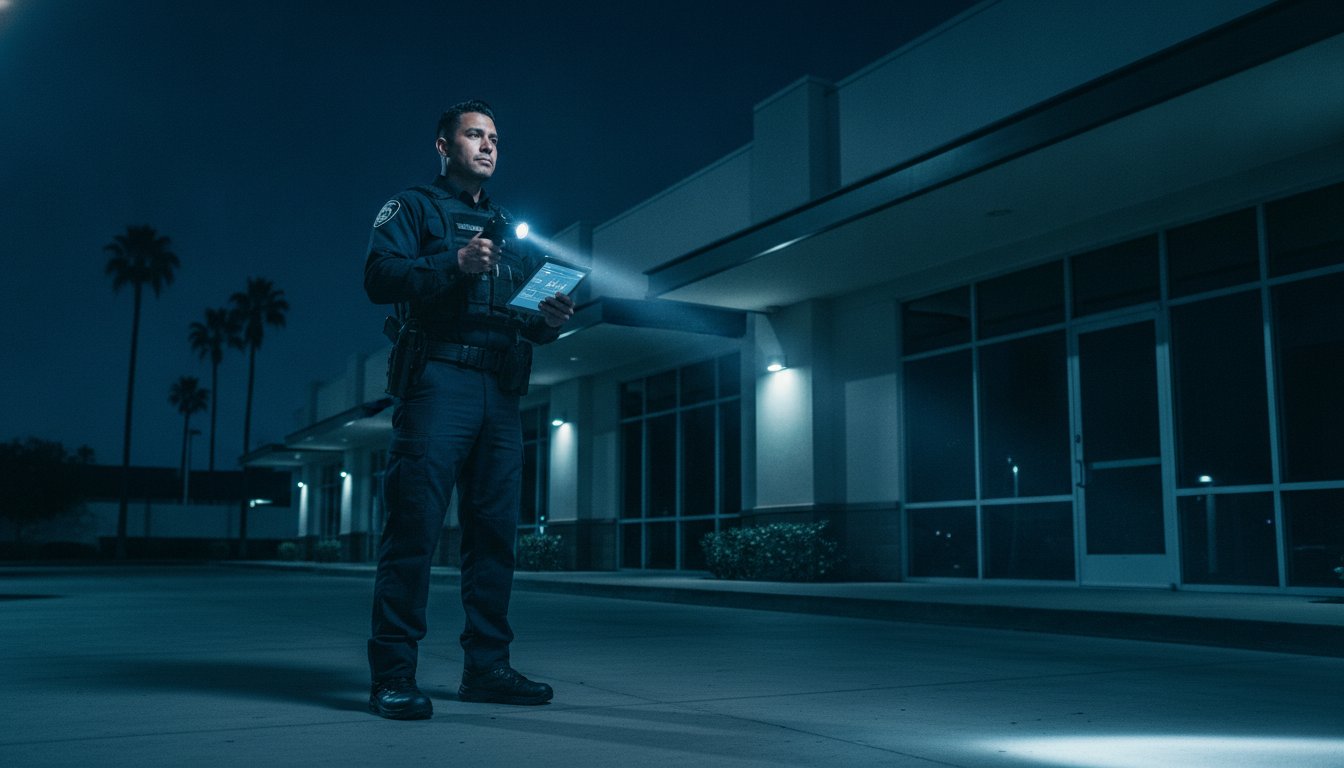
A single fire system failure isn’t just a technical glitch; it’s a critical vulnerability that triggers an immediate legal mandate under California Fire Code § 901.7. If your fire alarm or sprinkler system remains impaired for more than four hours within a 24-hour window, you’re legally required to implement a professional patrol. Mastering the fire watch requirements California enforces is the only way to shield your assets from both physical fire and aggressive regulatory fines. You likely feel the pressure of overlapping NFPA standards and state-specific mandates. It’s a high-stakes environment where confusion leads to immediate red tag closures.
This guide provides the strategic framework you need to master these rigorous operational standards and maintain absolute compliance. We’ll clarify the exact legal triggers for deployment and the disciplined logging protocols required to pass a Fire Marshal inspection without hesitation. You’ll gain a compliant framework that replaces site anxiety with methodical, unyielding human vigilance. We will examine the 2026 updates to LAFD Regulation 4, Cal/OSHA hot work durations, and the transition toward digital reporting standards.
Key Takeaways
- Identify the specific legal triggers, including system impairments exceeding four hours, that necessitate an immediate shift to human oversight.
- Implement methodical patrol protocols that ensure every area of your facility remains under the care of a vigilant and unyielding force.
- Maintain absolute compliance by mastering the documentation standards for fire watch requirements California officials demand during inspections.
- Execute precise monitoring windows for hot work operations to mitigate risks from welding, cutting, and grinding activities.
- Transition from high-stakes vulnerability to a state of order through disciplined risk assessment and professional field performance.
The California Fire Code Mandate: When Fire Watch Becomes Compulsory
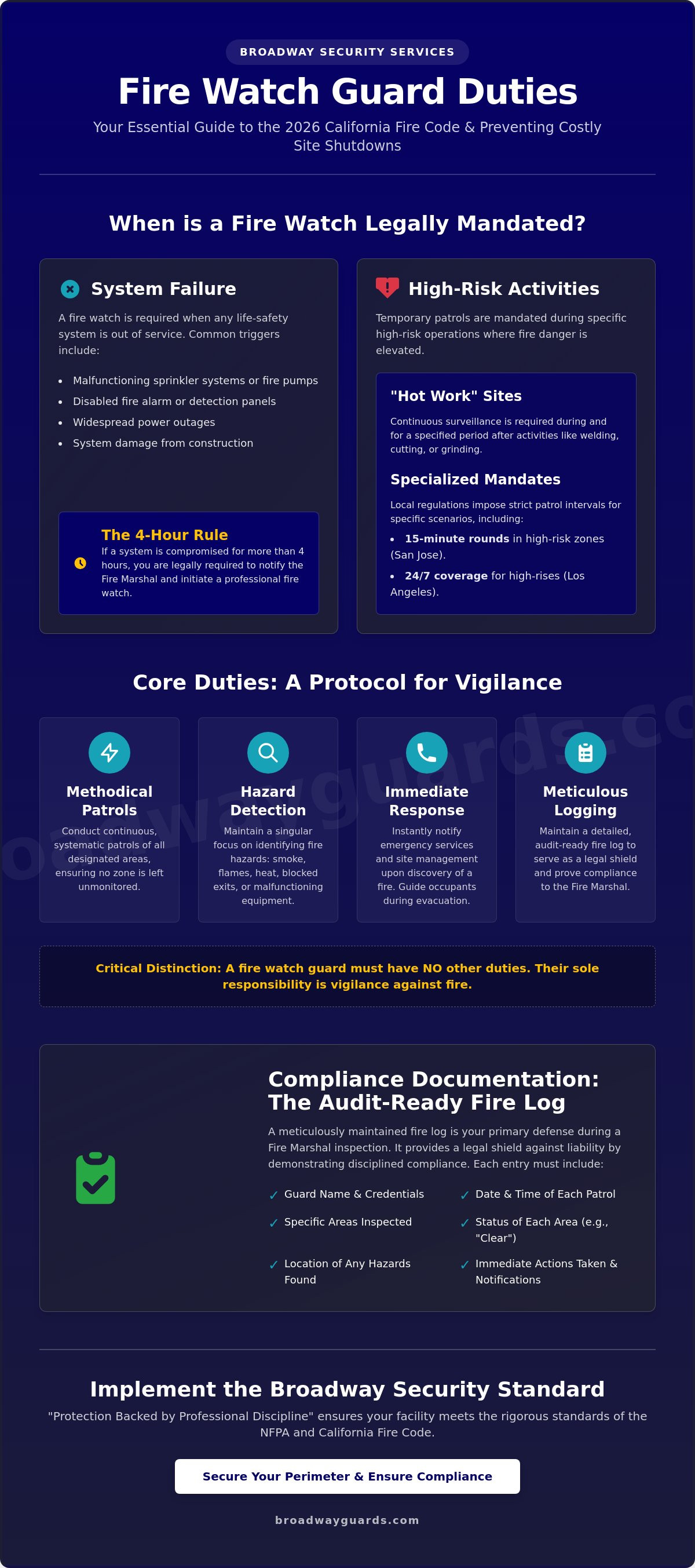
California law views fire protection as a layered defense system. When the electronic layer fails, the human layer must immediately engage to prevent catastrophic loss. Under the California Fire Code (CFC), a fire watch is a state-mandated monitoring system designed to provide continuous human surveillance when automated systems are compromised. These fire watch requirements California businesses must follow are not optional guidelines; they’re strict legal mandates enforced with absolute authority. The primary trigger occurs under CFC Section 901.7, which dictates that if a fire sprinkler or alarm system is out of service for more than four hours within a 24-hour period, the property owner must notify the fire department and initiate a patrol. This replaces failed technology with a disciplined, observant presence capable of identifying hazards and initiating emergency protocols without delay.
Understanding Title 19 and NFPA Standards
Title 19 of the California Code of Regulations establishes the baseline for public safety and property protection. It works in tandem with NFPA 101, the Life Safety Code, to ensure that high-occupancy structures remain habitable even during system maintenance. While a planned outage for system upgrades allows for scheduled oversight, an emergency malfunction requires an immediate transition to active deployment. This transition often involves a Fire Watch during Hot Work or system impairment to mitigate the elevated risk of ignition. The Fire Marshal maintains the authority to order 24/7 human surveillance until the Authority Having Jurisdiction (AHJ) certifies that the automated systems are fully restored to operational status. This level of oversight ensures that life and property remain protected from fire, explosion, and panic, even when technology fails.
The Consequences of Non-Compliance
Ignoring fire watch mandates carries severe penalties that extend far beyond simple administrative fines. Local authorities in the San Fernando Valley have the power to issue immediate “Stop Work” orders or red-tag a building, forcing a total site shutdown until compliance is verified. This loss of operational capacity is often accompanied by the immediate voidance of commercial insurance policies. If a fire occurs while a required watch is absent, carriers frequently deny claims based on the failure to maintain required safety standards. Property owners in areas like Woodland Hills or Canoga Park face massive legal and financial liabilities that can threaten the very existence of their enterprise. Maintaining a disciplined shield isn’t just about safety; it’s about the survival of your business assets under the scrutiny of California’s regulatory framework. Professional vigilance is the only acceptable response to a system failure.
Methodical Patrol Protocols: The Disciplined Guard’s Operational Duties
A fire watch is not a passive assignment. It is an active, tactical deployment that requires a vigilant and unyielding force to maintain site safety. Adhering to the fire watch requirements California mandates involves more than just presence; it requires a methodical patrol rhythm that covers every square foot of the facility. These rounds must be conducted with military-like precision to ensure that no vulnerability remains unaddressed. A professional guard acts as a disciplined shield, replacing failed electronic sensors with heightened human senses. This approach ensures that the transition from risk assessment to active deployment is seamless and effective.
The guard’s operational duties are defined by a strict adherence to protocol. During each round, the personnel must execute the following actions:
- Scanning for early warning signs of ignition, including smoke, unusual heat, or burning odors.
- Verifying that all fire exits and egress paths are completely unobstructed to ensure safe evacuation.
- Checking fire extinguishers to ensure they are accessible, properly charged, and ready for immediate use.
- Identifying potential fire hazards, such as blocked sprinkler heads or damaged fire doors.
Hazard Identification and Immediate Mitigation
Effective oversight requires the immediate mitigation of risks as they are identified. Guards must monitor the accumulation of flammable materials near high-heat sources, such as heavy machinery or industrial heaters. They inspect electrical panels and server rooms for signs of overloaded circuits or exposed wiring that could spark a catastrophic incident. To satisfy the fire watch requirements California enforces, hazardous materials like chemicals or pressurized canisters must be verified as secured within compliant containment areas. This proactive stance prevents fires before they start, moving beyond simple observation into the realm of active risk management. This level of detail is essential for passing rigorous Fire Marshal inspections.
The Discipline of Constant Presence
Professional fire watch personnel maintain a 24/7 vigilant posture. There is no room for electronic distractions, personal phone use, or lapses in attention. This constant visibility serves as a powerful deterrent against site negligence and potential arson. Relying on standard maintenance staff often leads to inconsistent monitoring, as their primary duties inevitably conflict with the need for total focus. Utilizing specialized fire watch services ensures that the individual on duty has no other responsibility than the preservation of life and property. This unwavering commitment to duty is what separates a compliant operation from a legal liability. Every round is documented with categorical precision to provide an unbreakable audit trail for regulatory authorities.
The Documentation Standard: Maintaining a Compliant Fire Watch Log
The Fire Watch Log functions as the “black box” of your facility’s safety operations. It is not merely a record of activity; it’s the definitive legal proof of adherence to fire watch requirements California authorities demand. During a Fire Marshal inspection, an incomplete or disorganized log is viewed as a failure of oversight, often leading to immediate penalties or site closures. Every entry must reflect the methodical discipline of the patrol, serving as a shield against regulatory scrutiny and potential litigation. A compliant log provides an unbreakable audit trail that demonstrates your commitment to unyielding human vigilance when technology fails.
Elements of a Regulatory-Compliant Log
In 2026, the Los Angeles Fire Department and other regional agencies have shifted toward modernized oversight. While paper logs are still utilized in some jurisdictions, digital reporting is now the gold standard for ensuring tamper-proof records for insurance defense. Each entry must include specific timestamps, precise location markers of the areas inspected, and the signature of the personnel on duty. These data points provide the transparency required for an effective regulatory response. Archiving these records is essential. Maintaining a historical record of compliant logs protects property owners from future claims and demonstrates a consistent pattern of professional discipline. If your records don’t show patrols every 30 to 60 minutes as required by local hazard levels, your compliance is compromised.
Emergency Communication Chains
A log is only as effective as the action it triggers. Fire watch personnel must operate within a fail-safe communication hierarchy that connects them directly to emergency responders. This protocol ensures that the local fire department is notified immediately upon the discovery of any fire or life safety hazard. Internal reporting chains must be equally rigid, ensuring site management is alerted to system impairments or safety breaches in real time. Personnel are trained on site-specific public address systems and alarm protocols to facilitate orderly evacuations if necessary. This structured approach to communication transforms a simple patrol into a comprehensive defense system. It ensures that every observation leads to a decisive and professional response, satisfying the fire watch requirements California enforces for commercial and industrial sites.

Hot Work vs. System Outages: Adapting Duties to Site Hazards
A fire watch is not a one-size-fits-all solution. The fire watch requirements California enforces vary significantly depending on the nature of the specific hazard. A hot work assignment involves high-intensity, localized monitoring of sparks and slag during activities like welding or cutting. Conversely, a system outage requires broad, facility-wide patrols to compensate for offline electronic sensors. A disciplined guard adapts their operational posture to meet these specific demands. Whether managing a temporary welding permit or a long-term sprinkler repair, the objective remains the same: unyielding protection of high-value assets and human life.
Hot Work Safety and the 35-Foot Rule
Cal/OSHA regulations under Title 8, Section 4848, mandate a rigorous pre-work inspection for all hot work operations. The guard must secure a 35-foot safety radius around the work area, ensuring all combustible materials are either removed or shielded with fire-resistant covers. During the operation, the guard monitors for immediate ignition from flying sparks or falling slag. Once the work concludes, a mandatory post-work monitoring period begins. In California, this watch must continue for at least 30 minutes, though local jurisdictions like Glendale or Los Angeles often require 60 minutes to ensure hidden smoldering fires don’t erupt. Coordination with construction site security guards ensures that these high-risk activities are integrated into a comprehensive site safety plan.
Interim Life Safety Measures (ILSM)
When fire sprinklers or alarm systems are offline for major repairs or widespread power outages, the fire watch serves as the facility’s human central nervous system. This is especially critical in high-occupancy environments like hospitals, retail centers, or residential complexes where evacuation is complex. These Interim Life Safety Measures require guards to act as human fire alarms, ready to trigger emergency protocols at the first sign of trouble. In these scenarios, fire watch personnel often coordinate with unarmed security guards to manage egress paths and support evacuation efforts. The level of oversight must be absolute to satisfy the fire watch requirements California Fire Marshals expect during an outage.
Occupied residential complexes require a different patrol cadence than vacant construction sites. In residential settings, the focus is on life safety and maintaining clear, illuminated egress paths for hundreds of occupants. At construction sites, the focus shifts to preventing property loss from smoldering slag or electrical malfunctions in unfinished systems. Failure to adapt these duties to the specific hazard profile can lead to regulatory failure and increased liability. To ensure your site meets every legal mandate with military-like precision, you should partner with Broadway Security Services for professional deployment. Our personnel are trained to handle the specific nuances of both hot work and system impairment with categorical precision.
The Broadway Standard: Disciplined Fire Watch in the San Fernando Valley
Broadway Security Services operates with a level of rigor that transforms standard compliance into a strategic defense. In the San Fernando Valley, the margin for error during a system failure is non-existent. We provide highly trained personnel who understand that fire watch requirements California enforces are the absolute baseline, not the ceiling. Our approach replaces the uncertainty of a technical failure with the reliability of a disciplined human shield. This transition from risk assessment to active deployment is managed with military-like precision, ensuring your high-value assets remain under the care of a vigilant and unyielding force.
Our training standards exceed basic security protocols to focus on the technical nuances of fire prevention and regulatory reporting. Every guard is instructed on the specific contact protocols for local Fire Marshals and the categorical logging methods required by the state. We offer customized fire watch services California firms rely on to maintain operational continuity. By integrating a professional security risk assessment CA into your broader fire prevention plan, we identify vulnerabilities before they trigger a mandatory watch. This proactive stance ensures that your facility isn’t just following the law but is actively fortified against disaster.
The Disciplined Shield Philosophy
Professionalism is the core of our field performance. A Broadway patrol round isn’t a casual walk-through; it’s a methodical sweep conducted with total focus. This level of order reflects your brand’s own commitment to safety and operational excellence. We provide reliable oversight for Canoga Park warehouses, large-scale construction sites, and retail centers. Each log entry is a testament to our presence, providing the tamper-proof documentation necessary for insurance defense and regulatory peace of mind. We don’t just observe; we protect with a stoic and professional posture that deters negligence and ensures immediate hazard mitigation.
Securing Your Assets with Broadway
Timing is critical when a fire alarm or sprinkler system goes offline. We offer fast-response emergency deployment to ensure you meet the fire watch requirements California mandates within the four-hour legal window. For long-term strategic monitoring, such as multi-year construction projects or high-rise renovations, we provide a consistent and methodical presence. Our personnel remain on-site until the Authority Having Jurisdiction (AHJ) formally clears the impairment. This unwavering commitment to duty provides property owners with the peace of mind that their investments are secure. Contact our Woodland Hills office for a professional evaluation of your site’s specific hazard profile. We’re prepared to serve as your disciplined shield against both physical fire and legal liability.
Fortifying Your Operational Integrity Through Disciplined Vigilance
Adherence to the fire watch requirements California enforces is the definitive line between operational continuity and catastrophic legal failure. You now understand the critical triggers for deployment, from system impairments exceeding four hours to the specific monitoring rhythms required for hot work. Protecting your assets requires more than just a presence; it demands a disciplined shield capable of executing methodical patrols and maintaining military-grade reporting standards. It’s the only way to ensure your site remains compliant under the scrutiny of the Fire Marshal.
Broadway Security Services provides California-certified fire watch experts who serve Canoga Park and the San Fernando Valley with unwavering commitment. We don’t just fill a regulatory gap; we provide peace of mind through structured oversight and rigorous accountability. Our personnel are trained to handle high-stakes environments with the precision your brand deserves. Don’t leave your compliance to chance when professional vigilance is available. Request a Strategic Fire Watch Consultation today to secure your facility against both physical fire and regulatory liability. Your safety is our primary duty.
Frequently Asked Questions
What is the primary difference between a security guard and a fire watch guard?
A fire watch guard is specialized personnel whose sole responsibility is the detection of fire hazards and the notification of emergency services. While a standard security guard focuses on access control and crime prevention, fire watch personnel must remain dedicated to life safety protocols during system impairments. This specialized role requires training in California Fire Code compliance and the methodical observation of ignition sources, which is distinct from general property protection duties.
How often do fire watch guards need to perform patrol rounds in California?
Patrol frequency is determined by the building’s hazard level and the specific directives of the local Fire Marshal. In Los Angeles and the San Fernando Valley, rounds are typically required every 30 to 60 minutes for commercial properties. High-occupancy buildings with sleeping residents may require intervals as frequent as 15 minutes. Adhering to these fire watch requirements California mandates ensures that no potential ignition source remains unobserved for more than a single patrol cycle.
Is a fire watch required if only part of the sprinkler system is down?
A fire watch is legally required even if only a portion of the fire protection system is impaired. If the malfunction affects a required sprinkler or alarm system for more than four hours in a 24-hour window, the mandate is triggered. Local authorities view any impairment as a critical vulnerability. You must initiate human surveillance for the affected zones to maintain life safety standards and avoid immediate red-tag closures of the entire facility.
What tools and equipment must a fire watch guard carry at all times?
Every fire watch guard must carry a reliable means of communication, such as a two-way radio or cellular phone, to contact emergency services immediately. They also require a compliant fire watch log to document each methodical round with precision. Essential hardware includes high-powered flashlights for inspecting dark corridors and master keys for accessing all areas of the facility. These tools ensure the guard can identify hazards and execute evacuation protocols without delay or obstruction.
Can fire watch guards perform other security duties simultaneously?
Fire watch personnel cannot perform other security or maintenance duties while on duty. The California Fire Code dictates that a fire watch must be the guard’s sole responsibility to ensure unyielding vigilance. Tasking a guard with access control or retail security while they’re assigned to fire watch creates a dangerous lapse in observation. This division of focus is a regulatory violation that can lead to significant fines and increased liability for the property owner.
How long must fire watch continue after hot work is completed?
California state law requires a fire watch to continue for a minimum of 30 minutes after all hot work operations are completed. However, local jurisdictions in Southern California frequently enforce a stricter 60-minute monitoring period to ensure hidden sparks don’t ignite. This post-work observation is critical for identifying smoldering fires in wall cavities or insulation. Guards must remain on-site until the area is certified as cool and safe by the designated safety officer.
What are the specific fire watch requirements for San Fernando Valley construction sites?
Construction sites in the San Fernando Valley must adhere to specific LAFD standards that often require a 24/7 watch if fire systems are not yet operational. These fire watch requirements California enforces for construction include the use of digital reporting to ensure tamper-proof documentation for inspections. Personnel must be familiar with Woodland Hills or Canoga Park specific hydrant locations and access points. This disciplined oversight prevents smoldering debris from escalating into a total loss.
Does a fire watch guard have the authority to stop work on a site?
A fire watch guard has the professional authority to stop work if they identify an immediate fire hazard or a violation of safety protocols. This authority is essential for preventing ignition during high-risk activities like welding or grinding. If a contractor fails to maintain the required 35-foot safety radius or ignores flammable material accumulation, the guard must intervene. This decisive action acts as a disciplined shield, prioritizing the safety of the entire site over temporary operational speed.