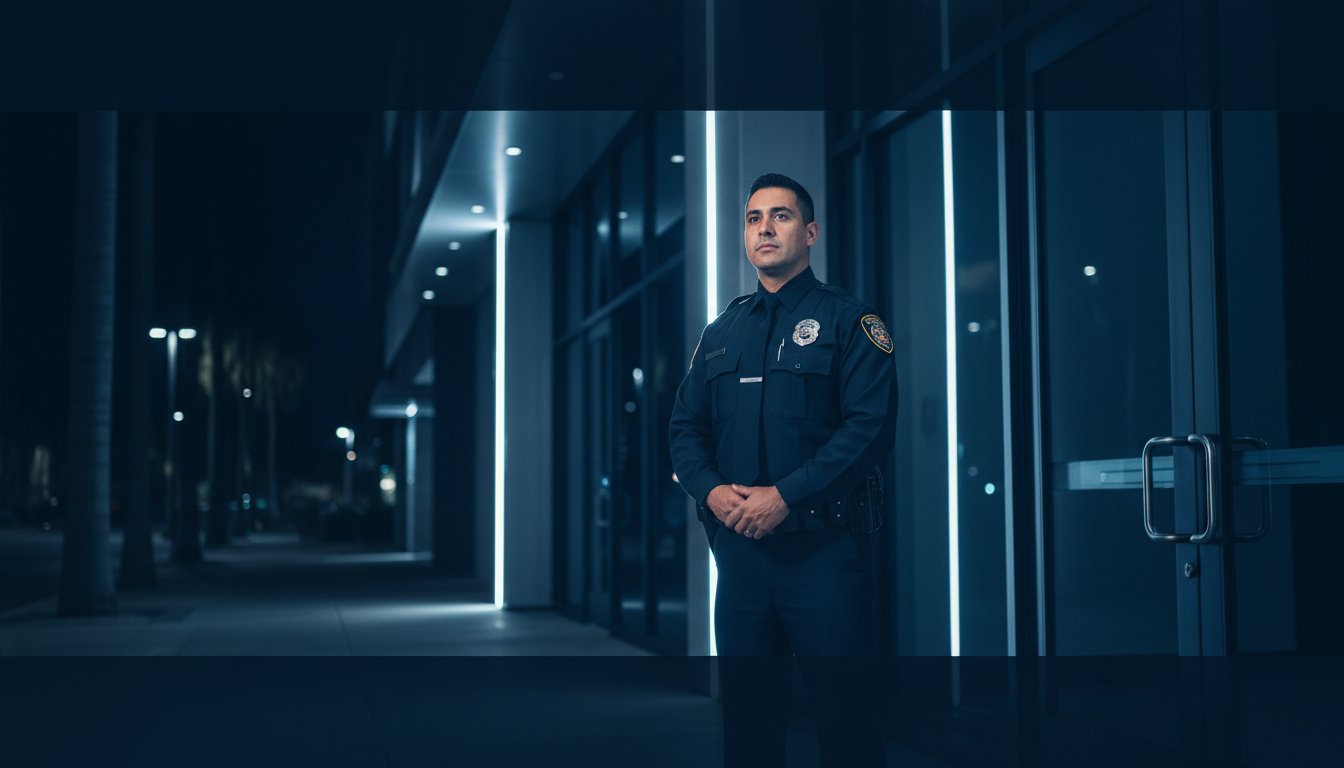

Managing Difficult Customers in Security: A Strategic De-escalation Guide for 2026

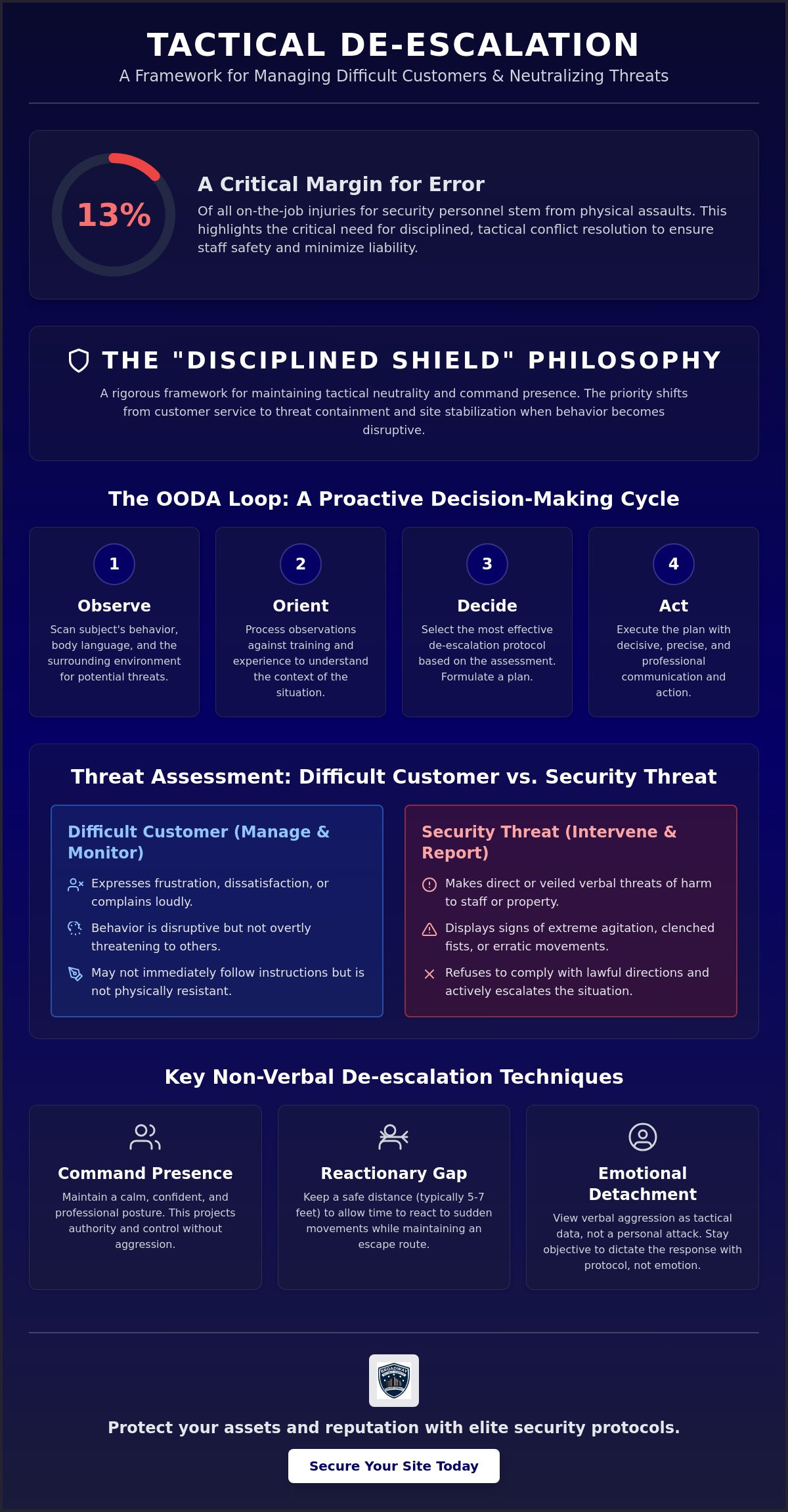
When 13% of all on-the-job injuries for security personnel stem from physical assaults, the margin for error in conflict resolution disappears. Maintaining order in a volatile environment requires more than just a physical presence; it demands a disciplined, tactical approach to managing difficult customers security protocols. You likely recognize the mounting pressure of staff burnout and the constant threat of legal liability that follows a poorly handled public incident. It is a reality that verbal abuse and unpredictable behavior can compromise the safety of your assets and the integrity of your brand if left unchecked.

This guide provides the professional protocols and tactical de-escalation techniques used by elite personnel to neutralize threats before they escalate. We will establish a clear framework for conflict resolution that reduces incident rates and reinforces a standard of unyielding professionalism on your site. You will learn how to transform volatile interactions into controlled outcomes, ensuring your business remains a secure and orderly environment. By the end of this article, you will have a command of the communication strategies necessary to protect your staff and your reputation with military precision.

Key Takeaways

  • Master the “Disciplined Shield” philosophy to maintain tactical neutrality and command presence during high-stress encounters.
  • Identify precise non-verbal communication techniques for managing difficult customers security protocols, focusing on stance and distance to neutralize aggression.
  • Establish clear thresholds for security intervention by distinguishing between standard customer frustration and legitimate security threats.
  • Implement standardized incident reporting procedures that provide a rigorous legal defense and ensure accountability across all site operations.
  • Understand why professional security training is essential for mitigating liability and protecting brand reputation in public-facing commercial environments.

The Volatility of Public-Facing Environments in 2026

Southern California commercial landscapes in 2026 demand a higher level of operational vigilance. Economic pressures have heightened public sensitivity, making on-site interactions significantly more unpredictable. Managing difficult customers security is a specialized discipline that goes beyond basic hospitality. It requires an unwavering commitment to tactical neutrality. While customer service staff focus on satisfaction, security personnel focus on the preservation of order. This distinction is critical for maintaining a secure environment where assets and personnel remain protected from escalating threats.

Poorly managed confrontations carry heavy financial and reputational weight. A single incident captured on video can damage a brand’s perception for years. Beyond the public image, the legal liability of a physical altercation can be devastating for any organization. Security professionals act as the disciplined shield that prevents these outcomes. They don’t instigate; they stabilize. This role requires a mindset of military-like precision, where every word and movement is calculated to lower the temperature of a situation and maintain site integrity.

The Evolution of On-Site Conflict

Conflict in retail and corporate settings has evolved into a high-stakes performance. Modern triggers for customer aggression often include:

  • Economic instability and heightened personal stress.
  • The pursuit of viral content through public filming and “clout” chasing.
  • Performative aggression designed to intimidate staff.

Security personnel must operate with the understanding that they’re always under observation. The dangerous mantra that “the customer is always right” must be discarded when it clashes with safety protocols. When a person’s behavior becomes disruptive, the professional priority shifts from service to containment. Order is the only standard that matters when safety is at risk.

Asset Protection and Personnel Safety

Conflict management is a vital component of a comprehensive security risk assessment CA. Identifying potential flashpoints before they ignite is a hallmark of professional oversight. By employing structured de-escalation techniques, guards protect on-site staff from the psychological trauma of verbal abuse. This proactive stance ensures business continuity. It prevents operations from grinding to a halt because of a single aggressive individual. A disciplined protector doesn’t just react to chaos; they anticipate and neutralize it through methodical, professional communication.

Mechanics of Tactical De-escalation: The Disciplined Shield

Broadway Security Services operates under the “Disciplined Shield” philosophy, which is a rigorous framework for managing difficult customers security challenges. This approach relies on the OODA Loop, a decision-making cycle consisting of Observe, Orient, Decide, and Act. Personnel observe the subject’s behavior, orient themselves within the environment, decide on the most effective protocol, and act with decisive precision. This methodical cycle allows our officers to stay ahead of an escalating situation, ensuring that every move is calculated to preserve site safety and minimize liability. It’s a proactive mindset that replaces chaos with order.

Maintaining emotional detachment is the bedrock of this philosophy. Professional guards don’t view verbal aggression as a personal attack; they view it as a tactical data point. This stoic mindset prevents the guard from being drawn into a customer’s emotional instability. By practicing tactical neutrality, the officer remains the dominant, stabilizing force in the room. This discipline ensures that the response is dictated by established protocols rather than impulsive reactions, which is essential for protecting the client’s assets and reputation. Every interaction is managed with the gravity of a high-stakes security operation.

The Power of Presence and Posture

Strategic positioning is more than a physical stance. It’s a method of commanding respect while maintaining an exit route. Guards utilize a “reactionary gap,” ensuring enough distance to respond to sudden movements without appearing aggressive. This command presence is how unarmed security guards prevent conflict before it begins. Unlike aggressive posturing, which can trigger further hostility, a professional posture signals that the site is under vigilant oversight. It’s a visible deterrent that communicates order and readiness to intervene if necessary, establishing a boundary that disruptive individuals are hesitant to cross.

Active Listening as a Security Tool

Tactical empathy is a sophisticated security tool used to gather intelligence and lower a subject’s physiological arousal. It involves listening to a grievance to identify the “hook,” which is the underlying issue driving the disruptive behavior. By paraphrasing and clarifying the subject’s statements, guards slow the interaction’s tempo and gain valuable time to assess the threat level. Aligning these techniques with Operational Protocols for Site Management ensures that every word serves the goal of stabilization. For organizations that require this level of operational rigor, exploring our specialized security solutions provides a path toward a more secure and predictable environment.

Difficult Customer vs. Security Threat: A Comparison Framework

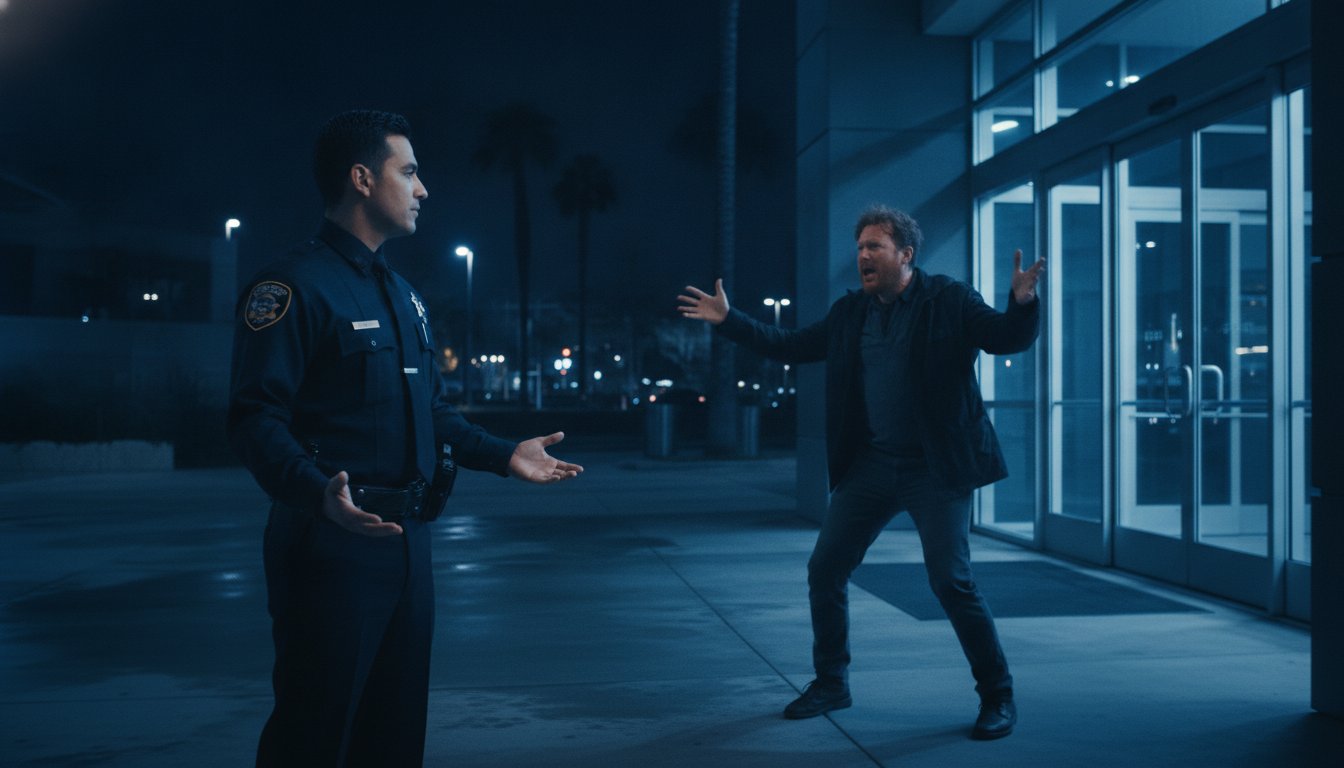
Precision in assessment is the foundation of site safety. Effective managing difficult customers security requires a clear distinction between a dissatisfied patron and a legitimate security risk. A difficult customer typically expresses frustration regarding a service or product. A security threat engages in behavior that compromises the safety of personnel, guests, or physical assets. The transition between these states is often rapid; therefore, professional guards maintain a state of constant observation to identify the exact moment a service issue becomes an operational crisis.

The spectrum of behavior moves from frustration to verbal abuse and finally to physical threat. In California, verbal abuse that includes specific threats of violence or persistent haranguing may meet the legal threshold for harassment. When an individual is asked to leave the premises and refuses, the situation escalates to trespassing under California Penal Code 602. Recognizing these legal benchmarks is essential. It ensures that security intervention is grounded in regulatory reality rather than emotional reaction. When de-escalation fails to achieve compliance, the protocol must shift from communication to tactical removal or law enforcement notification.

Identifying Red Flags and Pre-Attack Indicators

Professional protectors look for physiological signs that precede physical violence. These “red flags” include target glancing, clenched fists, and thousand-yard stares. Distinguishing between a customer “venting” and a targeted threat is a skill developed through rigorous training. A person venting uses generalized language; a threat is specific and directed. In high-stakes environments where the potential for violence is elevated, the deployment of armed security guard services Los Angeles provides a necessary layer of advanced threat management. These personnel are trained to neutralize high-risk indicators with the poise of a disciplined shield.

The Decision Matrix for Site Managers

Standardized response protocols prevent confusion during a crisis. Site managers must implement a decision matrix that dictates exactly when staff should disengage and allow security to take command. This hierarchy of response ensures that untrained employees aren’t exposed to unnecessary risk. Every interaction, regardless of the outcome, requires meticulous documentation. A professional incident report serves as the primary defense against future liability claims. It provides a chronological, fact-based account of the encounter, demonstrating that all actions taken were necessary, proportionate, and aligned with established safety standards. This level of accountability is what maintains the integrity of the business environment.

Managing Difficult Customers in Security: A Strategic De-escalation Guide for 2026

Operational Protocols for Site Management and Incident Reporting

Coordination with local San Fernando Valley law enforcement is a critical component of this framework. Whether dealing with the LAPD or the Los Angeles County Sheriff’s Department, your security team must provide a seamless transition of authority. This requires a deep understanding of California Bureau of Security and Investigative Services (BSIS) reporting standards. Failing to document incidents correctly can result in regulatory fines or weakened positions in future litigation. A disciplined protector views the paperwork as being just as vital as the physical presence on site.

Step-by-Step Incident Response

The response begins with the “Professional Greeting.” This is a formal assessment where the guard establishes authority while offering the individual a chance to comply voluntarily. If the disruption persists, the officer moves to the “Set Limits” phase. During this stage, the guard clearly states the consequences of continued behavior, such as removal or police intervention. The “Final Warning” is the last opportunity for the subject to self-correct. Once this threshold is crossed, the officer executes removal protocols with precision, ensuring the individual is escorted off the premises without unnecessary escalation.

Professional Documentation Standards

Documentation is the primary shield against legal repercussions. An incident report must be written in objective, non-emotive language. Avoid subjective descriptions like “the customer was angry.” Instead, use factual observations like “the subject raised their voice and clenched their fists.” Every report should include a single, concise sentence that defines the core incident clearly. Capturing witness statements and preserving video evidence immediately after the event is mandatory. These detailed records are essential for construction site security guards and retail personnel who must justify their actions in high-stakes legal disputes.

Post-incident debriefing allows your team to analyze the confrontation and refine future responses. This constant cycle of evaluation and improvement is what maintains a high standard of oversight. To ensure your facility is protected by personnel who master these rigorous protocols, contact Broadway Security today for a comprehensive consultation on our professional guard services.

Integrating Broadway Security Services for Strategic Conflict Mitigation

Professional training is the only reliable substitute for instinct when the safety of a facility is at stake. While many organizations rely on general employee common sense, Broadway Security Services implements a rigorous curriculum that transforms guards into disciplined stabilizers. Our personnel are trained to meet the specific requirements of California’s 2026 training regulations, including Senate Bill 652. This ensures every officer possesses the legal knowledge and tactical proficiency required for managing difficult customers security challenges. By replacing unpredictable human reactions with standardized, high-stakes protocols, we eliminate the gaps where liability often resides.

Tailored Solutions for Canoga Park Businesses

Regional expertise allows for a more responsive and intelligent security posture. Broadway Security Services maintains a deep operational footprint in the San Fernando Valley, providing Canoga Park businesses with localized support that understands the area’s specific challenges. We adapt our “Disciplined Shield” philosophy for high-density environments, such as event security Los Angeles requirements. Our consultation services help site managers develop internal crisis management strategies that sync perfectly with our guard operations. This creates a unified front that discourages disruption before it can manifest on your premises.

The Professionalism Guarantee

Our commitment to duty is defined by accountability and unyielding discipline. We don’t just provide a service; we provide an atmosphere of total reliability. Every guard from Broadway Security Services is a prepared protector who values rules and visible results above all else. This persona of self-assurance and structure gives our clients the peace of mind to focus on their core operations. The next step in securing your facility is a strategic partnership with our elite personnel. Contact Broadway Security Services today to begin a comprehensive assessment of your site’s security needs and fortify your defense against on-site volatility.

Commanding Site Order Through Professional Oversight

The landscape of 2026 requires a shift from reactive measures to a proactive, disciplined stance. You’ve learned that managing difficult customers security isn’t about winning arguments; it’s about neutralizing threats through tactical neutrality and precision communication. By implementing the Disciplined Shield philosophy and adhering to rigorous reporting standards, you protect both your physical assets and your brand’s reputation. Order is maintained when assessment is accurate and response is methodical.

Relying on Broadway’s highly trained BSIS-certified guards ensures your facility is under the care of personnel who master specialized de-escalation training protocols. Our Southern California regional security expertise provides a localized advantage in high-stakes environments. Secure your assets with Broadway’s disciplined security personnel today. Establishing a secure environment is the first step toward long-term operational success and peace of mind.

Frequently Asked Questions

What is the most effective de-escalation technique for security guards?

Tactical empathy is the primary technique for neutralizing high-stress encounters. It involves active listening to gather intelligence while simultaneously lowering the subject’s physiological arousal. By demonstrating that the grievance has been heard without conceding to the subject’s demands, guards maintain control. This methodical approach ensures that the officer remains the stabilizing force on site, preventing the escalation of tension through professional communication.

Can a security guard legally remove a difficult customer in California?

Security guards in California have the legal right to remove individuals who refuse to depart from private property. Once a subject is asked to leave and declines, they are in violation of California Penal Code 602 regarding trespassing. Guards must follow a strict removal protocol that prioritizes safety and site integrity. Minimizing physical contact is essential to prevent legal liability while maintaining the professional standards of the facility.

What is the difference between an angry customer and an abusive one?

An angry customer expresses dissatisfaction with a service or product, whereas an abusive individual targets personnel with harassment or specific threats. Identifying this threshold is vital for managing difficult customers security operations. When behavior shifts from venting to targeted intimidation, the situation moves from a service issue to a legitimate security threat. This requires a transition from verbal de-escalation to removal or law enforcement notification.

How does Broadway Security Services train guards for conflict resolution?

Broadway Security Services implements a training regimen that exceeds standard state mandates. Every guard undergoes instruction that complies with the 2026 requirements of California Senate Bill 652, including in-person de-escalation and use-of-force training. This ensures our personnel operate as a disciplined shield, capable of neutralizing tension through professional oversight. Our training is grounded in regulatory reality to ensure both site safety and legal compliance for every client.

Should I hire armed or unarmed guards for managing difficult customers?

The choice between armed and unarmed guards is determined by your site’s specific risk assessment and environmental triggers. Unarmed guards are highly effective for managing difficult customers security in retail or corporate settings where visible deterrence is the priority. Armed guards are reserved for high-risk environments where the potential for violence requires a higher tier of deterrent force. Both roles prioritize the preservation of order through disciplined oversight.

What information should be included in a security incident report?

A professional incident report must contain objective, non-emotive facts that provide a chronological account of the encounter. It should include the date, time, location, specific behaviors observed, and the guard’s response actions. Witness statements and descriptions of preserved video evidence are also mandatory. This documentation serves as the primary legal defense for the business, proving that all actions taken were necessary, proportionate, and aligned with site protocols.

How do I handle a customer who is filming a security interaction?

Guards must remain indifferent to the camera and maintain strict adherence to professional protocols. Filming is often a tactic used to provoke an emotional reaction or create viral content. By ignoring the device and focusing on the individual’s behavior, the guard maintains a command presence. This stoic response ensures that any resulting footage demonstrates a disciplined interaction, protecting the brand’s reputation and neutralizing the subject’s attempt at provocation.

When should I call the police during a customer confrontation?

Police notification is required when a situation exceeds a guard’s legal authority or safety threshold. This includes instances of physical assault, the brandishing of weapons, or a persistent refusal to leave after a final warning. Coordination with local law enforcement ensures a seamless transition of authority. It minimizes the risk of prolonged on-site disruption and ensures that criminal behavior is handled by the appropriate agency with military-like precision.

De-Escalation Security Services: The Tactical Discipline of Conflict Resolution in 2026

The most formidable tool in a modern security professional’s arsenal is not a weapon. It’s the disciplined application of tactical communication. In 2026, maintaining a secure environment requires more than just a physical presence. It demands high-stakes reliability and psychological precision. Professional de-escalation security services provide a proactive framework to resolve conflicts before they reach the point of no return. This approach transforms guards into a disciplined shield. It ensures that your assets remain protected without the risks associated with physical force.

You recognize that a single aggressive incident can lead to high liability and a negative public perception that lingers for years. It’s a reality that retail and public spaces face every day. This article shows you how professional de-escalation strategies reduce these risks while maintaining absolute order. You’ll discover how these methods align with California’s updated SB 652 training standards to provide a vigilant and unyielding force. We will examine the specific techniques that allow guards to act with precision to ensure a zero-incident environment and total regulatory compliance.

Key Takeaways

  • Learn how de-escalation security services have evolved into a proactive tactical discipline that prioritizes verbal resolution over physical force.
  • Understand the step-by-step contact protocols used by professional guards to identify exit routes and defuse tension with psychological precision.
  • Discover how implementing these strategies acts as a critical risk mitigation tool to reduce liability and protect your brand from the fallout of aggressive altercations.
  • Explore industry-specific applications for retail and healthcare environments that ensure safety while maintaining a professional public image in volatile spaces.
  • See how rigorous training and military-grade oversight ensure your security personnel exceed 2026 California state regulatory standards for maximum accountability.

What Are De-Escalation Security Services in the Modern Landscape?

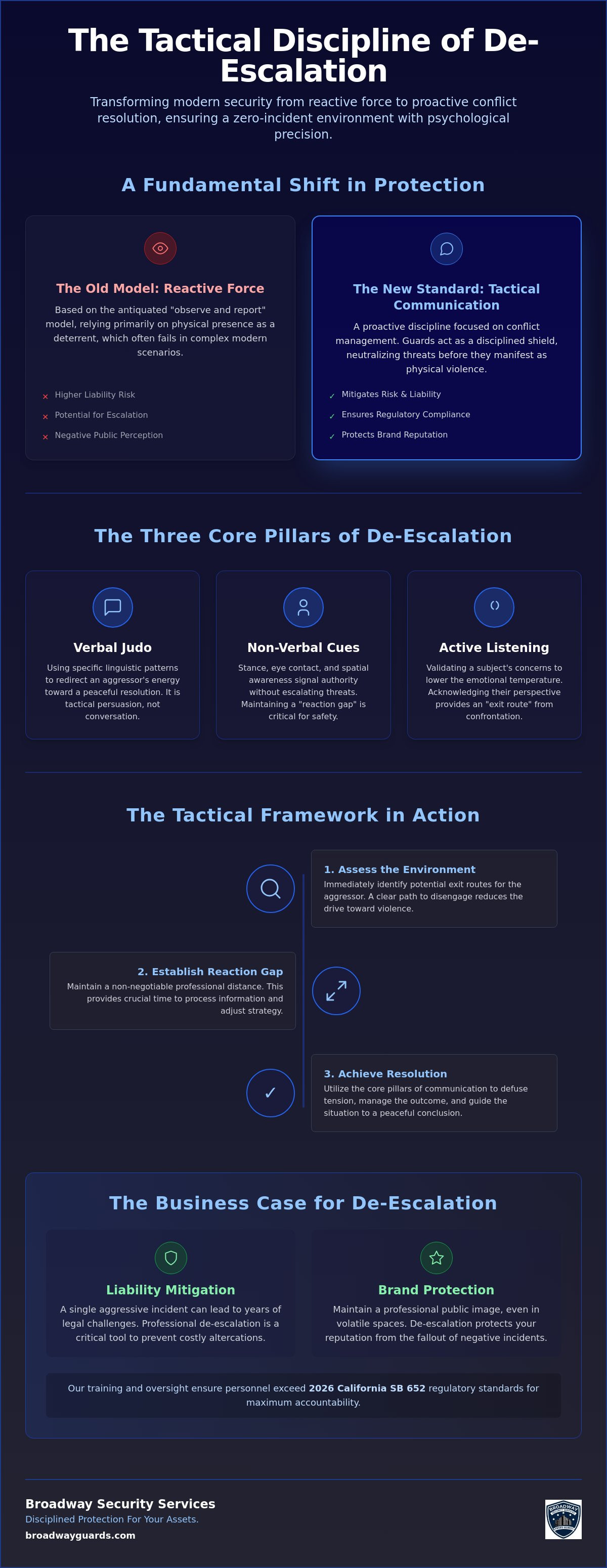
In the high-stakes environment of 2026, the definition of protection has fundamentally shifted. De-escalation is no longer a soft skill. It’s a tactical discipline. Professional de-escalation security services utilize a structured set of verbal and non-verbal techniques designed to neutralize a threat before it manifests as physical violence. This transition marks a departure from the antiquated “observe and report” model. Modern security requires proactive conflict management. Every guard operates as a disciplined shield, identifying the precursors of aggression and intervening with precision. This creates an atmosphere where order is maintained through psychological oversight rather than reactive force.

This methodology serves as the primary directive for unarmed security guards. Their effectiveness depends on their ability to manage the psychological foundation of a conflict. When an individual becomes agitated, their biological “fight or flight” response takes control. A professional guard understands this neurological state. They don’t react to the emotion; they manage the outcome. By recognizing these physiological triggers, security personnel maintain order through steady, methodical oversight. They ensure that a secure environment is preserved without escalating the situation unnecessarily.

The Core Pillars of Tactical De-Escalation

Success in conflict resolution relies on three operational pillars. These are not suggestions. They’re requirements for high-performance field operations.

  • Verbal Judo: This involves using specific linguistic patterns to redirect an aggressor’s energy toward a peaceful resolution. It’s about tactical communication that prioritizes compliance through professional persuasion.
  • Non-verbal cues: Stance, eye contact, and spatial awareness are critical. A guard’s physical positioning must signal authority without escalating the threat. Maintaining a professional “reaction gap” ensures safety while projecting a stoic, prepared image.
  • Active listening: Validating a subject’s concerns isn’t about agreement. It’s about lowering the emotional temperature. Acknowledging the individual’s perspective often provides the necessary “exit route” to end the confrontation.

Why Traditional Security Methods Are Evolving

The era of relying solely on “command presence” is over. While a strong physical profile remains a deterrent, it often fails to account for the complexities of modern public spaces. The widespread use of mobile technology and social media means every interaction is under constant scrutiny. High standards of conduct are mandatory. This shift is why these techniques are now integrated into comprehensive armed security guard services Los Angeles. Even when guards are equipped with tools for physical intervention, the goal remains prevention. This commitment to operational rigor ensures that safety and legal compliance are never compromised. Professionalism is the ultimate deterrent in a volatile world.

The Tactical Framework: How Professional Guards Defuse Conflict

Effective conflict resolution isn’t accidental. It’s the result of a rigorous, repeatable framework. At Broadway Security Services, our personnel utilize a strict contact protocol that prioritizes mental agility over physical reaction. This tactical discipline ensures that every interaction is managed with high-stakes reliability. Professional de-escalation security services begin with an immediate assessment of the environment. A guard’s first objective is to identify potential “exit routes” for the aggressor. When an individual feels cornered, their physiological drive toward violence increases. By providing a clear path for the subject to disengage, the guard maintains control of the situation without a single physical exchange. This methodical approach preserves order while minimizing the potential for a volatile scene.

Maintaining a professional distance is a non-negotiable standard of our field operations. This “reaction gap” provides the guard with the necessary time to process information and adjust their strategy. It’s not just about safety; it’s about maintaining a position of authority. If verbal redirection fails and safety is compromised, the guard is trained to transition seamlessly to physical intervention. This escalation is never impulsive. It’s a calculated response governed by California’s Bureau of Security and Investigative Services (BSIS) standards. Those seeking to fortify their site should consult with a professional security firm to ensure these protocols are integrated into their daily operations.

Step 1: The Initial Assessment and Presence

Before the first word is spoken, a guard establishes a calm, authoritative presence. This stoic image acts as a disciplined shield. During this phase, the guard scans for “pre-attack indicators.” These cues include heavy breathing, clenched fists, or a target-glance toward the guard’s equipment. Identifying these signs early allows for a preemptive shift in tactics. To maximize effectiveness, our teams utilize a security risk assessment CA to pre-plan responses for specific site vulnerabilities. This ensures that the guard isn’t just reacting to a crisis but is operating within a pre-determined tactical plan.

Step 2: Communication and Redirection

Communication follows the “Ask-Tell-Make” continuum. The guard starts by asking for compliance. If the subject refuses, they move to the “Tell” phase, where they set clear boundaries and consequences in a professional, non-threatening manner. Throughout this process, guards employ tactical empathy. This isn’t a sign of weakness; it’s a tool for alignment. By acknowledging the subject’s state without compromising authority, the guard can often redirect the individual toward a peaceful exit. This level of oversight ensures de-escalation security services remain the most effective deterrent in any retail or public space. Every word is chosen with precision to lower the emotional temperature and maintain the integrity of the secure environment.

Liability Mitigation: The Business Case for De-Escalation

Risk management in 2026 requires a shift from reactive force to proactive psychological oversight. For any organization, the financial consequences of a physical altercation far outweigh the investment in elite protection. Implementing professional de-escalation security services is a strategic decision that directly impacts the bottom line. By neutralizing threats through tactical communication, businesses reduce the frequency of “excessive force” lawsuits. These legal battles are costly, damaging, and often avoidable. Our approach ensures that every guard acts as a disciplined shield, protecting both the physical site and the corporate entity from legal exposure. This methodical oversight transforms security from a potential liability into a robust asset.

Insurance carriers increasingly prioritize firms that provide documented evidence of rigorous training. In California, adherence to the Bureau of Security and Investigative Services (BSIS) standards is mandatory. As of 2026, the 32 hours of required additional skills training specifically includes de-escalation and communication techniques. Demonstrating compliance with these regulations isn’t just about meeting a legal threshold. It’s about securing better insurance rates and proving a commitment to operational rigor. This meticulous oversight provides clients with peace of mind. You’ll know your security provider operates within the highest legal and ethical boundaries, minimizing risk at every level.

Reducing Physical and Legal Risk

The cost of a single violent incident can reach millions in legal fees and settlements. In contrast, the cost of premium training is a manageable operational expense. A disciplined protector uses words as their primary tool, ensuring that physical intervention remains a last resort. We prioritize detailed incident reporting and digital documentation for every encounter. This creates a transparent trail of professional conduct that serves as a robust legal defense if a situation is ever questioned. This level of accountability is what defines a truly professional security presence. It ensures that de-escalation security services provide a measurable return on investment through risk avoidance.

Maintaining a Safe and Welcoming Environment

In the retail and hospitality sectors, the “feeling of safety” is a critical component of customer retention. Aggressive security tactics create a hostile atmosphere that drives guests away. Our guards provide a “low-profile” presence that is observant and prepared without being intrusive. This balance is essential when handling complex issues like mental health crises or homelessness. By addressing these situations with dignity and tactical empathy, our personnel maintain order without creating a public scene. This preserves your brand reputation. It ensures that your environment remains welcoming for all legitimate visitors while keeping potential disruptors under a vigilant, unyielding watch.

De-Escalation Security Services: The Tactical Discipline of Conflict Resolution in 2026

Industry-Specific Applications in Southern California

De-Escalation in Retail and Hospitality

Retail loss prevention is no longer just about physical intervention. It’s about discretion. Handling a shoplifter requires a low-profile approach that secures the asset without creating a public scene. A volatile confrontation in a store aisle can damage brand reputation and alienate customers. Our personnel utilize verbal redirection to manage aggressive individuals and crowd flow during peak hours. This professional conduct aligns with our standards for event security Los Angeles. In these settings, guards must balance authority with a customer-service mindset. This ensures a secure environment where guests feel protected, not intimidated.

High-Stress Environments: Construction and Healthcare

The stakes are exceptionally high in healthcare and construction sectors. Hospital security involves managing agitated patients and stressed family members in emergency or psychiatric settings. Guards must possess a diverse skill set to lower the emotional temperature while maintaining a vigilant posture. On the other hand, construction site security guards frequently encounter trespassing incidents or disputes with neighboring residents. Resolving these conflicts through dialogue prevents project delays and reduces friction with the local community. Professionalism is the primary deterrent against site disruptions.

Even fire watch services require these skills. During a building evacuation, panic is a significant threat to life safety. Personnel must use methodical communication to maintain order and direct occupants to safety. Corporate offices also benefit from this discipline during high-stress events like employee terminations. A professional guard provides a stoic, prepared presence that discourages aggression before it starts. This level of oversight is essential for maintaining a secure and professional workplace. To secure your specific industry assets with these advanced protocols, partner with Broadway Security for unyielding protection.

The Broadway Standard: Disciplined Protection for Your Assets

Broadway Security Services operates on a foundation of military-grade discipline. We don’t just provide guards; we deploy a vigilant shield designed to protect your interests with unyielding precision. Our commitment to de-escalation security services is central to this mission. We believe that a professional presence is the most effective deterrent against disorder. This philosophy prioritizes prevention, ensuring that potential threats are identified and neutralized before they escalate into physical altercations. By maintaining a stoic and observant posture, our personnel provide the high-stakes reliability that modern businesses demand. Every contract is a promise of methodical oversight and absolute order.

Integrating these advanced protocols into your custom security contract is a straightforward process. We work with you to define the specific rules of engagement that match your site’s unique culture and risk profile. Whether you require unarmed guards for a retail space or executive protection for high-profile individuals, our standards remain consistent. This level of customization ensures that your assets are under the care of a force that is both flexible and disciplined. We take our responsibilities with the utmost gravity, providing a level of protection that serves as a benchmark for the industry. Broadway Security Services ensures safety through operational rigor in every deployment.

Our Training and Certification Process

Partnering for Peace of Mind

Choosing a security partner is a decision that impacts your safety and your reputation. We simplify this process by offering seamless deployment for businesses in Canoga Park and the surrounding Southern California regions. Our local expertise allows us to respond quickly to changing security needs while maintaining a high standard of quality. We don’t believe in a one-size-fits-all approach. Instead, we develop site-specific protocols that align with your operational goals. This partnership provides the peace of mind that comes from knowing your property is guarded by a vigilant and unyielding force. Request a professional risk assessment from Broadway Security Services today.

Fortifying Your Operations Through Tactical Resolve

The shift toward tactical conflict management marks a new era in professional protection. Implementing de-escalation security services is no longer a choice; it’s a strategic necessity for businesses that value safety and brand integrity. You’ve seen how a disciplined framework reduces liability while maintaining absolute order in high-stress environments. By prioritizing psychological precision over reactive force, you ensure that your facility remains a secure and welcoming space for all legitimate visitors. This methodical approach preserves the “feeling of safety” that is essential for long-term customer retention and operational success.

Broadway Security provides the high-stakes reliability your assets deserve. Our BSIS Certified Personnel have served the San Fernando Valley for over a decade, delivering military-grade operational oversight to every assignment. We don’t just observe; we protect through a vigilant presence and methodical intervention. This unwavering commitment to excellence ensures your business remains compliant with 2026 standards while fostering an atmosphere of trust and peace of mind. Every protocol we deploy is designed to act as a disciplined shield for your operations. Our commitment to safety through rigorous operational standards remains absolute.

Secure Your Facility with Broadway’s Disciplined De-Escalation Experts. Your safety is our primary directive. We look forward to fortifying your site with unyielding professionalism and tactical expertise.

Frequently Asked Questions

What is the primary goal of de-escalation in security?

The primary goal is to resolve a conflict and prevent physical violence through the application of tactical communication and psychological redirection. This approach preserves the safety of all parties while maintaining a secure environment without the need for force. By neutralizing aggression early, security personnel protect assets and reduce the potential for legal liability or brand damage. It’s about establishing order through a professional, unyielding presence and methodical oversight.

Are de-escalation techniques effective against violent individuals?

These techniques are highly effective when applied during the early stages of agitation to prevent an individual from reaching a violent state. However, once a subject manifests immediate physical aggression, the protocol shifts toward protective intervention. A disciplined protector recognizes the transition from a verbal threat to a physical one. The goal remains to minimize harm while ensuring the secure environment is not compromised by the subject’s actions.

Does California law require security guards to be trained in de-escalation?

California law requires comprehensive training that includes de-escalation as of January 1, 2026. Under Senate Bill 652, the mandatory 32 hours of additional skills training must cover communication techniques and interacting with people in crisis. This regulatory framework ensures that all guards possess the tactical discipline necessary to manage modern public spaces. Compliance with these BSIS standards is a functional signature of a professional and legitimate security provider.

How does de-escalation differ from traditional security methods?

Traditional methods often relied on command presence and reactive force to maintain order. In contrast, modern de-escalation security services prioritize proactive conflict management through verbal redirection and spatial awareness. This evolution shifts the guard’s role from a simple deterrent to a disciplined shield that manages the psychological foundation of a dispute. It requires higher standards of training and field performance to ensure safety through operational rigor rather than intimidation.

Can armed security guards use de-escalation techniques?

Armed personnel are strictly trained to use these techniques as their primary tool for conflict resolution. The presence of a firearm increases the stakes of any interaction, making the ability to defuse tension through words even more critical. A professional armed guard uses tactical communication to ensure that physical force remains a last resort. This disciplined approach demonstrates a high degree of self-assurance and an unwavering commitment to duty and safety.

What industries benefit most from de-escalation security services?

High-traffic industries such as retail, healthcare, and hospitality benefit significantly from these specialized de-escalation security services. Hospitals use these techniques to manage agitated patients, while retail environments rely on them to handle shoplifters without creating a public scene. Any sector where public interaction is frequent requires a security presence that can maintain order with psychological precision. This ensures that the environment remains welcoming for legitimate guests while staying secure from potential disruptors.

How do you measure the success of a de-escalation program?

Success is measured by a reduction in use-of-force incidents and a decrease in liability claims. A high-performance program tracks field performance through detailed reporting and the review of body-cam footage. When a secure environment is maintained with zero physical altercations, the program has met its objective. These metrics provide clear evidence of operational rigor and demonstrate that the guard force is acting as a vigilant and unyielding protector of the client’s assets.

What happens if de-escalation fails to resolve a conflict?

If a subject refuses to comply and safety is compromised, personnel transition seamlessly to defensive tactics or physical intervention. This escalation is governed by strict protocols and California’s use-of-force standards. The guard remains observant and prepared to take necessary action to protect lives and property. Once the threat is neutralized, the incident is documented with military-like precision to ensure total accountability and transparency for the client and regulatory authorities.

Hospital Security Guard Duties in Los Angeles: A Strategic Safety Guide for 2026

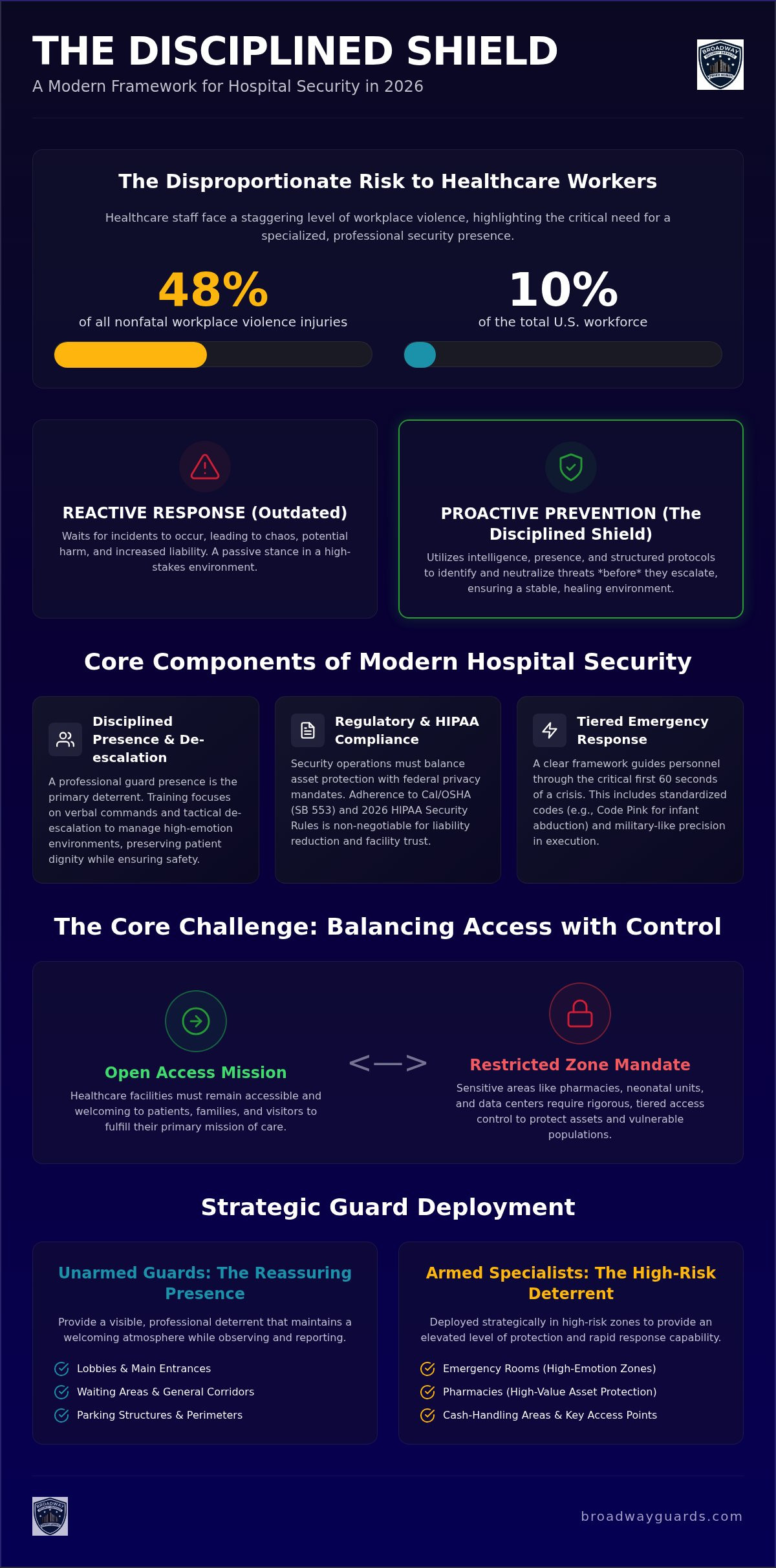
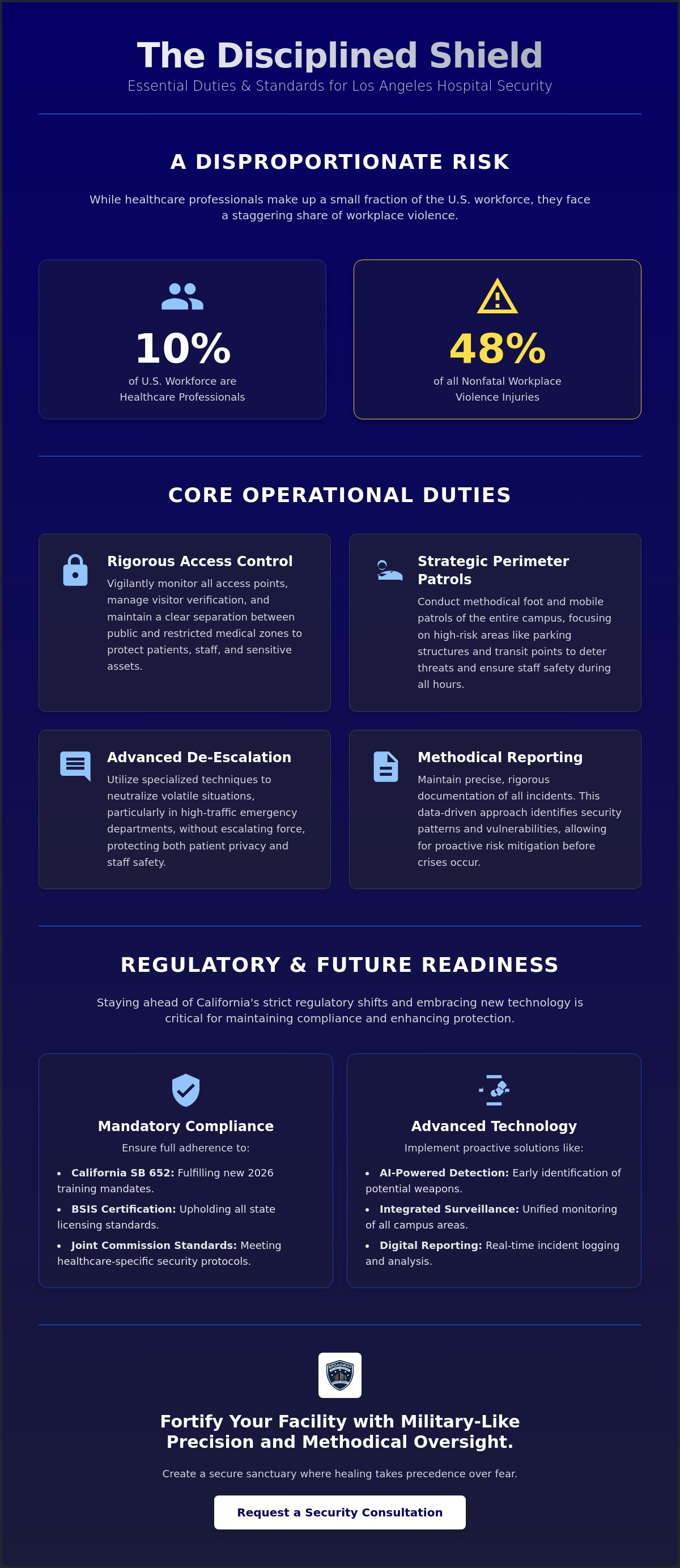
Healthcare professionals represent just 10% of the U.S. workforce, yet they endure a staggering 48% of all nonfatal workplace violence injuries. This data highlights a sobering reality for medical administrators: the safety of your staff is under constant pressure. You likely understand that maintaining a secure environment in Southern California requires more than just a visible presence. It demands a disciplined shield capable of managing high-stakes volatility. The complexity of hospital security guard duties Los Angeles providers must execute has never been higher, especially as violence in emergency departments continues to rise alongside strict liability concerns.

This strategic guide provides the clarity you need to master these essential responsibilities. You will discover the rigorous standards and essential protocols required to maintain a secure healthcare environment while staying ahead of California regulatory shifts. We will review the 2026 training mandates under SB 652, the implementation of AI-powered weapons detection, and the precise de-escalation techniques that protect both patient privacy and institutional reputation. Our analysis ensures your facility remains a place of healing, fortified by methodical oversight and unwavering professional discipline.

Key Takeaways

  • Apply the disciplined shield concept to balance high-stakes deterrence with the sensitive requirements of patient-centric care.
  • Master the essential hospital security guard duties Los Angeles medical centers must implement for rigorous access control and perimeter defense.
  • Utilize advanced de-escalation strategies designed to neutralize volatility in high-traffic emergency departments without escalating force.
  • Ensure compliance with the latest 2026 BSIS certification standards and mandatory California training requirements.
  • Build an environment of high-stakes reliability by prioritizing military-like precision and methodical oversight in every security interaction.

The Critical Role of Hospital Security in the Los Angeles Healthcare Landscape

Los Angeles medical centers operate at the intersection of high-density urban pressure and the delicate requirements of patient care. In this environment, security is not a secondary service. It’s a foundational pillar of operational stability. The unique landscape of Southern California necessitates a specialized approach where the duties of a security guard extend far beyond simple observation. A disciplined shield must be established to protect assets, staff, and patients with military-like precision. This specialized branch of security management requires a deep understanding of medical protocols and legal compliance.

High-Stakes Security in Urban Medical Environments

Facilities in the San Fernando Valley and across the Los Angeles basin face specific risks that require methodical oversight. High-density urban areas often see increased rates of localized theft and vandalism. These incidents can disrupt life-saving medical operations and compromise expensive equipment. Managing the interface between public access points and restricted medical zones requires a vigilant, 24/7 presence. In a city that never sleeps, the security perimeter must remain unyielding. There’s no room for lapse in a high-stakes environment.

Defining the Professional Standard for LA Guard Duties

The modern execution of hospital security guard duties Los Angeles administrators expect has evolved into active risk mitigation. It’s no longer enough to employ a passive watchman. A professional guard must maintain a stoic, authoritative presence that serves as a visible deterrent while remaining sensitive to the healthcare setting. This balance is critical. It creates an atmosphere of order without compromising the empathy required in a hospital. We don’t just provide a service; we provide a disciplined response to potential threats.

Rigorous reporting protocols and a hierarchy of accountability ensure that every incident is documented with precision. This data-driven approach allows for the identification of patterns before they escalate into crises. By prioritizing professional discipline, hospitals build a culture of trust. Patients and their families need to know that the environment is under the care of a vigilant force. This reassurance is vital for maintaining the high standards of care that Los Angeles residents deserve. It’s about creating a secure sanctuary where healing takes precedence over fear.

Core Operational Duties: Maintaining Order and Access Control

Effective security in a healthcare setting begins at the edge of the property. For 2026, the execution of hospital security guard duties Los Angeles facilities require has shifted toward a high-stakes model of methodical oversight. A disciplined shield isn’t static; it’s a dynamic presence that integrates physical patrols with advanced surveillance monitoring. This approach ensures that every square foot of the campus is under constant, vigilant care. We prioritize a proactive stance where technology and human observation work in a unified cadence to identify risks before they manifest into physical breaches.

Strategic Perimeter and Grounds Patrol

Methodical foot and mobile patrols are the backbone of this strategy. These aren’t casual walks; they’re structured sweeps designed to eliminate security blind spots and identify vulnerabilities. Parking structures and transit points receive specific attention to protect staff during late-night shift changes. By maintaining a stoic, visible presence, guards deter unauthorized entry and loitering before they become active threats. This level of rigor aligns with Joint Commission standards, which emphasize the necessity of a safe environment for both patients and healthcare providers.

Advanced Access Management Protocols

Access control is the first line of defense against internal volatility. Systematic screening protocols use a hybrid of hospitality-focused interaction and rigorous security screening to maintain a professional atmosphere. Guards manage credentials for restricted zones like pharmacies and high-risk laboratories with unwavering attention to detail. This prevents the unauthorized removal of controlled substances or sensitive patient data. Enforcing hospital-specific ‘No Trespassing’ and ‘Warning’ regulations effectively prevents unauthorized individuals from compromising sensitive medical areas. If your facility requires this level of precision, consider how professional hospital security can fortify your existing protocols.

Security personnel also act as the facility’s eyes for proactive hazard identification. Reporting maintenance issues or safety risks immediately prevents accidents and liability. Every action is recorded in detailed digital logs. These logs provide the operational transparency needed for legal compliance and administrative oversight. They ensure that every incident, no matter how minor, is documented with the accuracy required for high-stakes reliability. By maintaining these rigorous standards, we ensure that the hospital remains a controlled, orderly environment dedicated to patient recovery.

Specialized Healthcare Duties: Crisis Management and ER Security

The Emergency Department (ED) functions as the high-pressure frontline of urban medical volatility. In Los Angeles, where 91% of emergency physicians report being victims of or witnesses to violence, the execution of hospital security guard duties Los Angeles medical centers demand must be flawless. A disciplined protector doesn’t merely stand guard; they integrate into the clinical workflow to provide a layer of high-stakes reliability. This involves managing patient outbursts and behavioral health emergencies with a focus on methodical oversight. Every second counts when a crisis unfolds, making a structured response essential for hospital safety.

Tactical Response in Emergency Departments

Maintaining a high-visibility presence in waiting areas is the primary deterrent against disturbances. Security personnel collaborate closely with nursing staff to identify and manage aggressive or intoxicated individuals before a situation escalates. This partnership is vital. When a code is called, the transition from observation to intervention happens with military-like precision. Rapid-response protocols for lockdowns or active threats are executed according to a strict hierarchy. This ensures that the medical team can continue their life-saving work without interruption. Our presence creates an atmosphere of order that discourages volatility.

Medical Sensitivity and De-escalation Training

Professional de-escalation is a tactical tool, not just a soft skill. In 2026, training emphasizes trauma-informed care and understanding the psychological state of patients in crisis. This ensures that physical intervention is a last resort. Statistics from 2026 indicate that 84.8% of nurses reported experiencing workplace violence in the past year. By applying professional de-escalation techniques, security guards minimize these risks while adhering to patient privacy and safety regulations. We prioritize results-oriented phrasing that emphasizes accountability in every patient interaction.

Order must be balanced with the sensitive nature of healthcare delivery. Security guards also perform specialized medical escort services for high-value assets or sensitive personnel. This includes protecting high-risk pharmaceutical deliveries or providing safe passage for staff during high-risk transfers between departments. Every interaction is governed by a commitment to duty and professional discipline. This methodical approach transforms the security team into a vital asset for hospital operations. It ensures that both staff and patients remain under the care of a vigilant and unyielding force. Reliability is the linguistic anchor of our field performance. By implementing these rigorous operational standards and fulfilling the complex hospital security guard duties Los Angeles administrators expect, we reduce the $18.27 billion annual cost that violence imposes on U.S. hospitals.
Hospital Security Guard Duties in Los Angeles: A Strategic Safety Guide for 2026

Regulatory Compliance: California Standards and BSIS Requirements

Maintaining a secure medical environment in Southern California requires more than tactical skill; it demands strict adherence to state and federal mandates. The execution of hospital security guard duties Los Angeles facilities require is governed by the Bureau of Security and Investigative Services (BSIS). This regulatory body ensures that every protector operating within your facility meets high standards of legitimacy. Failure to comply with these regulations doesn’t just invite liability. It compromises the fundamental order of the institution. We prioritize a methodical approach to compliance to ensure your facility remains a sanctuary for healing.

The BSIS Certification Framework

California law mandates a specific training hierarchy for all security personnel to ensure field performance meets professional standards. As of January 1, 2026, Senate Bill 652 requires the initial 8-hour “Powers to Arrest and Appropriate Use of Force” training to be completed through a single BSIS-approved provider. This is only the beginning of a total 40-hour training requirement. Guards must complete 8 hours before application, 16 hours within the first 30 days of employment, and the final 16 hours within the first six months. We ensure every deployed guard meets or exceeds these state-mandated hours through rigorous oversight and verification of Live Scan background checks. This hierarchy of accountability is what builds a foundation of trust between the security force and hospital administration.

Privacy and Legal Accountability in Healthcare

Security in a hospital setting requires navigating complex patient privacy laws with absolute precision. HIPAA compliance is mandatory for guards who may encounter sensitive medical information or patient records during their patrols. Our personnel are trained to maintain the disciplined shield while respecting the confidentiality that healthcare delivery requires. This includes adhering to the Emergency Medical Treatment and Labor Act (EMTALA) guidelines. These regulations ensure that security protocols never interfere with a patient’s right to receive emergency medical care. Order must never come at the expense of legal and ethical obligations.

Precise documentation is the cornerstone of legal accountability. Every incident must be recorded with military-like precision to protect the facility from liability and ensure operational transparency. Integrating a security risk assessment CA into your compliance audits allows for the identification of regulatory gaps before they become legal vulnerabilities. For facilities seeking to fortify their compliance standing and overall safety, secure your facility with a professional security plan today. Methodical oversight is the only way to guarantee that your security team remains a vigilant and unyielding force within the legal framework of 2026.

Securing Your Facility with Broadway Security Services’ Disciplined Approach

Broadway Security Services delivers a specialized response to the escalating safety requirements of the Southern California healthcare sector. We understand that the hospital security guard duties Los Angeles medical centers require are not merely tasks. They’re high-stakes responsibilities that demand an unyielding commitment to duty. Our approach positions us as a disciplined shield for your facility. We move beyond basic protection to offer a framework of methodical oversight that prioritizes the safety of your assets. By choosing a partner that values rules and protocols above all else, you ensure your institution remains a controlled environment.

Our commitment to military-like precision ensures that every aspect of your security plan is executed with absolute reliability. We don’t believe in a one-size-fits-all strategy. Instead, we customize our security protocols to the specific layout and risk profile of your medical center. This includes identifying high-risk zones that require heightened vigilance. By maintaining a hierarchy of structure and clear reporting lines, we reduce institutional liability. Broadway Security Services provides the professional discipline necessary to manage the complexities of a 24-hour urban medical facility with total accountability.

The Broadway Standard of Professionalism

The core of our service lies in the caliber of our personnel. We deploy unarmed security guards who act as a vigilant force. They’re trained to maintain a stoic and professional presence in high-stress environments. Our guards utilize industry-specific terminology and high-value adjectives in their reporting to ensure absolute clarity for hospital administrators. This focus on presence, prevention, and professional accountability creates an atmosphere of order. We prioritize field performance through rigorous oversight, ensuring every guard understands the gravity of their role as a disciplined protector.

Next Steps for Comprehensive Protection

Securing a high-density medical facility requires a proactive and methodical plan. We help you transition from a reactive stance to one of organized prevention through a structured engagement process:

  • Professional Risk Assessment: Identifying site-specific vulnerabilities and security blind spots across your campus.
  • Strategic Protocol Development: Integrating a physical security presence with your facility’s existing safety technology and medical workflows.
  • Long-Term Security Management: Establishing a consistent oversight model that ensures ongoing adherence to all California regulatory standards.

The safety of your staff and patients shouldn’t be left to chance. Contact Broadway Security Services for a disciplined approach to healthcare safety that prioritizes order and trust. Let us provide the unyielding force your facility needs to thrive in 2026.

Fortifying Your Medical Facility for the Future

The security landscape of 2026 demands a shift from passive observation to methodical, active protection. Mastering the diverse hospital security guard duties Los Angeles administrators require means integrating tactical discipline with clinical sensitivity at every level of the organization. By prioritizing BSIS-certified personnel and specialized healthcare de-escalation training, you’re not just hiring guards; you’re establishing a disciplined shield that protects staff and patients alike. Order and reliability are the cornerstones of a safe healing environment. Every protocol must be executed with the military-like precision that high-stakes healthcare demands.

Broadway Security Services provides the unyielding force necessary to maintain this standard of excellence. Our strategic risk assessment expertise allows us to identify vulnerabilities before they escalate into crises. It is time to elevate your operational standards and ensure your assets are under the care of a vigilant and unyielding force. Secure your Los Angeles medical facility with our disciplined security personnel today. We’re ready to help you build a sanctuary of safety and professional reliability that supports your mission of healing.
Frequently Asked Questions

What are the primary responsibilities of a hospital security guard in Los Angeles?

The primary hospital security guard duties Los Angeles personnel perform include systematic access control, perimeter defense, and rapid crisis intervention. Guards maintain a vigilant presence to deter unauthorized entry while facilitating a safe environment for medical staff. Their role also encompasses proactive hazard identification and the maintenance of detailed digital logs to ensure operational transparency across the facility’s grounds and restricted zones.

Do hospital security guards in California need special certification?

All security personnel in California must possess a valid BSIS Guard Card and complete a state-mandated 40-hour training curriculum. New regulations for 2026 dictate that initial training must be completed through a single approved provider to ensure standardized professional discipline. This framework ensures a high level of legal knowledge and field performance before a protector begins their assignment in a high-stakes medical environment.

How does hospital security handle aggressive patients while remaining HIPAA compliant?

Security personnel utilize professional de-escalation techniques to neutralize patient aggression without compromising medical confidentiality. Guards focus on physical behavioral management rather than accessing clinical data. By adhering to strict reporting protocols that omit unnecessary medical details, they maintain the disciplined shield while ensuring the facility remains fully compliant with federal privacy regulations and patient rights.

What is the difference between armed and unarmed security in a hospital setting?

Armed guards provide a high-visibility deterrent for high-risk zones, such as pharmacies or cash handling areas, while unarmed guards focus on general patrol and patient-centric de-escalation. The choice depends on the specific risk profile identified during a strategic risk assessment. Both roles prioritize professional accountability and methodical oversight, though armed personnel undergo additional BSIS certification for firearm proficiency.

How do security guards assist in emergency room (ER) management?

In the Emergency Department, guards provide a stabilizing force by managing waiting room crowds and supporting clinical staff during patient outbursts. They execute rapid lockdown protocols when threats are detected to prevent the escalation of volatility. This methodical presence allows medical professionals to focus on care while the security team maintains total control over the physical environment and public access points.

Can security guards perform medical escorts within the facility?

Security guards frequently perform medical escorts for sensitive pharmaceutical deliveries, high-value equipment, and personnel moving through high-risk areas. These escorts are conducted with military-like precision to ensure that assets reach their destination without interference. This service is a critical component of the broader hospital security guard duties Los Angeles facilities require to maintain internal order and protect institutional integrity.

What training do Broadway Security Services guards receive for medical environments?

Broadway Security Services personnel undergo specialized training modules that prioritize order and patient-centric de-escalation. This curriculum is designed to meet the rigorous standards of modern healthcare environments while ensuring field performance remains unyielding. Every guard is prepared for the unique pressures of a hospital setting through a hierarchy of structure that emphasizes presence and prevention.

How does professional security reduce a hospital’s legal liability?

Professional security reduces liability by ensuring every incident is documented with military-like precision. By maintaining a hierarchy of structure and strict reporting lines, the facility gains a transparent record of all safety interventions. This methodical oversight provides the documented proof required to defend against claims of negligence while reinforcing the facility’s commitment to rigorous operational standards.

The Strategic Guide to Unarmed Security Guards: Prevention and Professionalism

Is an unarmed presence enough to stop a determined thief, or are you just paying for a uniform? Many property managers in the San Fernando Valley feel that unarmed security guards are a liability or, worse, a passive expense that fails when tested. You’ve likely dealt with unreliable personnel who lack discipline or seen the rising tide of local vandalism and wondered if your assets are truly protected. We understand that security isn’t about hope; it’s about a methodical approach to order and prevention.

This guide reveals how elite training and strategic visibility transform these officers into a disciplined shield for your business. By adhering to the rigorous standards of Senate Bill 652, which mandates specific training certified by BSIS licensed providers as of January 2026, professional oversight ensures your team maintains high-stakes reliability. You’ll discover how this vigilant force reduces insurance premiums and provides peace of mind through unyielding operational rigor. We will analyze the specific legal requirements, the impact of professional discipline on asset safety, and the strategic advantages of a visible, unarmed presence.

Key Takeaways

  • Understand the psychology of visible deterrence and how a methodical presence prevents incidents before they manifest.
  • Explore the core responsibilities of unarmed security guards, focusing on rigorous access control and professional de-escalation protocols.
  • Evaluate the liability landscape to determine when unarmed personnel provide the most strategic and cost-effective protection for your assets.
  • Identify specialized applications for maximum ROI, from securing construction sites to implementing retail loss prevention strategies.
  • Learn to establish a professional security framework by conducting vulnerability assessments and defining precise post orders that ensure accountability.

The Strategic Role of Unarmed Security Guards in Modern Asset Protection

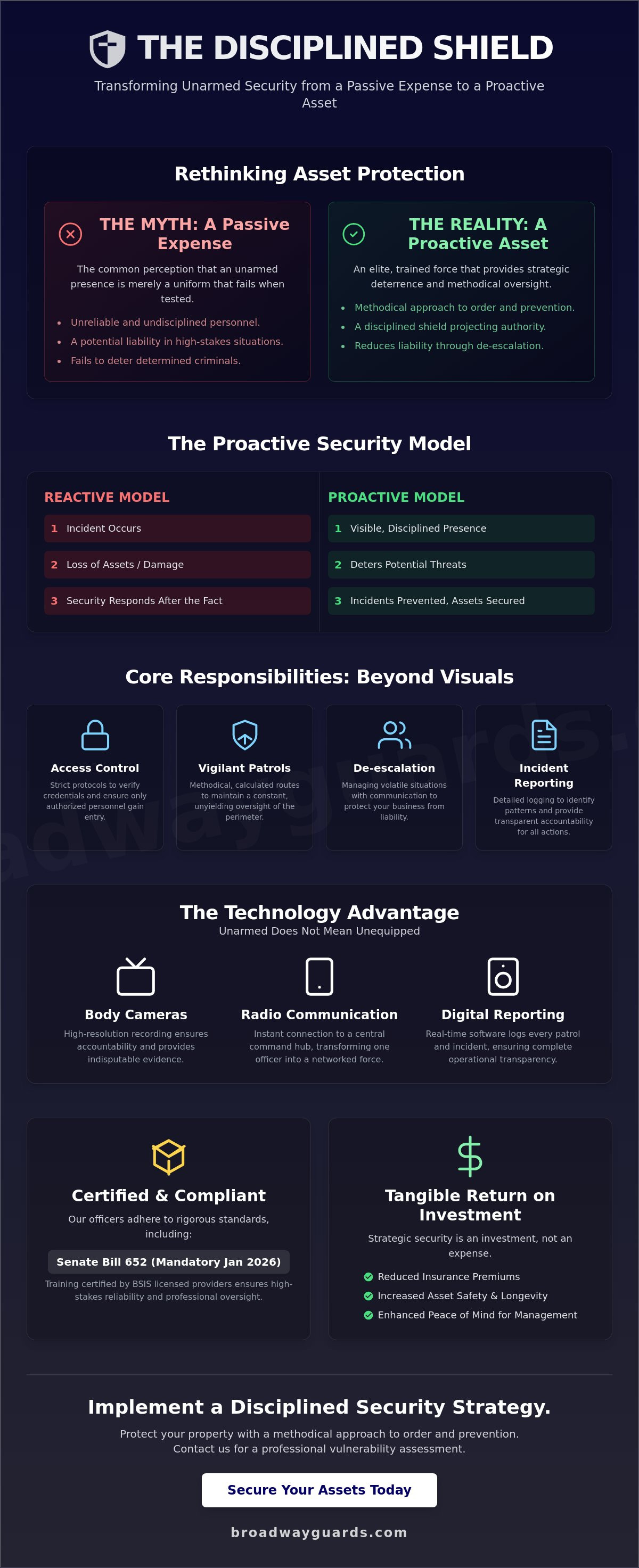
The Role of a Security Guard has evolved into a specialized discipline of proactive prevention. Unarmed security guards are professional officers trained in observation, reporting, and advanced de-escalation without the use of firearms. While they don’t carry lethal weapons, they’re far from unprotected. They utilize a sophisticated arsenal of tools, including high-resolution body cameras, instant radio communication, and digital reporting software. These assets ensure a constant link to a command center, transforming a single officer into a visible extension of a larger, disciplined shield. This represents a fundamental shift in commercial environments. We move away from reactive policing, which only responds after a loss occurs, and toward a proactive model that prioritizes asset safety through vigilance.

Maintaining a Disciplined Shield

Precision is the foundation of effective protection. A guard’s posture and patrol patterns shouldn’t be casual or unpredictable. Instead, they must reflect military-like precision to project an atmosphere of order. When an officer moves with a structured cadence and maintains an alert stance, it signals to potential intruders that the property is under active, unyielding oversight. Professional uniforms and stoic conduct influence public perception, creating a welcoming environment for legitimate guests while signaling a high-stakes risk to those with criminal intent. We rely on a culture of accountability. Every patrol is logged through reporting software, ensuring that methodical oversight is a documented reality rather than a vague promise. This rigorous operational standard builds trust and ensures that your assets are never left to chance.

Why Visibility is Your Best Defense

Criminals seek environments where they can operate without observation. Strategic visibility removes this opportunity. By positioning guards at critical access points and maintaining consistent perimeter patrols, you create a psychological barrier that stops crime before it starts. This approach effectively applies the “broken windows” theory to modern business. When a property appears strictly monitored, it discourages the minor infractions that often lead to more serious theft or vandalism. In high-traffic areas like the San Fernando Valley, retail centers have successfully reduced loitering and unauthorized entry simply by increasing the frequency of visible, disciplined patrols. It’s a matter of presence. A vigilant officer acts as a deterrent that technology alone cannot replicate. This strategic positioning ensures that every corner of your property remains under the care of a prepared and observant force.

  • Deterrence: A professional presence discourages criminal planning.
  • Observation: Detailed logging of daily activities identifies vulnerabilities early.
  • De-escalation: Managing conflict through communication reduces liability and keeps the peace.
  • Accountability: Digital reporting provides a transparent record of all security actions.

Core Responsibilities: Beyond the Visible Presence

Professional protection requires more than a stationary post. It demands a methodical execution of daily operations. Access control is the first line of defense. Every officer on duty follows a strict protocol for verifying credentials, ensuring only authorized personnel breach the perimeter. Perimeter patrols follow a calculated rhythm, leaving no sector unobserved. Incident logging provides the necessary data to identify patterns before they become threats. This level of detail is what separates a disciplined force from a passive observer. When conflict arises, the critical skill of de-escalation takes priority. Managing volatile situations without escalating to violence protects your business from liability while maintaining a safe environment for the public.

Crisis management is a core pillar of our operational standard. In medical or fire emergencies, these officers act as the immediate first responders. They secure the scene, provide initial assistance, and establish a clear path for emergency services. This role extends to liaison duties with Southern California law enforcement. During an incident, our team coordinates directly with local agencies to provide accurate data and physical support. This collaborative approach mirrors the state-level security guard regulations seen in other high-stakes jurisdictions, ensuring that every action is grounded in legal and professional rigor.

California BSIS Training Standards

Compliance is not optional; it’s the foundation of trust. In California, all unarmed security guards must meet the rigorous Bureau of Security and Investigative Services (BSIS) standards. As of January 1, 2026, Senate Bill 652 requires an initial eight-hour course on the Power to Arrest and Appropriate Use of Force before an application is even submitted. Once employed, officers must complete an additional 32 hours of training within their first six months. This 40-hour total covers essential modules like Terrorism Awareness and Communication. Broadway Security enforces these standards with military-like precision, often exceeding state minimums to ensure field performance remains unyielding. If you require a force that prioritizes these standards, consider our professional unarmed security guards for your next deployment.

Advanced Observation and Reporting (AOR)

The era of unreliable paper logs is over. We have transitioned to digital, real-time reporting systems that offer immediate transparency. These systems allow for the instant transmission of data, photos, and GPS-verified patrol points to our command center. Detailed incident reports are vital for protecting businesses from liability claims and insurance fraud. They provide a documented history of vigilant oversight that technology alone cannot provide. Advanced Observation and Reporting stands as the backbone of disciplined security oversight, providing a comprehensive and immutable record of every operational detail. This commitment to data-driven protection ensures that your assets are under the care of a force that values accountability above all else.

Evaluating Your Risk: Unarmed vs. Armed Security Personnel

Risk management is not a one-size-fits-all calculation. It requires a clinical analysis of your specific environment and the potential threats your assets face. Choosing unarmed security guards is often a strategic decision to minimize legal exposure while maintaining a high standard of safety. In public-facing sectors, the presence of a firearm can inadvertently escalate a volatile situation. By deploying unarmed personnel, you prioritize de-escalation and professional oversight. This approach provides a disciplined shield that protects your property without the high liability costs associated with armed force. It’s a matter of balancing protection levels with your operational budget to ensure maximum efficiency.

We utilize the “escalation of force” ladder to determine the appropriate level of intervention. A disciplined, visible presence is the first rung of this ladder. Professional communication and de-escalation tactics form the second. Physical control without the use of lethal weapons is the third. For complex commercial sites, a hybrid model often provides the most comprehensive coverage. This strategy involves placing armed guards at external checkpoints or high-risk perimeters while utilizing unarmed officers for interior access control and visitor management. This creates a layered defense system that remains both secure and welcoming.

When Unarmed Guarding is the Optimal Choice

Retail environments rely on loss prevention services to deter shoplifting and internal theft. A disciplined unarmed presence stops crime before it starts without creating a hostile atmosphere for legitimate customers. Corporate offices benefit from a similar approach. Guards manage visitor flow and ensure employee safety with a professional, non-aggressive profile that emphasizes order. In residential complexes, unarmed guards provide a sense of community safety. They maintain protocols and monitor entry points, ensuring that residents feel their environment is under the care of a vigilant and unyielding force. For property owners seeking to build a more complete defense plan, exploring professional residential security services can provide the multi-layered framework needed to address every vulnerability.
Identifying High-Risk Indicators

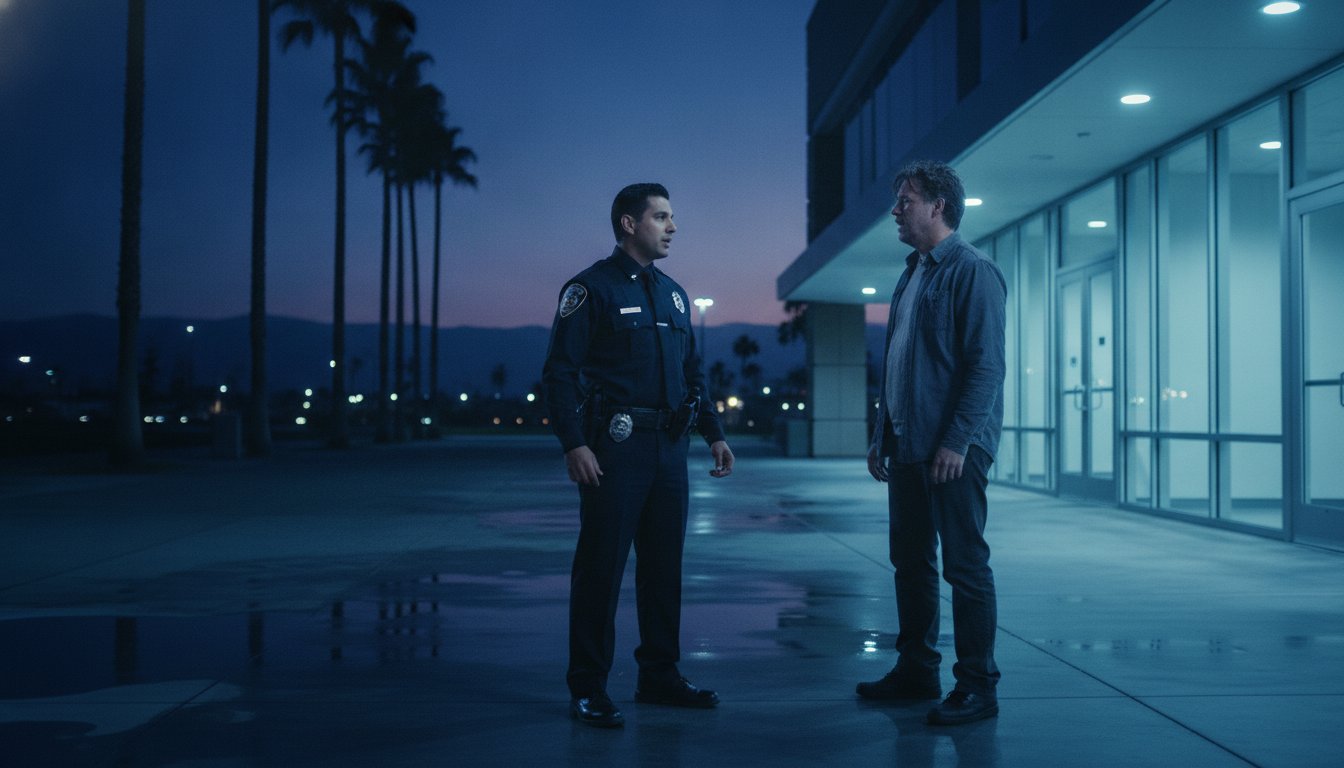
The transition to armed personnel is a decision driven by hard data and specific risk factors. If your operations involve the transport of high-value assets or cash, a more specialized deterrent is required. We evaluate local crime data in the San Fernando Valley to inform your security posture. When theft and vandalism rates spike in specific sectors, a more robust presence may be necessary to maintain order. A professional risk assessment is the only way to determine the correct guard type for your site. It identifies specific vulnerabilities and aligns your defense strategy with actual threats, ensuring your assets are never left to chance. This methodical approach guarantees that your security force is prepared for the specific challenges of your location.

  • Liability Reduction: Unarmed guards decrease the risk of legal complications in public areas.
  • Strategic Deterrence: Visibility alone prevents the majority of opportunistic crimes.
  • Budget Efficiency: Aligning guard type with actual risk levels optimizes security spending.
  • Layered Defense: Hybrid models provide specialized protection where it is needed most.

The Strategic Guide to Unarmed Security Guards: Prevention and Professionalism

Industry-Specific Applications: Where Unarmed Guards Deliver Maximum ROI

Maximizing return on investment requires a precise alignment of personnel with environmental risks. Deploying unarmed security guards allows businesses to establish a proactive shield without the overhead of armed units. In high-stakes commercial sectors, the primary goal is the preservation of assets through methodical oversight. Whether managing a retail floor or a complex construction site, the presence of a disciplined officer ensures that protocols are followed and vulnerabilities are neutralized before they can be exploited. This isn’t just about safety; it’s about maintaining the operational continuity of your business.

Construction and Industrial Site Deterrence

Construction sites are primary targets for high-value equipment theft and the pervasive issue of copper theft. Overnight patrols mitigate these risks by providing a constant, vigilant presence that technology alone cannot match. Our officers ensure site safety and support OSHA compliance through rigorous monitoring of safety protocols and unauthorized access points. This methodical approach protects your bottom line from the catastrophic costs of project delays and material loss. Learn more about our Construction Site Security services and how we maintain order on active job sites.

In retail environments, loss prevention services focus on strategic placement. Positioning officers at exits and high-value aisles creates a psychological barrier for shoplifters. Similarly, in healthcare settings, guards manage patient flow and secure sensitive areas. This ensures that medical professionals can operate in a secure environment, free from the distractions of unauthorized entry or disorderly conduct. Each officer acts as a prepared and observant force, dedicated to the specific protocols of the facility.

Corporate and Residential Management

Residential complexes in the San Fernando Valley require a balance of safety and professionalism. The concierge-security hybrid model serves residents by managing gated entry protocols and parking enforcement with a stoic, professional demeanor. This disciplined approach is essential for high-density environments where crisis response must be immediate and structured. For property owners looking to integrate physical personnel with modern technology, a comprehensive residential security strategy provides the structured framework necessary to address every layer of vulnerability. For gatherings in Canoga Park, event security provides crowd management and VIP access control, ensuring that order is maintained throughout the duration of the engagement. It’s a personality that values rules and visible results above all else.

Every industry has a unique risk profile that demands a specific operational standard. Our team delivers a disciplined shield that prioritizes your assets and the safety of your personnel. To secure your property with a vigilant force, contact our team to discuss our unarmed security guards for your specific industry needs.

  • Construction: Prevents copper and equipment theft through overnight vigilance.
  • Retail: Reduces shrinkage through strategic exit and aisle placement.
  • Healthcare: Maintains order and secures sensitive patient areas.
  • Residential: Manages access and parking with professional rigor.

Implementing a Disciplined Security Strategy in Southern California

Transitioning from a passive security posture to a proactive defense requires a methodical execution of four critical steps. First, you must conduct a comprehensive site vulnerability assessment. This clinical evaluation identifies physical weaknesses and operational gaps that could be exploited. Second, define specific ‘Post Orders’ that align with your business goals. These standing orders act as the definitive manual for your unarmed security guards, leaving no room for ambiguity in their daily duties. Third, select a provider with deep local roots in Canoga Park and Los Angeles. Regional expertise ensures that your force understands the specific criminal trends and environmental challenges of the San Fernando Valley. Finally, establish clear communication channels and reporting expectations to ensure total transparency. Broadway Security’s commitment to operational rigor is the logical conclusion for businesses that refuse to compromise on asset safety.

The Broadway Security Advantage

Our approach is built on a foundation of hierarchy and structure. Every deployment follows a chain of command that mirrors military-like precision. We don’t just place a body in a uniform; we deploy a vigilant officer who understands their role as a disciplined shield. This high standard of field performance is supported by our deep knowledge of the San Fernando Valley landscape. Local familiarity allows for optimized patrol routes and faster coordination with regional authorities. The ‘Disciplined Shield’ promise means accountability you can see. Every shift is documented through real-time reporting, providing you with an immutable record of our vigilance and your property’s status.

Taking the Next Step Toward Peace of Mind

Securing your facility begins with a professional consultation. During this initial phase, we analyze your specific risk profile and determine the most effective deployment of unarmed security guards to protect your interests. In the first 30 days of professional management, you can expect a rigorous implementation of your post orders and a noticeable shift in the atmosphere of your property. Our officers establish a consistent rhythm of oversight, ensuring that every protocol is followed with unwavering commitment. Secure your assets with a disciplined unarmed guard strategy from Broadway Security today and experience the reliability of a force that takes its duties with the utmost gravity.

  • Step 1: Identify vulnerabilities through clinical analysis.
  • Step 2: Codify duties in precise Post Orders.
  • Step 3: Partner with a provider rooted in Los Angeles and Canoga Park.
  • Step 4: Enforce transparency through digital reporting protocols.

Securing Your Future with Disciplined Oversight

Professional protection is the logical result of strict protocols and unwavering commitment. We’ve established that the most effective defense combines strategic visibility with the specialized skills of unarmed security guards. This disciplined approach minimizes liability while maximizing safety through elite training and real-time accountability. Our team applies BSIS Certified Training Standards to every deployment, ensuring that your property is monitored by a force that understands the gravity of its mission. With deep regional expertise in Canoga Park and the San Fernando Valley, we provide the localized knowledge necessary for rapid response and effective deterrence. You deserve a security partner that prioritizes order and precision above all else.

Request a Professional Security Consultation for Your Southern California Business

Your assets are too valuable to leave under the care of an undisciplined force. Take the final step toward a secure environment by choosing a partner that values rules, structure, and visible results. We stand ready to provide the vigilant protection your facility requires.

Frequently Asked Questions

What is the primary difference between unarmed and armed security guards?

The primary difference lies in the level of force and the associated liability profile. Armed guards carry firearms for high-threat environments where lethal force may be a requirement. Unarmed security guards prioritize de-escalation, advanced observation, and professional reporting to maintain a secure but welcoming environment. This strategic choice significantly reduces legal exposure for public-facing businesses while maintaining a disciplined shield over your assets.

Can unarmed security guards legally detain a suspect in California?

Unarmed officers in California possess the legal authority to perform a private person’s arrest under specific conditions. This power is utilized when a crime is committed in the officer’s presence. Every guard must complete the BSIS-certified “Power to Arrest” training module to ensure these actions are conducted within legal and regulatory boundaries. This methodical approach protects the property owner from potential liability claims and ensures order is maintained.

How much training do unarmed guards receive before being deployed?

California law requires a structured training progression for all professional officers. As of January 2026, Senate Bill 652 mandates an initial eight-hour course before an individual can even apply for a guard card. Once deployed, the officer must complete an additional 32 hours of specialized training within their first six months. This 40-hour total ensures every guard operates with professional discipline and high-stakes reliability.

Is unarmed security effective for preventing theft at construction sites?

Unarmed patrols are highly effective at preventing theft on industrial and construction sites. Their presence serves as a psychological deterrent that stops opportunistic crime before it starts. By monitoring access points and conducting perimeter patrols, they mitigate the risk of copper theft and equipment loss. Documented oversight provides the visible results necessary to maintain project timelines and protect your bottom line through consistent vigilance.

What equipment do unarmed security guards typically carry?

Modern officers utilize a sophisticated technological suite to maintain asset safety. Typical equipment includes high-resolution body cameras, digital radios for instant communication, and mobile devices for real-time reporting. These tools transform a single guard into a disciplined shield connected to a broader command structure. They focus on advanced observation and reporting to ensure total site transparency without the need for lethal weaponry.

How do I know if my business needs armed or unarmed security?

The decision depends on a clinical assessment of your specific risk level and environment. Armed guards are necessary for high-value asset transport or environments with documented violent threats. For most retail, corporate, or residential settings, unarmed security guards provide sufficient protection while minimizing liability. A professional vulnerability assessment will identify the specific deterrent level required to secure your facility effectively and maintain peace of mind.

Do unarmed guards help with insurance premiums for businesses?

Professional security oversight often leads to reduced insurance premiums for commercial properties. Insurance providers recognize that disciplined patrols and rigorous incident logging lower the overall risk profile of a business. By maintaining a documented history of vigilant protection, you demonstrate a commitment to risk mitigation. This proactive approach leads to long-term financial benefits and enhanced peace of mind for property owners and stakeholders.

What reporting should I expect from a professional security service?

You should expect comprehensive, digital reports that offer immediate transparency into field performance. Professional services provide real-time logs containing GPS-verified patrol points, date-stamped photos, and detailed incident summaries. This data-driven approach ensures that every action is accounted for and every vulnerability is addressed. Consistent reporting is the backbone of a culture of accountability and ensures your assets are under the care of an unyielding force.