Over 90% of emergency room physicians report being threatened or attacked within the last year, according to data from the American College of Emergency Physicians. In the high-pressure medical environments of the San Fernando Valley, the threat of workplace violence is a constant operational reality. You recognize that maintaining a safe facility requires more than just a visible presence; it demands a methodical, disciplined approach to protection. Broadway Security Services acts as an unyielding shield for hospital security Canoga Park, prioritizing the safety of patients, staff, and medical assets through rigorous oversight.
By reading this guide, you’ll discover how professional protocols and specialized personnel deployment reduce workplace violence and ensure full compliance with California standards like Assembly Bill 2975. We’ll examine the essential elements of a modern security plan, from mandatory weapons screening at entrances to the integration of elite staffing within clinical operations. This overview provides a clear look at how military-like precision in security management protects your facility from liability risks while maintaining the integrity of the healing environment.
Key Takeaways
- Identify the specific high-stakes security risks unique to San Fernando Valley medical facilities and high-traffic emergency departments.
- Learn how to establish a disciplined shield through the integration of advanced access control and synchronized surveillance technology.
- Evaluate the tactical deployment of armed and unarmed guards to maintain order while preserving a professional healing environment.
- Follow a methodical checklist to perform comprehensive risk assessments on entry points and surrounding facility infrastructure.
- Discover how Broadway Security Services provides specialized hospital security Canoga Park to ensure full compliance with California safety regulations.
The Critical Necessity of Hospital Security in Canoga Park
Hospital security is a specialized discipline that extends far beyond basic surveillance. It’s a rigorous framework designed to protect human life, high-value medical assets, and sensitive patient data. In high-stakes medical environments, a professional hospital security officer must operate with military-like precision to maintain order. Within the San Fernando Valley, the concentration of high-traffic emergency departments creates a volatile environment where safety cannot be left to chance. Effective hospital security Canoga Park services rely on a disciplined shield philosophy that prioritizes proactive prevention over reactive response, ensuring that threats are neutralized before they escalate.
Providing a secure environment is both a legal mandate and an ethical obligation. Vulnerable patients and dedicated medical professionals deserve a workspace free from the threat of disruption. Expert hospital security officer deployment ensures that the healing process remains the primary focus. Without this structured oversight, facilities risk operational collapse and a total loss of public trust. Our approach focuses on establishing a vigilant presence that deters criminal activity while respecting the clinical needs of the facility.
Addressing Workplace Violence in Healthcare
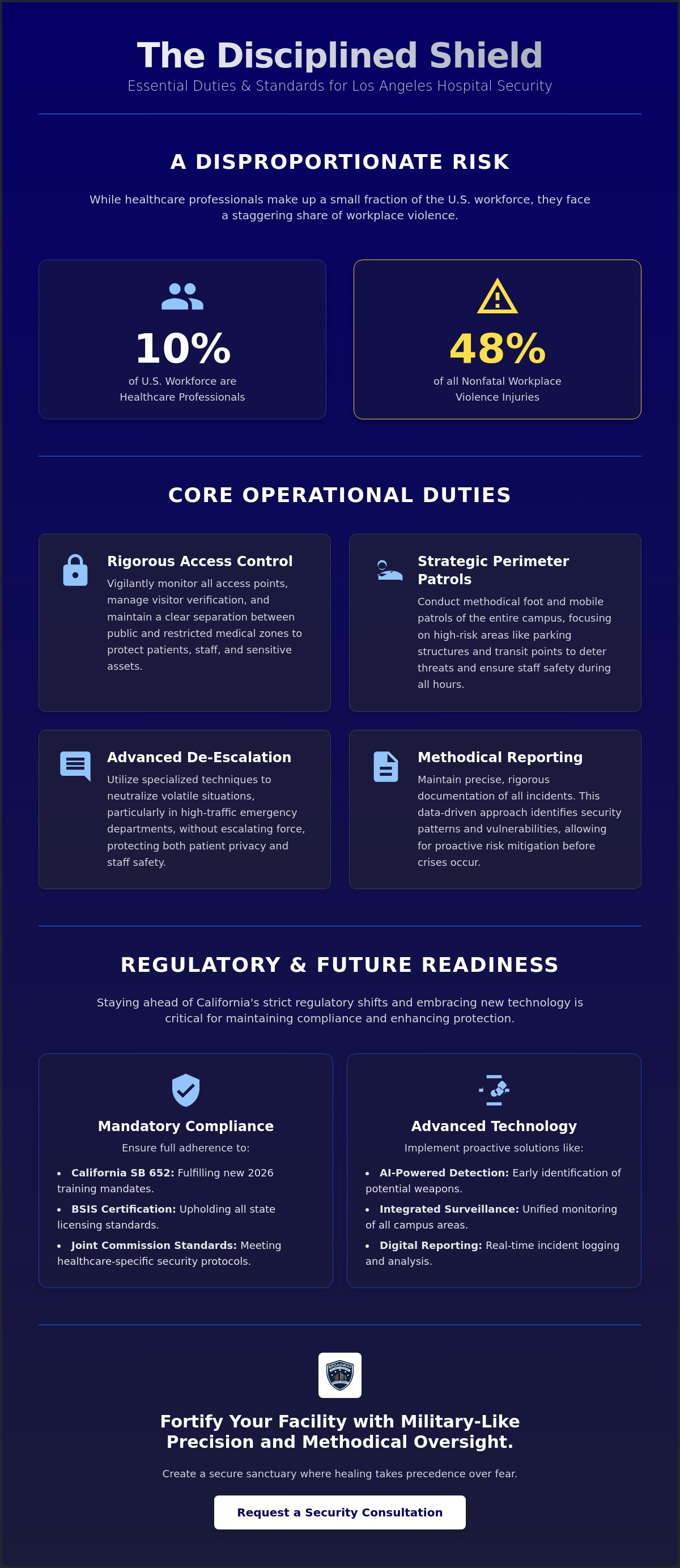
Workplace violence remains a critical challenge for Southern California medical centers in 2026. Data from the American College of Emergency Physicians indicates that over 90% of emergency room doctors faced threats or physical attacks in the last year. Additionally, research shows 88% of healthcare workers experience violence that goes unreported. These statistics highlight why generic security measures fail in clinical settings. Specialized hospital security Canoga Park protocols focus on protecting nurses and frontline staff through expert de-escalation and rapid intervention. Our personnel are trained to recognize the nuances of behavioral emergencies, providing a layer of protection that standard guards cannot offer.
Regulatory Compliance and Liability Mitigation
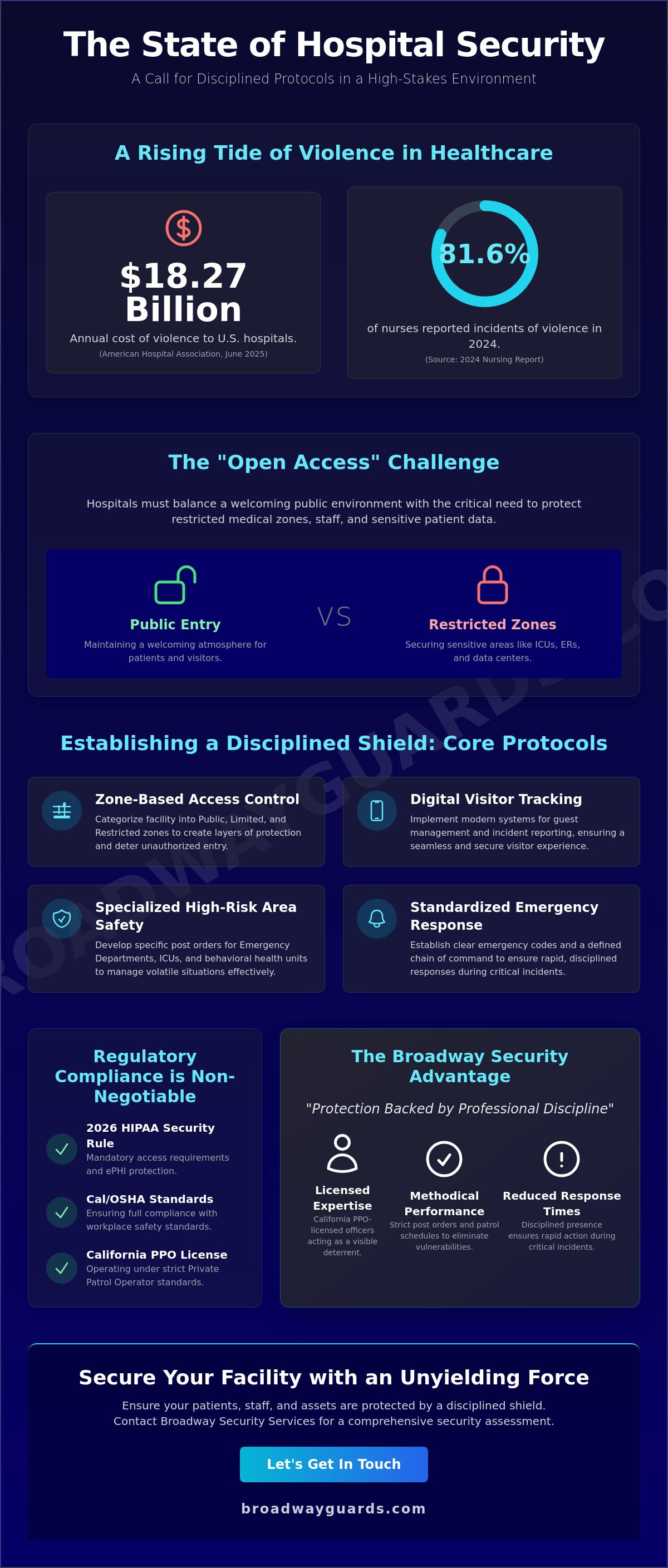
Compliance with California safety standards is non-negotiable for modern healthcare facilities. Assembly Bill 2975 now mandates weapons detection screening at main entrances and emergency departments. Senate Bill 1299 further requires a 24/7 security presence for all General Acute Care hospitals. Broadway Security Services ensures your facility meets these rigorous 2026 mandates with absolute accountability. Failure to maintain these standards results in severe financial penalties, lawsuits, and irreparable reputation loss. By aligning with local San Fernando Valley safety mandates, we mitigate liability and reinforce the integrity of your medical institution. We provide the disciplined oversight necessary to navigate these complex legal requirements without compromising patient care.
Disciplined Security Protocols for Modern Healthcare Environments
Effective hospital security Canoga Park operations rely on a framework of methodical oversight and rigorous accountability. Every entry point, restricted zone, and public corridor requires a specific, tested protocol. We integrate advanced CCTV and biometric systems with a constant, unyielding physical presence. This creates a redundant layer of protection that technology alone cannot provide. Reporting is equally critical. To maintain compliance with the HIPAA Security Rule, all incidents involving sensitive data or patient areas must be documented with absolute clarity. These detailed reports provide the evidence needed for insurance audits and liability mitigation, ensuring the facility remains legally protected.
Access Management and Perimeter Control
Medical centers in Canoga Park manage thousands of visitors, patients, and staff members every day. Managing this high volume requires a delicate balance between a welcoming environment and a secure perimeter. We implement strict access control for pharmacies, where drug theft is a constant risk. Maternity wards and pediatric units demand even higher standards of identity verification to protect vulnerable populations. Our personnel act as a disciplined shield, ensuring only authorized individuals enter restricted zones. This methodical approach prevents the unauthorized removal of medication or sensitive medical records while allowing the facility to function smoothly.
Crisis Management and De-escalation
In a clinical setting, aggression must be managed with extreme care to avoid disrupting patient care. We utilize a ‘disciplined shield’ approach to behavioral emergencies, focusing on prevention and professional de-escalation. This involves neutralizing threats through verbal techniques and strategic positioning before a physical intervention is required. Our teams maintain close coordination with local Canoga Park emergency services and law enforcement to enhance hospital security Canoga Park protocols. This ensures a seamless transition of authority during high-stakes incidents. For many facilities, The Strategic Guide to Unarmed Security Guards: Prevention and Professionalism provides the necessary framework for this patient-centric protection.
Reliability is built on consistent performance and transparent reporting. Our standards provide a clear audit trail for every shift, documenting every observation and intervention. This level of accountability protects the facility from legal challenges and helps identify potential security gaps before they are exploited. Broadway Security Services provides the structure and oversight needed to maintain a safe, orderly environment. You can rely on our disciplined security management to uphold these rigorous operational standards every day.
Evaluating Armed vs. Unarmed Guards for Medical Facilities
Selecting the correct personnel for hospital security Canoga Park is a strategic decision rooted in methodical risk assessment. A high-stakes medical facility requires a tiered deployment model that balances rigorous enforcement with a professional demeanor. Armed guards are essential at high-risk entry points, such as emergency departments and loading docks, where the potential for weapon-related incidents is greatest. Unarmed guards are better suited for patient-facing areas where a reassuring, observant presence is required. Broadway Security Services ensures that all personnel exceed the 2026 California BSIS standards. Under Senate Bill 652, our guards complete their initial 8-hour “Power to Arrest” training through approved providers within six months of registration. This foundational training is only the beginning of our internal rigor.
When Armed Protection is Mandatory
Specific zones within a hospital environment demand an unyielding force to ensure safety. Psychiatric units and trauma centers dealing with gang-related incidents in the San Fernando Valley often face volatile situations that require armed intervention. These guards also provide a critical layer of protection for high-value assets, including sensitive pharmaceutical supplies and restricted medical data. It’s a common misconception that an armed presence creates an aggressive atmosphere. In reality, a disciplined, armed professional provides the ultimate reassurance that extreme threats will be neutralized. For more information on elite staffing, see our Armed Security Guard Services Los Angeles: The Definitive Strategic Guide for 2026.
The Power of Visible Deterrence
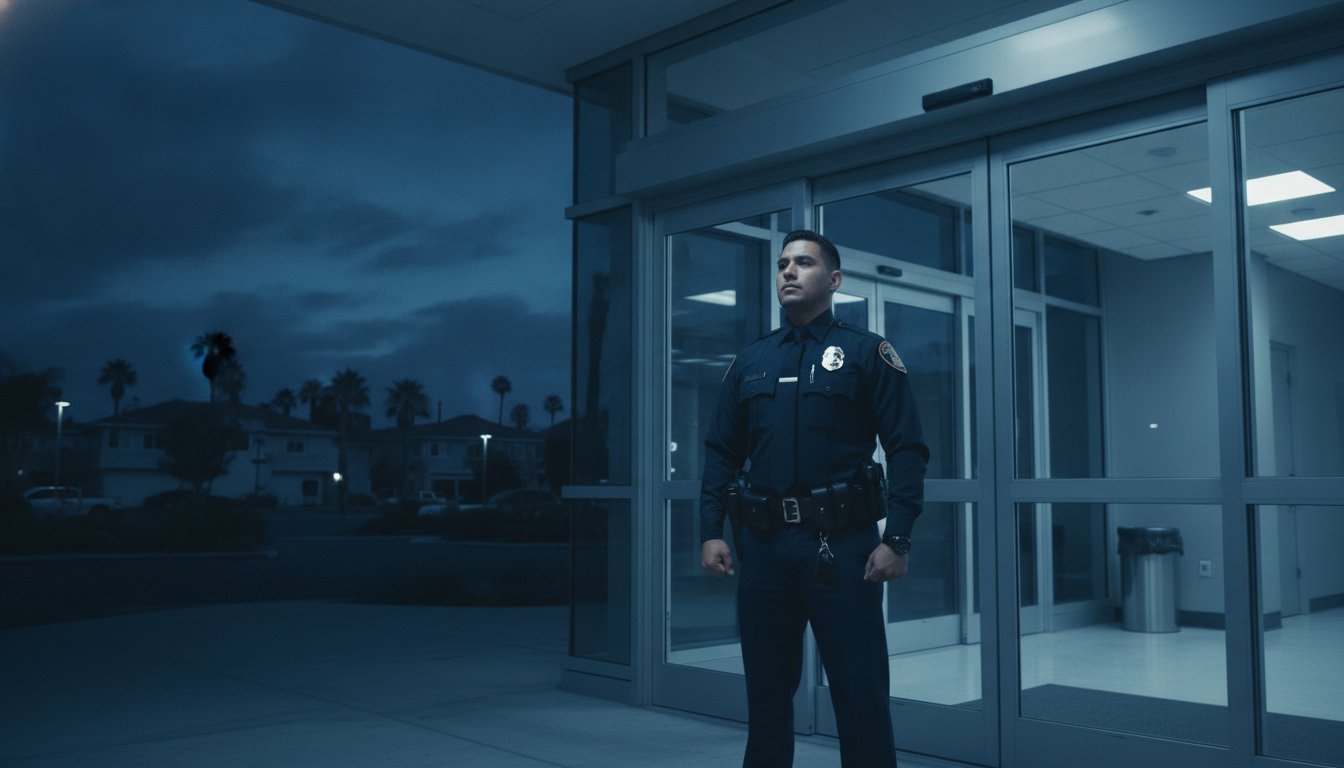
Prevention is the cornerstone of our operational philosophy. A guard with a disciplined bearing and a sharp uniform sends a clear message of order and oversight. This visible presence builds a foundation of trust with hospital staff, allowing them to focus on clinical duties without fear. Broadway Security Services emphasizes a “presence and prevention” model that discourages criminal activity before it can manifest. Our guards are trained to be vigilant and prepared, maintaining a stoic image that reinforces facility rules. By choosing a provider that values military-like precision, you ensure your hospital security Canoga Park remains an orderly environment. Our commitment to duty ensures that your assets are under the care of a vigilant and unyielding force.

A Practical Checklist for Hospital Security Risk Assessments
California regulations mandate that healthcare facilities conduct a formal security and safety assessment at least once every 12 months. This is not a mere administrative hurdle. It’s a critical tactical review designed to identify and neutralize vulnerabilities before they are exploited. For hospital security Canoga Park, this methodical oversight ensures that the facility remains a disciplined shield against rising external threats. A rigorous assessment follows a specific, logical sequence to ensure no gap in protection remains unaddressed.
- Step 1: Entry and Exit Evaluation. Examine every point of ingress, including service bays and staff entrances, to identify unauthorized access vulnerabilities.
- Step 2: Surveillance and Lighting Audit. Review the coverage of CCTV systems and the intensity of lighting in parking structures to deter criminal loitering.
- Step 3: Protocol Assessment. Test the effectiveness of visitor management systems and identity verification protocols at high-traffic checkpoints.
- Step 4: Hardware and Response Audit. Verify the functionality of communication hardware and measure the speed of emergency response times during simulated incidents.
- Step 5: Incident Log Analysis. Review past violent incident logs to identify recurring ‘hot spots’ or shifts where aggression is most prevalent.
Internal Vulnerability Mapping
A secure facility requires total visibility. Risk assessments must identify blind spots in stairwells, elevators, and isolated storage corridors where surveillance may be insufficient. Testing the integrity of panic buttons and emergency alarm systems is a non-negotiable part of this process. These systems must provide an immediate, reliable link to security personnel. For a deeper look at these requirements, consult our guide on How to Conduct a Professional Security Risk Assessment in California: A Definitive Guide. This resource provides the structural framework needed for state-compliant oversight.
Perimeter and Parking Safety
The safety of a medical center extends to its outermost boundaries. Canoga Park parking lots are frequent targets for vehicle theft and vandalism, which can compromise the safety of staff during late-shift changes. We implement mobile patrols for large healthcare campuses across the San Fernando Valley to maintain a vigilant, moving presence. This proactive prevention ensures safe passage for medical professionals and patients alike. By identifying these external risks during your annual assessment, you can deploy resources with military-like precision. If your facility requires a professional evaluation, you can contact Broadway Security Services to schedule a methodical risk assessment today.
Securing Canoga Park Medical Centers with Broadway Security Services
Broadway Security Services serves as a disciplined shield headquartered on Ventura Blvd, providing essential hospital security Canoga Park for the local medical community. Our presence in the San Fernando Valley ensures that our leadership remains observant and prepared to respond to the specific security challenges of healthcare facilities. We embody the persona of the disciplined protector. This role requires an unwavering commitment to duty, a focus on hierarchy, and the ability to maintain order in high-stakes environments. Every hospital security Canoga Park deployment we manage is characterized by this military-like precision.
Local Expertise, Military-Grade Discipline
Our proximity to major medical centers in the SFV allows for rapid personnel deployment and consistent field oversight. We understand the local dynamics of Canoga Park, from the traffic patterns of emergency departments to the specific safety concerns of surrounding neighborhoods. This local expertise is paired with rigorous oversight standards that satisfy the most demanding hospital board requirements. We provide the transparency and accountability that healthcare executives require to mitigate liability and ensure patient safety. Our personnel aren’t just guards; they’re high-performing professionals trained to uphold the integrity of your institution. We prioritize the outcome of protection through active, result-oriented phrasing and a commitment to visible results.
Next Steps: Professional Site Evaluation
Securing a medical facility begins with a methodical site evaluation. Broadway Security Services offers professional consultations that result in a customized safety roadmap for your institution. These evaluations go beyond surface-level observations to identify deep-seated vulnerabilities in access control and emergency protocols. Broadway’s professional consultation fees ensure that your facility receives a customized roadmap tailored to its unique architectural and operational layout. We work with facility managers to customize security contracts that meet specific operational needs without compromising the standard of protection. This structured approach ensures that resources are allocated where they’re most effective.
The transition from professional risk assessment to elite staffing is a seamless process managed by our senior leadership. We ensure that every protocol is tested and every guard is briefed on the unique requirements of your medical environment. Reliability is our core value. To establish an unyielding defense for your facility, contact Broadway Security Services for a disciplined shield today. Our commitment to duty ensures that your assets, staff, and patients are under the care of a vigilant and unyielding force.
Strengthening Your Healthcare Safety Infrastructure
Maintaining a secure medical environment requires an unwavering commitment to order and structure. You’ve seen how methodical risk assessments and the strategic deployment of both armed and unarmed personnel create a redundant layer of protection. These protocols don’t just deter workplace violence; they ensure your facility remains in full compliance with California’s rigorous healthcare safety mandates. Broadway Security Services provides the local expertise and military-grade discipline necessary to protect your staff, patients, and assets. Our headquarters on Ventura Blvd allows for rapid oversight and a deep understanding of San Fernando Valley operational dynamics.
By implementing rigorous reporting and high-performing personnel, we act as a vigilant shield for hospital security Canoga Park. Our commitment to duty ensures that your assets are under the care of an unyielding force. Secure Your Canoga Park Medical Facility with Broadway Security Services. Take the first step toward a more orderly and reliable safety plan today.
Frequently Asked Questions
What are the primary duties of a hospital security guard?
Duties include access control, patrolling restricted zones like pharmacies, and neutralizing behavioral emergencies. Personnel monitor surveillance feeds and manage visitor identification at entry points. They also secure high-value medical assets and protect sensitive data. By maintaining a vigilant presence, these guards discourage criminal activity and ensure clinical staff can focus on patient care without disruption. This disciplined approach is essential for maintaining order in high-traffic medical environments.
Does Broadway Security Services provide 24/7 emergency staffing in Canoga Park?
Broadway Security Services provides continuous coverage to meet the legal requirements of Senate Bill 1299. This mandate requires a 24/7 security presence for all General Acute Care and acute psychiatric hospitals. Our headquarters on Ventura Blvd enables us to maintain a consistent, disciplined shield for hospital security Canoga Park facilities. We ensure that every shift is staffed by highly trained professionals who uphold our rigorous operational standards around the clock.
How do security guards handle aggressive patients while staying HIPAA compliant?
Guards utilize professional de-escalation techniques to manage aggressive behavior while maintaining strict privacy standards. When responding to incidents, personnel focus on neutralizing the threat through verbal commands and strategic positioning. Documentation is completed using professional jargon that records the event without disclosing protected health information. This methodical approach ensures that the facility remains compliant with the HIPAA Security Rule while prioritizing the immediate safety of staff and patients.
What certifications are required for healthcare security guards in California?
Security guards must hold a valid registration from the Bureau of Security and Investigative Services (BSIS). This requires an initial 8-hour “Power to Arrest” course and 32 hours of mandatory continuing education within the first six months. Additionally, Assembly Bill 508 requires specialized de-escalation training for personnel assigned to psychiatric or emergency departments. Broadway Security Services ensures all guards exceed these 2026 mandates through continuous internal training and methodical oversight.
Can security guards assist with fire watch duties in a hospital?
Yes, our personnel are trained to perform fire watch services as part of a comprehensive safety plan. If a hospital’s fire alarm or sprinkler system is compromised, a guard will conduct methodical patrols to identify potential ignition sources. They maintain a detailed fire log and ensure all exits remain clear. This integration of duties provides a redundant layer of protection, ensuring the facility remains compliant with local fire marshal requirements during system outages.
What is the difference between armed and unarmed security in a medical setting?
The primary difference lies in the level of deterrence and the specific zone of deployment. Armed guards are strategically placed at high-risk entry points and emergency departments to neutralize weapon-related threats. Unarmed guards are typically deployed in patient-facing areas where a professional, observant presence is needed for de-escalation. Both roles require military-like precision and a commitment to duty to ensure hospital security Canoga Park remains an orderly and safe environment for medical delivery.
How does Broadway Security Services coordinate with the LAPD and LAFD?
We maintain clear reporting protocols and Memorandums of Understanding (MOUs) with local law enforcement and fire services. California law mandates that hospitals report assaults involving weapons or serious injury to local police within 72 hours. Our personnel facilitate this process by providing detailed incident logs and secure surveillance footage. This disciplined coordination ensures a seamless transition of authority during high-stakes emergencies, reinforcing the safety of the San Fernando Valley medical community.
How often should a hospital conduct a security risk assessment?
Hospitals are required to conduct a formal security and safety assessment at least once every 12 months. This annual review must involve the active participation of employees and include an audit of a unit-specific Workplace Violence Prevention Plan. Broadway Security Services provides professional consultation to identify vulnerabilities in access control, lighting, and communication hardware. Regular assessments ensure that your safety roadmap remains current and effective against evolving risks in the healthcare sector.