
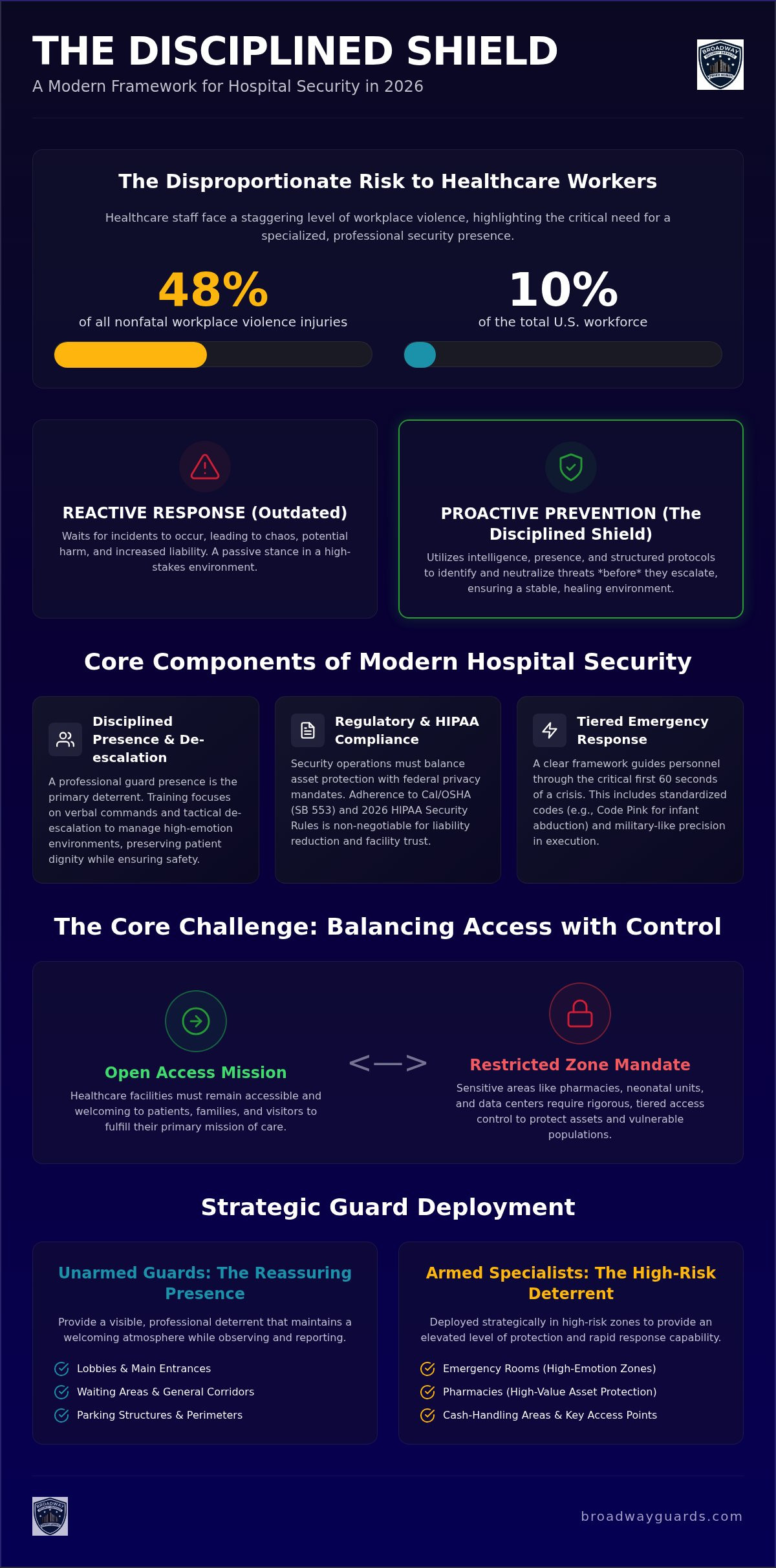
Healthcare workers experience 48% of all nonfatal workplace violence injuries in the United States, despite representing only 10% of the total workforce. This staggering statistic underscores a volatile reality that healthcare administrators can no longer ignore. Maintaining a healing environment requires more than just locks and cameras; it demands a sophisticated and disciplined approach to hospital security guard duties. A professional presence must serve as an unyielding shield, protecting staff and assets without compromising the patient-first compassion essential to clinical care.
You likely feel the persistent tension of keeping facilities accessible while securing restricted zones against rising threats. It’s a high-stakes environment where a single breach leads to significant liability or physical harm. This guide provides the strategic framework necessary to master the 2026 security landscape. We will examine the latest IAHSS weapons detection guidelines, the mandatory 2026 HIPAA Security Rule updates, and the tactical protocols required to reduce incidents. You’ll gain a clear roadmap for establishing an authoritative, professional security presence that ensures order and absolute peace of mind across your facility.
Key Takeaways
- Understand how modern hospital security guard duties have evolved into a proactive, intelligence-led discipline that prioritizes prevention over reaction.
- Learn to implement the “Disciplined Shield” approach, utilizing professional presence and tactical de-escalation to manage high-emotion environments safely.
- Master the balance between rigorous asset protection and federal privacy mandates, ensuring all security operations remain fully HIPAA compliant.
- Establish a tiered emergency response framework that guides personnel through the critical first 60 seconds of an active threat or crisis.
- Discover how military-like precision and professional risk assessment create a reliable security foundation for Southern California healthcare facilities.
Hospital Security Protocols in 2026: The Strategic Landscape
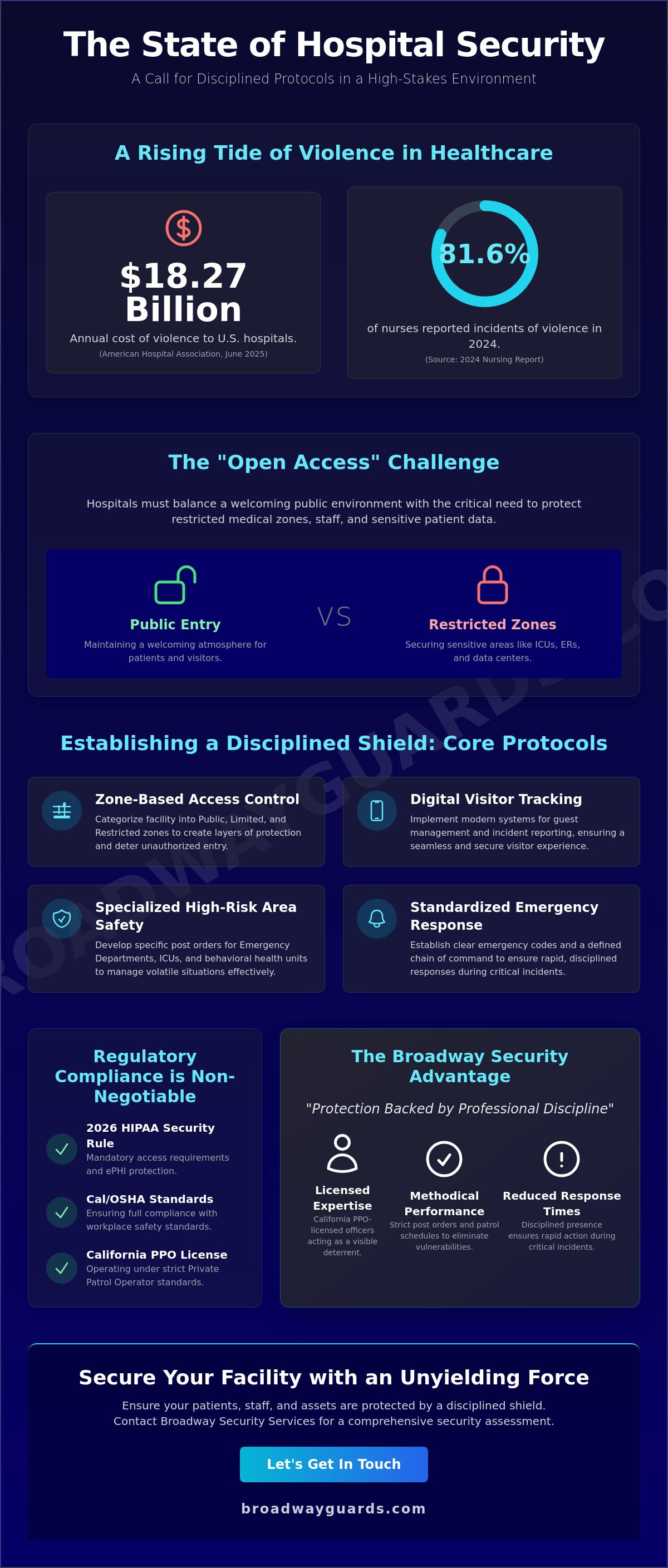
Modern hospital security operates as a disciplined framework where human presence and technological oversight converge to form a “disciplined shield.” In 2026, the industry has shifted decisively from reactive responses to proactive, intelligence-led protocols. Hospital security is the integration of patient safety, staff protection, and asset management. Effectively executing hospital security guard duties now requires a balance between the facility’s open-access nature and the necessity for rigorous, tiered access control. This proactive stance ensures that vulnerabilities are identified before they escalate into active threats. A disciplined presence doesn’t just respond to chaos; it prevents it through methodical observation and structured intervention.
The complexity of a hospital’s “open door” policy creates a significant strategic challenge. While healthcare missions require accessibility for patients and families, security mandates require restricted zones to protect sensitive areas like pharmacies and neonatal units. Managing this friction requires a sophisticated understanding of flow control and behavioral detection. Security is no longer a passive role. It’s an active, vigilant force that maintains the perimeter while facilitating the clinical mission of the institution.
The Evolving Threat Profile for Healthcare Facilities
Healthcare facilities in the San Fernando Valley face unique pressures due to high urban density and regional socio-economic shifts. Perimeter security and parking structure oversight are critical, as these areas often serve as the first point of contact for potential intruders or escalating conflicts. Beyond physical violence, security forces must address specialized risks such as high-value pharmaceutical theft and high-stakes infant protection protocols. Standardized Hospital Emergency Codes, such as “Code Pink,” provide the operational language needed for rapid response, but the effectiveness of these codes relies entirely on the discipline of the personnel on the ground. Vigilance in these high-stakes zones is non-negotiable for maintaining facility order and protecting the most vulnerable populations.
California Regulatory Standards for Hospital Safety
Compliance is a cornerstone of professional reliability and facility trust. In California, the legal landscape for healthcare safety is governed by strict Cal/OSHA standards, specifically SB 553 and its 2026 updates regarding workplace violence prevention. These regulations mandate that all security personnel undergo rigorous training and certification tailored specifically to the healthcare environment. Accountability is enforced through mandatory reporting systems that track every incident with military-like precision. These reports aren’t just administrative tasks; they’re essential for maintaining facility accreditation and reducing long-term liability. By adhering to these legal frameworks, hospital security guard duties are grounded in regulatory reality, ensuring that every action taken by a guard is both lawful and tactically sound.
The Human Element: Disciplined Presence and De-escalation
While high-tech sensors provide valuable data, they lack the capacity to intervene in a human crisis. A professional security presence serves as a primary deterrent, projecting an atmosphere of order that technology alone cannot replicate. This is the foundation of hospital security guard duties. A disciplined guard doesn’t just watch; they observe, assess, and act as a “disciplined shield” for patients and staff alike. By integrating into the hospital’s culture of care, security personnel maintain safety while preserving the trust essential to a healing environment.
Tactical de-escalation is a critical requirement in clinical settings. Training focuses on managing high-emotion environments, such as Emergency Rooms, where stress levels are at their peak. Guards are taught to neutralize aggression through verbal command and presence before physical intervention becomes necessary. This professional restraint ensures that safety doesn’t come at the cost of patient dignity. It creates an environment where patients feel protected rather than policed.
The choice between armed and unarmed personnel depends on the specific risk profile of the zone. Unarmed guards provide a reassuring presence in general areas, while armed specialists secure high-risk points. This strategic deployment ensures that the level of force is always appropriate for the clinical setting, maintaining a balance between rigorous asset protection and a welcoming atmosphere for care.
Specialized Training for Healthcare Security Personnel
Crisis Intervention Training (CIT) is mandatory for personnel stationed in high-risk areas like psychiatric wards. These specialists understand how to uphold the HIPAA Security Rule by protecting physical access to sensitive areas without infringing on patient rights. For facilities requiring a more robust deterrent, armed security guard services Los Angeles provide the necessary tactical oversight for high-risk zones. This specialized training ensures that guards remain unyielding at the perimeter while remaining respectful within the clinical space.
The Role of Mobile Patrols in Perimeter Defense
Perimeter defense extends beyond the lobby. Parking structures and remote entrances in the San Fernando Valley are often targets for vandalism or vehicle theft. Mobile patrols provide consistent, disciplined visibility across these expansive areas. Effective hospital security guard duties include coordinating with local law enforcement for rapid escalation when an incident exceeds on-site capacity. This structured approach to perimeter safety ensures that the entire facility remains a secure zone. For those seeking to harden their facility’s defenses, a professional risk assessment is the first step toward a comprehensive security plan.
HIPAA Compliance and Privacy in Security Operations
Security in a clinical environment requires a dual mandate: protecting physical assets and safeguarding patient privacy. Under the HIPAA Security Rule, every aspect of hospital security guard duties must align with federal confidentiality standards. This isn’t a suggestion; it’s a legal requirement that demands absolute discipline. A professional protector understands that their presence should never compromise a patient’s right to privacy. By adhering to the “Need to Know” principle, guards ensure they only access information essential to their immediate safety mission, maintaining a stoic and professional boundary at all times.
The management of surveillance technology requires specific operational rigor. Body-worn cameras and fixed CCTV systems must be positioned and utilized to avoid capturing sensitive clinical interactions or patient records. Footage is treated as protected data, requiring strict chain-of-custody protocols to prevent unauthorized disclosure. Whether deploying armed personnel or unarmed security guards, every member of the force must be trained to recognize the boundary between vigilance and intrusion. This creates an atmosphere of high-stakes reliability where patients feel secure without feeling exposed.
Physical Security vs. Data Privacy
Strategic facility layout is the first line of defense in maintaining privacy. Security checkpoints should be established at a distance from sensitive consultation areas to prevent the accidental overhearing of Protected Health Information (PHI). Following the IAHSS Security Design Guidelines ensures that physical barriers and access control systems enhance safety without creating privacy bottlenecks. Visitor logs and digital access records are managed under strict HIPAA guidelines, ensuring that entry data is archived securely and accessed only for authorized investigations. During patient transfers, security protocols focus on clearing paths and securing perimeters without exposing the patient to unnecessary public view.
Incident Reporting and Legal Documentation
A disciplined shield is built on a foundation of precise documentation. Authoritative incident reports must be drafted with objective, fact-based language that can withstand legal scrutiny. In the context of hospital security guard duties, a report is a legal record, not a narrative of opinion. Every entry in the security log must be methodical, detailing the “who, what, where, and when” with military-like precision. This level of oversight is vital when coordinating with hospital legal teams during post-incident investigations. Reliable reporting reduces liability and ensures that the facility remains in full compliance with both state and federal regulations.
Emergency Response Frameworks: A Step-by-Step Guide
A disciplined response is never accidental; it’s the result of a rigorous, tiered framework. Effective hospital security guard duties require personnel to navigate a spectrum of intervention, moving from verbal commands to physical restraint with absolute precision. This tiered approach ensures that force is only used when necessary, protecting the facility’s liability while maintaining safety. The initial phase focuses on detection and communication, ensuring that the entire security force is alerted instantly through coordinated mass notification systems. This synergy between technology and human presence forms an unyielding barrier against chaos.
The Critical 60 Seconds define the outcome of any active threat. During this window, security personnel must execute immediate actions: securing perimeters, initiating lockdowns, and establishing a clear line of communication with local law enforcement. There is no room for hesitation. Achieving this level of readiness starts with a comprehensive security risk assessment CA to identify and close response gaps before an actual emergency occurs.
Standardized Hospital Emergency Codes
Standardization is the language of order. When a Code Silver is called, indicating an active shooter, guards transition to tactical movement and lockdown procedures, acting as a liaison for arriving police units. In a Code Blue medical emergency, the guard’s role is to clear hallways and secure the immediate area so clinical teams can work without interference. Code Gray protocols manage combative individuals, where hospital security guard duties shift toward professional restraint and de-escalation. These codes ensure every staff member knows exactly what to expect from the security force during high-stakes events.
The Audit Process: Testing Your Protocols
Protocols are only as effective as the personnel who execute them. Regular tabletop exercises and live-action drills are mandatory for maintaining operational readiness. These simulations allow administrators to analyze response times and identify communication breakdowns under pressure. As we move through 2026, these audits must incorporate the latest security trends, including advanced weapons detection systems and updated Cal/OSHA standards. Constant refinement ensures that your facility’s shield remains unyielding. To implement these rigorous standards at your facility, consult with the experts at Broadway Security Services for a professional evaluation.
Implementing a Disciplined Shield with Broadway Security
Broadway Security Services stands as the disciplined shield for healthcare institutions across Canoga Park and the San Fernando Valley. Hospitals in Southern California face rising threats that demand more than just a presence; they require a partner committed to military-like precision. By choosing Broadway Security Services, administrators ensure that hospital security guard duties are executed with unyielding reliability. We don’t just provide personnel; we provide a structured defensive layer that integrates seamlessly with your clinical mission. This transition from vulnerability to vigilance begins with a commitment to order and methodical oversight.
Every security contract we design is customized to the specific needs of your healthcare facility or clinic. Vigilance replaces vulnerability when protocols are rooted in professional discipline and constant oversight. Our approach ensures that every guard understands the hierarchy of response and the gravity of their role in protecting lives and assets. We prioritize safety, trust, and peace of mind by maintaining a stoic, professional image that deters threats through presence alone. It’s a high-stakes environment where reliability isn’t optional; it’s the standard.
Our Professional Consultation and Risk Assessment
Identifying hidden vulnerabilities requires a methodical and observant eye. Our professional consultation process scrutinizes your facility’s current posture to find gaps in access control, perimeter defense, and data privacy. We develop site-specific protocols that align with your medical mission and community values. This roadmap for security enhancement provides a strategic plan for personnel deployment, ensuring that your assets are under the care of a vigilant force. We analyze every entry point and sensitive zone to ensure your “Disciplined Shield” is comprehensive and without compromise. This organized approach ensures that your facility is prepared for any contingency.
The Standard of Excellence in Guard Staffing
We maintain a standard of excellence through continuous training and rigorous accountability. Every guard deployed is subject to consistent oversight to ensure they remain a professional, reassuring presence for patients and staff. We emphasize the “Disciplined Shield” philosophy, where every action is result-oriented and every report is fact-based. This commitment to duty is what makes us a trusted partner in Southern California. Our field performance reporting ensures that hospital security guard duties are tracked and verified with military-like precision. Contact Broadway Security Services for a professional hospital risk assessment to begin hardening your facility’s defenses today.
Securing the Future of Healthcare with Vigilant Oversight
Mastering the complex landscape of healthcare safety requires a commitment to order and methodical oversight. By integrating disciplined human presence with rigorous emergency frameworks, facilities can effectively balance patient care with asset protection. Executing hospital security guard duties with military-like precision ensures that every threat is met with an unyielding response; this approach maintains the trust essential to a healing environment.
Broadway Security Services provides the regional expertise and professional discipline necessary to harden your facility against rising threats in Canoga Park and throughout Southern California. Our approach is rooted in comprehensive risk assessment and expert crisis management. Don’t leave your facility’s safety to chance. It’s time to move from vulnerability to a state of constant vigilance. Your staff and patients deserve the peace of mind that comes from a reliable, unyielding protector.
Secure Your Facility with Broadway’s Disciplined Shield
Frequently Asked Questions
What are the most critical security protocols for California hospitals in 2026?
Compliance with Cal/OSHA SB 553 and the updated 2026 HIPAA Security Rule represents the highest priority. Protocols must include mandatory weapons detection systems at high-traffic entrances and universal encryption for all mobile data. A disciplined approach to risk assessment is required to identify perimeter vulnerabilities. These standards ensure that security forces act as a proactive shield rather than a reactive service in high-stakes environments.
How does a hospital balance security with HIPAA privacy requirements?
Balancing these needs requires a strict “Need to Know” policy for all personnel. Guards are trained to secure physical areas without accessing patient health information. Surveillance cameras and security checkpoints are strategically placed to avoid capturing sensitive clinical discussions. This methodical separation ensures that hospital security guard duties are performed without compromising federal confidentiality mandates or the trust essential to a healing environment.
Should hospital security guards be armed or unarmed?
The decision depends on a facility’s specific risk profile and the zone being protected. Unarmed guards are ideal for general patient areas to maintain a reassuring presence. Armed guards are deployed in high-risk zones, such as emergency departments or pharmacies, where the threat of violence or theft is elevated. A professional risk assessment determines the appropriate level of force required for each post.
What is the role of security during a Code Silver emergency?
During a Code Silver, security personnel initiate immediate lockdown procedures and secure all perimeters to contain the threat. They act as the primary tactical liaison for law enforcement, providing real-time intelligence and facility access. Guards must execute these actions with military-like precision within the critical first 60 seconds. This disciplined response is vital for minimizing harm and restoring order during an active shooter event.
How often should hospital security protocols be audited and updated?
Protocols should undergo a comprehensive audit at least annually, with tabletop exercises conducted quarterly. These reviews ensure compliance with evolving Cal/OSHA standards and the latest 2026 security technologies. Regular testing identifies communication gaps and response delays before a real crisis occurs. Continuous refinement is the only way to maintain an unyielding shield in a volatile healthcare environment where risks shift rapidly.
Can security guards assist in de-escalating psychiatric patients?
Yes, provided they’ve received specialized Crisis Intervention Training (CIT). Guards assist clinical staff by providing a calm, authoritative presence that deters aggression without escalating the situation. Their role is to maintain a safe perimeter while clinical teams provide care. Professional restraint ensures that patient rights are respected even when physical intervention becomes a tactical necessity for the safety of everyone in the ward.
What training is required for security personnel working in healthcare environments?
Personnel must complete specialized training that covers hospital security guard duties, including HIPAA compliance, de-escalation, and California regulatory standards. Training for 2026 includes mastery of advanced weapons detection systems and infant protection protocols. This rigorous education builds a foundation of trust and expertise. It ensures that every guard is prepared for the unique challenges of a clinical setting with absolute reliability.
How does Broadway Security ensure guard accountability in hospital settings?
Accountability is maintained through a structured hierarchy and methodical field performance reporting. We utilize digital tracking and real-time oversight to ensure every guard adheres to site-specific protocols with military precision. Regular field inspections and performance audits reinforce our commitment to duty. This disciplined approach provides clients with absolute peace of mind, knowing their assets are under the care of a vigilant and unyielding force.