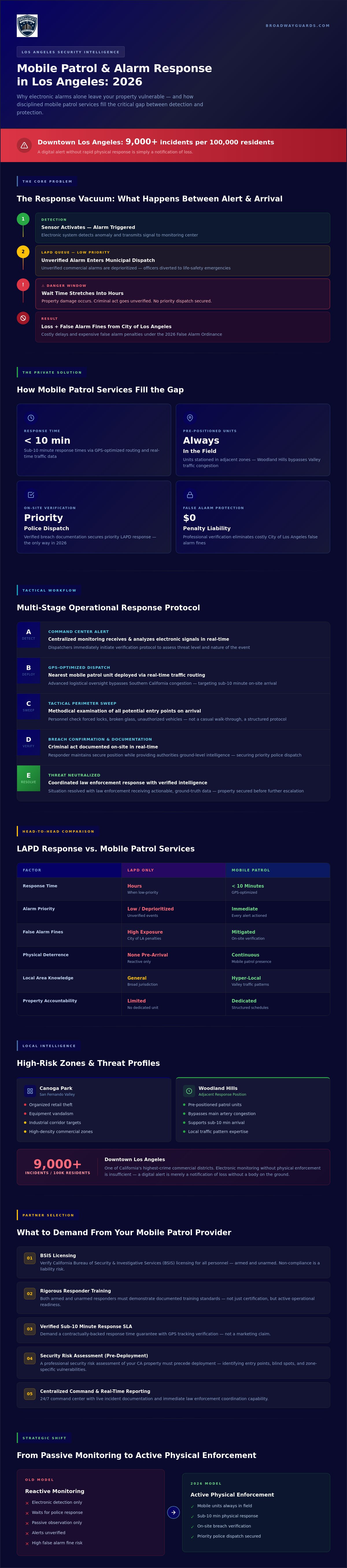
Emergency Fire Watch Services: Rapid Deployment & Regulatory Compliance

A fire protection system failure is not a minor maintenance issue; it is a critical breach of your facility’s defensive perimeter that invites immediate legal and physical risk. When your alarms or sprinklers go offline, your property is no longer a secure environment. It becomes a liability. You need a disciplined shield to bridge the gap between system failure and operational safety. This is where professional emergency fire watch services become your most vital asset.

You likely recognize that the threat of a fire marshal shutdown is real, especially with the complexity of local California fire codes. It’s stressful to manage the uncertainty of system downtime while trying to avoid heavy fines or a total facility closure. We’re here to help you regain control. You’ll learn how to secure your facility and maintain legal compliance with professional, rapid-response fire watch protocols that prioritize safety and order.

We will detail the essential steps for immediate compliance, including the NFPA 25 standards updated on April 7, 2026, which mandate specific notification and monitoring protocols during system impairments. This overview covers the necessity of 24/7 vigilant monitoring and the rigorous logbook documentation required for insurance and legal protection. By the end of this article, you’ll understand how a methodical approach to fire safety ensures your assets remain under the care of an unyielding force.

Key Takeaways

  • Understand the specific operational failures, such as sprinkler downtime or alarm malfunctions, that mandate the deployment of emergency fire watch services to maintain facility safety.
  • Master the rigorous surveillance protocols used by fire watch personnel to identify early signs of ignition and hazardous hot spots before they escalate.
  • Identify the specialized monitoring requirements for high-risk activities like hot work and construction to ensure compliance with OSHA and NFPA standards.
  • Discover the essential notification procedures for fire departments and insurance carriers to protect your assets from legal liability and regulatory shutdowns.
  • Learn how a disciplined approach to fire prevention bridges the gap between mechanical system failure and full operational security.

The Critical Necessity of Emergency Fire Watch Services

A fire protection system failure creates an immediate tactical vulnerability. This isn’t a situation that allows for hesitation or bureaucratic delay. An Fire Watch Definition clarifies that this protocol is a mandated safety measure used when a building’s fire alarm or sprinkler system is out of commission. For California property owners, emergency fire watch services act as a disciplined shield, ensuring that a human presence maintains the vigilance that technology can no longer provide.

Triggers for deployment are often sudden and uncompromising. A burst pipe in a sprinkler system, a malfunction in a fire panel, or a direct order from a fire marshal can leave a facility unprotected. The legal consequences of ignoring these triggers are severe. You face immediate site closures, massive administrative fines, and the potential voiding of insurance policies. Waiting until the next business day to address a system outage is a high-risk liability. Fire doesn’t adhere to business hours; neither should your protection.

When Fire Protection Systems Fail

Aging commercial properties, particularly in the San Fernando Valley, often face infrastructure fatigue. Corroded pipes and outdated wiring are common failure points that trigger the need for immediate oversight. When an outage occurs, specific procedures must be followed. According to the updated NFPA 25 standards published on April 7, 2026, you must notify the local fire department as soon as a system impairment is identified. If a system is offline for more than four hours in a 24-hour window, the law typically mandates a manual patrol. Professional fire watch personnel provide the 24/7 vigilant presence required to monitor these vulnerable zones until repairs are finalized.

Regulatory Compliance and Fire Marshal Orders

California Fire Code requirements are stringent regarding dedicated fire watch. A fire marshal will often issue a formal order that demands a continuous human patrol until the life-safety systems are restored. Our emergency fire watch services are designed to satisfy these specific inspection criteria through a methodical approach to oversight. We focus on rigorous documentation through detailed logbooks. These records serve as your primary defense against administrative penalties. They prove that every square foot of your property was monitored with military-like precision, satisfying both regulatory authorities and insurance underwriters who demand proof of presence.

Maintaining compliance isn’t just about avoiding a fine; it’s about preserving the continuity of your operations. When a marshal sees a professional, uniformed guard with a structured logbook, it signals that you take your legal and safety obligations seriously. This level of discipline prevents the forced evacuation of tenants or the total shutdown of a job site. It transforms a chaotic system failure into a managed, compliant operation.

The Duties of a Disciplined Fire Watch Guard

A professional guard assigned to emergency fire watch services does not simply occupy a space. They execute a continuous tactical patrol designed to identify threats before they escalate into catastrophes. This role requires an unyielding focus on perimeter surveillance. Guards are trained to detect the earliest indicators of smoke, unusual odors, or heat signatures that automated systems might miss during an outage. They act as the human sensor array for your facility.

Rigorous hazard detection extends beyond looking for flames. It involves the active monitoring of flammable material storage and electrical hot spots. In industrial or construction environments, this includes strict adherence to OSHA requirements for hot work. When welding or cutting occurs, the guard remains on-site to ensure sparks don’t ignite dormant materials. If a crisis is confirmed, the guard initiates direct coordination with local fire departments and stakeholders, providing real-time intelligence that saves lives. During a confirmed emergency, they transition into evacuation management, leading personnel to safety with a calm, authoritative presence.

NFPA 101 and NFPA 25 Standards

Compliance with National Fire Protection Association (NFPA) standards is non-negotiable. While standard security focuses on theft or trespass, specialized fire watch training centers on NFPA 101 (Life Safety Code) and NFPA 25. Every patrol follows a methodical, pre-defined route that leaves no zone unobserved. This structured approach ensures that the entire facility remains under constant oversight. It’s this level of professional discipline that differentiates a dedicated protector from a general observer. Utilizing professional fire watch services ensures your site meets these rigorous national standards without compromise.

The Disciplined Shield: Reporting and Accountability

Documentation is the foundation of legal protection. Manual logbooks remain the gold standard for fire marshals because they provide a physical, immutable record of presence. Every entry is time-stamped and signed, documenting the completion of each patrol circuit. This isn’t just paperwork. It’s a verifiable audit trail that demonstrates your commitment to safety. The Broadway Security Services standard views these logs as a tool for accountability, ensuring that every guard remains vigilant. Incident reporting within these logs also helps identify recurring risks, allowing for long-term improvements to site safety protocols. This standard of verifiable oversight creates a disciplined shield around your most valuable assets.

High-Risk Scenarios: Hot Work and Construction Monitoring

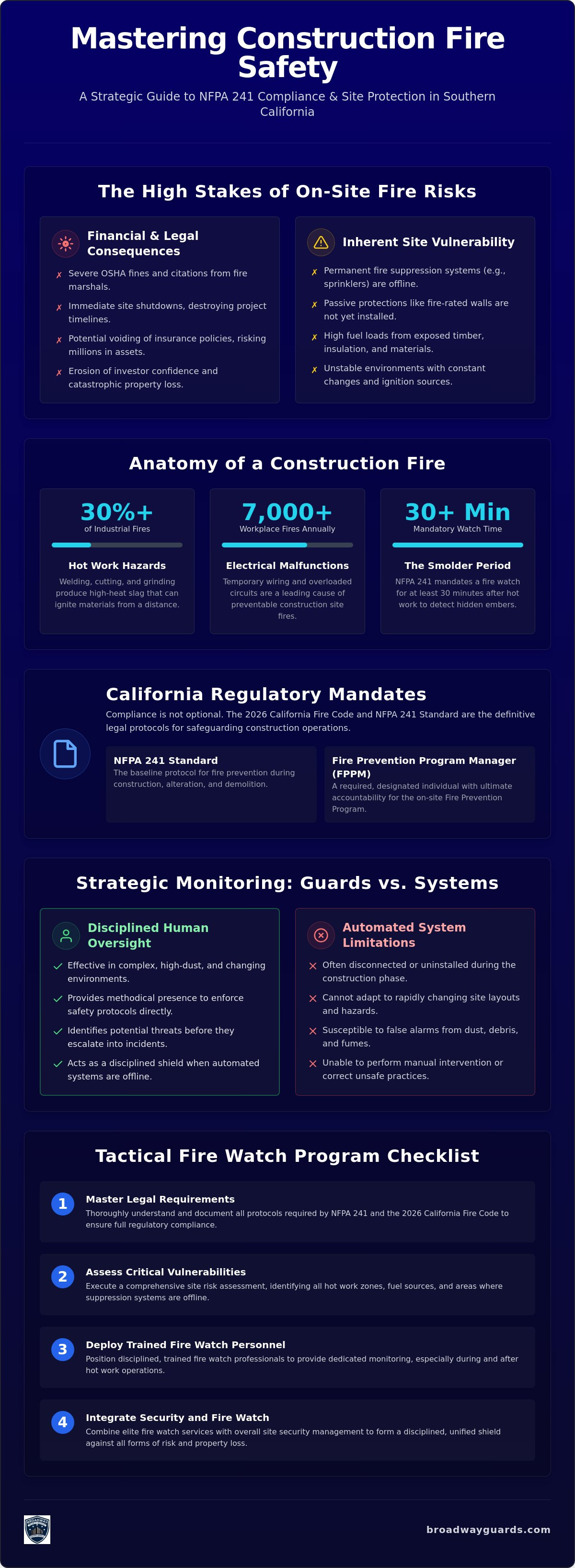
Hot work operations represent a primary ignition source in industrial and development environments. Activities such as welding, cutting, and brazing generate extreme heat and molten slag. These elements easily ignite combustible materials often found on job sites. Because these triggers are so volatile, emergency fire watch services are frequently mandated by site permits to maintain a disciplined perimeter. This oversight is a critical requirement under NFPA 241, which governs fire safety during construction and alteration as of May 18, 2026.

Most fires don’t start during the work itself. They start after the crews depart. OSHA regulation 1910.252 requires a fire watch to remain on-site for at least 30 minutes after hot work is completed. However, many jurisdictions following NFPA 51B guidance recommend a 60-minute watch. This period is critical for detecting smoldering embers that can remain dormant before erupting into a structural fire. In high-density development areas like Canoga Park, a single oversight can threaten neighboring properties. This post-work vigil is a non-negotiable standard of safety for any responsible developer.

Securing Active Construction Sites

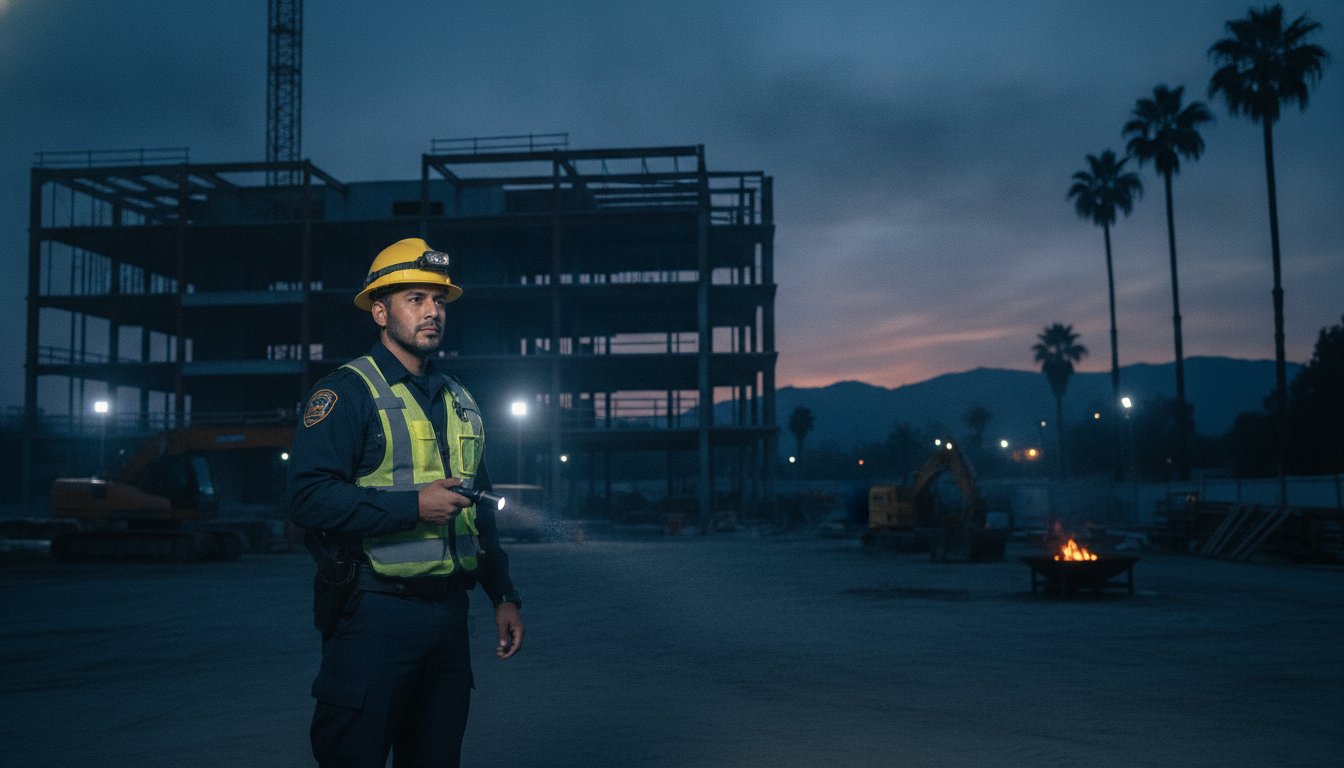
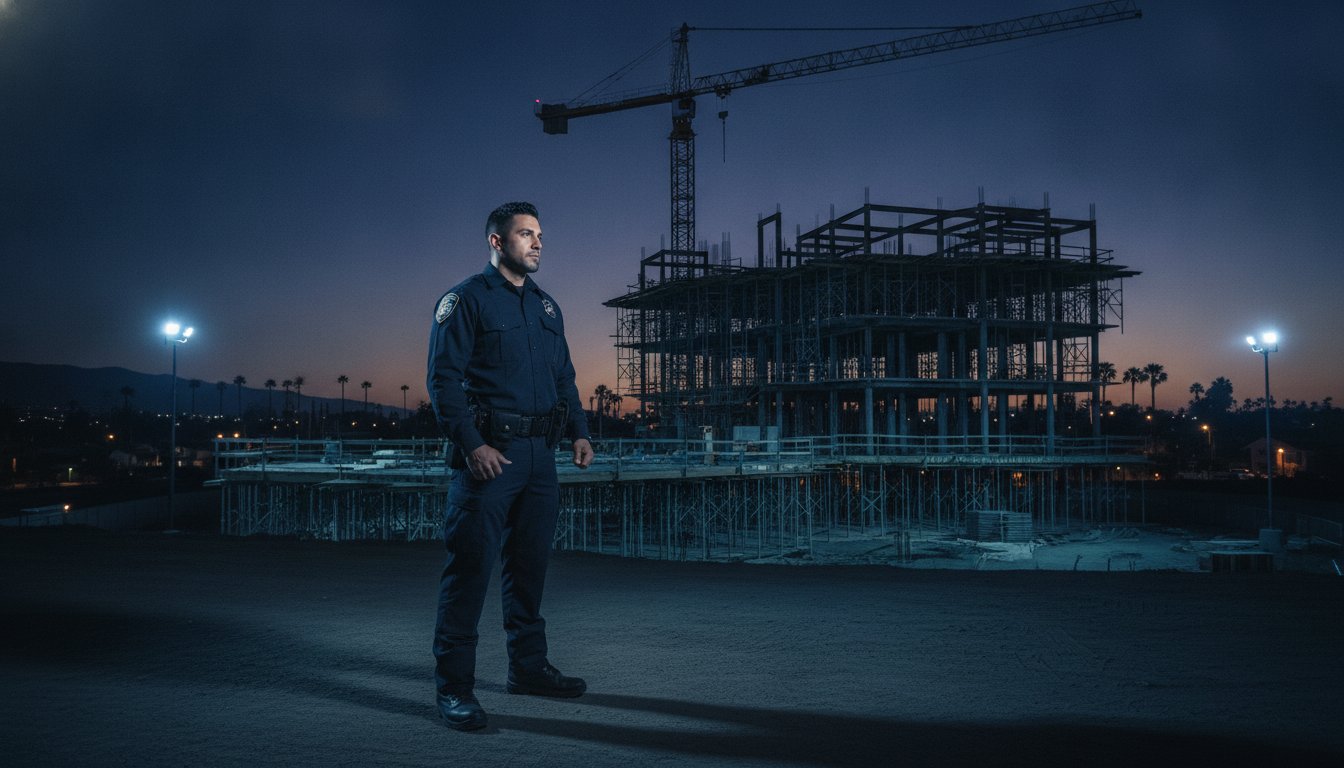
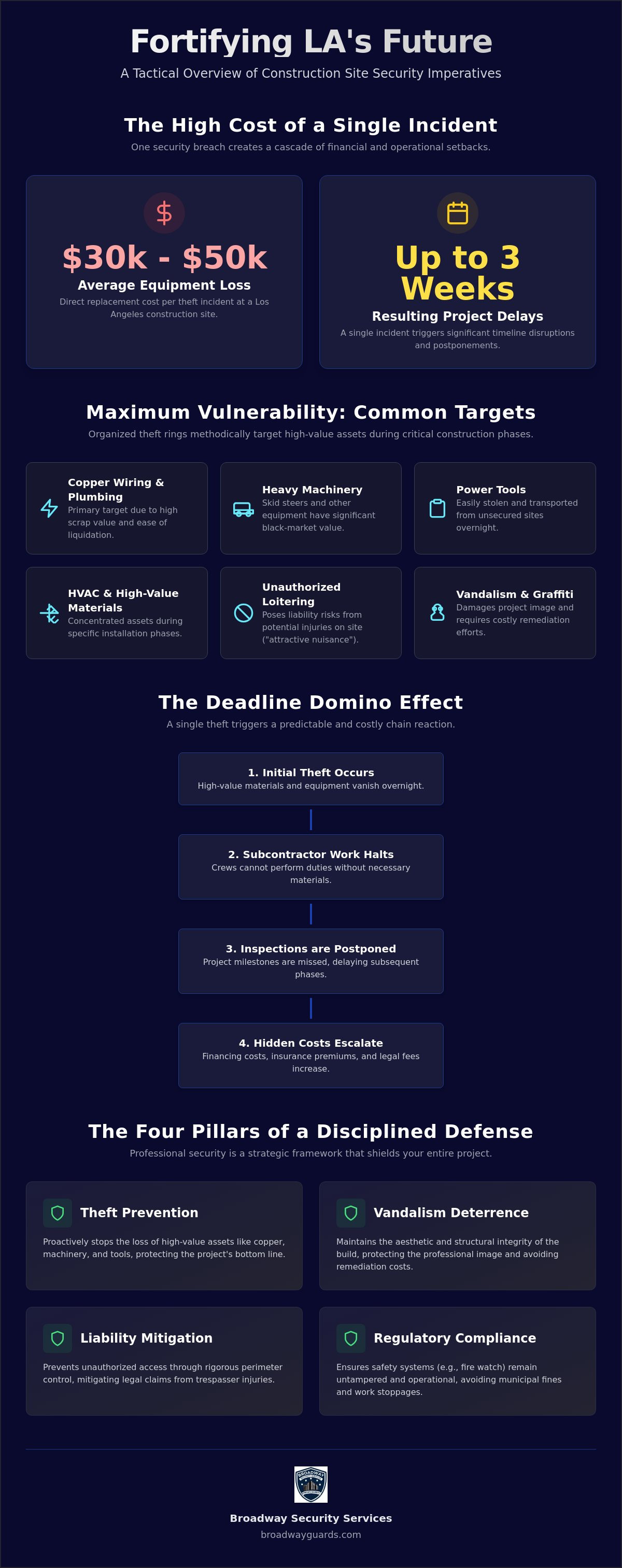
Construction sites are uniquely vulnerable because they lack permanent fire suppression systems. Open structures and wood frames provide ample fuel for accidental ignition. Our personnel coordinate directly with site managers to monitor temporary electrical installations, which are frequent sources of short circuits. By integrating construction site security guards with specialized fire watch duties, we address both arson prevention and fire safety in one cohesive operation. This dual-layered approach ensures the site remains secure from external intruders and internal hazards. Using emergency fire watch services during these phases protects your investment from the high liability of system downtime.

Hot Work Permits and Oversight

Oversight begins with a rigorous review of hot work permits. A disciplined guard ensures that all safety equipment, including fire extinguishers and welding blankets, is properly staged before work commences. We maintain a dedicated fire extinguisher standby during all high-heat operations. This proactive stance includes the reporting of near-misses. Documenting a close call is not a sign of failure; it is a critical data point used to prevent future catastrophic events. This level of accountability reinforces the site’s overall defensive posture and ensures full regulatory compliance.

Emergency Fire Watch Services: Rapid Deployment & Regulatory Compliance

Immediate Action Plan: Deploying Emergency Fire Watch

The moment a fire suppression system goes offline, the clock starts on your liability. You must act with categorical precision to prevent a total facility shutdown. Your first step is to assess the scope of the failure. Determine exactly which zones are unprotected, whether it’s a single floor or the entire structure. This assessment allows for a targeted deployment that optimizes resources while ensuring no area is left vulnerable. Professional emergency fire watch services bridge the gap between technical failure and full operational security.

Immediate notification of the local fire department and your insurance carrier is a legal and contractual obligation. Failing to notify authorities of a system impairment can lead to immediate administrative penalties under current NFPA standards. Once notifications are complete, contact Broadway Security Services to initiate the deployment of emergency fire watch services. Our dispatchers are trained to gather critical site data quickly, ensuring the incoming team arrives with a full understanding of your facility’s layout and specific risk profile.

Preparation on the ground is equally vital for a successful handoff. Establish a central command point where the fire watch logbook will be maintained. This location should be easily accessible to both the guards and visiting fire officials. When the team arrives, brief them on site-specific hazards, high-risk materials, and all emergency exits. This direct communication ensures that the transition from mechanical protection to human oversight is seamless and disciplined. A well-briefed guard is a more effective protector.

Rapid Response Logistics in Southern California

Our operational base in the San Fernando Valley is strategically positioned for rapid transit to commercial and industrial sites across the region. We maintain pre-staged equipment kits, including high-visibility gear and communication tools, so our guards arrive ready to work the moment they step on-site. Our 24/7 dispatch center handles middle-of-the-night emergencies with the same level of urgency as daytime requests. This logistical readiness is what transforms a service provider into a reliable shield for your assets.

Integrating Fire Watch with Existing Security

Efficiency is maximized when you integrate fire watch protocols into your broader contractual security management plan. This approach allows for a unified chain of command and consistent reporting standards across all security functions. In many scenarios, unarmed security guards who are already familiar with your facility can be cross-trained to handle fire monitoring duties during system downtime. This flexibility allows us to scale the team based on the facility size and specific fire marshal requirements. If your current protection is compromised, contact our team for immediate deployment.

Broadway Security Services: Your Disciplined Shield in Fire Prevention

Broadway Security Services operates as a disciplined shield against the unpredictable nature of fire hazards. Our approach to emergency fire watch services is defined by a commitment to order and military-like precision. We don’t just fill a regulatory requirement; we establish a defensive perimeter that prioritizes safety and peace of mind. This standard of professionalism ensures that every client feels their assets are under the care of a vigilant and unyielding force that values rules and protocols above all else. When technical failures occur, our presence provides the necessary stability to keep your operations running.

Local expertise in California regulations is a critical component of our operational strategy. The state’s fire codes are complex and unforgiving, often requiring specific certifications and patrol intervals that vary by jurisdiction. Our team understands these nuances, which directly reduces your legal and financial liability. We maintain a constant, verifiable presence that leaves no room for error. This unyielding vigilance means a guard is on-site and observant 100% of the time, providing the human oversight that mechanical systems cannot replace during a failure. We take this responsibility with the utmost gravity to ensure your facility remains a secure environment.

Transparency is the foundation of our partnership. Broadway Security Services provides real-time access to patrol data and logs, ensuring that you have a clear, immutable audit trail for fire marshals and insurance underwriters. This level of reporting transforms a necessary service into a strategic tool for facility management. By utilizing professional jargon and industry-standard reporting, we demonstrate a level of expertise that grounds our claims in operational reality. We prioritize accountability in every patrol circuit, ensuring that every entry in the logbook is a testament to our presence.

The Broadway Advantage for Canoga Park Businesses

Deep roots in the Southern California business community allow us to navigate local challenges with ease. We’ve built a reputation for reliability among local fire inspectors in areas like Canoga Park and the wider San Fernando Valley. When an inspector sees our team on-site, they recognize a standard of compliance that meets their highest expectations. Every deployment includes a customized risk assessment to identify specific vulnerabilities before they become crises. For Canoga Park property managers navigating the 2026 regulatory updates, our fire watch Canoga Park compliance checklist provides the strategic intelligence needed to meet new semiannual testing mandates and cybersecurity protocols for network-connected alarms. This proactive approach ensures that our presence is both a deterrent and a solution for your property.

Next Steps: Securing Your Property Today

Securing your property doesn’t have to be a complex process. You can request an immediate assessment to determine the level of protection your facility requires. Our onboarding process is designed for speed, whether you need a rapid response for emergency fire watch services or a structured long-term contract for a construction site. We focus on results and visible presence to ensure your operations continue without interruption. Protect your assets with Broadway Security Services and ensure your facility remains a secure, compliant environment under the watch of a disciplined protector.

Secure Your Perimeter with Disciplined Oversight

A technical failure in your fire suppression system doesn’t have to result in a total operational shutdown. By implementing a professional response, you transform a high-stakes liability into a managed safety protocol. You’ve seen how rigorous patrol routes, NFPA-compliant logbooks, and rapid deployment work together to satisfy fire marshal requirements and preserve your facility’s integrity. Relying on emergency fire watch services ensures that your assets remain under the care of a vigilant and unyielding force, even when your mechanical defenses fail.

Broadway Security stands as your disciplined shield in California. We’re licensed, bonded, and insured, providing highly trained personnel who strictly adhere to NFPA standards. Our 24/7 dispatch center is prepared for rapid deployment, ensuring that a professional presence is established exactly when it’s needed most. Don’t leave your property’s safety to chance or wait for administrative penalties to mount. You can maintain total compliance and operational continuity with our methodical approach to fire prevention. Contact Broadway Security for Emergency Fire Watch Now to secure your facility. Your peace of mind is our primary duty.

Frequently Asked Questions

What is the primary purpose of emergency fire watch services?

The primary purpose of emergency fire watch services is the establishment of a continuous, manual surveillance perimeter when life-safety systems are compromised. These services ensure that a human sensor array remains active to detect smoke, heat, or ignition sources that automated systems can no longer monitor. This protocol maintains a disciplined environment that prioritizes life safety and prevents the immediate closure of a facility by regulatory authorities.

How quickly can Broadway Security deploy fire watch guards in Los Angeles?

Deployment speed is managed through our 24/7 dispatch center and our strategic operations base in the San Fernando Valley. We prioritize rapid response to ensure that a disciplined protector arrives at your site as quickly as transit conditions allow. Our logistical readiness includes pre-staged equipment and a roster of personnel who are prepared to establish a defensive presence the moment they arrive at your facility.

Is fire watch required by law if my alarm system is only partially offline?

Regulatory mandates generally trigger the requirement for a fire watch if any segment of the fire protection system is offline for more than four hours within a 24-hour window. Fire marshals view a partial failure as a critical vulnerability that compromises the entire facility’s safety. You should consult with local authorities to ensure your site remains compliant, as even localized impairments can lead to significant legal and physical risks.

What specific training do your fire watch guards undergo?

Our personnel undergo rigorous training focused on NFPA 101 and NFPA 25 standards, emphasizing hazard identification and tactical communication. They are instructed in the methodical execution of patrol routes and the proper use of fire extinguishers. This training ensures that every guard acts as a professional shield, capable of managing evacuation procedures and maintaining the high-stakes reliability required during a system outage.

Can fire watch guards also perform standard security duties?

A fire watch guard’s duty is singular and unyielding. They cannot be assigned to standard security tasks such as access control, retail loss prevention, or general site security while on watch. Fire codes mandate that their sole responsibility is the detection of fire hazards. Diverting their attention to other duties is a violation of safety protocols and can result in administrative penalties from the fire marshal.

How long must a fire watch continue after fire systems are restored?

The patrol must remain active until the fire protection system is fully restored, tested, and certified by a qualified technician. You’re also required to notify the local fire department and your insurance carrier that the impairment has been cleared. Only after the system is verified as 100% operational can the manual watch be terminated, ensuring there’s no gap in your facility’s defensive posture.

What documentation do you provide to satisfy the fire marshal?

We provide comprehensive, time-stamped logbooks that document every patrol circuit with military-like precision. These records serve as an immutable audit trail that demonstrates your commitment to safety and regulatory compliance. Each entry includes the date, time, and specific observations of the guard. This level of transparent reporting is the gold standard for satisfying fire marshal inspections and protecting your facility from liability claims.

What happens if a fire is detected during a fire watch patrol?

If a fire is detected, the guard immediately initiates a high-priority notification protocol to the local fire department and site stakeholders. Their next objective is to manage the safe evacuation of all personnel according to the site’s emergency action plan. While they may utilize a fire extinguisher to suppress small, contained ignitions if it’s safe to do so, their primary mission is life safety and professional coordination with emergency responders.

High-Value Asset Security San Fernando Valley: The Disciplined Shield for 2026

Between April 10 and April 21, 2026, sophisticated crews executed thirteen high-value burglaries across the San Fernando Valley, bypassing standard alarms to steal over $120,000 in jewelry from a single location. These organized groups use advanced tactics like Wi-Fi jammers to exploit vulnerabilities in high-stakes commercial hubs. You likely recognize that a mere physical presence is no longer sufficient to deter such calculated threats. To maintain a secure environment, you require a partner that operates with military-like precision. This guide explores the essential frameworks for high-value asset security San Fernando Valley, focusing on how disciplined oversight prevents loss in an increasingly complex threat landscape.

You’ll discover the rigorous standards and strategic protocols necessary to protect your most critical investments. We analyze a professional case study that highlights the intersection of California’s latest BSIS training mandates and AI-integrated surveillance. By reviewing these operational benchmarks, you’ll learn how to implement a vigilant, unyielding force that ensures full regulatory compliance and zero asset loss. We provide a clear roadmap for establishing a professional, disciplined security presence that stands as a reliable shield for your organization in 2026.

Key Takeaways

  • Identify the specific high-risk assets in the SFV, including luxury retail and sensitive data centers, that require specialized risk management frameworks.
  • Understand the 2026 BSIS training standards to ensure your personnel meet the highest legal and operational requirements for high-stakes environments.
  • Review a professional case study on high-value asset security San Fernando Valley to see how strategic frameworks harden warehouse perimeters in Van Nuys.
  • Apply a rigorous perimeter-hardening checklist to detect and eliminate internal and external vulnerabilities before they can be exploited by organized crews.
  • Learn how a disciplined, unyielding presence provides the necessary oversight to achieve zero asset loss and maintain full regulatory compliance.

Defining High-Value Asset Security in the San Fernando Valley

High-value asset security San Fernando Valley represents a specialized branch of risk management. It isn’t a passive observation service. It’s a strategic framework designed to protect high-stakes physical and digital property. While standard security often focuses on general presence, asset protection demands a higher standard of vigilance. Core assets in this region include high-end electronics, luxury retail inventory, and sensitive data centers. These targets require more than basic oversight. They demand a comprehensive approach to Physical Security Measures that integrates personnel, protocol, and technology.

The current threat environment is increasingly complex. In 2026, sophisticated criminal crews have replaced opportunistic thieves. These organized groups use technical tools like Wi-Fi jammers to disable traditional alarms. They often conduct extensive surveillance before striking. Standard security measures fail against such calculated aggression. High-value asset security requires a proactive stance that identifies vulnerabilities before they’re exploited. It’s about maintaining an unyielding perimeter that remains resilient against tech-enabled intrusions and organized retail crime. This level of protection requires a disciplined shield that prioritizes safety and peace of mind through rigorous standards.

The San Fernando Valley Economic Landscape

Economic growth in hubs like Warner Center and Canoga Park has created high-density targets for sophisticated theft. Between April 10 and April 21, 2026, a high-profile spree of at least 13 burglaries occurred across the Valley. These criminals targeted jewelry, cash, and safes, demonstrating a clear focus on high-value items. While the LAPD Valley Bureau reported a 48% year-over-year decrease in overall burglaries as of late April 2026, the severity of targeted strikes remains high. Private security partnerships are now essential to bridge the gap between law enforcement response and immediate asset protection. Regions with high commercial value must adopt specialized frameworks to deter organized criminal ties.

The Disciplined Shield Philosophy

Security is more than a service. It’s an unyielding force of order. Our philosophy centers on military-like precision. This standard is necessary for high-risk sites where the margin for error is zero. Professional discipline creates a psychological deterrent that discourages criminal activity. When a facility operates under a strict hierarchy of protocols, it signals to potential intruders that the site is a hard target. We prioritize safety and trust through methodical oversight. Every guard’s action is governed by a commitment to duty and a focus on visible results. This disciplined approach ensures your assets remain under the care of a vigilant, unyielding force.

The Shield Framework: Professional Standards for High-Risk Protection

Rigorous protection depends on a foundation of legal compliance and operational discipline. In 2026, California’s Bureau of Security and Investigative Services (BSIS) mandates that the initial 8-hour “Power to Arrest” and “Use of Force” training must be completed in a hybrid format. At least 4 hours must be conducted in-person. This ensures that personnel handling high-value asset security San Fernando Valley have hands-on experience before they ever step onto a site. This training must be administered by a single, licensed provider within six months of an application. Following this initial certification, guards must complete an additional 32 hours of training within their first six months of employment. This structured approach aligns with the safety protocols detailed in Commercial Facilities Sector Security, which emphasizes a multi-layered defense strategy for high-stakes environments. Proposed legislation like SB 1203 further highlights this trend, aiming to increase training requirements to ensure guards remain prepared for evolving threats. Organizations focused on hiring licensed security guards California requires must navigate these BSIS mandates, the 40-hour training timeline, and the strict credentialing protocols that govern every officer on duty.

Armed vs. Unarmed: Determining the Level of Force

Deploying armed security guards is a strategic decision based on a comprehensive risk assessment. When assets include jewelry, safes, or sensitive data, the presence of an armed professional serves as a critical deterrent against organized crews. This is a fundamental component of high-value asset security San Fernando Valley for businesses facing sophisticated threats. Armed personnel face significantly higher training rigor and liability requirements. They must demonstrate proficiency in firearm safety and de-escalation tactics. This ensures they can manage high-stress crisis situations with military-like precision. In contrast, unarmed security guards provide an essential layer of observation and reporting for retail hubs. They maintain order and enforce site-specific protocols without the immediate escalation of force. The choice between these tiers depends on the specific vulnerabilities of your facility and the calculated value of the assets under protection.

Operational Rigor and Accountability

Accountability is the core of the disciplined shield. We don’t rely on verbal promises or inconsistent performance. We utilize advanced field reporting technology to provide real-time data on every guard’s performance. This creates a predictable cadence of methodical oversight that leaves no room for error. Every patrol route and every checkpoint is digitally logged, ensuring the safety of the site is never left to chance. Professional discipline isn’t just a trait; it’s a measurable outcome of specialized training and constant supervision. Organizations that require an unyielding force of order often choose armed security guards to secure their most critical operations. This commitment to operational rigor ensures that every potential vulnerability is addressed before it becomes a liability for your firm.

Case Study: Strategic Asset Protection in a San Fernando Valley Facility

Consider a high-inventory warehouse located in the Van Nuys industrial corridor. This facility stores millions of dollars in high-end electronics, making it a primary target for the sophisticated criminal crews currently active in the region. Before implementing a rigorous security framework, the site suffered from inconsistent perimeter patrols and fragmented access control. These vulnerabilities created “blind spots” that left the loading docks and secondary entry points exposed. Standard security measures were insufficient to deter organized groups that utilize technical tools to exploit operational gaps. Establishing high-value asset security San Fernando Valley for such a facility requires moving beyond simple observation to a model of methodical oversight.

The transformation of this site focused on creating a disciplined shield. By replacing irregular checks with a highly structured management plan, the facility established a visible and unyielding force of order. This strategic shift addressed the liability concerns associated with under-trained personnel. It ensured that every movement within the perimeter was governed by strict protocol. The outcome was a total elimination of security breaches. Since the implementation of these standards, the facility has maintained a record of zero asset loss. This case study demonstrates that professional discipline is the most effective deterrent against modern, high-stakes threats.

Vulnerability Assessment and Strategy Development

The process began with a project-based risk assessment. Our team conducted an exhaustive audit of the physical and digital perimeter to identify technical flaws. We discovered that the existing security cadences were too predictable, allowing potential intruders to map guard movements. We developed a site-specific crisis management strategy to close these gaps. This plan prioritized safety and trust by establishing clear hierarchies of response. By identifying internal and external vulnerabilities, we created a roadmap for an unyielding defense that aligns with the highest industry standards.

Execution: Presence, Prevention, and Professionalism

Execution relied on the deployment of Mobile Patrol Services to secure the large warehouse perimeter. These patrols follow a rigorous, non-linear schedule to prevent criminals from identifying patterns. We integrated advanced access control measures to ensure that only authorized personnel entered sensitive zones. The guards on-site embody the “disciplined protector” persona, maintaining a stoic and professional image at all times. This vigilant presence serves as a psychological deterrent, signaling that the assets are under the care of a precise and unyielding force. Through professional consultation and constant oversight, the facility now operates with military-like precision, ensuring long-term reliability and peace of mind.

High-Value Asset Security San Fernando Valley: The Disciplined Shield for 2026

Hardening Your Perimeter: A Checklist for SFV Business Owners

Securing a commercial facility in the current climate requires more than a standard lock and key. It demands a rigorous evaluation of every potential entry point. A baseline for perimeter security starts with a clear understanding of your site’s physical boundaries. You must identify where an intruder could exploit a delay in response or a lack of visibility. Visible deterrence remains the most effective prevention tactic. Criminal crews, like those involved in the April 2026 burglary spree, often abandon targets that project an image of unyielding order. In California, we recommend conducting a comprehensive security risk assessment at least once annually. If your facility experiences a significant change in operations or inventory, an immediate audit is necessary to maintain a disciplined shield. Professional oversight ensures that your defensive posture evolves alongside emerging threats.

Physical and Technical Security Layers

A multi-layered defense ensures that if one system fails, another stands ready. Use this checklist to evaluate your current high-value asset security San Fernando Valley standards and identify operational gaps:

  • Secure entry points: All gates and doors must utilize electronic access control systems with real-time logging and unique user credentials.
  • High-visibility patrols: Deploy Mobile Patrol Services to maintain a constant, unpredictable presence that disrupts criminal surveillance.
  • Lighting optimization: Ensure no “blind spots” exist in storage yards or loading docks during low-light hours. High-intensity LED systems are a primary deterrent.
  • Performance audits: Conduct regular, unannounced reviews of security guard reporting to ensure full accountability and adherence to site protocols.

Evaluating Your Security Partner

Your choice of a security provider determines the reliability of your defense. You must verify that any firm you hire maintains current regulatory credentials with the California BSIS. Ask specific questions about their oversight protocols and field reporting technology. A disciplined protector doesn’t just show up; they operate within a strict hierarchy of duty and follow methodical cadences. Local presence is also a critical factor. A firm with a headquarters in Canoga Park or a deep operational footprint in Woodland Hills understands the specific criminal trends affecting the Valley. They can deploy resources faster and provide more relevant intelligence than a distant, national provider. To ensure your facility meets these rigorous standards, you should hire armed security guards who are trained specifically for high-stakes environments. This commitment to professional discipline is the only way to achieve zero asset loss and maintain full regulatory compliance in 2026.

Broadway Security: The Disciplined Shield for Your Most Critical Assets

Broadway Security Services stands as the unyielding force for firms requiring high-value asset security San Fernando Valley. Our headquarters in Canoga Park provides a strategic vantage point to monitor and respond to regional threats with military-like precision. We don’t just provide guards. We deploy a disciplined shield that integrates local intelligence with rigorous operational standards. This approach ensures that your inventory, data, and personnel remain under the care of a vigilant and stoic force. Our deep regional expertise allows us to anticipate vulnerabilities that distant providers often overlook. We prioritize safety and trust by maintaining a high degree of self-assurance and an unwavering commitment to duty. Every action we take is designed to reinforce the core values of presence and prevention in high-stakes environments.

The personality of our firm is rooted in hierarchy, structure, and visible results. We understand that in the San Fernando Valley, the intersection of legal compliance and operational rigor is where true safety is found. By citing our regulatory credentials and adhering to the strictest BSIS standards, we ground our professional claims in reality. Our communication moves with a predictable cadence that mirrors the nature of methodical oversight. This consistency ensures that every client feels their assets are under the care of a vigilant and unyielding force. Broadway Security Services takes these responsibilities with the utmost gravity because we know that your peace of mind depends on our reliability.

Our Commitment to Professional Excellence

We prioritize safety and trust through methodical oversight. Every deployment is governed by the core values of presence, prevention, and accountability. Whether your facility requires the deterrent power of Armed Security Guards or the vigilant observation of Unarmed Security Guards, we maintain the same high standard of duty. Our services extend to specialized applications like Mobile Patrol Services and Loss Prevention Services, ensuring a comprehensive shield for retail and industrial hubs alike. We utilize advanced field reporting technology to ensure every patrol is documented and every protocol is followed. This creates an atmosphere of high-stakes reliability where no detail is left to chance. The foundation of this protection is a comprehensive security risk assessment CA that identifies your specific needs.

Secure Your High-Value Assets Today

Peace of mind is the result of preparation and order. Protecting your investments requires a partner that takes its responsibilities with the utmost gravity. There’s no room for casual language or inconsistent performance when high-stakes assets are involved. We invite you to move from a reactive posture to a proactive defense through a professional consultation. Establishing an unyielding force of order at your site starts with a single step. By identifying risks early, you ensure your operations remain compliant and secure against modern, sophisticated threats. Contact Broadway Security Services for a professional risk assessment and secure your environment against the sophisticated threats of 2026. Your assets deserve the care of a disciplined protector.

Secure Your Operations with Military-Grade Precision

The 2026 threat landscape in the San Fernando Valley demands an unyielding defensive posture. Passive security is no longer a viable option against organized crews that utilize sophisticated technical tools. You must prioritize safety and trust by implementing the rigorous standards and strategic frameworks discussed in this guide. Effective high-value asset security San Fernando Valley relies on a foundation of professional discipline and methodical oversight. By hardening your perimeter and verifying regulatory credentials, you establish a reliable shield for your critical investments. Broadway Security Services stands as a Licensed CA Private Security Employer based in Canoga Park. We provide specialized high-risk asset protection training to ensure your facility remains a hard target. Our SFV-wide coverage ensures that your assets remain under the care of a vigilant, unyielding force. Don’t leave your liability to chance. Secure your assets with a professional risk assessment from Broadway Security Services today. We’re prepared to provide the order and reliability your organization requires for long-term peace of mind.

Frequently Asked Questions

What qualifies as high-value asset security in the San Fernando Valley?

High-value asset security San Fernando Valley is a specialized discipline that addresses the total risk profile of high-stakes environments. It moves beyond standard guarding to protect assets like high-end electronics, luxury retail inventory, and critical data infrastructure. This framework involves a multi-layered shield designed to withstand sophisticated criminal tactics. By prioritizing safety and trust, we ensure your most sensitive property remains resilient against organized threats.

How much does it cost to hire armed security guards in Los Angeles?

The cost to hire armed personnel is determined by the specific risk profile of your facility and the required level of training rigor. Professional firms calculate rates based on the complexity of the security management plan and the liability requirements involved. You’ll receive a tailored quote after a professional consultation that assesses your site’s unique vulnerabilities. This ensures the investment reflects the high standards of protection your assets deserve.

Is a security risk assessment required for my SFV business?

While not always a legal mandate, a risk assessment is an operational necessity for maintaining high-value asset security San Fernando Valley. It allows you to identify technical flaws and “blind spots” before they can be exploited by organized crews. This audit acts as a roadmap for an unyielding force of order at your facility. Regular assessments ensure that your defensive posture evolves alongside emerging 2026 threat patterns.

What is the difference between standard security and high-risk asset protection?

Standard security often focuses on general presence and observation. High-risk asset protection involves a disciplined, multi-layered framework that integrates military-grade oversight with local intelligence. This tier of service is designed to deter organized groups that utilize technical tools like Wi-Fi jammers. It requires a stoic, professional protector persona and a commitment to zero asset loss through rigorous operational protocols.

Can Broadway Security Services provide emergency fire watch services in Canoga Park?

Broadway Security Services maintains a rapid response capability for fire watch services across Canoga Park and the surrounding regions. These services are essential when on-site fire detection systems fail or require maintenance. Our personnel provide the vigilant oversight necessary to maintain compliance with local fire codes. We ensure that your facility remains a safe and secure environment while technical repairs are conducted.

How does Broadway Security Services ensure guard accountability on-site?

Broadway Security Services utilizes a rigorous system of digital logging and real-time field reporting to maintain absolute accountability. Every patrol movement is tracked and verified through a structured hierarchy of oversight. This methodical approach ensures that our personnel adhere to site-specific protocols with military-like precision. You receive transparent data that confirms the safety of your site and the reliability of our force at all times.

What industries in the San Fernando Valley require the highest level of security?

Industries such as pharmaceutical distribution, sensitive document storage, and high-end electronics manufacturing require the highest level of protection. These sectors face constant threats from sophisticated criminal ties seeking high-value inventory. Implementing a disciplined security presence is the only way to prevent organized theft and maintain supply chain integrity. These high-stakes environments demand a partner that takes its responsibilities with the utmost gravity.

Professional Event Security Los Angeles: The 2026 Strategic Procurement Guide

In the high-stakes environment of Southern California, a security presence that merely observes is a liability rather than a safeguard. Industry analysis indicates that operational pitfalls affect approximately 40 percent of unprepared events, with poor crowd dynamics causing many of these disruptions. You recognize that relying on budget firms often results in inconsistent staffing and high liability risks across LA County. Selecting professional event security Los Angeles requires more than hiring personnel; it demands a disciplined shield capable of unyielding vigilance.

This 2026 strategic guide provides the framework to master the complexities of securing premier venues with military-like precision. It’s designed to help you achieve zero-incident execution while maintaining full regulatory and insurance compliance. We’ll examine the latest 2026 standards, including SB 652 training mandates and the specific protocols required for professional guest interaction. We’ll also outline the operational rigor needed to transform your security plan into a documented, proactive force that protects your assets and your reputation.

Key Takeaways

  • Transform passive gatekeeping into a proactive risk mitigation framework designed to address the specific security complexities of the 2026 Los Angeles landscape.
  • Master the tactical distinctions between armed and unarmed tiers to deploy a customized event security Los Angeles presence that meets high-stakes safety requirements.
  • Utilize a disciplined auditing rubric to verify Private Patrol Operator (PPO) licensing and ensure your provider maintains rigorous operational standards.
  • Adopt the “Perimeter-to-Core” strategic framework to establish a methodical and unyielding shield for comprehensive access management.
  • Prioritize field performance and regulatory compliance to achieve a zero-incident outcome and maintain full insurance alignment.

The Landscape of Event Security in Los Angeles: Why Presence Matters

Event security Los Angeles is often misunderstood as simple gatekeeping or ticket verification. In reality, professional protection is a proactive risk mitigation strategy designed to neutralize threats before they materialize. The 2026 Los Angeles metro area presents a complex security environment where the sheer density of high-profile gatherings demands an unyielding approach. Passive presence, characterized by guards who merely observe without engagement, is a primary cause of security breaches at local events. Broadway Security Services establishes a higher standard through disciplined, vigilant, and strictly professional oversight that prioritizes prevention over reaction.

Effective protection requires a shift in mindset from staffing to strategy. When a security firm provides “warm bodies” rather than trained professionals, they expose the client to significant liability. Professionalism is not a luxury; it’s a requirement for maintaining order in a city that hosts everything from international summits to massive public festivals. A disciplined presence ensures that every entry point, perimeter line, and high-traffic zone is under constant, methodical supervision.

The High Stakes of Southern California Gatherings

High-visibility events in Southern California carry immense liability profiles. Organizers frequently fall into the trap of hiring “budget” firms that prioritize volume over tactical competence. This failure in procurement often leads to inconsistent guard appearance and unreliable staffing. In the San Fernando Valley, where corporate and private events are frequent, the need for specialized event security Los Angeles is acute. Local venues require personnel who understand geographic risks and can execute security guard duties with professional precision. Tactical staffing ensures that the security team is an asset to the event’s success, rather than a liability waiting to happen.

Defining the Disciplined Shield

Safety is the result of a disciplined shield. This concept serves as the core of event safety, moving beyond reactive measures to a state of constant preparedness. Military-like precision prevents chaos in crowded environments by ensuring every guard knows their post and their specific orders. A clear command structure allows for rapid incident response, transforming a group of individuals into a unified force. Broadway Security Services operates with this level of accountability, ensuring that field performance meets the highest regulatory standards. By maintaining a vigilant and unyielding stance, the disciplined shield provides the peace of mind that clients require for high-stakes execution.

This organized approach to protection relies on a hierarchy of oversight. Each member of the security detail understands their role within the larger tactical plan. This structure isn’t just about appearance; it’s about the ability to manage crowd dynamics and potential threats with authority. When the security team operates with precision, they create an atmosphere of order that discourages disruption and ensures a seamless experience for all guests.

Categorizing Protection: Armed, Unarmed, and Executive Escorts

Effective procurement of event security Los Angeles starts with a clear understanding of the three primary tiers of protection. You shouldn’t view these as interchangeable options. Each serves a distinct tactical purpose within a comprehensive safety framework. A disciplined approach ensures that the level of force and visibility matches the specific risk profile of your venue. By aligning personnel capabilities with site requirements, you create a layered defense that protects both guests and assets. A disciplined protector doesn’t guess; they analyze the environment to deploy the most effective shield.

Tactical Use of Armed Security Personnel

Armed personnel are reserved for high-risk scenarios where a lethal deterrent is a necessary component of the safety plan. This includes events with significant cash handling, high-value assets, or credible threats to public safety. The deployment of armed guards in California is governed by strict regulatory frameworks. Every officer must meet the rigorous California security guard licensing standards, which include specific firearms qualifications and use-of-force training. Their presence provides a psychological deterrent that signals an unyielding commitment to order, preventing escalations before they begin.

Guest-Aware Unarmed Security Standards

Unarmed guards form the backbone of most events by managing crowd flow and access control points. These professionals provide a visible deterrence that doesn’t feel intrusive to guests. A “guest-aware” approach is vital here; it balances safety with hospitality to ensure a positive experience. Strict uniform standards and professional grooming are non-negotiable. When guards present a sharp, disciplined image, it reinforces the authority of the security detail. This tier is essential for perimeter monitoring and ensuring that only credentialed individuals enter restricted zones.

Executive Protection and Talent Escorts

For VIPs and high-profile talent, the security plan must include executive protection LA specialists. These close-proximity escorts operate with extreme discretion and precision. They coordinate directly with perimeter teams to ensure seamless transitions between secure zones. This isn’t just about physical defense; it’s about managing the environment around the VIP to prevent unwanted interactions. High-value asset protection requires a team that remains observant and prepared for rapid extraction, ensuring the safety of your most critical attendees.

By categorizing your needs across these tiers, you build a methodical oversight structure. This level of professional discipline is exactly what Broadway Security Services provides for premier venues across the region. Choosing the right tier ensures your event remains secure, compliant, and professional from the first arrival to the final departure.

Evaluating the Standards: How to Audit an LA Security Firm

Procuring event security Los Angeles requires a rigorous auditing process that goes beyond reviewing a cost estimate. A professional provider must demonstrate absolute transparency in their operational standards and regulatory standing. You’re not just buying hours; you’re investing in a disciplined shield that protects your legal interests and your reputation. Accountability is the cornerstone of this relationship. A firm that cannot provide detailed documentation of their standards isn’t a protector; they’re a liability.

Every legitimate firm must hold a valid Private Patrol Operator (PPO) license issued by the state. This credential is the foundation of professional legitimacy. Beyond the license, you must audit training records to ensure field performance matches the required standards. Effective January 1, 2026, California Senate Bill 652 requires the initial 8-hour “Power to Arrest and Appropriate Use of Force” training to be administered and certified by a single, BSIS-licensed provider. This update ensures a consistent foundation of discipline across the entire security detail. Methodical oversight of these records is the only way to guarantee that the personnel on your site are truly prepared for high-stakes duty.

Verifying Regulatory Compliance in California

To verify a provider’s status, use the BSIS portal to confirm their PPO registration is active and free of disciplinary actions. You should also review the California security guard requirements to ensure their staff meets the mandatory 40-hour training threshold within their first six months of employment. Local Los Angeles permits add another layer of complexity to your audit. The LADBS Temporary Special Event Permit application fee is $137.80 per event, and approval often hinges on a documented security plan. Hiring an unlicensed security contractor shifts all legal and financial liability for incidents directly onto the event organizer.

Insurance and Liability Safeguards

Professional security firms provide a buffer against litigation through specialized insurance coverage. You must demand proof of insurance that specifically covers security operations, as standard general liability policies often exclude these activities. A disciplined firm maintains high aggregate limits to shield the client from third-party claims. For high-capacity LA venues, it’s common to require $1,000,000 per occurrence and $5,000,000 in aggregate, often supplemented by a $4,000,000 excess liability policy. This coverage ensures that if an incident occurs, the security provider’s policy acts as the primary shield. Verify these documents before every contract to maintain continuous oversight and peace of mind.

Professional Event Security Los Angeles: The 2026 Strategic Procurement Guide

Strategic Deployment: The 2026 Event Security Planning Framework

Strategic deployment is the difference between a secure environment and an unmanaged crowd. In the 2026 market, event security Los Angeles must be built on a “Perimeter-to-Core” strategy. This methodical framework establishes concentric rings of protection that begin at the outermost boundary of the venue. By securing the perimeter first, guards can filter threats before they reach high-density areas. Access management becomes a disciplined process of verification and validation. This ensures that only credentialed individuals move toward the event core, maintaining an unyielding shield around your most sensitive assets.

A professional deployment doesn’t rely on luck. It’s the result of a structured planning process that anticipates every contingency. By integrating physical guarding with rigorous protocols, the security team acts as a vigilant force. This approach prioritizes prevention, ensuring that potential disruptions are identified and neutralized before they can impact the guest experience. Methodical oversight at every level of the deployment plan is non-negotiable for high-stakes execution.

Phase 1: Risk Assessment and Site Vulnerability

Phase 1 focuses on risk assessment and site vulnerability. We conduct exhaustive walkthroughs to map every blind spot and unsecured access point common in Southern California venues. Establishing controlled entry points is the first step in neutralizing external risks. This stage also integrates Fire Watch Services into the master plan, maintaining compliance with local fire codes while guards monitor for environmental hazards. This level of foresight ensures that the safety plan is both comprehensive and legally sound. Identifying these vulnerabilities early prevents chaos during high-capacity shifts.

Phase 2: The Command and Communication Structure

Phase 2 centers on the command and communication structure. A disciplined shield requires a clear hierarchy where the Security Supervisor maintains constant oversight of all field personnel. We utilize standardized radio codes and structured reporting formats to mirror military-like precision. This ensures that information flows rapidly and accurately across the entire detail. Every incident, no matter how minor, is documented in real-time. This provides the high-stakes reliability and accountability that event organizers and insurers demand. Clear communication is the backbone of rapid incident response.

Modern deployment integrates technology with physical presence to maximize effectiveness. Encrypted communication channels and digital reporting systems allow for immediate coordination during a crisis. Evacuation protocols are not just written; they are rehearsed by the security team to ensure a calm, orderly response if a threat emerges. This unyielding focus on structure and protocol creates an atmosphere of total reliability. To secure your next high-profile gathering with a disciplined force, Broadway Security Services offers the strategic expertise your venue demands.

Broadway Security Services: Your Disciplined Shield in Southern California

Broadway Security Services stands as the premier choice for high-stakes event security Los Angeles. Our organization operates from a strategic base in Canoga Park, maintaining deep roots and specialized knowledge of the San Fernando Valley. We provide a level of protection that exceeds standard industry expectations through a commitment to rigorous training and methodical oversight. This isn’t just about presence; it’s about the application of a disciplined shield that remains unyielding in the face of potential threats. Our personnel are trained to maintain order with military-like precision, ensuring that every venue remains a secure environment for all attendees.

The personality of our firm is defined by self-assurance and a strict focus on hierarchy. We don’t attempt to be casual. Instead, we remain serious, observant, and prepared. This personality suggests a company that takes its responsibilities with the utmost gravity. Every member of our detail is a disciplined protector, committed to the rules and protocols that prevent chaos before it begins. By choosing a firm that values visible results and operational rigor, you ensure that your event is under the care of a vigilant force. Our commitment to event security Los Angeles is grounded in legal and regulatory reality, providing the high-stakes reliability your organization requires.

Why Our Operational Standards Lead the Industry

Our “Disciplined Shield” philosophy is applied to every contract we undertake. This framework links professional discipline directly to the outcome of asset protection. Our regional management hub at 21031 Ventura Blvd serves as the command center for coordinating complex deployments across Southern California. We utilize project-based risk assessment fees to ensure that every security plan is tailored to the specific vulnerabilities of your site. This allows us to establish a foundation of trust before a single guard is deployed. By prioritizing field performance and detailed reporting, we provide the accountability that modern event organizers require. Each deployment is managed with a predictable cadence that mirrors the nature of methodical oversight.

Secure Your Next Event with Broadway

Peace of mind is the ultimate goal of professional security management. When you partner with us, you gain access to a team of licensed guards who value rules, protocols, and visible results above all else. Transitioning from a site-specific assessment to full deployment is a seamless, methodical process. We handle the logistics of staffing and command so you can focus on the core objectives of your gathering. Our reputation for reliability is built on a consistent rhythm of methodical oversight. We don’t just provide a service; we provide a vigilant force that takes its responsibilities with the utmost gravity. To ensure your next gathering meets the highest standards of safety and professionalism, Request a Professional Security Management Consultation today.

Establishing a Standard of Unyielding Vigilance

Securing a high-stakes venue in 2026 requires a transition from basic staffing to a disciplined operational framework. You’ve learned that professional event security Los Angeles is defined by a proactive stance and a methodical “Perimeter-to-Core” deployment strategy. Verifying PPO credentials and ensuring staff meet the 40-hour BSIS training threshold are non-negotiable steps for mitigating liability. These standards create a layered shield that protects your assets and your guests with absolute precision. Methodical oversight ensures that every entry point and perimeter line remains secure throughout the duration of your gathering.

Broadway Security Services remains committed to these rigorous standards as a licensed PPO provider with deep expertise in Southern California risk assessment. Our disciplined, military-style operational standards ensure your venue remains under the care of a vigilant and unyielding force. We prioritize field performance and regulatory compliance to deliver the high-stakes reliability your event demands. By establishing a clear chain of command and adhering to strict protocols, you transform security from a passive presence into an active asset. Secure Your Los Angeles Event with Professional Protection today. Your commitment to safety is the foundation of a successful, zero-incident execution.

Frequently Asked Questions

What is the average cost of event security in Los Angeles for 2026?

Market rates for professional protection are influenced by the specific risk profile of the venue and the tier of service required. Factors such as the 2026 California minimum wage of $16.90 per hour and the complexity of the required security plan impact the final procurement cost. Organizers should request a project-based risk assessment to determine the exact resources needed for their specific deployment. This methodical approach ensures that you aren’t paying for unnecessary coverage while maintaining an unyielding shield.

How many security guards do I need for an event with 500 guests?

A common industry staffing ratio for general admission events is one guard per 100 to 150 attendees, which typically requires four to five guards for a 500-guest gathering. However, specific venue requirements or the presence of alcohol will increase these numbers. For example, events at Los Angeles Department of Recreation and Parks facilities where alcohol is served require a minimum of two uniformed officers for every 100 expected participants. A disciplined assessment of your site’s entry points and perimeters will dictate the final headcount.

Does California law require armed guards for private events?

California law doesn’t mandate the use of armed personnel for private gatherings; the decision rests on the risk profile of the event. Armed guards are typically reserved for high-stakes scenarios involving significant cash, high-value assets, or credible threats to public safety. Most organizers find that a disciplined unarmed presence provides a sufficient psychological deterrent for standard corporate or private functions. The focus should remain on the quality of training and the precision of the command structure rather than the equipment alone.

What is a PPO license, and why is it mandatory for LA security firms?

A Private Patrol Operator (PPO) license is the essential regulatory credential issued by the Bureau of Security and Investigative Services (BSIS). It authorizes a company to legally provide event security Los Angeles and ensures the firm meets state-mandated insurance and training standards. Hiring an unlicensed contractor shifts all legal and financial liability for on-site incidents directly to the event organizer. You must verify a provider’s PPO status to guarantee that your protective force operates within the bounds of California law.

Can security guards assist with crowd control and guest check-ins?

Professional guards are specifically trained to manage crowd dynamics and secure access control points with military-like precision. They act as a disciplined shield at the perimeter, verifying credentials and ensuring that only authorized individuals enter the venue core. This “guest-aware” approach balances unyielding vigilance with professional hospitality. By maintaining order at the gates, the security detail prevents overcrowding and ensures a seamless experience for all high-profile attendees.

How do I handle a security emergency during a high-profile event?

Effective emergency management relies on a pre-established command structure and rehearsed evacuation protocols. The on-site Security Supervisor manages the response through standardized radio codes and real-time incident reporting. This structure ensures that information flows rapidly to all field personnel and, if necessary, to local authorities like the LAPD or LAFD. A disciplined force remains observant and prepared to execute crisis management plans without hesitation or chaos.

What is the difference between an unarmed guard and a fire watch guard?

Unarmed guards focus on general event security Los Angeles, including perimeter monitoring and crowd management. Fire watch guards are specialized personnel tasked with patrolling for fire hazards when automated detection systems are offline or during high-risk conditions. While both roles provide a vigilant presence, the fire watch guard is strictly focused on environmental safety and fire code compliance. Both tiers are critical components of a comprehensive safety framework for complex Southern California venues.

How far in advance should I book security for a Los Angeles event?

You should initiate the procurement process at least four to six weeks before your event date. This timeframe allows for a thorough site walkthrough to identify vulnerabilities and the development of a site-specific security plan. For high-visibility dates or major regional gatherings, earlier booking ensures the availability of a disciplined and professional detail. Proactive planning is the first step in establishing a reliable shield that protects your assets and your reputation.

California Security Guard Requirements: The 2026 Professional Training Guide

Licensure is a legal mandate, but professional discipline is an operational choice that separates a mere observer from a true protector. You likely recognize that the path to wearing a uniform is paved with rigorous standards and complex regulatory hurdles. For organizations focused on hiring licensed security guards California requires a level of oversight that ensures every officer on duty meets the highest threshold of accountability. It’s common to feel concerned about confusing bureaucratic acronyms like the BSIS and BPC, or the strict 40-hour training timeline mandated for all new personnel.

This guide provides the tactical roadmap you need to master these requirements with military-like precision. You’ll gain a clear understanding of the 8-hour versus 40-hour rule, the specific costs associated with the $60 initial application fee, and the protocols for obtaining armed permits. We’ll detail the impact of SB 652 regulations and the mandatory 16PF psychological assessment to ensure you move forward with absolute confidence in your state compliance. By the end of this professional briefing, you’ll possess the knowledge to navigate background checks and training blocks without the fear of disqualification.

Key Takeaways

  • Identify the specific BSIS foundational standards and identity requirements necessary to initiate the professional licensing process in 2026.
  • Execute the phased 40-hour training roadmap, including the critical modules for Power to Arrest and mandatory Appropriate Use of Force protocols.
  • Navigate the rigorous Live Scan fingerprinting and background clearance protocols essential for hiring licensed security guards California businesses rely on for protection.
  • Analyze the advanced certification requirements for armed personnel, including specialized firearms training and mandatory psychological assessments.
  • Bridge the gap between regulatory compliance and operational excellence by implementing a disciplined, military-standard approach to civilian security.

Foundational Eligibility: Who Can Become a California Security Professional?

The Bureau of Security and Investigative Services (BSIS) serves as the primary regulatory gatekeeper for the private security industry in 2026. This agency enforces the standards established under the Business and Professions Code to ensure that every individual tasked with protection is both capable and qualified. As of May 2026, the BSIS manages over 655,000 active licenses, a figure that underscores the scale of the state’s security apparatus. When hiring licensed security guards California organizations must recognize that these foundational requirements are not mere suggestions. They are essential protocols designed to establish a disciplined shield between your assets and potential threats.

A critical distinction exists between a private security guard and a proprietary private security officer. Private security guards are employed by Private Patrol Operators (PPOs) to provide services to third-party clients. In contrast, proprietary officers are employed directly by a single business to protect only that business’s property. To understand the broader scope of these duties, a Security Guard Profession Overview reveals that foundational standards are universal for maintaining order and preventing loss. Adhering to these standards ensures that the individual on post is an unyielding force for safety rather than a liability.

Age and Citizenship Prerequisites

Integrity begins with verification. To qualify for an unarmed registration, an applicant must be at least 18 years old. Those seeking armed positions must be at least 21. Every candidate must provide valid identification, typically a California driver’s license or a federally recognized Real ID, alongside a Social Security number. While U.S. citizenship isn’t a strict requirement for unarmed roles, every applicant must possess legal residency and a valid authorization to work in the United States. These identity checks prevent the infiltration of unauthorized personnel into sensitive environments, ensuring that the process of hiring licensed security guards California businesses undertake remains legally sound and operationally secure.

The Concept of Moral Turpitude in Security

The State of California demands more than a clean criminal record; it requires a demonstrated history of professional character. The BSIS evaluates fitness for duty based on the concept of moral turpitude, which refers to acts that are inherently base, vile, or contrary to the accepted rules of morality. Crimes involving fraud, theft, or intentional violence are primary grounds for disqualification. This rigorous screening process ensures that honesty and integrity are present from the moment an application is filed. Maintaining these high-stakes reliability standards is the only way to build a foundation of trust. Professional discipline isn’t just about following orders. It’s about having the character to stand firm when protocols are tested.

The Mandatory 40-Hour Training Roadmap: Phased Compliance

Professional security isn’t a static state; it’s a continuous pursuit of operational readiness. In California, the path to full licensure is a phased deployment of training modules designed to build a capable protector. This roadmap ensures that every officer remains sharp, legally compliant, and strategically prepared for the field. When your organization is hiring licensed security guards California law mandates a total of 40 hours of instruction. This isn’t a suggestion. It’s a mandatory legal framework that separates casual observers from disciplined professionals.

The timeline is strict. The initial 8 hours must be completed before the Guard Card application is even submitted. Once an officer is on post, they must complete an additional 16 hours of training within the first 30 days of employment. The final 16-hour block must be finalized within the first six months. To maintain an active status, every guard must undergo 8 hours of annual refresher training. This structure guarantees that the personnel protecting your perimeter are always operating at peak efficiency. Selecting a partner like Broadway Security Services ensures your personnel have mastered these phases with precision.

Initial 8-Hour Certification: The ‘Power to Arrest’

Integrity starts with a firm legal foundation. The Power to Arrest module defines the precise boundaries of a guard’s authority. It teaches officers how to detain suspects within the confines of the law while minimizing liability. As of January 1, 2026, SB 652 mandates that this initial 8-hour block, which includes the Appropriate Use of Force modules, must be completed through a single BSIS-approved provider. This change eliminates fragmented training and ensures a unified standard of performance. This certificate is the fundamental requirement for any individual seeking a position as an unarmed security professional. The process of hiring licensed security guards California businesses trust depends on this rigorous 8-hour adherence.

Mandatory Continuing Education (The 32-Hour Gap)

The remaining 32 hours of the roadmap allow for specialized skill development. While some modules are mandatory, others are elective, allowing guards to focus on communication, public relations, or liability management. For those moving into high-stakes roles, understanding the California Firearms Permit Requirements is essential for armed service eligibility. Employers bear the responsibility of tracking these hours and verifying that their staff meets every state-mandated milestone. This oversight creates an atmosphere of accountability where every officer’s credentials are beyond reproach. It ensures that your assets are under the care of a vigilant and unyielding force.

The Background Clearance Process: DOJ and FBI Protocols

Reliability is the cornerstone of effective protection. For organizations engaged in hiring licensed security guards California law mandates a rigorous vetting process that extends far beyond a simple resume review. Every candidate must undergo a comprehensive criminal history background check through both the California Department of Justice (DOJ) and the Federal Bureau of Investigation (FBI). This dual-layered screening ensures that individuals tasked with safeguarding your assets possess a history that aligns with the highest standards of professional integrity. It’s a methodical oversight process that eliminates high-risk applicants before they ever step foot on your property.

The Bureau of Security and Investigative Services (BSIS) utilizes this background data to confirm an applicant’s fitness for duty. This isn’t just a formality. It’s a disciplined shield designed to protect the public and your commercial interests. By cross-referencing national and state databases, the state ensures that a guard’s past doesn’t compromise your future security. This level of scrutiny creates an atmosphere of high-stakes reliability that clients demand from professional security providers.

Navigating the Live Scan System

The Live Scan process serves as the digital gateway for background verification. Candidates must visit authorized operators to submit their fingerprints electronically. For those operating in the San Fernando Valley or Canoga Park, numerous certified sites provide these services. The financial commitment for this vetting is precise. The DOJ and FBI background check fees total approximately $49. Additionally, Live Scan providers charge a “rolling fee” for the fingerprinting service, which typically ranges from $36 to $40. Turnaround times for clearance vary based on the complexity of the applicant’s history, but results are generally transmitted to the BSIS within 72 hours to several weeks. This consistent and methodical approach maintains the rhythm of operational readiness.

Automatic Disqualifiers and Criminal History

Integrity is non-negotiable in the security sector. The BSIS maintains strict protocols regarding criminal records to ensure public safety. Felony convictions are significant barriers to licensure. Certain misdemeanors, particularly those involving violence, weapons, or theft, also trigger immediate scrutiny. If an applicant has a history of firearms-related offenses, their aspirations for armed guard roles are effectively terminated. While the BSIS may consider evidence of rehabilitation for past incidents, the burden of proof rests entirely on the applicant. If a background check reveals a disqualifying event, the state issues a Letter of Denial. Applicants have the right to appeal, but the standard for overturning a decision is exceptionally high. This uncompromising stance ensures that every guard on duty remains an unyielding force for order.

California Security Guard Requirements: The 2026 Professional Training Guide

Advanced Certifications: Armed Permits and Specialized Training

A standard Guard Card represents the baseline of professional entry. However, high-risk environments demand a more sophisticated level of tactical deterrence. For commercial entities hiring licensed security guards California regulatory standards provide a framework for advanced certifications that elevate an officer’s capability. These permits, ranging from exposed firearm carry to chemical agent deployment, transform a standard observer into a specialized asset. This transition requires rigorous testing and a commitment to ongoing proficiency that aligns with military-standard oversight. Without these advanced credentials, a security presence remains incomplete in the face of modern threats.

Advanced training isn’t just about equipment. It’s about the discipline required to manage high-stakes scenarios with precision. Whether securing a construction site or providing executive protection, the presence of an officer with specialized permits provides a unique psychological advantage. This level of preparation ensures that your assets are under the care of a vigilant and unyielding force. If your operational needs require this level of expertise, you can secure advanced protection services here to ensure your site remains impenetrable.

The Path to Becoming an Armed Guard

Transitioning to an armed role involves a demanding certification process that prioritizes public safety. Applicants must complete a 14-hour BSIS Firearms Training Course, which balances classroom instruction on legal liability with live-range qualification. Compliance with AB 2515 is mandatory. This requires every armed applicant to pass the 16PF psychological assessment. This evaluation, which carries a $69 fee paid to PSI Services LLC, ensures that only those with the appropriate temperament carry a weapon in a professional capacity. To maintain the integrity of this permit, guards must complete a firearm qualification every six months. This repetitive, methodical oversight guarantees that every armed professional remains sharp, accountable, and ready for deployment.

Specialized Roles: Fire Watch and Mobile Patrol

Specialized services like Fire Watch and Mobile Patrol require more than basic licensing. When hiring licensed security guards California stakeholders must look for certifications that match their specific environmental risks. Fire Watch personnel must be trained in specific fire safety protocols and hazard identification to prevent catastrophic loss. In high-risk asset protection, tactical communication and crisis management are essential skills that go beyond the 40-hour roadmap. Broadway Security integrates these advanced permits into a comprehensive oversight strategy. Our officers utilize baton and chemical agent certifications to provide a layered defense for retail, hospital, and residential environments. This disciplined approach ensures that every specialized role is executed with the highest degree of operational rigor and precision.

Operational Excellence: Transitioning from Licensed to Disciplined

Obtaining a Guard Card serves as the legal baseline for entry into the profession. It does not, however, guarantee the level of vigilance required to protect high-value assets. When hiring licensed security guards California organizations must look beyond the basic BSIS registration to find a partner that prioritizes operational rigor. True security is a disciplined choice. It requires an unwavering commitment to protocols that extend far beyond the classroom. A license proves you’ve met the state’s minimums; discipline proves you can hold the line when a threat emerges.

The Broadway Security standard is defined by military-like precision in civilian protection. We view every assignment as a mission where failure is not an option. This philosophy demands more than just presence. It requires an active, result-oriented posture that emphasizes accountability at every level of the hierarchy. By linking professional discipline directly to the outcome of protection, we create an atmosphere of high-stakes reliability. Our clients feel their assets are under the care of a vigilant and unyielding force because we treat compliance as a starting point, not a finish line.

The Importance of On-Site Protocols

Effective oversight in locations like Canoga Park requires site-specific protocols that address local risks. Disciplined reporting and the use of digital logs are non-negotiable standards for modern security oversight. These tools provide a transparent, real-time record of activity. They ensure that every patrol is verified and every incident is documented with surgical precision. Additionally, a professional appearance serves as a primary tool for vandalism deterrence. A guard in a crisp, authoritative uniform sends a clear message of order and prevention. This visible presence often neutralizes a threat before it manifests, providing peace of mind through a posture of constant readiness. For businesses facing sophisticated organized theft, understanding the full scope of high-value asset security San Fernando Valley protocols is essential to closing the gaps that standard licensing alone cannot address.

Joining an Authoritative Security Force

Top-tier firms demand more than a clean background check or a completed 40-hour training block. They look for a proactive mindset capable of sophisticated risk assessment and crisis management. This level of readiness is maintained through continuous training that directly impacts client trust and site safety. A disciplined protector remains observant, prepared, and ready to act within the established chain of command. If you possess the required drive and wish to join a team defined by discipline and professional rigor, the standards are clear. Excellence is not an act; it is a habit of unyielding service. We prioritize those who understand that in the world of security, order is the only acceptable outcome.

Establishing an Unyielding Standard of Protection

Mastering the regulatory roadmap is the first step toward achieving operational readiness. From navigating the 40-hour training timeline to passing rigorous DOJ and FBI background protocols, the requirements for California security professionals are designed to ensure public trust. However, a Guard Card is merely the legal baseline. True safety is found in the transition from basic licensure to professional discipline. This shift ensures that every officer on post acts with military-like precision and maintains the highest standards of reporting and visibility at all times.

When you’re hiring licensed security guards California law provides the framework, but your choice of provider determines the final outcome. We are BSIS Licensed and Compliant specialists in high-risk asset protection, serving Canoga Park and the broader Southern California region. Our force is built on a foundation of rigorous oversight and unyielding vigilance. You’ve now mastered the roadmap; the next step is implementation. Secure your assets with Californias most disciplined guard force and experience the peace of mind that comes with professional order. Your safety is our primary mission.

Frequently Asked Questions

How long does it take to get a California Guard Card in 2026?

Clearance times depend on the efficiency of the background check process and the volume of applications at the BSIS. While the Bureau often updates its registry within 72 hours of receiving digital Live Scan results, manual reviews can extend the timeline to several weeks. Applicants must complete the initial 8-hour training block before filing. This methodical oversight ensures that only vetted personnel enter the field, maintaining the high-stakes reliability required for professional protection.

Can I work as a security guard while my application is still pending?

No individual may perform security duties until they possess a valid Guard Card or a hard-copy printout of an approved registration from the BSIS website. Operating without this credential is a violation of the Business and Professions Code. For organizations focused on hiring licensed security guards California regulations are uncompromising. Every officer must be fully cleared and registered before deployment to ensure legal compliance and operational integrity.

What is the total cost of becoming a security guard in California?

The total investment includes a $60 BSIS application fee and approximately $85 to $89 in Live Scan fingerprinting costs. Training provider fees for the mandatory 40-hour curriculum vary by institution. These costs represent the financial threshold for entry into a disciplined profession. Maintaining these standards ensures that every guard has undergone the necessary vetting to act as a reliable shield for high-value assets and personnel.

Does a California Guard Card expire, and how do I renew it?

A California Guard Card expires every two years. To maintain active status, guards must submit a renewal application and pay a $44 fee before the expiration date. Late renewals incur a delinquency fee, and guards cannot work with an expired license. This cycle of renewal reinforces accountability. It ensures that all personnel remain in good standing with state regulatory bodies and continue to meet the professional standards of the industry.

What is the difference between an armed and unarmed security guard permit?

An unarmed permit allows for general observation and reporting, while an armed permit requires an additional Exposed Firearm Permit. Armed applicants must be at least 21 years old and complete a 14-hour firearms course. They must also pass a $69 psychological assessment and undergo semi-annual range qualifications. This distinction represents the transition from standard prevention to high-risk tactical deterrence and specialized asset protection.

Can a previous misdemeanor prevent me from getting a Guard Card?

A previous misdemeanor can result in a denial if the offense involves violence, weapons, theft, or moral turpitude. The BSIS conducts a comprehensive review of all criminal history via DOJ and FBI databases. While the state may consider evidence of rehabilitation, the primary goal is to ensure public safety. Every applicant is held to a professional character standard that prioritizes honesty and operational integrity above all else.

Are online training courses valid for the BSIS 40-hour requirement?

Online training is valid for certain modules, but the initial 8-hour Power to Arrest and Use of Force training must be completed through a single BSIS-approved provider under SB 652 regulations. Hybrid models often combine digital instruction with in-person range time for armed certifications. This structured approach ensures consistency in training quality. It guarantees that the personnel you are hiring licensed security guards California depends on have mastered the necessary tactical protocols.

What additional permits do I need to work as a Fire Watch guard?

Working as a Fire Watch guard requires a valid BSIS Guard Card as the foundational credential. While the state does not issue a separate Fire Watch license, specialized training in fire safety, hazard identification, and emergency reporting is mandatory for these roles. Officers must demonstrate proficiency in site-specific protocols to prevent catastrophic loss. This specialized knowledge ensures that high-risk environments remain under the care of a vigilant and unyielding force.

How to Build a Comprehensive Residential Security Strategy in 2026

A smart lock is not a security strategy; it’s a convenience. True protection requires a disciplined intersection of technology and human oversight that most off-the-shelf products simply cannot provide. You likely recognize that standard alarm systems often fail to deter determined intruders in high-risk areas. This realization creates a valid anxiety, especially when the line between consumer gadgets and professional residential security services becomes blurred. Relying on a doorbell camera alone leaves your property vulnerable to gaps in response and execution.

You deserve the peace of mind that comes from a rigorous, multi-layered defense plan. This article demonstrates how to integrate professional personnel with 2026 technology to create an unyielding shield around your home. We’ll outline a clear framework for property protection, focusing on the critical role of physical security and disciplined oversight. From AI-powered video verification to the strategic deployment of mobile patrols, you’ll discover how to transition from reactive monitoring to a position of absolute control.

Key Takeaways

  • Understand the transition from reactive alarm monitoring to proactive, presence-based residential security services.
  • Learn the systematic process for conducting a site vulnerability evaluation to harden your property’s perimeter.
  • Evaluate the critical balance between AI surveillance technology and the superior deterrence of uniformed professional guards.
  • Verify essential California regulatory credentials like BSIS licensing to ensure your security provider meets legal and operational standards.
  • Access a framework for deploying armed or unarmed personnel specifically trained for the unique demands of estate protection.

What are Residential Security Services in 2026?

Effective protection for high-value properties has evolved beyond simple hardware installations. In 2026, professional residential security services represent a comprehensive, multi-layered defense strategy designed to neutralize threats before they escalate. It’s no longer sufficient to rely on reactive alarm systems that merely record a breach after it has occurred. Instead, the industry has shifted toward proactive, presence-based security. This approach creates a disciplined shield around your home and assets, ensuring that safety is a constant state of readiness rather than a series of disconnected alerts.

Modern safety requires a clear distinction between residential technology and professional services. While Internet of Things (IoT) gadgets provide data, only professional personnel offer the intervention necessary for true safety. Following home security best practices involves integrating these electronic tools into a broader operational framework that prioritizes human judgment and accountability. This transition ensures that every vulnerability is addressed by a specific protocol, moving the property owner from a position of anxiety to one of absolute control.

The Core Components of Modern Home Protection

Modern protection relies on three specific pillars of defense. Electronic surveillance acts as the sensory input, utilizing AI-driven analytics to distinguish between routine activity and genuine threats. Physical deterrence establishes a visible barrier through the deployment of armed or unarmed security guards and gated access points. Finally, operational oversight ensures these elements work in unison through methodical reporting and strict adherence to safety protocols. This hierarchy of defense provides a level of reliability that consumer-grade products cannot replicate.

Why Standard Alarms Often Fail Without Human Oversight

Standard alarm systems frequently suffer from false alarm fatigue, which causes local law enforcement to deprioritize automated alerts. This creates a dangerous delay between the moment an alert sounds and the physical arrival of responders. Professional residential security services eliminate this gap by providing immediate, on-site assessment and action. Beyond the logistics, the psychological impact of a vigilant protector is profound. Potential intruders seek easy targets; a visible, unyielding security force ensures your property is never perceived as an opportunity for vandalism or invasion.

How to Build Your Residential Security Plan: A 5-Step Guide

Building a defense plan is a matter of tactical precision. It’s not a retail purchase; it’s an operational commitment. A disciplined approach ensures that your property remains a hard target and that your assets are under the care of a vigilant force. Professional residential security services serve as the foundation of this strategy. By following a structured 5-step guide, you can eliminate vulnerabilities and establish a standard of protection that deters threats before they manifest.

Step 1: The Professional Risk Assessment

A plan begins with a cold, objective look at your property’s weaknesses. Professionals identify blind spots that homeowners often overlook, such as shadowed corners or unsecured garage access points. In regions like the San Fernando Valley, the risk profile can vary significantly between neighborhoods. Evaluating every gate, window, and entry point is the first step in establishing a vigilant defense. This assessment creates the baseline for all subsequent security decisions, ensuring no entry point is left unmonitored.

Step 2: Perimeter Hardening and Access Control

Once vulnerabilities are identified, the next phase is perimeter hardening. This involves the strategic placement of high-definition surveillance and high-intensity lighting. However, technology alone is insufficient. Strict access protocols for vendors and visitors must be implemented to maintain order. For larger estates, the deployment of mobile patrol services provides a visible and moving deterrent. These patrols ensure that every inch of the perimeter is under constant, methodical oversight.

Step 3: Choosing Between Armed and Unarmed Presence

The level of personnel must match the identified threat level. Armed security guards are the standard for high-value estate protection where the risk of targeted intrusion is elevated. Their presence signals a high-stakes commitment to safety and unyielding protection. Conversely, unarmed security guards often serve as a professional concierge and visible deterrent for residential complexes. They maintain order and enforce protocols without the heightened profile of a weapon. Selecting the right personnel level is a critical decision that balances visibility with the necessary force level.

Step 4: Integrating Technology with Physical Response

A multi-layered defense plan links electronic sensors directly to physical response protocols. When a perimeter sensor is triggered, the response shouldn’t be a phone call; it should be a physical intervention. This integration ensures that technology serves the guards, not the other way around. It creates a seamless transition from detection to neutralization, ensuring that no alert goes unaddressed.

Step 5: Establishing Recurring Security Audits

Security is not a static achievement. It’s a continuous process of refinement and discipline. Establishing a recurring schedule for audits ensures that equipment remains functional and personnel remain sharp. Regular reviews of field performance and reporting standards maintain the integrity of your residential security services over time. This methodical oversight ensures that your defensive shield remains unyielding against evolving threats.

Personnel vs. Technology: Achieving the Optimal Security Balance

Technology serves as a force multiplier, but it’s never a replacement for human vigilance. While AI-driven cameras in 2026 can distinguish between a person and a pet, they lack the capacity to interpret intent or physically intervene. A recording of a crime provides evidence for a later investigation; a professional presence prevents the crime from occurring in the first place. High-stakes reliability requires the immediate, decisive action that only trained personnel can provide. This is where professional residential security services prove their worth by bridging the gap between detection and neutralization.

Uniformed guards provide a psychological deterrence factor that technology cannot replicate. An intruder who sees a camera may simply cover their face, but an intruder who sees a disciplined guard recognizes a hard target. Personnel also serve as the ultimate verification tool. By confirming threats on-site, they eliminate the false alarms that often lead to delayed police response times. Beyond crime prevention, human judgment remains indispensable during medical emergencies or fire incidents, where every second requires a measured, professional response.

The Role of Mobile Patrols in Gated Communities

Mobile patrol services offer a dynamic layer of protection for residential complexes. These units utilize randomized patrol schedules to ensure that criminal elements cannot recognize or exploit patterns in oversight. A visible patrol presence acts as a powerful deterrent against vandalism and porch piracy, which often plague high-density neighborhoods. Because these patrols operate within a localized zone, they provide rapid response capabilities that far exceed the arrival times of external agencies. This creates a consistent atmosphere of order and safety.

Integrating Smart Technology with Guard Protocols

Modern protection utilizes technology as a tool for the protector. Guards monitor real-time video feeds from multiple entry points to maintain comprehensive site oversight without leaving their posts. Every incident is recorded in digital logs, ensuring property owners have a transparent record of field performance and reporting. This methodical integration ensures that technology enhances the guard’s effectiveness. It transforms raw data into actionable intelligence, allowing the residential security services team to maintain a vigilant and unyielding shield over your assets.

How to Build a Comprehensive Residential Security Strategy in 2026

California Security Standards: What Homeowners Must Know

In California, security is a strictly regulated discipline. Homeowners seeking professional residential security services must recognize that safety is inseparable from legal compliance. The Bureau of Security and Investigative Services (BSIS) governs all private security operations within the state. This regulatory body ensures that agencies adhere to rigorous standards regarding background checks, training, and operational conduct. Engaging an unlicensed provider doesn’t just compromise your safety; it creates significant legal vulnerabilities for the property owner. A disciplined shield requires a foundation of total legitimacy.

Liability management is a critical component of any comprehensive defense strategy. Professional insurance and bonding are non-negotiable requirements for any reputable security firm. These protections ensure that the property owner is not held financially responsible for incidents that occur during the line of duty. In Southern California residential zones, specific local ordinances may also dictate the deployment of armed personnel. Understanding these nuances is essential for maintaining order and avoiding the complications of non-compliance. Professional oversight ensures that every guard on your property meets these high-stakes requirements.

Verifying Guard Credentials and Training

Total reliability begins with the individual officer. Every guard must possess a valid BSIS “Guard Card,” which signifies they’ve completed the state-mandated power-to-arrest training and passed a criminal history background check. Beyond the basics, crisis de-escalation training is vital for residential environments where guards interact with families and guests. Broadway Security Services prioritizes military-like precision in its staffing, selecting personnel who value rules and protocols. This focus on discipline ensures that your assets are under the care of a vigilant and unyielding force. To secure your property with vetted professionals, contact our residential security experts today.

Regulatory Compliance for HOAs and Complexes

Homeowners Associations (HOAs) and residential complexes face unique legal requirements when contracting security. California law mandates specific language in security contracts to clearly define roles and responsibilities. Ensuring your provider meets state-mandated insurance minimums is a functional requirement for any board of directors. Professional consultation plays a vital role in maintaining this compliance, as it links operational rigor with legal reality. By adhering to these structured standards, residential communities can achieve a level of high-stakes reliability that protects both the residents and the association’s assets.

Implementing the Broadway Shield: Professional Residential Solutions

Establishing an effective defense for a high-value property requires more than just a presence; it requires an operational partnership rooted in discipline. Broadway Security Services provides customized management plans that serve as a disciplined shield for California estates. These plans integrate armed and unarmed residential guards into a cohesive defensive unit. Every deployment is governed by a commitment to professionalism and high-stakes reliability. Our approach ensures that every post is manned by a professional who values order, accountability, and the unyielding protection of your assets.

For neighborhoods across the San Fernando Valley, our mobile patrol services provide the proactive deterrence necessary to maintain safety in an evolving threat landscape. These units move with precision, conducting methodical checks of residential perimeters to identify and neutralize vulnerabilities. This localized oversight creates a foundation of trust for homeowners who require more than just automated alerts. By choosing professional residential security services, you ensure that your property is managed with the same rigor and precision found in high-level security operations. We prioritize safety through rigorous operational standards, ensuring your peace of mind is never compromised.

Strategic Safety for Canoga Park and Beyond

Our team possesses a deep understanding of the specific residential dynamics in Canoga Park and the surrounding Southern California regions. We apply professional discipline to private property protection, ensuring that every protocol is followed with military-like precision. This localized expertise allows us to anticipate risks unique to the area and deploy resources effectively. Property crime remains a persistent challenge throughout the community, and business owners in the area can benefit from understanding how retail security in Canoga Park is structured to address these same threats at the commercial level. The Broadway promise is a vigilant force dedicated to your safety. We move with a predictable cadence of methodical oversight, ensuring that your home remains a hard target against vandalism and intrusion.
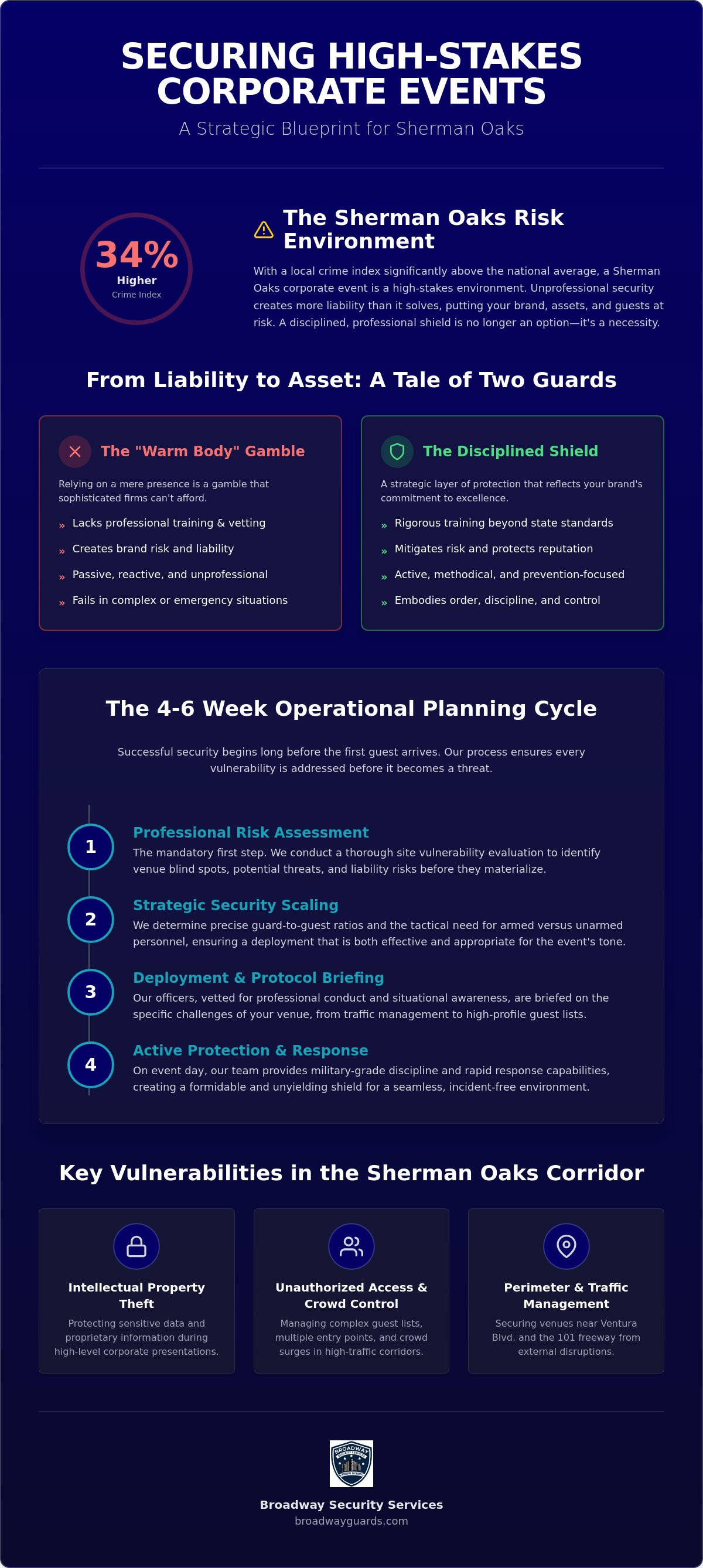
Securing Your Assets with Broadway Security Services

Initiating your defense strategy begins with a professional risk assessment. This process identifies the specific personnel levels and technology integrations required for your unique property layout. You can customize your guard schedule to ensure maximum deterrence during high-risk periods or specialized events. Taking action now ensures that your assets remain under the care of an unyielding protector. This methodical approach links professional discipline directly to the outcome of total protection. Request a professional consultation for your residential property to establish your comprehensive security framework and secure your legacy today.

Secure Your Legacy with Disciplined Protection

True safety in 2026 is a product of rigorous operational standards and unwavering vigilance. You’ve seen that while technology provides data, only a multi-layered defense plan utilizing professional residential security services can neutralize a physical threat. Effective protection requires a transition from reactive monitoring to a state of constant readiness. By prioritizing BSIS licensed and bonded providers, you ensure your property is managed with the highest degree of legal and operational integrity. This disciplined approach eliminates the gaps left by standard consumer gadgets.

Establishing this shield involves more than just equipment; it requires the deployment of highly trained armed and unarmed personnel who understand the unique security dynamics of Southern California. Our local expertise ensures your assets are protected by a force that values order and accountability above all else. You’ve taken the first step by understanding the importance of a structured defense strategy. Now, it’s time to translate that knowledge into a position of absolute control. Secure your residence with a professional security consultation and experience the peace of mind that comes from a dedicated protector. Your property deserves the care of an unyielding force.

Frequently Asked Questions

What is the difference between home security systems and residential security services?

Residential security systems are passive hardware tools like cameras and sensors that record data. In contrast, residential security services involve active human intervention through trained personnel. While a system alerts you to a breach, a professional guard physically secures the perimeter and neutralizes the threat. This distinction is critical for high-value estates where a recorded incident is not a substitute for a prevented one.

Do I need armed or unarmed guards for my residential complex?

The choice depends on your specific risk profile and property value. Armed guards are recommended for high-stakes environments where the risk of targeted intrusion is elevated. Unarmed guards are effective for residential complexes requiring a professional presence and concierge duties. A professional threat assessment determines the appropriate force level to maintain order and ensure resident safety.

How much does professional residential security cost in California?

Professional security costs vary based on the level of personnel and the complexity of the site. While basic DIY hardware kits may cost between $200 and $600, residential security services involving on-site personnel are scaled to the specific operational requirements of the property. Factors like patrol frequency, armed versus unarmed status, and specialized training levels influence the final investment. You should consult with a provider to establish a plan that meets your standards.

Can security guards integrate with my existing smart home cameras?

Professional guards utilize real-time video feeds as a force multiplier for site oversight. Integrating smart home technology with guard protocols allows for immediate verification of alerts. This ensures that electronic surveillance serves as a tool for the protector. By linking hardware to human response, you eliminate the delays associated with unverified automated alarms.

What are the benefits of mobile patrol services for a gated community?

Mobile patrols provide a dynamic layer of protection through randomized schedules. This unpredictability prevents criminal elements from identifying patterns in your security oversight. For gated communities, these patrols offer a visible deterrent against vandalism and porch piracy. Their localized presence ensures a rapid response capability that exceeds the arrival times of external law enforcement agencies.

Are residential security guards trained to handle medical emergencies?

Trained security personnel often serve as the first responders during medical crises. Guards are typically certified in CPR and basic first aid to provide immediate assistance while emergency services are in transit. This human judgment is a vital component of crisis management. It ensures that residents receive disciplined care during high-stakes situations where every second is critical.

How do I verify if a security company is properly licensed in California?

You can verify a company’s credentials through the California Bureau of Security and Investigative Services (BSIS). Every legitimate firm must hold a valid Private Patrol Operator (PPO) license. Additionally, individual guards must possess a valid Guard Card and specific certifications for armed duty. Checking these regulatory credentials ensures your property is under the care of a legally compliant and professional force.

Will having a professional security presence lower my homeowner’s insurance?

Many insurance carriers offer premium reductions for properties with a professional security presence. Insurers recognize that a disciplined guard force significantly reduces the risk of high-value theft and property damage. You should contact your insurance provider to discuss specific discounts available for properties utilizing professional residential security services. This investment often yields both safety and financial benefits.

Security Service Management 2026: The Essential FAQ for Commercial Protection

Effective security service management isn’t a passive expense. It’s a proactive, disciplined framework that transforms presence into prevention. You likely recognize that a lack of guard accountability and rising insurance premiums aren’t just administrative burdens. They’re critical gaps in your defensive perimeter. In California, the stakes are even higher as Senate Bill 652 mandates rigorous training standards that must be met to maintain legal and operational integrity. A failure in oversight is a failure in protection.

This guide provides the professional insights you need to master risk assessment and personnel oversight with military-like precision. You’ll learn how to address complex California compliance requirements while ensuring your assets remain under the care of a vigilant and unyielding force. We’ll preview the essential components of modern security contracts, the latest BSIS mandates, and the transparent reporting protocols that reduce liability and guarantee a disciplined, reliable presence on your site.

Key Takeaways

  • Understand how strategic security service management integrates personnel and technology to transform a passive presence into a proactive defensive shield.
  • Identify critical contract components necessary for transparent reporting, focusing on real-time digital logs that eliminate accountability gaps.
  • Evaluate the specific risk profiles of San Fernando Valley properties to determine the appropriate management model for armed versus unarmed personnel.
  • Navigate 2026 California BSIS compliance requirements and learn how professional oversight of Fire Watch services mitigates regulatory risk.
  • Master the principles of disciplined oversight to ensure your security force operates with the precision and reliability required for commercial protection.

What is Security Service Management and Why Is It Critical in 2026?

In the high-stakes commercial environment of Southern California, security service management is no longer a luxury. It’s a mandatory operational requirement. This discipline represents the strategic integration of elite personnel, advanced surveillance technology, and rigorous protocols. While some view security as a simple line item, true management transforms it into a proactive, disciplined shield. This Security Management Overview illustrates how the identification of assets and the implementation of strict protection policies form the bedrock of organizational safety. In 2026, the industry has shifted toward data-driven oversight. Real-time digital reporting and AI-enhanced monitoring have replaced outdated, passive methods. For property owners in the San Fernando Valley, this shift means greater accountability and a measurable reduction in long-term liability.

The Core Pillars of Professional Management

A disciplined approach to security begins long before a guard arrives on site. It starts with a strategic risk assessment. This foundation allows for the identification of specific vulnerabilities unique to a retail center in Woodland Hills or a construction site in Canoga Park. Professional management demands rigorous personnel selection. We don’t just hire; we vet for discipline and aptitude. Once selected, personnel undergo site-specific training that exceeds standard state requirements. Continuous performance auditing ensures that these standards never waver. Field supervision protocols involve unannounced inspections and digital checkpoint verification. This methodical oversight guarantees that every post remains alert and every protocol is followed to the letter.

Differentiating Staffing vs. Strategic Oversight

There’s a critical distinction between simple guard staffing and comprehensive security service management. Staffing merely fills a post with a body. This approach often fails in high-risk Los Angeles environments where threats are dynamic and sophisticated. Strategic oversight ensures that every post achieves a specific security objective. Management involves the active command and control of the security force. It includes crisis response planning and immediate incident mitigation. When a breach occurs, a managed service doesn’t just record the event; it executes a pre-planned, disciplined response. This level of professional rigor separates a reliable protector from a mere observer. By prioritizing oversight, commercial property owners ensure their assets are under the care of an unyielding force that values results over simple presence.

What Are the Essential Components of an Effective Security Contract?

A security contract serves as the tactical blueprint for site safety. It establishes the rigid parameters of security service management. Without specific, measurable metrics, a contract is merely a suggestion of safety rather than a guarantee of performance. In 2026, standardized reporting has transitioned entirely to digital platforms. Paper logs are obsolete and unacceptable for high-stakes environments. They’re prone to manipulation and lack the immutable timestamps required for legal defense. Digital logs provide real-time visibility into patrol patterns, ensuring that no sector of your property remains unobserved.

Effective management requires a strict command hierarchy. A high ratio of guards to a single supervisor inevitably leads to operational negligence. A disciplined shield requires frequent, unannounced field inspections to maintain professional standards. Technology integration is the modern standard for verification. GPS tracking and automated checkpoints verify that patrols are executed exactly as ordered. This methodology reflects the rigorous standards found in CISA System Security Management guidelines, which prioritize consistent log reviews and the maintenance of a secure posture. Body cameras add another layer of accountability, providing a definitive record of all interactions to mitigate liability claims.

Management provides psychological deterrence. It’s about creating a hard target environment. When bad actors observe a managed, tech-integrated force, they recognize an unyielding presence. This perception of order often stops a crime before the first step is taken. Your contract must also account for scalability. The ability to surge disciplined personnel during emergencies or large-scale events is a core requirement for commercial stability.

Accountability Through Technology

GPS geofencing creates a digital boundary that triggers immediate alerts if a guard deviates from their assigned route. This ensures constant coverage of high-value assets. Immediate incident notification systems allow management to coordinate a response within seconds of an alert. Over time, the data collected from these systems allows for predictive analysis. If patterns of unauthorized access emerge, security service management protocols are adjusted to reinforce vulnerable sectors. This data-driven precision is a cornerstone of elite protection services.

The Human Element: Training and Supervision

Technology is a tool for the human protector. Site-specific post orders are mandatory to replace generic, ineffective manuals. These orders must be updated regularly to reflect evolving threats. Guards must possess advanced training in de-escalation and crisis management to handle volatile situations without escalating risk. Field inspections verify that this training is applied with military-like precision. We prioritize rules, protocols, and visible results above all else. This methodical oversight ensures that the human element remains a reliable, unyielding force in the face of any challenge.

Armed vs. Unarmed: Which Management Model Fits Your Facility?

Risk dictates response. Effective security service management requires a cold, objective analysis of your facility’s vulnerabilities. In the San Fernando Valley, commercial properties present a wide spectrum of threats. A construction site in Canoga Park facing recurring copper theft requires a different tactical posture than a quiet corporate lobby in Woodland Hills. Armed personnel offer the highest level of visible deterrence, yet they demand significantly more management oversight. This includes rigorous use-of-force training and frequent evaluations to ensure they remain a disciplined shield. Every armed post requires a higher degree of accountability to mitigate the increased legal liability associated with lethal force.

The choice also hinges on the “deterrence factor” versus the “hospitality factor.” Retail environments often require a precise balance. You need an unyielding presence to discourage loss, but personnel must maintain a level of professionalism that doesn’t alienate legitimate customers. Broadway Security Services achieves this balance through methodical training and a strict focus on hierarchy. We prioritize rules and protocols to ensure our presence is reassuring to clients but formidable to threats. This creates an atmosphere of high-stakes reliability where the asset owner can focus on operations while we handle the burden of protection.

Managing High-Risk Asset Protection

Some environments leave no room for compromise. Armed security guards are a non-negotiable requirement for high-value retail, executive protection, and sites with critical infrastructure. These roles demand guards who meet the core competencies reflected in DoD Security Professional Standards, ensuring they possess the specialized skills required for high-stakes defense. Management protocols for these posts include daily equipment inspections and intensive scenario-based drills. This level of professional rigor is essential for liability protection and preventing sophisticated vandalism or theft at high-risk commercial sites. Static barriers alone cannot provide this level of defense; perimeter patrol security that actively identifies and neutralizes threats is what separates a truly protected site from a stationary target.

The Strategic Use of Unarmed Presence

Unarmed security guards serve as the essential eyes and ears for residential complexes and corporate offices. They provide a strategic management model without sacrificing the core values of presence and prevention. While the physical threat level might be lower, the requirement for disciplined reporting remains absolute. Unarmed personnel focus on access control, detailed incident logging, and mobile patrol duties. A cost-benefit analysis often reveals that for long-term contracts in low-risk environments, a well-managed unarmed force provides a comprehensive safety net while maintaining a professional, welcoming atmosphere for tenants and employees.

Security Service Management 2026: The Essential FAQ for Commercial Protection

How Does California Compliance Impact Security Management?

Operational success in California is inseparable from regulatory rigor. In 2026, the legal landscape for security service management has become significantly more complex. Managing a commercial property in the San Fernando Valley requires more than just a visible presence; it requires a deep understanding of the Bureau of Security and Investigative Services (BSIS) mandates. Failure to verify the credentials of your security force doesn’t just create a safety gap. It exposes your business to massive legal liability and state-level sanctions. A disciplined protector must operate within the strict confines of the law to ensure your assets remain truly secure.

Effective January 1, 2026, Senate Bill 652 has fundamentally shifted training requirements. Security guard applicants must now complete their initial 8-hour “Power to Arrest and Appropriate Use of Force” training within the six months immediately preceding their license application. This training must be certified by a single, BSIS-licensed provider to ensure consistency and quality. Once a guard receives their card, the management burden continues. New registrants are required to complete an additional 32 hours of specialized security officer skills training within their first six months of employment. Professional management ensures every guard on your site has met these rigorous standards before they ever step into a post.

Navigating BSIS and State Regulations

The responsibility for credential verification rests solely on the management team. You must ensure that your provider holds a valid Private Patrol Operator (PPO) license. This license is the functional signature of a legitimate security firm. Under California law, the mandatory reporting of use-of-force incidents is a critical component of security service management. Any incident involving the discharge of a weapon or a physical confrontation must be documented with military-like precision. We maintain an unyielding commitment to these reporting standards, protecting our clients from the fallout of undocumented field actions. Staying ahead of these evolving labor and safety laws is the only way to maintain a reliable, disciplined shield. If you need a provider that prioritizes these standards, you can secure your facility with a PPO-licensed partner today.
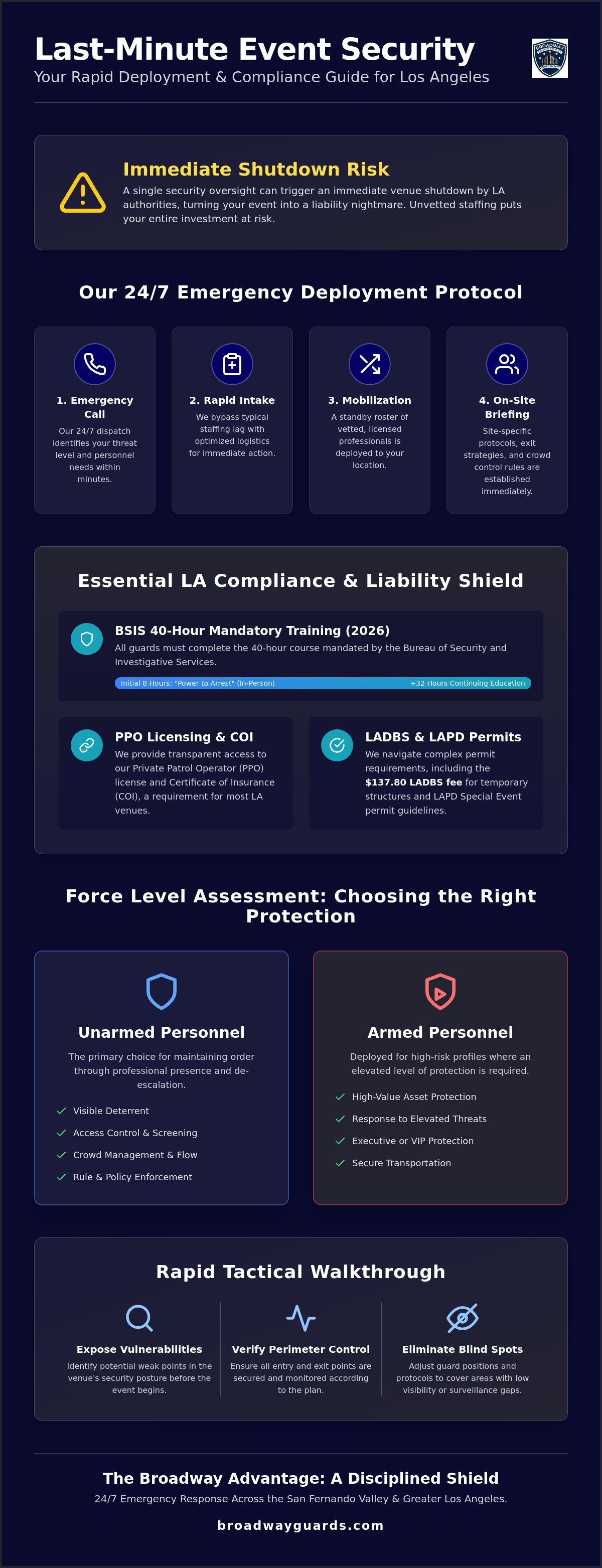
Fire Watch Compliance in Southern California

Fire Watch Services are a mandatory requirement when a building’s fire alarm or sprinkler system is non-functional. In cities like Canoga Park, the Los Angeles Fire Department (LAFD) mandates a continuous, vigilant watch to prevent catastrophic loss. Management of these services is high-stakes. Fire watch logs must be maintained with absolute accuracy to pass municipal inspections. These logs aren’t just paperwork; they’re legal proof of life-safety monitoring. Our approach integrates fire safety into our broader physical security framework. We ensure that personnel assigned to fire watch are trained to identify hazards and execute evacuation protocols with the same precision applied to asset protection. This methodical oversight prevents costly municipal fines and, more importantly, ensures the safety of every individual on your property.

Why Broadway Security Services is the Standard for Management in Canoga Park

The standard for security service management is defined by results, not promises. In Canoga Park and the surrounding San Fernando Valley, Broadway Security Services operates as a disciplined shield for commercial interests. Our approach is built on military-like precision, ensuring your assets remain under the care of a vigilant and unyielding force. We recognize that Woodland Hills and Canoga Park present unique operational challenges that national providers often overlook. Localized expertise allows us to respond with a level of speed and tactical awareness that ensures constant protection. We don’t just occupy a space; we command it through a rigorous hierarchy and a commitment to visible order.

Transparency is the cornerstone of our management philosophy. Clients receive direct access to leadership and real-time digital reporting, which eliminates the accountability gaps that often plague traditional security firms. Every patrol, every incident, and every observation is logged with immutable timestamps for your review. Broadway Security Services offers fully customizable contracts that scale from specific hourly staffing for retail security to full-scale risk management for complex construction sites. This flexibility ensures you only pay for the protection you need while maintaining the highest standards of professional rigor.

Our Proactive Risk Assessment Process

Superior protection begins with the identification of vulnerabilities before they manifest as incidents. Our security service management framework includes a comprehensive initial assessment of your property’s perimeter, access points, and internal protocols. We customize post orders to fit the specific rhythm of your business, ensuring that security measures facilitate rather than hinder your operations. Continuous improvement is a mandatory requirement of our service. We conduct quarterly security audits to refine our tactics and adapt to evolving threats in the San Fernando Valley. This methodical oversight ensures your defensive posture remains impenetrable over the long term.

The Broadway Commitment to Professionalism

Our guards are recognized as the most disciplined in Southern California. This reputation is earned through a focus on rules, protocols, and a stoic professional image. We prioritize the “disciplined shield” identity, ensuring our presence serves as a powerful deterrent to criminal activity. The Broadway Security Services headquarters at 21031 Ventura Blvd serves as the central hub for local oversight. This location allows our management team to maintain a constant, watchful presence over all field operations in the valley. We take our responsibilities with the utmost gravity, providing the peace of mind that comes from knowing your assets are protected by an unyielding force. Secure your facility with a professional risk assessment today and experience the difference of a managed security solution.

Secure Your Commercial Future Through Disciplined Oversight

Commercial stability in the current regulatory environment depends on more than just presence. It requires a strategic framework that integrates technology with human vigilance. You’ve explored how security service management transforms a reactive guard post into a proactive defensive perimeter. By prioritizing the rigorous standards of Senate Bill 652 and embracing real-time digital accountability, you effectively eliminate the gaps that lead to liability and loss.

Broadway Security Services provides the professional discipline required to safeguard your commercial interests. We combine our deep San Fernando Valley expertise with a commitment to military-style oversight that ensures your site remains a hard target. As a BSIS licensed and insured provider, we take the burden of compliance and protection off your shoulders. It’s time to elevate your safety standards with a partner that values results above all else. Request a Comprehensive Risk Assessment from Broadway Security Services to secure your facility. We’re ready to stand as your disciplined shield.

Frequently Asked Questions

What is the primary role of a security service management company?

A security service management company acts as the central command for your property’s defense. It’s responsible for the strategic integration of elite personnel, surveillance technology, and rigorous site protocols. Rather than just providing staffing, a management firm executes a comprehensive safety plan that prioritizes the outcome of protection. This systematic approach ensures that every guard on your site operates as part of a disciplined shield.

How does Broadway Security Services ensure guard accountability on-site?

We maintain accountability through a rigorous hierarchy and real-time digital verification. Every patrol is tracked via GPS geofencing to ensure no sector is neglected. Our field supervisors conduct unannounced inspections to verify that guards adhere to site-specific post orders with military-like precision. This methodical oversight eliminates the gaps often found in unmanaged staffing models, ensuring a reliable and unyielding presence.
What are the legal requirements for security management in California?

In California, any firm providing security must hold a valid Private Patrol Operator (PPO) license from the BSIS. Beyond licensing, effective security service management requires strict adherence to SB 652 training mandates for all personnel. This includes verified use-of-force training and documented skills development. Management is also legally responsible for the mandatory reporting of incidents to state authorities to maintain operational transparency.

Can security management help reduce my business insurance premiums?

A managed security framework often leads to reduced insurance costs by mitigating the risk of negligent security lawsuits. By maintaining immutable digital logs and a consistent audit trail, you provide insurers with evidence of proactive risk reduction. This documented deterrence demonstrates a higher standard of care. This professional rigor can help lower your overall liability profile and potentially decrease annual premiums.

What is the difference between a security consultant and a security manager?

A consultant provides high-level analysis and policy recommendations, whereas a manager handles the daily execution and active command of the force. Management involves the direct supervision of personnel, the enforcement of rules, and the immediate response to incidents. While a consultant identifies what should be done, a manager ensures it’s done with professional discipline and visible results.

How often should a security risk assessment be performed?

We recommend a comprehensive assessment at least every quarter to stay ahead of evolving threats. However, security service management protocols should be re-evaluated immediately if there are changes to your facility’s layout or local crime trends. Regular audits ensure your defensive posture remains effective. This constant refinement is essential for maintaining a high-stakes level of reliability on your property.

What happens if a guard fails to show up for a scheduled shift?

Our command structure includes a redundant staffing model to ensure no post is ever left vacant. If a primary guard is unable to report, our supervisors immediately deploy a qualified, disciplined replacement from our local pool. We prioritize continuity of protection above all else. This system prevents the dangerous security gaps that occur when a provider lacks a structured management hierarchy.

How does mobile patrol management differ from on-site guard management?

Mobile patrol management focuses on the strategic randomization of checks across several locations to prevent criminals from timing their activities. It relies on rapid response and high-visibility vehicle presence. On-site management involves a constant, unyielding perimeter at a single facility. Both models require strict reporting and GPS verification, but mobile patrols demand more complex logistical coordination to ensure every sector is inspected. Understanding why passive barriers fall short is essential; learn how active perimeter patrol security neutralizes threats before they escalate into costly incidents.

How to Conduct a Professional Security Risk Assessment in California: A Definitive Guide

In the first three weeks of January 2026, reported data breaches in California surged by 74 percent compared to the same period in 2025. This sharp increase in risk, combined with rising crime rates across Southern California, confirms that a standard security checklist is no longer sufficient for asset protection. You likely recognize that ineffective security measures are a significant liability under complex state laws. Conducting a professional security risk assessment CA is a tactical necessity to ensure your facility remains under the care of a vigilant and unyielding force.

You understand that true safety requires a disciplined approach rather than a reactive one. This guide provides the professional framework needed to identify vulnerabilities and protect your assets with military-like precision. We will outline the methodical process of evaluating physical threats, addressing insider risks, and meeting the newest California Privacy Protection Agency requirements. By following this structured guide, you’ll move from broad promises of safety to a state of rigorous operational oversight and high-stakes reliability.
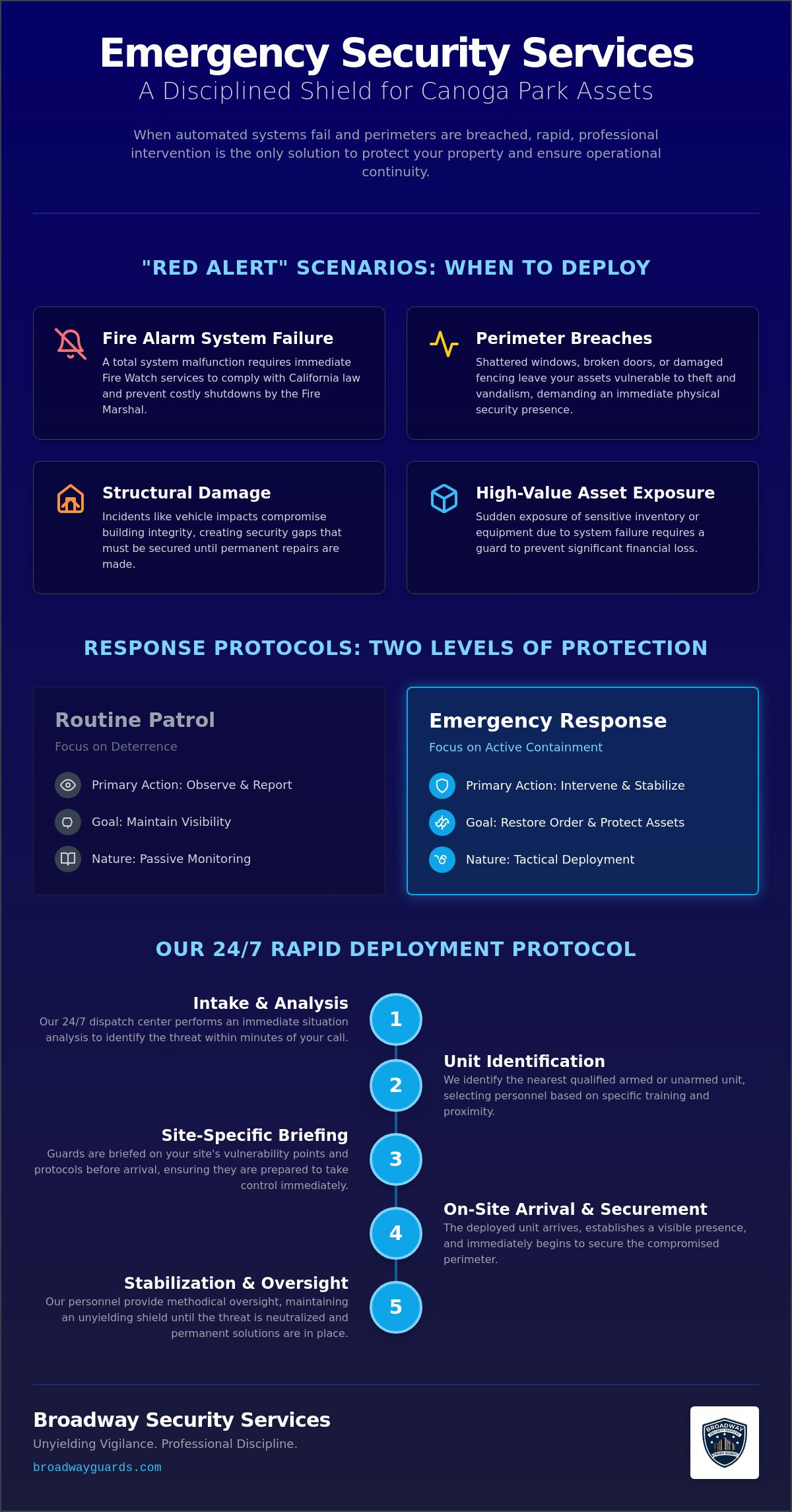
Key Takeaways

  • Establish a disciplined framework to transition your security strategy from reactive responses to proactive prevention.
  • Learn the methodical process of defining high-value asset zones and conducting a rigorous site inspection.
  • Master the tactical requirements of a professional security risk assessment CA to mitigate regional crime trends and navigate complex liability laws.
  • Evaluate why professional personnel outmatch technology alone and how to audit guard performance for maximum accountability.
  • Translate assessment findings into a rigorous operational protocol that ensures unyielding oversight and long-term asset protection.

Understanding the Security Risk Assessment Framework in California

Professional security is not a matter of chance; it’s a product of rigorous discipline. A security risk assessment CA serves as a comprehensive audit designed to expose every physical and operational vulnerability within a facility. This framework functions as a disciplined shield, ensuring that business continuity remains intact while assets are protected under a vigilant and unyielding force. The core objective is a strategic shift from reactive response to proactive prevention. Waiting for an incident to occur is a failure of oversight. Instead, a professional framework identifies threats before they manifest as losses, ensuring that your security posture is always one step ahead of potential intruders.

California businesses operate in a landscape of high urban density and complex legal precedents. These factors increase the likelihood of security incidents and the severity of subsequent litigation. Whether you are managing a retail environment or a construction site, the density of the San Fernando Valley or Greater Los Angeles demands a higher standard of vigilance. A disciplined assessment provides the oversight necessary to maintain order. It creates an atmosphere of high-stakes reliability where assets are never left to chance and every protocol is executed with military-like precision.
The Three Pillars of Professional Risk Evaluation

Establishing a robust risk assessment framework requires a focus on three fundamental pillars. First, threat identification recognizes the specific internal and external actors likely to target a site. This involves analyzing regional crime trends and identifying who might seek to disrupt your operations. Second, vulnerability analysis pinpoints weaknesses in current defenses. This includes everything from lighting gaps to lapses in guard presence. Third, impact assessment calculates the potential financial and legal fallout of a security breach. This methodical approach ensures that security resources are deployed with maximum efficiency and accountability.

Regulatory Standards and BSIS Compliance

Compliance with the Bureau of Security and Investigative Services (BSIS) is the baseline for security operations in California. Professional assessments align your site with these state standards and meet the rigorous requirements of insurance providers. Documented audits are essential for a strong premises liability defense. They demonstrate that a property owner has taken reasonable, disciplined steps to mitigate foreseeable risks. Without this documentation, a business remains legally exposed to the consequences of criminal activity. A professional assessment grounds your security claims in legal and regulatory reality, providing peace of mind through documented excellence.

A Step-by-Step Guide to Conducting Your Security Audit

Order begins at the property line. A professional security risk assessment CA requires a disciplined, step-by-step walkthrough to ensure no vulnerability remains hidden. This process starts with establishing a clear assessment perimeter. You must define high-value asset zones, identifying exactly where your most critical resources reside. Whether it’s a server room, a high-end retail floor, or a construction equipment depot, these zones require the highest level of scrutiny. A methodical site inspection isn’t a casual stroll. It’s a rigorous examination of every potential entry point for chaos. By documenting findings with military-like precision, you create a foundation of accountability that protects your interests and reduces liability.

During the walkthrough, don’t overlook the human element. Interviewing stakeholders and site managers is essential to identifying operational blind spots in daily routines. These conversations often reveal that protocols aren’t being followed or that certain gates are left propped open for convenience. Once you’ve gathered this intelligence, prioritize each risk using a Probability vs. Severity matrix. This tool allows you to focus resources on threats that are both likely to occur and catastrophic in nature, ensuring your security budget is deployed with maximum efficiency.

Phase 1: Perimeter and Access Control Audit

The first line of defense is your physical boundary. Test every gate, fence line, and entry point for unauthorized access potential. A loose latch or a gap in a perimeter fence isn’t just a maintenance issue; it’s a security failure. Lighting is equally critical. Evaluate coverage in high-risk areas like parking lots and loading docks to ensure there are no shadows where threats can hide. Finally, audit your visitor management protocols. Every person entering the site must be identified and logged according to strict standards. Maintaining a disciplined security presence at these access points is the most effective way to deter unauthorized entry.

Phase 2: Internal Systems and Personnel Review

Technology must be matched by human vigilance. Verify the placement and functionality of every surveillance camera and alarm system. Cameras alone aren’t a strategy; they’re a tool that requires oversight. Assess the visibility and discipline of your existing guard staff, whether they’re armed or unarmed. Look for signs of alertness and reporting accuracy. For California construction sites, reviewing fire watch compliance is a mandatory step to prevent catastrophic loss. Every guard must understand their role as a disciplined shield, ensuring that your assets remain under the care of a vigilant and unyielding force.

Identifying California-Specific Vulnerabilities and Threats

California’s security environment is uniquely challenging. High urban density in the San Fernando Valley and Greater Los Angeles creates a target-rich environment for criminal actors. A professional security risk assessment CA must account for these regional crime trends with surgical precision. It’s not just about general safety. It’s about understanding local dynamics. The homelessness crisis has introduced new complexities for commercial property owners. Trespassing and loitering require a disciplined response that balances legal compliance with firm asset protection. This ensures your property remains a secure, orderly environment under the care of a vigilant force.

State laws regarding guard intervention and loss prevention are notoriously complex. You must ensure your security protocols align with these regulations to avoid costly litigation. Environmental risks also demand attention. Fire watch services are often a regulatory necessity for construction zones and facilities with compromised alarm systems. A disciplined protector doesn’t just watch for intruders. They maintain a vigilant eye on all potential hazards to ensure business continuity. This level of oversight is what separates a professional operation from a reactive one. Every protocol must be executed with military-like precision to maintain a sense of order.

High-Risk Sectors in Southern California

Construction sites face constant threats from high-value equipment theft and vandalism. Retailers must combat sophisticated organized retail crime (ORC) strategies that bypass standard alarms. Hospitals require specialized hospital security protocols to manage high-traffic, high-stress environments where patient safety is paramount. Each sector demands a tailored application of the disciplined shield framework. Whether you need construction site security or loss prevention services, the approach must be methodical and unyielding. We prioritize the core values of presence and prevention to ensure your assets remain secure.

Legal Liability and the “Duty to Protect”

California courts look at “foreseeability” in premises liability cases. If a crime was predictable based on local trends, the property owner may be held liable for damages. Negligent security lawsuits carry significant financial risk. Using a documented risk assessment serves as professional evidence of reasonable security measures. It proves you exercised due diligence and maintained rigorous operational standards. This documentation acts as a legal shield, grounding your professional claims in regulatory reality. It provides the peace of mind that your assets are under the care of a vigilant and unyielding force. Reliability is not a promise; it’s a documented standard of quality.

How to Conduct a Professional Security Risk Assessment in California: A Definitive Guide

Evaluating the Effectiveness of Your Current Security Posture

Technology often provides a false sense of security. While cameras are useful for post-incident reporting, they don’t offer the active deterrence of a disciplined protector. A security risk assessment CA must evaluate if your current hardware is merely observing or actually preventing loss. We apply the “Broken Windows” theory in a commercial context; visible maintenance and order signal that a site is under rigorous oversight. Deterrence is achieved through the presence of a vigilant force, not just a recording device. If your facility shows signs of neglect, it invites disorder. Maintaining a pristine, well-lit perimeter is the first step in demonstrating that your assets are protected by an unyielding force.

Testing response times is a critical component of this evaluation. You must verify how quickly your communication chain functions during a simulated breach. If your current protocols rely on delayed notifications or unmonitored alarms, you have a single point of failure. A professional framework demands accountability at every level of the command structure. Auditing guard performance is equally vital. You should look for discipline, alertness, and reporting accuracy. A guard who lacks a structured reporting protocol is a liability, not an asset. Every patrol must be documented with precision to ensure that oversight is both consistent and methodical.

The Role of Professional Guard Presence

Choosing between armed security guards and unarmed security guards depends on your specific risk profile and the nature of the threats identified. In high-density areas like Canoga Park, mobile patrol services are often necessary for large perimeters where static posts leave gaps. Professional oversight transforms a guard from a bystander into a disciplined shield. This transition is marked by a visible commitment to duty and the ability to manage high-stakes reliability. When guards are trained to lead with a standard of quality, the outcome is a higher level of protection for your personnel and property.

Gap Analysis: Bridging the Distance Between Current and Ideal

Identifying single points of failure is the primary goal of a gap analysis. You must determine if a single compromised entry point or a distracted monitor could jeopardize the entire facility. A cost-benefit analysis often reveals that increasing personnel provides a higher return on safety than simply adding more hardware. This phase creates a roadmap for immediate, short-term, and long-term security improvements. To ensure your assets are under the care of a vigilant and unyielding force, you should request a professional security consultation to address these identified gaps with precision.

Implementing a Professional Security Management Plan

A document is not a defense. Translating the findings of your security risk assessment CA into a rigorous operational protocol is the only way to ensure your assets remain secure. This implementation phase requires a command structure that prioritizes accountability above all else. You must move from the theoretical identification of gaps to the physical deployment of countermeasures. Every vulnerability discovered during the audit phase demands a specific, documented response. This ensures that your security posture isn’t just a plan on a page but a living, breathing system of protection.

California’s environment is dynamic. Changes in local legislation or regional crime trends can render an old plan obsolete. Continuous oversight and periodic reassessments are mandatory to maintain site integrity. Integrating professional consultation provides the objective perspective needed to identify new threats before they impact your bottom line. By establishing a rhythm of methodical oversight, you ensure that your facility remains under the care of a vigilant and unyielding force. Reliability is a product of consistent application, not occasional effort.

The Broadway Security Approach to Risk

We utilize project-based risk assessment fees to provide comprehensive site evaluations that leave no stone unturned. This structure allows for a deep dive into your facility’s specific needs without the ambiguity of hourly billing for the audit phase. Once vulnerabilities are identified, we deploy highly trained personnel to serve as your disciplined shield. Whether the situation requires armed security guards or specialized retail security, our staff operates with military-like precision. Professional oversight is the anchor of our reliability, ensuring that every post is manned by a protector who values rules and protocols above all else.
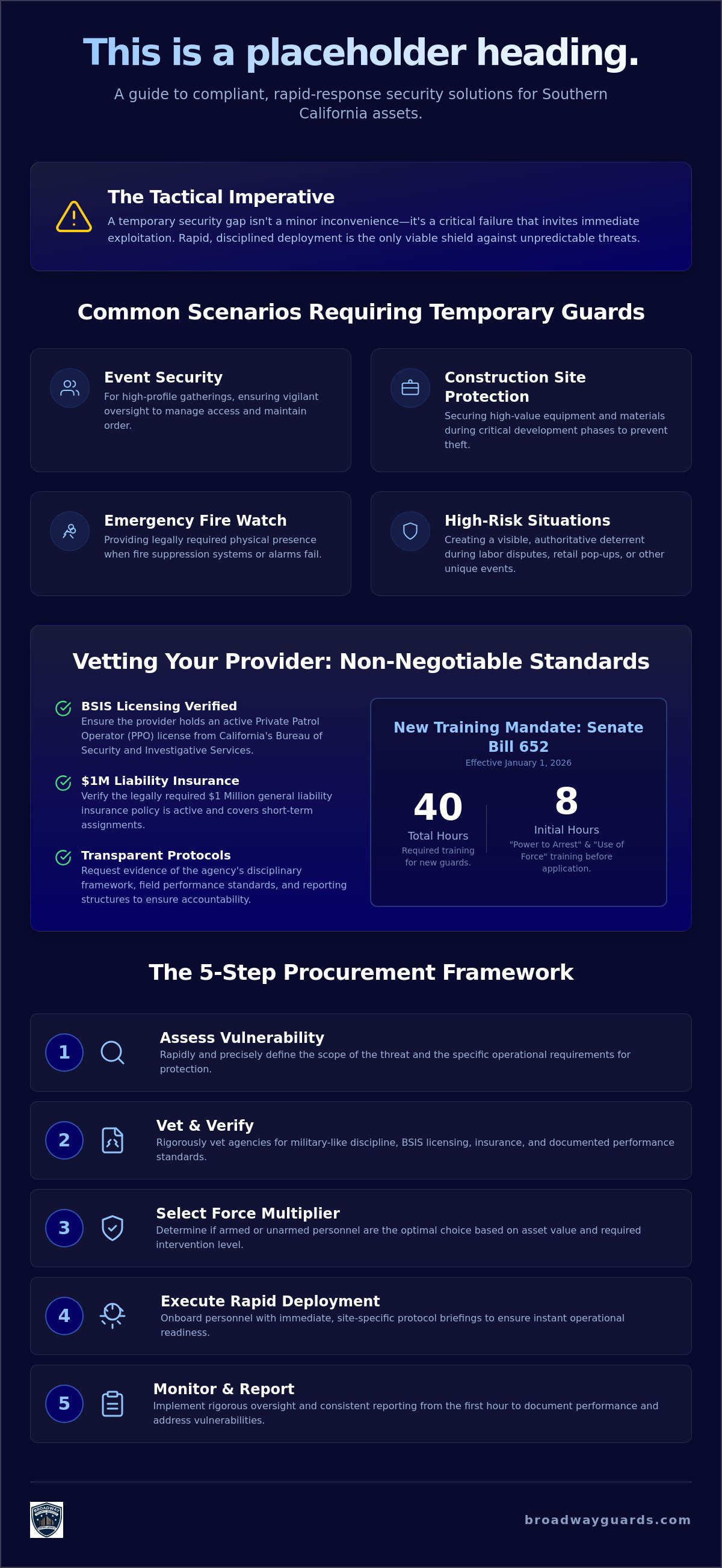
Moving from Assessment to Action

Order is maintained through action. We draft customized security contracts that evolve with your facility’s needs, ensuring your protection never stagnates. This might involve the integration of mobile patrol services for expansive perimeters or the placement of dedicated site guards for high-value internal zones. Maintaining constant vigilance is a standard of quality that links professional discipline directly to the outcome of protection. You can take the first step toward total site protection by contacting our Woodland Hills office to discuss your specific requirements. Moving from assessment to action is the definitive way to secure your peace of mind and protect your California assets.

Establishing a Disciplined Standard of Protection

Securing a facility in Southern California demands more than just technology; it requires a commitment to order and vigilance. By identifying vulnerabilities through a professional security risk assessment CA, you transition from a state of vulnerability to one of high-stakes reliability. This disciplined approach ensures that your assets remain under the care of a vigilant and unyielding force, meeting the rigorous standards expected by state regulators and insurance providers.

Broadway Security Services provides the professional oversight necessary to maintain business continuity in high-risk environments. Our BSIS-certified personnel bring military-style oversight to every post, ensuring that your protocols are executed with precision. Secure Your Assets: Request a Professional Risk Assessment from Broadway Security. Take control of your site’s safety today and establish a standard of protection that stands as a disciplined shield against disorder.

Frequently Asked Questions

What is included in a professional security risk assessment in California?

A professional assessment includes a methodical walkthrough of the site perimeter, access points, and high-value asset zones. Analysts evaluate the effectiveness of current technology and personnel while conducting stakeholder interviews to uncover operational blind spots. The final deliverable is a disciplined report that prioritizes vulnerabilities using a probability versus severity matrix. This ensures that resources are allocated with military-like precision to mitigate the most critical threats first.

How often should a California business perform a security audit?

Businesses should conduct a formal audit annually to maintain a rigorous standard of protection. However, immediate reassessments are necessary following a significant crime surge in the local area or major changes to the facility’s layout. Consistent oversight ensures your security posture remains a disciplined shield against evolving threats. Regularly scheduled reviews demonstrate a commitment to duty and help prevent the gradual decay of security protocols over time.

Does California law require businesses to have a security risk assessment?

As of January 1, 2026, new CCPA regulations require businesses processing personal data that presents a “significant risk” to conduct formal assessments. Beyond data privacy, California premises liability laws place a “duty to protect” on property owners if criminal activity is foreseeable. Completing a security risk assessment CA provides documented evidence that you’ve taken reasonable steps to identify and mitigate physical threats. This documentation acts as a critical legal defense in the event of a security breach.

What is the difference between a security survey and a risk assessment?

A security survey is a categorical inventory of existing hardware and protocols, whereas a risk assessment is an analytical evaluation of threats. The survey tells you what you have; the assessment tells you how likely those assets are to be compromised. A professional assessment focuses on the impact of a breach, calculating potential financial and legal fallout. It moves beyond a simple checklist to provide a strategic roadmap for unyielding asset protection.

Can a security risk assessment lower my insurance premiums in CA?

Insurers in California frequently offer premium credits or improved coverage terms for businesses that provide documented evidence of risk mitigation. By presenting a professional security risk assessment CA, you demonstrate a proactive approach to liability reduction. This signals to the insurer that your assets are under the care of a vigilant force. You should consult with your specific provider to verify which mitigation steps, such as professional guard presence, qualify for these financial incentives.

How do I choose between armed and unarmed guards for my facility?

The choice depends on the severity of the threats identified during your assessment and the value of the protected assets. Armed security guards are typically deployed in high-risk environments where the potential for violent confrontation is elevated. Unarmed security guards are effective for standard access control, retail environments, and general deterrence. A disciplined protector evaluates the specific risk profile of the site to ensure the force level is appropriate for the mission.

What are the specific fire watch requirements for CA construction sites?

Fire watch services are mandatory under the California Fire Code when a required fire protection system is out of service for more than four hours. On construction sites, dedicated personnel must be present during “hot work” activities and for a specified period afterward to detect smoldering fires. These individuals must have no other duties except fire watch. Their presence ensures that the site remains under constant, methodical oversight to prevent catastrophic property loss.

How long does a typical physical security risk assessment take to complete?

The duration of a physical assessment depends entirely on the size and complexity of the facility. A standard commercial site typically requires one to three days for the on-site walkthrough and stakeholder interviews. The subsequent data analysis and report generation usually take an additional one to two weeks. This structured timeline ensures that the final management plan is drafted with the precision and depth required for high-stakes reliability.

Construction Patrol Services: Comparing Security Models for LA Job Sites

In Los Angeles, only 4.3% of construction site crimes result in an arrest. This leaves nearly 92% of cases unresolved while project managers in the San Fernando Valley and across the basin face the fallout of stolen copper and vandalized machinery. Since California ranks first in the nation for construction equipment theft, effective construction patrol services are no longer a luxury; they are a tactical necessity. You likely recognize that a single breach can trigger months of project delays and drive insurance premiums to unsustainable levels. Protecting your assets requires more than a simple perimeter fence; it demands a disciplined shield.

This article provides a strategic comparison of mobile patrol and static security models to help you optimize site protection and minimize financial loss. We will analyze the tactical advantages of mobile units versus dedicated guard posts, giving you a clear decision-making framework for security staffing. By the end of this guide, you’ll understand how to deploy a vigilant force that ensures reduced liability and full compliance with California BSIS standards. Our objective is to provide the operational clarity needed to keep your project on schedule and under budget.

Key Takeaways

  • Identify the escalating financial risks of equipment theft and vandalism unique to the 2026 Southern California construction landscape.
  • Compare the tactical advantages of construction patrol services against static guarding to determine the most efficient model for your site’s perimeter.
  • Learn how rigorous protocols and technology like GPS tracking ensure total accountability and verifiable field performance.
  • Calculate the potential return on investment by analyzing how a professional security presence mitigates liability and reduces insurance premiums.
  • Establish a clear framework for selecting a security model that ensures full compliance with California BSIS standards and operational requirements.

The Rising Stakes for Southern California Construction Projects in 2026

Asset protection in Southern California has reached a critical juncture. As of May 2026, California remains the primary target for construction equipment theft in the United States. Project managers in the San Fernando Valley don’t just face the loss of machinery; they face a systemic threat to their operational timelines. With local arrest rates for construction site crimes sitting at a mere 4.3%, the burden of prevention falls entirely on the developer. Relying on reactive measures is no longer a viable strategy for high-stakes job sites. A disciplined presence is the only way to ensure order.

A single security breach often causes damage that far exceeds the value of the stolen items. While the theft of copper represents a $1 billion annual loss nationally, the resulting property damage and project delays can double that impact. Vandalism, arson, and the destruction of critical infrastructure during a break-in force contractors into costly work stoppages. Effective construction patrol services act as a disciplined shield, ensuring that minor incursions don’t escalate into catastrophic financial setbacks. Precision in oversight is what keeps a project on schedule.

Localized Vulnerabilities in Canoga Park and Beyond

The development corridor stretching through Canoga Park and the San Fernando Valley presents unique security challenges. High-value multifamily and industrial projects are prime targets for organized theft rings. Local crime patterns show a high concentration of activity in areas with rapid growth, where site perimeters are often in flux. Insurance providers now scrutinize these localized risks with greater intensity. Inadequate site protection can lead to higher premiums or the denial of claims if a site is found to be non-compliant with standard safety protocols. Location dictates the level of vigilance required.

Regulatory Pressures and Compliance Standards

Operating a job site in 2026 requires strict adherence to California’s evolving legal landscape. The Bureau of Security and Investigative Services (BSIS) maintains rigorous oversight of all security guard services within the state. Utilizing unlicensed or under-trained personnel isn’t just a safety risk; it’s a massive legal liability for developers. Under new 2026 regulations like the updated Title 24 Building Standards Code, maintaining a secure and orderly site is essential for wildfire safety and electrification compliance.

Professional construction patrol services also play a vital role in fire watch duties. With the increased focus on wildfire safety in the 2025 California Building Standards Code, having a vigilant presence to identify fire hazards is mandatory for many projects. A disciplined patrol ensures that your site remains compliant with both security standards and fire safety mandates. This comprehensive approach protects your investment from every angle while meeting all legal obligations.

Mobile Patrol vs. Static Guarding: A Strategic Comparison

Choosing between mobile patrol and static guarding is a tactical decision based on the specific risk profile of your job site. Project managers must weigh the need for constant access control against the requirement for broad perimeter visibility. While both models aim to prevent loss, their operational execution differs significantly. Static guarding provides a fixed, unyielding presence at vulnerable points. Conversely, mobile construction patrol services utilize high-visibility vehicles to secure expansive areas where a single stationary guard would be insufficient. The choice depends entirely on the mission requirements of your project.

Static guards are non-negotiable for sites housing high-value machinery or sensitive materials that require strict access management. These guards act as the first line of defense, verifying every individual who enters the perimeter. For many developers in the San Fernando Valley, the Hybrid Model is becoming the standard. This approach combines a static guard at the main entrance with randomized mobile patrols to verify the integrity of the entire fence line. This strategy ensures no blind spots remain for opportunistic thieves who monitor site vulnerabilities. It creates a comprehensive layer of protection that balances cost with high-stakes reliability.

Cost-Effectiveness and Coverage Range

Mobile patrols are designed for maximum efficiency across large perimeters. A single patrol vehicle can monitor ten times the area of a stationary guard by performing methodical sweeps of the property. This model is particularly effective for budget-conscious projects that still require a formidable deterrent. The sight of a marked vehicle signals to potential intruders that the site is under disciplined oversight. While hourly staffing fees for dedicated guards are higher due to the continuous presence, construction patrol services offer a scalable solution for sites with lower immediate risk but high visibility needs.

Response Times and Incident Management

Immediate intervention is the hallmark of static guarding. When a breach occurs, an on-site guard provides an instantaneous response, often preventing theft before it begins. Mobile patrols counter this with the tactical advantage of unpredictability. Thieves often monitor sites to identify patterns; randomized schedules disrupt this reconnaissance. Broadway Security maintains a standard of rigorous operational discipline across both models. Whether your site requires a fixed post or a mobile unit, our commitment to vigilance remains absolute. To determine which model fits your specific project needs, you can review our full range of construction site security options.

The Anatomy of a Disciplined Construction Patrol

Professional oversight requires more than a presence; it demands a methodical execution of duties. A disciplined patrol begins with a rigorous perimeter protocol that leaves nothing to chance. Every entry point, lock, and lighting fixture is inspected according to a pre-defined sequence. This systematic approach ensures that construction patrol services provide a consistent level of protection throughout the night. By standardizing these inspections, we eliminate the human error that often leads to security breaches. Precision in the field is the only way to safeguard high-value industrial assets.

Accountability is the foundation of trust between a security provider and a project manager. We utilize GPS tracking and geofencing to provide verifiable proof of presence. These technologies create a digital footprint for every patrol unit, ensuring that guards are hitting every vulnerable corner of the job site. Real-time reporting allows site supervisors to receive immediate updates on the status of their assets. This data-driven oversight transforms security from a passive cost into an active management tool. It prevents crises before they manifest by identifying vulnerabilities in real time.

Oversight and Accountability Technologies

Digital checkpoints are a core component of our operational rigor. By placing scan points at high-risk locations, such as copper storage areas and heavy machinery clusters, we ensure that every patrol is thorough. This “Disciplined Shield” approach provides clients with detailed logs of field performance. You don’t have to wonder if a patrol occurred; the data confirms it. Direct communication lines between patrol units and site supervisors ensure that any identified issues are addressed immediately. This level of transparency is essential for maintaining order on complex LA job sites.

Tactical Perimeter Inspections

Our construction patrol services include standardized checklists for every site visit. Guards don’t just drive by; they physically verify the integrity of gates, fencing, and unauthorized entry points. This process includes monitoring for internal threats, such as unauthorized after-hours access by sub-contractors or former employees. Beyond theft prevention, patrols focus on proactive hazard detection. We identify early signs of fire risks, equipment leaks, or flooding that could lead to significant property damage. A vigilant protector looks beyond the fence line to ensure the total safety of the environment.

Rigorous inspections of equipment locks and office trailers are mandatory. Thieves often target these specific areas because they house the most liquid assets on a site. By ensuring that all secondary security measures are engaged, our patrol units provide a multi-layered defense. This disciplined routine is what separates a professional security force from a mere visual deterrent. It’s about maintaining a constant state of readiness and ensuring that every asset remains under the care of an unyielding force.

Construction Patrol Services: Comparing Security Models for LA Job Sites

Evaluating Your Site’s Security ROI in 2026

Measuring the return on investment for security requires a cold analysis of the alternative. National estimates place the annual cost of construction equipment theft between $300 million and $1 billion. With a recovery rate of less than 25% for stolen assets, the financial impact of a single breach is often permanent. For a project manager, the true cost includes the loss of the asset, the increase in insurance premiums, and the operational downtime caused by missing machinery. Utilizing professional construction patrol services mitigates these risks by establishing a visible and unyielding barrier against criminal activity. Precision in protection is the only way to safeguard your margins.

Liability reduction is a primary driver of security ROI. California developers face some of the highest insurance rates in the nation due to the state’s ranking as the top target for equipment theft. Maintaining a disciplined security presence signals to underwriters that your site follows rigorous risk management protocols. This commitment to oversight can lead to significant long-term savings on insurance costs. Beyond the numbers, the peace of mind afforded to site supervisors allows them to focus on production rather than perimeter integrity. When your assets are under the care of a vigilant force, you eliminate the mental burden of high-stakes uncertainty.

Risk Assessment: The Foundation of Security ROI

Every site has a unique vulnerability profile that changes over time. A site in the early grading phase may only require mobile patrols to monitor heavy machinery scattered across a large acreage. As the project moves into the finishing stages, the presence of high-value interior materials like copper wiring necessitates a shift in strategy. A one-size-fits-all security plan is a waste of capital. Matching the level of protection to the current phase of development ensures that resources are allocated where they are most needed. This tactical flexibility is essential for maintaining a lean and effective budget.

Crisis Management and Loss Prevention

A disciplined security force does more than just watch; they act as a liaison with law enforcement. In the event of a breach, professional reporting and documentation are essential for asset recovery and insurance claims. This proactive approach reduces “soft” losses such as site vandalism and arson, which can be just as damaging as theft. Security management fees directly offset potential project delay costs. By maintaining a constant state of readiness, you protect your project’s timeline and your bottom line. To secure your assets with a disciplined shield, you can request a specialized quote for construction site security today.

Securing Your Assets with Broadway Security Services

Broadway Security Services operates with a single objective: the total preservation of your assets. We don’t view security as a passive commodity; it is a tactical operation requiring military-like precision. Our guards are recognized as the San Fernando Valley’s disciplined shield because they adhere to a standard of order that few competitors can match. By deploying our construction patrol services, you ensure that your site remains under the care of a vigilant and unyielding force. We prioritize prevention over reaction to ensure your project remains secure.
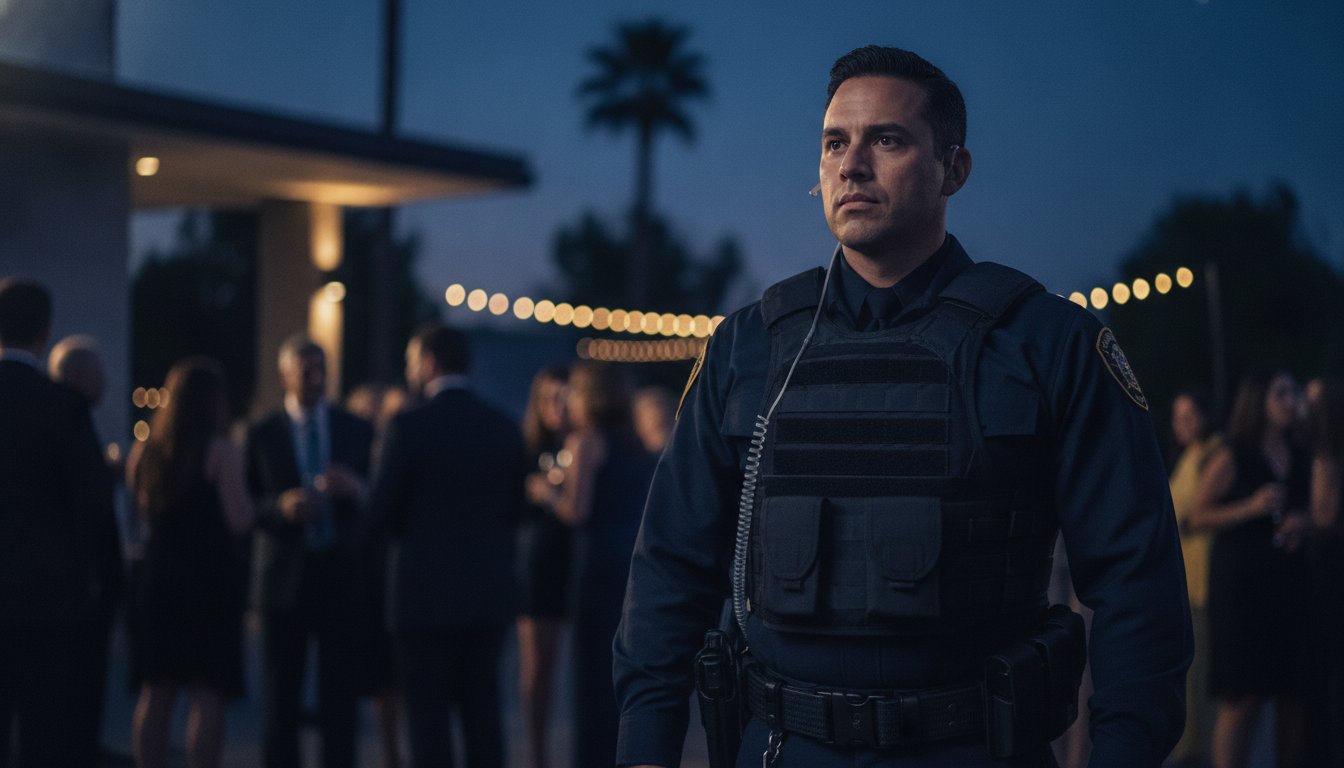
Professionalism is the foundation of our operational model. Every guard under our command understands the high stakes of construction security, where a single oversight can lead to massive financial loss. Our commitment to presence means that our patrol units are never just “on site”; they are actively engaged in methodical oversight. This disciplined approach creates an atmosphere of reliability that project managers can trust. We provide the peace of mind necessary to manage complex developments without the constant fear of equipment theft or vandalism.

The Broadway Advantage in Southern California

Our deep roots in the Canoga Park and Woodland Hills communities provide us with a unique understanding of the local threat landscape. We don’t just provide personnel; we provide a foundation of trust built on years of local performance. Our training standards are designed to exceed California regulatory requirements, ensuring that every guard is prepared for high-stakes scenarios. This intersection of professional consultation and field performance is what sets our agency apart. Every deployment is governed by a strict hierarchy and an unwavering commitment to duty.

Get a Strategic Security Consultation Today

Transitioning from a reactive posture to proactive site protection is essential for maintaining project timelines. Our team specializes in creating customizable contracts tailored to the specific needs of Canoga Park sites. We recognize that a site’s requirements change as it moves from grading to finishing. By requesting a comprehensive site risk assessment, you gain a clear decision-making framework for your security staffing. This ensures that your capital is used efficiently to minimize loss and reduce liability through professional construction patrol services.

It is time to move beyond inadequate site security. Protecting your investment requires a partner who takes the responsibility with the utmost gravity. We invite you to Contact Broadway Security for a professional site evaluation today. Secure your assets with a disciplined shield that ensures full compliance and peace of mind. Your next development deserves a security model built on operational rigor and an unyielding presence.

Securing Your Project’s Future with Disciplined Oversight

The financial safety of your job site depends on the transition from reactive observation to proactive prevention. We’ve analyzed how construction patrol services provide the tactical flexibility needed to secure expansive perimeters while static guards maintain control over high-value assets. By implementing military-grade oversight and rigorous reporting protocols, you eliminate the operational blind spots that lead to unresolved theft and project delays. A professional security presence is the most effective tool for maintaining project timelines and protecting your bottom line.

Broadway Security Services has served Southern California for over a decade. We provide the disciplined shield necessary for the most complex developments in the San Fernando Valley and beyond. As a BSIS Licensed and Insured agency, we prioritize legal compliance and field performance to ensure your assets remain under the care of an unyielding force. It’s time to protect your investment with a partner that values order and accountability above all else. We look forward to helping you maintain a secure and orderly job site.

Secure Your Job Site with a Disciplined Security Strategy

Frequently Asked Questions

What is the difference between a mobile patrol and a dedicated construction guard?

A dedicated guard provides a continuous, stationary presence at a specific post to manage access control and immediate response. Construction patrol services utilize high-visibility vehicles to conduct randomized, periodic sweeps across the entire site perimeter. While a dedicated guard is ideal for active gates, mobile patrols offer a cost-effective solution for monitoring expansive areas that don’t require a constant human post.

How often should a mobile patrol unit visit my construction site?

The frequency of visits is determined by a site-specific risk assessment and your current phase of development. Most project managers schedule between two and five randomized patrols per shift to disrupt criminal reconnaissance. This unpredictability ensures that opportunistic thieves cannot identify a gap in your site’s oversight. We adjust these intervals based on the value of the assets currently stored on your job site.

Are construction patrol services enough to satisfy my insurance requirements?

Many insurance providers in Southern California require a documented security plan to mitigate high-risk liability. Professional construction patrol services often satisfy these mandates by providing verifiable logs and a disciplined deterrent against theft. You should verify your specific policy requirements with your underwriter to ensure your chosen security model provides sufficient coverage for your machinery and materials.

What happens if a security guard discovers a breach during a patrol?

Our guards follow a strict tactical protocol for immediate containment and reporting. Upon discovering a breach, the officer secures the area to prevent further loss and initiates a notification chain to site supervisors and law enforcement. Every incident is documented with military-grade precision to support insurance claims and asset recovery efforts. This methodical response ensures that breaches are handled with professional gravity.

Can mobile patrol services also provide fire watch for my construction site?

Patrol units are trained to identify early signs of fire hazards, equipment leaks, and environmental risks during their rounds. We offer specialized fire watch services that can be integrated into your general security plan to ensure compliance with California’s 2026 building safety standards. This dual-purpose oversight protects your site from both criminal activity and preventable property damage.

How does Broadway Security ensure guards are actually performing their rounds?

We utilize a combination of GPS tracking, geofencing, and digital checkpoints to maintain total field accountability. Guards must scan electronic tags at high-risk locations, creating a real-time digital footprint of their activity. This data-driven oversight provides you with verifiable proof of performance for every patrol conducted. You’ll receive detailed reports that confirm our team is maintaining a vigilant and unyielding presence.

What are the typical costs for construction patrol services in Los Angeles for 2026?

Security costs in Los Angeles are influenced by the state minimum wage, which reached $16.90 per hour on January 1, 2026, and local municipal requirements. Total pricing depends on the frequency of patrols and the specific level of protection required for your project. You should consult with a security specialist to receive a customized quote that reflects your site’s unique risk profile and operational needs.

Do your security guards have the authority to detain trespassers on a job site?

Security guards in California possess the authority of a private citizen’s arrest under specific legal conditions. Our personnel prioritize the safety of the site and the containment of the situation while coordinating with local law enforcement for a formal arrest. This disciplined approach ensures that trespassers are managed according to BSIS standards and legal protocols. We focus on neutralizing the threat through professional presence and tactical coordination. Effective site access management protocols ensure that every entry point is verified and every movement is documented, reducing the likelihood that unauthorized individuals reach the point of trespass in the first place.

Commercial Office Security: A Comprehensive Guide to Professional Asset Protection in 2026

Over $1 trillion in corporate revenue disappeared due to physical security incidents in a single year. For the modern executive, commercial office security isn’t just a basic requirement; it’s a defensive perimeter that protects your most valuable assets. You recognize that low-cost providers often fail when high-stakes threats emerge. These inconsistencies leave your personnel and property vulnerable to unauthorized access and rising theft. A single breach can compromise years of growth and damage your professional reputation beyond repair.

This guide provides the strategic blueprint you need to master corporate safety through disciplined oversight and strategic personnel deployment. You’ll learn to mitigate rigorous risks while building a scalable framework that grows with your business. We’ll examine how professional standards and vigilant protocols reduce liability and insurance premiums. By the end of this article, you’ll have the knowledge to transform your facility into an orderly, secure environment. We’ll detail the essential components of an active, disciplined shield that ensures your assets remain under the care of an unyielding, professional force.

Key Takeaways

  • Understand why a multi-layered approach to commercial office security is the only way to counter the sophisticated threats of 2026.
  • Implement a disciplined framework that moves beyond basic keycards to professional identity verification and established perimeter defense.
  • Close the critical response time gap by identifying why physical presence is superior to passive surveillance for real-time risk mitigation.
  • Determine the optimal mix of armed and unarmed personnel for your facility based on site-specific vulnerabilities and rigorous risk assessments.
  • Ensure high-stakes reliability by adhering to operational standards that emphasize military-like precision and disciplined field oversight.

Defining Commercial Office Security in the Modern Era

Modern asset protection has transitioned from simple mechanical barriers to a complex ecosystem of integrated risk management. In 2026, commercial office security requires more than just a locked door or a basic alarm. It demands a multi-layered strategy that addresses both physical and digital vulnerabilities simultaneously. This shift reflects a move away from reactive hardware toward a proactive, disciplined shield designed to maintain order in high-stakes environments. You cannot rely on outdated methods to protect modern assets. A failure to adapt often leads to the rising theft and unauthorized access that plagues unmonitored facilities.

Corporate facilities face threats that residential systems simply cannot withstand. While a home system might rely on a single sensor, professional physical security measures for an office must integrate personnel with advanced technology. This creates a standard of high-stakes reliability. It’s the difference between a passive recording and an unyielding force that prevents incidents before they occur. High-volume data handling and evolving California privacy laws now require that physical access points be as secure as the digital firewalls protecting your servers. True protection is built on four core pillars:

  • Physical Presence: Professional personnel who provide an immediate, authoritative response to threats.
  • Technological Integration: Systems like OSDP access readers and AI-powered surveillance that work in tandem with guards.
  • Procedural Discipline: Strict protocols that govern every movement, entry point, and reporting cycle.
  • Strategic Oversight: Constant evaluation of risk to ensure the security framework scales with your business growth.

The Shift Toward Active Deterrence

Passive recording is no longer sufficient for modern liability standards. If a crime is captured on camera but not stopped, the liability remains a significant burden. Active deterrence means establishing a visible, authoritative presence that stops unauthorized access at the perimeter. This approach minimizes the response time gap. It ensures that threats are neutralized before they escalate into costly incidents. By deploying professional guards, you signal that your facility is under the care of a vigilant and unyielding force.

Regulatory Compliance and California Standards

In California, the Bureau of Security and Investigative Services (BSIS) sets the baseline for professional conduct. Adhering to these standards isn’t optional; it’s a non-negotiable metric for legitimate providers. For a business, hiring guards who exceed these training requirements leads to reduced insurance premiums and lower liability. It demonstrates a commitment to duty and legal compliance that protects your bottom line. Rigorous adherence to these regulations ensures that your security personnel are prepared for the specific legal and operational challenges of the California corporate environment.

The Essential Components of a Disciplined Security Framework

Effective commercial office security relies on a hierarchy of protocols that leave no room for error. A disciplined framework moves beyond hardware to encompass a holistic security approach, where physical and digital defenses operate as a single unit. This structure ensures that every entry point and asset remains under constant, professional oversight. Without this level of organization, technology remains a passive tool rather than an active shield.

Establishing a clear line of defense begins at the perimeter. Professional perimeter security involves more than fences; it requires active monitoring to detect intrusions before they reach the building core. Once inside, access control must transition from passive keycards to rigorous identity verification. Utilizing the 2026 OSDP standard ensures that communication between readers and controllers remains encrypted and secure. Transparency is maintained through detailed incident reporting, creating an immutable audit trail for every security event. This documentation is vital for liability protection and insurance compliance. Every framework must also include established emergency protocols for fire, medical crises, or intrusion scenarios to ensure a rapid, coordinated response.

Personnel: The Human Element of Security

A uniformed presence provides a psychological deterrent that technology alone cannot replicate. Trained guards manage lobby logistics with a level of professionalism that reinforces your company’s authority. There’s a critical distinction between an “unarmed” presence and “disarmed” oversight. Even without a firearm, a guard trained in de-escalation and situational awareness acts as a vigilant shield. They observe, report, and intervene according to strict protocols. For facilities requiring a higher level of threat mitigation, armed security guards provide the ultimate layer of asset protection.

Technological Force Multipliers

Technology serves as a force multiplier for on-site personnel. Integrating CCTV with active patrol units ensures maximum coverage of blind spots. In large-scale commercial complexes, mobile patrol units provide the agility needed to secure expansive parking structures and secondary entrances. Real-time tracking systems provide absolute accountability. You can see exactly where a guard is and when they completed their rounds. This level of site transparency ensures that your security framework remains responsive and scalable. It transforms commercial office security from a line item into a strategic asset that protects both your people and your bottom line.

Passive Surveillance vs. Active Presence: Addressing the Security Gap

Surveillance cameras are historians, not protectors. They document your losses but lack the capacity to prevent them. For effective commercial office security, you must bridge the gap between recording a crime and stopping one. Passive systems create a critical response time gap. While a camera captures an unauthorized entry, a physical presence provides the immediate intervention required to secure the perimeter. Real-time solutions demand a disciplined force capable of taking decisive action at the point of origin.

Human intervention prevents minor disputes from escalating into major liabilities. A trained guard identifies behavioral cues that algorithms miss. This proactive de-escalation protects your company from the rising office theft and unauthorized access that threaten modern workplaces. When you analyze the ROI, the cost of professional guard staffing is minimal compared to the potential loss of corporate assets. Data shows that one in four publicly listed companies has reported a drop in value following a physical security breach. A vigilant shield prevents such catastrophic outcomes by neutralizing threats before they manifest as financial losses. Businesses operating in high-crime areas face compounded risks, and understanding how to implement retail security in Canoga Park offers a practical framework for active deterrence that applies equally to commercial office environments.

The Limitations of AI and Automation

Algorithms often fail to distinguish between normal office activity and suspicious behavior. This limitation leads to alert fatigue. When remote systems trigger constant false alarms, the urgency of a real threat is often lost. Human judgment serves as the final arbiter in complex situations. By following security industry standards, your organization ensures that technology acts as a tool for professional personnel rather than a replacement for them. You need a mind, not just a machine, to navigate the nuances of corporate safety.

Professionalism as a Deterrent

Military-like precision in security operations maintains a sense of order that hardware cannot provide. A disciplined security force enhances the brand image of a commercial tenant. It signals to visitors and employees that their safety is a priority. Consistent patrol rhythms establish a culture of safety that permeates the entire facility. This visible commitment to duty acts as a psychological deterrent to any unauthorized individual. It ensures your facility remains an orderly, secure workplace where assets are under the care of an unyielding force.

Commercial Office Security: A Comprehensive Guide to Professional Asset Protection in 2026

Designing a Custom Security Strategy for Your Commercial Asset

A generic security plan is a liability. In the high-stakes environment of 2026, commercial office security must be tailored to the specific architectural and operational realities of your facility. Effective protection starts with a comprehensive risk assessment that identifies site-specific vulnerabilities. You can’t rely on a one-size-fits-all approach when protecting corporate assets worth millions. Strategy development requires a methodical evaluation of entry points, internal traffic patterns, and the specific threat profile of your industry. This disciplined process ensures that every guard post and surveillance angle serves a strategic purpose.

Determining the optimal mix of personnel is a critical decision for any executive. While unarmed guards provide professional oversight for standard lobby operations, certain high-value assets or executive suites may require the presence of armed personnel. This decision is guided by evolving threat data and the physical layout of the building. Clear post-orders must be established to provide guards with military-precision instructions for every possible scenario. These protocols ensure that response remains consistent and professional, regardless of the situation. Coordinating these efforts with local law enforcement further strengthens your defensive perimeter. Regular audits are necessary to adjust your strategy as new risks emerge, such as the January 1, 2026, CCPA amendment requiring annual cybersecurity audits for data-heavy businesses. This convergence of physical and digital safety demands constant vigilance.

The Vulnerability Assessment Process

Precision begins with a deep dive into your facility’s weaknesses. We evaluate perimeter lighting, blind spots in parking structures, and the integrity of all access points. Analyzing how employees and visitors move through the space allows us to place personnel where they are most effective. A vulnerability audit is a methodical examination of a facility’s physical defenses and procedural gaps used to establish a baseline for all security contracts. This data-driven approach eliminates guesswork and creates a foundation for high-stakes reliability.

Tailoring Security to Tenant Needs

Every commercial asset has unique requirements. A high-traffic lobby needs a guard who balances professional hospitality with rigorous access control. Conversely, sensitive executive suites require a more discreet, yet unyielding, presence. If your facility is undergoing renovation or has a compromised alarm system, fire watch services are essential to maintain safety and compliance. We also scale personnel for special corporate events or high-risk periods, ensuring your protection remains robust as your needs change. This flexibility is key to a scalable security framework that grows with your business. For a direct evaluation of your facility’s needs, you should request a professional security consultation to begin your strategy development.

The Broadway Security Services Standard: Vigilant Protection for Southern California

Broadway Security Services provides an authoritative, unyielding shield for corporate assets across the region. Our command center in Canoga Park ensures that commercial office security is managed with military-precision throughout the San Fernando Valley and beyond. We understand the specific geographic and operational nuances of the Southern California landscape. This localized expertise allows us to maintain a vigilant presence that anticipates regional threats before they manifest. Property managers require a partner who takes responsibility with the utmost gravity, and we deliver that through a strict focus on hierarchy, structure, and an unwavering commitment to duty.

Our proprietary reporting system serves as a cornerstone of our operational rigor. We provide property managers with unmatched transparency through a structured audit trail of every patrol and incident. This high level of accountability is vital for maintaining professional standards and legal readiness. By citing our regulatory credentials and exceeding standard BSIS requirements, we ground our professional claims in documented reality. You won’t find the inconsistent performance typical of unmonitored agencies. Instead, Broadway Security Services provides methodical oversight that mirrors the nature of elite asset protection. Our regional expertise extends beyond corporate campuses; our professional team also delivers proven retail security Canoga Park businesses depend on to combat grand theft shoplifting and protect inventory.

Elite Personnel Training and Discipline

Our selection process for both armed and unarmed security professionals is exceptionally rigorous. We prioritize candidates who possess the stoic professionalism required for high-stakes environments. Training is a continuous process that goes far beyond the initial badge. Our team undergoes ongoing education in de-escalation, crisis management, and strict legal compliance. This “disciplined shield” philosophy protects your bottom line by reducing liability and preventing loss before it occurs. We don’t just staff posts; we deploy trained protectors who value rules and protocols above all else.

A Partner in Commercial Safety

We move beyond the role of a simple vendor to become a strategic partner in your facility management. Our approach involves customized contractual management for office buildings and corporate parks, ensuring that our patrol rhythms align with your specific tenant needs. This ensures your assets remain under the care of a vigilant and unyielding force at all times. Our presence creates an atmosphere of order and peace of mind for your staff and visitors alike. We take our responsibilities with the gravity they deserve, ensuring your facility remains an orderly, secure workplace. Secure your commercial office with Broadway Security Services’ disciplined professionals.

Securing Your Corporate Future through Disciplined Oversight

The evolution of asset protection in 2026 demands a departure from outdated, passive monitoring. You have learned that commercial office security is most effective when it functions as an active, disciplined shield rather than a mere collection of cameras. By integrating professional personnel with rigorous access protocols and real-time response strategies, you create a workplace that is both secure and orderly. This methodical approach reduces liability and ensures that your corporate framework is capable of scaling alongside your business growth.

Broadway Security Services remains the benchmark for California-based operational excellence. Our BSIS certified personnel are held to military-precision training standards to guarantee high-stakes reliability for every client we serve. We prioritize accountability through structured reporting and a stoic commitment to duty. Establishing this level of protection is the only way to ensure your assets remain under the care of a vigilant and unyielding force. Take decisive action today to fortify your facility against rising threats and unauthorized access.

Request a Professional Risk Assessment for Your Office

Frequently Asked Questions

Is it better to have armed or unarmed security guards for a commercial office?

The choice between armed and unarmed personnel depends entirely on your site-specific threat profile. Unarmed guards are the standard for lobby management and general access control. Armed security is reserved for high-stakes environments where the risk of violent intrusion or high-value asset theft is elevated. A disciplined assessment identifies which level of force is required to maintain an unyielding shield around your property.

What are the primary benefits of hiring a professional security management firm?

Professional firms provide a structured chain of command and disciplined oversight that independent contractors often lack. You gain access to rigorous field performance reporting and a scalable security framework. This ensures high-stakes reliability through standardized training and a commitment to duty. Partnering with an established firm transforms security from a simple service into a strategic asset that protects your long-term corporate interests.

How do security guards integrate with existing CCTV and alarm systems?

Guards act as the active response element that transforms passive surveillance into a proactive defense. While cameras record evidence, on-site personnel provide the real-time intervention needed to neutralize threats. Integrating guards with your alarm systems ensures that every alert is verified and addressed by a disciplined professional. This synergy eliminates the response time gap and ensures your facility remains under constant, vigilant care.

Can a security guard help reduce my business insurance premiums?

Yes, a professional security presence can significantly reduce your business insurance premiums. Insurers reward companies that implement rigorous commercial office security standards because they lower the probability of successful theft or liability claims. By providing documented incident reports and proof of BSIS certification, you demonstrate a commitment to disciplined risk mitigation. This proactive approach signals to underwriters that your assets are under the care of a vigilant force.

What specific training do California security guards undergo?

California security guards must adhere to strict Bureau of Security and Investigative Services (BSIS) training mandates. This includes the initial 40-hour training block covering power to arrest and weapons of mass destruction. Professional agencies often require additional coursework in crisis management and de-escalation to ensure military-precision performance. These standards guarantee that every guard on your property is legally compliant and prepared for the high-stakes responsibilities of corporate protection.

How often should a commercial office perform a security risk assessment?

You should conduct a comprehensive risk assessment annually or whenever significant operational changes occur. New regulations, such as the 2026 CCPA cybersecurity audit requirements, may necessitate more frequent reviews of your physical and digital perimeters. Regular audits ensure your security framework remains effective against evolving threat data. This methodical approach allows you to adjust your defensive posture to maintain an orderly and secure workplace environment.

What is the role of a security guard during a fire emergency?

During a fire emergency, security guards act as the primary coordinators for evacuation and communication. Personnel providing commercial office security through fire watch services are specifically trained to identify early signs of danger and ensure all fire exits remain clear. They maintain a calm, authoritative presence to prevent panic while guiding employees to safety. Their disciplined oversight ensures that emergency protocols are followed precisely until local fire departments arrive.

How does physical security presence impact employee productivity and morale?

A visible, professional security presence fosters a sense of safety that allows employees to focus on their duties without distraction. When staff feel protected by an unyielding force, morale improves and turnover often decreases. This atmosphere of order creates a professional environment where safety is a foundational standard rather than a constant concern. Employees perform better when they know their workplace is under the care of a vigilant protector.

Professional Security Guards: The Definitive Standards for 2026

A uniform is merely fabric, but a disciplined operational framework is a shield. Most organizations have experienced the liability of unreliable personnel who lack the vigilance required for high-stakes protection. True professional security guards are defined by more than a badge; they’re the result of rigorous training protocols and a commitment to order that mirrors military precision. If you’ve struggled with unreliable oversight or confusing regulatory hurdles, you understand that safety isn’t a passive state. It’s an active result of superior standards.

You’ll learn the specific frameworks that define modern security excellence in 2026. We examine the rigorous 40-hour California training mandates, including the critical 8-hour Power to Arrest and Appropriate Use of Force certification required by the BSIS. This article provides a clear structure for evaluating guard quality and choosing between armed or unarmed utility with complete confidence. We’ll preview the oversight systems that eliminate confusion and ensure your provider remains compliant and unyielding in the face of risk.

Key Takeaways

  • Understand why a uniform alone is insufficient and how disciplined operational readiness establishes the baseline for true protection.
  • Explore the transition from passive observation to active intervention through specialized training modules designed for high-risk environments.
  • Learn to align force with specific site risks by evaluating the psychological deterrent effects of both armed and unarmed professional security guards.
  • Identify the critical role of field supervision and dispatch centers in maintaining a continuous, invisible layer of operational oversight.
  • Master a professional vetting framework that prioritizes BSIS PPO licensing and proven industry-specific experience to ensure total compliance.

Defining the Standards of Professional Security Guards

Professionalism in the security industry is a disciplined shield built on regulatory rigor and field oversight. A professional security guard is a licensed individual trained in risk mitigation and conflict resolution. While some organizations rely on a uniform to signal safety, a uniform is not a substitute for operational readiness. True protection involves a vigilant force capable of acting as both a first responder and a brand ambassador. This Overview of security guard roles highlights how these responsibilities have evolved beyond simple observation. Professional guards provide more than a presence; they represent the client’s commitment to order and safety.

Beyond the Uniform: Core Competencies

Elite protection requires high-level critical thinking and situational awareness. Professional security guards don’t just stand watch; they interpret digital data and identify emerging threats before they escalate. Effective communication and incident reporting accuracy are the foundations of accountability. A disciplined, authoritative presence creates a psychological deterrent that prevents crime through visible order. This level of readiness ensures that every interaction reinforces the client’s reputation while maintaining a hard perimeter. Guards must possess the soft skills necessary to de-escalate tension while maintaining the physical readiness to intervene if protocols require it.

The Regulatory Landscape: BSIS and California Compliance

In California, the Bureau of Security and Investigative Services (BSIS) sets the baseline for legitimacy. As of January 1, 2026, the standards for a Guard Card have become significantly more rigorous. Every applicant must complete an 8-hour Power to Arrest and Appropriate Use of Force training course within six months of their application. This initial step is only the beginning of a mandatory 40-hour training curriculum. The state now requires that this specific training is delivered and certified by a single, BSIS-licensed provider to ensure consistency across the force.

Compliance requires a structured approach to education:

  • Initial 8-hour pre-assignment training: Foundational legal and tactical knowledge required before stepping on-site.
  • 16 hours of on-the-job training: Completed within the first 30 days of employment to ground theory in reality.
  • 16 additional hours: Completed within the first six months to solidify professional standards.

A license alone is often insufficient for high-risk environments. Professional security guards must bridge the gap between basic state requirements and the reality of modern threats through continuous training. This commitment to regulatory rigor ensures that personnel are legally compliant and operationally superior. Relying on outdated licensing standards creates high liability concerns that no modern business can afford to ignore.

The Anatomy of Training: How Elite Guards Are Developed

Training isn’t a one-time checkbox; it’s a continuous hardening process that separates a mere observer from a disciplined protector. The industry has shifted away from the outdated “observe and report” model toward a framework of proactive intervention. Modern security guard training and duties now incorporate advanced technology literacy, predictive analytics, and rapid response tactics. Professional security guards aren’t just bodies in boots. They’re highly trained assets capable of identifying and neutralizing vulnerabilities before a breach occurs. Professional training must include legal ‘Use of Force’ boundaries to ensure every action remains within the strict confines of California law.

Elite development relies on a combination of classroom theory and simulation-based learning. While standardized modules provide the legal baseline, specialized training for high-risk environments differentiates a guard from a professional. Recurring drills ensure that emergency protocols become instinctual. This level of preparation converts a standard employee into a vigilant protector capable of high-stakes reliability. When an incident occurs, there’s no time for hesitation. A guard’s effectiveness is the direct result of the pressure-tested simulations they’ve endured long before they step onto your property.

De-escalation and Crisis Management Protocols

Conflict resolution is a core discipline for any modern force. Verbal judo allows personnel to defuse tension without resorting to physical force, preserving both safety and the client’s brand reputation. Training must include crisis intervention for mental health scenarios or high-stress environments where irrational behavior is a factor. Strict Standard Operating Procedures (SOPs) dictate the exact sequence of emergency responses. These protocols ensure that order is maintained even during chaos. By prioritizing communication, professional security guards can often resolve a threat before it requires a physical response.

Site-Specific Training vs. General Guarding

A professional’s utility is defined by their ability to adapt to unique environments. Securing a retail storefront requires a different tactical approach than managing construction site security. During the onboarding process, elite providers conduct a facility-specific vulnerability assessment to ground their strategy in reality. Personnel learn the specific ingress points, fire watch requirements, and high-value asset locations of your property. This granular focus ensures that guards aren’t just present; they’re integrated into the site’s unique operational flow. If you’re seeking a team that understands these nuances, it’s vital to partner with a firm that prioritizes rigorous training protocols for every deployment.

Armed vs. Unarmed Personnel: Aligning Force with Risk

Risk management is a precise calculation of force against potential threats. In regions like the San Fernando Valley, the decision to deploy armed or unarmed personnel depends on local crime data and asset vulnerability. Deploying professional security guards requires a strategic understanding of how presence influences behavior. While an armed presence offers the highest level of deterrence, it also introduces complex legal and insurance implications for business owners. Selecting the wrong tier of protection can leave an organization exposed to high liability or physical breach. A disciplined approach ensures that the level of force remains proportional to the identified risk.

A comprehensive assessment of a facility’s needs often involves analyzing the detailed tasks of security guards to determine the necessary response capability. The psychological deterrent effect of an armed guard is undeniable in high-threat environments, yet unarmed personnel are often more suitable for maintaining a welcoming brand image in retail or residential settings. Organizations must verify that their provider carries the specific insurance endorsements required for armed deployments. Failure to align your security contract with your insurance policy can result in catastrophic financial exposure in the event of an incident.

When Armed Presence is Mission-Critical

Certain environments demand a higher threshold of protection to ensure safety. High-value asset protection, financial institutions, and jewelry retail operations require the immediate intervention capabilities of armed security guard services Los Angeles providers. These roles are filled by personnel who have secured a California Exposed Firearm Permit, a process that involves rigorous background checks and firearms proficiency testing. For executive protection and high-profile events, an armed presence provides the unyielding force necessary to neutralize professional threats. It’s a mission-critical choice for assets that cannot be replaced.

The Strategic Value of Unarmed Deterrence

Unarmed vigilance remains the standard for many commercial and residential applications. Residential complex safety and customer-facing retail roles benefit from a professional who prioritizes de-escalation over physical force. Unarmed guards are the primary choice for fire watch services, where the focus is on methodical oversight and early detection of environmental hazards. This tier of service offers a cost-effective balance for businesses that require a vigilant eye without the high-stakes liability of a weapon. Choosing unarmed personnel doesn’t mean sacrificing quality; it means prioritizing observation and prevention in lower-risk environments.

Professional Security Guards: The Definitive Standards for 2026

Operational Oversight: The Invisible Layer of Protection

Operational oversight is the differentiator between a passive presence and a disciplined shield. While many providers focus solely on the individual at the post, field supervision is often the missing link in modern security contracts. Professional security guards require a structured environment of accountability to maintain peak vigilance over long shifts. Technology serves as a force multiplier in this regard, but it cannot replace the necessity of human command. A rigorous oversight framework ensures that every patrol is performed and every incident is documented with military-like precision.
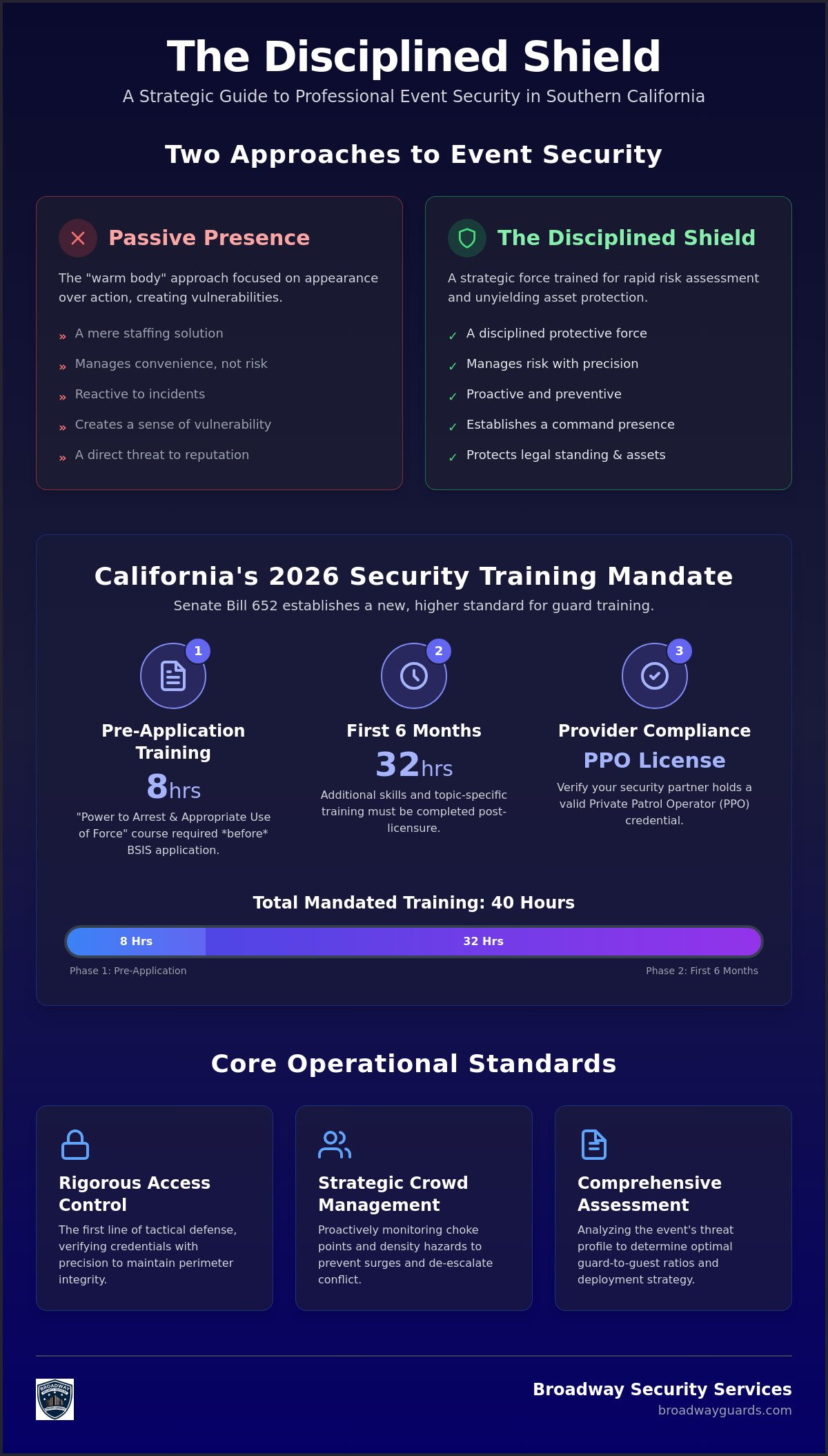
Accountability software provides the data necessary to verify field performance without ambiguity. Geofencing is a digital boundary tool used to verify that personnel remain within their assigned patrol zones in real-time. This system alerts management immediately if a guard leaves their designated area, ensuring constant coverage. Supporting these on-site assets is a 24/7 Dispatch Center that serves as the strategic hub for all field operations. This center provides a lifeline for personnel, offering rapid coordination during emergencies and maintaining a continuous link between the site and executive management.

Digital Reporting and Real-Time Accountability

Transparency is a requirement of high-stakes reliability. Electronic Daily Activity Reports (DARs) have replaced outdated paper logs, allowing for instant incident alerts and digital archiving. GPS tracking for mobile patrol vehicles and foot patrols provides a verifiable breadcrumb trail of all security movements. Clients have a fundamental right to transparent, on-demand security data to confirm their assets are protected. If you require a provider that prioritizes this level of visibility, you should evaluate our operational reporting standards to see how we maintain total site control.

Chain of Command and Field Supervision

A disciplined force operates within a clear, military-like hierarchy. This structure moves from the Guard to the Field Supervisor and finally to Senior Management, ensuring multiple layers of accountability. Unannounced site inspections are a core component of this system, keeping personnel sharp and compliant with all post orders. These inspections verify uniform standards, equipment readiness, and knowledge of site-specific protocols. Clear crisis management escalation paths ensure that when a threat is identified, the response is rapid and coordinated. Order is maintained through this relentless cycle of inspection and reinforcement.

Selecting Your Security Partner: A Professional Vetting Framework

Selecting a security provider is a strategic decision that carries significant legal and operational weight. A methodical vetting process ensures your assets are under the care of a disciplined force rather than a mere staffing agency. The primary credential for any provider in California is the Private Patrol Operator (PPO) license issued by the BSIS. This license confirms that the company has met the state’s rigorous standards for operational management and insurance. Without a verified PPO license, an agency cannot legally provide professional security guards to the public. Vetting must extend beyond a simple review of credentials to include a deep analysis of industry-specific experience.

Management responsiveness serves as a leading indicator of field performance. During the proposal phase, observe the speed and precision of their communication. A provider that fails to respond quickly to a request for information will likely falter during a real-world crisis. Operational rigor starts at the executive level and filters down to the guard on post. You should verify that the firm has a proven track record in your specific sector, whether you require hospital security or residential complex protection. A specialized approach ensures that the protocols deployed are relevant to your unique vulnerabilities. For organizations seeking a structured approach to safeguarding their facilities, a comprehensive corporate security planning framework provides the risk-first checklist necessary to align guard services, compliance mandates, and operational oversight into a single, cohesive strategy.

Evaluating Liability Coverage and Insurance

Liability protection is the bedrock of professional risk management. You must verify that your partner carries both General Liability and Workers’ Compensation insurance. General Liability protects your business from third-party claims, while Workers’ Comp ensures that you aren’t held liable for injuries sustained by guards on your property. Always demand an ‘Additional Insured’ endorsement for your specific location. This legal document links the provider’s insurance directly to your assets. Hiring uninsured or ‘under-the-table’ personnel creates a catastrophic exposure that can bankrupt an organization in the event of an incident.

The Broadway Standard: Disciplined Shield of Southern California

Broadway Security Services operates with military-like precision across Southern California, including Canoga Park and surrounding regions. Our approach is defined by a commitment to order and unyielding vigilance. We provide customized security management that aligns with the specific needs of commercial and residential clients. Every deployment is governed by the rigorous operational standards discussed throughout this guide. Safety isn’t a byproduct of chance; it’s the result of methodical oversight and elite training. Secure your assets with Broadway Security Services today to ensure your property is protected by a professional force that values duty above all else.

Securing Your Future with Operational Excellence

The standards for protection in 2026 demand a transition from passive observation to active, disciplined intervention. You’ve seen how professional security guards are forged through rigorous 40-hour training blocks and supported by digital accountability tools like geofencing. True safety isn’t a suggestion; it’s the direct result of strategic alignment between site-specific risks and a provider’s operational rigor. By prioritizing BSIS compliance and military-grade oversight, you eliminate the liability of unreliable personnel and establish a hard perimeter around your assets.

Broadway Security Services serves as a disciplined shield throughout Southern California and the San Fernando Valley. As a BSIS Licensed PPO, we prioritize the intersection of legal compliance and field performance to ensure your peace of mind. It’s time to replace confusion with confidence by choosing a partner that values order and unyielding duty. Hardening your property begins with a commitment to these definitive standards. Request a Professional Security Consultation with Broadway Security to ensure your assets remain under the care of a vigilant and unyielding force.

Frequently Asked Questions

What is the difference between a security guard and a private patrol officer?

A security guard is an individual employee who performs protection duties, while a Private Patrol Operator (PPO) is the licensed business entity authorized to provide those services. The PPO holds the legal responsibility for maintaining insurance, managing payroll, and ensuring all personnel meet state regulatory standards. Organizations must contract with a PPO to ensure their security force is legally compliant and fully insured.

How do I verify if a security guard company is licensed in California?

License verification is conducted through the Bureau of Security and Investigative Services (BSIS) online search tool. You must enter the company name or their specific PPO license number to confirm their status is “Clear” and “Active.” This verification step is critical when vetting professional security guards to ensure they’re backed by a legitimate, regulated organization.

Is it better to hire armed or unarmed security guards for a retail store?

The decision depends on the specific risk profile and inventory value of your location. Unarmed guards are often the standard for customer-facing retail roles where de-escalation and a welcoming brand image are the priorities. Armed personnel are reserved for high-threat environments or luxury retail sites where the deterrent of force is necessary to protect high-value assets and neutralize professional criminal activity.

What kind of training are professional security guards required to have?

California law requires professional security guards to complete a total of 40 hours of BSIS-certified training. This curriculum begins with an 8-hour course on the Power to Arrest and Appropriate Use of Force. Personnel must then complete 16 hours of on-the-job training within their first 30 days and an additional 16 hours of continuing education within their first six months of employment.

How much does it cost to hire professional security guards in Los Angeles?

Pricing for security services is influenced by the required level of expertise, the threat level of the site, and the specific equipment needs of the post. Armed services generally command a higher rate than unarmed vigilance due to the increased insurance and licensing requirements. You should request a detailed proposal from a licensed provider to understand the specific investment required for your facility’s safety.

Can a security guard make a citizen’s arrest in California?

Security guards have the authority to perform a citizen’s arrest under California Penal Code Section 837. This legal action is permitted when a public offense is committed in the guard’s presence or when a felony has been committed and there’s reasonable cause to believe the person arrested is responsible. Professional training ensures that guards understand the strict legal boundaries and liability risks associated with this process.

What should be included in a professional security guard’s daily report?

A professional Daily Activity Report (DAR) must provide a chronological log of all patrol rounds and site observations. It should include detailed accounts of any unusual incidents, maintenance issues, or safety hazards identified during the shift. Accurate reports also document all visitor interactions and deliveries to ensure a complete, transparent record of site activity for management review.

How quickly can security guards be deployed for an emergency fire watch?

Deployment speed for fire watch services is determined by the provider’s operational capacity and the proximity of available personnel to your location. When a fire suppression system fails, establishing a vigilant presence is a regulatory requirement to avoid facility closure. You should contact a local provider immediately to coordinate the fastest possible arrival of a disciplined guard to maintain site safety.